

ASTM F3561-23
(Test Method)Standard Test Method for Forced-Entry-Resistance of Fenestration Systems After Simulated Active Shooter Attack
General Information
- Abstract
SIGNIFICANCE AND USE
5.1 The test requirements specified herein have been established for use in evaluating the forced-entry resistance characteristics of assemblies to be used in commercial, residential, schools, government, and other institutional installations where the risk of a single person active shooter attack is present.
5.2 The procedures of this test method are intended to evaluate the ability to create an opening of sufficient size to permit passage of a test shape through it.
5.3 The procedure presented herein is based on post-event examination and are not intended to be used to establish or confirm the absolute prevention of forced entries.
SCOPE
1.1 This test method sets forth the requirements and testing procedures to test forced-entry-resistant building components, construction components, and specialty security equipment. This test method is intended primarily for manufacturers to test and rate their windows, doors, modular panels, glazings, and similar products to ensure that all manufactured products meet the necessary requirements for forced-entry protection after sustaining an active shooter assault.
1.2 This test method is currently designed to simulate an active shooter weakening the system with repetitive shots followed by mechanically driven impact to simulate forced entry.
1.3 This test method is not to be used for ballistic resistant glazing rating. Test projectiles are permitted to perforate the entire specimen. The test projectile firings are intended to simulate actions taken by an assailant to aid in the ability to gain entry to a facility.
1.4 This is a laboratory test to be performed on full systems and therefore not applicable for field testing.
1.5 All tests are executed on the exterior surface of the fenestration.
1.6 Systems are required to be tested as complete units in a test frame or fielded conditions. Mulled systems must be tested in the mulled condition. Test results only apply to the component or system as tested. Once a system is tested and deemed to satisfy the requirements of this test method, no design change can be made without a retest except those that qualify under Annex A1 Substitution Criteria.
1.7 Components (such as glazing, door leaves, etc.) may be tested in accordance with Appendix X1, receiving a capability statement for the component, but not a system rating per this standard.
1.8 Window and door systems shall be rated to at least a minimum level of Test Methods F476, F588, or F842, or combinations thereof, as appropriate prior to commencing this test evaluation. This test does not dual certify to the above mentioned standards.
1.9 The values stated in this standard are SI units with the exception of the nominal descriptors for tools.
1.10 This standard does not purport to address all of the safety concerns, if any, associated with its use. It is the responsibility of the user of this standard to establish appropriate safety, health, and environmental practices and determine the applicability of regulatory limitations prior to use.
1.11 This international standard was developed in accordance with internationally recognized principles on standardization established in the Decision on Principles for the Development of International Standards, Guides and Recommendations issued by the World Trade Organization Technical Barriers to Trade (TBT) Committee.
- Status
- Published
- Publication Date
- 14-Jun-2023
- Technical Committee
- F12 - Security Systems and Equipment
- Drafting Committee
- F12.10 - Systems Products and Services
Buy Documents
ASTM F3561-23 - Standard Test Method for Forced-Entry-Resistance of Fenestration Systems After Simulated Active Shooter Attack
REDLINE ASTM F3561-23 - Standard Test Method for Forced-Entry-Resistance of Fenestration Systems After Simulated Active Shooter Attack
Overview
ASTM F3561-23 outlines a standardized laboratory test method for evaluating the forced-entry resistance of fenestration systems-such as windows, doors, panels, and glazings-after exposure to a simulated active shooter attack. Developed by ASTM International, this standard is designed primarily for manufacturers of security building components for use in commercial, residential, educational, government, and institutional settings where there is a risk of forced entry following an active shooter assault.
This method simulates a scenario in which fenestration components have been structurally weakened by projectile impacts prior to a mechanical forced-entry attempt. The procedures described are not for ballistic rating, but rather to assess how well a system resists breaches that could allow passage by an attacker after firearm assault.
Key Topics
- Scope and Purpose: This standard applies to full-size fenestration systems intended to offer forced-entry resistance after being subjected to simulated active shooter attacks.
- Testing Sequence: The procedure includes weakening of glazing or panels using specified projectile patterns, followed by mechanical impact testing using a pendulum impactor.
- Laboratory-Only Evaluation: All testing must occur in controlled laboratory conditions and is not suitable for field evaluations.
- System Integrity: Products must be tested in their installed (ready-to-use) configuration, with no post-test modifications allowed without retesting unless specific substitution criteria are met.
- Component and System Testing: Both individual components (e.g., glazing, door leaves) and complete systems can be evaluated for their capability to resist forced entry.
- Pass/Fail Criteria: A system passes if, after testing, the opening created does not permit the passage of a test shape representing human ingress, and other detailed requirements are met.
Applications
ASTM F3561-23 is particularly relevant for:
- Manufacturers of security windows, doors, modular panels, and glazing seeking to validate and market their products as forced-entry-resistant following firearm assault.
- Building Owners and Operators in high-risk environments (schools, government facilities, correctional institutions, commercial sites) requiring evidence-based assessment of physical security systems.
- Security Consultants and Risk Assessment Teams who specify fenestration products for enhanced building security in accordance with recognized international standards.
- Architects and Designers involved in the specification and integration of security glazing and doors for new construction or retrofitting existing structures.
- Regulatory and Accreditation Bodies tasked with certifying or reviewing safety and security compliance for buildings.
Related Standards
Key standards referenced or aligned with ASTM F3561-23 include:
- ASTM F476 – Security of swinging door assemblies.
- ASTM F588 – Measuring forced entry resistance of window assemblies.
- ASTM F842 – Forced entry resistance of sliding door assemblies.
- ASTM F1915 – Glazing for detention facilities.
- ISO/IEC 17025 – Requirements for the competence of testing and calibration laboratories.
- Other ASTM glass and material standards, such as ASTM C1036, C1048, and C1172.
Practical Value
- Enhances Physical Security: Enables building owners to select fenestration systems with demonstrated resistance to forced-entry following gunfire, improving occupant safety and facility resilience.
- Promotes Product Transparency: Provides verifiable performance data for security products, aiding in risk assessments and procurement decisions.
- Supports Regulatory Compliance: Aligns with internationally recognized principles, ensuring relevance to global safety and security requirements.
- Facilitates Reliable Testing: Establishes uniform methods so test results are consistent, repeatable, and legally defensible in challenging environments.
ASTM F3561-23 thus serves as an essential benchmark for evaluating and specifying security fenestration systems capable of resisting forced entry after a simulated active shooter event.
Relations
- Effective Date
- 01-Apr-2020
- Refers
ASTM D3575-20 - Standard Test Methods for Flexible Cellular Materials Made from Olefin Polymers - Effective Date
- 01-Feb-2020
- Effective Date
- 01-May-2019
- Effective Date
- 01-May-2019
- Effective Date
- 01-Apr-2019
- Effective Date
- 01-Oct-2018
- Effective Date
- 01-Oct-2016
- Effective Date
- 01-Dec-2015
- Effective Date
- 01-Mar-2015
- Effective Date
- 01-Nov-2014
- Effective Date
- 15-Sep-2014
- Effective Date
- 15-Jul-2014
- Effective Date
- 01-May-2014
- Effective Date
- 01-May-2014
- Refers
ASTM D3575-14 - Standard Test Methods for Flexible Cellular Materials Made From Olefin Polymers - Effective Date
- 01-Jan-2014
Buy Documents
ASTM F3561-23 - Standard Test Method for Forced-Entry-Resistance of Fenestration Systems After Simulated Active Shooter Attack
REDLINE ASTM F3561-23 - Standard Test Method for Forced-Entry-Resistance of Fenestration Systems After Simulated Active Shooter Attack
Get Certified
Connect with accredited certification bodies for this standard

DIBt (Deutsches Institut für Bautechnik)
German Institute for Building Technology.
DIN CERTCO
DIN Group product certification.

Aboma Certification B.V.
Specialized in construction, metal, and transport sectors.
Sponsored listings
Frequently Asked Questions
ASTM F3561-23 is a standard published by ASTM International. Its full title is "Standard Test Method for Forced-Entry-Resistance of Fenestration Systems After Simulated Active Shooter Attack". This standard covers: SIGNIFICANCE AND USE 5.1 The test requirements specified herein have been established for use in evaluating the forced-entry resistance characteristics of assemblies to be used in commercial, residential, schools, government, and other institutional installations where the risk of a single person active shooter attack is present. 5.2 The procedures of this test method are intended to evaluate the ability to create an opening of sufficient size to permit passage of a test shape through it. 5.3 The procedure presented herein is based on post-event examination and are not intended to be used to establish or confirm the absolute prevention of forced entries. SCOPE 1.1 This test method sets forth the requirements and testing procedures to test forced-entry-resistant building components, construction components, and specialty security equipment. This test method is intended primarily for manufacturers to test and rate their windows, doors, modular panels, glazings, and similar products to ensure that all manufactured products meet the necessary requirements for forced-entry protection after sustaining an active shooter assault. 1.2 This test method is currently designed to simulate an active shooter weakening the system with repetitive shots followed by mechanically driven impact to simulate forced entry. 1.3 This test method is not to be used for ballistic resistant glazing rating. Test projectiles are permitted to perforate the entire specimen. The test projectile firings are intended to simulate actions taken by an assailant to aid in the ability to gain entry to a facility. 1.4 This is a laboratory test to be performed on full systems and therefore not applicable for field testing. 1.5 All tests are executed on the exterior surface of the fenestration. 1.6 Systems are required to be tested as complete units in a test frame or fielded conditions. Mulled systems must be tested in the mulled condition. Test results only apply to the component or system as tested. Once a system is tested and deemed to satisfy the requirements of this test method, no design change can be made without a retest except those that qualify under Annex A1 Substitution Criteria. 1.7 Components (such as glazing, door leaves, etc.) may be tested in accordance with Appendix X1, receiving a capability statement for the component, but not a system rating per this standard. 1.8 Window and door systems shall be rated to at least a minimum level of Test Methods F476, F588, or F842, or combinations thereof, as appropriate prior to commencing this test evaluation. This test does not dual certify to the above mentioned standards. 1.9 The values stated in this standard are SI units with the exception of the nominal descriptors for tools. 1.10 This standard does not purport to address all of the safety concerns, if any, associated with its use. It is the responsibility of the user of this standard to establish appropriate safety, health, and environmental practices and determine the applicability of regulatory limitations prior to use. 1.11 This international standard was developed in accordance with internationally recognized principles on standardization established in the Decision on Principles for the Development of International Standards, Guides and Recommendations issued by the World Trade Organization Technical Barriers to Trade (TBT) Committee.
SIGNIFICANCE AND USE 5.1 The test requirements specified herein have been established for use in evaluating the forced-entry resistance characteristics of assemblies to be used in commercial, residential, schools, government, and other institutional installations where the risk of a single person active shooter attack is present. 5.2 The procedures of this test method are intended to evaluate the ability to create an opening of sufficient size to permit passage of a test shape through it. 5.3 The procedure presented herein is based on post-event examination and are not intended to be used to establish or confirm the absolute prevention of forced entries. SCOPE 1.1 This test method sets forth the requirements and testing procedures to test forced-entry-resistant building components, construction components, and specialty security equipment. This test method is intended primarily for manufacturers to test and rate their windows, doors, modular panels, glazings, and similar products to ensure that all manufactured products meet the necessary requirements for forced-entry protection after sustaining an active shooter assault. 1.2 This test method is currently designed to simulate an active shooter weakening the system with repetitive shots followed by mechanically driven impact to simulate forced entry. 1.3 This test method is not to be used for ballistic resistant glazing rating. Test projectiles are permitted to perforate the entire specimen. The test projectile firings are intended to simulate actions taken by an assailant to aid in the ability to gain entry to a facility. 1.4 This is a laboratory test to be performed on full systems and therefore not applicable for field testing. 1.5 All tests are executed on the exterior surface of the fenestration. 1.6 Systems are required to be tested as complete units in a test frame or fielded conditions. Mulled systems must be tested in the mulled condition. Test results only apply to the component or system as tested. Once a system is tested and deemed to satisfy the requirements of this test method, no design change can be made without a retest except those that qualify under Annex A1 Substitution Criteria. 1.7 Components (such as glazing, door leaves, etc.) may be tested in accordance with Appendix X1, receiving a capability statement for the component, but not a system rating per this standard. 1.8 Window and door systems shall be rated to at least a minimum level of Test Methods F476, F588, or F842, or combinations thereof, as appropriate prior to commencing this test evaluation. This test does not dual certify to the above mentioned standards. 1.9 The values stated in this standard are SI units with the exception of the nominal descriptors for tools. 1.10 This standard does not purport to address all of the safety concerns, if any, associated with its use. It is the responsibility of the user of this standard to establish appropriate safety, health, and environmental practices and determine the applicability of regulatory limitations prior to use. 1.11 This international standard was developed in accordance with internationally recognized principles on standardization established in the Decision on Principles for the Development of International Standards, Guides and Recommendations issued by the World Trade Organization Technical Barriers to Trade (TBT) Committee.
ASTM F3561-23 is classified under the following ICS (International Classification for Standards) categories: 91.060.50 - Doors and windows. The ICS classification helps identify the subject area and facilitates finding related standards.
ASTM F3561-23 has the following relationships with other standards: It is inter standard links to ASTM E3062/E3062M-20, ASTM D3575-20, ASTM C1135-19, ASTM E3062/E3062M-19, ASTM F1915-05(2019), ASTM C1048-18, ASTM A574-16, ASTM C1135-15, ASTM E631-15, ASTM E631-14, ASTM C1172-14, ASTM C719-14, ASTM F588-14, ASTM F842-14, ASTM D3575-14. Understanding these relationships helps ensure you are using the most current and applicable version of the standard.
ASTM F3561-23 is available in PDF format for immediate download after purchase. The document can be added to your cart and obtained through the secure checkout process. Digital delivery ensures instant access to the complete standard document.
Standards Content (Sample)
This international standard was developed in accordance with internationally recognized principles on standardization established in the Decision on Principles for the
Development of International Standards, Guides and Recommendations issued by the World Trade Organization Technical Barriers to Trade (TBT) Committee.
Designation: F3561 − 23
Standard Test Method for
Forced-Entry-Resistance of Fenestration Systems After
Simulated Active Shooter Attack
This standard is issued under the fixed designation F3561; the number immediately following the designation indicates the year of
original adoption or, in the case of revision, the year of last revision. A number in parentheses indicates the year of last reapproval. A
superscript epsilon (´) indicates an editorial change since the last revision or reapproval.
1. Scope 1.8 Window and door systems shall be rated to at least a
minimum level of Test Methods F476, F588, or F842, or
1.1 This test method sets forth the requirements and testing
combinations thereof, as appropriate prior to commencing this
procedures to test forced-entry-resistant building components,
test evaluation. This test does not dual certify to the above
construction components, and specialty security equipment.
mentioned standards.
This test method is intended primarily for manufacturers to test
1.9 The values stated in this standard are SI units with the
and rate their windows, doors, modular panels, glazings, and
similar products to ensure that all manufactured products meet exception of the nominal descriptors for tools.
the necessary requirements for forced-entry protection after
1.10 This standard does not purport to address all of the
sustaining an active shooter assault.
safety concerns, if any, associated with its use. It is the
responsibility of the user of this standard to establish appro-
1.2 This test method is currently designed to simulate an
priate safety, health, and environmental practices and deter-
active shooter weakening the system with repetitive shots
mine the applicability of regulatory limitations prior to use.
followed by mechanically driven impact to simulate forced
1.11 This international standard was developed in accor-
entry.
dance with internationally recognized principles on standard-
1.3 This test method is not to be used for ballistic resistant
ization established in the Decision on Principles for the
glazing rating. Test projectiles are permitted to perforate the
Development of International Standards, Guides and Recom-
entire specimen. The test projectile firings are intended to
mendations issued by the World Trade Organization Technical
simulate actions taken by an assailant to aid in the ability to
Barriers to Trade (TBT) Committee.
gain entry to a facility.
2. Referenced Documents
1.4 This is a laboratory test to be performed on full systems
and therefore not applicable for field testing.
2.1 ASTM Standards:
A36/A36M Specification for Carbon Structural Steel
1.5 All tests are executed on the exterior surface of the
fenestration. A574 Specification for Alloy Steel Socket-Head Cap Screws
C719 Test Method for Adhesion and Cohesion of Elasto-
1.6 Systems are required to be tested as complete units in a
meric Joint Sealants Under Cyclic Movement (Hockman
test frame or fielded conditions. Mulled systems must be tested
Cycle)
in the mulled condition. Test results only apply to the compo-
C1036 Specification for Flat Glass
nent or system as tested. Once a system is tested and deemed
C1048 Specification for Heat-Strengthened and Fully Tem-
to satisfy the requirements of this test method, no design
pered Flat Glass
change can be made without a retest except those that qualify
C1135 Test Method for Determining Tensile Adhesion Prop-
under Annex A1 Substitution Criteria.
erties of Structural Sealants
1.7 Components (such as glazing, door leaves, etc.) may be
C1172 Specification for Laminated Architectural Flat Glass
tested in accordance with Appendix X1, receiving a capability
D1415 Test Method for Rubber Property—International
statement for the component, but not a system rating per this
Hardness
standard.
D3575 Test Methods for Flexible Cellular Materials Made
from Olefin Polymers
E631 Terminology of Building Constructions
This test method is under the jurisdiction of ASTM Committee F12 on Security
Systems and Equipment and is the direct responsibility of Subcommittee F12.10 on
Systems Products and Services. For referenced ASTM standards, visit the ASTM website, www.astm.org, or
Current edition approved June 15, 2023. Published June 2023. Originally contact ASTM Customer Service at service@astm.org. For Annual Book of ASTM
approved in 2022. Last previous edition approved in 2022 as F3561 – 22. DOI: Standards volume information, refer to the standard’s Document Summary page on
10.1520/F3561-23. the ASTM website.
Copyright © ASTM International, 100 Barr Harbor Drive, PO Box C700, West Conshohocken, PA 19428-2959. United States
F3561 − 23
E3062/E3062M Specification for Indoor Ballistic Test 3.1.12 ready-to-install, n—fabricated, with an appropriate
Ranges for Small Arms and Fragmentation Testing of final finish such as galvanizing, paint, or anodizing; the test
Ballistic-resistant Items specimen shall consist of the entire fenestration assembly and
F476 Test Methods for Security of Swinging Door Assem- contain all devices used to resist forced entry; all parts of the
blies test specimen shall be full size, as specified for actual use,
F588 Test Methods for Measuring the Forced Entry Resis- using the identical materials, details, and methods of construc-
tance of Window Assemblies, Excluding Glazing Impact tion.
F842 Test Methods for Measuring the Forced Entry Resis-
3.1.13 shop assembly drawing, n—a drawing which shows
tance of Sliding Door Assemblies, Excluding Glazing
how a system is assembled including the locations, dimensions,
Impact
and arrangements of all assembly elements such as bolts,
F1915 Test Methods for Glazing for Detention Facilities
glazing stops, and glazing spacers.
2.2 Other Standards:
3.1.14 system, n—the assembly of structural elements and
ISO/IEC 17025:2005 General Requirements for the Compe-
devices which comprise the forced-entry-resistant barrier.
tence of Testing and Calibration Laboratories
3.1.15 test director, n—the individual identified by the
3. Terminology
independent testing laboratory as being responsible to com-
plete the specified tests as required and to document the results,
3.1 Definitions of Terms Specific to This Standard:
in accordance with this test method.
3.1.1 component, n—integral part of a forced entry test
specimen such as: panels, frame, glazing, glazing bite, flanges, 3.1.16 test facility, n—laboratory or other area where
hinges, locks, jamb/wall, jamb/strike mullions, and mounting
forced-entry testing is conducted.
devices of different shape, size, and material.
3.1.17 test fixture, n—the structural assembly which holds
3.1.2 door, double, n—two-door assembly with an opening
the test specimen.
wider than as a single door with a common latch and lock edge;
3.1.18 test levels, n—the increments to which systems are
may or may not include a removable mullion; openings may be
tested.
asymmetrical with regard to the size of openings.
3.1.19 test plane, n—a plane parallel and contiguous to the
3.1.3 door panel, n—the swinging or sliding barrier by
face of the attack side of the test sample.
which an entry is closed and opened, not including framing,
3.1.20 test projectiles, n—projectiles or ammunition that is
operating, or latching mechanisms.
used to weaken the test specimen.
3.1.4 failure criteria, n—any failure of the manufacturer’s
3.1.21 test shape, n—a non-compressible sphere measuring
recommended mounting hardware or penetration of any por-
152 mm (6 in.) in diameter.
tion of the system sufficient to permit passage of the test shape.
3.1.22 test tools, n—the devices used by the test team during
3.1.5 fenestration, n—any glazed panel, window, door, cur-
the assault tests.
tain wall, or skylight unit on the exterior of a building.
3.1.23 testing report, n—a report provided by the test
3.1.6 glazing weakening, v—intentional structural deteriora-
facility that includes configuration documentation, any appli-
tion of a glazing or glazing infill.
cable abnormality, forced-entry testing data and photographs, a
3.1.7 impact assault, n—test of forced entry attack using an
certification of testing, a narrative summary of testing, time-
impactor on one dissimilar component in an attempt to create
stamped drawings that have been validated to match the test
an opening and permit passage of the test shape.
specimen, and all video recording(s) of testing.
3.1.8 impactor, n—45 kg striking mechanism capable of
3.1.24 view window, n—a window system which permits
being deployed in a pendulum motion.
visual contact through an otherwise opaque host assembly.
3.1.9 independent test facility, n—testing laboratory accred-
3.1.25 window frame, n—the opaque portion of a transpar-
ited to perform the referenced testing procedures by a nation-
ent assembly into which the transparent element is mounted.
ally recognized accrediting agency in accordance with ISO/
IEC 17025.
3.1.26 yaw, n—the angular deviation between the test pro-
jectile’s axis of symmetry and its line of travel.
3.1.10 mulled, n—the physical connection together of two
parts of the same system; the two systems may be anchored
3.2 Abbreviations:
directly to each other or have a mullion between them.
3.2.1 AN—annealed
3.1.11 mullion, n—a component used to divide two parts of
3.2.2 C1—center 1
the same system and it can be vertical or horizontal, movable
3.2.3 C2—center 2
or fixed; for purposes of this test method, a mullion does not
3.2.4 CS—chemically strengthened
include steel or concrete structural members (including seismic
joints) which are present in the building.
3.2.5 E—East
3.2.6 FT—fully tempered
Available from International Organization for Standardization (ISO), ISO
3.2.7 ft/s—feet per second
Central Secretariat, Chemin de Blandonnet 8, CP 401, 1214 Vernier, Geneva,
Switzerland, https://www.iso.org. 3.2.8 ft·lbf—foot pound-force
F3561 − 23
3.2.9 H—drop height Figure 1 in Test Methods F1915, or as specified by the
authority having jurisdiction provided it does not enhance or
3.2.10 HS—heat-strengthened
degrade the specimen.
3.2.11 in.—inch(es)
6.3 Velocity Measurement System—The velocity measure-
3.2.12 IRHD—international rubber hardness degree
ment system shall be capable of providing projectile velocities
–6
3.2.13 J—joules
with at least a 1 × 10 s sampling resolution and an accuracy
3.2.14 kg—kilogram of at least 61.5 m/s (65 ft/s).
3.2.15 L—horizontal swing distance
6.4 Support Fixture and Frame—The test specimen shall be
mounted in the frame along the full length of all edges or as
3.2.16 lb—pound
specified by the manufacturer’s installation instructions.
3.2.17 m/s—meters per second
6.4.1 The frame shall have a clamping plate to hold the test
3.2.18 mm—millimeter
specimen in position and means for producing uniform clamp-
3.2.19 MSG—manufacturers standard grade
ing of the specimen.
6.4.2 All edges of the test specimen shall be uniformly
3.2.20 n—noun
clamped with a clamping pressure sufficiently large that the
3.2.21 N—North
edges remain in position during the test. The test specimen in
3.2.22 N—Newtons
the frame shall be placed normal to the direction of attack with
3.2.23 NE—North East an accuracy of 60.02 rad (1°(degree)) in any orientation. Test
specimen shall be oriented to strike face in accordance with
3.2.24 NW—North West
manufacturer’s documentation. Manufacturer shall clearly
3.2.25 oz—ounce
mark the strike face on each specimen. The support and
3.2.26 R—radius of swing
retention system shall be reported.
3.2.27 S—South 6.4.3 The test fixture shall simulate installation in a perma-
nent steel or concrete structure which neither enhances nor
3.2.28 SE—South East
degrades the forced-entry protection of the system.
3.2.29 SW—South West
6.5 System Weakening Device—The system weakening de-
3.2.30 v—verb
vice shall be capable of firing 10 test projectiles meeting the
3.2.31 W—West
requirements of Table 1.
6.5.1 Test projectiles shall be fired using:
4. Summary of Test Method
6.5.1.1 AR-15 5.56 Rifle, capable of discharging projectiles
4.1 This test method establishes incremented levels of in accordance with 6.5.
6.5.1.2 Ballistic Firing Mechanism, capable of discharging
forced-entry protection via evaluation of a two-stage attack of
a single or mulled system by using a device for weakening of projectiles in accordance with 6.5.
components prior to forced entry impact of the fenestration
6.6 Forced Entry Impactor System:
system.
6.6.1 Impactor:
6.6.1.1 The forced entry impactor shall be a pendulum
5. Significance and Use
system with a cylindrical weight capable of delivering hori-
zontal impacts of 542 J (400 ft·lbf).
5.1 The test requirements specified herein have been estab-
6.6.1.2 The diagram of the impactor is shown in Fig. 1. It is
lished for use in evaluating the forced-entry resistance charac-
teristics of assemblies to be used in commercial, residential, a steel cylinder 152 mm 6 6 mm (6 in. 6 0.25 in.) in diameter,
360 mm 6 45 mm (14 in. 6 1.75 in.) long, with a hemispheri-
schools, government, and other institutional installations where
the risk of a single person active shooter attack is present. cal impact nose 152 mm 6 6 mm (6 in. 6 0.25 in.) in diameter
and maximum 76 mm (3 in.) deep. The impactor including eye
5.2 The procedures of this test method are intended to
bolts weighs 45 kg 6 1 kg (100 lb 6 2 lb).
evaluate the ability to create an opening of sufficient size to
6.6.1.3 The shot is used to obtain the proper weight of the
permit passage of a test shape through it.
impactor as needed. The shot should be constrained in holders
5.3 The procedure presented herein is based on post-event
attached to the impactor to avoid excessive movement during
examination and are not intended to be used to establish or
testing. The shot is to be positioned evenly to balance the
confirm the absolute prevention of forced entries.
weight of the impactor front to back in the suspension system.
6. Apparatus
6.1 Apparatus to conduct these tests include ballistic firing
mechanism or means to simulate ballistic type weakening, test TABLE 1 Test Projectiles
fixture, impactor, measurement device, test shape, and force
Ammunition Ammunition Identity Bullet Weight Velocity (m/s (ft/s))
Description Classification (AIC) grams (grain) ±10 m/s (±33 ft/s)
meter.
5.56 M193 3.6 +0/-0.1 g 1033 m/s (3390 ft/s)
6.2 Test Fixture—The test fixture shall be sized to accom-
(56 +0/-2 grains)
modate the test specimen and in accordance with design of
F3561 − 23
FIG. 1 Impactor Details
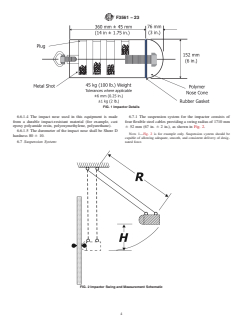
6.6.1.4 The impact nose used in this equipment is made 6.7.1 The suspension system for the impactor consists of
from a durable impact-resistant material (for example, cast four flexible steel cables providing a swing radius of 1710 mm
epoxy polyamide resin, polyoxymethylene, polyurethane).
6 52 mm (67 in. 6 2 in.), as shown in Fig. 2.
6.6.1.5 The durometer of the impact nose shall be Shore D
NOTE 1—Fig. 2 is for example only. Suspension system should be
hardness 80 6 10.
capable of allowing adequate, smooth, and consistent delivery of desig-
6.7 Suspension System: nated force.
FIG. 2 Impactor Swing and Measurement Schematic
F3561 − 23
TABLE 2 Potential Energy of Impactor and Drop Height
6.7.2 Fig. 3 includes a diagram of the pendulum system
when elevated and at rest, and the measurements required to Potential Energy, J Height of Drop (H)
Level
calculate the impact energy of the system. J (ft*lbf) mm (ft)
6.7.3 These cables are adjusted to equal length with turn- 1 68 50 152 0.50
2 136 100 305 1.00
buckles such that the impactor swings in a straight, true arc and
3 203 150 457 1.50
are attached to a steel frame that can be adjusted to be level
4 271 200 610 2.00
(Fig. 2). 5 339 250 762 2.50
6 407 300 914 3.00
6.7.4 Table 2 presents the potential energy of a pendulum
7 475 350 1067 3.50
system with a 45 kg 6 1 kg (100 lb 6 2 lb) weight as a
8 542 400 1219 4.00
function of various elevations of the weight. The suspension
cables are not included in the weight and energy calculations of
the impactor.
materials shall be consistent with all local and federal laws and
6.8 Test Shape—The test shape used to determine if passage
requirements found in the Resource Conservation & Recovery
has been achieved is defined in 3.1.21.
Act of 1976.
7. Hazards
8. Test Specimens
7.1 This test method involves potentially hazardous situa-
8.1 Systems submitted for testing shall be full-size systems
tions. Proper precautions shall be taken by the test facility to
complete with all required anchor bolt system hardware and
protect workers, observers, and the community. The test
representative of production systems.
location shall be secured to prevent unauthorized access during
8.2 Systems that move or operate (for example, doors,
testing. All testing personnel and observers shall be kept out of
hatches, operable windows) shall, at minimum, include all
the path of the projectile and behind a hardened barrier to
devices required for operation.
minimize ricochet or fragmentation hazards during testing. The
main backstop shall be designed to safely contain the projectile 8.3 The test specimen shall be ready-to-install.
and prevent damage to life or property down range in the
8.4 Three (3) test specimens of identical construction shall
projectile’s line of flight.
constitute a sample set for testing.
7.2 The testing lab shall be properly designed to minimize
8.4.1 Testing identical samples except for size in order to
health effects to workers resulting from lead dust exposure. qualify a product line is acceptable. Three samples of each the
Proper handling, storage, and disposal of lead contaminated largest and smallest units shall be submitted for testing. All unit
FIG. 3 Detail of Impactor Cable System
F3561 − 23
NOTE 2—The clamping pressure has relatively little effect on the test
increments inclusive of and between these sizes shall be
results for glass but can have considerable influence on the test results for
qualified when both sets successfully meet the criteria of this
plastic glazing sheet materials. For these materials, the manner of support
document.
and retention shall be reported.
10.2 The specimen shall have an edge support/coverage on
9. Preparation of Apparatus
all edges of 38 mm 6 6 mm (1.5 in. 6 0.25 in.). The specimen
9.1 Preparation:
shall be separated from the frame and the clamping plate by
9.1.1 Review the test specimen configuration and test
continuous rubber strips, 5 mm 6 0.5 mm (0.197 in. 6
sample documents supplied in accordance with 9.1.2 to ensure
0.02 in.) thick, 30 mm 6 5 mm (1.18 in. 6 0.197 in.) wide and
the proper sample is being tested.
of hardness (50 6 10) IRHD, in accordance with Test Method
9.1.2 Ensure testing apparatus is in good condition and
D1415.
configured per 6.2.
NOTE 3—The rigidly supported fixture prevents specimen translation
9.1.3 Install test specimen in support fixture per 6.4.
along the line of flight but permits its position and attitude to be readily
9.1.4 Support Fixture and Frame—The test specimen shall
adjusted so that it is perpendicular to the line of flight at the projectile
be mounted in the frame along the full length of all edges.
point of impact.
9.1.4.1 The frame shall have a clamping plate to hold the
10.2.1 The test specimen in the frame shall be placed
test specimen in position and means for producing uniform
normal to the direction of attack with an accuracy of 60.02 ra-
clamping of the test specimen.
dians (61° (degree)) in any orientation. Test specimen shall be
9.1.4.2 All edges of the test specimen shall be uniformly
oriented to strike face in accordance with manufacturer’s
clamped with a clamping pressure sufficiently large that the
documentation. Manufacturer shall clearly mark the strike face
edges remain in position during the test.
on each specimen. The support and retention system shall be
9.1.5 Forced-entry test specimens shall be mounted in
reported.
accordance with all the requirements of this section.
9.1.5.1 The mounting of the test specimen must give no
11. Calibration and Standardization
leverage advantages and shall not influence the performance of
the test specimen over the expected mounting conditions in the 11.1 Apparatus shall be inspected for defects prior to
field. testing, be in good working condition and not defective.
9.1.5.2 The test specimen shall be mounted in accordance
11.2 Velocity of the ballistic firing mechanism shall be
with the manufacturer’s instructions with particular attention
verified.
paid to the threat and protected side orientation during mount-
11.2.1 Velocity Measurement System—The velocity mea-
ing.
surement system shall be capable of providing projectile
(1) If the test specimen cannot be mounted according to the
–6
velocities with at least a 1 × 10 s sampling resolution and an
installation instructions submitted by manufacturer, the test
accuracy of at least 61.5 m/s (65 ft/s). The system shall
shall not be conducted.
maintain position and alignment throughout the testing se-
9.1.5.3 If the tested product type is typically installed in an
quence and shall minimize the effects of shock waves, sound
opening larger than the tested product size (for example, in a
waves, ultraviolent and infrared light, ejected propellant,
“rough opening”), the test specimen shall be mounted in a
sabots, and other debris that can decrease measurement accu-
rough opening of 8 mm 6 2 mm (0.315 in. 6 0.08 in.) larger
racy. Redundant velocity measurement system is required.
on all sides than the test specimen.
11.2.2 If radar, high-speed video, or X-ray is used for
9.1.5.4 For specimens that require footers, the test speci-
velocity measurement, the velocity reported shall be the
mens shall be erected (including those cast in place) on
velocity measured at 2.3 m 6 2.5 cm (90 in. 6 1.0 in.). from
footings, and either back-braced or capped with a simulated
the plane of the test item.
roof or ceiling panel to ensure that the bracing or capping
11.2.3 If light screens are used for velocity measurement,
reflect standard fielded conditions.
the requirements below shall be met.
11.2.3.1 The light screens shall be positioned as shown in
10. Specimen Preparation and Mounting
Specification E3062/E3062M.
10.1 Glazing System Tests—The test specimen will be
11.2.3.2 The inner screens shall be paired together, and the
mounted in accordance with the manufacturer’s recommenda-
outer screens shall be paired together.
tions and shall be securely anchored. Consideration should be
11.2.3.3 The light screen pairs shall be parallel to each other
given to, but is not limited to:
and perpendicular to the projectile firing system barrel.
10.1.1 Overall size of glazing system;
11.2.3.4 The distance from the last light screen to the test
10.1.2 Amount of “bite” within the frame;
item reference plane shall be no greater than 1.5 m (5 ft).
10.1.3 Integrity of the frame;
11.2.3.5 The light screens shall be fastened together to
10.1.4 Strength of base material;
prevent inadvertent changes in spacing.
10.1.5 Size of removable stop;
NOTE 4—The spacing between the light screens may be adjusted to
10.1.6 Removable stop fastener;
meet velocity measurement requirements.
10.1.7 Interface between glazing and frame; and
10.1.8 Integrity of anchorage of glazing system to adjoining 11.3 Impactor weight shall be verified to be 45 kg 6 1 kg
architectural features. (100 lb 6 2 lb).
F3561 − 23
11.4 Impactor nose cone shape and dimensions shall be 14.3.3 After panel operation test sequence, the test speci-
verified through measurement, free of gouges or cuts deeper men shall be considered operable per the manufacturer’s
than 12 mm (0.5 in.), and durometer shall be an average of 80 written installation instructions.
6 10 Shore D when measured in three distinct locations on the 14.3.4 Fenestration shall be locked prior to initiating any
nose cone, with a minimum of one location being at the center test projectile firings and the locks not operated again until the
of the impacting face of the nose cone. completion of the forced entry impactor tests.
14.3.5 At the completion of the final forced entry impact test
12. Conditioning sequence, the operability of the system shall be verified in
accordance with Section 14; however failure to operate is not
12.1 Specimens shall be conditioned prior to testing to
a condition of passing this test. The ability to operate the locks
ensure all components have reached temperature equilibrium.
and open the system shall be noted in the report.
12.2 Testing shall be performed at an ambient temperature
of 22 °C 6 4 °C (72 °F 6 7 °F).
15. Procedure for Fenestration Weakening
15.1 Glazing or Panel Weakening:
13. Test Director Role
15.1.1 Glazing or panel shall be pre-weakened by test
13.1 The Test Director is responsible for safety and will
projectiles prior to impact testing.
ensure that all reasonable safety precautions are employed.
15.1.2 Test pattern shall be centered on the target compo-
nent (normally geometric center of the glazing or panel) with
13.2 Safety—The test may be interrupted for reasons of
a minimum distance from the inner edge of the frame being
safety (imminent danger to or injury of test personnel). This
52 mm (2 in.).
interruption in the test will not be used for clearing away
15.1.3 Test pattern diameter shall be 457 mm 6 6 mm
debris, such as glass fragments produced during testing, from
(18 in. 6 0.25 in.) with all the impacts being positioned within
the test specimen. Any modifications to the test specimen made
the tolerance of the diameter with 0.785 radian 6 0.05 radian
for safety reasons must be agreed to by all parties and must not
(45° 6 3°) separation between shots. The center shots (C1 and
in any way enhance or detract from the sample’s forced-entry
C2) shall be located 52 mm 6 6 mm (2 in. 6 0.25 in.) from the
resistance.
geometrical center and along the W to E axis with 104 mm
13.3 The Test Director’s goal is to ensure consistency in the
6 6 mm (4 in. 6 0.25 in.) distance between the center of each
application and performance of this test. The Test Director
shot.
shall direct impacts and verify the system to the pass/fail
15.1.4 Test Projectile Firing—Ammunition of the appropri-
criteria presented in this document. The Test Director shall be
ate type and caliber (see 6.5) shall be single-fired to obtain the
provided a full set of plans prior to the test.
required number of fair hits on each test specimen. Shots shall
13.4 The Test Director shall, at a minimum, ensure the utilize the shot pattern shown in Fig. 4.
following: 15.1.5 The sequence of projectile firing shall be N, S, W, E,
13.4.1 Only those resources (impactor) specified may be followed by NW, SW, NE, SE, C1 and C2 as indicated in Fig.
4.
applied to the test specimen once forced-entry testing has
commenced; 15.1.6 The orientation and sequence of the shots shall not be
changed.
13.4.2 Impactor and firing device are used safely and
appropriately; and
15.2 Procedure for Lock Weakening:
13.4.3 The elapsed time between the weakening of the
15.2.1 Lock mechanisms in doors shall be pre-weakened by
glazing and impact commencing shall be minimized and shall
test projectiles prior to impact testing.
in no case exceed 2 h in order to simulate actual durations of
15.2.2 Test pattern shall be offset (to the right or left) of the
attack as closely as possible in a controlled environment.
locking mechanism so that the applicable West or East most
firing impacts the center of the lock with the remaining shots
14. Procedure for Panel Operability
on the door panel (Fig. 7).
15.2.3 Test pattern diameter shall be 229 mm 6 6 mm (9 in.
14.1 Prior to any testing of the system, the system shall have
6 0.25 in.) with all the impacts being positioned within the
its operability measured and recorded. No assembly shall be
tolerance of the diameter with 1.571 radian 6 0.05 radian (90°
modified or enhanced once operability has been recorded.
6 3°) separation between shots. The center shot (C3) shall be
14.2 Additional attachments that increase the strength of the
located to the side (right or left) and perpendicular to the
connection between the operable locking devices and the
vertical center of the locking mechanism (typically a panel
system are not permitted. Operation of the locking devices
impact location).
shall be done in a manner that will not cause collateral damage
15.2.4 Test Projectile Firing—Ammunition of the appropri-
to the specimen.
ate type and caliber shall be single-fired to obtain the required
14.3 Panel Operability Test:
number of fair hits on each test specimen. Shots shall utilize
14.3.1 This test applies only to systems that may be opened.
the shot pattern shown in Fig. 5.
14.3.2 Close and lock all portions of the test specimen. 15.2.5 The sequence of projective firing shall be C3, fol-
Submit each operable unit to five cycles of opening, closing, lowed by N, S, E, W as indicated in Fig. 5. The final shot shall
and locking prior to testing. be on the lock mechanism.
F3561 − 23
FIG. 4 Test Projectile Firing Pattern for Glazing and Panels
FIG. 5 Test Projectile Firing Pattern for Door Locking Mechanism
15.2.6 The orientation and sequence of the shots shall not be (12 in.) from the front surface of the specimen. All other firings
changed. shall be classified as unfair, and require retesting, except:
15.3.1 An impact at more than the maximum acceptable
15.3 Fair and Unfair Hits—For purposes of this test
velocity which does not cause panel perforation, but which is
method, a fair hit shall be a zero-degree obliquity ballistic
otherwise a fair hit, shall be classified as a fair hit at the
impact (63°) using the specified weight and type of un-yawed
discretion of the manufacturer.
bullet (0.05 radian (3°) maximum)) within the specified veloc-
ity range on the specified location of the test sample. Yaw is 15.3.2 In the case of an unfair hit, at the discretion of the
measured at the point of impact but no further than 300 mm manufacturer, select one of the following to continue testing:
F3561 − 23
15.3.2.1 Restart the pattern on a new sample; or 16.5.3 The impactor, stabilized in the launch position in a
15.3.2.2 Fire a replacement shot that is closer to the in- vertical plane normal to the test specimen, is released and falls
tended pattern than the unfair hit. without initial velocity or axial rotation.
15.3.2.3 Restarting the pattern is limited to only one speci- 16.5.4 Inspect each test specimen after each impact and
men per sample set.
record and report whether it complied or did not comply with
the applicable interpretation of results.
15.4 Evaluate glazing for passage of test shape at any time
16.5.5 Impacts start at the lowest drop height from Table 1
during the test projectile firing pattern when the Test Director
and advance through each level by successively increasing the
believes passage for failure is possible.
drop height until the target level or failure is reached.
15.4.1 No additional damage may be done to the glazing
16.5.5.1 The test specimen must pass two (2) sequential
system, including hand manipulation of fragments when evalu-
impacts from the same drop height for it to be deemed a pass
ating test shape passage.
at that level, or to move on to a higher level.
16.5.6 Specimens may be reused for higher classification
16. Procedure for Forced-Entry Testing
impact testing.
16.1 Forced-entry testing, regardless of the type of assem-
16.5.7 For systems with bent glass, each specimen of bent
bly being tested, shall consist of glazing weakening followed
glass will be impacted on the convex surface at the center of
by mechanical forced-entry impacts.
the specimen perpendicular to the frame from the selected drop
16.2 The impact assault will be at the center of the glazing
height.
or panel.
NOTE 5—The convex surface is tested due to the realistic constraints of
16.3 The impact assault for the lock shall be centered on test
the test set-up in impacting the concave surface. Additionally, as of the
projectile shot C3 of Fig. 5.
date of this publication no data was available that showed one surface is
more or less likely to break during impact.
16.4 Designate Forced-Entry Test Force Level:
...
This document is not an ASTM standard and is intended only to provide the user of an ASTM standard an indication of what changes have been made to the previous version. Because
it may not be technically possible to adequately depict all changes accurately, ASTM recommends that users consult prior editions as appropriate. In all cases only the current version
of the standard as published by ASTM is to be considered the official document.
Designation: F3561 − 22 F3561 − 23
Standard Test Method for
Forced-Entry-Resistance of Fenestration Systems After
Simulated Active Shooter Attack
This standard is issued under the fixed designation F3561; the number immediately following the designation indicates the year of
original adoption or, in the case of revision, the year of last revision. A number in parentheses indicates the year of last reapproval. A
superscript epsilon (´) indicates an editorial change since the last revision or reapproval.
1. Scope
1.1 This test method sets forth the requirements and testing procedures to test forced-entry-resistant building components,
construction components, and specialty security equipment. This test method is intended primarily for manufacturers to test and
rate their windows, doors, modular panels, glazings, and similar products to ensure that all manufactured products meet the
necessary requirements for forced-entry protection after sustaining an active shooter assault.
1.2 This test method is currently designed to simulate an active shooter weakening the system with repetitive shots followed by
mechanically driven impact to simulate forced entry.
1.3 This test method is not to be used for ballistic resistant glazing rating. Test projectiles are permitted to perforate the entire
specimen. The test projectile firings are intended to simulate actions taken by an assailant to aid in the ability to gain entry to a
facility.
1.4 This is a laboratory test to be performed on full systems and therefore not applicable for field testing.
1.5 All tests are executed on the exterior surface of the fenestration.
1.6 Systems are required to be tested as complete units in a test frame or fielded conditions. Mulled systems must be tested in the
mulled condition. Test results only apply to the component or system as tested. Once a system is tested and deemed to satisfy the
requirements of this test method, no design change can be made without a retest except those that qualify under Annex A1
Substitution Criteria.
1.7 Components (such as glazing, door leaves, etc.) may be tested in accordance with Appendix X1, receiving a capability
statement for the component, but not a system rating per this standard.
1.8 Window and door systems shall be rated to at least a minimum level of Test Methods F476, F588, or F842, or combinations
thereof, as appropriate prior to commencing this test evaluation. This test does not dual certify to the above mentioned standards.
1.9 The values stated in this standard are SI units with the exception of the nominal descriptors for tools.
This test method is under the jurisdiction of ASTM Committee F12 on Security Systems and Equipment and is the direct responsibility of Subcommittee F12.10 on
Systems Products and Services.
Current edition approved Aug. 1, 2022June 15, 2023. Published August 2022June 2023. Originally approved in 2022. Last previous edition approved in 2022 as
F3561 – 22. DOI: 10.1520/F3561-22.10.1520/F3561-23.
Copyright © ASTM International, 100 Barr Harbor Drive, PO Box C700, West Conshohocken, PA 19428-2959. United States
F3561 − 23
1.10 This standard does not purport to address all of the safety concerns, if any, associated with its use. It is the responsibility
of the user of this standard to establish appropriate safety, health, and environmental practices and determine the applicability of
regulatory limitations prior to use.
1.11 This international standard was developed in accordance with internationally recognized principles on standardization
established in the Decision on Principles for the Development of International Standards, Guides and Recommendations issued
by the World Trade Organization Technical Barriers to Trade (TBT) Committee.
2. Referenced Documents
2.1 ASTM Standards:
A36/A36M Specification for Carbon Structural Steel
A574 Specification for Alloy Steel Socket-Head Cap Screws
C719 Test Method for Adhesion and Cohesion of Elastomeric Joint Sealants Under Cyclic Movement (Hockman Cycle)
C1036 Specification for Flat Glass
C1048 Specification for Heat-Strengthened and Fully Tempered Flat Glass
C1135 Test Method for Determining Tensile Adhesion Properties of Structural Sealants
C1172 Specification for Laminated Architectural Flat Glass
D1415 Test Method for Rubber Property—International Hardness
D3575 Test Methods for Flexible Cellular Materials Made from Olefin Polymers
E631 Terminology of Building Constructions
E3062/E3062M Specification for Indoor Ballistic Test Ranges for Small Arms and Fragmentation Testing of Ballistic-resistant
Items
F476 Test Methods for Security of Swinging Door Assemblies
F588 Test Methods for Measuring the Forced Entry Resistance of Window Assemblies, Excluding Glazing Impact
F842 Test Methods for Measuring the Forced Entry Resistance of Sliding Door Assemblies, Excluding Glazing Impact
F1915 Test Methods for Glazing for Detention Facilities
2.2 Other Standards:
ISO/IEC 17025:2005 General Requirements for the Competence of Testing and Calibration Laboratories
3. Terminology
3.1 Definitions of Terms Specific to This Standard:
3.1.1 component, n—integral part of a forced entry test specimen such as: panels, frame, glazing, glazing bite, flanges, hinges,
locks, jamb/wall, jamb/strike mullions, and mounting devices of different shape, size, and material.
3.1.2 door, double, n—two-door assembly with an opening wider than as a single door with a common latch and lock edge; may
or may not include a removable mullion; openings may be asymmetrical with regard to the size of openings.
3.1.3 door panel, n—the swinging or sliding barrier by which an entry is closed and opened, not including framing, operating, or
latching mechanisms.
3.1.4 failure criteria, n—any failure of the manufacturer’s recommended mounting hardware or penetration of any portion of the
system sufficient to permit passage of the test shape.
3.1.5 fenestration, n—any glazed panel, window, door, curtain wall, or skylight unit on the exterior of a building.
3.1.6 glazing weakening, v—intentional structural deterioration of a glazing or glazing infill.
3.1.7 impact assault, n—test of forced entry attack using an impactor on one dissimilar component in an attempt to create an
opening and permit passage of the test shape.
3.1.8 impactor, n—45 kg striking mechanism capable of being deployed in a pendulum motion.
For referenced ASTM standards, visit the ASTM website, www.astm.org, or contact ASTM Customer Service at service@astm.org. For Annual Book of ASTM Standards
volume information, refer to the standard’s Document Summary page on the ASTM website.
Available from International Organization for Standardization (ISO), ISO Central Secretariat, Chemin de Blandonnet 8, CP 401, 1214 Vernier, Geneva, Switzerland,
https://www.iso.org.
F3561 − 23
3.1.9 independent test facility, n—testing laboratory accredited to perform the referenced testing procedures by a nationally
recognized accrediting agency in accordance with ISO/IEC 17025.
3.1.10 mulled, n—the physical connection together of two parts of the same system; the two systems may be anchored directly
to each other or have a mullion between them.
3.1.11 mullion, n—a component used to divide two parts of the same system and it can be vertical or horizontal, movable or fixed;
for purposes of this test method, a mullion does not include steel or concrete structural members (including seismic joints) which
are present in the building.
3.1.12 ready-to-install, n—fabricated, with an appropriate final finish such as galvanizing, paint, or anodizing; the test specimen
shall consist of the entire fenestration assembly and contain all devices used to resist forced entry; all parts of the test specimen
shall be full size, as specified for actual use, using the identical materials, details, and methods of construction.
3.1.13 shop assembly drawing, n—a drawing which shows how a system is assembled including the locations, dimensions, and
arrangements of all assembly elements such as bolts, glazing stops, and glazing spacers.
3.1.14 system, n—the assembly of structural elements and devices which comprise the forced-entry-resistant barrier.
3.1.15 test director, n—the individual identified by the independent testing laboratory as being responsible to complete the
specified tests as required and to document the results, in accordance with this test method.
3.1.16 test facility, n—laboratory or other area where forced-entry testing is conducted.
3.1.17 test fixture, n—the structural assembly which holds the test specimen.
3.1.18 test levels, n—the increments to which systems are tested.
3.1.19 test plane, n—a plane parallel and contiguous to the face of the attack side of the test sample.
3.1.20 test projectiles, n—projectiles or ammunition that is used to weaken the test specimen.
3.1.21 test shape, n—a non-compressible sphere measuring 152 mm (6 in.) in diameter.
3.1.22 test tools, n—the devices used by the test team during the assault tests.
3.1.23 testing report, n—a report provided by the test facility that includes configuration documentation, any applicable
abnormality, forced-entry testing data and photographs, a certification of testing, a narrative summary of testing, time-stamped
drawings that have been validated to match the test specimen, and all video recording(s) of testing.
3.1.24 view window, n—a window system which permits visual contact through an otherwise opaque host assembly.
3.1.25 window frame, n—the opaque portion of a transparent assembly into which the transparent element is mounted.
3.1.26 yaw, n—the angular deviation between the test projectile’s axis of symmetry and its line of travel.
3.2 Abbreviations:
3.2.1 AN—annealed
3.2.2 C1—center 1
3.2.3 C2—center 2
F3561 − 23
3.2.4 CS—chemically strengthened
3.2.5 E—East
3.2.6 FMJ—Full Metal Jacket bullet
3.2.6 FT—fully tempered
3.2.7 ft/s—feet per second
3.2.8 ft·lbf—foot pound-force
3.2.9 H—drop height
3.2.10 HS—heat-strengthened
3.2.11 in.—inch(es)
3.2.12 IRHD—international rubber hardness degree
3.2.13 J—joules
3.2.14 kg—kilogram
3.2.15 L—horizontal swing distance
3.2.16 lb—pound
3.2.17 m/s—meters per second
3.2.18 mm—millimeter
3.2.19 MSG—manufacturers standard grade
3.2.20 n—noun
3.2.21 N—North
3.2.22 N—Newtons
3.2.23 NE—North East
3.2.24 NW—North West
3.2.25 oz—ounce
3.2.26 R—radius of swing
3.2.27 S—South
3.2.28 SE—South East
F3561 − 23
3.2.29 SW—South West
3.2.30 v—verb
3.2.31 W—West
4. Summary of Test Method
4.1 This test method establishes incremented levels of forced-entry protection via evaluation of a two-stage attack of a single or
mulled system by using a device for weakening of components prior to forced entry impact of the fenestration system.
5. Significance and Use
5.1 The test requirements specified herein have been established for use in evaluating the forced-entry resistance characteristics
of assemblies to be used in commercial, residential, schools, government, and other institutional installations where the risk of a
single person active shooter attack is present.
5.2 The procedures of this test method are intended to evaluate the ability to create an opening of sufficient size to permit passage
of a test shape through it.
5.3 The procedure presented herein is based on post-event examination and are not intended to be used to establish or confirm the
absolute prevention of forced entries.
6. Apparatus
6.1 Apparatus to conduct these tests include ballistic firing mechanism or means to simulate ballistic type weakening, test fixture,
impactor, measurement device, test shape, and force meter.
6.2 Test Fixture—The test fixture shall be sized to accommodate the test specimen and in accordance with design of Figure 1 in
Test Methods F1915, or as specified by the authority having jurisdiction provided it does not enhance or degrade the specimen.
6.3 Velocity Measurement System—The velocity measurement system shall be capable of providing projectile velocities with at
–6
least a 1 × 10 secs sampling resolution and an accuracy of at least 61.5 m/s (65 ft/s).
6.4 Support Fixture and Frame—The test specimen shall be mounted in the frame along the full length of all edges or as specified
by the manufacturer’s installation instructions.
6.4.1 The frame shall have a clamping plate to hold the test specimen in position and means for producing uniform clamping of
the specimen.
6.4.2 All edges of the test specimen shall be uniformly clamped with a clamping pressure sufficiently large that the edges remain
in position during the test. The test specimen in the frame shall be placed normal to the direction of attack with an accuracy of
60.02 rad (1°(degree)) in any orientation. Test specimen shall be oriented to strike face in accordance with manufacturer’s
documentation. Manufacturer shall clearly mark the strike face on each specimen. The support and retention system shall be
reported.
6.4.3 The test fixture shall simulate installation in a permanent steel or concrete structure which neither enhances nor degrades the
forced-entry protection of the system.
6.5 GlassSystem Weakening Device—The glasssystem weakening device shall be capable of firing 10 test projectiles meeting the
requirements of Table 1.
6.5.1 Test projectiles shall be fired using:
6.5.1.1 AR-15 5.56 Rifle, capable of discharging projectiles in accordance with 6.5.
F3561 − 23
TABLE 1 Test Projectiles
Ammunition Ammunition Identity Bullet Weight Velocity (Meters (ft/
Description Classification (AIC) (grain) s))
±10 m/s (±33 ft/s)
5.56 NATO, M193 55 1027 m/s (3370 ft/s)
Copper
Jacket Lead
Core, FMJ
TABLE 1 Test Projectiles
Ammunition Ammunition Identity Bullet Weight Velocity (m/s (ft/s))
Description Classification (AIC) grams (grain) ±10 m/s (±33 ft/s)
5.56 M193 3.6 +0/-0.1 g 1033 m/s (3390 ft/s)
(56 +0/-2 grains)
6.5.1.2 Ballistic Firing Mechanism, capable of discharging projectiles in accordance with 6.5.
6.6 Forced Entry Impactor System:
6.6.1 Impactor:
6.6.1.1 The forced entry impactor shall be a pendulum system with a cylindrical weight capable of delivering horizontal impacts
of 542 J (400 ft·lbf).
6.6.1.2 The diagram of the impactor is shown in Fig. 1. It is a steel cylinder 152 mm 6 6 mm (6 in. 6 0.25 in.) in diameter, 360
mm 6 45 mm (14 in. 6 1.75 in.) long, with a hemispherical impact nose 152 mm 6 6 mm (6 in. 6 0.25 in. ) in.) in diameter and
maximum 76 mm (3 in.) deep. The impactor including eye bolts weighs 45 kg 6 1 kg (100 lb 6 2 lb).
6.6.1.3 The shot is used to obtain the proper weight of the impactor as needed. The shot should be constrained in holders attached
to the impactor to avoid excessive movement during testing. The shot is to be positioned evenly to balance the weight of the
impactor front to back in the suspension system.
6.6.1.4 The impact nose used in this equipment is made from a durable impact-resistant material (for example, cast epoxy
polyamide resin; however, any durable impact-resistant material is satisfactory.resin, polyoxymethylene, polyurethane).
6.6.1.5 The durometer of the impact nose shall be Shore D hardness 80 6 10.
6.7 Suspension System:
FIG. 1 Impactor Details
F3561 − 23
6.7.1 The suspension system for the impactor consists of four flexible steel cables providing a swing radius of 1710 mm 6 52
mm (67 in. 6 2 in.), as shown in Fig. 2.
NOTE 1—Fig. 2 is for example only. Suspension system should be capable of allowing adequate, smooth, and consistent delivery of designated force.
6.7.2 Fig. 3 includes a diagram of the pendulum system when elevated and at rest, and the measurements required to calculate
the impact energy of the system.
6.7.3 These cables are adjusted to equal length with turnbuckles such that the impactor swings in a straight, true arc and are
attached to a steel frame that can be adjusted to be level (Fig. 2).
6.7.4 Table 2 presents the potential energy of a pendulum system with a 45 kg 6 1 kg (100 lb 6 2 lb) weight as a function of
various elevations of the weight. The suspension cables are not included in the weight and energy calculations of the impactor.
6.8 Test Shape—The test shape used to determine if passage has been achieved is defined in 3.1.21.
7. Hazards
7.1 This test method involves potentially hazardous situations. Proper precautions shall be taken by the test facility to protect
workers, observers, and the community. The test location shall be secured to prevent unauthorized access during testing. All testing
personnel and observers shall be kept out of the path of the projectile and behind a hardened barrier to minimize ricochet or
fragmentation hazards during testing. The main backstop shall be designed to safely contain the projectile and prevent damage to
life or property down range in the projectile’s line of flight.
7.2 The testing lab shall be properly designed to minimize health effects to workers resulting from lead dust exposure. Proper
FIG. 2 Impactor Swing and Measurement Schematic
F3561 − 23
FIG. 3 Detail of Impactor Cable System
TABLE 2 Potential Energy of Impactor and Drop Height
Potential Energy, J Height of Drop (H)
Level
J (ft*lbf) mm (ft)
1 68 50 152 0.50
2 136 100 305 1.00
3 203 150 457 1.50
4 271 200 610 2.00
5 339 250 762 2.50
6 407 300 914 3.00
7 475 350 1067 3.50
8 542 400 1219 4.00
handling, storage, and disposal of lead contaminated materials shall be consistent with all local and federal laws and requirements
found in the Resource Conservation & Recovery Act of 1976.
8. Test Specimens
8.1 Systems submitted for testing shall be full-size systems complete with all required anchor bolt system hardware and
representative of production systems.
8.2 Systems that move or operate (for example, doors, hatches, operable windows) shall, at minimum, include all devices required
for operation.
8.3 The test specimen shall be ready-to-install.
8.4 Three (3) test specimens of identical construction shall constitute a sample set for testing.
8.4.1 Testing identical samples except for size in order to qualify a product line is acceptable. Three samples of each the largest
and smallest units shall be submitted for testing. All unit increments inclusive of and between these sizes shall be qualified when
both sets successfully meet the criteria of this document.
F3561 − 23
9. Preparation of Apparatus
9.1 Preparation:
9.1.1 Review the test specimen configuration and test sample documents supplied in accordance with 9.1.2 to ensure the proper
sample is being tested.
9.1.2 Ensure testing apparatus is in good condition and configured per 6.2.
9.1.3 Install test specimen in support fixture per 6.4.
9.1.4 Support Fixture and Frame—The test specimen shall be mounted in the frame along the full length of all edges.
9.1.4.1 The frame shall have a clamping plate to hold the test specimen in position and means for producing uniform clamping
of the test specimen.
9.1.4.2 All edges of the test specimen shall be uniformly clamped with a clamping pressure sufficiently large that the edges remain
in position during the test.
9.1.5 Forced-entry test specimens shall be mounted in accordance with all the requirements of this section.
9.1.5.1 The mounting of the test specimen must give no leverage advantages and shall not influence the performance of the test
specimen over the expected mounting conditions in the field.
9.1.5.2 The test specimen shall be mounted in accordance with the manufacturer’s instructions with particular attention paid to
the threat and protected side orientation during mounting.
(1) If the test specimen cannot be mounted according to the installation instructions submitted by manufacturer, the test shall
not be conducted.
9.1.5.3 If the tested product type is typically installed in an opening larger than the tested product size (for example, in a “rough
opening”), the test specimen shall be mounted in a rough opening of 8 mm 6 2 mm (0.315 in. 6 0.08 in.) larger on all sides than
the test specimen.
9.1.5.4 For specimens that require footers, the test specimens shall be erected (including those cast in place) on footings, and either
back-braced or capped with a simulated roof or ceiling panel to ensure that the bracing or capping reflect standard fielded
conditions.
10. Specimen Preparation and Mounting
10.1 Glazing System Tests—The test specimen will be mounted in accordance with the manufacturer’s recommendations and shall
be securely anchored. Consideration should be given to, but is not limited to:
10.1.1 Overall size of glazing system;
10.1.2 Amount of “bite” within the frame;
10.1.3 Integrity of the frame;
10.1.4 Strength of base material;
10.1.5 Size of removable stop;
10.1.6 Removable stop fastener;
10.1.7 Interface between glazing and frame; and
10.1.8 Integrity of anchorage of glazing system to adjoining architectural features.
F3561 − 23
NOTE 2—The clamping pressure has relatively little effect on the test results for glass but can have considerable influence on the test results for plastic
glazing sheet materials. For these materials, the manner of support and retention shall be reported.
10.2 The specimen shall have an edge support/coverage on all edges of 38 mm 6 6 mm (1.5 in. 6 0.25 in.). The specimen shall
be separated from the frame and the clamping plate by continuous rubber strips, 5 mm 6 0.5 mm (0.197 in. 6 0.02 in.) thick, 30
mm 6 5 mm (1.18 in. 6 0.197 in.) wide and of hardness (50 6 10) IRHD, in accordance with Test Method D1415.
NOTE 3—The rigidly supported fixture prevents specimen translation along the line of flight but permits its position and attitude to be readily adjusted
so that it is perpendicular to the line of flight at the projectile point of impact.
10.2.1 The test specimen in the frame shall be placed normal to the direction of attack with an accuracy of 60.02 radians (61°
(degree)) in any orientation. Test specimen shall be oriented to strike face in accordance with manufacturer’s documentation.
Manufacturer shall clearly mark the strike face on each specimen. The support and retention system shall be reported.
11. Calibration and Standardization
11.1 Apparatus shall be inspected for defects prior to testing, be in good working condition and not defective.
11.2 Velocity of the ballistic firing mechanism shall be verified.
11.2.1 Velocity Measurement System—The velocity measurement system shall be capable of providing projectile velocities with
–6
at least a 1 × 10 secs sampling resolution and an accuracy of at least 61.5 m/s (65 ft/s). The system shall maintain position and
alignment throughout the testing sequence and shall minimize the effects of shock waves, sound waves, ultraviolent and infrared
light, ejected propellant, sabots, and other debris that can decrease measurement accuracy. Redundant velocity measurement
system is required.
11.2.2 If radar, high-speed video, or X-ray is used for velocity measurement, the velocity reported shall be the velocity measured
at 2.3 m 6 2.5 cm (90 in. 6 1.0 in.). from the plane of the test item.
11.2.3 If light screens are used for velocity measurement, the requirements below shall be met.
11.2.3.1 The light screens shall be positioned as shown in Specification E3062/E3062M.
11.2.3.2 The inner screens shall be paired together, and the outer screens shall be paired together.
11.2.3.3 The light screen pairs shall be parallel to each other and perpendicular to the projectile firing system barrel.
11.2.3.4 The distance from the last light screen to the test item reference plane shall be no greater than 1.5 m (5 ft).
11.2.3.5 The light screens shall be fastened together to prevent inadvertent changes in spacing.
NOTE 4—The spacing between the light screens may be adjusted to meet velocity measurement requirements.
11.3 Impactor weight shall be verified to be 45 kg 6 1 kg (100 lb 6 2 lb).
11.4 Impactor nose cone shape and dimensions shall be verified through measurement, free of gouges or cuts deeper than 12 mm
(0.5 in.), and durometer shall be an average of 80 6 10 Shore D when measured in three distinct locations on the nose cone, with
a minimum of one location being at the center of the impacting face of the nose cone.
12. Conditioning
12.1 Specimens shall be conditioned prior to testing to ensure all components have reached temperature equilibrium.
12.2 Testing shall be performed at an ambient temperature of 22 °C 6 4 °C (72 °F 6 7 °F).
F3561 − 23
13. Test Director Role
13.1 The Test Director is responsible for safety and will ensure that all reasonable safety precautions are employed.
13.2 Safety—The test may be interrupted for reasons of safety (imminent danger to or injury of test personnel). This interruption
in the test will not be used for clearing away debris, such as glass fragments produced during testing, from the test specimen. Any
modifications to the test specimen made for safety reasons must be agreed to by all parties and must not in any way enhance or
detract from the sample’s forced-entry resistance.
13.3 The Test Director’s goal is to ensure consistency in the application and performance of this test. The Test Director shall direct
impacts and verify the system to the pass/fail criteria presented in this document. The Test Director shall be provided a full set of
plans prior to the test.
13.4 The Test Director shall, at a minimum, ensure the following:
13.4.1 Only those resources (impactor) specified may be applied to the test specimen once forced-entry testing has commenced;
13.4.2 Impactor and firing device are used safely and appropriately; and
13.4.3 The elapsed time between the weakening of the glazing and impact commencing shall be minimized and shall in no case
exceed 2 h in order to simulate actual durations of attack as closely as possible in a controlled environment.
14. Procedure for Panel Operability
14.1 Prior to any testing of the system, the system shall have its operability measured and recorded. No assembly shall be modified
or enhanced once operability has been recorded.
14.2 Additional attachments that increase the strength of the connection between the operable locking devices and the system are
not permitted. Operation of the locking devices shall be done in a manner that will not cause collateral damage to the specimen.
14.3 Panel Operability Test:
14.3.1 This test applies only to systems that may be opened.
14.3.2 Close and lock all portions of the test specimen. Submit each operable unit to five cycles of opening, closing, and locking
prior to testing.
14.3.3 After panel operation test sequence, the test specimen shall be considered operable per the manufacturer’s written
installation instructions.
14.3.4 Fenestration shall be locked prior to initiating any test projectile firings and the locks not operated again until the
completion of the forced entry impactor tests.
14.3.5 At the completion of the final forced entry impact test sequence, the operability of the system shall be verified in accordance
with Section 14; however failure to operate is not a condition of passing this test. The ability to operate the locks and open the
system shall be noted in the report.
15. Procedure for Fenestration Weakening
15.1 Glazing or Panel Weakening:
15.1.1 Glazing or panel shall be pre-weakened by test projectiles prior to impact testing.
15.1.2 Test pattern shall be centered on the target component (normally geometric center of the glazing or panel) with a minimum
distance from the inner edge of the frame being 52 mm (2 in.).
15.1.3 Test pattern diameter shall be 457 mm 6 6 mm (18 in. 6 0.25 in.) with all the impacts being positioned within the tolerance
F3561 − 23
of the diameter with 0.785 radian 6 0.05 radian (45° 6 3°) separation between shots. The center shots (C1 and C2) shall be located
52 mm 6 6 mm (2 in. 6 0.25 in.) from the geometrical center and along the W to E axis with 104 mm 6 6 mm (4 in. 6 0.25 in.)
distance between the center of each shot.
15.1.4 Test Projectile Firing—Ammunition of the appropriate type and caliber (see 6.5) shall be single-fired to obtain the required
number of fair hits on each test specimen. Shots shall utilize the shot pattern shown in Fig. 4.
15.1.5 The sequence of projectiveprojectile firing shall be N, S, W, E, followed by NW, SW, NE, SE, C1 and C2 as indicated in
Fig. 4.
15.1.6 The orientation and sequence of the shots shall not be changed.
15.2 Procedure for Lock Weakening:
15.2.1 Lock mechanisms in doors shall be pre-weakened by test projectiles prior to impact testing.
15.2.2 Test pattern shall be offset (to the right or left) of the locking mechanism so that the applicable West orEast most firing
impacts the center of the lock with the remaining shots on the door panel (Fig. 7).
15.2.3 Test pattern diameter shall be 229 mm 6 6 mm (9 in. 6 0.25 in.) with all the impacts being positioned within the tolerance
of the diameter with 1.571 radian 6 0.05 radian (90° 6 3°) separation between shots. The center shot (C3) shall be located to the
side (right or left) and perpendicular to the vertical center of the locking mechanism (typically a panel impact location).
15.2.4 Test Projectile Firing—Ammunition of the appropriate type and caliber shall be single-fired to obtain the required number
of fair hits on each test specimen. Shots shall utilize the shot pattern shown in Fig. 5.
15.2.5 The sequence of projective firing shall be C3, followed by N, S, E, W as indicated in Fig. 5. The final shot shall be on the
lock mechanism.
15.2.6 The orientation and sequence of the shots shall not be changed.
15.3 Fair and Unfair Hits—For purposes of this test method, a fair hit shall be a zero-degree obliquity ballistic impact (63°) using
the specified weight and type of un-yawed bullet (0.05 radian (3°) maximum)) within the specified velocity range on the specified
FIG. 4 Test Projectile Firing Pattern for Glazing and Panels
F3561 − 23
FIG. 5 Test Projectile Firing Pattern for Door Locking Mechanism
location of the test sample. Yaw is measured at the point of impact but no further than 300 mm (12 in.) from the front surface of
the specimen. All other firings shall be classified as unfair, and require retesting, except:
15.3.1 An impact at more than the maximum acceptable velocity which does not cause panel perforation, but which is otherwise
a fair hit, shall be classified as a fair hit at the discretion of the manufacturer.
15.3.2 In the case of an unfair hit, at the discretion of the manufacturer, select one of the following to continue testing:
15.3.2.1 Restart the pattern on a new sample; or
15.3.2.2 Fire a replacement shot that is closer to the intended pattern than the unfair hit.
15.3.2.3 Restarting the pattern is limited to only one specimen per sample set.
15.4 Evaluate glazing for passage of test shape at any time during the test projectile firing pattern when the Test Director believes
passage for failure is possible.
15.4.1 No additional damage may be done to the glazing system, including hand manipulation of fragments when evaluating test
shape passage.
16. Procedure for Forced-Entry Testing
16.1 Forced-entry testing, regardless of the type of assembly being tested, shall consist of glazing weakening followed by
mechanical forced-entry impacts.
16.2 The impact assault will be at the center of the glazing or panel.
16.3 The impact assault for the lock shall be centered on test projectile shot C3 of Fig. 5.
16.4 Designate Forced-Entry Test Force Level:
16.4.1 Target force shall be selected from Table 2.
F3561 − 23
16.5 Perform the impact assault testing for the selected resistance force on each dissimilar component.
16.5.1 With the impactor at rest, the furthest protruding point of the impacting nose cone shall be located no more than 52 mm
(2 in.) from the surface of the specimen and no more than 52 mm (2 in.) in any direction from the intended impact location on
the specimen.
16.5.2 Align the impactor with the impact position as required. Raise the impactor to the selected drop height intended for
classification and stabilize it. At the selected drop height, the suspension devicefront two suspension cables shall be taut, and the
axes to allow smooth travel. The impactor drop height shall be measured from the lower most point of the impactor and cable shall
be where the nose cone, gasket, and impactor meet (Fig. 6in line.).
16.5.3 The impactor, stabilized in the launch position in a vertical plane normal to the test specimen, is released and falls without
initial velocity or axial rotation.
16.5.4 Inspect each test specime
...