

ASTM D7292-18
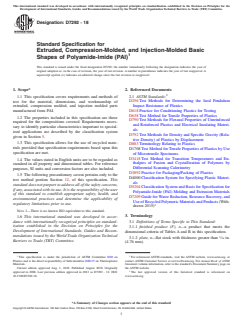
(Specification)Standard Specification for Extruded, Compression-Molded, and Injection-Molded Basic Shapes of Polyamide-Imide (PAI)
General Information
- Abstract
ABSTRACT
This specification covers the requirements and test methods for the material, dimensions, and workmanship of extruded, compression molded, and injection molded basic shapes. The specimens shall be made of polyamide-imide which may be filled, lubricated, or reinforced with carbon, graphite, or glass fibers; lubricants such as PTFE, graphite, silicone, and molybdenum disulfide; mineral; combinations of reinforcements or fillers; or both. Tests shall be conducted in the standard laboratory conditions to determine the physical properties of the specimens. Physical properties shall conform to the ultimate tensile strength, elongation at break, tensile modulus, flexural modulus, Izod impact, glass transition temperature, and specific gravity requirements. Dimensional tests shall also be performed to determine the conformance of the specimens to the size thickness, thickness tolerance, camber length, and width bow specifications.
SCOPE
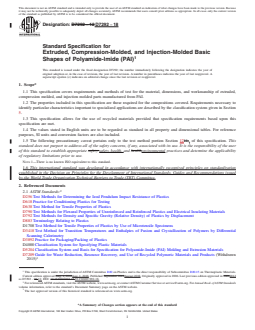
1.1 This specification covers requirements and methods of test for the material, dimensions, and workmanship of extruded, compression molded, and injection molded parts manufactured from PAI.
1.2 The properties included in this specification are those required for the compositions covered. Requirements necessary to identify particular characteristics important to specialized applications are described by the classification system given in Section 5.
1.3 This specification allows for the use of recycled materials provided that specification requirements based upon this specification are met.
1.4 The values stated in English units are to be regarded as standard in all property and dimensional tables. For reference purposes, SI units and conversion factors are also included.
1.5 The following precautionary caveat pertains only to the test method portion Section 12, of this specification. This standard does not purport to address all of the safety concerns, if any, associated with its use. It is the responsibility of the user of this standard to establish appropriate safety, health, and environmental practices and determine the applicability of regulatory limitations prior to use.
Note 1: There is no known ISO equivalent to this standard.
1.6 This international standard was developed in accordance with internationally recognized principles on standardization established in the Decision on Principles for the Development of International Standards, Guides and Recommendations issued by the World Trade Organization Technical Barriers to Trade (TBT) Committee.
- Status
- Published
- Publication Date
- 31-Jul-2018
- Technical Committee
- D20 - Plastics
- Drafting Committee
- D20.15 - Thermoplastic Materials
Buy Documents
ASTM D7292-18 - Standard Specification for Extruded, Compression-Molded, and Injection-Molded Basic Shapes of Polyamide-Imide (PAI)
REDLINE ASTM D7292-18 - Standard Specification for Extruded, Compression-Molded, and Injection-Molded Basic Shapes of Polyamide-Imide (PAI)
Overview
ASTM D7292-18 is the internationally recognized standard specification for extruded, compression-molded, and injection-molded basic shapes of polyamide-imide (PAI). Developed by ASTM International, this standard outlines requirements and testing methods for the material composition, dimensions, and workmanship of PAI shapes-such as rods, plates, sheets, and tubular bars-used in high-performance engineering applications. The scope of ASTM D7292-18 encompasses both virgin and recycled PAI materials, and includes grades that may be filled, lubricated, or reinforced with materials such as glass fibers, carbon fibers, graphite, PTFE, silicone, and molybdenum disulfide.
Key Topics
- Product Types: Covers extruded, compression-molded, and injection-molded PAI basic shapes.
- Material Composition: Specifies both unfilled and filled PAI; fillers and reinforcements can include glass fibers, carbon/graphite fibers, minerals, lubricants, or combinations.
- Testing Methods: Details standardized test methods for physical properties, including:
- Ultimate tensile strength
- Elongation at break
- Tensile modulus
- Flexural modulus
- Izod impact resistance
- Glass transition temperature (Tg)
- Specific gravity
- Dimensional Tolerances: Provides specific requirements for size, thickness tolerance, camber, roundness, and width bow.
- Workmanship: Mandates that shapes are free from defects such as blisters, cracks, voids, foreign particles, and surface imperfections that limit commercial usability.
- Classification System: Utilizes a codified designation system based on type, class, and grade-facilitating customized material specifications by property set.
- Recycled Content: Permits use of recycled PAI, provided all specification requirements are met.
- Ordering and Certification: Sets requirements for product certification and order designation, ensuring traceability and quality assurance.
Applications
PAI shapes manufactured under ASTM D7292-18 are valued for their exceptional mechanical, thermal, and tribological properties. Key application areas include:
- Aerospace Components: Bearings, bushings, and seals requiring high thermal stability and wear resistance.
- Automotive Parts: Engine and transmission components exposed to elevated temperatures and demanding environments.
- Electrical Insulation: Plates and rods offering insulation, dimensional stability, and toughness.
- Industrial Equipment: Wear pads, gears, pump components, and low-friction machine parts.
- Medical Devices: Components where biocompatibility and high-performance plastics are required (subject to additional biocompatibility assessments).
Manufacturers and specifiers rely on ASTM D7292-18 to ensure PAI plastic shapes are fit for critical applications requiring reliability, durability, and compliance with rigorous specifications.
Related Standards
ASTM D7292-18 references several other important ASTM standards to define test methods, terminology, and classification systems for plastics and PAI materials. Relevant related standards include:
- ASTM D256: Test Methods for Determining the Izod Pendulum Impact Resistance of Plastics
- ASTM D638: Test Method for Tensile Properties of Plastics
- ASTM D790: Test Methods for Flexural Properties of Plastics
- ASTM D792: Test Methods for Density and Specific Gravity of Plastics
- ASTM D883: Terminology Relating to Plastics
- ASTM D3418: Test Method for Transition Temperatures and Enthalpies of Polymers
- ASTM D1708: Test Method for Tensile Properties by Microtensile Specimens
- ASTM D5204: Classification System and Basis for Specification for Polyamide-Imide (PAI) Molding and Extrusion Materials
- ASTM D3892: Practice for Packaging of Plastics
Note: There is no known ISO equivalent to ASTM D7292-18, making this standard particularly critical for international procurement and compliance in advanced industrial sectors.
Keywords: ASTM D7292, polyamide-imide, PAI, compression molded, injection molded, extruded shapes, plastics standard, engineering plastics, ASTM plastics specifications, high performance plastics
Relations
- Effective Date
- 01-Aug-2018
- Effective Date
- 01-Feb-2024
- Effective Date
- 01-Nov-2023
- Effective Date
- 01-Jan-2020
- Effective Date
- 01-Aug-2019
- Effective Date
- 15-Apr-2019
- Effective Date
- 01-Feb-2019
- Effective Date
- 01-Dec-2018
- Effective Date
- 01-Nov-2018
- Effective Date
- 01-Oct-2018
- Effective Date
- 01-Dec-2017
- Effective Date
- 15-Aug-2017
- Effective Date
- 01-Jul-2017
- Effective Date
- 01-Dec-2015
- Effective Date
- 01-Dec-2015
Buy Documents
ASTM D7292-18 - Standard Specification for Extruded, Compression-Molded, and Injection-Molded Basic Shapes of Polyamide-Imide (PAI)
REDLINE ASTM D7292-18 - Standard Specification for Extruded, Compression-Molded, and Injection-Molded Basic Shapes of Polyamide-Imide (PAI)
Get Certified
Connect with accredited certification bodies for this standard

DIN CERTCO
DIN Group product certification.

Smithers Quality Assessments
US management systems and product certification.
Sponsored listings
Frequently Asked Questions
ASTM D7292-18 is a technical specification published by ASTM International. Its full title is "Standard Specification for Extruded, Compression-Molded, and Injection-Molded Basic Shapes of Polyamide-Imide (PAI)". This standard covers: ABSTRACT This specification covers the requirements and test methods for the material, dimensions, and workmanship of extruded, compression molded, and injection molded basic shapes. The specimens shall be made of polyamide-imide which may be filled, lubricated, or reinforced with carbon, graphite, or glass fibers; lubricants such as PTFE, graphite, silicone, and molybdenum disulfide; mineral; combinations of reinforcements or fillers; or both. Tests shall be conducted in the standard laboratory conditions to determine the physical properties of the specimens. Physical properties shall conform to the ultimate tensile strength, elongation at break, tensile modulus, flexural modulus, Izod impact, glass transition temperature, and specific gravity requirements. Dimensional tests shall also be performed to determine the conformance of the specimens to the size thickness, thickness tolerance, camber length, and width bow specifications. SCOPE 1.1 This specification covers requirements and methods of test for the material, dimensions, and workmanship of extruded, compression molded, and injection molded parts manufactured from PAI. 1.2 The properties included in this specification are those required for the compositions covered. Requirements necessary to identify particular characteristics important to specialized applications are described by the classification system given in Section 5. 1.3 This specification allows for the use of recycled materials provided that specification requirements based upon this specification are met. 1.4 The values stated in English units are to be regarded as standard in all property and dimensional tables. For reference purposes, SI units and conversion factors are also included. 1.5 The following precautionary caveat pertains only to the test method portion Section 12, of this specification. This standard does not purport to address all of the safety concerns, if any, associated with its use. It is the responsibility of the user of this standard to establish appropriate safety, health, and environmental practices and determine the applicability of regulatory limitations prior to use. Note 1: There is no known ISO equivalent to this standard. 1.6 This international standard was developed in accordance with internationally recognized principles on standardization established in the Decision on Principles for the Development of International Standards, Guides and Recommendations issued by the World Trade Organization Technical Barriers to Trade (TBT) Committee.
ABSTRACT This specification covers the requirements and test methods for the material, dimensions, and workmanship of extruded, compression molded, and injection molded basic shapes. The specimens shall be made of polyamide-imide which may be filled, lubricated, or reinforced with carbon, graphite, or glass fibers; lubricants such as PTFE, graphite, silicone, and molybdenum disulfide; mineral; combinations of reinforcements or fillers; or both. Tests shall be conducted in the standard laboratory conditions to determine the physical properties of the specimens. Physical properties shall conform to the ultimate tensile strength, elongation at break, tensile modulus, flexural modulus, Izod impact, glass transition temperature, and specific gravity requirements. Dimensional tests shall also be performed to determine the conformance of the specimens to the size thickness, thickness tolerance, camber length, and width bow specifications. SCOPE 1.1 This specification covers requirements and methods of test for the material, dimensions, and workmanship of extruded, compression molded, and injection molded parts manufactured from PAI. 1.2 The properties included in this specification are those required for the compositions covered. Requirements necessary to identify particular characteristics important to specialized applications are described by the classification system given in Section 5. 1.3 This specification allows for the use of recycled materials provided that specification requirements based upon this specification are met. 1.4 The values stated in English units are to be regarded as standard in all property and dimensional tables. For reference purposes, SI units and conversion factors are also included. 1.5 The following precautionary caveat pertains only to the test method portion Section 12, of this specification. This standard does not purport to address all of the safety concerns, if any, associated with its use. It is the responsibility of the user of this standard to establish appropriate safety, health, and environmental practices and determine the applicability of regulatory limitations prior to use. Note 1: There is no known ISO equivalent to this standard. 1.6 This international standard was developed in accordance with internationally recognized principles on standardization established in the Decision on Principles for the Development of International Standards, Guides and Recommendations issued by the World Trade Organization Technical Barriers to Trade (TBT) Committee.
ASTM D7292-18 is classified under the following ICS (International Classification for Standards) categories: 83.140.99 - Other rubber and plastics products. The ICS classification helps identify the subject area and facilitates finding related standards.
ASTM D7292-18 has the following relationships with other standards: It is inter standard links to ASTM D7292-12, ASTM D883-24, ASTM D883-23, ASTM D883-20, ASTM D883-19c, ASTM D883-19a, ASTM D883-19, ASTM D883-18a, ASTM D883-18, ASTM D1708-18, ASTM D5204-17, ASTM D883-17, ASTM D790-17, ASTM D790-15e1, ASTM D790-15. Understanding these relationships helps ensure you are using the most current and applicable version of the standard.
ASTM D7292-18 is available in PDF format for immediate download after purchase. The document can be added to your cart and obtained through the secure checkout process. Digital delivery ensures instant access to the complete standard document.
Standards Content (Sample)
This international standard was developed in accordance with internationally recognized principles on standardization established in the Decision on Principles for the
Development of International Standards, Guides and Recommendations issued by the World Trade Organization Technical Barriers to Trade (TBT) Committee.
Designation: D7292 −18
Standard Specification for
Extruded, Compression-Molded, and Injection-Molded Basic
Shapes of Polyamide-Imide (PAI)
This standard is issued under the fixed designation D7292; the number immediately following the designation indicates the year of
original adoption or, in the case of revision, the year of last revision. A number in parentheses indicates the year of last reapproval. A
superscript epsilon (´) indicates an editorial change since the last revision or reapproval.
1. Scope* 2. Referenced Documents
2.1 ASTM Standards:
1.1 This specification covers requirements and methods of
test for the material, dimensions, and workmanship of D256 Test Methods for Determining the Izod Pendulum
Impact Resistance of Plastics
extruded, compression molded, and injection molded parts
manufactured from PAI. D618 Practice for Conditioning Plastics for Testing
D638 Test Method for Tensile Properties of Plastics
1.2 The properties included in this specification are those
D790 Test Methods for Flexural Properties of Unreinforced
required for the compositions covered. Requirements neces-
and Reinforced Plastics and Electrical Insulating Materi-
sary to identify particular characteristics important to special-
als
ized applications are described by the classification system
D792 Test Methods for Density and Specific Gravity (Rela-
given in Section 5.
tive Density) of Plastics by Displacement
1.3 This specification allows for the use of recycled mate-
D883 Terminology Relating to Plastics
rials provided that specification requirements based upon this
D1708 Test Method forTensile Properties of Plastics by Use
specification are met.
of Microtensile Specimens
D3418 Test Method for Transition Temperatures and En-
1.4 The values stated in English units are to be regarded as
thalpies of Fusion and Crystallization of Polymers by
standard in all property and dimensional tables. For reference
Differential Scanning Calorimetry
purposes, SI units and conversion factors are also included.
D3892 Practice for Packaging/Packing of Plastics
1.5 The following precautionary caveat pertains only to the
D4000 Classification System for Specifying Plastic Materi-
test method portion Section 12, of this specification. This
als
standard does not purport to address all of the safety concerns,
D5204 Classification System and Basis for Specification for
if any, associated with its use. It is the responsibility of the user
Polyamide-Imide (PAI) Molding and Extrusion Materials
of this standard to establish appropriate safety, health, and
D7209 Guide for Waste Reduction, Resource Recovery, and
environmental practices and determine the applicability of
Use of Recycled Polymeric Materials and Products (With-
regulatory limitations prior to use.
drawn 2015)
NOTE 1—There is no known ISO equivalent to this standard.
3. Terminology
1.6 This international standard was developed in accor-
dance with internationally recognized principles on standard-
3.1 Definitions of Terms Specific to This Standard:
ization established in the Decision on Principles for the 3.1.1 finished product (F), n—a product that meets the
Development of International Standards, Guides and Recom-
dimensional criteria of Tables A and B in this specification.
mendations issued by the World Trade Organization Technical
3.1.2 plate, n—flat stock with thickness greater than ⁄16 in.
Barriers to Trade (TBT) Committee.
(4.76 mm).
1 2
This specification is under the jurisdiction of ASTM Committee D20 on For referenced ASTM standards, visit the ASTM website, www.astm.org, or
Plastics and is the direct responsibility of Subcommittee D20.15 on Thermoplastic contact ASTM Customer Service at service@astm.org. For Annual Book of ASTM
Materials. Standards volume information, refer to the standard’s Document Summary page on
Current edition approved Aug. 1, 2018. Published August 2018. Originally the ASTM website.
approved in 2006. Last previous edition approved in 2012 as D7292 - 12. DOI: The last approved version of this historical standard is referenced on
10.1520/D7292-18. www.astm.org.
*A Summary of Changes section appears at the end of this standard
Copyright © ASTM International, 100 Barr Harbor Drive, PO Box C700, West Conshohocken, PA 19428-2959. United States
D7292 − 18
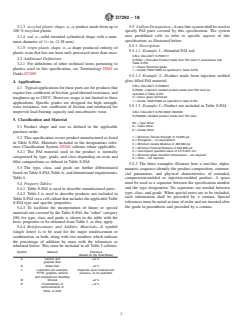
3.1.3 recycled plastic shape, n—a product made from up to 5.5 CalloutDesignation—Aone-linesystemshallbeusedto
100 % recycled plastic. specify PAI parts covered by this specification. The system
uses predefined cells to refer to specific aspects of this
3.1.4 rod, n—solid extruded cylindrical shape with a mini-
3 specification, as illustrated below:
mum diameter of ⁄32 in. (2.38 mm).
5.5.1 Description:
3.1.5 virgin plastic shape, n—a shape produced entirely of
5.5.1.1 Example 1—Extruded PAI rod:
plastic resin that has not been melt processed more than once.
CELL CALLOUT: S-PAI0111
3.2 Additional Definitions:
S-PAI01 = Extruded Product made from PAI resin in accordance with
Table S-PAI
3.2.1 For definitions of other technical terms pertaining to
1 = Class: Electrical grade
plastics used in this specification, see Terminology D883 or
1 = Grade: PAI011M03 as specified in Table S-PAI
Guide D7209.
5.5.1.2 Example 2—Product made from injection molded
glass filled PAI material:
4. Applications
CELL CALLOUT: S-PAI0231
4.1 Typical applications for these parts are for products that
S-PAI02 = Injection molded product made from PAI resin as
require low coefficient of friction, good thermal resistance, and
specified in Table S-PAI
3 = Class: glass reinforced
toughness up to 250°C. However, usage is not limited to these
1 = Grade: PAI013G30 as specified in table S-PAI
applications. Specific grades are designed for high strength,
5.5.1.3 Example 3—Product not included in Table S-PAI:
wear resistance, low coefficient of friction and reinforced for
CELL CALLOUT: S-PAI 0000 1022500
improved load bearing capacity and non-abrasive wear.
S-PA0000 = Molded product made from PAI resin
5. Classification and Material
00 = Type Other
0 = Class Other
5.1 Product shape and size as defined in the applicable
0 = Grade Other
purchase order.
1 = Minimum Tensile Strength of 10,000 psi
5.2 This specification covers product manufactured as listed
0 = Elongation – no requirement
in Table S-PAI. Materials included in the designations refer-
2 = Minimum tansile Modulus of 400,000 psi
ence Classification System D5204 callouts where applicable. 2 = Minimum Flexural Modulus of 550,000 psi
5 = Izod Impact specified value of 4.5 ft-lb/in min
5.2.1 The PAI material used in the product is normally
0 = Minimum glass transition temperature – not required
categorized by type, grade, and class depending on resin and
0 = other – not required
filler compositions as defined in Table S-PAI.
5.5.2 The three examples illustrate how a one-line, alpha-
5.3 The type, class, and grade are further differentiated
numeric sequence identify the product composition, commer-
based on Table S-PAI, TableA, and dimensional requirements,
cial parameters, and physical characteristics of extruded,
Table I.
compression-molded or injection-molded product. A space
must be used as a separator between the specification number
5.4 Property Tables:
and the type designation. No separators are needed between
5.4.1 Table S-PAI is used to describe manufactured parts.
type, class, and grade. When special notes are to be included,
5.4.2 Table I is used to describe products not included in
such information shall be preceded by a comma. Special
Table S-PAI via a cell callout that includes the applicableTable
tolerances must be noted at time of order and are inserted after
S-PAI type and specific properties.
the grade in parenthesis and preceded by a comma.
5.4.3 To facilitate the incorporation of future or special
materials not covered by the Table S-PAI, the “other” category
(00) for type, class and grade is shown in the table with the
basic properties to be obtained from Table I, as they apply.
5.4.4 Reinforcements and Additive Materials—A symbol
(single letter) is to be used for the major reinforcement or
combination, or both, along with two numbers which indicate
the percentage of addition by mass with the tolerances as
tabulated below. This must be included in all Table I callouts.
Symbol Material Tolerance
(Based on the Total Mass)
C Carbon and ±2 %
graphite fiber
G Glass fiber ±2 %
L Lubricants (for example, Depends upon material and
PTFE, graphite, silicone process—to be specified
and molybdenum disulfide)
M Mineral ±2 %
R Combinations of ±3 %
reinforcements or
fillers, or both
D7292 − 18
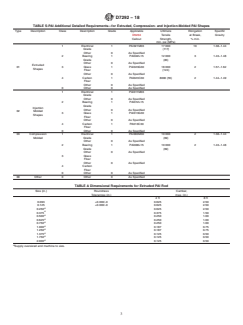
TABLE S-PAI Additional Detailed Requirements—for Extruded, Compression- and Injection-Molded PAI Shapes
Type Description Class Description Grade Applicable Ultimate Elongation Specific
D5204 Tensile at Break, Gravity
Callout Strength, % min.
min. psi (MPa)
1 Electrical 1 PAI021M03 17 000 10 1.38–1.44
Grade (117)
Other 0 As Specified
2 Bearing 1 PAI022L15 12 000 3 1.43–1.48
Grade (83)
Other 0 As Specified
Extruded
01 3 Glass 1 PAI023G30 18 000 2 1.57–1.62
Shapes
Fiber (124)
Other 0 As Specified
4 Carbon 1 PAI023C30 8000 (55) 2 1.44–1.49
Fiber
Other 0 As Specified
0 Other 0 As Specified
1 Electrical 1 PAI011M03
Grade
Other 0 As Specified
2 Bearing 1 PAI012L15
Grade
Injection
Other 0 As Specified
02 Molded
3 Glass 1 PAI013G30
Shapes
Fiber
Other 0 As Specified
4 Carbon 1 PA013C30
Fiber
0 Other 0 As Specified
03 Compression 1 Electrical 1 PAI000M30 10 000 2 1.38–1.44
Molded Grade (69)
Other 0 As Specified
2 Bearing 1 PAI000L15 10 000 2 1.43–1.48
Grade (69)
Other 0 As Specified
3 Glass
Fiber
Other 0 As Specified
4 Carbon
Fiber
0 Other 0 As Specified
00 Other 0 Other 0 As Specified
TABLE A Dimensional Requirements for Extruded PAI Rod
Size (in.) Roundness Camber,
Tolerances (in.) max. (in.)
4ft 8ft
0.093 +0.003/-0 0.625 2.50
0.1
...
This document is not an ASTM standard and is intended only to provide the user of an ASTM standard an indication of what changes have been made to the previous version. Because
it may not be technically possible to adequately depict all changes accurately, ASTM recommends that users consult prior editions as appropriate. In all cases only the current version
of the standard as published by ASTM is to be considered the official document.
Designation: D7292 − 12 D7292 − 18
Standard Specification for
Extruded, Compression-Molded, and Injection-Molded Basic
Shapes of Polyamide-Imide (PAI)
This standard is issued under the fixed designation D7292; the number immediately following the designation indicates the year of
original adoption or, in the case of revision, the year of last revision. A number in parentheses indicates the year of last reapproval. A
superscript epsilon (´) indicates an editorial change since the last revision or reapproval.
1. Scope*
1.1 This specification covers requirements and methods of test for the material, dimensions, and workmanship of extruded,
compression molded, and injection molded parts manufactured from PAI.
1.2 The properties included in this specification are those required for the compositions covered. Requirements necessary to
identify particular characteristics important to specialized applications are described by the classification system given in Section
5.
1.3 This specification allows for the use of recycled materials provided that specification requirements based upon this
specification are met.
1.4 The values stated in English units are to be regarded as standard in all property and dimensional tables. For reference
purposes, SI units and conversion factors are also included.
1.5 The following precautionary caveat pertains only to the test method portion Section 1211,, of this specification. This
standard does not purport to address all of the safety concerns, if any, associated with its use. It is the responsibility of the user
of this standard to establish appropriate safety safety, health, and healthenvironmental practices and determine the applicability
of regulatory limitations prior to use.
NOTE 1—There is no known ISO equivalent to this standard.
1.6 This international standard was developed in accordance with internationally recognized principles on standardization
established in the Decision on Principles for the Development of International Standards, Guides and Recommendations issued
by the World Trade Organization Technical Barriers to Trade (TBT) Committee.
2. Referenced Documents
2.1 ASTM Standards:
D256 Test Methods for Determining the Izod Pendulum Impact Resistance of Plastics
D618 Practice for Conditioning Plastics for Testing
D638 Test Method for Tensile Properties of Plastics
D790 Test Methods for Flexural Properties of Unreinforced and Reinforced Plastics and Electrical Insulating Materials
D792 Test Methods for Density and Specific Gravity (Relative Density) of Plastics by Displacement
D883 Terminology Relating to Plastics
D1708 Test Method for Tensile Properties of Plastics by Use of Microtensile Specimens
D3418 Test Method for Transition Temperatures and Enthalpies of Fusion and Crystallization of Polymers by Differential
Scanning Calorimetry
D3892 Practice for Packaging/Packing of Plastics
D4000 Classification System for Specifying Plastic Materials
D5204 Classification System and Basis for Specification for Polyamide-Imide (PAI) Molding and Extrusion Materials
D7209 Guide for Waste Reduction, Resource Recovery, and Use of Recycled Polymeric Materials and Products (Withdrawn
2015)
This specification is under the jurisdiction of ASTM Committee D20 on Plastics and is the direct responsibility of Subcommittee D20.15 on Thermoplastic Materials.
Current edition approved Aug. 1, 2012Aug. 1, 2018. Published September 2012August 2018. Originally approved in 2006. Last previous edition approved in 20062012
as D7292 - 06.12. DOI: 10.1520/D7292-12.10.1520/D7292-18.
For referenced ASTM standards, visit the ASTM website, www.astm.org, or contact ASTM Customer Service at service@astm.org. For Annual Book of ASTM Standards
volume information, refer to the standard’s Document Summary page on the ASTM website.
The last approved version of this historical standard is referenced on www.astm.org.
*A Summary of Changes section appears at the end of this standard
Copyright © ASTM International, 100 Barr Harbor Drive, PO Box C700, West Conshohocken, PA 19428-2959. United States
D7292 − 18
2.2 ANSI Standard:
Z1.4-1993 Sampling Procedure and Tables for Inspection by Attributes
3. Terminology
3.1 Definitions of Terms Specific to This Standard:
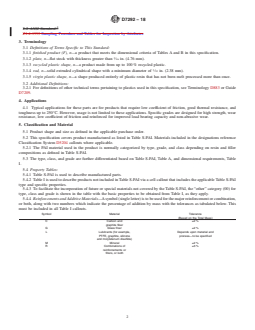
3.1.1 finished product (F), n—a product that meets the dimensional criteria of Tables A and B in this specification.
3.1.2 plate, n—flat stock with thickness greater than ⁄16 in. (4.76 mm).
3.1.3 recycled plastic shape, n—a product made from up to 100 % recycled plastic.
3.1.4 rod, n—solid extruded cylindrical shape with a minimum diameter of ⁄32 in. (2.38 mm).
3.1.5 virgin plastic shape, n—a shape produced entirely of plastic resin that has not been melt processed more than once.
3.2 Additional Definitions:
3.2.1 For definitions of other technical terms pertaining to plastics used in this specification, see Terminology D883 or Guide
D7209.
4. Applications
4.1 Typical applications for these parts are for products that require low coefficient of friction, good thermal resistance, and
toughness up to 250°C. However, usage is not limited to these applications. Specific grades are designed for high strength, wear
resistance, low coefficient of friction and reinforced for improved load bearing capacity and non-abrasive wear.
5. Classification and Material
5.1 Product shape and size as defined in the applicable purchase order.
5.2 This specification covers product manufactured as listed in Table S-PAI. Materials included in the designations reference
Classification System D5204 callouts where applicable.
5.2.1 The PAI material used in the product is normally categorized by type, grade, and class depending on resin and filler
compositions as defined in Table S-PAI.
5.3 The type, class, and grade are further differentiated based on Table S-PAI, Table A, and dimensional requirements, Table
I.
5.4 Property Tables:
5.4.1 Table S-PAI is used to describe manufactured parts.
5.4.2 Table I is used to describe products not included in Table S-PAI via a cell callout that includes the applicable Table S-PAI
type and specific properties.
5.4.3 To facilitate the incorporation of future or special materials not covered by the Table S-PAI, the “other” category (00) for
type, class and grade is shown in the table with the basic properties to be obtained from Table I, as they apply.
5.4.4 Reinforcements and Additive Materials—A symbol (single letter) is to be used for the major reinforcement or combination,
or both, along with two numbers which indicate the percentage of addition by mass with the tolerances as tabulated below. This
must be included in all Table I callouts.
Symbol Material Tolerance
(Based on the Total Mass)
C Carbon and ±2 %
graphite fiber
G Glass fiber ±2 %
L Lubricants (for example, Depends upon material and
PTFE, graphite, silicone process—to be specified
and molybdenum disulfide)
M Mineral ±2 %
R Combinations of ±3 %
reinforcements or
fillers, or both
D7292 − 18
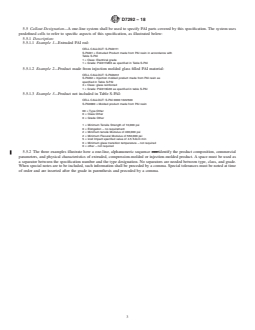
5.5 Callout Designation—A one-line system shall be used to specify PAI parts covered by this specification. The system uses
predefined cells to refer to specific aspects of this specification, as illustrated below:
5.5.1 Description:
5.5.1.1 Example 1—Extruded PAI rod:
CELL CALLOUT: S-PAI0111
S-PAI01 = Extruded Product made from PAI resin in accordance with
Table S-PAI
1 = Class: Electrical grade
1 = Grade: PAI011M03 as specified in Table S-PAI
5.5.1.2 Example 2—Product made from injection molded glass filled PAI material:
CELL CALLOUT: S-PAI0231
S-PAI02 = Injection molded product made from PAI resin as
specified in Table S-PAI
3 = Class: glass reinforced
1 = Grade: PAI013G30 as specified in table S-PAI
5.5.1.3 Example 3—Product not included in Table S-PAI:
CELL CALLOUT: S-PAI 0000 1022500
S-PA0000 = Molded product made from PAI resin
00 = Type Other
0 = Class Other
0 = Grade Other
1 = Minimum Tensile Strength of 10,000 psi
0 = Elongation – no requirement
2 = Minimum tansile Modulus of 400,000 psi
2 = Minimum Flexural Modulus of 550,000 psi
5 = Izod Impact specified value of 4.5 ft-lb/in min
0 = Minimum glass transition temperature – not required
0 = other – not required
5.5.2 The three examples illustrate how a one-line, alphanumeric sequence can identify the product composition, commercial
parameters, and physical characteristics of extruded, compression-molded or injection-molded product. A space must be used as
a separator between the specification number and the type designation. No separators are needed between type, class, and grade.
When special notes are to be included, such information shall be preceded by a comma. Special tolerances must be noted at time
of order and are inserted after the grade in parenthesis and preceded by a comma.
D7292 − 18
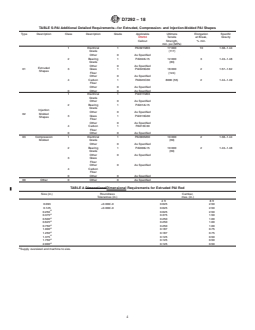
TABLE S-PAI Additional Detailed Requirements—for Extruded, Compression- and Injection-Molded PAI Shapes
Type Description Class Description Grade Applicable Ultimate Elongation Specific
D5204 Tensile at Break, Gravity
Callout Strength, % min.
min. psi (MPa)
1 Electrical 1 PAI021M03 17 000 10 1.38–1.44
Grade (117)
Other 0 As Specified
2 Bearing 1 PAI022L15 12 000 3 1.43–1.48
Grade (83)
Other 0 As Specified
Extruded
01 3 Glass 1 PAI023G30 18 000 2 1.57–1.62
Shapes
Fiber (124)
Other 0 As Specified
4 Carbon 1 PAI023C30 8000 (55) 2 1.44–1.49
Fiber
Other 0 As Specified
0 Other 0 As Specified
1 Electrical 1 PAI011M03
Grade
Other 0 As Specified
2 Bearing 1 PAI012L15
Grade
Injection
Other 0 As Specified
02 Molded
3 Glass 1 PAI013G30
Shapes
Fiber
Other 0 As Specified
4 Carbon 1 PA013C30
Fiber
0 Other 0 As Specified
03 Compression 1 Electrical 1 PAI000M30 10 000 2 1.38–1.44
Molded Grade (69)
Other 0 As Specified
2 Bearing 1 PAI000L15 10 000 2 1.43–1.48
Grade (69)
Other 0 As Specified
3 Glass
Fiber
Other 0 As Specified
4 Carbon
Fiber
0 Other 0 As Specified
00 Other 0 Other 0 As Specified
TABLE A DimenstionalDimensional Requirements for Extruded PAI Rod
Size (in.) Roundness Camber,
Tolerances (in.) max. (in.)
4 ft 8 ft
0.093 +0.003/-0 0.625 2.50
0.125 +0.003/-0 0.625 2.50
A
0.250 0.625 2.50
A
0.375 0.375 1.50
A
0.500 0.250 1.00
A
...