

ASTM E1962-19
(Practice)Standard Practice for Ultrasonic Surface Testing Using Electromagnetic Acoustic Transducer (EMAT) Techniques
General Information
- Abstract
SIGNIFICANCE AND USE
5.1 EMAT techniques show benefits and advantages over conventional piezoelectric ultrasonic techniques in special applications where flexibility in the type of wave mode generation and where no fluid coupling is desired. EMATs are highly efficient in the generation of surface waves.
5.2 Since EMATs are highly efficient in the generation of surface waves, and since acoustic techniques utilizing surface waves are proven effective for detecting surface and near-surface discontinuities, they should be considered for any applications where conventional penetrant testing and magnetic particle NDT techniques are effective but undesirable.
5.3 Since EMAT techniques are non-contacting, they should be considered for ultrasonic testing where applications involve automation, high-speed examinations, moving objects, applications in remote or hazardous locations, applications to objects at elevated temperatures, or objects with rough surfaces.
5.4 The purpose of this practice is to promote the EMAT technique of the ultrasonic method as a viable alternative to conventional PT and MPT methods for detecting the presence of surface and near-surface material discontinuities.
5.5 The use of EMATs and the selection of appropriate operating parameters presuppose a knowledge of the geometry of the component; the probable location, size, orientation, and reflectivity of the expected flaws; the allowable range of EMAT lift-off; and the laws of physics governing the propagation of ultrasonic waves. This procedure pertains to a specific EMAT surface inspection application.
SCOPE
1.1 This practice covers guidelines for utilizing EMAT techniques for detecting material discontinuities that are primarily open to the surface (for example, cracks, seams, laps, cold shuts, laminations, through leaks, lack of fusion). This technique can also be sensitive to flaws and discontinuities that are not surface-breaking, provided their proximity to the surface is less than or equal to the Rayleigh wave length.
1.2 This practice covers procedures for the non-contact coupling of surface waves into a material via electromagnetic fields.
1.3 The procedures of this practice are applicable to any material in which acoustic waves can be introduced electromagnetically. This includes any material that is either electrically conductive or ferromagnetic, or both.
1.4 This practice is intended to provide examination capabilities for in-process, final, and maintenance applications.
1.5 This practice does not provide standards for the evaluation of derived indications. Interpretation, classification, and ultimate evaluation of indications, albeit necessary, are beyond the scope of this practice. Separate specifications or agreement will be necessary to define the type, size, location, and direction of indications considered acceptable or non-acceptable.
1.6 Units—The values stated in inch-pound units are to be regarded as standard. The values given in parentheses are mathematical conversions to SI units that are provided for information only and are not considered standard.
1.7 This standard does not purport to address all of the safety concerns, if any, associated with its use. It is the responsibility of the user of this standard to establish appropriate safety, health, and environmental practices and determine the applicability of regulatory limitations prior to use.
1.8 This international standard was developed in accordance with internationally recognized principles on standardization established in the Decision on Principles for the Development of International Standards, Guides and Recommendations issued by the World Trade Organization Technical Barriers to Trade (TBT) Committee.
- Status
- Published
- Publication Date
- 30-Nov-2019
- Technical Committee
- E07 - Nondestructive Testing
- Drafting Committee
- E07.06 - Ultrasonic Method
Buy Documents
ASTM E1962-19 - Standard Practice for Ultrasonic Surface Testing Using Electromagnetic Acoustic Transducer (EMAT) Techniques
REDLINE ASTM E1962-19 - Standard Practice for Ultrasonic Surface Testing Using Electromagnetic Acoustic Transducer (EMAT) Techniques
Overview
ASTM E1962-19: Standard Practice for Ultrasonic Surface Testing Using Electromagnetic Acoustic Transducer (EMAT) Techniques provides comprehensive guidelines for the use of EMAT technology in non-destructive testing (NDT) for detecting surface and near-surface material discontinuities. Unlike conventional piezoelectric ultrasonic methods, EMAT techniques enable non-contact generation and detection of surface acoustic waves, making them particularly suitable for situations where fluid coupling is undesirable and high inspection flexibility is required. This standard is crucial for industries seeking advanced, reliable solutions for surface inspection, especially where traditional penetrant and magnetic particle testing techniques pose limitations.
Key Topics
- Non-contact Ultrasonic Testing: EMATs allow for ultrasonic surface testing without physical contact or couplants, reducing preparation time and enabling testing of materials at elevated temperatures or rough surfaces.
- Detection of Surface and Near-Surface Flaws: The practice is designed to identify typical surface-breaking and near-surface flaws such as cracks, laps, laminations, through leaks, and lack of fusion.
- Versatile Application: EMATs are effective on any electrically conductive or ferromagnetic materials, broadening their usability across various metals and alloys.
- Testing Techniques: Three principal EMAT techniques are described:
- Pulse-echo and Pitch-catch Reflected Wave Technique: Utilizes reflection of surface waves for flaw detection.
- Attenuation Technique: Detects flaws by measuring the attenuation of surface waves.
- Diffraction Technique: Focuses on flaw detection using diffracted ultrasonic waves, enhancing detection of flaws with varying orientations.
- Automation and High-Speed Examination: The non-contact nature and adaptability make EMATs ideal for automated inspection lines, high-speed testing of moving products, and examination in hazardous or remote locations.
Applications
ASTM E1962-19 is applied wherever advanced surface and near-surface flaw detection is needed. Key sectors and applications include:
- Weld Inspection: Effective for identifying weld cracks and discontinuities in both production and maintenance settings.
- High-Temperature and In-process Testing: Suitable for real-time inspection where components are hot or in motion, such as rolled products or pipe manufacturing.
- Difficult-to-Access or Hazardous Environments: EMATs allow testing where physical access is limited or safety is a concern.
- Quality Control: Used for final inspection and maintenance across aerospace, automotive, power generation, petrochemical, and manufacturing industries.
- Materials Compatibility: Can be used on any conductive or ferromagnetic material, thereby supporting a wide range of industrial materials.
Related Standards
The effectiveness and implementation of ASTM E1962-19 often involve reference to additional standards and guidelines:
- ASTM E543: Specification for Agencies Performing Nondestructive Testing.
- ASTM E587: Practice for Ultrasonic Angle-Beam Contact Testing.
- ASTM E1316: Terminology for Nondestructive Examinations.
- ASTM E1774: Guide for Electromagnetic Acoustic Transducers (EMATs).
- ASTM E1816: Practice for Thickness Measurement by Pulse-Echo EMAT Methods.
- ANSI/ASNT SNT-TC-1A and CP-189: Personnel Qualification and Certification in Nondestructive Testing.
- NAS-410: Qualification and Certification of Nondestructive Testing Personnel.
- ISO 9712: Qualification and Certification of NDT Personnel.
These related standards ensure proper qualification, methodology, and terminology for EMAT-based ultrasonic testing in line with international NDT best practices.
Keywords: ultrasonic testing, EMAT, electromagnetic acoustic transducer, surface flaw detection, nondestructive testing, Rayleigh waves, material inspection, ASTM E1962-19, standards compliance, NDT of welds.
Relations
- Effective Date
- 01-Dec-2019
- Effective Date
- 01-Feb-2024
- Effective Date
- 01-Jun-2020
- Effective Date
- 01-Dec-2019
- Effective Date
- 01-Mar-2019
- Effective Date
- 01-Jan-2018
- Effective Date
- 15-Jun-2017
- Effective Date
- 01-Feb-2017
- Effective Date
- 01-Aug-2016
- Effective Date
- 01-Feb-2016
- Effective Date
- 01-Dec-2015
- Effective Date
- 01-Sep-2015
- Effective Date
- 01-Jun-2014
- Effective Date
- 01-Jun-2014
- Effective Date
- 01-Dec-2013
Buy Documents
ASTM E1962-19 - Standard Practice for Ultrasonic Surface Testing Using Electromagnetic Acoustic Transducer (EMAT) Techniques
REDLINE ASTM E1962-19 - Standard Practice for Ultrasonic Surface Testing Using Electromagnetic Acoustic Transducer (EMAT) Techniques
Get Certified
Connect with accredited certification bodies for this standard

IMP NDT d.o.o.
Non-destructive testing services. Radiography, ultrasonic, magnetic particle, penetrant, visual inspection.
Inštitut za kovinske materiale in tehnologije
Institute of Metals and Technology. Materials testing, metallurgical analysis, NDT.
Q Techna d.o.o.
NDT and quality assurance specialist. 30+ years experience. NDT personnel certification per ISO 9712, nuclear and thermal power plant inspections, QA/
Sponsored listings
Frequently Asked Questions
ASTM E1962-19 is a standard published by ASTM International. Its full title is "Standard Practice for Ultrasonic Surface Testing Using Electromagnetic Acoustic Transducer (EMAT) Techniques". This standard covers: SIGNIFICANCE AND USE 5.1 EMAT techniques show benefits and advantages over conventional piezoelectric ultrasonic techniques in special applications where flexibility in the type of wave mode generation and where no fluid coupling is desired. EMATs are highly efficient in the generation of surface waves. 5.2 Since EMATs are highly efficient in the generation of surface waves, and since acoustic techniques utilizing surface waves are proven effective for detecting surface and near-surface discontinuities, they should be considered for any applications where conventional penetrant testing and magnetic particle NDT techniques are effective but undesirable. 5.3 Since EMAT techniques are non-contacting, they should be considered for ultrasonic testing where applications involve automation, high-speed examinations, moving objects, applications in remote or hazardous locations, applications to objects at elevated temperatures, or objects with rough surfaces. 5.4 The purpose of this practice is to promote the EMAT technique of the ultrasonic method as a viable alternative to conventional PT and MPT methods for detecting the presence of surface and near-surface material discontinuities. 5.5 The use of EMATs and the selection of appropriate operating parameters presuppose a knowledge of the geometry of the component; the probable location, size, orientation, and reflectivity of the expected flaws; the allowable range of EMAT lift-off; and the laws of physics governing the propagation of ultrasonic waves. This procedure pertains to a specific EMAT surface inspection application. SCOPE 1.1 This practice covers guidelines for utilizing EMAT techniques for detecting material discontinuities that are primarily open to the surface (for example, cracks, seams, laps, cold shuts, laminations, through leaks, lack of fusion). This technique can also be sensitive to flaws and discontinuities that are not surface-breaking, provided their proximity to the surface is less than or equal to the Rayleigh wave length. 1.2 This practice covers procedures for the non-contact coupling of surface waves into a material via electromagnetic fields. 1.3 The procedures of this practice are applicable to any material in which acoustic waves can be introduced electromagnetically. This includes any material that is either electrically conductive or ferromagnetic, or both. 1.4 This practice is intended to provide examination capabilities for in-process, final, and maintenance applications. 1.5 This practice does not provide standards for the evaluation of derived indications. Interpretation, classification, and ultimate evaluation of indications, albeit necessary, are beyond the scope of this practice. Separate specifications or agreement will be necessary to define the type, size, location, and direction of indications considered acceptable or non-acceptable. 1.6 Units—The values stated in inch-pound units are to be regarded as standard. The values given in parentheses are mathematical conversions to SI units that are provided for information only and are not considered standard. 1.7 This standard does not purport to address all of the safety concerns, if any, associated with its use. It is the responsibility of the user of this standard to establish appropriate safety, health, and environmental practices and determine the applicability of regulatory limitations prior to use. 1.8 This international standard was developed in accordance with internationally recognized principles on standardization established in the Decision on Principles for the Development of International Standards, Guides and Recommendations issued by the World Trade Organization Technical Barriers to Trade (TBT) Committee.
SIGNIFICANCE AND USE 5.1 EMAT techniques show benefits and advantages over conventional piezoelectric ultrasonic techniques in special applications where flexibility in the type of wave mode generation and where no fluid coupling is desired. EMATs are highly efficient in the generation of surface waves. 5.2 Since EMATs are highly efficient in the generation of surface waves, and since acoustic techniques utilizing surface waves are proven effective for detecting surface and near-surface discontinuities, they should be considered for any applications where conventional penetrant testing and magnetic particle NDT techniques are effective but undesirable. 5.3 Since EMAT techniques are non-contacting, they should be considered for ultrasonic testing where applications involve automation, high-speed examinations, moving objects, applications in remote or hazardous locations, applications to objects at elevated temperatures, or objects with rough surfaces. 5.4 The purpose of this practice is to promote the EMAT technique of the ultrasonic method as a viable alternative to conventional PT and MPT methods for detecting the presence of surface and near-surface material discontinuities. 5.5 The use of EMATs and the selection of appropriate operating parameters presuppose a knowledge of the geometry of the component; the probable location, size, orientation, and reflectivity of the expected flaws; the allowable range of EMAT lift-off; and the laws of physics governing the propagation of ultrasonic waves. This procedure pertains to a specific EMAT surface inspection application. SCOPE 1.1 This practice covers guidelines for utilizing EMAT techniques for detecting material discontinuities that are primarily open to the surface (for example, cracks, seams, laps, cold shuts, laminations, through leaks, lack of fusion). This technique can also be sensitive to flaws and discontinuities that are not surface-breaking, provided their proximity to the surface is less than or equal to the Rayleigh wave length. 1.2 This practice covers procedures for the non-contact coupling of surface waves into a material via electromagnetic fields. 1.3 The procedures of this practice are applicable to any material in which acoustic waves can be introduced electromagnetically. This includes any material that is either electrically conductive or ferromagnetic, or both. 1.4 This practice is intended to provide examination capabilities for in-process, final, and maintenance applications. 1.5 This practice does not provide standards for the evaluation of derived indications. Interpretation, classification, and ultimate evaluation of indications, albeit necessary, are beyond the scope of this practice. Separate specifications or agreement will be necessary to define the type, size, location, and direction of indications considered acceptable or non-acceptable. 1.6 Units—The values stated in inch-pound units are to be regarded as standard. The values given in parentheses are mathematical conversions to SI units that are provided for information only and are not considered standard. 1.7 This standard does not purport to address all of the safety concerns, if any, associated with its use. It is the responsibility of the user of this standard to establish appropriate safety, health, and environmental practices and determine the applicability of regulatory limitations prior to use. 1.8 This international standard was developed in accordance with internationally recognized principles on standardization established in the Decision on Principles for the Development of International Standards, Guides and Recommendations issued by the World Trade Organization Technical Barriers to Trade (TBT) Committee.
ASTM E1962-19 is classified under the following ICS (International Classification for Standards) categories: 19.100 - Non-destructive testing. The ICS classification helps identify the subject area and facilitates finding related standards.
ASTM E1962-19 has the following relationships with other standards: It is inter standard links to ASTM E1962-14, ASTM E1316-24, ASTM E587-15(2020), ASTM E1316-19b, ASTM E1316-19, ASTM E1316-18, ASTM E1316-17a, ASTM E1316-17, ASTM E1316-16a, ASTM E1316-16, ASTM E1316-15a, ASTM E1316-15, ASTM E1316-14, ASTM E1316-14e1, ASTM E1316-13d. Understanding these relationships helps ensure you are using the most current and applicable version of the standard.
ASTM E1962-19 is available in PDF format for immediate download after purchase. The document can be added to your cart and obtained through the secure checkout process. Digital delivery ensures instant access to the complete standard document.
Standards Content (Sample)
This international standard was developed in accordance with internationally recognized principles on standardization established in the Decision on Principles for the
Development of International Standards, Guides and Recommendations issued by the World Trade Organization Technical Barriers to Trade (TBT) Committee.
Designation:E1962 −19
Standard Practice for
Ultrasonic Surface Testing Using Electromagnetic Acoustic
Transducer (EMAT) Techniques
This standard is issued under the fixed designation E1962; the number immediately following the designation indicates the year of
original adoption or, in the case of revision, the year of last revision. A number in parentheses indicates the year of last reapproval. A
superscript epsilon (´) indicates an editorial change since the last revision or reapproval.
1. Scope* 1.8 This international standard was developed in accor-
dance with internationally recognized principles on standard-
1.1 This practice covers guidelines for utilizing EMAT
ization established in the Decision on Principles for the
techniques for detecting material discontinuities that are pri-
Development of International Standards, Guides and Recom-
marily open to the surface (for example, cracks, seams, laps,
mendations issued by the World Trade Organization Technical
cold shuts, laminations, through leaks, lack of fusion). This
Barriers to Trade (TBT) Committee.
technique can also be sensitive to flaws and discontinuities that
are not surface-breaking, provided their proximity to the
2. Referenced Documents
surface is less than or equal to the Rayleigh wave length.
2.1 ASTM Standards:
1.2 This practice covers procedures for the non-contact
E543 Specification for Agencies Performing Nondestructive
coupling of surface waves into a material via electromagnetic
Testing
fields.
E587 Practice for Ultrasonic Angle-Beam Contact Testing
1.3 The procedures of this practice are applicable to any E1316 Terminology for Nondestructive Examinations
material in which acoustic waves can be introduced electro-
E1816 PracticeforMeasuringthicknessbyPulse-EchoElec-
magnetically. This includes any material that is either electri-
tromagnetic Acoustic Transducer (EMAT) Methods
cally conductive or ferromagnetic, or both.
2.2 ANSI/ASNT Standards:
Recommended Practice SNT-TC-1A Personnel Qualifica-
1.4 This practice is intended to provide examination capa-
tion and Certification in Nondestructive Testing
bilities for in-process, final, and maintenance applications.
ANSI/ASNT CP-189 Standard for Qualification and Certifi-
1.5 This practice does not provide standards for the evalu-
cation of Nondestructive Testing Personnel
ation of derived indications. Interpretation, classification, and
2.3 AIA Standard:
ultimate evaluation of indications, albeit necessary, are beyond
NAS-410 Certification and Qualification of Nondestructive
the scope of this practice. Separate specifications or agreement
Test Personnel
will be necessary to define the type, size, location, and
2.4 ISO Standard:
direction of indications considered acceptable or non-
ISO 9712 Qualification and Certification of NDT Personnel
acceptable.
1.6 Units—The values stated in inch-pound units are to be
3. Terminology
regarded as standard. The values given in parentheses are
3.1 Definitions:
mathematical conversions to SI units that are provided for
3.1.1 Additional related terminology is defined inTerminol-
information only and are not considered standard.
ogy E1316.
1.7 This standard does not purport to address all of the
3.2 Definitions of Terms Specific to This Standard:
safety concerns, if any, associated with its use. It is the
responsibility of the user of this standard to establish appro-
priate safety, health, and environmental practices and deter-
For referenced ASTM standards, visit the ASTM website, www.astm.org, or
mine the applicability of regulatory limitations prior to use.
contact ASTM Customer Service at service@astm.org. For Annual Book of ASTM
Standards volume information, refer to the standard’s Document Summary page on
the ASTM website.
Available from American National Standards Institute (ANSI), 25 W. 43rd St.,
This practice is under the jurisdiction of ASTM Committee E07 on Nonde- 4th Floor, New York, NY 10036, http://www.ansi.org.
structive Testing and is the direct responsibility of Subcommittee E07.06 on Available from Aerospace Industries Association (AIA), 1000 Wilson Blvd.,
Ultrasonic Method. Suite 1700, Arlington, VA 22209, http://www.aia-aerospace.org.
Current edition approved Dec. 1, 2019. Published December 2019. Originally Available from International Organization for Standardization (ISO), ISO
approved in 1998. Last previous edition approved in 2014 as E1962 – 14. DOI: Central Secretariat, BIBC II, Chemin de Blandonnet 8, CP 401, 1214 Vernier,
10.1520/E1962-19. Geneva, Switzerland, http://www.iso.org.
*A Summary of Changes section appears at the end of this standard
Copyright © ASTM International, 100 Barr Harbor Drive, PO Box C700, West Conshohocken, PA 19428-2959. United States
E1962−19
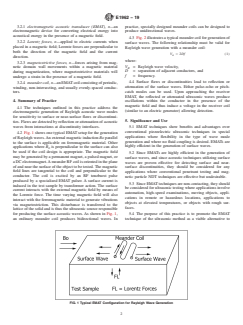
3.2.1 electromagnetic acoustic transducer (EMAT), n—an practice, specially designed meander coils can be designed to
electromagnetic device for converting electrical energy into produce unidirectional waves.
acoustical energy in the presence of a magnetic field.
4.3 Fig. 2 illustrates a typical meander coil for generation of
3.2.2 Lorentz forces, n—applied to electric currents when
surface waves. The following relationship must be valid for
placed in a magnetic field; Lorentz forces are perpendicular to
Rayleigh wave generation with a meander coil:
both the direction of the magnetic field and the current
V 5 2Df (1)
R
direction.
where:
3.2.3 magnetostrictive forces, n—forces arising from mag-
V = Rayleigh wave velocity,
netic domain wall movements within a magnetic material
R
D = separation of adjacent conductors, and
during magnetization, where magnetostrictive materials will
f = frequency.
undergo a strain in the presence of a magnetic field.
4.4 Surface flaws or discontinuities lead to reflection or
3.2.4 meander coil, n—anEMATcoilconsistingofperiodic,
attenuation of the surface waves. Either pulse-echo or pitch-
winding, non-intersecting, and usually evenly-spaced conduc-
catch modes can be used. Upon approaching the receiver
tors.
EMAT, the reflected or attenuated ultrasonic waves produce
4. Summary of Practice
oscillations within the conductor in the presence of the
magnetic field and thus induce a voltage in the receiver coil
4.1 The techniques outlined in this practice address the
(similar to an electric generator) allowing detection.
electromagnetic generation of Rayleigh acoustic wave modes
for sensitivity to surface or near-surface flaws or discontinui-
5. Significance and Use
ties. Flaws are detected by reflection or attenuation of acoustic
waves from interactions at discontinuity interfaces.
5.1 EMAT techniques show benefits and advantages over
conventional piezoelectric ultrasonic techniques in special
4.2 Fig. 1 shows one typical EMAT setup for the generation
applications where flexibility in the type of wave mode
of Rayleigh waves.An external magnetic induction Bo parallel
generation and where no fluid coupling is desired. EMATs are
to the surface is applicable on ferromagnetic material. Other
highly efficient in the generation of surface waves.
applications where B is perpendicular to the surface can also
be used if the coil design is appropriate. The magnetic field
5.2 Since EMATs are highly efficient in the generation of
may be generated by a permanent magnet, a pulsed magnet, or
surface waves, and since acoustic techniques utilizing surface
aDCelectromagnet.AmeanderRFcoilisorientedintheplane
waves are proven effective for detecting surface and near-
of and near the surface of the object to be tested. The magnetic
surface discontinuities, they should be considered for any
field lines are tangential to the coil and perpendicular to the
applications where conventional penetrant testing and mag-
conductor. The coil is excited by an RF toneburst pulse
netic particle NDT techniques are effective but undesirable.
produced by a specialized EMAT pulser. A surface current is
5.3 Since EMATtechniques are non-contacting, they should
induced in the test sample by transformer action. The surface
be considered for ultrasonic testing where applications involve
current interacts with the external magnetic field by means of
automation, high-speed examinations, moving objects, appli-
the Lorentz force. The time varying magnetic field will also
cations in remote or hazardous locations, applications to
interact with the ferromagnetic material to generate vibrations
objects at elevated temperatures, or objects with rough sur-
via magnetostriction. This disturbance is transferred to the
faces.
lattice of the solid and is thus the ultrasonic source responsible
for producing the surface acoustic waves. As shown in Fig. 1, 5.4 The purpose of this practice is to promote the EMAT
an ordinary meander coil produces bidirectional waves. In technique of the ultrasonic method as a viable alternative to
FIG. 1Typical EMAT Configuration for Rayleigh Wave Generation
E1962−19
method sensitive to the attenuation of surface waves. The third
technique involves surface wave diffraction with focused
meander coils.
7.2 Pulse-Echo or Pitch-Catch Reflected Surface Wave
Technique—These techniques are analogous to conventional
FIG. 2Typical EMAT Meander Coil for Generation of Surface
ultrasonic techniques. The techniques use either one (pulse-
Waves
echo) or two (pitch-catch) EMAT sensors and rely upon the
reception of reflected surface waves from the flaw. The
conventional PT and MPT methods for detecting the presence
advantage of these techniques is simplicity. One disadvantage
of surface and near-surface material discontinuities.
is the difficulty in detecting all flaw orientations without
elaborate scanning routines. Also, when these techniques are
5.5 The use of EMATs and the selection of appropriate
usedforweldapplications,aproblemarisesinthattherootand
operating parameters presuppose a knowledge of the geometry
crown of the weld can produce reflections that are prominent
of the component; the probable location, size, orientation, and
enough to interfere with and even obscure flaw signals. When
reflectivityoftheexpectedflaws;theallowablerangeofEMAT
such interferences are apparent, it is recommended that one of
lift-off; and the laws of physics governing the propagation of
the other two techniques described herein be utilized to avoid
ultrasonic waves. This procedure pertains to a specific EMAT
these problems.
surface inspection application.
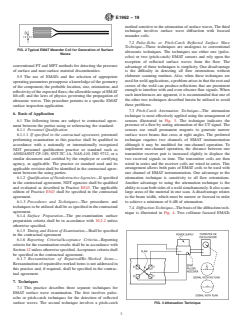
7.3 Pitch-Catch Attenuation Technique—The attenuation
6. Basis of Application
technique is most effectively applied using the arrangement of
sensors illustrated in Fig. 3. The technique indicates the
6.1 The following items are subject to contractual agree-
ment between the parties using or referencing the standard: presence of a flaw by noting attenuation of the UT signal. The
sensors use small permanent magnets to generate narrow
6.1.1 Personnel Qualification
6.1.1.1 If specified in the contractual agreement, personnel surface wave beams that cross at right angles. The preferred
technique requires two channels of EMAT instrumentation
performing examination to this practice shall be qualified in
accordance with a nationally or internationally recognized although it may be modified for one-channel operation. To
implement one-channel operation, the distance between one
NDT personnel qualification practice or standard such as
ANSI/ASNT CP-189, SNT-TC-1A, NAS-410, ISO 9712, or a transmitter receiver pair is increased slightly to displace the
two received signals in time. The transmitter coils are then
similar document and certified by the employer or certifying
agency, as applicable. The practice or standard used and its wired in series and the receiver coils are wired in series. This
applicable revision shall be identified in the contractual agree- arrangement allows both pairs of EMAT coils to be used with
ment between the using parties. one channel of EMAT instrumentation. One advantage to the
6.1.2 Qualification of Nondestructive Agencies—Ifspecified attenuation technique is sensitivity to all flaw orientations.
in the contractual agreement, NDT agencies shall be qualified Another advantage to using the attenuation technique is the
and evaluated as described in Practice E543. The applicable abilitytoscanbothsidesofaweldsimultaneously.Italsoscans
large areas of the material in one scan. A disadvantage relates
edition of Practice E543 shall be specified in the contractual
agreement. to the beam width, which must be narrow or focused in order
to achieve a minimum of 6 dB of attenuation.
6.1.3 Procedures and Techniques—The procedures and
techniques to be utilized shall be as specified in the contractual
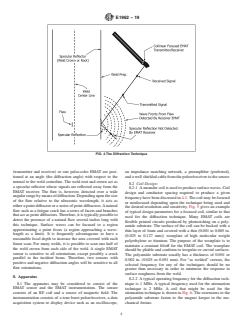
7.4 Diffraction Technique—Thebasisofthediffractiontech-
agreement.
nique is illustrated in Fig. 4. Two collinear focused EMATs
6.1.4 Surface Preparation—The pre-examination surface
preparation criteria shall be in accordance with 10.2.2 unless
otherwise specified.
6.1.5 Timing and Extent of Examination—Shall be specified
in the contractual agreement
6.1.6 Reporting Criteria/Acceptance Criteria—Reporting
criteria for the examination results shall be in accordance with
Section 12 unless otherwise specified.Acceptance criteria shall
be specified in the contractual agreement.
6.1.7 Reexamination of Repaired/Re-Worked Items—
Reexamination of repaired/re-worked items is not addressed in
this practice and, if required, shall be specified in the contrac-
tual agreement.
7. Techniques
7.1 This practice describes three separate techniques for
EMAT surface wave examination. The first involves pulse-
echo or pitch-catch techniques for the detection of reflected
surface waves. The second technique involves a pitch-catch FIG. 3Attenuation Technique
E1962−19
FIG. 4The Diffraction Technique
(transmitter and receiver) or one pulse-echo EMAT are posi- an impedance matching network, a preamplifier (preferred),
tioned at an angle (the diffraction angle) with respect to the andawellshieldedcablefromthepulser/receivertothesensor.
normal to the weld centerline. The weld root and crown act as
8.2 Coil Design:
a specular reflector whose signals are reflected away from the
8.2.1 Ameander coil is used to produce surface waves. Coil
EMAT receiver. The flaw is, however, detected over a wide
design and conductor spacing required to produce a given
angularrangebymeansofdiffraction.Dependinguponthesize
frequency have been discussed in 4.3.The coil may be focused
of the flaw relative to the ultrasonic wavelength, it acts as
or nonfocused depending upon the technique being used and
eitherapointdiffractororaseriesofpointdiffractors.Anatural
the desired resolution and sensitivity. Fig. 5 gives an example
flaw such as a fatigue crack has a series of facets and branches
of typical design parameters for a focused coil, similar to that
thatactaspointdiffractors.Therefore,itistypicallypossibleto
used for the diffraction technique. Many EMAT coils are
detect the presence of a natural flaw several inches long with
flexible printed circuits produced by photoetching on a poly-
this technique. Surface waves can be focused to a region
amide substrate. The surface of the coil can be backed with a
approximating a point focus (a region approaching a wave-
thin layer of foam and covered with a thin (0.001 to 0.005 in.
length as a limit). It is frequently advantageous to have a
(0.025 to 0.127 mm)) wearplate of high molecular weight
reasonable focal depth to increase the area covered with each
polyethylene or titanium. The purpose of the wearplate is to
linear scan. For many welds, it is possible to scan one half of
maintain a constant liftoff for the EMAT coil. The wearplate
the weld crown from each side of the weld. A single EMAT
should be pliable and conform to irregular or curved surfaces.
sensor is sensitive to all orientations except possibly a crack
The polyamide substrate usually has a thickness of 0.001 or
parallel to the incident beam. Therefore, two sensors with
0.002 in. (0.025 or 0.051 mm). For “as welded” crowns, the
positive and negative diffraction angles will be sensitive to all
selected frequency for any of the techniques should be no
flaw orientations.
greater than necessary in order to minimize the response to
surface roughness from the weld.
8. Apparatus
8.2.2 A typical operating frequency for the diffraction tech-
8.1 The apparatus may be considered to consist of the nique is 1 MHz. A typical frequency used for the attenuation
EMAT sensor and the EMAT instrumentation. The sensor technique is 2 MHz. A coil that might be used for the
consists of an RF coil and a source of magnetic field. The attenuation technique is shown in Fig. 6. The extensions to the
instrumentation consists of a tone burst pulser/receiver, a data polyamide substrate fasten to the magnet keeper in the me-
acquisition system or display device such as an oscilloscope, chanical fixture.
E1962−19
FIG. 5Design Parameters for Typical Focused EMAT Coil
FIG. 6A Typical EMAT coil Used for the Attenuation Technique
8.3 Coil Excitation—A high-power, specialized RF genera- direction could be either parallel or perpendicular to the
tor is necessary to provide excitation to the coil in th
...
This document is not an ASTM standard and is intended only to provide the user of an ASTM standard an indication of what changes have been made to the previous version. Because
it may not be technically possible to adequately depict all changes accurately, ASTM recommends that users consult prior editions as appropriate. In all cases only the current version
of the standard as published by ASTM is to be considered the official document.
Designation: E1962 − 14 E1962 − 19
Standard Practice for
Ultrasonic Surface Testing Using Electromagnetic Acoustic
Transducer (EMAT) Techniques
This standard is issued under the fixed designation E1962; the number immediately following the designation indicates the year of
original adoption or, in the case of revision, the year of last revision. A number in parentheses indicates the year of last reapproval. A
superscript epsilon (´) indicates an editorial change since the last revision or reapproval.
1. Scope*
1.1 This practice covers guidelines for utilizing EMAT techniques for detecting material discontinuities that are primarily open
to the surface (for example, cracks, seams, laps, cold shuts, laminations, through leaks, lack of fusion). This technique can also
be sensitive to flaws and discontinuities that are not surface-breaking, provided their proximity to the surface is less than or equal
to the Rayleigh wave length.
1.2 This practice covers procedures for the non-contact coupling of surface waves into a material via electromagnetic fields.
1.3 The procedures of this practice are applicable to any material in which acoustic waves can be introduced electromagneti-
cally. This includes any material that is either electrically conductive or ferromagnetic, or both.
1.4 This practice is intended to provide examination capabilities for in-process, final, and maintenance applications.
1.5 This practice does not provide standards for the evaluation of derived indications. Interpretation, classification, and ultimate
evaluation of indications, albeit necessary, are beyond the scope of this practice. Separate specifications or agreement will be
necessary to define the type, size, location, and direction of indications considered acceptable or non-acceptable.
1.6 Units—The values stated in inch-pound units are to be regarded as the standards. The SI units standard. The values given
in parentheses are for information only.mathematical conversions to SI units that are provided for information only and are not
considered standard.
1.7 This standard does not purport to address all of the safety concerns, if any, associated with its use. It is the responsibility
of the user of this standard to establish appropriate safety safety, health, and healthenvironmental practices and determine the
applicability of regulatory limitations prior to use.
1.8 This international standard was developed in accordance with internationally recognized principles on standardization
established in the Decision on Principles for the Development of International Standards, Guides and Recommendations issued
by the World Trade Organization Technical Barriers to Trade (TBT) Committee.
2. Referenced Documents
2.1 ASTM Standards:
E543 Specification for Agencies Performing Nondestructive Testing
E587 Practice for Ultrasonic Angle-Beam Contact Testing
E1316 Terminology for Nondestructive Examinations
E1774 Guide for Electromagnetic Acoustic Transducers (EMATs)
E1816 Practice for Measuring thickness by Pulse-Echo Electromagnetic Acoustic Transducer (EMAT) Methods
2.2 ANSI/ASNT Standards:
Recommended Practice SNT-TC-1A Personnel Qualification and Certification in Nondestructive Testing
ANSI/ASNT CP-189 Standard for Qualification and Certification of Nondestructive Testing Personnel
This practice is under the jurisdiction of ASTM Committee E07 on Nondestructive Testing and is the direct responsibility of Subcommittee E07.06 on Ultrasonic Method.
Current edition approved Oct. 1, 2014Dec. 1, 2019. Published October 2014December 2019. Originally approved in 1998. Last previous edition approved in 20092014
as E1962 - 09.E1962 – 14. DOI: 10.1520/E1962-14.10.1520/E1962-19.
For referenced ASTM standards, visit the ASTM website, www.astm.org, or contact ASTM Customer Service at service@astm.org. For Annual Book of ASTM Standards
volume information, refer to the standard’s Document Summary page on the ASTM website.
Available from American National Standards Institute (ANSI), 25 W. 43rd St., 4th Floor, New York, NY 10036, http://www.ansi.org.
*A Summary of Changes section appears at the end of this standard
Copyright © ASTM International, 100 Barr Harbor Drive, PO Box C700, West Conshohocken, PA 19428-2959. United States
E1962 − 19
2.3 MilitaryAIA Standard:
MIL-STD-410NAS-410 Nondestructive Testing Personnel Qualification and CertificationCertification and Qualification of
Nondestructive Test Personnel
2.4 ISO Standard:
ISO 9712 Qualification and Certification of NDT Personnel
3. Terminology
3.1 Definitions:
3.1.1 Additional related terminology is defined in Terminology E1316.
3.2 Definitions of Terms Specific to This Standard:
3.2.1 electromagnetic acoustic transducer (EMAT)—(EMAT), n—an electromagnetic device for converting electrical energy
into acoustical energy in the presence of a magnetic field.
3.2.2 Lorentz forces—forces, n—applied to electric currents when placed in a magnetic field.field; Lorentz forces are
perpendicular to both the direction of the magnetic field and the current direction.
3.2.3 magnetostrictive forces—forces, n—forces arising from magnetic domain wall movements within a magnetic material
during magnetization, where magnetostrictive materials will undergo a strain in the presence of a magnetic field.
3.2.4 meander coil—coil, n—an EMAT coil consisting of periodic, winding, non-intersecting, and usually evenly-spaced
conductors.
4. Summary of Practice
4.1 The techniques outlined in this practice address the electromagnetic generation of Rayleigh acoustic wave modes for
sensitivity to surface or near-surface flaws or discontinuities. Flaws are detected by reflection or attenuation of acoustic waves from
interactions at discontinuity interfaces.
4.2 Fig. 1 shows one typical EMAT setup for the generation of Rayleigh waves. An external magnetic induction Bo parallel to
the surface is applicable on ferromagnetic material. Other applications where B is perpendicular to the surface can also be used
if the coil design is appropriate. The magnetic field may be generated by a permanent magnet, a pulsed magnet, or a DC
electromagnet. A meander RF coil is oriented in the plane of and near the surface of the object to be tested. The magnetic field
lines are tangential to the coil and perpendicular to the conductor. The coil is excited by an RF toneburst pulse produced by a
specialized EMAT pulser. A surface current is induced in the test sample by transformer action. The surface current interacts with
the external magnetic field by means of the Lorentz force. The time varying magnetic field will also interact with the ferromagnetic
material to generate vibrations via magnetostriction. This disturbance is transferred to the lattice of the solid and is thus the
ultrasonic source responsible for producing the surface acoustic waves. As shown in Fig. 1, an ordinary meander coil produces
bidirectional waves. In practice, specially designed meander coils can be designed to produce unidirectional waves.
4.3 Fig. 2 illustrates a typical meander coil for generation of surface waves. The following relationship must be valid for
Rayleigh wave generation with a meander coil:
FIG. 1 Typical EMAT Configuration for Rayleigh Wave Generation
Available from U.S. Government Printing Office Superintendent of Documents, 732 N. Capitol St., NW, Mail Stop: SDE, Washington, DC 20401.Aerospace Industries
Association (AIA), 1000 Wilson Blvd., Suite 1700, Arlington, VA 22209, http://www.aia-aerospace.org.
Available from International Organization for Standardization (ISO), ISO Central Secretariat, BIBC II, Chemin de Blandonnet 8, CP 401, 1214 Vernier, Geneva,
Switzerland, http://www.iso.org.
E1962 − 19
FIG. 2 Typical EMAT Meander Coil for Generation of Surface Waves
V 5 2Df (1)
R
where:
V = Rayleigh wave velocity,
R
D = separation of adjacent conductors, and
f = frequency.
4.4 Surface flaws or discontinuities lead to reflection or attenuation of the surface waves. Either pulse-echo or pitch-catch modes
can be used. Upon approaching the receiver EMAT, the reflected or attenuated ultrasonic waves produce oscillations within the
conductor in the presence of the magnetic field and thus induce a voltage in the receiver coil (similar to an electric generator)
allowing detection.
5. Significance and Use
5.1 EMAT techniques show benefits and advantages over conventional piezoelectric ultrasonic techniques in special
applications where flexibility in the type of wave mode generation and where no fluid coupling is desired. EMATs are highly
efficient in the generation of surface waves.
5.2 Since EMATs are highly efficient in the generation of surface waves, and since acoustic techniques utilizing surface waves
are proven effective for detecting surface and near-surface discontinuities, they should be considered for any applications where
conventional penetrant testing and magnetic particle NDT techniques are effective but undesirable.
5.3 Since EMAT techniques are non-contacting, they should be considered for ultrasonic testing where applications involve
automation, high-speed examinations, moving objects, applications in remote or hazardous locations, applications to objects at
elevated temperatures, or objects with rough surfaces.
5.4 The purpose of this practice is to promote the EMAT technique of the ultrasonic method as a viable alternative to
conventional PT and MPT methods for detecting the presence of surface and near-surface material discontinuities.
5.5 The use of EMATs and the selection of appropriate operating parameters presuppose a knowledge of the geometry of the
component; the probable location, size, orientation, and reflectivity of the expected flaws; the allowable range of EMAT lift-off;
and the laws of physics governing the propagation of ultrasonic waves. This procedure pertains to a specific EMAT surface
inspection application.
6. Basis of Application
6.1 The following items are subject to contractual agreement between the parties using or referencing the standard:
6.1.1 Personnel Qualification
6.1.1.1 If specified in the contractual agreement, personnel performing examination to this practice shall be qualified in
accordance with a nationally or internationally recognized NDT personnel qualification practice or standard such as ANSI/ASNT-
CP-189, SNT-TC-1A, MIL STD-410, ANSI/ASNT CP-189, SNT-TC-1A, NAS-410, ISO 9712, or a similar document and certified
by the employer or certifying agency, as applicable. The practice or standard used and its applicable revision shall be identified
in the contractual agreement between the using parties.
6.1.2 Qualification of Nondestructive Agencies—If specified in the contractual agreement, NDT agencies shall be qualified and
evaluated as described in Practice E543. The applicable edition of Practice E543 shall be specified in the contractual agreement.
6.1.3 Procedures and Techniques—The procedures and techniques to be utilized shall be as specified in the contractual
agreement.
6.1.4 Surface Preparation—The pre-examination surface preparation criteria shall be in accordance with 10.2.2 unless
otherwise specified.
6.1.5 Timing and Extent of Examination—Shall be specified in the contractual agreement
6.1.6 Reporting Criteria/Acceptance Criteria—Reporting criteria for the examination results shall be in accordance with Section
12 unless otherwise specified. Acceptance criteria shall be specified in the contractual agreement.
6.1.7 Reexamination of Repaired/Re-Worked Items—Reexamination of repaired/re-worked items is not addressed in this
practice and, if required, shall be specified in the contractual agreement.
E1962 − 19
7. Techniques
7.1 This practice describes three separate techniques for EMAT surface wave examination. The first involves pulse-echo or
pitch-catch techniques for the detection of reflected surface waves. The second technique involves a pitch-catch method sensitive
to the attenuation of surface waves. The third technique involves surface wave diffraction with focused meander coils.
7.2 Pulse-Echo or Pitch-Catch Reflected Surface Wave Technique—These techniques are analogous to conventional ultrasonic
techniques. The techniques use either one (pulse-echo) or two (pitch-catch) EMAT sensors and rely upon the reception of reflected
surface waves from the flaw. The advantage of these techniques is simplicity. One disadvantage is the difficulty in detecting all
flaw orientations without elaborate scanning routines. Also, when these techniques are used for weld applications, a problem arises
in that the root and crown of the weld can produce reflections that are prominent enough to interfere with and even obscure flaw
signals. When such interferences are apparent, it is recommended that one of the other two techniques described herein be utilized
to avoid these problems.
7.3 Pitch-Catch Attenuation Technique—The attenuation technique is most effectively applied using the arrangement of sensors
illustrated in Fig. 3. The technique indicates the presence of a flaw by noting attenuation of the UT signal. The sensors use small
permanent magnets to generate narrow surface wave beams that cross at right angles. The preferred technique requires two
channels of EMAT instrumentation although it may be modified for one-channel operation. To implement one-channel operation,
the distance between one transmitter receiver pair is increased slightly to displace the two received signals in time. The transmitter
coils are then wired in series and the receiver coils are wired in series. This arrangement allows both pairs of EMAT coils to be
used with one channel of EMAT instrumentation. One advantage to the attenuation technique is sensitivity to all flaw orientations.
Another advantage to using the attenuation technique is the ability to scan both sides of a weld simultaneously. It also scans large
areas of the material in one scan. A disadvantage relates to the beam width, which must be narrow or focused in order to achieve
a minimum of 6 dB of attenuation.
7.4 Diffraction Technique—The basis of the diffraction technique is illustrated in Fig. 4. Two collinear focused EMATs
(transmitter and receiver) or one pulse-echo EMAT are positioned at an angle (the diffraction angle) with respect to the normal to
the weld centerline. The weld root and crown act as a specular reflector whose signals are reflected away from the EMAT receiver.
The flaw is, however, detected over a wide angular range by means of diffraction. Depending upon the size of the flaw relative
to the ultrasonic wavelength, it acts as either a point diffractor or a series of point diffractors. A natural flaw such as a fatigue crack
has a series of facets and branches that act as point diffractors. Therefore, it is typically possible to detect the presence of a natural
flaw several inches long with this technique. Surface waves can be focused to a region approximating a point focus (a region
approaching a wavelength as a limit). It is frequently advantageous to have a reasonable focal depth to increase the area covered
with each linear scan. For many welds, it is possible to scan one half of the weld crown from each side of the weld. A single EMAT
sensor is sensitive to all orientations except possibly a crack parallel to the incident beam. Therefore, two sensors with positive
and negative diffraction angles will be sensitive to all flaw orientations.
8. Apparatus
8.1 The apparatus may be considered to consist of the EMAT sensor and the EMAT instrumentation. The sensor consists of an
RF coil and a source of magnetic field. The instrumentation consists of a tone burst pulser/receiver, a data acquisition system or
display device such as an oscilloscope, an impedance matching network, a preamplifier (preferred), and a well shielded cable from
the pulser/receiver to the sensor.
8.2 Coil Design:
FIG. 3 Attenuation Technique
E1962 − 19
FIG. 4 The Diffraction Technique
8.2.1 A meander coil is used to produce surface waves. Coil design and conductor spacing required to produce a given frequency
hashave been discussed in 4.3. The coil may be focused or nonfocused depending upon the technique being used and the desired
resolution and sensitivity. Fig. 5 gives an example of typical design parameters for a focused coil, similar to that used for the
diffraction technique. Many EMAT coils are flexible printed circuits produced by photoetching on a polyamide substrate. The
FIG. 5 Design Parameters for Typical Focused EMAT Coil
E1962 − 19
surface of the coil can be backed with a thin layer of foam and covered with a thin (0.001 to 0.005 in. (0.025 to 0.127 mm))
wearplate of high molecular weight polyethylene or titanium. The purpose of the wearplate is to maintain a constant liftoff for the
EMAT coil. The wearplate should be pliable and conform to irregular or curved surfaces. The polyamide substrate usually has a
thickness of 0.001 or 0.002 in. (0.025 or 0.051 mm). For “as welded” crowns, the selected frequency for any of the techniques
should be no greater than necessary in order to minimize the response to surface roughness from the weld.
8.2.2 A typical operating frequency for the diffraction technique is 1 MHz. A typical frequency used for the attenuation
technique is 2 MHz. A coil that might be used for the attenuation technique is shown in Fig. 6. The extensions to the polyamide
substrate fasten to the magnet keeper in the mechanical fixture.
8.3 Coil Excitation—A high-power, specialized RF generator is necessary to provide excitation to the coil in the form of a
toneburst of several cycles.
8.4 Magnetization—In room temperature applications (nominally less than 180°F [82°C])180 °F (82 °C)), neodymium iron
boron permanent magnets can be used for all EMAT surface wave techniques. High temperature applications may require the use
of more complicated magnetization techniques, such as electromagnetics or specialized permanent magnets designed for operation
in high temperatures. Typical dimensions of the magnets and the direction of the magnetic induction B is shown in Fig. 7 for the
attenuation and diffraction techniques. The direction of B is perpendicular to both the RF coil and the examination surface. The
permanent magnets allow compact sensors to be used for field applications, however, pulsed or DC electromagnets could also be
used, if required. The field d
...