

ASTM F603-12(2020)
(Specification)Standard Specification for High-Purity Dense Aluminum Oxide for Medical Application
General Information
- Abstract
SCOPE
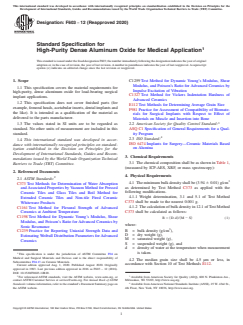
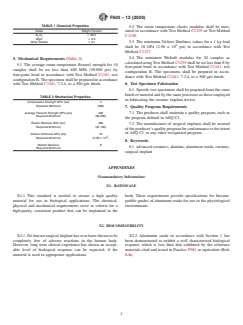
1.1 This specification covers the material requirements for high-purity, dense aluminum oxide for load-bearing surgical implant applications.
1.2 This specification does not cover finished parts (for example, femoral heads, acetabular inserts, dental implants and the like). It is intended as a qualification of the material as delivered to the parts manufacturer.
1.3 The values stated in SI units are to be regarded as standard. No other units of measurement are included in this standard.
1.4 This international standard was developed in accordance with internationally recognized principles on standardization established in the Decision on Principles for the Development of International Standards, Guides and Recommendations issued by the World Trade Organization Technical Barriers to Trade (TBT) Committee.
- Status
- Published
- Publication Date
- 31-Jul-2020
- Technical Committee
- F04 - Medical and Surgical Materials and Devices
- Drafting Committee
- F04.13 - Ceramic Materials


Overview
ASTM F603-12(2020), titled Standard Specification for High-Purity Dense Aluminum Oxide for Medical Application, defines the material requirements for high-purity, dense aluminum oxide ceramic intended for load-bearing surgical implant applications. Developed by ASTM International, this standard specifies the chemical, physical, and mechanical properties necessary for alumina ceramics used in medical component manufacturing. It does not cover finished implant devices but focuses on qualifying the base material as delivered to parts manufacturers. The standard is aligned with internationally recognized principles and supports compliance with global quality and material assessment best practices.
Key Topics
- Material Purity and Composition:
- Specifies aluminum oxide (Al₂O₃) content of at least 99.5%.
- Limits for magnesium oxide (MgO) and other oxides to ensure material uniformity.
- Physical Properties:
- Minimum bulk density specified through rigorous measurement techniques.
- Grain size requirements to maintain mechanical reliability and biocompatibility.
- Mechanical Properties:
- Includes criteria for flexural strength, compressive strength, elastic modulus, Vickers hardness, and Weibull modulus, ensuring suitability for load-bearing applications.
- Test Methods and Quality Control:
- Refers to standardized ASTM and ISO test methods for property verification, including tests for hardness, modulus, and strength.
- Quality program requirements based on ASQ C1, ensuring traceability and product consistency for medical use.
- Biocompatibility:
- Requires aluminum oxide grades with a demonstrated history of biological acceptability in surgical applications and compliance with referenced standards for biocompatibility assessment.
Applications
High-purity dense aluminum oxide ceramics qualified under ASTM F603-12(2020) are widely used in medical and surgical implant manufacturing. Typical applications include:
- Load-Bearing Implant Components:
- Used as base material for femoral heads, acetabular inserts, and other orthopedic components where mechanical strength and wear resistance are critical.
- Dental Implants:
- Applied in the fabrication of high-durability dental implant bodies and abutments.
- Other Surgical Devices:
- Suitable for custom and pre-formed surgical ceramics where non-reactive surfaces and structural integrity are required in physiological environments.
Manufacturers and suppliers use this standard as a qualification step to demonstrate high quality, consistent ceramic material-helping ensure final implant safety, performance, and regulatory compliance.
Related Standards
- ASTM C1161 - Test Method for Flexural Strength of Advanced Ceramics
- ASTM C1327 - Test Method for Vickers Indentation Hardness of Advanced Ceramics
- ASTM C1198/C1239 - Methods for Determining Young’s Modulus, Shear Modulus, and Poisson’s Ratio
- ASTM F981 - Assessment of Biocompatibility of Biomaterials for Surgical Implants
- ISO 6474 - Implants for Surgery - Ceramic Materials Based on Alumina
- ASQ C1 - Specification of General Requirements for a Quality Program
By adhering to ASTM F603-12(2020) and related standards, material producers and device manufacturers can ensure medical-grade aluminum oxide ceramics deliver reliable performance and meet stringent biocompatibility criteria vital for global surgical and dental applications.
Relations
- Effective Date
- 01-Aug-2020
- Effective Date
- 01-Jan-2020
- Refers
ASTM C1327-15(2019) - Standard Test Method for Vickers Indentation Hardness of Advanced Ceramics - Effective Date
- 01-Jul-2019
- Effective Date
- 01-Jul-2018
- Effective Date
- 01-Sep-2017
- Effective Date
- 01-Aug-2016
- Effective Date
- 01-Aug-2016
- Effective Date
- 01-Jan-2015
- Effective Date
- 01-Dec-2014
- Effective Date
- 01-Mar-2014
- Effective Date
- 01-Jan-2014
- Effective Date
- 01-Aug-2013
- Effective Date
- 01-Aug-2013
- Effective Date
- 01-Aug-2013
- Effective Date
- 15-Nov-2012
Get Certified
Connect with accredited certification bodies for this standard

BSI Group
BSI (British Standards Institution) is the business standards company that helps organizations make excellence a habit.

TÜV Rheinland
TÜV Rheinland is a leading international provider of technical services.

TÜV SÜD
TÜV SÜD is a trusted partner of choice for safety, security and sustainability solutions.
Sponsored listings
Frequently Asked Questions
ASTM F603-12(2020) is a technical specification published by ASTM International. Its full title is "Standard Specification for High-Purity Dense Aluminum Oxide for Medical Application". This standard covers: SCOPE 1.1 This specification covers the material requirements for high-purity, dense aluminum oxide for load-bearing surgical implant applications. 1.2 This specification does not cover finished parts (for example, femoral heads, acetabular inserts, dental implants and the like). It is intended as a qualification of the material as delivered to the parts manufacturer. 1.3 The values stated in SI units are to be regarded as standard. No other units of measurement are included in this standard. 1.4 This international standard was developed in accordance with internationally recognized principles on standardization established in the Decision on Principles for the Development of International Standards, Guides and Recommendations issued by the World Trade Organization Technical Barriers to Trade (TBT) Committee.
SCOPE 1.1 This specification covers the material requirements for high-purity, dense aluminum oxide for load-bearing surgical implant applications. 1.2 This specification does not cover finished parts (for example, femoral heads, acetabular inserts, dental implants and the like). It is intended as a qualification of the material as delivered to the parts manufacturer. 1.3 The values stated in SI units are to be regarded as standard. No other units of measurement are included in this standard. 1.4 This international standard was developed in accordance with internationally recognized principles on standardization established in the Decision on Principles for the Development of International Standards, Guides and Recommendations issued by the World Trade Organization Technical Barriers to Trade (TBT) Committee.
ASTM F603-12(2020) is classified under the following ICS (International Classification for Standards) categories: 11.040.40 - Implants for surgery, prosthetics and orthotics. The ICS classification helps identify the subject area and facilitates finding related standards.
ASTM F603-12(2020) has the following relationships with other standards: It is inter standard links to ASTM F603-12(2016), ASTM C1198-20, ASTM C1327-15(2019), ASTM C1239-13(2018), ASTM C373-17, ASTM C373-16, ASTM C373-16e1, ASTM C1327-15, ASTM C373-14a, ASTM C373-14, ASTM C1259-14, ASTM C1239-13, ASTM C1198-09(2013), ASTM C1161-13, ASTM E112-12. Understanding these relationships helps ensure you are using the most current and applicable version of the standard.
ASTM F603-12(2020) is available in PDF format for immediate download after purchase. The document can be added to your cart and obtained through the secure checkout process. Digital delivery ensures instant access to the complete standard document.
Standards Content (Sample)
This international standard was developed in accordance with internationally recognized principles on standardization established in the Decision on Principles for the
Development of International Standards, Guides and Recommendations issued by the World Trade Organization Technical Barriers to Trade (TBT) Committee.
Designation:F603 −12 (Reapproved 2020)
Standard Specification for
High-Purity Dense Aluminum Oxide for Medical Application
ThisstandardisissuedunderthefixeddesignationF603;thenumberimmediatelyfollowingthedesignationindicatestheyearoforiginal
adoptionor,inthecaseofrevision,theyearoflastrevision.Anumberinparenthesesindicatestheyearoflastreapproval.Asuperscript
epsilon (´) indicates an editorial change since the last revision or reapproval.
1. Scope C1259Test Method for Dynamic Young’s Modulus, Shear
Modulus, and Poisson’s Ratio forAdvanced Ceramics by
1.1 This specification covers the material requirements for
Impulse Excitation of Vibration
high-purity, dense aluminum oxide for load-bearing surgical
C1327Test Method for Vickers Indentation Hardness of
implant applications.
Advanced Ceramics
1.2 This specification does not cover finished parts (for
E112Test Methods for Determining Average Grain Size
example,femoralheads,acetabularinserts,dentalimplantsand
F981Practice for Assessment of Compatibility of Biomate-
the like). It is intended as a qualification of the material as
rials for Surgical Implants with Respect to Effect of
delivered to the parts manufacturer.
Materials on Muscle and Insertion into Bone
1.3 The values stated in SI units are to be regarded as 2.2 American Society for Quality Control Standard:
standard. No other units of measurement are included in this ASQ C1Specification of General Requirements for a Qual-
standard. ity Program
2.3 ISO Standard:
1.4 This international standard was developed in accor-
ISO 6474Implants for Surgery—Ceramic Materials Based
dance with internationally recognized principles on standard-
on Alumina
ization established in the Decision on Principles for the
Development of International Standards, Guides and Recom-
3. Chemical Requirements
mendations issued by the World Trade Organization Technical
3.1 The chemical composition shall be as shown in Table 1,
Barriers to Trade (TBT) Committee.
(measured by ICP-AES, XRF, or mass spectrocopy):
2. Referenced Documents
4. Physical Requirements
2.1 ASTM Standards:
4.1 Theminimumbulkdensityshallbe(3.94 60.01)g/cm
C373Test Methods for Determination of Water Absorption
as determined by Test Method C373 as applied with the
andAssociated Properties byVacuum Method for Pressed
following modifications.
Ceramic Tiles and Glass Tiles and Boil Method for
4.1.1 Weight determination, 3.1 and 5.1 of Test Method
Extruded Ceramic Tiles and Non-tile Fired Ceramic
C373 shall be made to the nearest 0.001 g.
Whiteware Products
4.1.2 Thecalculationofbulkdensityin12.1ofTestMethod
C1161Test Method for Flexural Strength of Advanced
C373 shall be calculated as follows:
Ceramics at Ambient Temperature
C1198Test Method for Dynamic Young’s Modulus, Shear
B 5 ~D·d!/~M 2S! (1)
Modulus, and Poisson’s Ratio forAdvanced Ceramics by
where:
Sonic Resonance
B = bulk density (g/cm ),
C1239Practice for Reporting Uniaxial Strength Data and
D = dry weight (g),
Estimating Weibull Distribution Parameters forAdvanced
M = saturated weight (g),
Ceramics
S = suspended weight (g), and
d = density of water at the temperature when measurement
1 is taken.
This specification is under the jurisdiction of ASTM Committee F04 on
Medical and Surgical Materials and Devices and is the direct responsibility of
4.2 The median grain size shall be 4.5 µm or less, in
Subcommittee F04.13 on Ceramic Materials.
accordance with Section 10 of Test Methods E112.
Current edition approved Aug. 1, 2020. Published August 2020. Originally
approved in 1983. Last previous edition approved in 2016 as F603 – 12 (2016).
DOI: 10.1520/F0603-12R20.
2 3
For referenced ASTM standards, visit the ASTM website, www.astm.org, or Available from American Society for Quality (ASQ), 600 N. Plankinton Ave.,
contact ASTM Customer Service at service@astm.org. For Annual Book of ASTM Milwaukee, WI 53203, http://www.asq.org.
Standards volume information, refer to the standard’s Document Summary page on Available fromAmerican National Standards Institute (ANSI), 25 W. 43rd St.,
the ASTM website. 4th Floor, New York, NY 10036, http://www.ansi.org.
Copyright © ASTM International, 100 Barr Harbor Drive, PO Box C700, West Conshohocken, PA 19428-2959. United States
F603−12 (2020)
TABLE 1 Chemical Properties
5.2 The room temperature elastic modulus shall be mea-
Oxide Weight Percent sured in accordance with Test Method C1239 or Test Method
Al O $ 99.5
2 3
C1198.
MgO # 0.5
Other Oxides # 0.1
5.3 The minimum Vickers Hardness values fora1kg load
shall be 18 GPa (2.56 × 10 psi) in accordance with Test
Method C1327.
5.4 The minimum Weibull modulus for 30 samples as
5. Mechanical Requirements (Table 2)
calculated usingTest Method C1239 shall be no less than 8 by
5.1 The average room temperature flexural strength for 10
four-point bend in accordance with Test Method C1161, test
samples shall be no less than 400 MPa (580
...