

ASTM A504/A504M-18(2023)
(Specification)Standard Specification for Wrought Carbon Steel Wheels
General Information
- Abstract
ABSTRACT
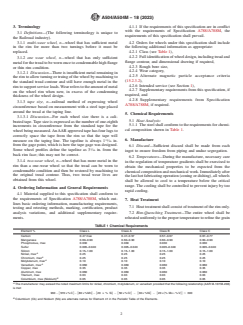
This specification deals with one-wear, two-wear, and multiple-wear wrought carbon steel wheels for locomotives and cars. The classes of steel wheels according to passenger car service covered here are: Class L, which are for high speed services with more severe braking conditions than other classes and light wheel loads; Class A, which are for high speed services with more severe braking conditions, but moderate wheel loads; Class B, which are for high speed services with severe braking conditions and heavier wheel loads; Class C (1), which are for services with light braking conditions and heavier wheel loads; and Class C (2), which are for services with heavier braking conditions where off-tread brakes are employed. Class B and C wheels shall be used for freight cars in interchange service, and are recommended for use on locomotives. Wheels shall be treated by rim-quenching and shot peening, and shall be finished by rough boring and machining. Heat analysis and rim hardness measurement procedures shall be performed to evaluate the conformance of wheel specimens with chemical composition and Brinell hardness requirements, respectively. Materials shall also go through nondestructive ultrasonic and magnetic particle examinations. Finally, customary product marking procedures shall be followed.
SCOPE
1.1 This specification covers one-wear, two-wear, and multiple-wear wrought carbon steel wheels for locomotives and cars, designated Classes L, A, B, and C, heat-treated, wheels.
1.2 The service for which the various classes are intended is as follows:
1.2.1 Class B or C wheels shall be used for freight cars in interchange service.
1.2.2 Class B or C wheels are recommended for use on locomotives.
1.2.3 For passenger car service, the various classes are intended generally as follows:
1.2.3.1 Class L—High speed with more severe braking conditions than other classes and light wheel loads.
1.2.3.2 Class A—High speed with more severe braking conditions, but moderate wheel loads.
1.2.3.3 Class B—High speed service with severe braking conditions and heavier wheel loads.
1.2.3.4 Class C—(1) Service with light braking conditions and heavier wheel loads.
1.2.3.5 Class C—(2) Service with heavier braking conditions where off-tread brakes are employed.
1.3 Supplemental requirements are provided for use where additional testing or additional restrictions are required by the purchaser. Supplementary requirements included in Specification A788/A788M may also be specified by the purchaser for forgings ordered to this specification. Any supplemental requirements apply only when specified in the purchase order.
1.4 The values stated in either SI units or inch-pound units are to be regarded separately as standard. Within the text and tables, the SI units are shown in brackets. The values stated in each system may not be exact equivalents; therefore, each system shall be used independently of the other. Combining values from the two systems may result in nonconformance with the standard.
1.5 Unless the order specifies the applicable “M” specification designation, the material shall be furnished to the inch-pound units.
1.6 This standard does not purport to address all of the safety concerns, if any, associated with its use. It is the responsibility of the user of this standard to establish appropriate safety, health, and environmental practices and determine the applicability of regulatory limitations prior to use.
1.7 This international standard was developed in accordance with internationally recognized principles on standardization established in the Decision on Principles for the Development of International Standards, Guides and Recommendations issued by the World Trade Organization Technical Barriers to Trade (TBT) Committee.
- Status
- Published
- Publication Date
- 14-Mar-2023
- Technical Committee
- A01 - Steel, Stainless Steel and Related Alloys
- Drafting Committee
- A01.06 - Steel Forgings and Billets
Overview
ASTM A504/A504M-18(2023) is the internationally recognized standard specification for wrought carbon steel wheels used in locomotives and railcars. Developed by ASTM International, this standard sets requirements for the classification, manufacture, testing, and marking of one-wear, two-wear, and multiple-wear heat-treated steel wheels designed to ensure reliability, safety, and performance in both passenger and freight rail applications. It encompasses critical properties like chemical composition, mechanical characteristics, dimensional tolerances, and nondestructive testing practices, making it a cornerstone document for rail wheel procurement and quality assurance.
Key Topics
Wheel Classification:
The standard defines several classes of steel wheels, each aligned to specific rail service conditions:- Class L: For high speed passenger cars with severe braking and light wheel loads.
- Class A: For high speed passenger cars with moderate wheel loads.
- Class B: For applications with heavier loads and severe braking, suitable for both freight cars in interchange service and recommended for locomotives.
- Class C: Encompasses both lighter and heavier braking conditions, often where off-tread brakes are used, and suited to passenger and freight cars under varying loads.
Manufacturing Requirements:
Wheels must be heat treated (rim-quenching and shot peening), rough bored, and finished to specifications. Correct temperature regulation and cooling are vital to achieving the mechanical properties required for safety and durability.Testing and Inspection:
- Heat Analysis ensures compliance with chemical composition guidelines for elements such as carbon, manganese, and silicon.
- Brinell Hardness Tests validate rim hardness according to class-specific ranges, tested on representative production samples.
- Nondestructive Examinations:
- Ultrasonic Testing in line with ASTM A388/A388M, focusing on flaw detection in the wheel rim.
- Magnetic Particle Inspection as per ASTM A275/A275M for surface integrity and defect identification after final machining.
Marking and Traceability:
Product marking protocols, including heat and class identification, are strictly defined for stamping and paint stenciling to ensure full traceability throughout the wheel’s service life.
Applications
ASTM A504/A504M wheels are fundamental to the global railway industry and support the safe movement of goods and passengers:
- Passenger Rail Cars: Use wheels chosen per required class for sustainable high-speed operations and safe, efficient braking.
- Freight Cars: Must utilize Class B or C wheels to ensure durability in rigorous, interchange-heavy freight service.
- Locomotives: Recommended to use Class B or C wheels for robust performance under high mechanical stress.
- Rail Infrastructure Projects: The standard is essential for specifying wheel requirements during new builds, refurbishment, or upgrades for consistent interoperability and regulatory compliance.
- Railcar Manufacturers & Maintenance Operators: Depend on A504/A504M specifications to ensure the safety and performance of rolling stock through the entire product lifecycle.
Related Standards
- ASTM A788/A788M: General requirements for steel forgings, referenced for supplementary testing and restrictions.
- ASTM A275/A275M: Practice for magnetic particle testing of steel forgings.
- ASTM A388/A388M: Practice for ultrasonic examination of steel forgings.
- AAR M-107/M-208: Association of American Railroads standard for wheels, carbon steel.
- SAE J 827, J 2277, J 442, J 443: SAE International recommended practices for shot peening and coverage determination.
- ASTM E11: Specification for woven wire test sieve cloth and sieves, often used for shot size control.
- ASTM E399: Test method for fracture toughness, referenced in supplementary requirements for additional safety assessments.
Keywords: ASTM A504, carbon steel wheels, locomotive wheels, rail car wheels, freight car wheels, passenger car wheels, rail wheel standards, rim hardness, nondestructive testing, railway safety, wheel manufacturing, shot peening, ultrasonic inspection.
Relations
- Effective Date
- 01-Nov-2023
- Effective Date
- 01-Nov-2023
- Effective Date
- 01-May-2019
- Effective Date
- 01-Nov-2018
- Effective Date
- 01-Sep-2018
- Effective Date
- 01-Mar-2018
- Effective Date
- 01-Nov-2017
- Effective Date
- 01-May-2017
- Effective Date
- 01-Dec-2016
- Effective Date
- 01-May-2015
- Effective Date
- 01-Oct-2014
- Effective Date
- 15-May-2014
- Effective Date
- 01-Nov-2013
- Effective Date
- 01-Oct-2013
- Refers
ASTM A275/A275M-08(2013) - Standard Practice for Magnetic Particle Examination of Steel Forgings - Effective Date
- 01-Apr-2013
Get Certified
Connect with accredited certification bodies for this standard

TÜV Rheinland
TÜV Rheinland is a leading international provider of technical services.

TÜV SÜD
TÜV SÜD is a trusted partner of choice for safety, security and sustainability solutions.

DEKRA Certification Inc.
DEKRA US certification services.
Sponsored listings
Frequently Asked Questions
ASTM A504/A504M-18(2023) is a technical specification published by ASTM International. Its full title is "Standard Specification for Wrought Carbon Steel Wheels". This standard covers: ABSTRACT This specification deals with one-wear, two-wear, and multiple-wear wrought carbon steel wheels for locomotives and cars. The classes of steel wheels according to passenger car service covered here are: Class L, which are for high speed services with more severe braking conditions than other classes and light wheel loads; Class A, which are for high speed services with more severe braking conditions, but moderate wheel loads; Class B, which are for high speed services with severe braking conditions and heavier wheel loads; Class C (1), which are for services with light braking conditions and heavier wheel loads; and Class C (2), which are for services with heavier braking conditions where off-tread brakes are employed. Class B and C wheels shall be used for freight cars in interchange service, and are recommended for use on locomotives. Wheels shall be treated by rim-quenching and shot peening, and shall be finished by rough boring and machining. Heat analysis and rim hardness measurement procedures shall be performed to evaluate the conformance of wheel specimens with chemical composition and Brinell hardness requirements, respectively. Materials shall also go through nondestructive ultrasonic and magnetic particle examinations. Finally, customary product marking procedures shall be followed. SCOPE 1.1 This specification covers one-wear, two-wear, and multiple-wear wrought carbon steel wheels for locomotives and cars, designated Classes L, A, B, and C, heat-treated, wheels. 1.2 The service for which the various classes are intended is as follows: 1.2.1 Class B or C wheels shall be used for freight cars in interchange service. 1.2.2 Class B or C wheels are recommended for use on locomotives. 1.2.3 For passenger car service, the various classes are intended generally as follows: 1.2.3.1 Class L—High speed with more severe braking conditions than other classes and light wheel loads. 1.2.3.2 Class A—High speed with more severe braking conditions, but moderate wheel loads. 1.2.3.3 Class B—High speed service with severe braking conditions and heavier wheel loads. 1.2.3.4 Class C—(1) Service with light braking conditions and heavier wheel loads. 1.2.3.5 Class C—(2) Service with heavier braking conditions where off-tread brakes are employed. 1.3 Supplemental requirements are provided for use where additional testing or additional restrictions are required by the purchaser. Supplementary requirements included in Specification A788/A788M may also be specified by the purchaser for forgings ordered to this specification. Any supplemental requirements apply only when specified in the purchase order. 1.4 The values stated in either SI units or inch-pound units are to be regarded separately as standard. Within the text and tables, the SI units are shown in brackets. The values stated in each system may not be exact equivalents; therefore, each system shall be used independently of the other. Combining values from the two systems may result in nonconformance with the standard. 1.5 Unless the order specifies the applicable “M” specification designation, the material shall be furnished to the inch-pound units. 1.6 This standard does not purport to address all of the safety concerns, if any, associated with its use. It is the responsibility of the user of this standard to establish appropriate safety, health, and environmental practices and determine the applicability of regulatory limitations prior to use. 1.7 This international standard was developed in accordance with internationally recognized principles on standardization established in the Decision on Principles for the Development of International Standards, Guides and Recommendations issued by the World Trade Organization Technical Barriers to Trade (TBT) Committee.
ABSTRACT This specification deals with one-wear, two-wear, and multiple-wear wrought carbon steel wheels for locomotives and cars. The classes of steel wheels according to passenger car service covered here are: Class L, which are for high speed services with more severe braking conditions than other classes and light wheel loads; Class A, which are for high speed services with more severe braking conditions, but moderate wheel loads; Class B, which are for high speed services with severe braking conditions and heavier wheel loads; Class C (1), which are for services with light braking conditions and heavier wheel loads; and Class C (2), which are for services with heavier braking conditions where off-tread brakes are employed. Class B and C wheels shall be used for freight cars in interchange service, and are recommended for use on locomotives. Wheels shall be treated by rim-quenching and shot peening, and shall be finished by rough boring and machining. Heat analysis and rim hardness measurement procedures shall be performed to evaluate the conformance of wheel specimens with chemical composition and Brinell hardness requirements, respectively. Materials shall also go through nondestructive ultrasonic and magnetic particle examinations. Finally, customary product marking procedures shall be followed. SCOPE 1.1 This specification covers one-wear, two-wear, and multiple-wear wrought carbon steel wheels for locomotives and cars, designated Classes L, A, B, and C, heat-treated, wheels. 1.2 The service for which the various classes are intended is as follows: 1.2.1 Class B or C wheels shall be used for freight cars in interchange service. 1.2.2 Class B or C wheels are recommended for use on locomotives. 1.2.3 For passenger car service, the various classes are intended generally as follows: 1.2.3.1 Class L—High speed with more severe braking conditions than other classes and light wheel loads. 1.2.3.2 Class A—High speed with more severe braking conditions, but moderate wheel loads. 1.2.3.3 Class B—High speed service with severe braking conditions and heavier wheel loads. 1.2.3.4 Class C—(1) Service with light braking conditions and heavier wheel loads. 1.2.3.5 Class C—(2) Service with heavier braking conditions where off-tread brakes are employed. 1.3 Supplemental requirements are provided for use where additional testing or additional restrictions are required by the purchaser. Supplementary requirements included in Specification A788/A788M may also be specified by the purchaser for forgings ordered to this specification. Any supplemental requirements apply only when specified in the purchase order. 1.4 The values stated in either SI units or inch-pound units are to be regarded separately as standard. Within the text and tables, the SI units are shown in brackets. The values stated in each system may not be exact equivalents; therefore, each system shall be used independently of the other. Combining values from the two systems may result in nonconformance with the standard. 1.5 Unless the order specifies the applicable “M” specification designation, the material shall be furnished to the inch-pound units. 1.6 This standard does not purport to address all of the safety concerns, if any, associated with its use. It is the responsibility of the user of this standard to establish appropriate safety, health, and environmental practices and determine the applicability of regulatory limitations prior to use. 1.7 This international standard was developed in accordance with internationally recognized principles on standardization established in the Decision on Principles for the Development of International Standards, Guides and Recommendations issued by the World Trade Organization Technical Barriers to Trade (TBT) Committee.
ASTM A504/A504M-18(2023) is classified under the following ICS (International Classification for Standards) categories: 43.040.50 - Transmissions, suspensions. The ICS classification helps identify the subject area and facilitates finding related standards.
ASTM A504/A504M-18(2023) has the following relationships with other standards: It is inter standard links to ASTM A388/A388M-23, ASTM A275/A275M-23, ASTM A788/A788M-19, ASTM A788/A788M-18b, ASTM A788/A788M-18a, ASTM A788/A788M-18, ASTM A788/A788M-17a, ASTM A788/A788M-17, ASTM A788/A788M-16a, ASTM A788/A788M-15, ASTM A788/A788M-14a, ASTM A788/A788M-14, ASTM A788/A788M-13, ASTM E11-13, ASTM A275/A275M-08(2013). Understanding these relationships helps ensure you are using the most current and applicable version of the standard.
ASTM A504/A504M-18(2023) is available in PDF format for immediate download after purchase. The document can be added to your cart and obtained through the secure checkout process. Digital delivery ensures instant access to the complete standard document.
Standards Content (Sample)
This international standard was developed in accordance with internationally recognized principles on standardization established in the Decision on Principles for the
Development of International Standards, Guides and Recommendations issued by the World Trade Organization Technical Barriers to Trade (TBT) Committee.
Designation: A504/A504M − 18 (Reapproved 2023)
Standard Specification for
Wrought Carbon Steel Wheels
This standard is issued under the fixed designation A504/A504M; the number immediately following the designation indicates the year
of original adoption or, in the case of revision, the year of last revision. A number in parentheses indicates the year of last reapproval.
A superscript epsilon (´) indicates an editorial change since the last revision or reapproval.
1. Scope 1.5 Unless the order specifies the applicable “M” specifica-
tion designation, the material shall be furnished to the inch-
1.1 This specification covers one-wear, two-wear, and
pound units.
multiple-wear wrought carbon steel wheels for locomotives
1.6 This standard does not purport to address all of the
and cars, designated Classes L, A, B, and C, heat-treated,
safety concerns, if any, associated with its use. It is the
wheels.
responsibility of the user of this standard to establish appro-
1.2 The service for which the various classes are intended is
priate safety, health, and environmental practices and deter-
as follows:
mine the applicability of regulatory limitations prior to use.
1.2.1 Class B or C wheels shall be used for freight cars in
1.7 This international standard was developed in accor-
interchange service.
dance with internationally recognized principles on standard-
1.2.2 Class B or C wheels are recommended for use on
ization established in the Decision on Principles for the
locomotives.
Development of International Standards, Guides and Recom-
1.2.3 For passenger car service, the various classes are
mendations issued by the World Trade Organization Technical
intended generally as follows:
Barriers to Trade (TBT) Committee.
1.2.3.1 Class L—High speed with more severe braking
conditions than other classes and light wheel loads.
2. Referenced Documents
1.2.3.2 Class A—High speed with more severe braking
2.1 ASTM Standards:
conditions, but moderate wheel loads.
A275/A275M Practice for Magnetic Particle Examination of
1.2.3.3 Class B—High speed service with severe braking
Steel Forgings
conditions and heavier wheel loads.
A388/A388M Practice for Ultrasonic Examination of Steel
1.2.3.4 Class C—(1) Service with light braking conditions
Forgings
and heavier wheel loads.
A788/A788M Specification for Steel Forgings, General Re-
1.2.3.5 Class C—(2) Service with heavier braking condi-
quirements
tions where off-tread brakes are employed.
E11 Specification for Woven Wire Test Sieve Cloth and Test
1.3 Supplemental requirements are provided for use where
Sieves
additional testing or additional restrictions are required by the
E399 Test Method for Linear-Elastic Plane-Strain Fracture
purchaser. Supplementary requirements included in Specifica-
Toughness of Metallic Materials
tion A788/A788M may also be specified by the purchaser for
2.2 SAE Documents:
forgings ordered to this specification. Any supplemental re-
SAE J 442 Test Strip, Holder and Gage for Shot Peening
quirements apply only when specified in the purchase order.
SAE J 443 Recommended Practice for Procedures for Using
1.4 The values stated in either SI units or inch-pound units
Standard Shot Peening Test Strip
are to be regarded separately as standard. Within the text and
SAE J 827 Recommended Practice for Cast Steel Shot
tables, the SI units are shown in brackets. The values stated in
SAE J 2277 Shot Peening Coverage Determination
each system may not be exact equivalents; therefore, each
2.3 AAR Standard:
system shall be used independently of the other. Combining
AAR M-107/M-208 Wheels, Carbon Steel
values from the two systems may result in nonconformance
with the standard.
For referenced ASTM standards, visit the ASTM website, www.astm.org, or
contact ASTM Customer Service at service@astm.org. For Annual Book of ASTM
This specification is under the jurisdiction of ASTM Committee A01 on Steel, Standards volume information, refer to the standard’s Document Summary page on
Stainless Steel and Related Alloys and is the direct responsibility of Subcommittee the ASTM website.
A01.06 on Steel Forgings and Billets. Available from SAE International (SAE), 400 Commonwealth Dr., Warrendale,
Current edition approved March 15, 2023. Published April 2023. Originally PA 15096, http://www.sae.org.
approved in 1964 to replace A57 and A186. Last previous edition approved in 2018 Available from Association of American Railroads (AAR), 425 Third Street,
as A504/A504M – 18. DOI: 10.1520/A0504_A0504M-18R23. SW, Washington, DC 20024, http://www.aar.org.
Copyright © ASTM International, 100 Barr Harbor Drive, PO Box C700, West Conshohocken, PA 19428-2959. United States
A504/A504M − 18 (2023)
3. Terminology 4.1.1 If the requirements of this specification are in conflict
with the requirements of Specification A788/A788M, the
3.1 Definitions—(The following terminology is unique to
requirements of this specification shall prevail.
the Railroad industry).
3.1.1 multi-wear wheel, n—wheel that has sufficient metal 4.2 Orders for wheels under this specification shall include
in the rim for more than two turnings before it must be the following additional information as appropriate:
replaced. 4.2.1 Class (see Table 1),
4.2.2 Full identification of wheel design, including tread and
3.1.2 one wear wheel, n—wheel that has only sufficient
flange contour, and dimensional drawing if required,
metal for the tread to be worn once to condemnable high flange
4.2.3 Rough bore size,
or thin rim condition.
4.2.4 Wear category,
3.1.2.1 Discussion—There is insufficient metal remaining in
4.2.5 Alternate magnetic particle acceptance criteria
the rim to allow turning or truing of the wheel by machining to
(15.2.3.2),
the standard tread contour and still have enough metal in the
4.2.6 Intended service (see Section 1),
rim to support service loads. Wear refers to the amount of metal
4.2.7 Supplementary requirements from this specification, if
on the wheel rim when new, in excess of the condemning
required, and
thickness of the wheel design.
4.2.8 Supplementary requirements from Specification
3.1.3 tape size, n—railroad method of expressing wheel
A788/A788M, if required.
circumference based on measurement with a steel tape placed
around the tread at the taping line.
5. Chemical Requirements
3.1.3.1 Discussion—For each wheel size there is a cali-
5.1 Heat Analysis:
brated tape. Tape size is expressed as the number of one-eighth
5.1.1 The steel shall conform to the requirements for chemi-
increments in circumference from the standard tape for the
cal composition shown in Table 1.
wheel being measured. An AAR approved tape has four lugs to
correctly space the tape from the rim so that the tape will
11 6. Manufacture
measure on the taping line. The tapeline is always 1 ⁄16 in.
from the gage point, which is how the tape gage was designed.
6.1 Discard—Sufficient discard shall be made from each
Some wheel profiles define the tapeline as 3 ⁄16 in. from the
ingot to ensure freedom from piping and undue segregation.
back rim face; this may not be correct.
6.2 Temperatures—During the manufacture, necessary care
3.1.4 two-wear wheel, n—wheel that has more metal in the
in the regulation of temperature gradients shall be exercised to
rim than a one-wear wheel so that the tread can be worn to
obtain the mechanical properties to be expected from the
condemnable condition and then be restored by machining to
chemical composition and mechanical work. Immediately after
the original tread contour. Thus, two tread wear lives are
the last hot fabricating operation (coning or dishing), all wheels
obtained from this wheel.
shall be allowed to cool to a temperature below the critical
range. The cooling shall be controlled to prevent injury by too
4. Ordering Information and General Requirements
rapid cooling.
4.1 Material supplied to this specification shall conform to
the requirements of Specification A788/A788M, which out-
7. Heat Treatment
lines basic ordering information, manufacturing requirements,
7.1 Heat treatment shall consist of treatment of the rim only.
testing and retesting methods, marking, certification, product
analysis variations, and additional supplementary require- 7.2 Rim-Quenching Treatment—The entire wheel shall be
ments. reheated uniformly to the proper temperature to refine the grain
TABLE 1 Chemical Requirements
Element % Class L Class A Class B Class C
Carbon 0.47 max 0.47–0.57 0.57–0.67 0.67–0.77
Manganese 0.60–0.90 0.60–0.90 0.60–0.90 0.60–0.90
Phosphorous, max 0.030 0.030 0.030 0.030
Sulfur 0.005–0.040 0.005–0.040 0.005–0.040 0.005–0.040
Silicon 0.15–1.00 0.15–1.00 0.15–1.00 0.15–1.00
A
Nickel, max 0.25 0.25 0.25 0.25
A
Chromium, max 0.25 0.25 0.25 0.25
A
Molybdenum, max 0.10 0.10 0.10 0.10
A
Vanadium, max 0.060 0.060 0.060 0.060
Copper, max 0.35 0.35 0.35 0.35
Aluminum, max 0.060 0.060 0.060 0.060
Titanium, max 0.03 0.03 0.03 0.03
B
Columbium, max (Niobium) 0.05 0.05 0.05 0.05
A
The manufacturer may exceed the noted maximum limits for nickel, chromium, molybdenum, or vanadium provided that the following relationship (AAR M-107/M-208)
is met:
930 2 570 × %C 2 80 × %Mn 2 20 × % Sig 2 50 × %Cr 2 30 × %Ni 2 20 × % Mo1%V . 390
f g f g f f g f g f s dg
B
Columbium (Cb) and Niobium (Nb) are alternate names for Element 41 in the Periodic Table of the Elements.
A504/A504M − 18 (2023)
and then the rims shall be quenched. Following quenching, the 8.3.1 Wheel Surface Condition—The peened appearance of
wheel shall be charged into a furnace for tempering to meet the rim and hub shall not be cause for rejection.
requirements of Section 13, and subsequently cooled under 8.3.2 Frequency of Test—Arc height determinations shall be
controlled conditions. made on Almen strips attached to a test wheel at the beginning
and end of each production run but not less than once in each
7.3 For production of railroad wheels, the flow of water
eight operating hours.
during rim spray quenching shall not be interrupted, once
8.3.3 Retest—If a test fails to meet the arc height require-
started, until quenching is completed. Similarly, immersion
ments of 0.010 Almen C-2, two retests shall be made. These
quenching of the rim shall not be interrupted. For non-railroad
retests shall be averaged with the first determination. The
wheels, water flow may be interrupted per Supplementary
average shall be not less than 0.010 and no more than one value
Requirement S7.
of the three shall be less than 0.010.
8.3.4 Repeening—When test values fail to meet the provi-
8. Shot Peening
sions of 8.3.3, corrective action shall be initiated and satisfac-
8.1 Scope—The plate surfaces (area between the hub and
tory test values secured before proceeding with production
rim) of all wheels shall be shot-peened in accordance with the
peening. If the average Almen value is less than 0.010, all the
following requirements:
wheels peened since the last satisfactory test shall be repeened
with full exposure.
8.2 Requirements:
8.2.1 Shot—The shot shall be No. 660 or larger hardened
9. Retreatment
steel as specified in SAE J 827.
9.1 Any wheel failing to meet the requirements of Section
8.2.2 Shot Size Control—The peening machines shall be
13 may be retreated and tested in accordance with 13.1 and
equipped with a separator for continuously removing broken
13.2.
shot. Sufficient new shot shall be added to ensure that a
minimum of 85 % of No. 550 or larger shot (retained on a #14
10. Mating
screen as defined by Specification E11) is maintained in the
10.1 Wheels shall be measured and marked to the lower
machines at all times.
tape number until the next graduation is reached. Wheels shall
8.2.3 Peening Intensity—The peening intensity shall be
be shipped in pairs of the same measured tape size.
sufficient to produce an average arc height of not less than
0.010 Almen C-2 on the front plate near the hub fillet and on
NOTE 1—The tables of tape sizes may be referred to in the Wheel and
the back plate near the rim fillet of wheels of the standard
Axle Manual of the Association of American Railroads.
design, and at back plate hub fillet and front plate rim fillet of
11. Permissible Dimensional Variations
the reverse plate design. The area to be peened is defined as the
plate area extended approximately one half of the way into the
11.1 The wheels shall conform to the permissible dimension
hub and rim fillet radii on the front and on the back of the
variations specified in Table 2. When the permissible dimen-
wheel.
sion variations in Table 2 allow a certain percentage of the
8.2.4 Arc Height Measurement—Measurements of arc
wheels to vary by a given amount from standard dimensions
height shall be made in accordance with SAE J 442 or SAE J for tape size, the percentage of such wheels shipped by any
443.
manufacturer shall not exceed this percentage during a calen-
8.2.5 Coverage—The minimum peening time shall be suf- dar year. No individual purchaser may receive more than this
ficient to ensure that full coverage is attained on the Almen C percentage in daily shipments of such wheels except by
strip as defined in the Alternate Procedure of SAE J 2277. agreement with the manufacturer.
8.2.6 Sequence—Shot peening shall be performed on all
12. Finish
wheels and after any corrective surface preparation in the plate
area. Plate area is defined in 8.2.3. Peening may be performed 12.1 Wheels shall be rough bored and shall not have black
prior to dimensional inspection and nondestructive examina-
spots in the rough bore. The front and back hub faces of wheels
tion. shall be parallel to the plane of the vertical reference line and
8.2.7 Portable Peeners—A portable peening device may be shall be machined.
used to re-peen small reconditioned areas (no larger than about
12.2 Wheels shall be machined and finished smooth without
2 in. by 3 in. [50 mm by 75 mm]) on wheel plate surfaces
excessive tool chatter.
excluding the critical fillet areas (front hub and back rim). The
12.3 Wheels shall be given a thorough surface examination
portable equipment must be capable of peening an Almen C-2
and gauging at the place of manufacture before being offered
Strip to develop the required average arc height of not less than
for inspection. They shall have a workmanlike finish and must
0.010 in. [0.203 mm] with a reasonable time of peening.
be free of conditions likely to develop in or cause removal from
Peening time of wheel plates must be at least as long as the
service.
time required to develop the 0.010 in. arc height. The equip-
ment must be tested on an Almen C Strip each 8 h shift that the
12.4 Wheels shall not be covered with any substance to such
portable peener is used. A record of the Almen C test results an extent as to hide defects.
shall be maintained.
12.5 “As forged” surfaces shall be free of abrupt changes in
8.3 Quality Assurance Provisions: section or grooves and in a clean condition free of scale prior
A504/A504M − 18 (2023)
TABLE 2 Permissible Variations in Wheel Dimensions
Narrow Flange Type Wide Flange Type
Wheel Dimensions
in. mm in. mm
Flange:
1 1
Height of flange + ⁄16 −0 +1.5 −0 + ⁄16 −0 +1.5 −0
1 1 3
Thickness of flange + ⁄16 −0 +1.5 −0 + ⁄32 − ⁄32 +0.8 −2.4
Rim:
A A A A
Tape sizes, less than 44 in. [110 cm] +14 −0 +14 −0 +14 −0 +14 −0
B B
5 % −5 5 % −5
Inside diameter (back face of rim)
3 3
(x) maximum governed by rim thickness and tape size (x) − ⁄8 (x) −10 (x) − ⁄8 (x) −10
Inside diameter (front face of rim)
C C C C
1 1
Maximum variation from back face diameter +0 − ⁄4 +0 −6 ± ⁄4 ±6
D D D D
Thickness of rim (measured with AAR steel wheel gauge, or equivalent)
1 1
Corner at inside diameter of back rim face, radius, max (sharp corner preferable) ⁄8 3 ⁄8 3
1 1
Rotundity, opening in ring gauge, max ⁄32 0.8 ⁄32 0.8
1 1
Wid
...