

ASTM C117-23
(Test Method)Standard Test Method for Materials Finer than 75-μm (No. 200) Sieve in Mineral Aggregates by Washing
General Information
- Abstract
SIGNIFICANCE AND USE
4.1 Material finer than the 75-μm (No. 200) sieve can be separated from larger particles much more efficiently and completely by wet sieving than through the use of dry sieving. Therefore, when accurate determinations of material finer than 75 μm (No. 200) in fine or coarse aggregate are desired, this test method is used on the sample prior to dry sieving in accordance with Test Method C136/C136M. The results of this test method are included in the calculation in Test Method C136/C136M, and the total amount of material finer than 75 μm (No. 200) by washing, plus that obtained by dry sieving the same sample, is reported with the results of Test Method C136/C136M. Usually, the additional amount of material finer than 75 μm (No. 200) obtained in the dry sieving process is a small amount. If it is large, the efficiency of the washing operation should be checked. It could also be an indication of degradation of the aggregate.
4.2 Plain water is adequate to separate the material finer than 75 μm (No. 200) from the coarser material with most aggregates. In some cases, the finer material is adhering to the larger particles, such as some clay coatings and coatings on aggregates that have been extracted from bituminous mixtures. In these cases, the fine material will be separated more readily with a wetting agent in the water.
SCOPE
1.1 This test method covers the determination of the amount of material finer than a 75-μm (No. 200) sieve in aggregate by washing. Clay particles and other aggregate particles that are dispersed by the wash water, as well as water-soluble materials, will be removed from the aggregate during the test.
1.2 Two procedures are included, one using only water for the washing operation, and the other including a wetting agent to assist the loosening of the material finer than the 75-μm (No. 200) sieve from the coarser material. Unless otherwise specified, Procedure A (water only) shall be used.
1.3 The values stated in SI units are to be regarded as the standard. No other units of measurement are included in this standard.
Note 1: Sieve size is identified by its standard designation in Specification E11. The alternative designation given in parentheses is for information only and does not represent a different standard sieve size.
1.4 The text of this standard refers to notes and footnotes that provide explanatory material. These notes and footnotes (excluding those in tables and figures) shall not be considered as requirements of the standard.
1.5 This standard does not purport to address all of the safety concerns, if any, associated with its use. It is the responsibility of the user of this standard to establish appropriate safety, health, and environmental practices and determine the applicability of regulatory limitations prior to use.
1.6 This international standard was developed in accordance with internationally recognized principles on standardization established in the Decision on Principles for the Development of International Standards, Guides and Recommendations issued by the World Trade Organization Technical Barriers to Trade (TBT) Committee.
- Status
- Published
- Publication Date
- 14-Nov-2023
- Technical Committee
- C09 - Concrete and Concrete Aggregates
- Drafting Committee
- C09.20 - Aggregates
Buy Documents

ASTM C117-23 - Standard Test Method for Materials Finer than 75-μm (No. 200) Sieve in Mineral Aggregates by Washing
REDLINE ASTM C117-23 - Standard Test Method for Materials Finer than 75-μm (No. 200) Sieve in Mineral Aggregates by Washing
Overview
ASTM C117-23 is the international standard test method for determining the amount of material finer than a 75-μm (No. 200) sieve in mineral aggregates by washing. Developed by ASTM International, this standard is commonly used in the field of construction materials testing to assess the quality and cleanliness of both fine and coarse aggregates.
The test method focuses on improving accuracy in the separation and quantification of finer materials, such as clay particles, dust, and other minute particles, by utilizing a wet sieving process. This approach helps ensure reliable aggregate grading, vital in applications like concrete, asphalt, and other construction mixtures.
Key Topics
- Purpose and Scope: Designed to determine the percentage of aggregate particles finer than 75 μm (No. 200) through washing with water or water plus a wetting agent.
- Procedures:
- Procedure A: Uses only water for separation and is the default unless otherwise specified.
- Procedure B: Incorporates a wetting agent to help release finer materials that adhere to aggregate particles.
- Measurement Accuracy: All measurements and reporting are performed in SI units, as specified by the standard.
- Use of Sieves: Results depend on the use of sieves compliant with ASTM E11 specifications, notably a 75-μm (No. 200) sieve.
- Repeatability and Precision: The standard references acceptable ranges for single-operator and multilaboratory precision, ensuring consistency between different labs and tests.
- Sample Preparation: Methods and mass requirements are defined based on aggregate nominal maximum size, with sampling conducted following ASTM D75/D75M and prepared per ASTM C702/C702M.
Applications
- Aggregate Quality Control: Ensures aggregates for concrete, asphalt, and other construction applications meet required cleanliness and grading standards.
- Concrete and Asphalt Production: Assists in verifying that aggregates used in mixtures will produce durable, long-lasting products by minimizing detrimental fine materials.
- Construction Material Testing: Standardizes the measurement of fine particles to detect potential aggregate degradation or contamination.
- Compliance Testing: Provides a recognized methodology for regulatory and contract compliance where specific aggregate cleanliness thresholds are required.
Adhering to ASTM C117-23 allows material suppliers, testing laboratories, and construction engineers to:
- Guarantee product quality by minimizing excess fines that could affect mix performance.
- Ensure consistency in materials for infrastructure projects, helping prevent issues such as reduced strength, poor durability, or workability challenges.
- Identify aggregate degradation or improper washing procedures that could lead to project delays or material rejection.
Related Standards
- ASTM C136/C136M: Test Method for Sieve Analysis of Fine and Coarse Aggregates; often used in conjunction with C117 for comprehensive particle size distribution assessment.
- ASTM E11: Specification for Woven Wire Test Sieve Cloth and Test Sieves; ensures consistent, reliable sieve sizes for testing.
- ASTM D75/D75M: Practice for Sampling Aggregates; covers proper techniques for material sampling prior to testing.
- ASTM C702/C702M: Practice for Reducing Samples of Aggregate to Testing Size; ensures representative and manageable sample sizes.
- AASHTO T11: Method of Test for Amount of Material Finer than 0.075-mm Sieve in Aggregate; similar in scope and methodology to ASTM C117 for highway materials testing.
By following ASTM C117-23, organizations can achieve more accurate aggregate grading, enhance construction quality, and comply with both industry and regulatory specifications for mineral aggregates.
Relations
- Effective Date
- 15-Nov-2023
- Effective Date
- 01-Feb-2024
- Effective Date
- 01-Jan-2024
- Effective Date
- 15-Jun-2015
- Effective Date
- 15-Nov-2023
- Effective Date
- 15-Nov-2023
- Effective Date
- 15-Nov-2023
- Effective Date
- 15-Nov-2023
- Effective Date
- 15-Nov-2023
- Referred By
ASTM D1073-16(2022) - Standard Specification for Fine Aggregate for Asphalt Paving Mixtures - Effective Date
- 15-Nov-2023
- Effective Date
- 15-Nov-2023
- Effective Date
- 15-Nov-2023
- Effective Date
- 15-Nov-2023
- Effective Date
- 15-Nov-2023
- Referred By
ASTM D5106-22 - Standard Specification for Steel Slag Aggregates for Asphalt Paving Mixtures - Effective Date
- 15-Nov-2023
Buy Documents
ASTM C117-23 - Standard Test Method for Materials Finer than 75-μm (No. 200) Sieve in Mineral Aggregates by Washing
REDLINE ASTM C117-23 - Standard Test Method for Materials Finer than 75-μm (No. 200) Sieve in Mineral Aggregates by Washing
Get Certified
Connect with accredited certification bodies for this standard

DIBt (Deutsches Institut für Bautechnik)
German Institute for Building Technology.
DIN CERTCO
DIN Group product certification.

Aboma Certification B.V.
Specialized in construction, metal, and transport sectors.
Sponsored listings
Frequently Asked Questions
ASTM C117-23 is a standard published by ASTM International. Its full title is "Standard Test Method for Materials Finer than 75-μm (No. 200) Sieve in Mineral Aggregates by Washing". This standard covers: SIGNIFICANCE AND USE 4.1 Material finer than the 75-μm (No. 200) sieve can be separated from larger particles much more efficiently and completely by wet sieving than through the use of dry sieving. Therefore, when accurate determinations of material finer than 75 μm (No. 200) in fine or coarse aggregate are desired, this test method is used on the sample prior to dry sieving in accordance with Test Method C136/C136M. The results of this test method are included in the calculation in Test Method C136/C136M, and the total amount of material finer than 75 μm (No. 200) by washing, plus that obtained by dry sieving the same sample, is reported with the results of Test Method C136/C136M. Usually, the additional amount of material finer than 75 μm (No. 200) obtained in the dry sieving process is a small amount. If it is large, the efficiency of the washing operation should be checked. It could also be an indication of degradation of the aggregate. 4.2 Plain water is adequate to separate the material finer than 75 μm (No. 200) from the coarser material with most aggregates. In some cases, the finer material is adhering to the larger particles, such as some clay coatings and coatings on aggregates that have been extracted from bituminous mixtures. In these cases, the fine material will be separated more readily with a wetting agent in the water. SCOPE 1.1 This test method covers the determination of the amount of material finer than a 75-μm (No. 200) sieve in aggregate by washing. Clay particles and other aggregate particles that are dispersed by the wash water, as well as water-soluble materials, will be removed from the aggregate during the test. 1.2 Two procedures are included, one using only water for the washing operation, and the other including a wetting agent to assist the loosening of the material finer than the 75-μm (No. 200) sieve from the coarser material. Unless otherwise specified, Procedure A (water only) shall be used. 1.3 The values stated in SI units are to be regarded as the standard. No other units of measurement are included in this standard. Note 1: Sieve size is identified by its standard designation in Specification E11. The alternative designation given in parentheses is for information only and does not represent a different standard sieve size. 1.4 The text of this standard refers to notes and footnotes that provide explanatory material. These notes and footnotes (excluding those in tables and figures) shall not be considered as requirements of the standard. 1.5 This standard does not purport to address all of the safety concerns, if any, associated with its use. It is the responsibility of the user of this standard to establish appropriate safety, health, and environmental practices and determine the applicability of regulatory limitations prior to use. 1.6 This international standard was developed in accordance with internationally recognized principles on standardization established in the Decision on Principles for the Development of International Standards, Guides and Recommendations issued by the World Trade Organization Technical Barriers to Trade (TBT) Committee.
SIGNIFICANCE AND USE 4.1 Material finer than the 75-μm (No. 200) sieve can be separated from larger particles much more efficiently and completely by wet sieving than through the use of dry sieving. Therefore, when accurate determinations of material finer than 75 μm (No. 200) in fine or coarse aggregate are desired, this test method is used on the sample prior to dry sieving in accordance with Test Method C136/C136M. The results of this test method are included in the calculation in Test Method C136/C136M, and the total amount of material finer than 75 μm (No. 200) by washing, plus that obtained by dry sieving the same sample, is reported with the results of Test Method C136/C136M. Usually, the additional amount of material finer than 75 μm (No. 200) obtained in the dry sieving process is a small amount. If it is large, the efficiency of the washing operation should be checked. It could also be an indication of degradation of the aggregate. 4.2 Plain water is adequate to separate the material finer than 75 μm (No. 200) from the coarser material with most aggregates. In some cases, the finer material is adhering to the larger particles, such as some clay coatings and coatings on aggregates that have been extracted from bituminous mixtures. In these cases, the fine material will be separated more readily with a wetting agent in the water. SCOPE 1.1 This test method covers the determination of the amount of material finer than a 75-μm (No. 200) sieve in aggregate by washing. Clay particles and other aggregate particles that are dispersed by the wash water, as well as water-soluble materials, will be removed from the aggregate during the test. 1.2 Two procedures are included, one using only water for the washing operation, and the other including a wetting agent to assist the loosening of the material finer than the 75-μm (No. 200) sieve from the coarser material. Unless otherwise specified, Procedure A (water only) shall be used. 1.3 The values stated in SI units are to be regarded as the standard. No other units of measurement are included in this standard. Note 1: Sieve size is identified by its standard designation in Specification E11. The alternative designation given in parentheses is for information only and does not represent a different standard sieve size. 1.4 The text of this standard refers to notes and footnotes that provide explanatory material. These notes and footnotes (excluding those in tables and figures) shall not be considered as requirements of the standard. 1.5 This standard does not purport to address all of the safety concerns, if any, associated with its use. It is the responsibility of the user of this standard to establish appropriate safety, health, and environmental practices and determine the applicability of regulatory limitations prior to use. 1.6 This international standard was developed in accordance with internationally recognized principles on standardization established in the Decision on Principles for the Development of International Standards, Guides and Recommendations issued by the World Trade Organization Technical Barriers to Trade (TBT) Committee.
ASTM C117-23 is classified under the following ICS (International Classification for Standards) categories: 91.100.15 - Mineral materials and products. The ICS classification helps identify the subject area and facilitates finding related standards.
ASTM C117-23 has the following relationships with other standards: It is inter standard links to ASTM C117-17, ASTM C670-24a, ASTM C670-24, ASTM C670-15, ASTM C1093-23, ASTM C1098-08(2022), ASTM C1065-08(2022), ASTM D2940/D2940M-20, ASTM D1241-15, ASTM D1073-16(2022), ASTM C1471/C1471M-22, ASTM D7428-15(2023), ASTM C897-15(2020), ASTM C1077-24, ASTM D5106-22. Understanding these relationships helps ensure you are using the most current and applicable version of the standard.
ASTM C117-23 is available in PDF format for immediate download after purchase. The document can be added to your cart and obtained through the secure checkout process. Digital delivery ensures instant access to the complete standard document.
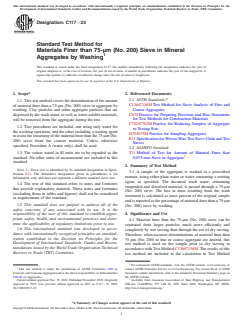
Standards Content (Sample)
This international standard was developed in accordance with internationally recognized principles on standardization established in the Decision on Principles for the
Development of International Standards, Guides and Recommendations issued by the World Trade Organization Technical Barriers to Trade (TBT) Committee.
Designation: C117 − 23
Standard Test Method for
Materials Finer than 75-μm (No. 200) Sieve in Mineral
Aggregates by Washing
This standard is issued under the fixed designation C117; the number immediately following the designation indicates the year of
original adoption or, in the case of revision, the year of last revision. A number in parentheses indicates the year of last reapproval. A
superscript epsilon (´) indicates an editorial change since the last revision or reapproval.
This standard has been approved for use by agencies of the U.S. Department of Defense.
1. Scope* 2. Referenced Documents
2.1 ASTM Standards:
1.1 This test method covers the determination of the amount
C136/C136M Test Method for Sieve Analysis of Fine and
of material finer than a 75-μm (No. 200) sieve in aggregate by
Coarse Aggregates
washing. Clay particles and other aggregate particles that are
C670 Practice for Preparing Precision and Bias Statements
dispersed by the wash water, as well as water-soluble materials,
for Test Methods for Construction Materials
will be removed from the aggregate during the test.
C702/C702M Practice for Reducing Samples of Aggregate
1.2 Two procedures are included, one using only water for
to Testing Size
the washing operation, and the other including a wetting agent
D75/D75M Practice for Sampling Aggregates
to assist the loosening of the material finer than the 75-μm (No.
E11 Specification for Woven Wire Test Sieve Cloth and Test
200) sieve from the coarser material. Unless otherwise
Sieves
specified, Procedure A (water only) shall be used.
2.2 AASHTO Standard:
1.3 The values stated in SI units are to be regarded as the
T11 Method of Test for Amount of Material Finer than
standard. No other units of measurement are included in this 0.075-mm Sieve in Aggregate
standard.
3. Summary of Test Method
NOTE 1—Sieve size is identified by its standard designation in Speci-
3.1 A sample of the aggregate is washed in a prescribed
fication E11. The alternative designation given in parentheses is for
manner, using either plain water or water containing a wetting
information only and does not represent a different standard sieve size.
agent, as specified. The decanted wash water, containing
1.4 The text of this standard refers to notes and footnotes
suspended and dissolved material, is passed through a 75-μm
that provide explanatory material. These notes and footnotes
(No. 200) sieve. The loss in mass resulting from the wash
(excluding those in tables and figures) shall not be considered
treatment is calculated as mass percent of the original sample
as requirements of the standard.
and is reported as the percentage of material finer than a 75-μm
1.5 This standard does not purport to address all of the
(No. 200) sieve by washing.
safety concerns, if any, associated with its use. It is the
responsibility of the user of this standard to establish appro- 4. Significance and Use
priate safety, health, and environmental practices and deter-
4.1 Material finer than the 75-μm (No. 200) sieve can be
mine the applicability of regulatory limitations prior to use.
separated from larger particles much more efficiently and
1.6 This international standard was developed in accor-
completely by wet sieving than through the use of dry sieving.
dance with internationally recognized principles on standard-
Therefore, when accurate determinations of material finer than
ization established in the Decision on Principles for the
75 μm (No. 200) in fine or coarse aggregate are desired, this
Development of International Standards, Guides and Recom-
test method is used on the sample prior to dry sieving in
mendations issued by the World Trade Organization Technical
accordance with Test Method C136/C136M. The results of this
Barriers to Trade (TBT) Committee.
test method are included in the calculation in Test Method
For referenced ASTM standards, visit the ASTM website, www.astm.org, or
This test method is under the jurisdiction of ASTM Committee C09 on contact ASTM Customer Service at service@astm.org. For Annual Book of ASTM
Concrete and Concrete Aggregatesand is the direct responsibility of Subcommittee Standards volume information, refer to the standard’s Document Summary page on
C09.20 on Aggregates. the ASTM website.
Current edition approved Nov. 15, 2023. Published November 2023. Originally Available from American Association of State Highway and Transportation
approved in 1935. Last previous edition approved in 2017 as C117 – 17. DOI: Officials (AASHTO), 555 12th St., NW, Suite 1000, Washington, DC 20004,
10.1520/C0117-23. http://www.transportation.org.
*A Summary of Changes section appears at the end of this standard
Copyright © ASTM International, 100 Barr Harbor Drive, PO Box C700, West Conshohocken, PA 19428-2959. United States
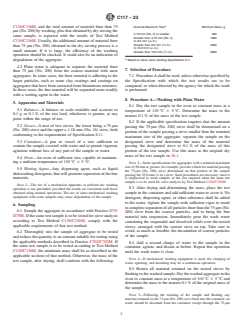
C117 − 23
A
C136/C136M, and the total amount of material finer than 75
Nominal Maximum Size Minimum Mass, g
μm (No. 200) by washing, plus that obtained by dry sieving the
4.75 mm (No. 4) or smaller 300
same sample, is reported with the results of Test Method
Greater than 4.75 mm (No. 4) 1000
C136/C136M. Usually, the additional amount of material finer ⁄8 in.)
to 9.5 mm (
Greater than 9.5 mm ( ⁄8 in.) 2500
than 75 μm (No. 200) obtained in the dry sieving process is a
to 19.0 mm ( ⁄4 in.)
small amount. If it is large, the efficiency of the washing
Greater than 19.0 mm ( ⁄4 in.) 5000
operation should be checked. It could also be an indication of
A
degradation of the aggregate. Based on sieve sizes meeting Specification E11.
4.2 Plain water is adequate to separate the material finer
7. Selection of Procedure
than 75 μm (No. 200) from the coarser material with most
aggregates. In some cases, the finer material is adhering to the 7.1 Procedure A shall be used, unless otherwise specified by
the Specification with which the test results are to be
larger particles, such as some clay coatings and coatings on
aggregates that have been extracted from bituminous mixtures. compared, or when directed by the agency for which the work
is performed.
In these cases, the fine material will be separated more readily
with a wetting agent in the water.
8. Procedure A—Washing with Plain Water
5. Apparatus and Materials
8.1 Dry the test sample in the oven to constant mass at a
5.1 Balance—A balance or scale readable and accurate to
temperature of 110 °C 6 5 °C. Determine the mass to the
0.1 g or 0.1 % of the test load, whichever is greater, at any
nearest 0.1 % of the mass of the test sample.
point within the range of use.
8.2 If the applicable specification requires that the amount
5.2 Sieves—A nest of two sieves, the lower being a 75-μm
passing the 75-μm (No. 200) sieve shall be determined on a
(No. 200) sieve and the upper a 1.18-mm (No. 16) sieve, both
portion of the sample passing a sieve smaller than the nominal
conforming to the requirements of Specification E11.
maximum size of the aggregate, separate the sample on the
designated sieve and determine the mass of the material
5.3 Container—A pan or vessel of a size sufficient to
contain the sample covered with water and to permit vigorous passing the designated sieve to 0.1 % of the mass of this
portion of the test sample. Use this mass as the original dry
agitation without loss of any part of the sample or water.
mass of the test sample in 10.1.
5.4 Oven—An oven of sufficient size, capable of maintain-
ing a uniform temperature of 110 °C 6 5 °C. NOTE 3—Some specifications for aggregates with a nominal maximum
size of 50 mm or greater, for example, provide a limit for material passing
5.5 Wetting Agent—Any dispersing agent, such as liquid
the 75-μm (No. 200) sieve determined on that portion of the sample
dishwashing detergents, that will promote separation of the fine
passing the 25.0-mm (1-in.) sieve. Such procedures are necessary since it
materials. is impractical to wash samples of the size required when the same test
sample is to be used for sieve analysis by Test Method C136/C136M.
NOTE 2—The use of a mechanical apparatus to perform the washing
8.3 After drying and determining the mass, place the test
operation is not precluded, provided the results are consistent with those
obtained using manual operations. The use of some mechanical washing
sample in the container and add suf
...
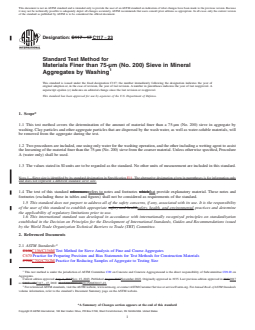
This document is not an ASTM standard and is intended only to provide the user of an ASTM standard an indication of what changes have been made to the previous version. Because
it may not be technically possible to adequately depict all changes accurately, ASTM recommends that users consult prior editions as appropriate. In all cases only the current version
of the standard as published by ASTM is to be considered the official document.
Designation: C117 − 17 C117 − 23
Standard Test Method for
Materials Finer than 75-μm (No. 200) Sieve in Mineral
Aggregates by Washing
This standard is issued under the fixed designation C117; the number immediately following the designation indicates the year of
original adoption or, in the case of revision, the year of last revision. A number in parentheses indicates the year of last reapproval. A
superscript epsilon (´) indicates an editorial change since the last revision or reapproval.
This standard has been approved for use by agencies of the U.S. Department of Defense.
1. Scope*
1.1 This test method covers the determination of the amount of material finer than a 75-μm (No. 200) sieve in aggregate by
washing. Clay particles and other aggregate particles that are dispersed by the wash water, as well as water-soluble materials, will
be removed from the aggregate during the test.
1.2 Two procedures are included, one using only water for the washing operation, and the other including a wetting agent to assist
the loosening of the material finer than the 75-μm (No. 200) sieve from the coarser material. Unless otherwise specified, Procedure
A (water only) shall be used.
1.3 The values stated in SI units are to be regarded as the standard. No other units of measurement are included in this standard.
NOTE 1—Sieve size is identified by its standard designation in Specification E11. The alternative designation given in parentheses is for information only
and does not represent a different standard sieve size.
1.4 The text of this standard references refers to notes and footnotes whichthat provide explanatory material. These notes and
footnotes (excluding those in tables and figures) shall not be considered as requirements of the standard.
1.5 This standard does not purport to address all of the safety concerns, if any, associated with its use. It is the responsibility
of the user of this standard to establish appropriate safety and healthsafety, health, and environmental practices and determine
the applicability of regulatory limitations prior to use.
1.6 This international standard was developed in accordance with internationally recognized principles on standardization
established in the Decision on Principles for the Development of International Standards, Guides and Recommendations issued
by the World Trade Organization Technical Barriers to Trade (TBT) Committee.
2. Referenced Documents
2.1 ASTM Standards:
C136C136/C136M Test Method for Sieve Analysis of Fine and Coarse Aggregates
C670 Practice for Preparing Precision and Bias Statements for Test Methods for Construction Materials
C702C702/C702M Practice for Reducing Samples of Aggregate to Testing Size
This test method is under the jurisdiction of ASTM Committee C09 on Concrete and Concrete Aggregatesand is the direct responsibility of Subcommittee C09.20 on
Aggregates.
Current edition approved Aug. 1, 2017Nov. 15, 2023. Published August 2017November 2023. Originally approved in 1935. Last previous edition approved in 20132017
as C117 – 13.C117 – 17. DOI: 10.1520/C0117-17.10.1520/C0117-23.
For referenced ASTM standards, visit the ASTM website, www.astm.org, or contact ASTM Customer Service at service@astm.org. For Annual Book of ASTM Standards
volume information, refer to the standard’s Document Summary page on the ASTM website.
*A Summary of Changes section appears at the end of this standard
Copyright © ASTM International, 100 Barr Harbor Drive, PO Box C700, West Conshohocken, PA 19428-2959. United States
C117 − 23
D75D75/D75M Practice for Sampling Aggregates
E11 Specification for Woven Wire Test Sieve Cloth and Test Sieves
2.2 AASHTO Standard:
T11 Method of Test for Amount of Material Finer than 0.075-mm Sieve in Aggregate
3. Summary of Test Method
3.1 A sample of the aggregate is washed in a prescribed manner, using either plain water or water containing a wetting agent, as
specified. The decanted wash water, containing suspended and dissolved material, is passed through a 75-μm (No. 200) sieve. The
loss in mass resulting from the wash treatment is calculated as mass percent of the original sample and is reported as the percentage
of material finer than a 75-μm (No. 200) sieve by washing.
4. Significance and Use
4.1 Material finer than the 75-μm (No. 200) sieve can be separated from larger particles much more efficiently and completely by
wet sieving than through the use of dry sieving. Therefore, when accurate determinations of material finer than 75 μm (No. 200)
in fine or coarse aggregate are desired, this test method is used on the sample prior to dry sieving in accordance with Test Method
C136C136/C136M. The results of this test method are included in the calculation in Test Method C136C136/C136M, and the total
amount of material finer than 75 μm (No. 200) by washing, plus that obtained by dry sieving the same sample, is reported with
the results of Test Method C136C136/C136M. Usually, the additional amount of material finer than 75 μm (No. 200) obtained in
the dry sieving process is a small amount. If it is large, the efficiency of the washing operation should be checked. It could also
be an indication of degradation of the aggregate.
4.2 Plain water is adequate to separate the material finer than 75 μm (No. 200) from the coarser material with most aggregates.
In some cases, the finer material is adhering to the larger particles, such as some clay coatings and coatings on aggregates that have
been extracted from bituminous mixtures. In these cases, the fine material will be separated more readily with a wetting agent in
the water.
5. Apparatus and Materials
5.1 Balance—A balance or scale readable and accurate to 0.1 g or 0.1 % of the test load, whichever is greater, at any point within
the range of use.
5.2 Sieves—A nest of two sieves, the lower being a 75-μm (No. 200) sieve and the upper a 1.18-mm (No. 16) sieve, both
conforming to the requirements of Specification E11.
5.3 Container—A pan or vessel of a size sufficient to contain the sample covered with water and to permit vigorous agitation
without loss of any part of the sample or water.
5.4 Oven—An oven of sufficient size, capable of maintaining a uniform temperature of 110 6 5°C.110 °C 6 5 °C.
5.5 Wetting Agent—Any dispersing agent, such as liquid dishwashing detergents, that will promote separation of the fine materials.
NOTE 2—The use of a mechanical apparatus to perform the washing operation is not precluded, provided the results are consistent with those obtained
using manual operations. The use of some mechanical washing equipment with some samples may cause degradation of the sample.
6. Sampling
6.1 Sample the aggregate in accordance with Practice D75D75/D75M. If the same test sample is to be tested for sieve analysis
according to Test Method C136C136/C136M, comply with the applicable requirements of that test method.
6.2 Thoroughly mix the sample of aggregate to be tested and reduce the quantity to an amount suitable for testing using the
applicable methods described in Practice C702C702/C702M. If the same test sample is to be tested according to Test Method
Available from American Association of State Highway and Transportation Officials (AASHTO), 444 N. Capitol 555 12th St., NW, Suite 249,1000, Washington, DC
20001.20004, http://www.transportation.org.
C117 − 23
C136C136/C136M, the minimum mass shall be as described in the applicable sections of that method. Otherwise, the mass of the
test sample, after drying, shall conform with the following:
C117 − 23
A
Nominal Maximum Size Minimum Mass, g
4.75 mm (No. 4) or smaller 300
Greater than 4.75 mm (No. 4) 1000
to 9.5 mm ( ⁄8 in.)
Greater than 9.5 mm ( ⁄8 in.) 2500
to 19.0 mm ( ⁄4 in.)
Greater than 19.0 mm ( ⁄4 in.) 5000
A
Based on sieve sizes meeting Specification E11.
7. Selection of Procedure
7.1 Procedure A shall be used, unless otherwise specified by the Specification with which the test results are to be compared, or
when directed by the agency for which the work is performed.
8. Procedure A—Washing with Plain Water
8.1 Dry the test sample in the oven to constant mass at a temperature of 110 6 5°C.110 °C 6 5 °C. Determine the mass to the
nearest 0.1 % of the mass of the test sample.
8.2 If the applicable specification requires that the amount passing the 75-μm (No. 200) sieve s
...