

ASTM E1188-23
(Practice)Standard Practice for Collection and Preservation of Information and Physical Items by a Technical Investigator
General Information
- Abstract
SIGNIFICANCE AND USE
2.1 This practice is intended for use by any technical investigator when investigating an incident that can be reasonably expected to be the subject of litigation. The intent is to obtain sufficient information and physical items to identify evidence associated with the incident and to preserve it for analysis.
2.2 The quality of evidence may change with time, therefore, special effort should be taken to capture and preserve evidence in an expeditious manner. This practice sets forth guidelines for the collection and preservation of evidence for further analysis.
2.3 Evidence that has been collected and preserved is identified with, and traceable to, the incident. This practice sets forth guidelines for such procedures.
SCOPE
1.1 This practice covers guidelines for the collection and preservation of information and physical items by any technical investigator pertaining to an incident that can be reasonably expected to be the subject of litigation.
1.2 This practice describes generally accepted professional principles and operations, although the facts and issues of each situation require consideration, and frequently involve matters not expressly dealt with herein. Deviations from this practice should be based on specific articulable circumstances.
1.3 This standard does not purport to address all of the safety concerns, if any, associated with its use. It is the responsibility of the user of this standard to establish appropriate safety, health, and environmental practices and determine the applicability of regulatory limitations prior to use.
1.4 This international standard was developed in accordance with internationally recognized principles on standardization established in the Decision on Principles for the Development of International Standards, Guides and Recommendations issued by the World Trade Organization Technical Barriers to Trade (TBT) Committee.
- Status
- Published
- Publication Date
- 31-Aug-2023
- Technical Committee
- E30 - Forensic Sciences
- Drafting Committee
- E30.11 - Interdisciplinary Forensic Science Standards
Buy Documents
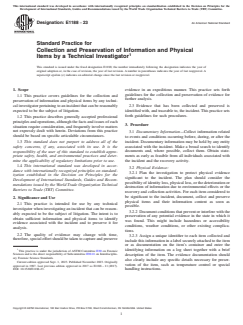


ASTM E1188-23 - Standard Practice for Collection and Preservation of Information and Physical Items by a Technical Investigator
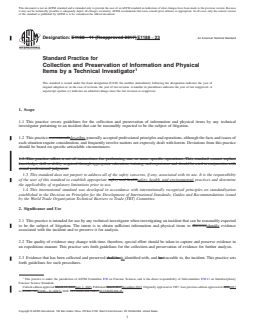

REDLINE ASTM E1188-23 - Standard Practice for Collection and Preservation of Information and Physical Items by a Technical Investigator
Overview
ASTM E1188-23 is the Standard Practice for Collection and Preservation of Information and Physical Items by a Technical Investigator, developed by ASTM International. This standard provides essential guidelines for technical investigators tasked with collecting and preserving information and physical evidence related to incidents that may be subject to litigation. By following the documented procedures, investigators can ensure that evidence is identified, adequately preserved, and traceable to its source, supporting the integrity of future legal or technical analysis.
Key Topics
Collection of Documentary Information
Emphasizes the systematic acquisition of relevant documentation, such as reports, statements, and records from individuals or entities involved in the incident. Collecting information promptly helps maintain its reliability and usefulness for analysis.Physical Evidence Preservation
Provides best practices for identifying, collecting, and preserving physical items. This includes protecting evidence from identity loss, deterioration, or contamination and documenting all conditions that may impact evidence integrity.Photographic Documentation
Recommends immediate and thorough photographic or video recording of the incident scene and every stage of evidence collection. The use of high-resolution images and detailed records of date, time, and photographer ensures visual evidence is clear and reproducible.Chain of Custody and Traceability
Ensures that each piece of evidence is uniquely identified and its history documented, including initial collection and subsequent transfers. Proper chain of custody supports the admissibility and authenticity of evidence in legal or technical proceedings.Documentation of Evidence Handling
Includes requirements for logging the identity, location, date/time, and responsible personnel for every item collected, as well as records of any changes or transfers in custody.
Applications
ASTM E1188-23 is widely used in various sectors where evidence collection and preservation are critical, including:
Forensic Engineering Investigations
Assists forensic engineers in methodically gathering and safeguarding evidence related to accidents, equipment failures, or product liability events.Legal Proceedings and Litigation
Supports legal professionals by establishing reliable, court-accepted practices for handling evidence, thereby strengthening the foundation for expert testimony.Industrial and Workplace Incidents
Guides safety, quality, and risk management teams in collecting facts following workplace incidents to facilitate root cause analysis and regulatory compliance.Insurance and Claims Investigations
Provides insurance investigators with standardized methods for securing and documenting physical items and information to address liability or claims disputes.
Related Standards
Several standards are closely related to ASTM E1188-23 and provide complementary guidance in evidence collection and forensic investigation:
- ASTM E1459 - Standard Guide for Physical Evidence Labeling and Related Documentation
- ASTM E1492 - Standard Practice for Receiving, Documenting, Storing, and Retrieving Evidence in a Forensic Science Laboratory
- ASTM E860 - Standard Practice for Examining and Preparing Items That Are or May Become Involved in Criminal or Civil Litigation
- ASTM E620 - Standard Practice for Reporting Opinions of Scientific or Technical Experts
For a comprehensive approach to forensic standards compliance and evidence integrity, practitioners should consult both ASTM E1188-23 and these related documents.
Keywords: evidence collection, evidence preservation, technical investigator, forensic engineering, chain of custody, incident investigation, ASTM E1188-23, physical evidence, legal proceedings, documentary information.
Relations
- Effective Date
- 01-Sep-2023
- Effective Date
- 01-Sep-2023
- Referred By
ASTM E1459-13(2018) - Standard Guide for Physical Evidence Labeling and Related Documentation - Effective Date
- 01-Sep-2023
- Effective Date
- 01-Sep-2023
- Effective Date
- 01-Sep-2023
- Effective Date
- 01-Sep-2023
- Effective Date
- 01-Sep-2023
- Effective Date
- 01-Sep-2023
- Effective Date
- 01-Sep-2023
- Effective Date
- 01-Sep-2023
- Effective Date
- 01-Sep-2023
Buy Documents
ASTM E1188-23 - Standard Practice for Collection and Preservation of Information and Physical Items by a Technical Investigator
REDLINE ASTM E1188-23 - Standard Practice for Collection and Preservation of Information and Physical Items by a Technical Investigator
Get Certified
Connect with accredited certification bodies for this standard

IMP NDT d.o.o.
Non-destructive testing services. Radiography, ultrasonic, magnetic particle, penetrant, visual inspection.
Inštitut za kovinske materiale in tehnologije
Institute of Metals and Technology. Materials testing, metallurgical analysis, NDT.
Q Techna d.o.o.
NDT and quality assurance specialist. 30+ years experience. NDT personnel certification per ISO 9712, nuclear and thermal power plant inspections, QA/
Sponsored listings
Frequently Asked Questions
ASTM E1188-23 is a standard published by ASTM International. Its full title is "Standard Practice for Collection and Preservation of Information and Physical Items by a Technical Investigator". This standard covers: SIGNIFICANCE AND USE 2.1 This practice is intended for use by any technical investigator when investigating an incident that can be reasonably expected to be the subject of litigation. The intent is to obtain sufficient information and physical items to identify evidence associated with the incident and to preserve it for analysis. 2.2 The quality of evidence may change with time, therefore, special effort should be taken to capture and preserve evidence in an expeditious manner. This practice sets forth guidelines for the collection and preservation of evidence for further analysis. 2.3 Evidence that has been collected and preserved is identified with, and traceable to, the incident. This practice sets forth guidelines for such procedures. SCOPE 1.1 This practice covers guidelines for the collection and preservation of information and physical items by any technical investigator pertaining to an incident that can be reasonably expected to be the subject of litigation. 1.2 This practice describes generally accepted professional principles and operations, although the facts and issues of each situation require consideration, and frequently involve matters not expressly dealt with herein. Deviations from this practice should be based on specific articulable circumstances. 1.3 This standard does not purport to address all of the safety concerns, if any, associated with its use. It is the responsibility of the user of this standard to establish appropriate safety, health, and environmental practices and determine the applicability of regulatory limitations prior to use. 1.4 This international standard was developed in accordance with internationally recognized principles on standardization established in the Decision on Principles for the Development of International Standards, Guides and Recommendations issued by the World Trade Organization Technical Barriers to Trade (TBT) Committee.
SIGNIFICANCE AND USE 2.1 This practice is intended for use by any technical investigator when investigating an incident that can be reasonably expected to be the subject of litigation. The intent is to obtain sufficient information and physical items to identify evidence associated with the incident and to preserve it for analysis. 2.2 The quality of evidence may change with time, therefore, special effort should be taken to capture and preserve evidence in an expeditious manner. This practice sets forth guidelines for the collection and preservation of evidence for further analysis. 2.3 Evidence that has been collected and preserved is identified with, and traceable to, the incident. This practice sets forth guidelines for such procedures. SCOPE 1.1 This practice covers guidelines for the collection and preservation of information and physical items by any technical investigator pertaining to an incident that can be reasonably expected to be the subject of litigation. 1.2 This practice describes generally accepted professional principles and operations, although the facts and issues of each situation require consideration, and frequently involve matters not expressly dealt with herein. Deviations from this practice should be based on specific articulable circumstances. 1.3 This standard does not purport to address all of the safety concerns, if any, associated with its use. It is the responsibility of the user of this standard to establish appropriate safety, health, and environmental practices and determine the applicability of regulatory limitations prior to use. 1.4 This international standard was developed in accordance with internationally recognized principles on standardization established in the Decision on Principles for the Development of International Standards, Guides and Recommendations issued by the World Trade Organization Technical Barriers to Trade (TBT) Committee.
ASTM E1188-23 is classified under the following ICS (International Classification for Standards) categories: 19.020 - Test conditions and procedures in general. The ICS classification helps identify the subject area and facilitates finding related standards.
ASTM E1188-23 has the following relationships with other standards: It is inter standard links to ASTM E1188-11(2017), ASTM E2128-20, ASTM E1459-13(2018), ASTM E860-22, ASTM G145-08(2023), ASTM E3272-23, ASTM E3193-21, ASTM F561-19, ASTM E2733-23, ASTM E1843-20, ASTM E1492-11(2017). Understanding these relationships helps ensure you are using the most current and applicable version of the standard.
ASTM E1188-23 is available in PDF format for immediate download after purchase. The document can be added to your cart and obtained through the secure checkout process. Digital delivery ensures instant access to the complete standard document.
Standards Content (Sample)
This international standard was developed in accordance with internationally recognized principles on standardization established in the Decision on Principles for the
Development of International Standards, Guides and Recommendations issued by the World Trade Organization Technical Barriers to Trade (TBT) Committee.
Designation: E1188 − 23 An American National Standard
Standard Practice for
Collection and Preservation of Information and Physical
Items by a Technical Investigator
This standard is issued under the fixed designation E1188; the number immediately following the designation indicates the year of
original adoption or, in the case of revision, the year of last revision. A number in parentheses indicates the year of last reapproval. A
superscript epsilon (´) indicates an editorial change since the last revision or reapproval.
1. Scope evidence in an expeditious manner. This practice sets forth
guidelines for the collection and preservation of evidence for
1.1 This practice covers guidelines for the collection and
further analysis.
preservation of information and physical items by any techni-
cal investigator pertaining to an incident that can be reasonably
2.3 Evidence that has been collected and preserved is
expected to be the subject of litigation.
identified with, and traceable to, the incident. This practice sets
forth guidelines for such procedures.
1.2 This practice describes generally accepted professional
principles and operations, although the facts and issues of each
3. Procedure
situation require consideration, and frequently involve matters
not expressly dealt with herein. Deviations from this practice
3.1 Documentary Information—Collect information related
should be based on specific articulable circumstances.
to events and conditions occurring before, during, or after the
incident. Documentary information may be held by any entity
1.3 This standard does not purport to address all of the
safety concerns, if any, associated with its use. It is the associated with the incident. Make a broad search to identify
documents and, where possible, collect them. Obtain state-
responsibility of the user of this standard to establish appro-
priate safety, health, and environmental practices and deter- ments as early as feasible from all individuals associated with
the incident and the recovery activity.
mine the applicability of regulatory limitations prior to use.
1.4 This international standard was developed in accor-
3.2 Physical Evidence:
dance with internationally recognized principles on standard-
3.2.1 Plan the investigation to protect physical evidence
ization established in the Decision on Principles for the
significant to the incident. The plan should consider the
Development of International Standards, Guides and Recom-
possibility of identity loss, physical loss, or the deterioration or
mendations issued by the World Trade Organization Technical
destruction of information due to environmental effects or the
Barriers to Trade (TBT) Committee.
recovery and collection activities. For each item considered to
be significant to the incident, document, collect and preserve
2. Significance and Use
physical items and their information content as soon as
2.1 This practice is intended for use by any technical
possible.
investigator when investigating an incident that can be reason-
3.2.2 Document conditions that prevent or interfere with the
ably expected to be the subject of litigation. The intent is to
preservation of any potential evidence in the state in which it
obtain sufficient information and physical items to identify
was found. This might include hazardous or accessibility
evidence associated with the incident and to preserve it for
conditions, weather conditions, or other existing complica-
analysis.
tions.
2.2 The quality of evidence may change with time,
3.2.3 Assign a unique identifier to each item collected and
therefore, special effort should be taken to capture and preserve
include this information in a label securely attached to the item
or as documentation on the item’s container and enter the
identifying information on a log sheet together with a brief
This practice is under the jurisdiction of ASTM Committee E30 on Forensic
Sciences and is the direct responsibility of Subcommittee E30.11 on Interdisciplin-
description of the item. The evidence documentation should
ary Forensic Science Standards.
also clearly include any specific details necessary for preser-
Current edition approved Sept. 1, 2023. Published November 2023. Originally
vation of the item, such as temperature control or special
approved in 1987. Last previous edition approved in 2
...
This document is not an ASTM standard and is intended only to provide the user of an ASTM standard an indication of what changes have been made to the previous version. Because
it may not be technically possible to adequately depict all changes accurately, ASTM recommends that users consult prior editions as appropriate. In all cases only the current version
of the standard as published by ASTM is to be considered the official document.
Designation: E1188 − 11 (Reapproved 2017) E1188 − 23 An American National Standard
Standard Practice for
Collection and Preservation of Information and Physical
Items by a Technical Investigator
This standard is issued under the fixed designation E1188; the number immediately following the designation indicates the year of
original adoption or, in the case of revision, the year of last revision. A number in parentheses indicates the year of last reapproval. A
superscript epsilon (´) indicates an editorial change since the last revision or reapproval.
1. Scope
1.1 This practice covers guidelines for the collection and preservation of information and physical items by any technical
investigator pertaining to an incident that can be reasonably expected to be the subject of litigation.
1.2 This practice recommendsdescribes generally accepted professional principles and operations, although the facts and issues of
each situation require consideration, and frequently involve matters not expressly dealt with herein. Deviations from this practice
should be based on specific articulable circumstances.
1.3 This practice offers a set of instructions for performing one or more specific operations. This standard cannot replace
knowledge, skill or ability acquired through appropriate education, training, and experience and should be used in conjunction with
sound professional judgment.
1.3 This standard does not purport to address all of the safety concerns, if any, associated with its use. It is the responsibility
of the user of this standard to establish appropriate safety and healthsafety, health, and environmental practices and determine
the applicability of regulatory limitations prior to use.
1.4 This international standard was developed in accordance with internationally recognized principles on standardization
established in the Decision on Principles for the Development of International Standards, Guides and Recommendations issued
by the World Trade Organization Technical Barriers to Trade (TBT) Committee.
2. Significance and Use
2.1 This practice is intended for use by any technical investigator when investigating an incident that can be reasonably expected
to be the subject of litigation. The intent is to obtain sufficient information and physical items to discoveridentify evidence
associated with the incident and to preserve it for analysis.
2.2 The quality of evidence may change with time, therefore, special effort should be taken to capture and preserve evidence in
an expeditious manner. This practice sets forth guidelines for the collection and preservation of evidence for further analysis.
2.3 Evidence that has been collected and preserved shall be is identified with, and be traceable to, the incident. This practice sets
forth guidelines for such procedures.
This practice is under the jurisdiction of ASTM Committee E30 on Forensic Sciences and is the direct responsibility of Subcommittee E30.11 on Interdisciplinary
Forensic Science Standards.
Current edition approved March 15, 2017Sept. 1, 2023. Published March 2017November 2023. Originally approved in 1987. Last previous edition approved in 20112017
as E1188 – 11.E1188 – 11 (2017). DOI: 10.1520/E1188-11R17.10.1520/E1188-23.
Copyright © ASTM International, 100 Barr Harbor Drive, PO Box C700, West Conshohocken, PA 19428-2959. United States
E1188 − 23
3. Procedure
3.1 Documentary Information—Collect information related to events and conditions occurring before, during, or after the incident.
Documentary information may be held by any entity associated with the incident. Make a broad search to identify documents and,
where possible, collect them. Obtain statements as early as feasible from all individuals associated with the incident and the
recovery activity.
3.2 Physical Evidence:
3.2.1 Plan the investigation to protect physical evidence significant to the incident. The plan should consider the possibility of
identity loss, physical loss, or the deterioration or destruction of information due to environmental effects or the recovery and
collection activities. For each item considered to be significant to the incident, document, collect and preserve physical items and
their information content as soon as possible.
3.2.2 Document conditions that prevent or interfere with the preservation of any potential evidence in the state in which it was
found. This might include hazardous or accessibility conditions, weather conditions, or other existing complications.
3.2.3 Assign a unique identifier to each item collected and include this information in a label securely attached to the i
...