

ASTM C182-19
(Test Method)Standard Test Method for Thermal Conductivity of Insulating Firebrick
General Information
- Abstract
SIGNIFICANCE AND USE
3.1 The thermal conductivity of insulating firebrick (IFB) is a property required for the selection of IFB for a specific thermal performance. Users select brick to provide a specified heat-loss and cold-face temperature without exceeding the temperature limitation of the brick. This test method establishes placement of thermocouples and the positioning of test specimens in the calorimeter. This test method must be used with Test Method C201.
SCOPE
1.1 This test method supplements Test Method C201, and shall be used in conjunction with that test method to determine the thermal conductivity of insulating firebrick.
1.2 The values stated in inch-pound units are to be regarded as standard. The values given in parentheses are mathematical conversions to SI units that are provided for information only and are not considered standard.
1.3 This standard does not purport to address all of the safety concerns, if any, associated with its use. It is the responsibility of the user of this standard to establish appropriate safety, health, and environmental practices and determine the applicability of regulatory limitations prior to use.
1.4 This international standard was developed in accordance with internationally recognized principles on standardization established in the Decision on Principles for the Development of International Standards, Guides and Recommendations issued by the World Trade Organization Technical Barriers to Trade (TBT) Committee.
- Status
- Published
- Publication Date
- 31-Mar-2019
- Technical Committee
- C08 - Refractories
- Drafting Committee
- C08.02 - Thermal Properties



Overview
ASTM C182-19: Standard Test Method for Thermal Conductivity of Insulating Firebrick provides a widely recognized procedure for determining the thermal conductivity of insulating firebrick (IFB). Published by ASTM International, this standard serves as a supplement to ASTM C201 and is essential in the selection and performance evaluation of insulating firebrick used in high-temperature applications. Accurate measurement of thermal conductivity is critical to ensure heat-loss control and cold-face temperature management without exceeding the thermal limits of the firebrick.
This standard is applicable internationally, reflecting principles established by the World Trade Organization (WTO) Technical Barriers to Trade (TBT) Committee. It supports both inch-pound and SI units but considers inch-pound values as standard.
Key Topics
- Test Method Supplementation: ASTM C182-19 is used in conjunction with ASTM C201 for comprehensive measurement of IFB thermal conductivity.
- Sample Preparation: Guidance is provided for selecting and preparing test specimens, including thermocouple placement and drilling procedures to ensure precise results.
- Thermocouple Placement: Specific instructions for embedding calibrated thermocouples at designated positions within the firebrick specimen to accurately monitor temperature gradients.
- Test Apparatus: The calorimeter set-up is detailed, incorporating additional elements such as refractory fiber paper strips and silicon carbide slabs, per the requirements of insulating firebrick testing.
- Steady-State Heat Flow: Procedures for achieving and verifying steady state during testing, including water flow and furnace atmosphere controls, are provided to ensure data accuracy.
- Reporting and Data Recording: Alignment with ASTM C201 for data recording, calculations, and reporting standards.
Applications
The test method outlined in ASTM C182-19 is crucial in industries where insulating firebricks are subjected to high temperatures and precise thermal insulation characteristics are required. Applications include:
- Industrial Furnaces: Enhances the selection of insulating firebricks to minimize heat losses and protect structures from exposure to excessive temperatures.
- Kilns and Refractory Linings: Facilitates compliance with design specifications for thermal protection in processes such as ceramics firing, metalworking, and heat treating.
- Process Engineering: Supports research and quality assurance teams in selecting appropriate firebrick products based on reliable thermal conductivity data.
- Comparison and Specification: Enables manufacturers and end-users to compare different IFB grades for optimum performance and energy efficiency.
Adhering to this standard ensures consistent, repeatable results critical for regulatory compliance, operational safety, and cost-effective thermal management.
Related Standards
- ASTM C201: Test Method for Thermal Conductivity of Refractories - The primary standard for determining refractory thermal conductivity, which ASTM C182-19 supplements.
- ASTM C155: Classification of Insulating Firebrick - Provides guidance for the taxonomy and grouping of IFB products referenced in testing procedures.
- ASTM E220: Test Method for Calibration of Thermocouples By Comparison Techniques - Essential for accurate temperature measurement in the calorimeter.
Practical Value
ASTM C182-19 delivers practical value for engineers, manufacturers, and quality assurance specialists involved in the selection, design, and verification of insulating firebrick products. With a standardized thermal conductivity test method:
- Consistency and comparability of IFB performance data across different products and suppliers is ensured.
- The risks of overheating, thermal damage, and costly heat losses in high-temperature installations can be reduced.
- Customers and stakeholders can trust data based on internationally validated procedures.
By following ASTM C182-19, professionals help maintain safety, quality, and performance standards in the use of insulating firebricks, contributing to efficient industrial operations and regulatory compliance.
Relations
- Effective Date
- 01-Apr-2019
- Effective Date
- 01-Nov-2013
- Effective Date
- 01-Sep-2013
- Effective Date
- 01-Sep-2013
- Effective Date
- 01-Mar-2009
- Refers
ASTM E220-07a - Standard Test Method for Calibration of Thermocouples By Comparison Techniques - Effective Date
- 01-Nov-2007
- Refers
ASTM E220-07e1 - Standard Test Method for Calibration of Thermocouples By Comparison Techniques - Effective Date
- 01-May-2007
- Effective Date
- 01-May-2007
- Effective Date
- 01-Mar-2007
- Effective Date
- 01-Sep-2004
- Effective Date
- 10-May-2002
- Effective Date
- 10-Sep-1998
- Effective Date
- 10-Feb-1997
- Effective Date
- 10-Feb-1997
- Effective Date
- 10-Nov-1996
Frequently Asked Questions
ASTM C182-19 is a standard published by ASTM International. Its full title is "Standard Test Method for Thermal Conductivity of Insulating Firebrick". This standard covers: SIGNIFICANCE AND USE 3.1 The thermal conductivity of insulating firebrick (IFB) is a property required for the selection of IFB for a specific thermal performance. Users select brick to provide a specified heat-loss and cold-face temperature without exceeding the temperature limitation of the brick. This test method establishes placement of thermocouples and the positioning of test specimens in the calorimeter. This test method must be used with Test Method C201. SCOPE 1.1 This test method supplements Test Method C201, and shall be used in conjunction with that test method to determine the thermal conductivity of insulating firebrick. 1.2 The values stated in inch-pound units are to be regarded as standard. The values given in parentheses are mathematical conversions to SI units that are provided for information only and are not considered standard. 1.3 This standard does not purport to address all of the safety concerns, if any, associated with its use. It is the responsibility of the user of this standard to establish appropriate safety, health, and environmental practices and determine the applicability of regulatory limitations prior to use. 1.4 This international standard was developed in accordance with internationally recognized principles on standardization established in the Decision on Principles for the Development of International Standards, Guides and Recommendations issued by the World Trade Organization Technical Barriers to Trade (TBT) Committee.
SIGNIFICANCE AND USE 3.1 The thermal conductivity of insulating firebrick (IFB) is a property required for the selection of IFB for a specific thermal performance. Users select brick to provide a specified heat-loss and cold-face temperature without exceeding the temperature limitation of the brick. This test method establishes placement of thermocouples and the positioning of test specimens in the calorimeter. This test method must be used with Test Method C201. SCOPE 1.1 This test method supplements Test Method C201, and shall be used in conjunction with that test method to determine the thermal conductivity of insulating firebrick. 1.2 The values stated in inch-pound units are to be regarded as standard. The values given in parentheses are mathematical conversions to SI units that are provided for information only and are not considered standard. 1.3 This standard does not purport to address all of the safety concerns, if any, associated with its use. It is the responsibility of the user of this standard to establish appropriate safety, health, and environmental practices and determine the applicability of regulatory limitations prior to use. 1.4 This international standard was developed in accordance with internationally recognized principles on standardization established in the Decision on Principles for the Development of International Standards, Guides and Recommendations issued by the World Trade Organization Technical Barriers to Trade (TBT) Committee.
ASTM C182-19 is classified under the following ICS (International Classification for Standards) categories: 81.080 - Refractories. The ICS classification helps identify the subject area and facilitates finding related standards.
ASTM C182-19 has the following relationships with other standards: It is inter standard links to ASTM C182-88(2013), ASTM E220-13, ASTM C201-93(2013), ASTM C155-97(2013), ASTM C201-93(2009), ASTM E220-07a, ASTM E220-07e1, ASTM E220-07, ASTM C155-97(2007), ASTM C201-93(2004), ASTM E220-02, ASTM C201-93(1998), ASTM C155-97(2002), ASTM C155-97, ASTM E220-86(1996)e1. Understanding these relationships helps ensure you are using the most current and applicable version of the standard.
ASTM C182-19 is available in PDF format for immediate download after purchase. The document can be added to your cart and obtained through the secure checkout process. Digital delivery ensures instant access to the complete standard document.
Standards Content (Sample)
This international standard was developed in accordance with internationally recognized principles on standardization established in the Decision on Principles for the
Development of International Standards, Guides and Recommendations issued by the World Trade Organization Technical Barriers to Trade (TBT) Committee.
Designation: C182 − 19
Standard Test Method for
Thermal Conductivity of Insulating Firebrick
This standard is issued under the fixed designation C182; the number immediately following the designation indicates the year of
original adoption or, in the case of revision, the year of last revision. A number in parentheses indicates the year of last reapproval. A
superscript epsilon (´) indicates an editorial change since the last revision or reapproval.
1. Scope lishes placement of thermocouples and the positioning of test
specimens in the calorimeter. This test method must be used
1.1 This test method supplements Test Method C201, and
with Test Method C201.
shall be used in conjunction with that test method to determine
the thermal conductivity of insulating firebrick.
4. Apparatus
1.2 The values stated in inch-pound units are to be regarded
4.1 The apparatus shall consist of that described in the
as standard. The values given in parentheses are mathematical
Apparatus section of Test Method C201 with the addition of
conversions to SI units that are provided for information only
thermocouples, drilling jig, and refractory fiber paper as
and are not considered standard.
described in Sections 6 and 7.
1.3 This standard does not purport to address all of the
5. Test Specimens
safety concerns, if any, associated with its use. It is the
responsibility of the user of this standard to establish appro-
5.1 The test specimens shall be selected and prepared as
priate safety, health, and environmental practices and deter-
described in the Test Sample and Preparation section of Test
mine the applicability of regulatory limitations prior to use.
Method C201.
1.4 This international standard was developed in accor-
6. Installation of Thermocouples in Test Specimen
dance with internationally recognized principles on standard-
ization established in the Decision on Principles for the
6.1 Thermocouples—Calibrated thermocouples shall be
Development of International Standards, Guides and Recom-
embeddedinthetestspecimenatthreepointsformeasuringthe
mendations issued by the World Trade Organization Technical
temperature. Chromel-Alumel thermocouples shall be used for
Barriers to Trade (TBT) Committee.
temperatures below 1400 °F (760 °C), and above that tempera-
ture platinum-10 % rhodium/platinum thermocouples shall be
2. Referenced Documents
used. The platinum thermocouples may also be used at the
2.1 ASTM Standards: lower temperatures, but the electromotive force (emf) will not
C155 Classification of Insulating Firebrick be as high as when using base-metal thermocouples. Wire of
C201 Test Method for Thermal Conductivity of Refractories AWG 28 (0.320 mm) shall be used for making either type of
E220 Test Method for Calibration of Thermocouples By thermocouple.
Comparison Techniques
6.2 Installation of Thermocouples—Holes for the thermo-
couple wires shall be drilled through the 4 ⁄2-in. (114-mm)
3. Significance and Use
dimension of the test specimen by the use of a drilling jig so as
3.1 The thermal conductivity of insulating firebrick (IFB) is
to obtain accurate placement of the thermocouples. The three
a property required for the selection of IFB for a specific
thermocouples shall be located so that the hot junction of the
thermal performance. Users select brick to provide a specified
first couple is 0.20 in. (5.1 mm) below the hot face of the test
heat-loss and cold-face temperature without exceeding the
specimen, the junction of the second at the midpoint, and the
temperature limitation of the brick. This test method estab-
junction of the third 0.20 in. above the cold face. The
thermocouple wires leading out from the hot junctions shall be
located in planes parallel to the calorimeter surface. In order to
This test method is under the jurisdiction of ASTM Committee C08 on
have the hot junctions over the center of the calorimeter, they
Refractories and is the direct responsibility of Subcommittee C08.02 on Thermal
shall be located on an axis passing through the center of and at
Properties.
rightanglestothe9by4 ⁄2-in.(228by114-mm)areaofthetest
Current edition approved April 1, 2019. Published May 2019. Originally
approved in 1943. Last previous edition approved in 2013 as C182 – 88 (2013).
specimen.
DOI: 10.1520/C0182-19.
For referenced ASTM standards, visit the ASTM website, www.astm.org, or NOTE 1—Insulating firebrick that cannot be prepared to this precision
contact ASTM Customer Service at service@astm.org. For Annual Book of ASTM
Standards volume information, refer to the standard’s Document Summary page on
the ASTM website. Test Method E220 specifies calibration procedures for thermocouples.
Copyright © ASTM International, 100 Barr Harbor Drive, PO Box C700, West Conshohocken, PA 19428-2959. United States
C182 − 19
because of the structure of the product should be prepared in accordance
identical pattern, shall be placed on top of the ceramic fiber
with the instructions for fireclay dense refractories.
board. The test specimen and guard brick shall then be placed
as described in 7.1.
7. Set-Up of Test Specimen and Silicon Carbide Slab
7.3 The silicon carbide slab shall be placed over the 9 by
1 1
7.1 Two strips of refractory fiber paper 13 ⁄2 by ⁄2 by
13 ⁄2-in. (228 by 342-mm) area of the three 9-in. sample brick,
0.02 in. (343 by 13 by 0.5 mm) shall be placed along the
and it shall be spaced 1 in. (25 mm) above the sample by
13 ⁄2-in. dimension of the inner guard at the outside edges, as
1 placing under each corner of the slab rectangular pieces of
shown in Fig. 1. Twelve strips of refractory fiber paper 2 by ⁄2
Group 30 or 32 (see Classification C155) insulating firebrick
by 0.02 in. (51 by 13 by 0.5 mm) shall be placed on the outer
cut to measure ⁄8 in. (10 mm) square and 1.00 in. (25.4 mm)
guard at intervals in the pattern shown in Fig. 1. These strips
in length.
serve as spacers to prevent contact between the test material
and the calorimeter assembly. The test specimen shall be
8. Procedure
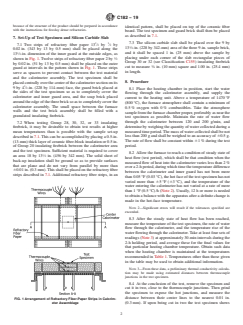
placedcentrallyoverthecenter
...
This document is not an ASTM standard and is intended only to provide the user of an ASTM standard an indication of what changes have been made to the previous version. Because
it may not be technically possible to adequately depict all changes accurately, ASTM recommends that users consult prior editions as appropriate. In all cases only the current version
of the standard as published by ASTM is to be considered the official document.
Designation: C182 − 88 (Reapproved 2013) C182 − 19
Standard Test Method for
Thermal Conductivity of Insulating Firebrick
This standard is issued under the fixed designation C182; the number immediately following the designation indicates the year of
original adoption or, in the case of revision, the year of last revision. A number in parentheses indicates the year of last reapproval. A
superscript epsilon (´) indicates an editorial change since the last revision or reapproval.
1. Scope
1.1 This test method supplements Test Method C201, and shall be used in conjunction with that test method to determine the
thermal conductivity of insulating firebrick.
1.2 The values stated in inch-pound units are to be regarded as standard. The values given in parentheses are mathematical
conversions to SI units that are provided for information only and are not considered standard.
1.3 This standard does not purport to address all of the safety problems,concerns, if any, associated with its use. It is the
responsibility of the user of this standard to establish appropriate safety safety, health, and healthenvironmental practices and
determine the applicability of regulatory limitations prior to use.
1.4 This international standard was developed in accordance with internationally recognized principles on standardization
established in the Decision on Principles for the Development of International Standards, Guides and Recommendations issued
by the World Trade Organization Technical Barriers to Trade (TBT) Committee.
2. Referenced Documents
2.1 ASTM Standards:
C155 Classification of Insulating Firebrick
C201 Test Method for Thermal Conductivity of Refractories
E220 Test Method for Calibration of Thermocouples By Comparison Techniques
3. Significance and Use
3.1 The thermal conductivity of insulating firebrick (IFB) is a property required for the selection of IFB for a specific thermal
performance. Users select brick to provide a specified heat-loss and cold-face temperature without exceeding the temperature
limitation of the brick. This test method establishes placement of thermocouples and the positioning of test samplesspecimens in
the calorimeter. This test method must be used with Test Method C201.
4. Apparatus
4.1 The apparatus shall consist of that described in the Apparatus section of Test Method C201 with the addition of
thermocouples, drilling jig, and refractory fiber paper as described in Sections 6 and 7.
5. Test SampleSpecimens
5.1 The test samplespecimens shall be selected and prepared as described in the Test Sample and Preparation section of Test
Method C201.
6. Installation of Thermocouples in Test Specimen
6.1 Thermocouples—Calibrated thermocouples shall be embedded in the test specimen at three points for measuring the
temperature. Chromel-Alumel thermocouples shall be used for temperatures below 1400°F (760°C),1400 °F (760 °C), and above
that temperature platinum-10 % rhodium/platinum thermocouples shall be used. The platinum thermocouples may also be used at
This test method is under the jurisdiction of ASTM Committee C08 on Refractories and is the direct responsibility of Subcommittee C08.02 on Thermal Properties.
Current edition approved Sept. 1, 2013April 1, 2019. Published September 2013May 2019. Originally approved in 1943. Last previous edition approved in 20092013 as
C182 – 88 (2013). (2009). DOI: 10.1520/C0182-88R13.10.1520/C0182-19.
For referenced ASTM standards, visit the ASTM website, www.astm.org, or contact ASTM Customer Service at service@astm.org. For Annual Book of ASTM Standards
volume information, refer to the standard’s Document Summary page on the ASTM website.
Test Method E220 specifies calibration procedures for thermocouples.
Copyright © ASTM International, 100 Barr Harbor Drive, PO Box C700, West Conshohocken, PA 19428-2959. United States
C182 − 19
the lower temperatures, but the electromotive force (emf) will not be as high as when using base-metal thermocouples. Wire of
AWG 28 (0.320 mm) shall be used for making either type of thermocouple.
6.2 Installation of Thermocouples—Holes for the thermocouple wires shall be drilled through the 4 ⁄2-in. (114-mm) dimension
of the test specimen by the use of a drilling jig so as to obtain accurate placement of the thermocouples. The three thermocouples
shall be located so that the hot junction of the first couple is 0.20 in. (5.1 mm) below the hot face of the test specimen, the junction
of the second at the midpoint, and the junction of the third 0.20 in. above the cold face. The thermocouple wires leading out from
the hot junctions shall be located in planes parallel to the calorimeter surface. In order to have the hot junctions over the center
of the calorimeter, they shall be located on an axis passing through the center of and at right angles to the 9 by 4 ⁄2-in. (228 by
114-mm) area of the test specimen.
NOTE 1—Insulating firebrick that cannot be prepared to this precision because of the structure of the product,product should be prepared in accordance
with the instructions for fireclay dense refractories.
7. Set-Up of Test SampleSpecimen and Silicon Carbide Slab
1 1 1
7.1 Two strips of refractory fiber paper 13 ⁄2 by ⁄2 by 0.02 in. 0.02 in. (343 by 13 by 0.5 mm) shall be placed along the 13 ⁄2-in.
dimension of the inner guard at the outside edges, as shown in Fig. 1. Twelve strips of refractory fiber paper 2 by ⁄2 by 0.02 in.
0.02 in. (51 by 13 by 0.5 mm) shall be placed on the outer guard at intervals in the pattern shown in Fig. 1. These strips serve as
spacers to prevent contact between the test material and the calorimeter assembly. The test specimen shall be placed centrally over
the center of the calorimeter section on its 9 by 4 ⁄2-in. (228 by 114-mm) face, the guard brick placed at the sides of the test
specimen so as to completely cover the calorimeter and inner guard area, and the soap brick placed around the edge of the three
brick so as to completely cover the calorimeter assembly. The small space between the furnace walls and the test brick assembly
shall be filled with a granulated insulating firebrick.
7.2 When testing Group 28, 30, 32, or 33 insulating firebrick, it m
...