


ASTM F2933-21a
(Specification)Standard Consumer Safety Specification for Crib Mattresses
Standard Consumer Safety Specification for Crib Mattresses
ABSTRACT
This consumer safety specification establishes design requirements, testing requirements and methods, and requirements for labeling for full-size and non-full-size crib mattresses. Crib mattress produced after the approval date of this specification shall be deemed non-compliant unless it conforms to all requirements described by the specification. The standard covers calibration and standardization, test methods, and marking and labeling.
SCOPE
1.1 This consumer safety specification establishes design requirements, testing requirements and methods, and requirements for labeling for full-size crib mattresses, non-full-size crib mattresses, and after-market mattresses for play yards and non-full size cribs.
1.2 No crib mattress produced after the approval date of this consumer safety specification shall, either by label or other means, indicate compliance with this specification unless it conforms to all requirements contained herein.
1.3 Units—The values stated in inch-pound units are to be regarded as the standard. The values given in parentheses are mathematical conversions to SI units that are provided for information only and are not considered standard.
1.4 This standard does not purport to address all of the safety concerns, if any, associated with its use. It is the responsibility of the user of this standard to establish appropriate safety, health, and environmental practices and determine the applicability of regulatory limitations prior to use.
1.5 This international standard was developed in accordance with internationally recognized principles on standardization established in the Decision on Principles for the Development of International Standards, Guides and Recommendations issued by the World Trade Organization Technical Barriers to Trade (TBT) Committee.
General Information
- Status
- Published
- Publication Date
- 31-Aug-2021
- Technical Committee
- F15 - Consumer Products
- Drafting Committee
- F15.66 - Crib Mattresses
Relations
- Effective Date
- 15-Mar-2019
- Effective Date
- 01-Dec-2017
- Effective Date
- 15-Apr-2016
- Effective Date
- 01-Nov-2015
- Effective Date
- 01-Sep-2013
- Effective Date
- 01-May-2013
- Effective Date
- 01-May-2013
- Effective Date
- 01-Apr-2013
- Effective Date
- 01-Oct-2012
- Effective Date
- 01-Sep-2012
- Effective Date
- 01-Jun-2012
- Refers
ASTM F406-12a - Standard Consumer Safety Specification for Non-Full-Size Baby Cribs/Play Yards - Effective Date
- 01-May-2012
- Effective Date
- 15-Jan-2012
- Effective Date
- 15-Aug-2011
- Refers
ASTM F406-11b - Standard Consumer Safety Specification for Non-Full-Size Baby Cribs/Play Yards - Effective Date
- 15-Aug-2011
Overview
ASTM F2933-21a: Standard Consumer Safety Specification for Crib Mattresses establishes comprehensive safety and performance requirements for full-size and non-full-size crib mattresses, including after-market mattresses for play yards and non-full-size cribs. Developed by ASTM International, this standard focuses on reducing the risk of injury and death associated with unsafe crib mattresses through stringent design, testing, and labeling criteria. Compliance with this standard ensures that crib mattresses meet rigorous quality and safety requirements, providing peace of mind to manufacturers, retailers, and consumers.
Key Topics
- Design Requirements: Specifies the minimum size, thickness, and fit criteria for both full-size and non-full-size crib mattresses to ensure proper fit and compatibility, minimizing hazardous gaps that could cause entrapment or suffocation.
- Testing Requirements and Methods: Outlines procedures for mattress dimensional measurement, labeling permanency, seam strength, and hazardous part checks. Test methods standardize the assessment of mattress dimensions, label attachment, and the absence of sharp points, edges, or small parts.
- Labeling and Warning Statements: Details mandatory labeling, including manufacturer’s information, date of manufacture, and specific language and formatting for safety warnings. Labels must be permanent, conspicuous, and meet color and formatting criteria described in ANSI Z535.4, increasing the effectiveness of safety communications for caregivers.
- Regulatory Compliance: Requires conformance with applicable federal regulations, including lead content in surface coatings, flammability requirements, and other consumer product safety standards.
Applications
- Crib Mattress Manufacturing: Manufacturers must design and produce crib mattresses that comply with ASTM F2933-21a requirements. This includes controlling dimensions and thickness, ensuring durable stitching, and adhering to all testing and labeling specifications before bringing a product to market.
- After-Market Products: The standard describes specific criteria for after-market mattresses used in play yards and non-full-size cribs, such as requiring equivalent or better performance compared to original equipment and providing necessary assembly instructions and warnings.
- Retail Packaging: All retail packaging for crib mattresses must display required warnings and labeling so that safety information is highly visible at the point of sale, helping consumers make informed purchasing decisions.
- Regulatory and Quality Assurance: Test labs and regulatory bodies use the standard’s test methods to evaluate crib mattresses for compliance, supporting safety certification, product recalls, and consumer protection initiatives.
Related Standards
Manufacturers and compliance professionals working with ASTM F2933-21a should also reference the following related standards and regulations:
- ASTM F406: Consumer Safety Specification for Non-Full-Size Baby Cribs/Play Yards
- ASTM F1169: Consumer Safety Specification for Full-Size Baby Cribs
- ASTM F2194: Consumer Safety Specification for Bassinets and Cradles
- ANSI Z535.4 – 2011: Product Safety Signs and Labels
- 16 CFR 1632 & 16 CFR 1633: Federal flammability requirements for mattresses and mattress pads
- 16 CFR 1303: Ban of lead-containing paint in certain products
- Consumer Product Safety Improvement Act (CPSIA): Federal requirements for children’s products, including lead content and small parts
Practical Value
Adhering to ASTM F2933-21a helps manufacturers, importers, and retailers bring to market crib mattresses that prioritize infant safety and reduce legal liability. The standard supports regulatory compliance with federal requirements, simplifies the product certification process, and provides clear guidance for product design, testing, and labeling. End-users ultimately benefit from improved child safety, reduced risk of crib-related injuries, and greater confidence in product selection and use.
Keywords: ASTM F2933-21a, crib mattress safety, crib mattress specification, infant mattress requirements, crib mattress labeling, crib mattress testing, ASTM standards for children’s products, mattress conformity, safety labeling for cribs, after-market crib mattresses
Buy Documents
ASTM F2933-21a - Standard Consumer Safety Specification for Crib Mattresses
REDLINE ASTM F2933-21a - Standard Consumer Safety Specification for Crib Mattresses
Frequently Asked Questions
ASTM F2933-21a is a technical specification published by ASTM International. Its full title is "Standard Consumer Safety Specification for Crib Mattresses". This standard covers: ABSTRACT This consumer safety specification establishes design requirements, testing requirements and methods, and requirements for labeling for full-size and non-full-size crib mattresses. Crib mattress produced after the approval date of this specification shall be deemed non-compliant unless it conforms to all requirements described by the specification. The standard covers calibration and standardization, test methods, and marking and labeling. SCOPE 1.1 This consumer safety specification establishes design requirements, testing requirements and methods, and requirements for labeling for full-size crib mattresses, non-full-size crib mattresses, and after-market mattresses for play yards and non-full size cribs. 1.2 No crib mattress produced after the approval date of this consumer safety specification shall, either by label or other means, indicate compliance with this specification unless it conforms to all requirements contained herein. 1.3 Units—The values stated in inch-pound units are to be regarded as the standard. The values given in parentheses are mathematical conversions to SI units that are provided for information only and are not considered standard. 1.4 This standard does not purport to address all of the safety concerns, if any, associated with its use. It is the responsibility of the user of this standard to establish appropriate safety, health, and environmental practices and determine the applicability of regulatory limitations prior to use. 1.5 This international standard was developed in accordance with internationally recognized principles on standardization established in the Decision on Principles for the Development of International Standards, Guides and Recommendations issued by the World Trade Organization Technical Barriers to Trade (TBT) Committee.
ABSTRACT This consumer safety specification establishes design requirements, testing requirements and methods, and requirements for labeling for full-size and non-full-size crib mattresses. Crib mattress produced after the approval date of this specification shall be deemed non-compliant unless it conforms to all requirements described by the specification. The standard covers calibration and standardization, test methods, and marking and labeling. SCOPE 1.1 This consumer safety specification establishes design requirements, testing requirements and methods, and requirements for labeling for full-size crib mattresses, non-full-size crib mattresses, and after-market mattresses for play yards and non-full size cribs. 1.2 No crib mattress produced after the approval date of this consumer safety specification shall, either by label or other means, indicate compliance with this specification unless it conforms to all requirements contained herein. 1.3 Units—The values stated in inch-pound units are to be regarded as the standard. The values given in parentheses are mathematical conversions to SI units that are provided for information only and are not considered standard. 1.4 This standard does not purport to address all of the safety concerns, if any, associated with its use. It is the responsibility of the user of this standard to establish appropriate safety, health, and environmental practices and determine the applicability of regulatory limitations prior to use. 1.5 This international standard was developed in accordance with internationally recognized principles on standardization established in the Decision on Principles for the Development of International Standards, Guides and Recommendations issued by the World Trade Organization Technical Barriers to Trade (TBT) Committee.
ASTM F2933-21a is classified under the following ICS (International Classification for Standards) categories: 97.140 - Furniture. The ICS classification helps identify the subject area and facilitates finding related standards.
ASTM F2933-21a has the following relationships with other standards: It is inter standard links to ASTM F1169-19, ASTM F406-17, ASTM F2194-16, ASTM F406-15, ASTM F2194-13a, ASTM F406-13, ASTM F1169-13, ASTM F2194-13, ASTM F2194-12b, ASTM F2194-12a, ASTM F2194-12, ASTM F406-12a, ASTM F406-12, ASTM F1169-11, ASTM F406-11b. Understanding these relationships helps ensure you are using the most current and applicable version of the standard.
ASTM F2933-21a is available in PDF format for immediate download after purchase. The document can be added to your cart and obtained through the secure checkout process. Digital delivery ensures instant access to the complete standard document.
Standards Content (Sample)
This international standard was developed in accordance with internationally recognized principles on standardization established in the Decision on Principles for the
Development of International Standards, Guides and Recommendations issued by the World Trade Organization Technical Barriers to Trade (TBT) Committee.
Designation: F2933 −21a
Standard Consumer Safety Specification for
Crib Mattresses
This standard is issued under the fixed designation F2933; the number immediately following the designation indicates the year of
original adoption or, in the case of revision, the year of last revision. A number in parentheses indicates the year of last reapproval. A
superscript epsilon (´) indicates an editorial change since the last revision or reapproval.
1. Scope F2194 Consumer Safety Specification for Bassinets and
Cradles
1.1 This consumer safety specification establishes design
2.2 Federal Standards:
requirements, testing requirements and methods, and require-
16 CFR 1303 Ban of Lead-Containing Paint and Certain
ments for labeling for full-size crib mattresses, non-full-size
Consumer Products Bearing Lead-Containing Paint
crib mattresses, and after-market mattresses for play yards and
16 CFR 1500.48 Technical Requirements for Determining a
non-full size cribs.
Sharp Point in Toys and Other Articles for Use by
1.2 No crib mattress produced after the approval date of this
Children Under Eight Years of Age
consumer safety specification shall, either by label or other
16 CFR 1500.49 Technical Requirements for Determining a
means, indicate compliance with this specification unless it
Sharp Metal or Glass Edge in Toys or Other Articles
conforms to all requirements contained herein.
Intended for Use by Children Under Eight Years of Age
1.3 Units—The values stated in inch-pound units are to be 16 CFR 1501 Method for Identifying Toys and Other Ar-
regarded as the standard. The values given in parentheses are ticles Intended for Use by Children Under Three Years of
mathematical conversions to SI units that are provided for Age Which Present Choking, Aspiration or Ingestion
information only and are not considered standard. Hazards Because of Small Parts
16 CFR 1219 Requirements for Full-Size Baby Cribs
1.4 This standard does not purport to address all of the
16 CFR 1220 Requirements for Non-Full-Size Baby Cribs
safety concerns, if any, associated with its use. It is the
16 CFR 1632 Standard for the Flammability of Mattresses
responsibility of the user of this standard to establish appro-
and Mattress Pads
priate safety, health, and environmental practices and deter-
16 CFR 1633 Standard for the Flammability (Open Flame)
mine the applicability of regulatory limitations prior to use.
of Mattress Sets
1.5 This international standard was developed in accor-
Consumer Product Safety Improvement Act of 2008 (CP-
dance with internationally recognized principles on standard-
SIA)
ization established in the Decision on Principles for the
2.3 Other Standards:
Development of International Standards, Guides and Recom-
ANSI Z535.4 – 2011 Product Safety Signs And Labels
mendations issued by the World Trade Organization Technical
Barriers to Trade (TBT) Committee.
3. Terminology
2. Referenced Documents
3.1 Definitions:
3.1.1 after-market mattress for play yard or non-full-size
2.1 ASTM Standards:
crib, n—a mattress sold or distributed for a play yard or
D3359 Test Methods for Rating Adhesion by Tape Test
non-full-sized crib.
F406 Consumer Safety Specification for Non-Full-Size
3.1.1.1 Discussion—This does not include a replacement
Baby Cribs/Play Yards
mattress provided or sold by an original equipment manufac-
F1169 Consumer Safety Specification for Full-Size Baby
turer (OEM) if, and only if, it is equivalent with respect to
Cribs
dimensions, and specifications to the mattress that was pro-
vided with the original product.
This consumer safety specification is under the jurisdiction ofASTM Commit-
3.1.2 conspicuous, adj—visible, when the mattress is being
tee F15 on Consumer Products and is the direct responsibility of Subcommittee
handled by a consumer placing the mattress in its intended use
F15.66 on Crib Mattresses.
position in a product.
Current edition approved Sept. 1, 2021. Published October 2021. Originally
approved in 2013. Last previous edition approved in 2021 as F2933 – 21. DOI:
10.1520/F2933-21A.
2 3
For referenced ASTM standards, visit the ASTM website, www.astm.org, or Available from the U.S. Government Printing Office, Superintendent of
contact ASTM Customer Service at service@astm.org. For Annual Book of ASTM Documents, 732 N. Capital St., NW, Washington, DC 20402-0001.
Standards volume information, refer to the standard’s Document Summary page on Available from American National Standards Institute (ANSI), 25 W. 43rd St.,
the ASTM website. 4th Floor, New York, NY 10036, http://www.ansi.org.
Copyright © ASTM International, 100 Barr Harbor Drive, PO Box C700, West Conshohocken, PA 19428-2959. United States
F2933 − 21a
or any protruding components are considered exempt from these require-
3.1.3 core, n—main support system that may be present in a
ments.
mattress, such as springs, foam, hair block, or resilient filling.
5.2 Thereshallbenosmallpartsasdefinedby16CFR1501
3.1.4 crib, n—bed that is designed to provide sleeping
beforetestingorliberatedasaresultoftestingtothisconsumer
accommodations for an infant which have specific interior
safety specification.
dimensions as determined by it being either a full size or
non-full size crib:
5.3 Any paint and surface coatings on the product shall
3 5
comply with 16 CFR 1303.
3.1.4.1 full size crib, n—52 ⁄8 in. 6 ⁄8 in. (1330 mm 6 16
mm); Width 28 in. 6 ⁄8 in. (711 mm 6 16 mm) (as defined in
5.4 Openings—Holes or slots that extend entirely through a
16 CFR 1219 and Consumer Safety Specification F1169).
wall section of any rigid material less than 0.375 in. (9.53 mm)
3.1.4.2 non-full size crib, n—interior length dimension ei- thick and admit a 0.210-in. (5.33-mm) diameter rod shall also
ther greater than 55 in. (1397 mm) or smaller than 49 ⁄4 in. admit a 0.375-in. (9.53-mm) diameter rod. Holes or slots that
(1264 mm) or an interior width dimension either greater than are between 0.210 and 0.375 in. (5.33 and 9.53 mm) and have
5 3
30 ⁄8 in. (778 mm) or smaller than 25 ⁄8 in. (645 mm) or both a wall thickness less than 0.375 in. (9.53 mm), but are limited
(as defined in 16 CFR 1220 and ASTM F406).
in depth to 0.375 in. (9.53 mm) maximum by another rigid
surface, shall be permissible. The product shall be evaluated in
3.1.5 mattress, n—ticking filled with a resilient material
all the manufacturer’s recommended use positions.
used alone or in combination with other products intended or
5.4.1 This requirement applies to vents, zipper tabs, and any
promoted for sleeping on it.
other rigid components that may be designed into a mattress.
3.1.5.1 Discussion—Forthepurposeofthisconsumersafety
specification, this term includes crib mattresses and non-full-
5.5 Labeling:
size crib mattresses.
5.5.1 Warning labels (whether paper or non-paper) shall be
3.1.6 non-paper label, n—any label material (such as plastic permanent when tested in accordance with 6.1. Non-coated
or metal) that either will not tear without the aid of tools or paper warning label shall not be applied on either side of
tears leaving a sharply defined edge. sleeping surface.
3.1.7 paper label, n—any label material that tears without
NOTE 2—Non-coated paper label may absorb water and can deteriorate.
the aid of tools and leaves a fibrous edge.
5.5.2 Warning statements applied directly onto the surface
3.1.8 surface, n—side of a mattress that is intended for
of the mattress by hot stamping, heat transfer, printing, and so
sleeping on it and can be tested.
forth shall be permanent when tested in accordance with 6.1.4.
3.1.9 ticking, n—outermost layer of fabric or related mate-
5.5.3 Non-paper labels shall not liberate small parts when
rial that encloses the core and upholstery materials of a tested in accordance with 6.1.5.
mattress.
5.6 Mattress Dimensions:
3.1.9.1 Discussion—A mattress ticking may consist of sev-
5.6.1 Full-Size Crib Mattresses:
eral layers of fabric or related materials quilted together.
5.6.1.1 Mattress Size—The dimensions of a full-size crib
3.1.10 upholstery material, n—all material, either loose or
mattress shall measure at least 27 ⁄4 in. (690 mm) wide and
attached, between the mattress ticking and the core of a
51 ⁄8 in. (1310 mm) long when tested in accordance with 6.2.
mattress, if a core is present.
5.6.2 Non-Full-Size Crib Mattresses:
5.6.2.1 Mattress Size—The dimensions of a mattress sup-
4. Calibration and Standardization
plied with a non-full-size baby crib shall be such that the
4.1 All testing shall be conducted on a rigid and level
mattress, when inserted in the center of the crib, in a noncom-
surface unless the test instructions are different.
pressed state at any of the adjustable positions of the mattress
support, shall not leave a gap of more than ⁄2 in. (12.7 mm) at
4.2 The product shall be completely assembled, unless
any point between the perimeter of the mattress and the
otherwise noted, in accordance with the manufacturer’s in-
perimeter of the crib. When the mattress is placed against the
structions.
perimeter of the crib, the resulting gap shall not exceed 1.0 in.
4.3 The product to be tested shall be in a room with an
(25.4 mm).
ambient temperature of 73 °F 6 9 °F (23 °C 6 5 °C) for at
5.6.2.2 Mattress Thickness:
least 8 h before testing. Testing shall then be conducted within
(1) Amattress supplied with a non-full-size crib shall, in a
this temperature range.
non-compressed state, have a thickness that will provide a
4.4 All testing required by this specification shall be con-
minimum effective crib-side height dimension of at least 20 in.
ducted on the same product unless otherwise specified.
(508 mm) as measured from the upper surface of the mattress
to the upper surface of the crib side or end panel. For this
5. General Requirements
measurement, the crib side shall be in its highest adjustable
position and the mattress support in its lowest adjustable
5.1 There shall be no hazardous points or edges as defined
position.
by 16 CFR 1500.48 and 16 CFR 1500.49 before and after
(2) Amattress supplied with a non-full-size crib shall, in a
testing to this consumer safety specification.
non-compressed state, have a thickness that will provide a
NOTE 1—Mattresses that do not have any exterior components other
than ticking (for example, vents, vibrating motors, zippers, and so forth) minimum effective crib-side height dimension of at least 3 in.
F2933 − 21a
(76 mm) as measured from the upper surface of the mattress to 6.1.3 A warning label attached by a seam shall be consid-
the upper surface of the crib side or end panel. For this ered permanent if it does not detach when subjected to a 15 lbf
measurement, the crib side shall be in its lowest adjustable (67 N) pull force applied in any direction most likely to cause
position and the mattress support in its highest adjustable failure using a clamp with a ⁄4-in. (19-mm) diameter clamping
position. surface. Apply the force evenly over 5 s and maintain for an
additional 10 s.
5.7 Mattress Seam Stitching—All seam stitching that is
6.1.4 Adhesion Test for Warnings Applied Directly onto the
accessible to the occupant shall be lock-stitching.
Surface of the Product:
NOTE 3—The seam stitching on the inside of product is not considered
6.1.4.1 Apply the tape test defined in Test Method B,
accessible to the occupant.
Cross-Cut Tape Test, of Test Methods D3359, eliminating the
5.8 After-Market Mattress for Play Yard and Non-Full Size parallel cuts.
Crib—For the purposes of this section, the term product refers 6.1.4.2 Perform this test once in each different location
to a play yard or non-full-size crib. where warnings are applied.
5.8.1 For Mesh/Fabric-sided Products and Rigid-sided 6.1.4.3 The warning statements will be considered perma-
Non-Rectangular Products: nentiftheprintingintheareatestedisstilllegibleandattached
after being subjected to this test.
5.8.1.1 The aftermarket mattress and product it is tested in
6.1.5 A non-paper label, during an attempt to remove it
shall meet the applicable requirements of the following sec-
without the aid of tools or solvents, shall not be removed nor
tions of Consumer Safety Specification F406 when tested with
shall not fit entirely within the small parts cylinder defined in
each brand and model of product for which it is intended to
16 CFR 1501 if it can be removed.
replace the mattress: Stability; Cord/Strap Length; Mattress;
Mattresses for Rigid Sided Products; Crib Side Height; Height
6.2 Mattress Dimensional Measurements for Full-Size Crib
of Sides; Floor Strength; Mattress Vertical Displacement.
Mattress:
5.8.1.2 If the aftermarket mattress is intended to be used in
6.2.1 Test Equipment—Mattress Measuring Box:
the bassinet of a play yard with a bassinet attachment, the
6.2.1.1 The mattress measuring box is a rectangular box
mattress shall also meet the specifications of the following 1
with rigid walls having interior dimensions at least 29 ⁄2 in. by
sections of Consumer Safety Specification F2194 when tested
54in.(749 mmby1372mm)withwallsatleast8in.(203mm)
with each brand and model for which it is intended to replace
high that are perpendicular to the floor. The wall and floor
the mattress: Pad Thickness for Fabric or Mesh Sided Prod-
thicknesses should be sufficient to avoid warping or deforma-
ucts; Pad Dimensions; Side Height; Bassinets with Segmented
tion during testing. See Fig. 1 for example.
Mattresses.
6.2.1.2 The interior floor of the box should be made of or
This section applies only to a play yard mattress that is
covered with a material that provides a smooth surface that
interchangeably used as a play yard mattress and as a bassinet
allows the mattress to slide freely.
mattress/pad.
6.2.1.3 Oneshortsideoftheboxshouldhaveaslidingpanel
1 1
5.8.1.3 The aftermarket mattress must be at least the same
measuring 26 ⁄8 in. 6 ⁄2 in. (664 mm 6 12.7 mm) with its end
1 1
size as the original equipment mattress or larger and lay flat on
located ⁄2 in. 6 ⁄4 in. (12.7 mm 6 6.3 mm) from the inside
the floor of the product, in contact with the play yard mattress
surface of Wall D in Fig. 1. This panel will be called Panel A.
support structure or floor.
6.2.1.4 One long side of the box should have a sliding panel
1 1
5.8.1.4 If the original equipment mattress includes a floor
measuring 50 ⁄2 in. 6 ⁄2 in. (1283 mm 6 12.7 mm) with its
1 1
support structure, the aftermarket mattress must include a floor
end located ⁄2 in. 6 ⁄4 in. (12.7 mm 6 6.3 mm) from the
support structure that is at least as thick as the original
inside surface of Wall C in Fig. 1. This panel
...
This document is not an ASTM standard and is intended only to provide the user of an ASTM standard an indication of what changes have been made to the previous version. Because
it may not be technically possible to adequately depict all changes accurately, ASTM recommends that users consult prior editions as appropriate. In all cases only the current version
of the standard as published by ASTM is to be considered the official document.
Designation: F2933 − 21 F2933 − 21a
Standard Consumer Safety Specification for
Crib Mattresses
This standard is issued under the fixed designation F2933; the number immediately following the designation indicates the year of
original adoption or, in the case of revision, the year of last revision. A number in parentheses indicates the year of last reapproval. A
superscript epsilon (´) indicates an editorial change since the last revision or reapproval.
1. Scope
1.1 This consumer safety specification establishes design requirements, testing requirements and methods, and requirements for
labeling for full-size crib mattresses, non-full-size crib mattresses, and after-market mattresses for play yards and non-full size
cribs.
1.2 No crib mattress produced after the approval date of this consumer safety specification shall, either by label or other means,
indicate compliance with this specification unless it conforms to all requirements contained herein.
1.3 Units—The values stated in inch-pound units are to be regarded as the standard. The values given in parentheses are
mathematical conversions to SI units that are provided for information only and are not considered standard.
1.4 This standard does not purport to address all of the safety concerns, if any, associated with its use. It is the responsibility
of the user of this standard to establish appropriate safety, health, and environmental practices and determine the applicability of
regulatory limitations prior to use.
1.5 This international standard was developed in accordance with internationally recognized principles on standardization
established in the Decision on Principles for the Development of International Standards, Guides and Recommendations issued
by the World Trade Organization Technical Barriers to Trade (TBT) Committee.
2. Referenced Documents
2.1 ASTM Standards:
D3359 Test Methods for Rating Adhesion by Tape Test
F406 Consumer Safety Specification for Non-Full-Size Baby Cribs/Play Yards
F1169 Consumer Safety Specification for Full-Size Baby Cribs
F2194 Consumer Safety Specification for Bassinets and Cradles
2.2 Federal Standards:
16 CFR 1303 Ban of Lead-Containing Paint and Certain Consumer Products Bearing Lead-Containing Paint
16 CFR 1500.48 Technical Requirements for Determining a Sharp Point in Toys and Other Articles for Use by Children Under
Eight Years of Age
16 CFR 1500.49 Technical Requirements for Determining a Sharp Metal or Glass Edge in Toys or Other Articles Intended for
Use by Children Under Eight Years of Age
This consumer safety specification is under the jurisdiction of ASTM Committee F15 on Consumer Products and is the direct responsibility of Subcommittee F15.66
on Crib Mattresses.
Current edition approved June 15, 2021Sept. 1, 2021. Published July 2021October 2021. Originally approved in 2013. Last previous edition approved in 20192021 as
F2933 – 19.F2933 – 21. DOI: 10.1520/F2933-21.10.1520/F2933-21A.
For referenced ASTM standards, visit the ASTM website, www.astm.org, or contact ASTM Customer Service at service@astm.org. For Annual Book of ASTM Standards
volume information, refer to the standard’s Document Summary page on the ASTM website.
Available from the U.S. Government Printing Office, Superintendent of Documents, 732 N. Capital St., NW, Washington, DC 20402-0001.
Copyright © ASTM International, 100 Barr Harbor Drive, PO Box C700, West Conshohocken, PA 19428-2959. United States
F2933 − 21a
16 CFR 1501 Method for Identifying Toys and Other Articles Intended for Use by Children Under Three Years of Age Which
Present Choking, Aspiration or Ingestion Hazards Because of Small Parts
16 CFR 1219 Requirements for Full-Size Baby Cribs
16 CFR 1220 Requirements for Non-Full-Size Baby Cribs
16 CFR 1632 Standard for the Flammability of Mattresses and Mattress Pads
16 CFR 1633 Standard for the Flammability (Open Flame) of Mattress Sets
Consumer Product Safety Improvement Act of 2008 (CPSIA)
2.3 Other Standards:
ANSI Z535.4 – 2011 Product Safety Signs And Labels
3. Terminology
3.1 Definitions:
3.1.1 after-market mattress for play yard or non-full-size crib, n—a mattress sold or distributed for a play yard or non-full-sized
crib.
3.1.1.1 Discussion—
This does not include a replacement mattress provided or sold by an original equipment manufacturer (OEM) if, and only if, it
is equivalent with respect to dimensions, and specifications to the mattress that was provided with the original product.
3.1.2 conspicuous, adj—visible, when the mattress is being handled by a consumer. consumer placing the mattress in its intended
use position in a product.
3.1.3 core, n—main support system that may be present in a mattress, such as springs, foam, hair block, or resilient filling.
3.1.4 crib, n—bed that is designed to provide sleeping accommodations for an infant which have specific interior dimensions as
determined by it being either a full size or non-full size crib:
3 5 5
3.1.4.1 full size crib, n—52 ⁄8 in. 6 ⁄8 in. (1330 mm 6 16 mm); Width 28 in. 6 ⁄8 in. (711 mm 6 16 mm) (as defined in 16
CFR 1219 and Consumer Safety Specification F1169).
3.1.4.2 non-full size crib, n—interior length dimension either greater than 55 in. (1397 mm) or smaller than 49 ⁄4 in. (1264 mm)
5 3
or an interior width dimension either greater than 30 ⁄8 in. (778 mm) or smaller than 25 ⁄8 in. (645 mm) or both (as defined in 16
CFR 1220 and ASTM F406).
3.1.5 mattress, n—ticking filled with a resilient material used alone or in combination with other products intended or promoted
for sleeping on it.
3.1.5.1 Discussion—
For the purpose of this consumer safety specification, this term includes crib mattresses and non-full-size crib mattresses.
3.1.6 non-paper label, n—any label material (such as plastic or metal) that either will not tear without the aid of tools or tears
leaving a sharply defined edge.
3.1.7 paper label, n—any label material that tears without the aid of tools and leaves a fibrous edge.
3.1.8 surface, n—side of a mattress that is intended for sleeping on it and can be tested.
3.1.9 ticking, n—outermost layer of fabric or related material that encloses the core and upholstery materials of a mattress.
3.1.9.1 Discussion—
A mattress ticking may consist of several layers of fabric or related materials quilted together.
3.1.10 upholstery material, n—all material, either loose or attached, between the mattress ticking and the core of a mattress, if a
core is present.
4. Calibration and Standardization
4.1 All testing shall be conducted on a rigid and level surface unless the test instructions are different.
Available from American National Standards Institute (ANSI), 25 W. 43rd St., 4th Floor, New York, NY 10036, http://www.ansi.org.
F2933 − 21a
4.2 The product shall be completely assembled, unless otherwise noted, in accordance with the manufacturer’s instructions.
4.3 The product to be tested shall be in a room with an ambient temperature of 73 °F 6 9 °F (23 °C 6 5 °C) for at least 8 h before
testing. Testing shall then be conducted within this temperature range.
4.4 All testing required by this specification shall be conducted on the same product unless otherwise specified.
5. General Requirements
5.1 Any product under this consumer safety specification shall comply with all other applicable mandatory federal statutes and
regulations (for example, CPSIA, 16 CFR 1632, 16 CFR 1633, and so forth).
5.1 There shall be no hazardous points or edges as defined by 16 CFR 1500.48 and 16 CFR 1500.49 before and after testing to
this consumer safety specification.
NOTE 1—Mattresses that do not have any exterior components other than ticking (for example, vents, vibrating motors, zippers, and so forth) or any
protruding components are considered exempt from these requirements.
5.2 There shall be no small parts as defined by 16 CFR 1501 before testing or liberated as a result of testing to this consumer safety
specification.
5.3 Any paint and surface coatings on the product shall comply with 16 CFR 1303.
5.4 Openings—Holes or slots that extend entirely through a wall section of any rigid material less than 0.375 in. (9.53 mm) thick
and admit a 0.210-in. (5.33-mm) diameter rod shall also admit a 0.375-in. (9.53-mm) diameter rod. Holes or slots that are between
0.210 and 0.375 in. (5.33 and 9.53 mm) and have a wall thickness less than 0.375 in. (9.53 mm), but are limited in depth to 0.375
in. (9.53 mm) maximum by another rigid surface, shall be permissible. The product shall be evaluated in all the manufacturer’s
recommended use positions.
5.4.1 This requirement applies to vents, zipper tabs, and any other rigid components that may be designed into a mattress.
5.5 Labeling:
5.5.1 Warning labels (whether paper or non-paper) shall be permanent when tested in accordance with 6.1. Non-coated paper
warning label shall not be applied on either side of sleeping surface.
NOTE 2—Non-coated paper label may absorb water and can deteriorate.
5.5.2 Warning statements applied directly onto the surface of the mattress by hot stamping, heat transfer, printing, and so forth
shall be permanent when tested in accordance with 6.1.4.
5.5.3 Non-paper labels shall not liberate small parts when tested in accordance with 6.1.5.
5.6 Mattress Dimensions:
5.6.1 Full-Size Crib Mattresses:
1 5
5.6.1.1 Mattress Size—The dimensions of a full-size crib mattress shall measure at least 27 ⁄4 in. (690 mm) wide and 51 ⁄8 in. (1310
mm) long when tested in accordance with 6.2.
5.6.2 Non-Full-Size Crib Mattresses:
5.6.2.1 Mattress Size—The dimensions of a mattress supplied with a non-full-size baby crib shall be such that the mattress, when
inserted in the center of the crib, in a noncompressed state at any of the adjustable positions of the mattress support, shall not leave
F2933 − 21a
a gap of more than ⁄2 in. (12.7 mm) at any point between the perimeter of the mattress and the perimeter of the crib. When the
mattress is placed against the perimeter of the crib, the resulting gap shall not exceed 1.0 in. (25.4 mm).
5.6.2.2 Mattress Thickness:
(1) A mattress supplied with a non-full-size crib shall, in a noncompressednon-compressed state, have a thickness that will
provide a minimum effective crib-side height dimension of at least 20 in. (508 mm) as measured from the upper surface of the
mattress to the upper surface of the crib side or end panel. For this measurement, the crib side shall be in its highest adjustable
position and the mattress support in its lowest adjustable position.
(2) A mattress supplied with a non-full-size crib shall, in a noncompressednon-compressed state, have a thickness that will
provide a minimum effective crib-side height dimension of at least 3 in. (76 mm) as measured from the upper surface of the
mattress to the upper surface of the crib side or end panel. For this measurement, the crib side shall be in its lowest adjustable
position and the mattress support in its highest adjustable position.
5.7 Mattress Seam Stitching—All seam stitching that is accessible to the occupant shall be lock-stitching.
NOTE 3—The seam stitching on the inside of product is not considered accessible to the occupant.
5.8 After-Market Mattress for Play Yard and Non-Full Size Crib—For the purposes of this section, the term product refers to a play
yard or non-full-size crib.
5.8.1 For Mesh/Fabric Sided Mesh/Fabric-sided Products and Rigid Sided Rigid-sided Non-Rectangular Products:
5.8.1.1 The aftermarket mattress and product it is tested in shall meet the applicable requirements of the following sections of
Consumer Safety Specification F406 when tested with each brand and model of product for which it is intended to replace the
mattress: Stability; Cord/Strap Length; Mattress; Mattresses for Rigid-sided Rigid Sided Products; Crib Side Height; Height of
Sides; Floor Strength; Mattress Vertical Displacement.
5.8.1.2 If the aftermarket mattress is intended to be used in the bassinet of a play yard with a bassinet attachment, the mattress
shall also meet the specifications of the following sections of Consumer Safety Specification F2194 when tested with each brand
and model for which it is intended to replace the mattress: Pad Thickness for Fabric or Mesh Sided Products; Pad
dimensions;Dimensions; Side Height; Bassinets with Segmented Mattresses.
This section applies only to a play yard mattress that is interchangeably used as a play yard mattress and as a bassinet
mattress/pad.
5.8.1.3 The aftermarket mattress must be at least the same size as the original equipment mattress or larger and lay flat on the floor
of the product, in contact with the play yard mattress support structure or floor.
5.8.1.4 If the original equipment mattress includes a floor support structure, the aftermarket mattress must include a floor support
structure that is at least as thick as the original equipment mattress floor support structure.
5.8.1.5 If the original equipment mattress includes storage accommodations for the product instruction manual, the aftermarket
mattress shall provide equivalent storage accommodations for the product instruction manual.
6. Test Methods
6.1 Permanency of Labels and Warnings:
6.1.1 A paper label (excluding labels attached by a seam) shall be considered permanent if, during an attempt to remove it without
the aid of tools or solvents, it cannot be removed, it tears upon removal, or such action damages the surface to which it is attached.
6.1.2 A non-paper label (excluding labels attached by a seam) shall be considered permanent if, during an attempt to remove it
without the aid of tools or solvents, it cannot be removed or such action damages the surface to which it is attached.
6.1.3 A warning label attached by a seam shall be considered permanent if it does not detach when subjected to a 15 lbf (67 N)
pull force applied in any direction most likely to cause failure using a clamp with a ⁄4-in. (19-mm) diameter clamping surface.
Apply the force evenly over 5 s and maintain for an additional 10 s.
6.1.4 Adhesion Test for Warnings Applied Directly onto the Surface of the Product:
F2933 − 21a
6.1.4.1 Apply the tape test defined in Test Method B, Cross-Cut Tape Test, of Test Methods D3359, eliminating the parallel cuts.
6.1.4.2 Perform this test once in each different location where warnings are applied.
6.1.4.3 The warning statements will be considered permanent if the printing in the area tested is still legible and attached after
being subjected to this test.
6.1.5 A non-paper label, during an attempt to remove it without the aid of tools or solvents, shall not be removed nor shall not
fit entirely within the small parts cylinder defined in 16 CFR 1501 if it can be removed.
6.2 Mattress Dimensional Measurements for Full-Size Crib Mattress:
6.2.1 Test Equipment—Mattress Measuring Box:
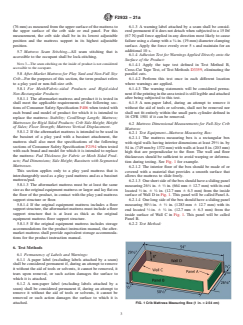
6.2.1.1 The mattress measuring box is a rectangular box with rigid walls having interior dimensions at least 29 ⁄2 in. by 54 in.
(749 mm by 1372 mm) with walls at least 8 in. (203 mm) high that are perpendicular to the floor. The wall and floor thicknesses
should be sufficient to avoid warping or deformation during testing. See Fig. 1 for example.
6.2.1.2 The interior floor of the box should be made of or covered with a material that provides a smooth surface that allows the
mattress to slide freely.
1 1
6.2.1.3 One short side of the box should have a sliding panel measuring 26 ⁄8 in. 6 ⁄2 in. (664 mm 6 12.7 mm) with its end
1 1
located ⁄2 in. 6 ⁄4 in. (12.7 mm 6 6.3 mm) from the inside surface of Wall D in Fig. 1. This panel will be called Panel A.
1 1
6.2.1.4 One long side of the box should have a sliding panel measuring 50 ⁄2 in. 6 ⁄2 in. (1283 mm 6 12.7 mm) with its end
1 1
located ⁄2 in. 6 ⁄4 in. (12.7 mm 6 6.3 mm) from the inside surface of Wall C in Fig. 1. This panel will be called Panel B.
6.2.2 Test Method:
6.2.2.1 Place the mattress into the mattress measuring box so it is touching Walls C and D.
6.2.2.2 To position the mattress in the measuring box, gradually apply a 7 lbf (31.1 N) force to the midpoint of Panel A. Release
this force. Then gradually apply a 14 lbf (62.3 N) force to the midpoint of Panel B. Release this force.
6.2.2.3 Apply a 7 lbf 6 1 lbf (31.1 N 6 4.4 N) force to the midpoint of Panel A within a period of 5 s. Within 30 s of application
of the force to Panel A, and while maintaining this force, apply a 14 lbf 6 1 lbf (62.3 N 6 4.4 N) force to the midpoint of Panel
B within a period of 5 s.
6.2.2.4 Apply the forces from 6.2.2.3 for 60 s. With forces still applied, applied to the midpoints of Panels A and B, measure the
length and width of the interior dimension measured from the horizontal midpoints of Panel A to Wall C (length) and Panel B to
Wall D (width). These measurements are to be considered the mattress dimensions.
FIG. 1 Crib Mattress Measuring Box (1 in. = 2.54 cm)
F2933 − 21a
7. Marking and Labeling
7.1 Each mattress and its retail package shall be marked or labeled clearly and legibly to indicate the following:
7.1.1 The name, place of business (city, state, and mailing address, including zip code), and telephone number of the manufacturer,
distributor
...
Questions, Comments and Discussion
Ask us and Technical Secretary will try to provide an answer. You can facilitate discussion about the standard in here.
Loading comments...