

ASTM E1917-13(2018)
(Test Method)Standard Test Method for Determination of Phosphorus in Nickel, Ferronickel, and Nickel Alloys by Phosphovanadomolybdate Spectrophotometry
General Information
- Abstract
SIGNIFICANCE AND USE
5.1 This test method is used for the determination of phosphorus in nickel, ferronickel, and nickel alloy samples by molecular absorption spectrometry to check compliance with compositional specifications. It is assumed that all who use the procedure will be trained analysts capable of performing common laboratory procedures skillfully and safely. It is expected that the work will be performed in a properly equipped laboratory and that proper waste disposal procedures will be followed. Appropriate quality control practices must be followed, such as those described in Guide E882.
SCOPE
1.1 This test method covers the determination of phosphorus in nickel, ferronickel, and nickel alloys in the range 0.0007 % to 0.05 %.
1.2 Arsenic, chromium, hafnium, niobium, silicon, tantalum, titanium, and tungsten interfere, but the interference can be avoided by complexation or volatilization (for chromium). The lowest phosphorus content (0.0007 %) can be reached only in samples with low contents of interfering elements.
1.3 The values stated in SI units are to be regarded as standard. No other units of measurement are included in this standard.
1.4 This standard does not purport to address all of the safety concerns, if any, associated with its use. It is the responsibility of the user of this standard to establish appropriate safety, health, and environmental practices and determine the applicability of regulatory limitations prior to use. For specific hazards associated with the use of this test method see Practices E50. Refer to specific warning notes given throughout this test method.
1.5 This international standard was developed in accordance with internationally recognized principles on standardization established in the Decision on Principles for the Development of International Standards, Guides and Recommendations issued by the World Trade Organization Technical Barriers to Trade (TBT) Committee.
- Status
- Published
- Publication Date
- 30-Sep-2018
- Technical Committee
- E01 - Analytical Chemistry for Metals, Ores, and Related Materials
- Drafting Committee
- E01.08 - Ni and Co and High Temperature Alloys

Overview
ASTM E1917-13(2018) defines a standardized test method for the determination of phosphorus content in nickel, ferronickel, and nickel alloys using phosphovanadomolybdate spectrophotometry. This method is intended for quality control, specification compliance, and routine analysis in analytical laboratories. The standard is suitable for quantifying phosphorus concentrations in the range of 0.0007% to 0.05%. It is expected that analyses covered by this standard are performed by trained laboratory professionals using appropriate safety and environmental practices.
Key Topics
Scope of the Method
- Applicable for nickel, ferronickel, and nickel alloys
- Detects phosphorus in the range of 0.0007% to 0.05%
- Sensitive to the presence of certain interfering elements such as arsenic, chromium, hafnium, niobium, silicon, tantalum, titanium, and tungsten
Methodology
- Utilizes molecular absorption spectrometry at a wavelength of 355 nm
- Phosphorus forms a phosphovanadomolybdate complex, which is then extracted and analyzed
- Interfering elements are addressed through complexation or volatilization (particularly for chromium)
Quality and Safety Requirements
- Samples should be free from contamination (such as oil or grease)
- Accurate sample preparation and handling of reagents are essential
- Laboratories must implement appropriate quality control, guided by applicable standards (such as ASTM Guide E882)
- Safety procedures must be aligned with regulations and practices like ASTM E50
Applications
Compositional Analysis
- Ensures nickel, ferronickel, and nickel alloys comply with product specifications regarding phosphorus content
- Helps manufacturers and users meet quality control requirements in various industries, including metallurgy, electronics, and aerospace
Quality Assurance and Accreditation
- Recognized for use in interlaboratory studies, supporting repeatability and reproducibility, which are critical for laboratory accreditation and certification
Research and Development
- Offers an established method for R&D teams to monitor and refine alloy compositions during product development
Related Standards
- ASTM E29 - Practice for Using Significant Digits in Test Data to Determine Conformance with Specifications
- ASTM E50 - Practices for Apparatus, Reagents, and Safety Considerations for Chemical Analysis of Metals, Ores, and Related Materials
- ASTM E135 - Terminology Relating to Analytical Chemistry for Metals, Ores, and Related Materials
- ASTM E882 - Guide for Accountability and Quality Control in the Chemical Analysis Laboratory
- ASTM E1601 - Practice for Conducting an Interlaboratory Study to Evaluate the Performance of an Analytical Method
- ISO 5725:1986 - Determination of repeatability and reproducibility for a standard test method by interlaboratory tests
- ISO 11400:1992(E) - Nickel, Ferronickel, and Nickel Alloys - Determination of phosphorus content by phosphovanadomolybdate spectrophotometry
Practical Value
Implementing ASTM E1917 provides confidence in phosphorus testing results for nickel-based alloys, critical for product reliability and regulatory compliance. Laboratories following this method benefit from a clear framework for accurate, repeatable analysis, supporting both internal quality processes and external customer requirements. Proper application of this standard helps minimize the risk of product rejection due to off-spec phosphorus levels, contributing to efficient manufacturing and material certification workflows.
Keywords: phosphorus determination, nickel analysis, ferronickel, nickel alloys, spectrophotometry, compositional specifications, ASTM E1917, quality control, laboratory standards
Relations
- Effective Date
- 01-Oct-2018
- Effective Date
- 01-Jan-2020
- Effective Date
- 01-Nov-2019
- Effective Date
- 15-May-2019
- Effective Date
- 01-Sep-2017
- Effective Date
- 01-Dec-2016
- Effective Date
- 01-Dec-2016
- Effective Date
- 01-Aug-2016
- Effective Date
- 15-May-2016
- Effective Date
- 01-Jul-2015
- Effective Date
- 15-May-2015
- Effective Date
- 15-Aug-2014
- Effective Date
- 01-Apr-2014
- Effective Date
- 15-Feb-2014
- Effective Date
- 01-Dec-2013
Get Certified
Connect with accredited certification bodies for this standard

Element Materials Technology
Materials testing and product certification.

Inštitut za kovinske materiale in tehnologije
Institute of Metals and Technology. Materials testing, metallurgical analysis, NDT.
Sponsored listings
Frequently Asked Questions
ASTM E1917-13(2018) is a standard published by ASTM International. Its full title is "Standard Test Method for Determination of Phosphorus in Nickel, Ferronickel, and Nickel Alloys by Phosphovanadomolybdate Spectrophotometry". This standard covers: SIGNIFICANCE AND USE 5.1 This test method is used for the determination of phosphorus in nickel, ferronickel, and nickel alloy samples by molecular absorption spectrometry to check compliance with compositional specifications. It is assumed that all who use the procedure will be trained analysts capable of performing common laboratory procedures skillfully and safely. It is expected that the work will be performed in a properly equipped laboratory and that proper waste disposal procedures will be followed. Appropriate quality control practices must be followed, such as those described in Guide E882. SCOPE 1.1 This test method covers the determination of phosphorus in nickel, ferronickel, and nickel alloys in the range 0.0007 % to 0.05 %. 1.2 Arsenic, chromium, hafnium, niobium, silicon, tantalum, titanium, and tungsten interfere, but the interference can be avoided by complexation or volatilization (for chromium). The lowest phosphorus content (0.0007 %) can be reached only in samples with low contents of interfering elements. 1.3 The values stated in SI units are to be regarded as standard. No other units of measurement are included in this standard. 1.4 This standard does not purport to address all of the safety concerns, if any, associated with its use. It is the responsibility of the user of this standard to establish appropriate safety, health, and environmental practices and determine the applicability of regulatory limitations prior to use. For specific hazards associated with the use of this test method see Practices E50. Refer to specific warning notes given throughout this test method. 1.5 This international standard was developed in accordance with internationally recognized principles on standardization established in the Decision on Principles for the Development of International Standards, Guides and Recommendations issued by the World Trade Organization Technical Barriers to Trade (TBT) Committee.
SIGNIFICANCE AND USE 5.1 This test method is used for the determination of phosphorus in nickel, ferronickel, and nickel alloy samples by molecular absorption spectrometry to check compliance with compositional specifications. It is assumed that all who use the procedure will be trained analysts capable of performing common laboratory procedures skillfully and safely. It is expected that the work will be performed in a properly equipped laboratory and that proper waste disposal procedures will be followed. Appropriate quality control practices must be followed, such as those described in Guide E882. SCOPE 1.1 This test method covers the determination of phosphorus in nickel, ferronickel, and nickel alloys in the range 0.0007 % to 0.05 %. 1.2 Arsenic, chromium, hafnium, niobium, silicon, tantalum, titanium, and tungsten interfere, but the interference can be avoided by complexation or volatilization (for chromium). The lowest phosphorus content (0.0007 %) can be reached only in samples with low contents of interfering elements. 1.3 The values stated in SI units are to be regarded as standard. No other units of measurement are included in this standard. 1.4 This standard does not purport to address all of the safety concerns, if any, associated with its use. It is the responsibility of the user of this standard to establish appropriate safety, health, and environmental practices and determine the applicability of regulatory limitations prior to use. For specific hazards associated with the use of this test method see Practices E50. Refer to specific warning notes given throughout this test method. 1.5 This international standard was developed in accordance with internationally recognized principles on standardization established in the Decision on Principles for the Development of International Standards, Guides and Recommendations issued by the World Trade Organization Technical Barriers to Trade (TBT) Committee.
ASTM E1917-13(2018) is classified under the following ICS (International Classification for Standards) categories: 77.120.40 - Nickel, chromium and their alloys. The ICS classification helps identify the subject area and facilitates finding related standards.
ASTM E1917-13(2018) has the following relationships with other standards: It is inter standard links to ASTM E1917-13, ASTM E135-20, ASTM E1601-19, ASTM E135-19, ASTM E50-17, ASTM E882-10(2016), ASTM E882-10(2016)e1, ASTM E50-11(2016), ASTM E135-16, ASTM E135-15a, ASTM E135-15, ASTM E135-14b, ASTM E135-14a, ASTM E135-14, ASTM E135-13a. Understanding these relationships helps ensure you are using the most current and applicable version of the standard.
ASTM E1917-13(2018) is available in PDF format for immediate download after purchase. The document can be added to your cart and obtained through the secure checkout process. Digital delivery ensures instant access to the complete standard document.
Standards Content (Sample)
This international standard was developed in accordance with internationally recognized principles on standardization established in the Decision on Principles for the
Development of International Standards, Guides and Recommendations issued by the World Trade Organization Technical Barriers to Trade (TBT) Committee.
Designation: E1917 − 13 (Reapproved 2018)
Standard Test Method for
Determination of Phosphorus in Nickel, Ferronickel, and
Nickel Alloys by Phosphovanadomolybdate
Spectrophotometry
This standard is issued under the fixed designation E1917; the number immediately following the designation indicates the year of
original adoption or, in the case of revision, the year of last revision. A number in parentheses indicates the year of last reapproval. A
superscript epsilon (´) indicates an editorial change since the last revision or reapproval.
1. Scope E29 Practice for Using Significant Digits in Test Data to
Determine Conformance with Specifications
1.1 This test method covers the determination of phospho-
E50 Practices for Apparatus, Reagents, and Safety Consid-
rus in nickel, ferronickel, and nickel alloys in the range
erations for Chemical Analysis of Metals, Ores, and
0.0007 % to 0.05 %.
Related Materials
1.2 Arsenic, chromium, hafnium, niobium, silicon,
E135 Terminology Relating to Analytical Chemistry for
tantalum, titanium, and tungsten interfere, but the interference
Metals, Ores, and Related Materials
can be avoided by complexation or volatilization (for chro-
E882 Guide for Accountability and Quality Control in the
mium). The lowest phosphorus content (0.0007 %) can be
Chemical Analysis Laboratory
reached only in samples with low contents of interfering
E1601 Practice for Conducting an Interlaboratory Study to
elements.
Evaluate the Performance of an Analytical Method
1.3 The values stated in SI units are to be regarded as 2.2 ISO Standards:
standard. No other units of measurement are included in this ISO 5725:1986 Precision of Test Methods—Determination
standard. of Repeatability and Reproducibility for a Standard Test
Method by Inter-laboratory Tests
1.4 This standard does not purport to address all of the
ISO 11400:1992(E) Nickel, Ferronickel, and Nickel
safety concerns, if any, associated with its use. It is the
Alloys—Determination of Phosphorus Content—
responsibility of the user of this standard to establish appro-
Phosphovanadomolybdate MolecularAbsorption Spectro-
priate safety, health, and environmental practices and deter-
metric Method
mine the applicability of regulatory limitations prior to use.
For specific hazards associated with the use of this test method
3. Terminology
see Practices E50. Refer to specific warning notes given
3.1 Definitions—For definitions of terms used in this test
throughout this test method.
method, refer to Terminology E135.
1.5 This international standard was developed in accor-
dance with internationally recognized principles on standard-
4. Summary of Test Method
ization established in the Decision on Principles for the
4.1 The sample is dissolved in a mixture of HCl and HNO .
Development of International Standards, Guides and Recom-
HClO is added and the solution is evaporated to fumes of
mendations issued by the World Trade Organization Technical
HClO to remove chromium as volatile chromyl chloride.
Barriers to Trade (TBT) Committee.
Silicon and refractory elements are complexed with fluoride
2. Referenced Documents ions through the addition of HF. Phosphorus is converted to
2 phosphovanadomolybdicacidinanHClO andHNO solution.
4 3
2.1 ASTM Standards:
The phosphovanadomolybdic acid is extracted with 2-methyl-
2-pentanone in the presence of citric acid to complex arsenic.
Absorbance is measured at 355 nm.
This practice is under the jurisdiction of ASTM Committee E01 on Analytical
Chemistry for Metals, Ores, and Related Materials and is the direct responsibility of
5. Significance and Use
Subcommittee E01.08 on Ni and Co and High Temperature Alloys.
Current edition approved Oct. 1, 2018. Published November 2018. Originally
5.1 This test method is used for the determination of
approved in 1997. Last previous edition approved in 2013 as E1917 – 13. DOI:
phosphorus in nickel, ferronickel, and nickel alloy samples by
10.1520/E1917-13R18.
For referenced ASTM standards, visit the ASTM website, www.astm.org, or
contact ASTM Customer Service at service@astm.org. For Annual Book of ASTM
Standards volume information, refer to the standard’s Document Summary page on Available fromAmerican National Standards Institute (ANSI), 25 W. 43rd St.,
the ASTM website. 4th Floor, New York, NY 10036, http://www.ansi.org.
Copyright © ASTM International, 100 Barr Harbor Drive, PO Box C700, West Conshohocken, PA 19428-2959. United States
E1917 − 13 (2018)
TABLE 2 Nominal Composition of Nickel and Ferro-nickel
molecular absorption spectrometry to check compliance with
Samples, %
compositional specifications. It is assumed that all who use the
Test Material P As Cr Fe Si Ni
procedure will be trained analysts capable of performing
Ni #1 0.00005 - - < 0.01 - balance
common laboratory procedures skillfully and safely. It is
Ni #2 0.0008 - - balance - balance
expected that the work will be performed in a properly
Fe-Ni #1 0.01 < 0.001 0.5 balance 0.5 25
equipped laboratory and that proper waste disposal procedures
Fe-Ni #2 0.01 0.1 4.5 balance 5 25
Fe-Ni #3 0.045 0.001 0.5 balance 0.6 25
will be followed.Appropriate quality control practices must be
Fe-Ni #4 0.045 0.1 4.5 balance 5 25
followed, such as those described in Guide E882.
6. Apparatus
TABLE 3 Nominal Composition of Nickel Alloy Samples, %
6.1 Spectrophotometer—Capable of measuring absorbance
Sample P Co Cr Cu Fe Mo Ni Nb W
at a wavelength of 355 nm.
4D-7 0.01 - - 32 1 - 65 - -
4D-8 0.01 - 21 - 4 9 62 3 -
6.2 Cells—To fit spectrophotometer, having an optical path
4D-9 0.02 - 19 - 19 3 53 5 -
of 1 cm.
4D-10 0.02 - 20 - 46 - 31 - -
4D-11 0.01 - 21 - 20 8 47 - -
NOTE 1—Cells having other dimensions can be used, provided suitable A
4D-12 0.005 42 21 - 2 4 20 4 4
adjustments can be made in the amount of sample and reagents used.
A
Standard Reference alloy BAM 328-1, certified at 0.005 % P was used as
6.3 Plastic separatory funnels, 250-mL capacity. sample 4D-12.
7. Reagents
TABLE 4 Results of Statistical Analysis
7.1 Purity and Concentration of Reagents—The purity and
Repeatability Reproducibility
concentration of common chemical reagents and water shall
Test Mean,
Index (Practice Index (Practice
A
Material %
conform to Practices E50. The reagents should be free of or
E1601) E1601)
contain only minimal amounts (< 0.1 µg⁄g) of phosphorus.
Ni #2 0.00091 0.0002 0.0004
B
7.1.1 Verify the absence of phosphorus in the reagents using 4D-12 0.0054 0.0004 0.0022
4D-8 0.0089 0.0024 0.0050
theblanktest.Reagentsgivinghighblankvaluesareunsuitable
FeNi #1 0.0100 0.0012 0.0014
and should not be used.The blank value for all reagents should
FeNi #2 0.0100 0.0012 0.0012
be below 0.0005 % P calculated for a 1-g sample. 4D-7 0.0120 0.0016 0.0026
4D-11 0.0135 0.0016 0.0027
7.2 Ammonium Metavanadate Solution—Dissolve 2.5 g of
4D-9 0.0148 0.0023 0.0028
4D-10 0.0185 0.0010 0.0022
ammonium metavanadate (NH VO ) in water, dilute to 1 L,
4 3
FeNi #4 0.0425 0.0027 0.0038
and mix.
FeNi #3 0.0437 0.0021 0.0068
A
7.3 Citric Acid Solution—Dissolve 500 g citric acid mono-
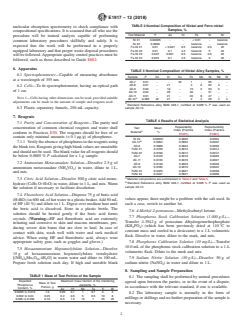
Material compositions are summarized in Table 2 and Table 3.
B
Standard Reference alloy BAM 328-1, certified at 0.005 % P was used as
hydrate (C H O ·H O) in water, dilute to 1 L, and mix. Warm
6 8 7 2
sample 4D-12.
the solution if necessary to facilitate dissolution.
7.4 Fluoroboric Acid Solution—Disperse 75 g of boric acid
values appear, there might be a problem with the salt used. In
(H BO )in600 mLofhotwaterinaplasticbeaker.Add50 mL
3 3
of HF (40 %) and dilute to 1 L. Digest over medium heat until such a case, switch to another lot.
the boric acid is dissolved. Store in a plastic bottle. The
7.6 4-Methyl-2-pentanone—Methylisobutyl ketone.
solution should be heated gently if the boric acid forms
7.7 Phosphorus Stock Calibration Solution (1.000 g⁄L)—
crystals. (Warning—HF and fluoroboric acid are extremely
Transfer 4.3942 g of potassium dihydrogenorthophosphate
irritating and corrosive to skin and mucous membranes, pro-
(KH PO ) (which has been previously dried at 110 °C to
2 4
ducing severe skin burns that are slow to heal. In case of
constant mass and cooled in a desiccator) to a 1-L volumetric
contact with skin, wash well with water and seek medical
flask. Dissolve in water, dilute to the mark, and mix.
advice. When using HF and fluoroboric acid, always wear
appropriate safety gear, such as goggles and gloves.) 7.8 Phosphorus Calibration Solution (10 mg⁄L)—Transfer
10.0 mL of the phosphorus stock calibration solution to a 1-L
7.5 Hexaammonium Heptamolybdate Solu
...