

ASTM F985-18(2023)
(Specification)Standard Specification for Pilot Platform
General Information
- Abstract
ABSTRACT
This specification provides design and construction details for Panama Canal pilot platforms placed aboard the vessel. Platforms shall conform to the requirements of the Panama Canal Commission and Title 35 of the Code of Federal Regulations. The platforms shall be welded-aluminum construction. Decking shall be serrated-aluminum grating. Canopy shall be of vinyl-nylon construction with sewn seams and metallic grommets. Finally, canopy tie-downs shall be of a specified nylon line thickness.
SCOPE
1.1 This specification covers design and construction details for pilot platforms.
1.2 The values stated in SI units are to be regarded as standard. No other units of measurement are included in this standard.
1.3 This international standard was developed in accordance with internationally recognized principles on standardization established in the Decision on Principles for the Development of International Standards, Guides and Recommendations issued by the World Trade Organization Technical Barriers to Trade (TBT) Committee.
- Status
- Published
- Publication Date
- 30-Jun-2023
- Technical Committee
- F25 - Ships and Marine Technology
- Drafting Committee
- F25.03 - Outfitting and Deck Machinery
Overview
ASTM F985-18(2023) - Standard Specification for Pilot Platform establishes comprehensive requirements for the design and construction of pilot platforms used aboard vessels, particularly in compliance with the specific needs of the Panama Canal. Developed by ASTM International, this standard ensures that pilot platforms are safe, durable, and consistent with recognized global principles of standardization, meeting both Panama Canal Commission rules and Title 35 of the Code of Federal Regulations.
This specification focuses on welded aluminum construction, providing details on materials, workmanship, dimensions, and finish, with the aim of ensuring reliable performance and safety for marine personnel and operations.
Key Topics
1. Design and Construction Requirements
- Pilot platforms must have welded-aluminum construction with materials compliant with ASTM B221, Alloy 5086.
- Decking is specified as serrated-aluminum grating for slip resistance and durability.
- Canopies must be constructed from vinyl-nylon fabric, finished with sewn seams and metallic grommets for added strength and weather resistance.
- Canopy tie-downs are specified as 4 mm thick nylon lines for secure attachment.
2. Regulatory and Compliance
- Platforms must satisfy the Panama Canal Commission and CFR Title 35 requirements.
- The standard aligns with WTO TBT Committee principles to support international market access and reduce technical barriers to trade.
3. Dimensions and Tolerances
- All measurements are stated in SI units only.
- Tolerances are strict, ensuring consistency across installations. Construction tolerance is 4 mm, and bolt hole location tolerance is 1 mm.
- The typical unit weight is approximately 1250 N.
4. Workmanship and Safety
- Finished pilot platforms must be free from weld splatter, sharp edges, or burrs that could cause injury.
- Optional paint finishes may be specified by the customer to match vessel-specific requirements or branding.
Applications
Pilot platforms constructed to ASTM F985-18(2023) standards are crucial in several maritime contexts:
- Panama Canal Transit: Ensures platforms are uniformly safe and functional for maritime pilots boarding and leaving ships.
- Ship Outfitting: Used worldwide for new builds and retrofitting vessels operating in regions that require compliance with international and Panama Canal regulations.
- Marine Safety Upgrades: Supports ship operators in maintaining compliance with updated safety protocols and industry best practices.
- Inspection and Certification: Provides a benchmark for surveyors, regulatory bodies, and shipowners to assess pilot platform integrity and suitability.
Related Standards
For a comprehensive approach to ship and marine outfitting, consider referencing these related standards:
- ASTM B221: Specification for Aluminum and Aluminum-Alloy Extruded Bars, Rods, Wire, Profiles, and Tubes - referenced as the base material standard for welded aluminum construction.
- Panama Canal Commission Requirements: Ensure platforms meet regional safety and operational standards, especially for vessels transiting the Canal.
- Title 35, Code of Federal Regulations: Outlines federal requirements impacting marine operations and equipment in U.S. waters.
ASTM F985-18(2023) is essential for shipbuilders, marine engineers, naval architects, regulatory agencies, and maritime operators seeking to implement robust, compliant, and internationally accepted pilot platform designs. Its focus on safety, durability, and regulatory alignment makes it an indispensable part of maritime outfitting standards.
Relations
- Effective Date
- 01-Apr-2013
- Effective Date
- 15-Nov-2012
- Effective Date
- 15-Jan-2012
- Effective Date
- 08-Aug-2008
- Effective Date
- 01-Nov-2006
- Effective Date
- 01-Oct-2005
- Effective Date
- 01-Jun-2005
- Effective Date
- 05-Oct-2004
- Effective Date
- 10-May-2000
Get Certified
Connect with accredited certification bodies for this standard

DNV
DNV is an independent assurance and risk management provider.

Lloyd's Register
Lloyd's Register is a global professional services organisation specialising in engineering and technology.

FSC International
Forest Stewardship Council certification.
Sponsored listings
Frequently Asked Questions
ASTM F985-18(2023) is a technical specification published by ASTM International. Its full title is "Standard Specification for Pilot Platform". This standard covers: ABSTRACT This specification provides design and construction details for Panama Canal pilot platforms placed aboard the vessel. Platforms shall conform to the requirements of the Panama Canal Commission and Title 35 of the Code of Federal Regulations. The platforms shall be welded-aluminum construction. Decking shall be serrated-aluminum grating. Canopy shall be of vinyl-nylon construction with sewn seams and metallic grommets. Finally, canopy tie-downs shall be of a specified nylon line thickness. SCOPE 1.1 This specification covers design and construction details for pilot platforms. 1.2 The values stated in SI units are to be regarded as standard. No other units of measurement are included in this standard. 1.3 This international standard was developed in accordance with internationally recognized principles on standardization established in the Decision on Principles for the Development of International Standards, Guides and Recommendations issued by the World Trade Organization Technical Barriers to Trade (TBT) Committee.
ABSTRACT This specification provides design and construction details for Panama Canal pilot platforms placed aboard the vessel. Platforms shall conform to the requirements of the Panama Canal Commission and Title 35 of the Code of Federal Regulations. The platforms shall be welded-aluminum construction. Decking shall be serrated-aluminum grating. Canopy shall be of vinyl-nylon construction with sewn seams and metallic grommets. Finally, canopy tie-downs shall be of a specified nylon line thickness. SCOPE 1.1 This specification covers design and construction details for pilot platforms. 1.2 The values stated in SI units are to be regarded as standard. No other units of measurement are included in this standard. 1.3 This international standard was developed in accordance with internationally recognized principles on standardization established in the Decision on Principles for the Development of International Standards, Guides and Recommendations issued by the World Trade Organization Technical Barriers to Trade (TBT) Committee.
ASTM F985-18(2023) is classified under the following ICS (International Classification for Standards) categories: 47.020.10 - Hulls and their structure elements. The ICS classification helps identify the subject area and facilitates finding related standards.
ASTM F985-18(2023) has the following relationships with other standards: It is inter standard links to ASTM B221-13, ASTM B221-12a, ASTM B221-12, ASTM B221-08, ASTM B221-06, ASTM B221-05a, ASTM B221-05, ASTM B221-04a, ASTM B221-00. Understanding these relationships helps ensure you are using the most current and applicable version of the standard.
ASTM F985-18(2023) is available in PDF format for immediate download after purchase. The document can be added to your cart and obtained through the secure checkout process. Digital delivery ensures instant access to the complete standard document.
Standards Content (Sample)
This international standard was developed in accordance with internationally recognized principles on standardization established in the Decision on Principles for the
Development of International Standards, Guides and Recommendations issued by the World Trade Organization Technical Barriers to Trade (TBT) Committee.
Designation: F985 − 18 (Reapproved 2023) An American National Standard
Standard Specification for
Pilot Platform
This standard is issued under the fixed designation F985; the number immediately following the designation indicates the year of original
adoption or, in the case of revision, the year of last revision. A number in parentheses indicates the year of last reapproval. A superscript
epsilon (´) indicates an editorial change since the last revision or reapproval.
1. Scope 3. Ordering Information
1.1 This specification covers design and construction details 3.1 Pilot platforms shall be ordered by this ASTM designa-
tion and year of issue.
for pilot platforms.
3.2 Paint finish (if other than standard).
1.2 The values stated in SI units are to be regarded as
standard. No other units of measurement are included in this
4. Materials and Methods
standard.
4.1 Platforms shall be welded-aluminum construction in
1.3 This international standard was developed in accor-
accordance with Specification B221, Alloy 5086.
dance with internationally recognized principles on standard-
4.2 Decking shall be serrated-aluminum grating.
ization established in the Decision on Principles for the
Development of International Standards, Guides and Recom-
4.3 Canopy shall be of vinyl-nylon construction with sewn
mendations issued by the World Trade Organization Technical seams and metallic grommets.
Barriers to Trade (TBT) Committee.
4.4 Canopy tie-downs shall be 4 mm nylon line.
4.5 Paint finish, if required, shall be in accordance with
2. Referenced Documents
customer specifications.
2.1 ASTM Standards:
5. Dimensions, Weight, and Permissible Variations
B221 Specification for Aluminum and Aluminum-Alloy Ex-
truded Bars, Rods, Wire, Profiles, and Tubes
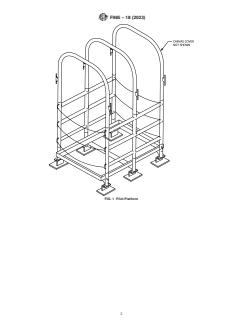
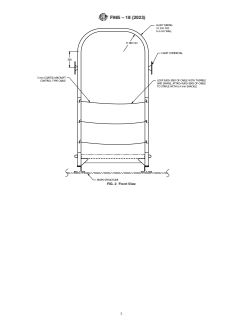
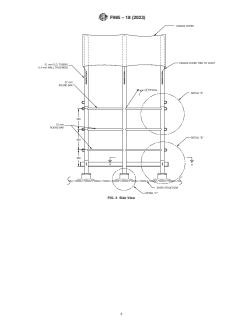
5.1 Dimensions as indicated in Figs. 1-7.
5.2 The approximate unit weight is 1250 N.
5.3 The construction tolerance is 4 mm, except bolt hole
This specification is under the jurisdiction of ASTM Committee F25 on Ships
location 1 mm.
and Marine Technology and is the direct responsibility of Subcommittee F25.03 on
Outfitting and Deck Machinery.
6. Workmanship, Finish, and Appearance
Current edition approved July 1, 2023. Published July 2023. Originally approved
in 1986. Last previous edition approved in 2018 as F985 – 18. DOI: 10.1520/F0985- 6.1 Shelters shall be free of weld splatter, sharp edges, and
18R23
...