

ASTM D3485-22
(Specification)Standard Specification for Coilable High Density Polyethylene (HDPE) Cable in Conduit (CIC)
General Information
- Abstract
SCOPE
1.1 This specification covers cable in conduit (CIC), which is a smooth-walled, coilable, high-density polyethylene (HDPE) conduit (duct) that contains preassembled wires and cables. The outside diameter of the conduit is controlled and the wire or cable encased within may be comprised of single or multiple configurations consisting of electrical/power wires or cables, fiber optic, traditional copper communication, coaxial cable, or any combination thereof. CIC configurations are preassembled into the conduit during the extrusion process and in industry-specific designs for use in commercial, industrial, transportation, government, and utility applications
1.2 This specification does not attempt to identify every possible preassembled conduit/cable configuration but is intended to identify material and minimum assembled product properties for optimizing reliability and service life.
1.3 The values stated in inch-pound units are to be regarded as standard. The values given in parentheses are mathematical conversions to SI units that are provided for information only and are not considered standard.
Note 1: UL 1990 and CSA C22.2 No.327 have a similar scope to D3485; however, there are differences in scope and requirements.
Note 2: End users may elect to field install single or multiple wire or cable configurations into field-installed conduit. In the case where polyethylene conduit is to have the wire or cable configurations field installed, then the more appropriate specifications to select for establishing the conduit’s material, dimensional, workmanship, and property tests would be Specification F2160, UL 651A, CSA C22.2 No.327 or NEMA TC-7.
Note 3: Whenever two sets of values are presented, in different units, the imperial units are the standard, while those in the parentheses (metric units) are provided for informational purposes.
1.4 This standard does not purport to address all of the safety concerns, if any, associated with its use. It is the responsibility of the user of this standard to establish appropriate safety, health, and environmental practices and determine the applicability of regulatory limitations prior to use.
1.5 This international standard was developed in accordance with internationally recognized principles on standardization established in the Decision on Principles for the Development of International Standards, Guides and Recommendations issued by the World Trade Organization Technical Barriers to Trade (TBT) Committee.
- Status
- Published
- Publication Date
- 30-Jun-2022
- Technical Committee
- F17 - Plastic Piping Systems
- Drafting Committee
- F17.26 - Olefin Based Pipe
Buy Documents
ASTM D3485-22 - Standard Specification for Coilable High Density Polyethylene (HDPE) Cable in Conduit (CIC)
REDLINE ASTM D3485-22 - Standard Specification for Coilable High Density Polyethylene (HDPE) Cable in Conduit (CIC)
Overview
ASTM D3485-22 is the internationally recognized standard specification for Coilable High Density Polyethylene (HDPE) Cable in Conduit (CIC). This standard, developed by ASTM International, sets forth critical requirements for smooth-walled, coilable HDPE conduits that incorporate preassembled wires or cables-such as power, fiber optic, copper communication, or coaxial types-during the extrusion process. Designed for use in commercial, industrial, transportation, government, and utility sectors, this standard ensures the reliability and durability of cable-in-conduit installations, streamlining deployment for underground and other challenging environments.
Key Topics
- Material Requirements: Specifies the use of HDPE resins that meet strict criteria for density, melt index, flexural modulus, tensile strength, and environmental safety, ensuring robust and long-lasting conduit performance.
- Conduit Construction: Covers dimensional controls for outside diameter and wall thickness, requirements for homogeneous material quality, and guidelines on allowable rework material and the avoidance of hazardous substances.
- Preassembled Cable Configurations: Allows single or multiple wire/cable types to be encased within the HDPE conduit, providing flexibility for various communication and power system designs.
- Mechanical and Environmental Testing: Details qualification test methods for pipe stiffness, flexibility, impact resistance at low temperatures, and UV stability for above-ground and outdoor installations.
- Installation and Marking: Outlines recommended installation practices-including trenching, plowing, and horizontal directional drilling-and mandates proper conduit marking for traceability and compliance with codes.
- Certification and Quality Control: Requires manufacturer certification that products meet ASTM D3485-22 requirements, including ongoing quality control and retesting protocols.
Applications
HDPE CIC solutions covered by ASTM D3485-22 are ideal for:
- Underground Utility Distribution: Protecting and simplifying the installation of power, communication, and fiber optic cables beneath roads, city infrastructure, or rural areas.
- Telecommunications Networks: Enabling rapid deployment of fiber or copper cabling for broadband, telephone, or high-speed data services.
- Transportation and Municipal Projects: Providing robust conduit for traffic management, lighting, and signal systems.
- Industrial and Commercial Facilities: Supporting secure cable management in plants, campuses, or distribution centers.
- Government and Defense: Meeting reliability needs for critical infrastructure and public works.
This standard enables continuous runs of conduit with minimal joints, decreasing the risk of water ingress and physical damage while reducing installation time and costs.
Related Standards
ASTM D3485-22 references and aligns with several key industry documents, drawing on their best practices and test methods for HDPE conduit performance:
- UL 1990 and CSA C22.2 No. 327: Comparable North American certifications for nonmetallic underground conduit with conductors.
- ASTM F2160: Specification for Solid Wall HDPE Conduit, particularly when conduit without pre-installed cables is field-assembled.
- NEMA TC 7: Industry guidelines for smooth-wall, coilable electrical polyethylene conduit.
- UL 651A: Schedule 40 and 80 HDPE Conduit.
- NFPA 70 (National Electrical Code): Regulatory compliance for cable installations.
- IEEE 1210: Test protocols for compatibility of cable-pulling lubricants.
- Plastic Pipe Institute (PPI) Manuals: Handbooks for polyethylene pipe applications and technical references for installation and performance.
Practical Value
Implementing ASTM D3485-22 ensures that coilable HDPE cable in conduit meets stringent standards for safety, durability, and efficiency. Key benefits include:
- Corrosion resistance and protection from mechanical damage
- Simplified project logistics with preassembled cable options
- Reduced installation time and disruption
- Support for evolving utility and broadband infrastructure
By meeting ASTM D3485-22 requirements, stakeholders deliver reliable, efficient, and future-ready cable protection systems for a variety of critical infrastructure projects.
Keywords: ASTM D3485-22, HDPE cable in conduit, coilable conduit, preassembled cable, underground cable protection, utility conduit, conduit standards, fiber optic conduit, power cable conduit.
Relations
- Refers
ASTM D1238-23a - Standard Test Method for Melt Flow Rates of Thermoplastics by Extrusion Plastometer - Effective Date
- 15-Nov-2023
- Effective Date
- 01-Apr-2020
- Effective Date
- 01-Jan-2019
- Effective Date
- 01-Nov-2018
- Refers
ASTM D1600-18 - Standard Terminology for Abbreviated Terms Relating to Plastics (Withdrawn 2024) - Effective Date
- 01-Jan-2018
- Effective Date
- 15-Nov-2017
- Effective Date
- 01-Aug-2017
- Effective Date
- 01-Jul-2017
- Effective Date
- 01-Feb-2017
- Effective Date
- 15-Nov-2016
- Effective Date
- 01-Aug-2016
- Effective Date
- 01-Dec-2015
- Effective Date
- 01-Dec-2015
- Effective Date
- 01-Jun-2015
- Refers
ASTM D2122-15 - Standard Test Method for Determining Dimensions of Thermoplastic Pipe and Fittings - Effective Date
- 15-Mar-2015
Buy Documents
ASTM D3485-22 - Standard Specification for Coilable High Density Polyethylene (HDPE) Cable in Conduit (CIC)
REDLINE ASTM D3485-22 - Standard Specification for Coilable High Density Polyethylene (HDPE) Cable in Conduit (CIC)
Get Certified
Connect with accredited certification bodies for this standard

IMQ S.p.A. (Certification)
Italian electrical product certification.

SLG Prüf- und Zertifizierungs GmbH
German testing and certification body.

UL Solutions
Global safety science company with testing, inspection and certification.
Sponsored listings
Frequently Asked Questions
ASTM D3485-22 is a technical specification published by ASTM International. Its full title is "Standard Specification for Coilable High Density Polyethylene (HDPE) Cable in Conduit (CIC)". This standard covers: SCOPE 1.1 This specification covers cable in conduit (CIC), which is a smooth-walled, coilable, high-density polyethylene (HDPE) conduit (duct) that contains preassembled wires and cables. The outside diameter of the conduit is controlled and the wire or cable encased within may be comprised of single or multiple configurations consisting of electrical/power wires or cables, fiber optic, traditional copper communication, coaxial cable, or any combination thereof. CIC configurations are preassembled into the conduit during the extrusion process and in industry-specific designs for use in commercial, industrial, transportation, government, and utility applications 1.2 This specification does not attempt to identify every possible preassembled conduit/cable configuration but is intended to identify material and minimum assembled product properties for optimizing reliability and service life. 1.3 The values stated in inch-pound units are to be regarded as standard. The values given in parentheses are mathematical conversions to SI units that are provided for information only and are not considered standard. Note 1: UL 1990 and CSA C22.2 No.327 have a similar scope to D3485; however, there are differences in scope and requirements. Note 2: End users may elect to field install single or multiple wire or cable configurations into field-installed conduit. In the case where polyethylene conduit is to have the wire or cable configurations field installed, then the more appropriate specifications to select for establishing the conduit’s material, dimensional, workmanship, and property tests would be Specification F2160, UL 651A, CSA C22.2 No.327 or NEMA TC-7. Note 3: Whenever two sets of values are presented, in different units, the imperial units are the standard, while those in the parentheses (metric units) are provided for informational purposes. 1.4 This standard does not purport to address all of the safety concerns, if any, associated with its use. It is the responsibility of the user of this standard to establish appropriate safety, health, and environmental practices and determine the applicability of regulatory limitations prior to use. 1.5 This international standard was developed in accordance with internationally recognized principles on standardization established in the Decision on Principles for the Development of International Standards, Guides and Recommendations issued by the World Trade Organization Technical Barriers to Trade (TBT) Committee.
SCOPE 1.1 This specification covers cable in conduit (CIC), which is a smooth-walled, coilable, high-density polyethylene (HDPE) conduit (duct) that contains preassembled wires and cables. The outside diameter of the conduit is controlled and the wire or cable encased within may be comprised of single or multiple configurations consisting of electrical/power wires or cables, fiber optic, traditional copper communication, coaxial cable, or any combination thereof. CIC configurations are preassembled into the conduit during the extrusion process and in industry-specific designs for use in commercial, industrial, transportation, government, and utility applications 1.2 This specification does not attempt to identify every possible preassembled conduit/cable configuration but is intended to identify material and minimum assembled product properties for optimizing reliability and service life. 1.3 The values stated in inch-pound units are to be regarded as standard. The values given in parentheses are mathematical conversions to SI units that are provided for information only and are not considered standard. Note 1: UL 1990 and CSA C22.2 No.327 have a similar scope to D3485; however, there are differences in scope and requirements. Note 2: End users may elect to field install single or multiple wire or cable configurations into field-installed conduit. In the case where polyethylene conduit is to have the wire or cable configurations field installed, then the more appropriate specifications to select for establishing the conduit’s material, dimensional, workmanship, and property tests would be Specification F2160, UL 651A, CSA C22.2 No.327 or NEMA TC-7. Note 3: Whenever two sets of values are presented, in different units, the imperial units are the standard, while those in the parentheses (metric units) are provided for informational purposes. 1.4 This standard does not purport to address all of the safety concerns, if any, associated with its use. It is the responsibility of the user of this standard to establish appropriate safety, health, and environmental practices and determine the applicability of regulatory limitations prior to use. 1.5 This international standard was developed in accordance with internationally recognized principles on standardization established in the Decision on Principles for the Development of International Standards, Guides and Recommendations issued by the World Trade Organization Technical Barriers to Trade (TBT) Committee.
ASTM D3485-22 is classified under the following ICS (International Classification for Standards) categories: 29.035.20 - Plastics and rubber insulating materials. The ICS classification helps identify the subject area and facilitates finding related standards.
ASTM D3485-22 has the following relationships with other standards: It is inter standard links to ASTM D1238-23a, ASTM F412-20, ASTM F412-19, ASTM D4883-18, ASTM D1600-18, ASTM D2444-17, ASTM F412-17a, ASTM D790-17, ASTM F412-17, ASTM F412-16a, ASTM F412-16, ASTM D790-15, ASTM D790-15e1, ASTM F412-15, ASTM D2122-15. Understanding these relationships helps ensure you are using the most current and applicable version of the standard.
ASTM D3485-22 is available in PDF format for immediate download after purchase. The document can be added to your cart and obtained through the secure checkout process. Digital delivery ensures instant access to the complete standard document.
Standards Content (Sample)
This international standard was developed in accordance with internationally recognized principles on standardization established in the Decision on Principles for the
Development of International Standards, Guides and Recommendations issued by the World Trade Organization Technical Barriers to Trade (TBT) Committee.
Designation:D3485 −22 An American National Standard
Standard Specification for
Coilable High Density Polyethylene (HDPE) Cable in Conduit
(CIC)
This standard is issued under the fixed designation D3485; the number immediately following the designation indicates the year of
original adoption or, in the case of revision, the year of last revision. A number in parentheses indicates the year of last reapproval. A
superscript epsilon (´) indicates an editorial change since the last revision or reapproval.
1. Scope* 1.5 This international standard was developed in accor-
dance with internationally recognized principles on standard-
1.1 This specification covers cable in conduit (CIC), which
ization established in the Decision on Principles for the
is a smooth-walled, coilable, high-density polyethylene
Development of International Standards, Guides and Recom-
(HDPE) conduit (duct) that contains preassembled wires and
mendations issued by the World Trade Organization Technical
cables. The outside diameter of the conduit is controlled and
Barriers to Trade (TBT) Committee.
the wire or cable encased within may be comprised of single or
multiple configurations consisting of electrical/power wires or
2. Referenced Documents
cables, fiber optic, traditional copper communication, coaxial
2.1 ASTM Standards:
cable, or any combination thereof. CIC configurations are
D618 Practice for Conditioning Plastics for Testing
preassembled into the conduit during the extrusion process and
D638 Test Method for Tensile Properties of Plastics
in industry-specific designs for use in commercial, industrial,
D790 Test Methods for Flexural Properties of Unreinforced
transportation, government, and utility applications
and Reinforced Plastics and Electrical Insulating Materi-
1.2 This specification does not attempt to identify every
als
possible preassembled conduit/cable configuration but is in-
D792 Test Methods for Density and Specific Gravity (Rela-
tended to identify material and minimum assembled product
tive Density) of Plastics by Displacement
properties for optimizing reliability and service life.
D1238 Test Method for Melt Flow Rates of Thermoplastics
1.3 The values stated in inch-pound units are to be regarded by Extrusion Plastometer
as standard. The values given in parentheses are mathematical
D1505 Test Method for Density of Plastics by the Density-
conversions to SI units that are provided for information only Gradient Technique
and are not considered standard.
D1600 Terminology forAbbreviatedTerms Relating to Plas-
tics
NOTE 1—UL 1990 and CSA C22.2 No.327 have a similar scope to
D1693 Test Method for Environmental Stress-Cracking of
D3485; however, there are differences in scope and requirements.
NOTE 2—End users may elect to field install single or multiple wire or Ethylene Plastics
cable configurations into field-installed conduit. In the case where
D2122 Test Method for Determining Dimensions of Ther-
polyethylene conduit is to have the wire or cable configurations field
moplastic Pipe and Fittings
installed,thenthemoreappropriatespecificationstoselectforestablishing
D2412 Test Method for Determination of External Loading
the conduit’s material, dimensional, workmanship, and property tests
Characteristics of Plastic Pipe by Parallel-Plate Loading
would be Specification F2160, UL 651A, CSA C22.2 No.327 or NEMA
TC-7.
D2444 Practice for Determination of the Impact Resistance
NOTE 3—Whenever two sets of values are presented, in different units,
of Thermoplastic Pipe and Fittings by Means of a Tup
the imperial units are the standard, while those in the parentheses (metric
(Falling Weight)
units) are provided for informational purposes.
D3350 Specification for Polyethylene Plastics Pipe and Fit-
1.4 This standard does not purport to address all of the
tings Materials
safety concerns, if any, associated with its use. It is the
D4883 Test Method for Density of Polyethylene by the
responsibility of the user of this standard to establish appro-
Ultrasound Technique
priate safety, health, and environmental practices and deter-
F2160 Specification for Solid Wall High Density Polyethyl-
mine the applicability of regulatory limitations prior to use.
ene (HDPE) Conduit Based on Controlled Outside Diam-
eter (OD)
This specification is under the jurisdiction ofASTM Committee F17 on Plastic
Piping Systemsand is the direct responsibility of Subcommittee F17.26 on Olefin
Based Pipe. For referenced ASTM standards, visit the ASTM website, www.astm.org, or
Current edition approved July 1, 2022. Published July 2022. Originally approved contact ASTM Customer Service at service@astm.org. For Annual Book of ASTM
in 1976. Last previous edition approved in 2015 as D3485– 15. DOI:10.1520/ Standards volume information, refer to the standard’s Document Summary page on
D3485-22. the ASTM website.
*A Summary of Changes section appears at the end of this standard
Copyright © ASTM International, 100 Barr Harbor Drive, PO Box C700, West Conshohocken, PA 19428-2959. United States
D3485−22
F412 Terminology Relating to Plastic Piping Systems 4. Application and Installation
2.2 Other References:
4.1 General—This specification covers conduit made from
NFPA 70 National Electrical Code
non-pressure rated HDPE resins available in five wall types
NEMA TC 7 Smooth-Wall Coilable Electrical Polyethylene
that are outside diameter controlled with installed cables.
Conduit
4.2 HDPE conduit for underground electrical distribution
Underwriter Laboratories, Inc – UL 1990 , Nonmetallic
systems utilizing insulations suitable for use with power and
Underground Conduit with Conductors.
electrical conductors not exceeding 194 °F (90 °C) for normal
Underwriter Laboratories, Inc – UL 651A Schedule 40 and
allowable cable operating temperature. The minimum recom-
80 High Density Polyethylene (HDPE) Conduit
mended installation temperature for the HDPE conduit is
IEEE Standard 1210 Standard Tests for Determining Com-
-13 °F (-25 °C), but in no case should be lower than the
patibility of Cable-Pulling Lubricants with Wire and
minimum installation temperature of the cable.
Cable
4.3 CIC is ideally suited for underground or buried instal-
CSA C22.2 No. 327 HDPE conduit, conductors-in-conduit,
lations that allow it to be placed in continuous runs between
and fittings
8 termination points with a limited number of obstructions in the
2.3 Plastic Pipe Institute Standards:
route. CIC can be installed using any of the following
Handbook of Polyethylene Pipe
installation methods; in a trench, plowed or horizontal direc-
TN-48 Guidelines for Choosing Wall Thickness for HDPE
tionally drilled.
Conduit Based on “mini-HDD”
TR-47 Pipe Stiffness and Flattening Tests in Coilable HDPE 4.4 Concrete encasement of CIC made from HDPE for
conduit; and Its Relationship to burial Depth in Conduit providing added mechanical protection is an acceptable option.
Applications
4.5 CIC may be required by local, state or federal agencies
3.1 Definitions—General terms used in this specification are or other governing bodies or codes to be approved for use. For
as defined in Terminology F412 and abbreviations are in example, CIC with electrical cables may need to be installed in
accordance with Terminology D1600, unless otherwise speci- accordance with the NFPA 70 National Electric Code (NEC)
fied. and have third party testing, be properly labeled and listed by
a certified testing laboratory.
3.2 Definitions of Terms Specific to This Standard:
3.2.1 continuous runs—buried sections of coilable CIC
5. Materials and Manufacture
comprised of long lengths having no joints between access
5.1 Polyethylene Plastics—the high-density polyethylene
structures as opposed to the assembling short sections such as
(HDPE) materials used to make the conduit under this speci-
20 foot lengths of conduit and field installation of the cable or
fication shall meet or exceed the following requirements:
cables.
5.1.1 Compound—PEresincompoundsshallbeclassifiedin
3.2.2 delaminate, v—coextruded layers such as, a color
accordance with Specification D3350 and Table 1.
layer on the outside of the conduit, shall be permanently
5.1.2 Rework Material—Clean polyethylene compound
bonded and homogeneous to the conduit wall.
from the manufacturer’s internal production may be com-
3.2.3 obstructions, n—Anything that crosses the path or
pounded into the conduit, either alone or blended with virgin
interrupts a continuous run of conduit or power cable such as,
compound. Conduit containing the rework material must meet
other utilities and road crossings.
all the material and property requirements of this specification.
3.2.4 termination points—end points of continuous runs of Where rework material is known to contain cadmium, lead,
CIC that provide access to the conduit and cable within mercury and/or hexavalent chromium, the loading of rework
structures such as vaults, hand holes and manholes for con- shall be limited such that the final conduit product shall not
necting cable to a device or splicing of the cable ends.
3.3 Acronyms:
TABLE 1 Minimum Compound Requirements Based on Cell
Classification per Specification D3350
CIC = Cable in Conduit
ASTM Minimum
Properties
HDPE = High Density Polyethylene
Test Method Acceptable Cell / Value
Density D1505, D792,or $3 / > 0.940 grams/cm
D4883
A
Melt Index, (190/2.16) D1238 $3 / <0.40 or 2
Available from the National Fire Protection Assn., 470 Atlantic Ave., Boston,
Flexural Modulus D790 $4/$ 80 000 psi
MA 02210.
Tensile Strength D638 $4/$ 3 000 psi
Available from National Electrical Manufacturers Association (NEMA), 1300
Slow Crack Growth D1693 $4, or 8
N. 17th St., Suite 1752, Rosslyn, VA 22209, http://www.nema.org.
Resistance as defined in 5.1.4.3
Available from Underwriters Laboratories (UL), 2600 N.W. Lake Rd., Camas, Hydrostatic Design Basis No test $0 Pressure rated compounds
WA 98607-8542, http://www.ul.com. required are not required
Color and UV resistance D3350 CorE
Available from Institute of Electrical and Electronics Engineers, Inc. (IEEE),
as defined in 5.4.1
445 Hoes Ln., Piscataway, NJ 08854, http://www.ieee.org.
Available from Canadian Standards Association (CSA), 178 Rexdale
A
Boulevard, Toronto, Ontario, Canada M9W 1R3, https://www.csagroup.org/store/
Cell class 2 allows for a higher melt index up to 1.00 but for this standard the
Available from Plastics Pipe Institute (PPI), 105 Decker Court, Suite 825,
maximum allowed is 0.55 provided all of the conditions of 5.1.4.2 are met.
Irving, TX 75062, http://www.plasticpipe.org.
D3485−22
contain more than 0.01 % by weight cadmium and no more and mixing that may adversely impact the conduit’s final
than 0.1 % by weight each of lead, mercury, and hexavalent homogeneity resulting in reduced performance properties.
chromium. When using the smaller particle size as specified for above
ground applications, the end-user should receive assurance of
NOTE 4—Conformance with the metal requirements of 5.1.2 can be
processing capability from the manufacturer.
demonstrated by either a determination of heavy metals in the final
5.3.2 Where conduit that is to be extruded with colors other
product or a calculation of the maximum heavy metals expected to be
present based on their presence in the rework material.
thanblackandisintendedforabovegradeinstallationwithUV
exposure during its service life, the end user should consult
5.1.3 Color Compounds—Color concentrate compounds
with the manufacturer for assurance that the colorant used in
used to color the conduit shall have no cadmium, lead,
extruding the conduit has sufficient UVstabilizer additives that
mercury, and hexavalent chromium added as an intentional
will achieve the service life requirements for the application.
ingredient and shall contain no more than 0.01 % by weight
cadmium and no more than 0.1 % by weight each of lead,
5.4 Outdoor Storage Stability:
mercury, and hexavalent chromium.
5.4.1 Both black and color conduits, shall have sufficient
formulations of carbon black (2% minimum as defined in
NOTE 5—Conformance with the requirements of 5.1.3 can be demon-
Specification D3350) or UV color additives that are properly
strated based on letters of compliance from color compound
manufacturers, for example, RoHS9 compliance letter.
dispersed either by pre-compounding or compounding during
extrusion of the conduit. The additive levels shall be sufficient
5.1.4 Material Physical Properties:
to protect the conduit from UV degradation during shipping
5.1.4.1 Density—Density values shall be determined byTest
and storage outdoors uncovered for a minimum of 1 year.
Methods D792, D1505 or D4883.
5.1.4.2 Melt Index—Melt index of up to 0.55 grams/10
6. Requirements
minutes as per Test Method D1238 condition 190/2.16 is
allowable provided that all other material requirements speci-
6.1 Workmanship—Each conduit layer shall be homoge-
fied in Table 1 are met.
neous throughout and essentially uniform in color, opacity,
5.1.4.3 Slow Crack Growth—The minimum requirement as
density and other properties. The inside and outside surfaces
per Test method D1693, Condition B, 10% Igepal solution,
shall be free of visible; cracks, holes, blisters, voids, foreign
with a requirement of F10 > 96 hours as defined per cell
materials or other surface defects.
classification 8 in D3350. Cell class 4 or higher are also
6.2 Dimensions and Tolerances:
acceptable.
6.2.1 Outside Diameters—The outside diameters and toler-
5.1.4.4 The requirements listed in this section, shall be
ances shall be as shown in Table 2 for SDR and Schedule sizes
confirmed for the PE compound by the resin or conduit
covered by this specification, when measured in accordance
manufacturer. In addition, the CIC manufacturer shall conduct
with Test Method D2122.
the quality control tests listed in Section 7.
6.2.2 Wall Thickness—The wall thicknesses and tolerances
NOTE 6—Standard industry conduit has cell classification of shall be as shown in Fig. 3 and Table 4 for the SDR and
PE334480C/E (select C for black or E for color). Not all permutations of
Schedule sizes respectively, and shall be measured in accor-
cell classes are commercially available.
dance with Test Method D2122.
5.2 Coextruded Layer—Any material used as a coextruded
6.2.3 Special Sizes—When mutually agreed to between the
layer on the inside or outside surfaces for lubrication or
manufacturer and the purchaser, other trade sizes and wall
color-coding of the conduit shall adhere to the surface of the
types shall be acceptable provided they adhere to the dimen-
PE and shall not delaminate during normal use. Further,
sionaltolerances.Thetoleranceforoutsidediametershallbe 6
coextruded materials shall not degrade or lower the perfor-
5% of the nominal outside diameter.The lowest minimum wall
mance of the PE conduit.
thickness for any conduit diameter shall be 0.062 in. (1.57
mm).Tolerancesforwallthicknessesshallbeasetminimumof
5.3 Above Grade Applications—PE material installed in
+12% or less but not less than 0.020 in.
above ground application that will be subjected to long term
UV exposure, such as aerial suspension, shall have UV
6.3 Ovality:
stabilization additives compounded into the HDPE. The UV
stabilization additives shall be compounded to create homog-
enousdispersionforassuringlong-termproductprotection.For
TABLE 2 Outside Diameter and Tolerance for PE Conduit, SDR
example, UV stabilization of black conduit shall have a
and Schedule Diameters
minimum of 2 % by weight of carbon black having an average
Outside Diameter Tolerance
particle size less than or equal to 45 nanometers and be
Nominal Size in.
in. mm in. mm
thoroughly dispersed throughout the conduit wall.
⁄2 (12.7) 0.840 (21.3) ±0.004 (± 0.1)
5.3.1 Using smaller particle sizing than 45 nanometers is
⁄4 (19.1) 1.050 (26.7) ±0.005 (± 0.1)
not recommended due to processing complexities in dispersion
1 (25.4) 1.315 (33.4) ±0.007 (±0.2)
1 ⁄4 (31.8) 1.660 (42.2) ±0.008 (±0.2)
1 ⁄2 (38.1) 1.900 (48.3) ±0.010 (±0.2)
2 (50.8) 2.375 (60.3) ±0.012 (±0.3)
DIRECTIVE 2011/65/EU of the European Parliament and of the Council of 8
2 ⁄2 (63.5) 2.875 (73.0) ±0.014 (±0.4)
June 2011 on the restriction of the use of certain hazardous substances in electrical 3 (76.2) 3.500 (88.9) ±0.018 (±0.4)
and electronic equipment.
D3485−22
TABLE 3 SDR’s 15.5, 13.5 and 11 Minimum Walls and Nominal ID’s
Nominal Size SDR 15.5 SDR 13.5 SDR 11
A B A B A B
in. (mm) Minimum Wall Nominal ID Minimum Wall Nominal ID Minimu
...
This document is not an ASTM standard and is intended only to provide the user of an ASTM standard an indication of what changes have been made to the previous version. Because
it may not be technically possible to adequately depict all changes accurately, ASTM recommends that users consult prior editions as appropriate. In all cases only the current version
of the standard as published by ASTM is to be considered the official document.
Designation: D3485 − 15 D3485 − 22 An American National Standard
Standard Specification for
Coilable High Density Polyethylene (HDPE) Cable in Conduit
(CIC)
This standard is issued under the fixed designation D3485; the number immediately following the designation indicates the year of
original adoption or, in the case of revision, the year of last revision. A number in parentheses indicates the year of last reapproval. A
superscript epsilon (´) indicates an editorial change since the last revision or reapproval.
1. Scope Scope*
1.1 This specification covers cable in conduit (CIC), which is a smooth-walled, coilable, high-density polyethylene (HDPE)
conduit (duct) that contains preassembled wires and cables. The outside diameter of the conduit is controlled and the wire or cable
encased within may be comprised of single or multiple configurations consisting of electrical/power wires or cables, fiber optic,
traditional copper communication, coaxial cable, or any combination thereof. CIC configurations are preassembled into the conduit
during the extrusion process and in industry-specific designs for use in commercial, industrial, transportation, government, and
utility applications
1.2 This specification does not attempt to identify every possible preassembled conduit/cable configuration but is intended to
identify material and minimum assembled product properties for optimizing reliability and service life.
1.3 The values stated in inch-pound units are to be regarded as standard. The values given in parentheses are mathematical
conversions to SI units that are provided for information only and are not considered standard.
NOTE 1—Whenever two sets of values are presented, in different units, the imperial units are the standard, while those in the parentheses (metric unites)
are provided for informational purposes.UL 1990 and CSA C22.2 No.327 have a similar scope to D3485; however, there are differences in scope and
requirements.
NOTE 2—End users may elect to field install single or multiple wire or cable configurations into field-installed conduit. In the case where polyethylene
conduit is to have the wire or cable configurations field installed, then the more appropriate specifications to select for establishing the conduit’s material,
dimensional, workmanship, and property tests would be Specification F2160, UL 651A, CSA C22.2 No.327 or NEMA TC-7.
NOTE 3—Whenever two sets of values are presented, in different units, the imperial units are the standard, while those in the parentheses (metric units)
are provided for informational purposes.
1.4 This standard does not purport to address all of the safety concerns, if any, associated with its use. It is the responsibility
of the user of this standard to establish appropriate safety, health, and environmental practices and determine the applicability of
regulatory limitations prior to use.
1.5 This international standard was developed in accordance with internationally recognized principles on standardization
established in the Decision on Principles for the Development of International Standards, Guides and Recommendations issued
by the World Trade Organization Technical Barriers to Trade (TBT) Committee.
This specification is under the jurisdiction of ASTM Committee F17 on Plastic Piping Systemsand is the direct responsibility of Subcommittee F17.26 on Olefin Based
Pipe.
Current edition approved March 1, 2015July 1, 2022. Published May 2015July 2022. Originally approved in 1976. Last previous edition approved in 20082015 as
D3485– 02 which was withdrawn in July 2011 and reinstated in March 2014. DOI:10.1520/D3485-15.– 15. DOI:10.1520/D3485-22.
*A Summary of Changes section appears at the end of this standard
Copyright © ASTM International, 100 Barr Harbor Drive, PO Box C700, West Conshohocken, PA 19428-2959. United States
D3485 − 22
2. Referenced Documents
2.1 ASTM Standards:
D618 Practice for Conditioning Plastics for Testing
D638 Test Method for Tensile Properties of Plastics
D790 Test Methods for Flexural Properties of Unreinforced and Reinforced Plastics and Electrical Insulating Materials
D792 Test Methods for Density and Specific Gravity (Relative Density) of Plastics by Displacement
D1238 Test Method for Melt Flow Rates of Thermoplastics by Extrusion Plastometer
D1505 Test Method for Density of Plastics by the Density-Gradient Technique
D1600 Terminology for Abbreviated Terms Relating to Plastics
D1693 Test Method for Environmental Stress-Cracking of Ethylene Plastics
D2122 Test Method for Determining Dimensions of Thermoplastic Pipe and Fittings
D2412 Test Method for Determination of External Loading Characteristics of Plastic Pipe by Parallel-Plate Loading
D2444 Practice for Determination of the Impact Resistance of Thermoplastic Pipe and Fittings by Means of a Tup (Falling
Weight)
D3350 Specification for Polyethylene Plastics Pipe and Fittings Materials
D4883 Test Method for Density of Polyethylene by the Ultrasound Technique
F2160 Specification for Solid Wall High Density Polyethylene (HDPE) Conduit Based on Controlled Outside Diameter (OD)
F412 Terminology Relating to Plastic Piping Systems
2.2 Other References:
NFPA 70 National Electrical Code
NEMA TC 7-20137 Smooth-Wall Coilable Electrical Polyethylene Conduit
Underwriter Laboratories, Inc – UL 1990 , Nonmetallic Underground Conduit with Conductors.
Underwriter Laboratories, Inc – UL 651A Schedule 40 and 80 High Density Polyethylene (HDPE) Conduit
IEEE Standard 1210 Standard Tests for Determining Compatibility of Cable-Pulling Lubricants with Wire and Cable
CSA C22.2 No. 327 HDPE conduit, conductors-in-conduit, and fittings
2.3 Plastic Pipe Institute Standards:
Handbook of Polyethylene Pipe
TR-46 (2009)TN-48 Technical Reference, Guidelines for Use of Mini-Horizontal Directional Drilling for Placement of High
Density Polyethylene Pipe (2009)Choosing Wall Thickness for HDPE Conduit Based on “mini-HDD”
TR-47/2011TR-47 Pipe Stiffness and Flattening Tests in Coilable HDPE conduit; and Its Relationship to burial Depth in Conduit
Applications
3.1 Definitions—General terms used in this specification are as defined in Terminology F412 and abbreviations are in accordance
with Terminology D1600, unless otherwise specified.
3.2 Definitions of Terms Specific to This Standard:
3.2.1 continuous runs—buried sections of coilable CIC comprised of long lengths having no joints between access structures as
opposed to the assembling short sections such as 20 foot lengths of conduit and field installation of the cable or cables.
3.2.2 delaminate, v—coextruded layers such as, a color layer on the outside of the conduit, shall be permanently bonded and
homogeneous to the conduit wall.
3.2.3 obstructions, n—Anything that crosses the path or interrupts a continuous run of conduit or power cable such as, other
utilities and road crossings.
3.2.4 termination points—end points of continuous runs of CIC that provide access to the conduit and cable within structures such
as vaults, hand holes and manholes for connecting cable to a device or splicing of the cable ends.
For referenced ASTM standards, visit the ASTM website, www.astm.org, or contact ASTM Customer Service at service@astm.org. For Annual Book of ASTM Standards
volume information, refer to the standard’s Document Summary page on the ASTM website.
Available from the National Fire Protection Assn., 470 Atlantic Ave., Boston, MA 02210.
Available from National Electrical Manufacturers Association (NEMA), 1300 N. 17th St., Suite 1752, Rosslyn, VA 22209, http://www.nema.org.
Available from Underwriters Laboratories (UL), 2600 N.W. Lake Rd., Camas, WA 98607-8542, http://www.ul.com.
Available from Institute of Electrical and Electronics Engineers, Inc. (IEEE), 445 Hoes Ln., Piscataway, NJ 08854, http://www.ieee.org.
Available from Canadian Standards Association (CSA), 178 Rexdale Boulevard, Toronto, Ontario, Canada M9W 1R3, https://www.csagroup.org/store/
Available from Plastics Pipe Institute (PPI), 105 Decker Court, Suite 825, Irving, TX 75062, http://www.plasticpipe.org.
D3485 − 22
3.3 Acronyms:
CIC = Cable in Conduit
HDPE = High Density Polyethylene
4. Application and Installation
4.1 General—This specification covers conduit made from non-pressure rated HDPE resins available in five wall types that are
outside diameter controlled.controlled with installed cables.
4.2 HDPE conduit for underground electrical distribution systems utilizing insulations suitable for use with power and electrical
conductors not exceeding 194°F (90°C)194 °F (90 °C) for normal allowable cable operating temperature. The minimum
recommended installation temperature for the HDPE ductconduit is -13°F (-25°C),-13 °F (-25 °C), but in no case should be lower
than the minimum installation temperature of the cable.
4.3 CIC is ideally suited for underground or buried installations that allow it to be placed in continuous runs between termination
points with a limited number of obstructions in the route. CIC can be installed using any of the following installation methods;
in a trench, plowed or horizontal directionally drilled.
4.4 Concrete encasement of CIC made from HDPE for providing added mechanical protection is an acceptable option.
4.5 CIC may be required by local, state or federal agencies or other governing bodies or codes to be approved for use. For
example, CIC with electrical cables may need to be installed in accordance with the NFPA 70 National Electric Code (NEC) and
have third party testing, be properly labeled and listed by a certified testing laboratory.
5. Materials and Manufacture
5.1 Polyethylene Plastics—the high-density polyethylene (HDPE) materials used to make the conduit under this specification shall
meet or exceed the following requirements:
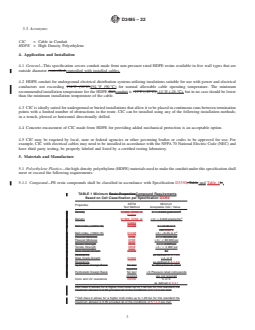
5.1.1 Compound—PE resin compounds shall be classified in accordance with Specification D3350, Table and Table 11.
TABLE 1 Minimum Resin PropertiesCompound Requirements
Based on Cell Classification per Specification D3350
ASTM Minimum
Properties
Test Method Acceptable Cell / Value
Density D1505, D792, or 3 / > 0.940 grams/cm
D4883
Density D1505, D792, or $3 / > 0.940 grams/cm
D4883
Melt Index, (190/2.16) D1238 3 / <0.40 or 2
see Note 2
A
Melt Index, (190/2.16) D1238 $3 / <0.40 or 2
Flexural Modulus D790 4 / $ 80,000 psi
Flexural Modulus D790 $4 / $ 80 000 psi
Tensile Strength D638 4 / $ 3,000 psi
Tensile Strength D638 $4 / $ 3 000 psi
Slow Crack Growth D1693 8 /
Resistance as defined in 5.1.3.3
Slow Crack Growth D1693 $4, or 8
Resistance as defined in 5.1.4.3
Hydrostatic Design Basis No test 0 / Not pressure rated
required
Hydrostatic Design Basis No test $0 Pressure rated compounds
required are not required
Color and UV resistance D3350 C or E
as defined in 5.4.1
Cell class 2 allows for a higher melt index up to 1.00 but for this standard the
maximum allowed is 0.55 provided all of the conditions of 5.1.3.2 are met.
A
Cell class 2 allows for a higher melt index up to 1.00 but for this standard the
maximum allowed is 0.55 provided all of the conditions of 5.1.4.2 are met.
D3485 − 22
5.1.2 Rework Material—Clean polyethylene compound from the manufacturer’s internal production may be compounded into the
conduit, either alone or blended with virgin compound. Conduit containing the rework material must meet all the material and
property requirements of this specification. Where rework material is known to contain cadmium, lead, mercury and/or hexavalent
chromium, the loading of rework shall be limited such that the final conduit product shall not contain more than 0.01 % by weight
cadmium and no more than 0.1 % by weight each of lead, mercury, and hexavalent chromium.
NOTE 4—Conformance with the metal requirements of 5.1.2 can be demonstrated by either a determination of heavy metals in the final product or a
calculation of the maximum heavy metals expected to be present based on their presence in the rework material.
5.1.3 Color Compounds—Color concentrate compounds used to color the conduit shall have no cadmium, lead, mercury, and
hexavalent chromium added as an intentional ingredient and shall contain no more than 0.01 % by weight cadmium and no more
than 0.1 % by weight each of lead, mercury, and hexavalent chromium.
NOTE 5—Conformance with the requirements of 5.1.3 can be demonstrated based on letters of compliance from color compound manufacturers, for
example, RoHS9 compliance letter.
5.1.4 Material Physical Properties:
5.1.4.1 Density—Density values shall be determined by Test Methods D792, D1505 or D4883.
5.1.4.2 Melt Index—Melt index of up to 0.55 grams/10 minutes as per Test Method D1238 condition 190/2.16 is allowable
provided that all other material requirements specified in Table 1 are met.
5.1.4.3 Slow Crack Growth—The minimum requirement as per Test method D1693, Condition B, 10% Igepal solution, with a
requirement of F10 > 96 hours as defined per cell classification 8 in D3350. Cell class 4 or higher are also acceptable.
5.1.4.4 The testsrequirements listed in this section, shall be confirmed for the PE compound by the resin or conduit manufacturer.
In addition, the CIC manufacturer shall conduct the quality control tests listed in Section 7.
NOTE 6—Standard industry conduit has cell classification of PE334480C/E (select C for black or E for color). Not all permutations of cell classes are
commercially available.
5.1.3.5 Minimum resin properties for cell classification 334480C/E (select C for black or E for color) Table 1.
5.2 Coextruded Layer—Any material used as a coextruded layer on the inside or outside surfaces for lubrication or color-coding
of the conduit shall adhere to the surface of the PE and shall not delaminate during normal use. Further, coextruded materials shall
not degrade or lower the performance of the PE conduit.
5.3 Above Grade Applications—PE material installed in above ground application that will be subjected to long term UV exposure,
such as aerial suspension, shall have UV stabilization additives compounded into the HDPE. The UV stabilization additives shall
be compounded to create homogenous dispersion for assuring long-term product protection. For example, UV stabilization of black
conduit shall have a minimum of 2%2 % by weight of carbon black having an average particle size less than or equal to 45
nanometers and be thoroughly dispersed throughout the conduit wall.
5.3.1 Using smaller particle sizing than 45 nanometers is not recommended due to processing complexities in dispersion and
mixing that may adversely impact the conduit’s final homogeneity resulting in reduced performance properties. When using the
smaller particle size as specified for above ground applications, the end-user should receive assurance of processing capability from
the manufacturer.
5.3.2 Where conduit that is to be extruded with colors other than black and is intended for above grade installation with UV
exposure during its service life, the end user should consult with the manufacturer for assurance that the colorant used in extruding
the conduit has sufficient UV stabilizer additives that will achieve the service life requirements for the application.
DIRECTIVE 2011/65/EU of the European Parliament and of the Council of 8 June 2011 on the restriction of the use of certain hazardous substances in electrical and
electronic equipment.
D3485 − 22
5.4 Outdoor Storage Stability:
5.4.1 Both black and color conduits, shall have sufficient formulations of carbon black (2% minimum as defined in Specification
D3350) or UV color additives that are properly dispersed either by pre-compounding or compounding during extrusion of the
conduit. The additive levels shall be sufficient to protect the conduit from UV degradation during shipping and storage outdoors
uncovered for a minimum of 1 year.
6. Requirements
6.1 Workmanship—Each conduit layer shall be homogeneous throughout and essentially uniform in color, opacity, density and
other properties. The inside and outside surfaces shall be free of visible; cracks, holes, blisters, voids, foreign materials or other
surface defects.
6.2 Dimensions and Tolerances:
6.2.1 Outside Diameters—The outside diameters and tolerances shall be as shown in Table 2 for SDR and Schedule sizes covered
by this specification, when measured in accordance with Test Method D2122.
6.2.2 Wall Thickness—The wall thicknesses and tolerances shall be as shown in Fig. 3 and Table 4 for the SDR and Schedule sizes
respectively, and shall be measured in accordance with Test Method D2122.
6.2.3 Special Sizes—When mutually agreed to between the manufacturer and the purchaser, other trade sizes and wall types shall
be acceptable provided they adhere to the dimensional tolerances. The tolerance for outside diameter shall be 6 5% of the nominal
outside diameter. The lowest minimum wall thickness for any conduit diameter shall be 0.062 in. (1.57 mm). Tolerances for wall
thicknesses shall be a set minimum of +12% or less but not less than 0.020 in.
6.3 Out-of-Roundness—is a measurement of variations in wall thickness commonly called out-of-roundness shall not exceed 12%
and shall be tested in accordance with Section 7.
6.3 Ovality:
6.3.1 There are different causes of ovality for HDPE conduit, the
...