

ASTM D5268-23
(Specification)Standard Specification for Topsoil Used for Landscaping and Construction Purposes
General Information
- Abstract
ABSTRACT
This specification covers the physical evaluation of an inorganic soil containing a limited amount of organic material, relative to its use as topsoil for landscaping and horticultural purposes in construction. Though the presence of the correct nutrients and pH status in the soil is necessary for healthy plant growth, this specification, however, does not address either the determination or the availability of such properties. When physically evaluating soil relative to its suitability to support plant growth (primarily grasses), tests must be made to determine the presence and the amount of organic matter, inorganic matter (sand, silt, and clay), and deleterious materials (rocks, gravel, slag, cinder, roots, and sod). The apparatuses required here are sieves and containers, balances, and a muffle furnace.
SCOPE
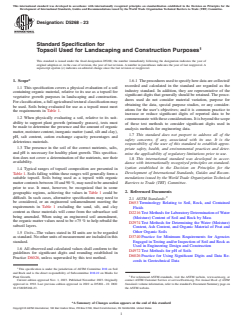
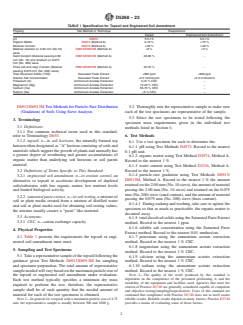
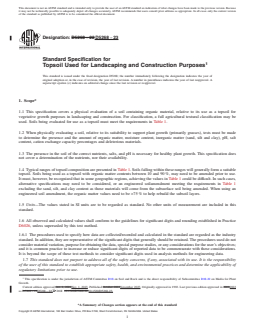
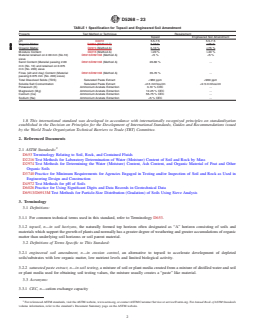
1.1 This specification covers a physical evaluation of a soil containing organic material, relative to its use as a topsoil for vegetative growth purposes in landscaping and construction. For classification, a full agricultural textural classification may be used. Soils being evaluated for use as a topsoil must meet the requirements in Table 1.
1.2 When physically evaluating a soil, relative to its suitability to support plant growth (primarily grasses), tests must be made to determine the presence and the amount of organic matter, moisture content, inorganic matter (sand, silt and clay), pH, salt content, cation exchange capacity percentages and deleterious materials.
1.3 The presence in the soil of the correct nutrients, salts, and pH is necessary for healthy plant growth. This specification does not cover a determination of the nutrients, nor their availability.
1.4 Typical ranges of topsoil composition are presented in Table 1. Soils falling within these ranges will generally form a suitable topsoil. Soils being used as a topsoil with organic matter contents between 10 and 90 %, may need to be amended prior to use. It must, however, be recognized that in some geographic regions, achieving the values in Table 1 could be difficult. In such cases, alternative specifications may need to be considered, or an engineered soilamendment meeting the requirements in Table 1 excluding the sand, silt, and clay content as those materials will come from the subsurface soil being amended. When using an engineered soil amendment, the organic matter values need to be >75 % to help rebuild the subsoil layers.
1.5 Units—The values stated in SI units are to be regarded as standard. No other units of measurement are included in this standard.
1.6 All observed and calculated values shall conform to the guidelines for significant digits and rounding established in Practice D6026, unless superseded by this test method.
1.6.1 The procedures used to specify how data are collected/recorded and calculated in the standard are regarded as the industry standard. In addition, they are representative of the significant digits that generally should be retained. The procedures used do not consider material variation, purpose for obtaining the data, special purpose studies, or any considerations for the user’s objectives; and it is common practice to increase or reduce significant digits of reported data to be commensurate with these considerations. It is beyond the scope of these test methods to consider significant digits used in analysis methods for engineering data.
1.7 This standard does not purport to address all of the safety concerns, if any, associated with its use. It is the responsibility of the user of this standard to establish appropriate safety, health, and environmental practices and determine the applicability of regulatory limitations prior to use.
1.8 This international standard was developed in accordance with internationally recognized principles on standardization established in the Decision on Principles for the Development of International Standards, Guides and Recommendations is...
- Status
- Published
- Publication Date
- 31-Oct-2023
- Technical Committee
- D18 - Soil and Rock
- Drafting Committee
- D18.22 - Media for Plant Growth
Buy Documents


ASTM D5268-23 - Standard Specification for Topsoil Used for Landscaping and Construction Purposes

REDLINE ASTM D5268-23 - Standard Specification for Topsoil Used for Landscaping and Construction Purposes
Overview
ASTM D5268-23: Standard Specification for Topsoil Used for Landscaping and Construction Purposes provides requirements for the physical evaluation of topsoil intended for landscaping, horticulture, and construction applications. Developed by ASTM International, this standard focuses on the essential physical characteristics of inorganic soils with limited organic material, specifically concerning their ability to support healthy plant growth, especially grass. The scope does not address soil nutrient content or chemical availability but specifies how to examine and classify topsoil for use in construction sites and landscaping projects.
Key Topics
Physical Evaluation Criteria
The standard outlines methodologies for assessing topsoil, including:- Organic matter content
- Inorganic constituents (sand, silt, clay)
- Moisture content
- pH and salt concentration
- Cation exchange capacity (CEC) for selected minerals
- Presence of deleterious materials (rocks, gravel, slag, cinders, roots, sod)
Testing Methods
ASTM D5268-23 refers to established ASTM test methods, such as:- ASTM D4972 for pH testing
- ASTM D2974 for organic matter determination
- ASTM D2216 for moisture content
- ASTM D6913/D6913M for particle-size distribution
- Ammonium acetate extraction for mineral content
Specification Ranges
The standard details acceptable ranges for properties like:- pH: 5.5 to 7.5
- Organic matter: 3-10% for topsoil, >75% for engineered soil amendment
- Moisture content: ≤20% for topsoil
- Sand content: 20-60%
- Fines (silt and clay): 35-70%
- Soluble salts and total dissolved solids within defined limits
Sampling and Reporting
Guidance is provided for sample collection, mass requirements, and documentation. Each topsoil batch tested must be certified, and results reported against specified requirements.
Applications
ASTM D5268-23 applies broadly to the construction and landscaping sectors. Practical use cases include:
Site Preparation for Landscaping
Ensures topsoil used in new or renovated outdoor spaces meets physical requirements for supporting turf, ornamental plants, and natural restoration projects.Urban and Commercial Construction
Used for evaluating and selecting soils for lawns, athletic fields, road embankments, commercial developments, golf courses, and parks.Quality Assurance in Material Supply
Material suppliers and contractors reference this standard to guarantee the delivered topsoil matches project specifications, reducing risk of poor plant establishment and associated rework.Engineered Soil Amendments
Where indigenous soils cannot meet standard requirements, ASTM D5268-23 offers specifications for engineered soil amendments, providing flexibility for varying geographic and project needs.
Related Standards
For comprehensive soil evaluation and testing in line with ASTM D5268-23, refer to these relevant standards:
- ASTM D653 - Terminology Related to Soil, Rock, and Contained Fluids
- ASTM D2216 - Test Methods for Laboratory Determination of Water (Moisture) Content of Soil and Rock by Mass
- ASTM D2974 - Test Methods for Determining Water, Ash, and Organic Material of Peat and Other Organic Soils
- ASTM D3740 - Practice for Agencies Engaged in Testing and/or Inspection of Soil and Rock as Used in Engineering Design and Construction
- ASTM D4972 - Test Methods for pH of Soils
- ASTM D6913/D6913M - Test Methods for Particle-Size Distribution (Gradation) of Soils Using Sieve Analysis
- ASTM D6026 - Practice for Using Significant Digits and Data Records in Geotechnical Data
Conclusion
Adhering to ASTM D5268-23 supports best practices in topsoil selection and quality management for landscaping and construction, ensuring stable vegetation establishment and long-term site performance. By following its guidelines, professionals can achieve consistent, reliable results and minimize environmental and project risks. For optimal compliance, always reference the latest ASTM standards and related procedures during soil evaluation and project execution.
Relations
- Replaces
ASTM D5268-22 - Standard Specification for Topsoil Used for Landscaping and Construction Purposes - Effective Date
- 01-Nov-2023
- Effective Date
- 01-Nov-2023
- Effective Date
- 01-Oct-2019
- Effective Date
- 01-Nov-2023
- Effective Date
- 01-Nov-2023
- Effective Date
- 01-Nov-2023
- Referred By
ASTM F1953-10(2018) - Standard Guide for Construction and Maintenance of Grass Tennis Courts - Effective Date
- 01-Nov-2023
Buy Documents
ASTM D5268-23 - Standard Specification for Topsoil Used for Landscaping and Construction Purposes
REDLINE ASTM D5268-23 - Standard Specification for Topsoil Used for Landscaping and Construction Purposes
Get Certified
Connect with accredited certification bodies for this standard

Control Union Certifications
Global certification for agriculture and sustainability.

ECOCERT
Organic and sustainability certification.

FSC International
Forest Stewardship Council certification.
Sponsored listings
Frequently Asked Questions
ASTM D5268-23 is a technical specification published by ASTM International. Its full title is "Standard Specification for Topsoil Used for Landscaping and Construction Purposes". This standard covers: ABSTRACT This specification covers the physical evaluation of an inorganic soil containing a limited amount of organic material, relative to its use as topsoil for landscaping and horticultural purposes in construction. Though the presence of the correct nutrients and pH status in the soil is necessary for healthy plant growth, this specification, however, does not address either the determination or the availability of such properties. When physically evaluating soil relative to its suitability to support plant growth (primarily grasses), tests must be made to determine the presence and the amount of organic matter, inorganic matter (sand, silt, and clay), and deleterious materials (rocks, gravel, slag, cinder, roots, and sod). The apparatuses required here are sieves and containers, balances, and a muffle furnace. SCOPE 1.1 This specification covers a physical evaluation of a soil containing organic material, relative to its use as a topsoil for vegetative growth purposes in landscaping and construction. For classification, a full agricultural textural classification may be used. Soils being evaluated for use as a topsoil must meet the requirements in Table 1. 1.2 When physically evaluating a soil, relative to its suitability to support plant growth (primarily grasses), tests must be made to determine the presence and the amount of organic matter, moisture content, inorganic matter (sand, silt and clay), pH, salt content, cation exchange capacity percentages and deleterious materials. 1.3 The presence in the soil of the correct nutrients, salts, and pH is necessary for healthy plant growth. This specification does not cover a determination of the nutrients, nor their availability. 1.4 Typical ranges of topsoil composition are presented in Table 1. Soils falling within these ranges will generally form a suitable topsoil. Soils being used as a topsoil with organic matter contents between 10 and 90 %, may need to be amended prior to use. It must, however, be recognized that in some geographic regions, achieving the values in Table 1 could be difficult. In such cases, alternative specifications may need to be considered, or an engineered soilamendment meeting the requirements in Table 1 excluding the sand, silt, and clay content as those materials will come from the subsurface soil being amended. When using an engineered soil amendment, the organic matter values need to be >75 % to help rebuild the subsoil layers. 1.5 Units—The values stated in SI units are to be regarded as standard. No other units of measurement are included in this standard. 1.6 All observed and calculated values shall conform to the guidelines for significant digits and rounding established in Practice D6026, unless superseded by this test method. 1.6.1 The procedures used to specify how data are collected/recorded and calculated in the standard are regarded as the industry standard. In addition, they are representative of the significant digits that generally should be retained. The procedures used do not consider material variation, purpose for obtaining the data, special purpose studies, or any considerations for the user’s objectives; and it is common practice to increase or reduce significant digits of reported data to be commensurate with these considerations. It is beyond the scope of these test methods to consider significant digits used in analysis methods for engineering data. 1.7 This standard does not purport to address all of the safety concerns, if any, associated with its use. It is the responsibility of the user of this standard to establish appropriate safety, health, and environmental practices and determine the applicability of regulatory limitations prior to use. 1.8 This international standard was developed in accordance with internationally recognized principles on standardization established in the Decision on Principles for the Development of International Standards, Guides and Recommendations is...
ABSTRACT This specification covers the physical evaluation of an inorganic soil containing a limited amount of organic material, relative to its use as topsoil for landscaping and horticultural purposes in construction. Though the presence of the correct nutrients and pH status in the soil is necessary for healthy plant growth, this specification, however, does not address either the determination or the availability of such properties. When physically evaluating soil relative to its suitability to support plant growth (primarily grasses), tests must be made to determine the presence and the amount of organic matter, inorganic matter (sand, silt, and clay), and deleterious materials (rocks, gravel, slag, cinder, roots, and sod). The apparatuses required here are sieves and containers, balances, and a muffle furnace. SCOPE 1.1 This specification covers a physical evaluation of a soil containing organic material, relative to its use as a topsoil for vegetative growth purposes in landscaping and construction. For classification, a full agricultural textural classification may be used. Soils being evaluated for use as a topsoil must meet the requirements in Table 1. 1.2 When physically evaluating a soil, relative to its suitability to support plant growth (primarily grasses), tests must be made to determine the presence and the amount of organic matter, moisture content, inorganic matter (sand, silt and clay), pH, salt content, cation exchange capacity percentages and deleterious materials. 1.3 The presence in the soil of the correct nutrients, salts, and pH is necessary for healthy plant growth. This specification does not cover a determination of the nutrients, nor their availability. 1.4 Typical ranges of topsoil composition are presented in Table 1. Soils falling within these ranges will generally form a suitable topsoil. Soils being used as a topsoil with organic matter contents between 10 and 90 %, may need to be amended prior to use. It must, however, be recognized that in some geographic regions, achieving the values in Table 1 could be difficult. In such cases, alternative specifications may need to be considered, or an engineered soilamendment meeting the requirements in Table 1 excluding the sand, silt, and clay content as those materials will come from the subsurface soil being amended. When using an engineered soil amendment, the organic matter values need to be >75 % to help rebuild the subsoil layers. 1.5 Units—The values stated in SI units are to be regarded as standard. No other units of measurement are included in this standard. 1.6 All observed and calculated values shall conform to the guidelines for significant digits and rounding established in Practice D6026, unless superseded by this test method. 1.6.1 The procedures used to specify how data are collected/recorded and calculated in the standard are regarded as the industry standard. In addition, they are representative of the significant digits that generally should be retained. The procedures used do not consider material variation, purpose for obtaining the data, special purpose studies, or any considerations for the user’s objectives; and it is common practice to increase or reduce significant digits of reported data to be commensurate with these considerations. It is beyond the scope of these test methods to consider significant digits used in analysis methods for engineering data. 1.7 This standard does not purport to address all of the safety concerns, if any, associated with its use. It is the responsibility of the user of this standard to establish appropriate safety, health, and environmental practices and determine the applicability of regulatory limitations prior to use. 1.8 This international standard was developed in accordance with internationally recognized principles on standardization established in the Decision on Principles for the Development of International Standards, Guides and Recommendations is...
ASTM D5268-23 is classified under the following ICS (International Classification for Standards) categories: 65.020.40 - Landscaping and silviculture. The ICS classification helps identify the subject area and facilitates finding related standards.
ASTM D5268-23 has the following relationships with other standards: It is inter standard links to ASTM D5268-22, ASTM D3740-23, ASTM D3740-19, ASTM D7322/D7322M-17, ASTM D5883-18, ASTM D8249-19, ASTM F1953-10(2018). Understanding these relationships helps ensure you are using the most current and applicable version of the standard.
ASTM D5268-23 is available in PDF format for immediate download after purchase. The document can be added to your cart and obtained through the secure checkout process. Digital delivery ensures instant access to the complete standard document.
Standards Content (Sample)
This international standard was developed in accordance with internationally recognized principles on standardization established in the Decision on Principles for the
Development of International Standards, Guides and Recommendations issued by the World Trade Organization Technical Barriers to Trade (TBT) Committee.
Designation: D5268 − 23
Standard Specification for
Topsoil Used for Landscaping and Construction Purposes
This standard is issued under the fixed designation D5268; the number immediately following the designation indicates the year of
original adoption or, in the case of revision, the year of last revision. A number in parentheses indicates the year of last reapproval. A
superscript epsilon (´) indicates an editorial change since the last revision or reapproval.
1. Scope* 1.6.1 The procedures used to specify how data are collected/
recorded and calculated in the standard are regarded as the
1.1 This specification covers a physical evaluation of a soil
industry standard. In addition, they are representative of the
containing organic material, relative to its use as a topsoil for
significant digits that generally should be retained. The proce-
vegetative growth purposes in landscaping and construction.
dures used do not consider material variation, purpose for
For classification, a full agricultural textural classification may
obtaining the data, special purpose studies, or any consider-
be used. Soils being evaluated for use as a topsoil must meet
ations for the user’s objectives; and it is common practice to
the requirements in Table 1.
increase or reduce significant digits of reported data to be
1.2 When physically evaluating a soil, relative to its suit-
commensurate with these considerations. It is beyond the scope
ability to support plant growth (primarily grasses), tests must
of these test methods to consider significant digits used in
be made to determine the presence and the amount of organic
analysis methods for engineering data.
matter, moisture content, inorganic matter (sand, silt and clay),
1.7 This standard does not purport to address all of the
pH, salt content, cation exchange capacity percentages and
safety concerns, if any, associated with its use. It is the
deleterious materials.
responsibility of the user of this standard to establish appro-
1.3 The presence in the soil of the correct nutrients, salts,
priate safety, health, and environmental practices and deter-
and pH is necessary for healthy plant growth. This specifica-
mine the applicability of regulatory limitations prior to use.
tion does not cover a determination of the nutrients, nor their
1.8 This international standard was developed in accor-
availability.
dance with internationally recognized principles on standard-
ization established in the Decision on Principles for the
1.4 Typical ranges of topsoil composition are presented in
Development of International Standards, Guides and Recom-
Table 1. Soils falling within these ranges will generally form a
mendations issued by the World Trade Organization Technical
suitable topsoil. Soils being used as a topsoil with organic
Barriers to Trade (TBT) Committee.
matter contents between 10 and 90 %, may need to be amended
prior to use. It must, however, be recognized that in some
2. Referenced Documents
geographic regions, achieving the values in Table 1 could be
difficult. In such cases, alternative specifications may need to
2.1 ASTM Standards:
be considered, or an engineered soilamendment meeting the
D653 Terminology Relating to Soil, Rock, and Contained
requirements in Table 1 excluding the sand, silt, and clay
Fluids
content as those materials will come from the subsurface soil
D2216 Test Methods for Laboratory Determination of Water
being amended. When using an engineered soil amendment,
(Moisture) Content of Soil and Rock by Mass
the organic matter values need to be >75 % to help rebuild the
D2974 Test Methods for Determining the Water (Moisture)
subsoil layers.
Content, Ash Content, and Organic Material of Peat and
Other Organic Soils
1.5 Units—The values stated in SI units are to be regarded
D3740 Practice for Minimum Requirements for Agencies
as standard. No other units of measurement are included in this
Engaged in Testing and/or Inspection of Soil and Rock as
standard.
Used in Engineering Design and Construction
1.6 All observed and calculated values shall conform to the
D4972 Test Methods for pH of Soils
guidelines for significant digits and rounding established in
D6026 Practice for Using Significant Digits and Data Re-
Practice D6026, unless superseded by this test method.
cords in Geotechnical Data
This specification is under the jurisdiction of ASTM Committee D18 on Soil
and Rock and is the direct responsibility of Subcommittee D18.22 on Media for
Plant Growth. For referenced ASTM standards, visit the ASTM website, www.astm.org, or
Current edition approved Nov. 1, 2023. Published November 2023. Originally contact ASTM Customer Service at service@astm.org. For Annual Book of ASTM
approved in 1992. Last previous edition approved in 2022 as D5268 – 22. DOI: Standards volume information, refer to the standard’s Document Summary page on
10.1520/D5268-23. the ASTM website.
*A Summary of Changes section appears at the end of this standard
Copyright © ASTM International, 100 Barr Harbor Drive, PO Box C700, West Conshohocken, PA 19428-2959. United States
D5268 − 23
TABLE 1 Specification for Topsoil and Engineered Soil Amendment
Property Test Method or Technique Requirement
Topsoil Engineered Soil Amendment
pH D4972 5.5-7.5 5.5-7.5
Organic Matter D2974 (Method A) 3-10 % $75 %
Moisture Content D2216 (Method A) #20 % #40 %
Material retained on 2.00 mm (No.10) D6913/D6913M (Method A) <5 % <5 %
sieve
Sand Content (Material passing 2.00 D6913/D6913M (Method A) 20-60 % .
mm (No. 10) and retained on 0.075
mm (No. 200) sieve
Fines (silt and clay) Content (Material D6913/D6913M (Method A) 35-70 % .
passing 0.075 mm (No. 200) sieve)
Total Dissolved Solids (TDS) Saturated Paste Extract <960 ppm <960 ppm
Soluble Salt Concentration Saturated Paste Extract <2.5 mmhos/cm <2.5 mmhos/cm
Potassium (K) Ammonium Acetate Extraction 3-10 % CEC .
Magnesium (Mg) Ammonium Acetate Extraction 12-25 % CEC .
Calcium (Ca) Ammonium Acetate Extraction 55-75 % CEC .
Sodium (Na) Ammonium Acetate Ex
...
This document is not an ASTM standard and is intended only to provide the user of an ASTM standard an indication of what changes have been made to the previous version. Because
it may not be technically possible to adequately depict all changes accurately, ASTM recommends that users consult prior editions as appropriate. In all cases only the current version
of the standard as published by ASTM is to be considered the official document.
Designation: D5268 − 22 D5268 − 23
Standard Specification for
Topsoil Used for Landscaping and Construction Purposes
This standard is issued under the fixed designation D5268; the number immediately following the designation indicates the year of
original adoption or, in the case of revision, the year of last revision. A number in parentheses indicates the year of last reapproval. A
superscript epsilon (´) indicates an editorial change since the last revision or reapproval.
1. Scope*
1.1 This specification covers a physical evaluation of a soil containing organic material, relative to its use as a topsoil for
vegetative growth purposes in landscaping and construction. For classification, a full agricultural textural classification may be
used. Soils being evaluated for use as a topsoil must meet the requirements in Table 1.
1.2 When physically evaluating a soil, relative to its suitability to support plant growth (primarily grasses), tests must be made
to determine the presence and the amount of organic matter, moisture content, inorganic matter (sand, silt and clay), pH, salt
content, cation exchange capacity percentages and deleterious materials.
1.3 The presence in the soil of the correct nutrients, salts, and pH is necessary for healthy plant growth. This specification does
not cover a determination of the nutrients, nor their availability.
1.4 Typical ranges of topsoil composition are presented in Table 1. Soils falling within these ranges will generally form a suitable
topsoil. Soils being used as a topsoil with organic matter contents between 10 and 90 %, may need to be amended prior to use.
It must, however, be recognized that in some geographic regions, achieving the values in Table 1 could be difficult. In such cases,
alternative specifications may need to be considered, or an engineered soilamendment meeting the requirements in Table 1
excluding the sand, silt, and clay content as those materials will come from the subsurface soil being amended. When using an
engineered soil amendment, the organic matter values need to be >75 % to help rebuild the subsoil layers.
1.5 Units—The values stated in SI units are to be regarded as standard. No other units of measurement are included in this
standard.
1.6 All observed and calculated values shall conform to the guidelines for significant digits and rounding established in Practice
D6026, unless superseded by this test method.
1.6.1 The procedures used to specify how data are collected/recorded and calculated in the standard are regarded as the industry
standard. In addition, they are representative of the significant digits that generally should be retained. The procedures used do not
consider material variation, purpose for obtaining the data, special purpose studies, or any considerations for the user’s objectives;
and it is common practice to increase or reduce significant digits of reported data to be commensurate with these considerations.
It is beyond the scope of these test methods to consider significant digits used in analysis methods for engineering data.
1.7 This standard does not purport to address all of the safety concerns, if any, associated with its use. It is the responsibility
of the user of this standard to establish appropriate safety, health, and environmental practices and determine the applicability of
regulatory limitations prior to use.
This specification is under the jurisdiction of ASTM Committee D18 on Soil and Rock and is the direct responsibility of Subcommittee D18.22 on Media for Plant
Growth.
Current edition approved Oct. 1, 2022Nov. 1, 2023. Published October 2022November 2023. Originally approved in 1992. Last previous edition approved in 20192022
ɛ1
as D5268 – 19D5268 – 22. . DOI: 10.1520/D5268-22.10.1520/D5268-23.
*A Summary of Changes section appears at the end of this standard
Copyright © ASTM International, 100 Barr Harbor Drive, PO Box C700, West Conshohocken, PA 19428-2959. United States
D5268 − 23
TABLE 1 Specification for Topsoil and Engineered Soil Amendment
Property Test Method or Technique Requirement
Topsoil Engineered Soil Amendment
pH D4972 5.5-7.5 5.5-7.5
Organic Matter D2974 (Method C) 3-10 % $75 %
Organic Matter D2974 (Method A) 3-10 % $75 %
Moisture Content D2216 (Method A) #20 % #40 %
Material retained on 2.00 mm (No.10) D6913/D6913M (Method A) <5 % <5 %
sieve
Sand Content (Material passing 2.00 D6913/D6913M (Method A) 20-60 % .
mm (No. 10) and retained on 0.075
mm (No. 200) sieve
Fines (silt and clay) Content (Material D6913/D6913M (Method A) 35-70 % .
passing 0.075 mm (No. 200) sieve)
Total Dissolved Solids (TDS) Saturated Paste Extract <960 ppm <960 ppm
Soluble Salt Concentration Saturated Paste Extract <2.5 mmhos/cm <2.5 mmhos/cm
Potassium (K) Ammonium Acetate Extraction 3-10 % CEC .
Magnesium (Mg) Ammonium Acetate Extraction 12-25 % CEC .
Calcium (Ca) Ammonium Acetate Extraction 55-75 % CEC .
Sodium (Na) Ammonium Acetate Extraction <5 % CEC .
1.8 This international standard was developed in accordance with internationally recognized principles on standardization
established in the Decision on Principles for the Development of International Standards, Guides and Recommendations issued
by the World Trade Organization Technical Barriers to Trade (TBT) Committee.
2. Referenced Documents
2.1 ASTM Standards:
D653 Terminology Relating to Soil, Rock, and Contained Fluids
D2216 Test Methods for Laboratory Determination of Water (Moisture) Content of Soil and Rock by Mass
D2974 Test Methods for Determining the Water (Moisture) Content, Ash Content, and Organic Material of Peat and Other
Organic Soils
D3740 Practice for Minimum Requirements for Agencies Engaged in Testing and/or Inspection of Soil and Rock as Used in
Engineering Design and Construction
D4972 Test Methods for pH of Soils
D6026 Practice for Using Significant Digits and Data Records in Geotechnical Data
D6913/D6913M Test Methods for Particle-Size Distribution (Gradation) of Soils Using Sieve Analysis
3. Terminology
3.1 Definitions:
3.1.1 For common technical terms used in this standard, refer to Terminology D653.
3.1.2 t
...