

ASTM A623-22
(Specification)Standard Specification for Tin Mill Products, General Requirements
General Information
- Abstract
ABSTRACT
This specification covers a group of common requirements which shall apply to tin mill products. The steel shall be made by the open-hearth, electric-furnace, or basic-oxygen process. The steel shall conform to specified chemical composition requirements. Rockwell 30T hardness test shall be done to the plates. This test forms the basis for a system of temper designation. The mechanical properties of continuously annealed plate and batch annealed plate of the same Rockwell 30T temper designation are not identical. It is important to keep in mind, that the Rockwell 30T test does not measure all various factors which contribute to the fabrication characteristics of the plate.
SCOPE
1.1 This specification covers a group of common requirements, which unless otherwise specified in the purchase order or in an individual specification, shall apply to tin mill products.
1.2 In case of any conflict in requirements, the requirements of the purchase order, the individual material specification, and this general specification shall prevail in the sequence named.
Note 1: A complete metric companion to Specification A623 has been developed—Specification A623M; therefore no metric equivalents are presented in this specification.
1.3 The following safety caveat covers Annex A3 through Annex A10 of this specification: This standard does not purport to address all of the safety concerns, if any, associated with its use. It is the responsibility of the user of this standard to establish appropriate safety, health, and environmental practices and determine the applicability of regulatory limitations prior to use.
1.4 This international standard was developed in accordance with internationally recognized principles on standardization established in the Decision on Principles for the Development of International Standards, Guides and Recommendations issued by the World Trade Organization Technical Barriers to Trade (TBT) Committee.
- Status
- Published
- Publication Date
- 28-Feb-2022
- Technical Committee
- A01 - Steel, Stainless Steel and Related Alloys
- Drafting Committee
- A01.20 - Tin Mill Products
Buy Documents
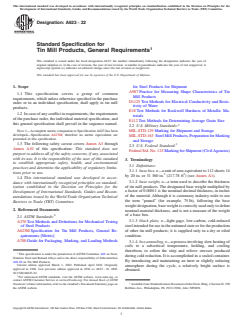
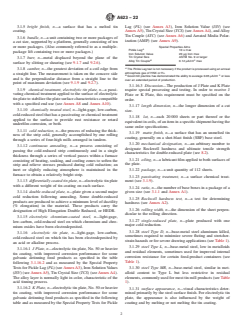
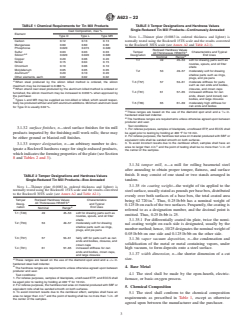
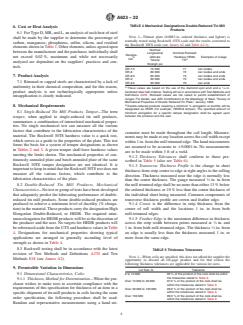
ASTM A623-22 - Standard Specification for Tin Mill Products, General Requirements
REDLINE ASTM A623-22 - Standard Specification for Tin Mill Products, General Requirements
Overview
ASTM A623-22 - Standard Specification for Tin Mill Products, General Requirements sets forth the common requirements for tin mill products, including specifications for steel production, chemical composition, mechanical properties, and product tolerances. Developed by ASTM International, this standard is crucial for manufacturers, purchasers, and end-users involved in the production and use of tin mill products such as electrolytic tinplate, black plate, and electrolytic chromium-coated steel. The standard guides quality assurance, testing, inspection, and compliance across a wide variety of industrial and commercial sectors.
Key Topics
Scope and Applicability
- Applies to a broad range of tin mill products unless otherwise specified in an order or material specification.
- Outlines the precedence of order requirements over general or individual specifications in case of conflicts.
- No metric equivalents are presented, but a companion metric specification (A623M) exists.
Steel Production Methods
- Steel must be produced via open-hearth, electric-furnace, or basic-oxygen processes.
Chemical Composition
- Defines maximum allowable concentrations for elements such as carbon, manganese, phosphorus, sulfur, silicon, copper, and nickel for types D, L, and MR steel.
Mechanical Properties
- Incorporates Rockwell 30T hardness testing to determine temper designation.
- Specifies mechanical property variations between batch and continuous annealing processes.
- Addresses mechanical designations for double-reduced products, including high elongation double reduced (HEDR) types.
Dimensional Tolerances & Testing
- Prescribes permissible variations for thickness, width, burr, camber, and coil length.
- References standard test methods for hardness (ASTM E18) and mechanical testing (ASTM A370).
- Requirements for shearing, packaging, marking, and inspection.
Terminology and Definitions
- Standardizes terms such as “base box,” “black plate,” “differentially coated tin plate,” and “continuous annealing,” improving consistency throughout the tin mill product supply chain.
Applications
ASTM A623-22 is essential in industries utilizing tin-coated or uncoated light-gauge steel, primarily for the manufacture of:
Food and Beverage Containers
- Widely used in the production of cans, lids, and closures, where quality and uniformity are critical for safety and longevity.
Consumer Goods
- Tin mill products are used in packaging for aerosols, closures, and decorative containers.
Automotive and Industrial Uses
- Employed where corrosion resistance and strength-to-weight ratio are required, including filter shells and specialty parts.
Electronics and Electrical Components
- Provides material for components that require specific fabrication characteristics and reliable surface finishes.
By specifying mechanical, chemical, and dimensional requirements, ASTM A623-22 helps manufacturers ensure compliant production, maintain consistent quality, and meet regulatory or customer requirements. The standard also aids in minimizing disputes by providing clear language on inspection, retesting, and rejection criteria.
Related Standards
For comprehensive conformance and industry best practices, the following related ASTM and government standards are referenced:
- ASTM A370 – Mechanical Testing of Steel Products
- ASTM A700 – Packaging, Marking, and Loading Methods for Steel Products
- ASTM E18 – Rockwell Hardness of Metallic Materials
- ASTM E112 – Determining Average Grain Size
- ASTM A987 – Measuring Shape Characteristics of Tin Mill Products
- ASTM A623M – Metric Companion Specification for Tin Mill Products
- U.S. Military Standards – MIL-STD-129 (Marking for Shipment), MIL-STD-163 (Preparation for Marking and Storage)
- Federal Standard No. 123 – Marking for Shipment (Civil Agencies)
Understanding and referencing ASTM A623-22, alongside these related documents, is fundamental to achieving quality assurance and regulatory compliance in the production and use of tin mill products.
Keywords: ASTM A623-22, tin mill products, tinplate specification, Rockwell hardness, mechanical properties, steel standards, packaging, food can manufacturing, electrolytic tinplate, material compliance, steel chemical composition.
Relations
- Effective Date
- 01-Mar-2024
- Effective Date
- 01-Nov-2019
- Effective Date
- 01-Jul-2019
- Effective Date
- 01-Jul-2018
- Refers
ASTM A370-17a - Standard Test Methods and Definitions for Mechanical Testing of Steel Products - Effective Date
- 15-Nov-2017
- Effective Date
- 01-Jul-2017
- Effective Date
- 01-Jan-2017
- Effective Date
- 01-Nov-2015
- Effective Date
- 01-Nov-2014
- Effective Date
- 15-May-2014
- Effective Date
- 15-Nov-2013
- Effective Date
- 01-Dec-2012
- Effective Date
- 15-Nov-2012
- Refers
ASTM A370-12a - Standard Test Methods and Definitions for Mechanical Testing of Steel Products - Effective Date
- 15-Oct-2012
- Effective Date
- 15-Mar-2012
Buy Documents
ASTM A623-22 - Standard Specification for Tin Mill Products, General Requirements
REDLINE ASTM A623-22 - Standard Specification for Tin Mill Products, General Requirements
Get Certified
Connect with accredited certification bodies for this standard

Element Materials Technology
Materials testing and product certification.

Inštitut za kovinske materiale in tehnologije
Institute of Metals and Technology. Materials testing, metallurgical analysis, NDT.
Sponsored listings
Frequently Asked Questions
ASTM A623-22 is a technical specification published by ASTM International. Its full title is "Standard Specification for Tin Mill Products, General Requirements". This standard covers: ABSTRACT This specification covers a group of common requirements which shall apply to tin mill products. The steel shall be made by the open-hearth, electric-furnace, or basic-oxygen process. The steel shall conform to specified chemical composition requirements. Rockwell 30T hardness test shall be done to the plates. This test forms the basis for a system of temper designation. The mechanical properties of continuously annealed plate and batch annealed plate of the same Rockwell 30T temper designation are not identical. It is important to keep in mind, that the Rockwell 30T test does not measure all various factors which contribute to the fabrication characteristics of the plate. SCOPE 1.1 This specification covers a group of common requirements, which unless otherwise specified in the purchase order or in an individual specification, shall apply to tin mill products. 1.2 In case of any conflict in requirements, the requirements of the purchase order, the individual material specification, and this general specification shall prevail in the sequence named. Note 1: A complete metric companion to Specification A623 has been developed—Specification A623M; therefore no metric equivalents are presented in this specification. 1.3 The following safety caveat covers Annex A3 through Annex A10 of this specification: This standard does not purport to address all of the safety concerns, if any, associated with its use. It is the responsibility of the user of this standard to establish appropriate safety, health, and environmental practices and determine the applicability of regulatory limitations prior to use. 1.4 This international standard was developed in accordance with internationally recognized principles on standardization established in the Decision on Principles for the Development of International Standards, Guides and Recommendations issued by the World Trade Organization Technical Barriers to Trade (TBT) Committee.
ABSTRACT This specification covers a group of common requirements which shall apply to tin mill products. The steel shall be made by the open-hearth, electric-furnace, or basic-oxygen process. The steel shall conform to specified chemical composition requirements. Rockwell 30T hardness test shall be done to the plates. This test forms the basis for a system of temper designation. The mechanical properties of continuously annealed plate and batch annealed plate of the same Rockwell 30T temper designation are not identical. It is important to keep in mind, that the Rockwell 30T test does not measure all various factors which contribute to the fabrication characteristics of the plate. SCOPE 1.1 This specification covers a group of common requirements, which unless otherwise specified in the purchase order or in an individual specification, shall apply to tin mill products. 1.2 In case of any conflict in requirements, the requirements of the purchase order, the individual material specification, and this general specification shall prevail in the sequence named. Note 1: A complete metric companion to Specification A623 has been developed—Specification A623M; therefore no metric equivalents are presented in this specification. 1.3 The following safety caveat covers Annex A3 through Annex A10 of this specification: This standard does not purport to address all of the safety concerns, if any, associated with its use. It is the responsibility of the user of this standard to establish appropriate safety, health, and environmental practices and determine the applicability of regulatory limitations prior to use. 1.4 This international standard was developed in accordance with internationally recognized principles on standardization established in the Decision on Principles for the Development of International Standards, Guides and Recommendations issued by the World Trade Organization Technical Barriers to Trade (TBT) Committee.
ASTM A623-22 is classified under the following ICS (International Classification for Standards) categories: 77.140.50 - Flat steel products and semi-products. The ICS classification helps identify the subject area and facilitates finding related standards.
ASTM A623-22 has the following relationships with other standards: It is inter standard links to ASTM A370-24, ASTM A700-14(2019), ASTM A370-19, ASTM E18-18, ASTM A370-17a, ASTM E18-17, ASTM A370-17, ASTM A370-15, ASTM A700-14, ASTM A370-14, ASTM A370-13, ASTM E18-12, ASTM E112-12, ASTM A370-12a, ASTM A370-12. Understanding these relationships helps ensure you are using the most current and applicable version of the standard.
ASTM A623-22 is available in PDF format for immediate download after purchase. The document can be added to your cart and obtained through the secure checkout process. Digital delivery ensures instant access to the complete standard document.
Standards Content (Sample)
This international standard was developed in accordance with internationally recognized principles on standardization established in the Decision on Principles for the
Development of International Standards, Guides and Recommendations issued by the World Trade Organization Technical Barriers to Trade (TBT) Committee.
Designation:A623 −22
Standard Specification for
Tin Mill Products, General Requirements
This standard is issued under the fixed designation A623; the number immediately following the designation indicates the year of
original adoption or, in the case of revision, the year of last revision.Anumber in parentheses indicates the year of last reapproval.A
superscript epsilon (´) indicates an editorial change since the last revision or reapproval.
This standard has been approved for use by agencies of the U.S. Department of Defense.
1. Scope for Steel Products for Shipment
A987Practice for Measuring Shape Characteristics of Tin
1.1 This specification covers a group of common
Mill Products
requirements,whichunlessotherwisespecifiedinthepurchase
D1125Test Methods for Electrical Conductivity and Resis-
order or in an individual specification, shall apply to tin mill
tivity of Water
products.
E18Test Methods for Rockwell Hardness of Metallic Ma-
1.2 Incaseofanyconflictinrequirements,therequirements
terials
ofthepurchaseorder,theindividualmaterialspecification,and
E112Test Methods for Determining Average Grain Size
this general specification shall prevail in the sequence named.
2.2 U.S. Military Standards:
NOTE1—AcompletemetriccompaniontoSpecificationA623hasbeen MIL-STD-129Marking for Shipment and Storage
developed—Specification A623M; therefore no metric equivalents are
MIL-STD-163 SteelMillProducts,PreparationforMarking
presented in this specification.
and Storage
1.3 The following safety caveat covers Annex A3 through 3
2.3 U.S. Federal Standard:
Annex A10 of this specification: This standard does not
FederalStd.No.123MarkingforShipment(CivilAgencies)
purport to address all of the safety concerns, if any, associated
with its use. It is the responsibility of the user of this standard
3. Terminology
to establish appropriate safety, health, and environmental
3.1 Definitions:
practices and determine the applicability of regulatory limita-
3.1.1 base box, n—aunitofareaequivalentto112sheets14
tions prior to use.
2 2
by 20 in. or 31360 in. (217.78 ft ) (see Annex A1).
1.4 This international standard was developed in accor-
3.1.2 base weight, n—a term used to describe the thickness
dance with internationally recognized principles on standard-
of tin mill products. The designated base weight multiplied by
ization established in the Decision on Principles for the
a factor of 0.00011 is the nominal decimal thickness, in inches
Development of International Standards, Guides and Recom-
of the material. Although it is customary industry-wide to use
mendations issued by the World Trade Organization Technical
the term “pound” (for example, 75lb), following the base
Barriers to Trade (TBT) Committee.
weightdesignation,baseweightiscorrectlyusedonlytodefine
2. Referenced Documents nominal material thickness, and is not a measure of the weight
of a base box.
2.1 ASTM Standards:
3.1.3 black plate, n—light-gage, low-carbon, cold-reduced
A370Test Methods and Definitions for Mechanical Testing
steelintendedforuseintheuntinnedstateorfortheproduction
of Steel Products
of other tin mill products; it is supplied only in a dry or oiled
A623MSpecification for Tin Mill Products, General Re-
condition.
quirements [Metric]
A700Guide for Packaging, Marking, and Loading Methods
3.1.4 box annealing, n—aprocessinvolvingslowheatingof
coils to a subcritical temperature, holding, and cooling
therefrom, to soften the strip and relieve stresses produced
This specification is under the jurisdiction ofASTM Committee A01 on Steel,
during cold reduction. It is accomplished in a sealed container.
Stainless Steel and RelatedAlloys and is the direct responsibility of Subcommittee
By introducing and maintaining an inert or slightly reducing
A01.20 on Tin Mill Products.
Current edition approved March 1, 2022. Published April 2022. Originally
atmosphere during the cycle, a relatively bright surface is
approved in 1968. Last previous edition approved in 2016 as A623–16. DOI:
obtained.
10.1520/A0623-22.
For referenced ASTM standards, visit the ASTM website, www.astm.org, or
contact ASTM Customer Service at service@astm.org. For Annual Book of ASTM
Standards volume information, refer to the standard’s Document Summary page on AvailablefromStandardizationDocumentsOrderDesk,Bldg.4SectionD,700
the ASTM website. Robbins Ave., Philadelphia, PA 19111-5094, Attn: NPODS.
Copyright © ASTM International, 100 Barr Harbor Drive, PO Box C700, West Conshohocken, PA 19428-2959. United States
A623−22
3.1.5 bright finish, n—a surface that has a melted tin Lag (PL) (see Annex A3), Iron Solution Value (ISV) (see
coating. AnnexA5),Tin Crystal Size (TCS) (see AnnexA4), andAlloy
Tin Couple (ATC) (see Annex A6) and Aerated Media Polar-
3.1.6 bundle, n—a unit containing two or more packages of
ization (AMP) (see Annex A9).
a cut size, supported by a platform, generally consisting of ten
Special Properties Aims
or more packages. (Also commonly referred to as a multiple-
A
Pickle Lag 10 s max
package lift containing two or more packages.)
Iron Solution Value 20 µg Iron max
Tin Crystal Size ASTM No. 9 or larger
3.1.7 burr, n—metal displaced beyond the plane of the
B 2
Alloy Tin Couple 0.12 µA/cm max
surface by slitting or shearing (see 9.1.7 and 9.2.6).
A
3.1.8 camber, n—the greatest deviation of a coil edge from
The Pickle Lag test is not necessary if the product is processed using an anneal
atmosphere gas of HNX or H .
a straight line. The measurement is taken on the concave side
B 2
Good mill practice has demonstrated the ability to average 0.05 µA/cm or less
and is the perpendicular distance from a straight line to the
over an extended period of production.
point of maximum deviation (see 9.1.9 and 9.2.7).
3.1.16.3 Discussion—The production of J Plate and K Plate
3.1.9 chemical treatment, electrolytic tin plate, n—a passi-
require special processing and testing. In order to receive J
vating chemical treatment applied to the surface of electrolytic
Plate or K Plate, this requirement must be specified on the
tinplatetostabilizetheplatesurfacecharacteristicscompatible
order.
with a specified end use (see Annex A8 and Annex A10).
3.1.17 length dimension, n—the longer dimension of a cut
3.1.10 chemically treated steel, n—light-gage, low-carbon,
size.
cold-reduced steel that has a passivating or chemical treatment
3.1.18 lot, n—each 20000 sheets or part thereof or the
applied to the surface to provide rust resistance or retard
equivalentincoils,ofaniteminaspecificshipmenthavingthe
underfilm corrosion, or both.
same order specifications.
3.1.11 cold reduction, n—the process of reducing the thick-
3.1.19 matte finish, n—a surface that has an unmelted tin
ness of the strip cold, generally accomplished by one rolling
coating, generally on a shot-blast finish (SBF) base steel.
through a series of four-high mills arranged in tandem.
3.1.20 mechanical designation, n—an arbitrary number to
3.1.12 continuous annealing, n—a process consisting of
designate Rockwell hardness and ultimate tensile strength
passing the cold-reduced strip continuously and in a single
characteristics for double-reduced plate (see 8.2).
thickness through a series of vertical passes within a furnace
3.1.21 oiling, n—alubricantfilmappliedtobothsurfacesof
consisting of heating, soaking, and cooling zones to soften the
the plate.
strip and relieve stresses produced during cold reduction; an
inert or slightly reducing atmosphere is maintained in the
3.1.22 package, n—a unit quantity of 112 sheets.
furnace to obtain a relatively bright strip.
3.1.23 passivating treatment, n—a surface chemical treat-
3.1.13 differentiallycoatedtinplate,n—electrolytictinplate ment (see 3.1.9).
with a different weight of tin coating on each surface.
3.1.24 ratio, n—the number of base boxes in a package of a
3.1.14 double-reduced plate, n—plate given a second major
given size (see 3.1.1 and Annex A1).
cold reduction following annealing. Some double-reduced
3.1.25 Rockwell hardness test, n—a test for determining
products are produced to achieve a minimum level of ductility
hardness (see Annex A2).
(% elongation) in the material. These products carry the
3.1.26 rolling width, n—the dimension of the sheet perpen-
designation of High Elongation Double Reduced, or HEDR.
dicular to the rolling direction.
3.1.15 electrolytic chromium-coated steel, n—light-gage,
3.1.27 single-reduced plate, n—plate produced with one
low-carbon, cold-reduced steel on which chromium and chro-
major cold reduction.
mium oxides have been electrodeposited.
3.1.28 steel Type D, n—base-metal steel aluminum killed,
3.1.16 electrolytic tin plate, n—light-gage, low-carbon,
sometimes required to minimize severe fluting and stretcher-
cold-reduced steel on which tin has been electrodeposited by
strain hazards or for severe drawing applications (see Table 1).
an acid or alkaline process.
3.1.29 steel Type L, n—base-metal steel, low in metalloids
3.1.16.1 J Plate, n—electrolytic tin plate, No. 50 or heavier
and residual elements, sometimes used for improved internal
tin coating, with improved corrosion performance for some
corrosion resistance for certain food-product containers (see
galvanic detinning food products as specified in the table
Table 1).
following 3.1.16.2 and as measured by the Special Property
TestsforPickleLag(PL)(seeAnnexA3),IronSolutionValues 3.1.30 steel Type MR, n—base-metal steel, similar in met-
(ISV) (see AnnexA5),Tin Crystal Size (TCS) (see AnnexA4). alloid content to Type L but less restrictive in residual
The alloy layer is normally light in color, characteristic of the elements,commonlyusedformosttinmillproducts(seeTable
acid tinning process. 1).
3.1.16.2 K Plate, n—electrolytic tin plate, No. 50 or heavier 3.1.31 surface appearance, n—visual characteristics deter-
tin coating, with improved corrosion performance for some mined primarily by the steel surface finish. For electrolytic tin
galvanic detinning food products as specified in the following plate, the appearance is also influenced by the weight of
table and as measured by the Special Property Tests for Pickle coating and by melting or not melting the tin coating.
A623−22
TABLE 1 Chemical Requirements for Tin Mill Products TABLE 3 Temper Designations and Hardness Values
Single-Reduced Tin Mill Products—Continuously Annealed
Cast Composition, max %
Element
Type D Type L Type MR
NOTE 1—Thinner plate (0.0083in. ordered thickness and lighter) is
normally tested using the Rockwell 15TS scale and the results converted
Carbon 0.12 0.13 0.13
Manganese 0.60 0.60 0.60 to the Rockwell 30TS scale (see Annex A2 and Table A2.1).
Phosphorus 0.020 0.015 0.020
Rockwell Hardness Values
Temper Characteristics and Typical
Sulfur 0.03 0.03 0.03 A
All Thicknesses HR30TS
A,B
Designation End Uses
Silicon 0.020 0.020 0.020
B
Nominal Range
Copper 0.20 0.06 0.20
T-1 49 45–53 soft for drawing parts such as
Nickel 0.15 0.04 0.15
nozzles, spouts, and oil filter
Chromium 0.10 0.06 0.10
shells
Molybdenum 0.05 0.05 0.05
T-2 53 49–57 moderately soft for drawing
C
Aluminum 0.20 0.10 0.20
shallow parts such as rings,
Other elements, each 0.02 0.02 0.02
plugs, and pie pans
A
T-3 (T57) 57 53–61 moderate stiffness for parts
When steel produced by the silicon killed method is ordered, the silicon
such as can ends and bodies,
maximum may be increased to 0.080 %.
B
closures, and crown caps
When strand cast steel produced by the aluminum killed method is ordered or
T-4 (T61) 61 57–65 increased stiffness for can
furnished, the silicon maximum may be increased to 0.030 % when approved by
ends, drawn (and ironed) can
the purchaser.
C
bodies, and large closures
Types L and MR may be supplied as non-killed or killed, which would respec-
T-5 (T65) 65 61–69 moderately high stiffness for
tively be produced without and with aluminum additions. Minimum aluminum level
can ends and bodies
for Type D is usually 0.02 %.
A
These ranges are based on the use of the diamond spot anvil and a ⁄16 in.
hardened steel ball indenter.
B
The hardness ranges are requirements unless otherwise agreed upon between
producer and user.
Test conditions:
3.1.32 surface finishes, n—steel surface finishes for tin mill
1. For referee purposes, samples of blackplate, unreflowed ETP, and ECCS shall
products imparted by the finishing-mill work rolls; these may be aged prior to testing by holding at 400 °F for 10 min.
2. For referee purposes, the hardness test area on material produced with SBF or
be either ground or blasted-roll finishes.
equivalent rolls shall be sanded smooth on both surfaces.
3. To avoid incorrect results due to the cantilever effect, samples shall have an
3.1.33 temper designation, n—an arbitrary number to des-
area no larger than 4 in. and the point of testing shall be no more than ⁄2 in. off
ignate a Rockwell hardness range for single-reduced products,
the center of the samples.
whichindicatestheformingpropertiesoftheplate(seeSection
8 and Tables 2 and 3).
3.1.34 temper mill, n—a mill for rolling basemetal steel
after annealing to obtain proper temper, flatness, and surface
finish. It may consist of one stand or two stands arranged in
TABLE 2 Temper Designations and Hardness Values
tandem.
Single-Reduced Tin Mill Products—Box Annealed
3.1.35 tin coating weight—the weight of tin applied to the
NOTE 1—Thinner plate (0.0083in. ordered thickness and lighter) is
normally tested using the Rockwell 15TS scale and the results converted
steelsurface,usuallystatedaspoundsperbasebox,distributed
to the Rockwell 30TS scale (see Annex A2 and Table A2.1).
evenly over both surfaces of a base box, the total coated area
Rockwell Hardness Values
Temper Characteristics
being 62720in. . Thus, 0.25lb⁄bb has a nominal weight of
A
All Thicknesses HR30TS
Desig- and Typical
0.125lb on each of the two surfaces. Frequently, the coating is
B
nation End Uses
Nominal Range
referred to as a designation number, and the decimal point is
T-1 (T49) 49 45–53 soft for drawing parts such as
omitted. Thus, 0.25lb⁄bb is 25.
nozzles, spouts, and oil filter
shells 3.1.35.1 For differentially coated tin plate, twice the nomi-
T-2 (T53) 53 49–57 moderately soft for drawing
nal coating weight on each side is designated, usually by the
shallow parts such as rings,
numbermethod;hence,10/25designatesthenominalweightof
plugs, and pie pans
0.05lb⁄bb on one side and 0.125lb⁄bb on the other side.
T-3 (T57) 57 53–61 fairly stiff for parts such as can
3.1.36 vapor vacuum deposition, n—the condensation and
ends and bodies, closures, and
solidification of the metal or metal containing vapors, under
crown caps
T-4 (T61) 61 57–65 increased stiffness for can high vacuum, to form deposits onto a steel surface.
ends and bodies, crown caps,
3.1.37 width dimension, n—the shorter dimension of a cut
and large closures
size.
A 1
These ranges are based on the use of the diamond spot anvil and a ⁄16 in.
hardened steel ball indenter.
B
The hardness ranges are requirements unless otherwise agreed upon between 4. Base Metal
producer and user.
4.1 The steel shall be made by the open-hearth, electric-
Test conditions:
1. For referee purposes, samples of blackplate, unreflowed ETP, and ECCS shall
furnace, or basic-oxygen process.
be aged prior to testing by holding at 400 °F for 10 min.
2. For referee purposes, the hardness test area on material produced with SBF or
5. Chemical Composition
equivalent rolls shall be sanded smooth on both surfaces.
3. To avoid incorrect results due to the cantilever effect, samples shall have an
5.1 The steel shall conform to the chemical composition
area no larger than 4 in. and the point of testing shall be no more than ⁄2 in. off
requirements as prescribed in Table 1, except as otherwise
the center of the samples.
agreed upon between the manufacturer and the purchaser.
A623−22
TABLE 4 Mechanical Designations Double-Reduced Tin Mill
6. Cast or Heat Analysis
Products
6.1 ForTypeD,MR,andL,ananalysisofeachheatofsteel
NOTE 1—Thinner plate (0.0083in. ordered thickness and lighter) is
shall be made by the supplier to determine the percentage of
normally tested using Rockwell 15TS scale and the results converted to
carbon, manganese, phosphorus, sulfur, silicon, and residual
the Rockwell 30TS scale (see Annex A2 and Table A2.1).
elementsshowninTable1.Otherelements,unlessagreedupon
Nominal
between the manufacturer and the purchaser, individually shall
Longitudinal Nominal Rockwell
Designa-
not exceed 0.02%, maximum and while not necessarily Ultimate Hardness HR30- Examples of Usage
B
tion
A
Tensile TS
analyzed are dependent on the suppliers’ practices and con-
Strengh psi
trols.
DR-7.5 75 000 71 can bodies
DR-8 80 000 72 can bodies and ends
7. Product Analysis DR-8.5 85 000 73 can bodies and ends
DR-9 90 000 75 can bodies and ends
7.1 Rimmed or capped steels are characterized by a lack of
DR-9.5 95 000 76 can ends
uniformity in their chemical composition, and for this reason, A
These values are based on the use of the diamond spot anvil and a ⁄16 in.
product analysis is not technologically appropriate unless
hardened steel ball indenter. Testing will be in accordance with Test Methods and
Definitions A370. Rockwell values are too varied to permit establishment of
misapplication is clearly indicated.
ranges. For details, see AISI Contributions to the Metallurgy of Steel, “Survey of
Mechanical Properties of Double Reduced Tin Plate,” January 1966.
B
8. Mechanical Requirements
Double-reduced products requiring a minimum % elongation or ductility will be
designated as HEDR (for example, HEDR-8 temper). The specified amount of
8.1 Single-Reduced Tin Mill Products, Temper—The term
minimum elongation for a specific temper designation shall be agreed upon
between the producer and the user.
temper, when applied to single-reduced tin mill products,
summarizes a combination of interrelated mechanical proper-
ties. No single mechanical test can measure all the various
factors that contribute to the fabrication characteristics of the
crometer must be made throughout the coil length. Measure-
material. The Rockwell 30TS hardness value is a quick test,
mentsmaybemadeatanylocationacrossthecoilwidthexcept
which serves as a guide to the properties of the plate. This test
within1in.fromthemilltrimmededge.Thehandmicrometers
forms the basis for a system of temper designations as shown
are assumed to be accurate to 60.0001in. No measurements
in Tables 2 and 3. A given temper shall have hardness values
are to be made within 3ft of a weld.
meeting the limits shown. The mechanical properties of con-
9.1.2 Thickness Tolerances shall conform to those pre-
tinuously annealed plate and batch annealed plate of the same
scribed in Table 5 (also see Table 6).
Rockwell 30TS temper designation are not identical. It is
9.1.3 Transverse Thickness Profile is the change in sheet
importanttokeepinmindthattheRockwell30TStestdoesnot
thicknessfromstripcentertoedgeatrightanglestotherolling
measure all the various factors, which contribute to the
direction. Thickness measured near the edge is normally less
fabrication characteristics of the plate.
than the center thickness. The gauge measured ⁄4in. in from
themilltrimmededgeshallbenomorethaneither13%below
8.2 Double-Reduced Tin Mill Products, Mechanical
Characteristics—Notestorgroupoftestshavebeendeveloped the ordered thickness or 10% less than the center thickness of
the individual sheet being measured. Common components of
that adequately predict the fabricating performance of double-
reduced tin mill products. Some double-reduced products are transverse thickness profile are crown and feather edge.
produced to achieve a minimum level of ductility (% elonga- 9.1.4 Crown is the difference in strip thickness from the
tion)inthematerial.TheseproductscarrythedesignationHigh center of roll width and the locations 1 in. in from both
Elongation Double-Reduced, or HEDR. The required mini- mill-trimmed edges.
mumelongationforHEDRproductswillbeatthediscretionof 9.1.5 Feather Edge is the maximum difference in thickness
the producer and the user. No targets for HEDR products will across the strip width between points measured at ⁄4in. and
bereferencedasidefromtheUTSandhardnessvaluesinTable 1in. from both mill-trimmed edges. The thickness ⁄4in. from
4. Designations for mechanical properties showing typical an edge is usually less than the thickness measured 1 in. or
applications are arranged in generally ascending level of more from the same edge.
strength as shown in Table 4.
8.3 Rockwell testing shall be in accordance with the latest
TABLE 5 Thickness Tolerances
revision of Test Methods and Definitions A370 and Test
NOTE 1—When coils are specified, this does not afford the supplier the
Methods E18 (see Annex A2).
opportunity to discard all off-gage product and for that reason the
following thickness tolerances are applicable for various lot sizes.
9. Permissible Variation in Dimensions
Lot Size, lb Tolerance
9.1 Dimensional Characteristics, Coils:
0 to 12 000 95 % of the product of the coils shall be within
the tolerances stated in Table 6
9.1.1 Thickness, Method for Determination—When the pur-
Over 12 000 to 30 000 97.5 % of the product of the coils shall be
chaser wishes to make tests to ascertain compliance with the
within the tolerances stated in Table 6
requirements of this specification for thickness of an item in a Over 30 000 to 150 000 99.0 % of the product of the coils shall be
within the tolerances stated in Table 6
specific shipment of tin mill products in coils having the same
Over 150 000 99.5 % of the product of the coils shall be
order specification, the following procedure shall be used:
within the tolerances stated in Table 6
Random and representative measurements using a hand mi-
A623−22
TABLE 6 Ordered Thickness and Thickness Tolerances
9.2.2 Thickness Tolerances—Tin mill products in cut sizes
are produced within thickness tolerances of +5%, −8% of the
NOTE 1—Thickness tolerances are +5% and −8% from the ordered
ordered thickness (see Table 6). Any sheets not meeting this
thickness.
requirement are subject to rejection.
Ordered Thickness Thickness
Thickness, Tolerance, Tolerances
9.2.3 Transverse Thickness Profile is the change in sheet
in. Over, in. Under, in.
thicknessfromstripcentertoedgeatrightanglestotherolling
0.0050 0.0003 0.0004
direction. Thickness measured near the edge is normally less
0.0055 0.0003 0.0004
0.0061 0.0003 0.0005
than the center thickness. The gauge measured ⁄4in. in from
0.0066 0.0003 0.0005
themilltrimmededgeshallbenomorethaneither13%below
0.0072 0.0004 0.0006
the ordered thickness or 10% less than the center thickness of
0.0077 0.0004 0.0006
0.0083 0.0004 0.0007 the individual sheet being measured. Common components of
0.0088 0.0004 0.0007
transverse thickness profile are crown and feather edge.
0.0094 0.0005 0.0008
0.0099 0.0005 0.0008 9.2.4 Crown is the difference in strip thickness from the
0.0105 0.0005 0.0008
center of roll width and the locations 1in. in from both
0.0110 0.0006 0.0009
mill-trimmed edges.
0.0113 0.0006 0.0009
0.0118 0.0006 0.0009
9.2.5 Feather Edge is the maximum difference in thickness
0.0123 0.0006 0.0010
across the strip width between points measured at ⁄4in. and
0.0130 0.0007 0.0010
1in. from both mill-trimmed edges. The thickness ⁄4in. from
0.0141 0.0007 0.0011
0.0149 0.0007 0.0012
an edge is usually less than the thickness measured 1in. or
more from the same edge.
9.2.6 Burr—A maximum of 0.002in. is permissible. Burr
may be estimated by using a micrometer with a flat anvil and
9.1.6 Width—Coils are trimmed to the ordered width. The
spindle and measuring the difference between strip thickness
slit dimension shall not vary over width by more than −0,
adjacent to the edge and strip thickness at the edge, which
+ ⁄8in.
includes the displaced metal. Care must be taken during that
9.1.7 Burr—A maximum of 0.002in. is permissible. Burr
measurement to avoid deforming the displaced metal.
may be estimated by using a micrometer with a flat anvil and
9.2.7 Camber—The maximum permissible deviation is
spindle and measuring the difference between strip thickness
⁄16in. for each 48in. of length or fraction thereof, in accor-
adjacent to the edge and strip thickness at the edge, which
dance with the latest revision of measuring methods and
includes the displaced metal. Care must be taken during that
definitions in Test Method A987.
measurement to avoid deforming the displaced metal.
9.2.8 Out-of-Square is the deviation of an end edge from a
9.1.8 Coil Length—Variation between the measured length
straight line, which is placed at a right angle to the side of the
by the purchaser versus the supplier’s billed length shall not
plate, touching one corner and extending to the opposite side.
exceed the limits prescribed in Table 7.
The amount of deviation is customarily limited to ⁄16in. for
9.1.8.1 Since it is a common practice for each consumer’s
any edge measurement, except that a bundle may contain a
shearing operation to keep a running measurement of their
maximum of four sheets with a deviation up to ⁄8in.
supplier’s coil shipments, any length variation in small lots (1
to 5 coils) for a given period will automatically be included in 9.2.9 Shearing Practice—Tin mill products are sheared to
this summary. Before concluding there is a length variation in
the ordered width and to the ordered length. The greater
these small lots the total length received from the supplier, dimension is considered length. The slit dimension shall not
regardless of base weight, over periods of one month or one
vary over the designated overrun by more than –0, + ⁄8in. and
quarter, or both should be checked. the drum cut dimension shall not vary over the designated
1 1
9.1.9 Camber is limited to a maximum of ⁄4in. in 20ft of
overrun by more than –0, + ⁄4in.
length, in accordance with the latest revision of measuring
methods and definitions in Test Method A987.
10. Special Requirements
9.1.10 Inside Coil Diameters—Thestandardinsidediameter
10.1 Welds—Coils may contain lap or mash welds, the
produced is approximately 16in.
locations of which are marked. A hole may be punched
9.2 Dimensional Characteristics, Cut Sizes:
adjacent to the weld for automatic rejection of the weld during
9.2.1 Thickness, Method for Determination—Random mea-
shearing. The leading ends of lap welds shall not exceed 1in.
surements must be made at least 1in. from the edge of the
10.2 Cores—If coil centers must be supported to minimize
sheet using a hand micrometer. The hand micrometers are
damage, this requirement should be so stated on the order as a
assumed to be accurate to 60.0001in.
special requirement.
11. Sheet Count—Cut Sizes
TABLE 7 Coil Length Variation
No. of Coils Variation, ±, %
11.1 Small variations in sheet count/bundle should average
1 3
out to at least the proper exact count in quantities of 400
100 0.1
packages or more.
A623−22
12. Retest Procedure er’s works, except as noted in the basis of purchase of the
applicable specification, shall be rejected and the supplier
12.1 In the event the material fails to meet the specified
notified.
requirements, two further series of samples are to be selected
bythepurchaserinaccordancewiththeapplicableprocedures.
16. Packaging
Both retests must meet the specification limits to qualify as
16.1 Unless otherwise specified, the tin plate shall be
meeting the requirements.
packaged and loaded in accordance with Practices A700.
13. Conditions of Manufacture
16.2 When specified in the contract or order, and for direct
13.1 Thepurchasershouldbeinformedofanyalterationsin
procurement by or direct shipment to the Government, when
the method of manufacture, which will significantly affect the
LevelAisspecified,preservation,packagingandpackingshall
properties of the purchased product. Similarly, the purchaser
be in accordance with the LevelArequirements of MIL-STD-
should inform the manufacturer of modifications in their
163.
fabrication methods, which will significantly affect the way in
16.3 The standard method of shipping coils is with the eye
which the purchased product is used.
of the coil vertical.
14. Inspection
17. Marking
14.1 The inspector representing the purchaser shall have
17.1 As a minimum requirement, the material shall be
entry, at all times while work on the contract of the purchaser
identified by having the manufacturer’s name, ASTM
is being performed, to all parts of the manufacturer’s works
designation, weight, purchaser’s order number, and material
that concern the manufacture of the material ordered. The
identification legibly stenciled on top of each lift or shown on
supplier shall afford the inspector all reasonable facilities to
a tag attached to each coil or shipping unit.
satisfy him that the material is being furnished in accordance
17.2 When specified in the contract or order, and for direct
with this specification. Unless otherwise specified, all inspec-
procurementbyordirectshipmenttotheGovernment,marking
tion and tests shall be made prior to shipment at the supplier’s
for shipment, in addition to requirements specified in the
works and such inspection or sampling shall be made in
contract or order, shall be in accordance with MIL-STD-129
conjunction with and to the extent of the manufacturer’s
for military agencies and in accordance with Federal Std. No.
regular inspection operations.
123 for civil agencies.
15. Rejection
18. Keywords
15.1 Material that shows excessive number of injurious
imperfections subsequent to its acceptance at the manufactur- 18.1 strength; tensile; tin mill products
ANNEXES
(Mandatory Information)
A1. ABBREVIATED RATIO TABLES FOR TIN MILL PRODUCTS
A1.1 Thebaseboxistheunitofareaof112sheets14by20 A1.2.2 The following example demonstrates the use of
2 2
in. or 31360in. (217.78ft ). these tables. The example applies to various sheet dimensions
as follows:
A1.2 Todeterminethenumberofbaseboxesrepresentedby
A1.2.2.1 Sheet with No Fractional Dimensions—Step 1
112 sheets of any other dimensions, a computation is neces-
only.
sary. The computation is carried out using ratio tables.
A1.2.2.2 Sheet with Fractional Dimensions on Only One
A1.2.1 Tables A1.1-A1.6 are an abbreviated set of such Dimension—Steps 1 and 2.
A1.2.2.3 Sheet with Fractional Dimensions on Both
ratiotables,whichcanbeusedtodeterminethenumberofbase
boxes represented by 112 and 1000 sheets in sizes from ⁄16in. Dimensions—Steps 1, 2, 3, and 4.
square to 50in. square.
A1.2.3 An example of the use of abbreviated ratio tables to
developthenumberofbaseboxesrepresentedby112and1000
1 1
4 sheets with specified dimensions 28 ⁄16by 34 ⁄2in. is given in
These tables are reproduced, by permission of the American Iron and Steel
Institute, from “Tin Mill Products,” Steel Products Manual, AISI, 1963. Table A1.7.
A623−22
TABLE A1.1 Tin Plate Ratios—Base Boxes per 112 Sheets Full-Inch Widths
A623−22
TABLEA1.1 Continued
A623−22
TABLEA1.1 Continued
A623−22
TABLEA1.1 Continued
A623−22
TABLE A1.2 Tin Plate Ratios—Base Boxes per 112 Sheets Full-Inch Widths
A623−22
TABLE A1.3 Tin Plate Ratios—Base Boxes per 112 Sheets Fractional Widths and Length
A623−22
TABLE A1.4 Tin Plate Ratios—Base Boxes per 1000 Sheets Full-Inch Widths
A623−22
TABLEA1.4 Continued
A623−22
TABLEA1.4 Continued
A623−22
TABLEA1.4 Continued
A623−22
TABLE A1.5 Tin Plate Ratios—Base Boxes per 1000 Sheets Fractional Widths
A623−22
TABLE A1.6 Tin Plate Ratios—Base Boxes per 1000 Sheets Fractional Widths and Lengths
TABLE A1.7 Example of the Use of Abbreviated Ratio Tables
1 1
Dimensional Components of a 28 ⁄16 by 34 ⁄2-in. Sheet for Use in Abbreviated Ratio Tables
Step Components 112 Sheet Table 1000 Sheet Table
A B
Ratio Ratio
1 34 by 28 3.4000 A1.1 30.36 A1.4
228by ⁄2 0.0500 A1.2 0.45 A1.5
3 ⁄16 by 34 0.0076 A1.2 0.07 A1.5
1 1
4 ⁄16 by ⁄2 0.0001 A1.3 0.00 A1.6
Total 3.4577 30.88
A 1 1
One-hundred twelve sheets measuring 28 ⁄16 by 34 ⁄2 in. represents 3.4577 base boxes.
B
1 1
One-thousand sheets measuring 28 ⁄16 by 34 ⁄2 in. represents 30.88 base boxes.
A623−22
A2. ROCKWELL HARDNESS TESTING OF TIN MILL PRODUCTS
A2.1 Scope A2.4.2 Conversion—Hardnesstestsmadeonthe15TSscale
may be converted to the 30TS scale by the use of TableA2.1.
A2.1.1 This annex covers the application to tin mill prod-
ucts of Rockwell superficial hardness tests using the 15TS and
30TS scales. Tests shall be made in accordance with the latest
revision of Test Methods and Definitions A370 and with the TABLE A2.1 Conversion Table (Approximation) Rockwell
Hardness Testing
methods outlined in Test Methods E18, with the exceptions
HR 30TS HR 15TS HR 30TS HR 15TS
given in the following sections.
82.0 93.0 65.0 84.0
81.5 92.5 64.0 . . .
A2.2 Anvil
81.0 . . . 63.5 83.5
A2.2.1 All tests shall be made using the diamond spot anvil
80.5 92.0 62.5 83.0
80.0 . . . 62.0 . . .
and a ⁄16in. hardened steel ball indenter.
79.0 91.5 61.5 82.5
78.5 . . . 60.5 82.0
A2.3 Specimens
78.0 91.0 60.0 . . .
77.5 90.5 59.5 81.5
A2.3.1 Thickness—The recommendations given inTable 12
77.0 . . . 58.5 81.0
of Test Methods E18 shall not apply to tests on tin mill
76.0 90.0 58.0 . . .
products. The Rockwell superficial scale to be used shall be
75.5 89.5 57.0 80.5
determinedfromthenominalthicknessofthematerialasgiven 75.0 . . . 56.5 . . .
74.5 89.0 56.0 80.0
in the following table:
74.0 88.5 55.0 79.5
Nominal Sheet Rockwell Major Load, 73.5 . . . 54.5 . . .
Thickness, in. Superficial Scale kgf 73.0 88.0 54.0 79.0
72.0 87.5 53.0 78.5
0.0083 and less 15TS 15 71.5 . . . 52.5 . . .
71.0 87.0 51.5 78.0
0.0215–0.0084 30TS 30
70.0 86.5 51.0 77.5
A2.3.2 Surface Finish—The surface of the specimen in
69.5 . . . 50.5 . . .
contact with the diamond spot anvil shall be flat, smooth, and
69.0 86.0 49.5 77.0
68.0 85.5 49.0 76.5
free from dirt or surface irregularities. When necessary, both
67.5 . . . 48.5 . . .
specimen surfaces shall be sanded smooth to remove surface
67.0 85.0 47.5 76.0
irregularities that may affect the test results. Sanding debris
66.0 . . . 47.0 75.5
65.5 84.5 46.0 . . .
shall be removed from the sample before testing. Unless
otherwise agreed upon, the tin coating shall not be removed
from the surface on which the indentation is made.
A2.4 Reports
It is recognized that such conversions are for convenience in
A2.4.1 Number of Tests—The Rockwell scale value to be reporting and that conversion, particularly from tests on thin
reported shall be the average of at least three impressions. and soft materials, is not an accurate process.
A3. METHOD FOR DETERMINATION OF PICKLE LAG ON STEEL FOR ELECTROLYTIC TIN PLATE
INTRODUCTION
It is not intended that variations in apparatus, sample preparation, or procedures from those
described in this specification method be precluded. Suppliers or consumers may employ such
variations for control purposes provided test results agree with results obtained by the standard
method.
A623−22
A3.1 Scope A3.4.2 Purity of Water—Unless otherwise indicated, refer-
ences to water shall be understood to mean distilled water or
A3.1.1 The rate of pickling test, also called the pickle lag
water of equal purity.
test, is one of four special property tests used to measure
A3.4.3 For Rate of Pickling Test:
certain characteristics of electrolytic tin plate, which affect
A3.4.3.1 Hydrochloric Acid (HCl), (6 N).
internal corrosion resistance. The test is applicable to No. 50,
No. 50/25, and heavier electrolytic tin plate (for K-plate, see
A3.4.4 For Sample Preparation:
3.1.16.2andJ-plate,see3.1.16.1).ItisnotapplicabletoNo.25
A3.4.4.1 Acetone.
and lighter electrolytic tin plate.
A3.4.4.2 Antimony Trichloride Solution (120 g/L)—
Dissolve 120g of antimony trichloride (SbCl)in1Lof
A3.2 Summary of Method
concentrated HCl.
A3.2.1 The time lag for a piece of steel to attain constant
A3.4.4.3 Sodium Carbonate Solution (Na CO ) (0.5%).
2 3
dissolution rate in acid under controlled conditions is deter-
A3.4.4.4 Sodium Hydroxide Solution (NaOH) (10%).
mined. The change in pressure in a closed system caused by
A3.4.4.5 Sodium Peroxide (Na O ), granulated.
2 2
hydrogen evolution from the steel is continuously plotted on a
A3.4.5 For Water Bath:
chart through use of an electro-mechanical linkage and mer-
A3.4.5.1 Paraffın Oil.
cury manometer.
A3.5 Test Specimen Preparation
A3.3 Apparatus
5 1
A3.5.1 Test Specimen—A piece of steel ⁄16 by 2 ⁄2in. with
A3.3.1 Reaction Vessel, consisting of a specially modified
thelongdimensionperpendiculartotherollingdirectionofthe
125mL Erlenmeyer flask. The flask shall have a 10mm bore
steel.
stopcock, glass sealed to the mouth and a small-diameter glass
A3.5.1.1 Cut a piece of metal ⁄16by 4in. or longer. The
tube side arm sealed in the side just below the mouth of the
added length above the 2 ⁄2in. serves as a handle during
original flask. The bottom of the flask shall be rounded out.A
preparation.
mercury switch shall be attached to the stop-cock plug with a
A3.5.1.2 Remove surface oil and grease by dipping the
metal band.
specimen in acetone and wiping with a cloth or paper towel.
A3.3.2 Constant-Temperature Water Bath, large enough to
A3.5.1.3 Cathodically clean the specimen in 0.5% solution
accommodatethereactionvesselandmaintainatemperatureof
of Na CO , rinse in water, and dry.
2 3
90 6 0.5°C.
A3.5.1.4 Detin the specimen by immersing in SbCl -HCl
solution at room temperature.Allow the specimen to remain in
A3.3.3 Recording Mercury Manometer, to measure the rate
solution 10 to 20s after bubbling ceases.
of increase in pressure in the vessel generated by hydrogen.
A3.5.1.5 Removethespecimen,rinseintapwater,andwipe
Initial setup of the recorder is described in Section 10.
surfacecleanofantimony.(Awetcellulosespongewithalittle
A3.3.4 A 15 by ⁄8in. magnetized-steel rod for removal of
non-ionic detergent has been found effective.)
test specimen. (A one-hole rubber stopper may be positioned
A3.5.1.6 Immerse specimen in 10% NaOH solution held at
near the upper end to prevent the bottom of the rod from
90°C for approximately 1min. During this time, add granu-
striking the bottom of the reaction flask.)
lated Na O slowly to keep solution bubbling freely. This
2 2
treatment removes the last traces of antimony and any iron-tin
A3.3.5 Coordinate Paper, 4 by 11in., with either 10 or 20
alloy not removed during detinning. More than one specimen
gradations to the inch.
may be treated at one time. A stainless steel beaker with
A3.4 Reagents and Materials
specimens contacting the beaker appears to facilitate removal
of the antimony and iron-tin alloy.
A3.4.1 Purity of Reagents—Reagent grade chemicals shall
A3.5.1.7 Rinse specimen successively in tap water, distilled
be used in all tests. Unless otherwise indicated, it is intended
ordeionizedwaterandacetone.Alternativelyrinsespecimenin
that all reagents shall conform to the specifications of the
tap water and wipe dry with a clean towel.
Committee on Analytical Reagents of the American Chemical
5 1
6 A3.5.1.8 Trim specimen to ⁄16 by 2 ⁄2in.
Society, where such specifications are available. Other grades
A3.5.1.9 Handlethespecimenwithforcepsastouchingwith
may be used, provided it is first ascertained that the reagent is
the fingers may produce erratic test results.
of sufficiently high purity to permit its use without lessening
the accuracy of the determination.
A3.6 Procedure
A3.6.1 Bring the constant-temperature water bath to 90 6
Willey,A.R.,Krickl,J.L.,andHartwell,R.R.,“SteelSurfacePropertiesAffect
0.5°C, making certain the 6 N HCl in the reaction vessel has
Internal Corrosion Performance ofTin Plate Containers,” Corrosion,Vol 12, No. 9,
also reached 90°C, if it has been freshly transferred.
1956, p. 433.
Reagent Chemicals, American Chemical Society Specifications, American
A3.6.2 Start recorder and place the pen against the graph
Chemical Society, Washington, DC. For suggestions on the testing of reagents not
listedbytheAmericanChemicalSociety,see Analar Standards for Laboratory U.K. paper near the bottom.
Chemicals, BDH Ltd., Poole, Dorset, U.K., and the United States Pharmacopeia
A3.6.3 Drop the specimen into the reaction vessel and
and National Formulary, U.S. Pharmacopeial Convention, Inc. (USPC), Rockville,
MD. immediately close the stopcock. The mercury switch will start
A623−22
the recorder drum turning. The pressure generated by reaction of the side arm to the manometer. Lag time is not affected by
of the acid on the specimen will cause the pen to rise. small variation in headspace volume.
A3.8.3 It is essential that the system be gastight.Aperiodic
A3.6.4 Allow approximately 2 to 2 ⁄2in. of vertical pen
test to check the system is recommended. Attach an aspirator
travel. Remove pen from paper and immediately open stop-
bulb to the reaction vessel inlet. Raise pressure to about 2in.
cock.
Hg. Close the stopcock and start the recording drum and
A3.6.5 Remove the specimen with a magnetized rod.
holding pressure in system. If the system is gastight, the
A3.6.6 Reposition the pen for the next determination and
recording pen will draw a straight horizontal line.
repeat the procedure.
A3.9 Assembly and Preparation of Apparatus
A3.6.7 Change acid after every ten specimens.
A3.9.1 It has been found convenient to alter the manometer
A3.7 Calculation
(see A3.3.3) furnished with the equipment to avoid occasional
problems of air entrapment in the mercury reservoir. The
A3.7.1 Extrapolate the upper straight-line portion of the
reservoir may be replaced with a stainless steel U-tube and
curve to the horizontal base line.
connected to the two glass tubes with rubber tubing.
A3.7.2 Measure the time in seconds along the horizontal
A3.9.2 Remove the front panel and the circular plate on top
base line between the origin of the curve and the point where
of the recorder (see A3.3.3) to install the mercury manometer.
the extrapolation intersects the base line. This time in seconds
Make an electrical connection from the mercury reservoir or
is defined as the pickle lag. A typical curve is shown in Fig.
the stainless steel U-tube to the electrical relay. With the
A3.1.
traveling rack about ⁄4in. from its bottom position insert the
A3.8 Interferences moving electrical contact in the manometer arm with the
reservoir trap at top and attach it to the top of the rack. Add
A3.8.1 Do not use rubber stoppers and tubing in contact
mercury to the trap to bring the level up to the bottom of the
with the acid. Some substance is extracted from the rubber,
moving contact. Add a drop of 6 N HCl to the straight
which acts as an inhibitor and increases lag time.
manometer arm to keep the wall clean. The arm should be
A3.8.2 Headspace in the vessel affects the slope of the
cleaned or replaced when it becomes coated with mercury
corrosion—time curve. The total volume of headspace in the
compounds.
reaction vessel between the liquid level and the plug of the
A3.9.3 Connect the straight manometer arm to the reaction
stopcockshouldbeapproximately40mLincludingthevolume
vessel with an 18in. length of rubber or vinyl tubing, ⁄16in.
inside diameter.
A3.9.4 Connect the mercury switch in series with the motor
drivefortherecorderdrum.Theswitchisadjustedsothemotor
turns on when the stopcock of the reaction vessel is in the
closed position. The rack should oscillate vertically when the
switch on the top of the recorder is turned to the on position.
A3.9.5 Addalayerofparaffinoilapproximately ⁄4in.thick
to the water bath in order to minimize evaporation.
A3.9.6 Mount the reaction vessel in the constant-
temperature water bath using a corrosion-resistant buret holder
so that the
...
This document is not an ASTM standard and is intended only to provide the user of an ASTM standard an indication of what changes have been made to the previous version. Because
it may not be technically possible to adequately depict all changes accurately, ASTM recommends that users consult prior editions as appropriate. In all cases only the current version
of the standard as published by ASTM is to be considered the official document.
Designation: A623 − 16 A623 − 22
Standard Specification for
Tin Mill Products, General Requirements
This standard is issued under the fixed designation A623; the number immediately following the designation indicates the year of
original adoption or, in the case of revision, the year of last revision. A number in parentheses indicates the year of last reapproval. A
superscript epsilon (´) indicates an editorial change since the last revision or reapproval.
This standard has been approved for use by agencies of the U.S. Department of Defense.
1. Scope
1.1 This specification covers a group of common requirements, which unless otherwise specified in the purchase order or in an
individual specification, shall apply to tin mill products.
1.2 In case of any conflict in requirements, the requirements of the purchase order, the individual material specification, and this
general specification shall prevail in the sequence named.
NOTE 1—A complete metric companion to Specification A623 has been developed—Specification A623M; therefore no metric equivalents are presented
in this specification.
1.3 The following safety caveat covers Annex A3 through Annex A10 of this specification: This standard does not purport to
address all of the safety concerns, if any, associated with its use. It is the responsibility of the user of this standard to establish
appropriate safety safety, health, and healthenvironmental practices and determine the applicability of regulatory limitations prior
to use.
1.4 This international standard was developed in accordance with internationally recognized principles on standardization
established in the Decision on Principles for the Development of International Standards, Guides and Recommendations issued
by the World Trade Organization Technical Barriers to Trade (TBT) Committee.
2. Referenced Documents
2.1 ASTM Standards:
A370 Test Methods and Definitions for Mechanical Testing of Steel Products
A623M Specification for Tin Mill Products, General Requirements [Metric]
A700 Guide for Packaging, Marking, and Loading Methods for Steel Products for Shipment
A987 Practice for Measuring Shape Characteristics of Tin Mill Products
D1125 Test Methods for Electrical Conductivity and Resistivity of Water
E18 Test Methods for Rockwell Hardness of Metallic Materials
E112 Test Methods for Determining Average Grain Size
2.2 U.S. Military Standards:
MIL-STD-129 Marking for Shipment and Storage
MIL-STD-163 Steel Mill Products, Preparation for Marking and Storage
This specification is under the jurisdiction of ASTM Committee A01 on Steel, Stainless Steel and Related Alloys and is the direct responsibility of Subcommittee A01.20
on Tin Mill Products.
Current edition approved Dec. 1, 2016March 1, 2022. Published December 2016April 2022. Originally approved in 1968. Last previous edition approved in 20112016
as A623 - 11.A623 – 16. DOI: 10.1520/A0623-16.10.1520/A0623-22.
For referenced ASTM standards, visit the ASTM website, www.astm.org, or contact ASTM Customer Service at service@astm.org. For Annual Book of ASTM Standards
volume information, refer to the standard’s Document Summary page on the ASTM website.
Available from Standardization Documents Order Desk, Bldg. 4 Section D, 700 Robbins Ave., Philadelphia, PA 19111-5094, Attn: NPODS.
Copyright © ASTM International, 100 Barr Harbor Drive, PO Box C700, West Conshohocken, PA 19428-2959. United States
A623 − 22
2.3 U.S. Federal Standard:
Federal Std. No. 123 Marking for Shipment (Civil Agencies)
3. Terminology
3.1 Definitions:
2 2
3.1.1 base box, n—a unit of area equivalent to 112 sheets 14 by 20 in. or 31 360 in. (217.78 ft ) (see Annex A1).
3.1.2 base weight, n—a term used to describe the thickness of tin mill products. The designated base weight multiplied by a factor
of 0.00011 is the nominal decimal thickness, in inches of the material. Although it is customary industry-wide to use the term
“pound” (for example, 75 lb), 75 lb), following the base weight designation, base weight is correctly used only to define nominal
material thickness, and is not a measure of the weight of a base box.
3.1.3 black plate, n—light-gage, low-carbon, cold-reduced steel intended for use in the untinned state or for the production of other
tin mill products. Itproducts; it is supplied only in a dry or oiled condition.
3.1.4 box annealing, n—a process involving slow heating of coils to a subcritical temperature, holding, and cooling therefrom, to
soften the strip and relieve stresses produced during cold reduction. It is accomplished in a sealed container. By introducing and
maintaining an inert or slightly reducing atmosphere during the cycle, a relatively bright surface is obtained.
3.1.5 bright finish, n—a surface that has a melted tin coating.
3.1.6 bundle, n—a unit containing two or more packages of a cut size, supported by a platform, generally consisting of ten or more
packages. (Also commonly referred to as a multiple-package lift containing two or more packages.)
3.1.7 burr, n—metal displaced beyond the plane of the surface by slitting or shearing (see 9.1.7 and 9.2.6).
3.1.8 camber, n—the greatest deviation of a coil edge from a straight line. The measurement is taken on the concave side and is
the perpendicular distance from a straight line to the point of maximum deviation (see 9.1.9 and 9.2.7).
3.1.9 chemical treatment, electrolytic tin plate, n—a passivating chemical treatment applied to the surface of electrolytic tin plate
to stabilize the plate surface characteristics compatible with a specified end use (see Annex A8 and Annex A10).
3.1.10 chemically treated steel, n—light-gage, low-carbon, cold-reduced steel that has a passivating or chemical treatment applied
to the surface to provide rust resistance or retard underfilm corrosion, or both.
3.1.11 cold reduction—reduction, n—the process of reducing the thickness of the strip cold, generally accomplished by one rolling
through a series of four-high mills arranged in tandem.
3.1.12 continuous annealing—annealing, n—a process consisting of passing the cold-reduced strip continuously and in a single
thickness through a series of vertical passes within a furnace consisting of heating, soaking, and cooling zones to soften the strip
and relieve stresses produced during cold reduction. Anreduction; an inert or slightly reducing atmosphere is maintained in the
furnace to obtain a relatively bright strip.
3.1.13 differentially coated tin plate—plate, n—electrolytic tin plate with a different weight of tin coating on each surface.
3.1.14 double-reduced plate—plate, n—plate given a second major cold reduction following annealing. Some double-reduced
products are produced to achieve a minimum level of ductility (% elongation) in the material. These products carry the designation
of High Elongation Double Reduced, or HEDR.
3.1.15 electrolytic chromium-coated steel—steel, n—light-gage, low-carbon, cold-reduced steel on which chromium and
chromium oxides have been electrodeposited.
3.1.16 electrolytic tin plate—plate, n—light-gage, low-carbon, cold-reduced steel on which tin has been electrodeposited by an
acid or alkaline process.
A623 − 22
3.1.16.1 J Plate—Plate, n—electrolytic tin plate, No. 50 or heavier tin coating, with improved corrosion performance for some
galvanic detinning food products as specified in the table following 3.1.16.2 and as measured by the Special Property Tests for
Pickle Lag (PL) (see Annex A3), Iron Solution Values (ISV) (see Annex A5), Tin Crystal Size (TCS) (see Annex A4). The alloy
layer is normally light in color, characteristic of the acid tinning process.
3.1.16.2 K Plate—Plate, n—electrolytic tin plate, No. 50 or heavier tin coating, with improved corrosion performance for some
galvanic detinning food products as specified in the following table and as measured by the Special Property Tests for Pickle Lag
(PL) (see Annex A3), Iron Solution Value (ISV) (see Annex A5), Tin Crystal Size (TCS) (see Annex A4), and Alloy Tin Couple
(ATC) (see Annex A6) and Aerated Media Polarization (AMP) (see Annex A9).
Special Properties Aims
A
Pickle Lag 10 s max
Iron Solution Value 20 μg Iron max
Tin Crystal Size ASTM No. 9 or larger
B 2
Alloy Tin Couple 0.12 μA/cm max
A
The Pickle Lag test is not necessary if the product is processed using an anneal atmosphere gas of HNX or H .
B 2
Good mill practice has demonstrated the ability to average 0.05 μA/cm or less over an extended period of production.
3.1.16.3 Discussion—The production of J Plate and K Plate require special processing and testing. In order to receive J Plate
or K Plate, this requirement must be specified on the order.
3.1.17 length dimension—dimension, n—the longer dimension of a cut size.
3.1.18 lot—lot, n—each 20 000 sheets or part thereof or the equivalent in coils, of an item in a specific shipment having the same
order specifications.
3.1.19 matte finish—finish, n—a surface that has an unmelted tin coating, generally on a shot-blast finish (SBF) base steel.
3.1.20 mechanical designation—designation, n—an arbitrary number to designate Rockwell hardness and ultimate tensile strength
characteristics for double-reduced plate (see 8.2).
3.1.21 oiling—oiling, n—a lubricant film applied to both surfaces of the plate.
3.1.22 package—package, n—a unit quantity of 112 sheets.
3.1.23 passivating treatment—treatment, n—a surface chemical treatment (see 3.1.9).
3.1.24 ratio—ratio, n—the number of base boxes in a package of a given size (see 3.1.1 and Annex A1).
3.1.25 Rockwell hardness test—test, n—a test for determining hardness (see Annex A2).
3.1.26 rolling width—width, n—the dimension of the sheet perpendicular to the rolling direction.
3.1.27 single-reduced plate—plate, n—plate produced with one major cold reduction.
3.1.28 steel Type D—D, n—base-metal steel aluminum killed, sometimes required to minimize severe fluting and stretcher-strain
hazards or for severe drawing applications (see Table 1).
3.1.29 steel Type L—L, n—base-metal steel, low in metalloids and residual elements, sometimes used for improved internal
corrosion resistance for certain food-product containers (see Table 1).
3.1.30 steel Type MR—MR, n—base-metal steel, similar in metalloid content to Type L but less restrictive in residual elements,
commonly used for most tin mill products (see Table 1).
3.1.31 surface appearance—appearance, n—visual characteristics determined primarily by the steel surface finish. For electrolytic
tin plate, the appearance is also influenced by the weight of coating and by melting or not melting the tin coating.
A623 − 22
TABLE 1 Chemical Requirements for Tin Mill Products
Cast Composition, max %
Element
Type D Type L Type MR
Carbon 0.12 0.13 0.13
Manganese 0.60 0.60 0.60
Phosphorus 0.020 0.015 0.020
Sulfur 0.03 0.03 0.03
A,B
Silicon 0.020 0.020 0.020
Copper 0.20 0.06 0.20
Nickel 0.15 0.04 0.15
Chromium 0.10 0.06 0.10
Molybdenum 0.05 0.05 0.05
C
Aluminum 0.20 0.10 0.20
Other elements, each 0.02 0.02 0.02
A
When When steel produced by the silicon killed method is ordered, the silicon
maximum may be increased to 0.080 %.
B
When When strand cast steel produced by the aluminum killed method is ordered
or furnished, the silicon maximum may be increased to 0.030 % when approved by
the purchaser.
C
Types Types L and MR may be supplied as non-killed or killed, which would
respectively be produced without and with aluminum additions. Minimum alumi-
num level for Type D is usually 0.02 %.
3.1.32 surface finishes—finishes, n—steel surface finishes for tin mill products imparted by the finishing-mill work rolls.
Theserolls; these may be either ground or blasted-roll finishes.
3.1.33 temper designation—designation, n—an arbitrary number to designate a Rockwell hardness range for single-reduced
products, which indicates the forming properties of the plate (see Section 8 and Tables 2 and 3).
3.1.34 temper mill—mill, n—a mill for rolling basemetal steel after annealing to obtain proper temper, flatness, and surface finish.
It may consist of one stand or two stands arranged in tandem.
TABLE 2 Temper Designations and Hardness Values
Single-Reduced Tin Mill Products—Box Annealed
NOTE 1—Thinner plate (0.0083 in. (0.0083 in. ordered thickness and
lighter) is normally tested using the Rockwell 15TS scale and the results
converted to the Rockwell 30TS scale (see Annex A2 and Table A2.1).
Rockwell Hardness Values
Temper Characteristics
A
All Thicknesses HR30TS
Desig- and Typical
B
nation End Uses
Nominal Range
T-1 (T49) 49 45–53 soft for drawing parts such as
nozzles, spouts, and oil filter
shells
T-2 (T53) 53 49–57 moderately soft for drawing
shallow parts such as rings,
plugs, and pie pans
T-3 (T57) 57 53–61 fairly stiff for parts such as can
ends and bodies, closures, and
crown caps
T-4 (T61) 61 57–65 increased stiffness for can
ends and bodies, crown caps,
and large closures
A
These These ranges are based on the use of the diamond spot anvil and a ⁄16 in.
hardened steel ball indenter.
B
The The hardness ranges are requirements unless otherwise agreed upon
between producer and user.
Test conditions:
1. For referee purposes, samples of blackplate, unreflowed ETP, and ECCS shall
be aged prior to testing by holding at 400°F400 °F for 10 min.10 min.
2. For referee purposes, the hardness test area on material produced with SBF or
equivalent rolls shall be sanded smooth on both surfaces.
3. To avoid incorrect results due to the cantilever effect, samples shall have an
2 1
area no larger than 4 in.4 in. and the point of testing shall be no more than ⁄2 in.
in. off the center of the samples.
A623 − 22
TABLE 3 Temper Designations and Hardness Values
Single-Reduced Tin Mill Products—Continuously Annealed
NOTE 1—Thinner plate (0.0083-in.(0.0083 in. ordered thickness and
lighter) is normally tested using the Rockwell 15TS scale and the results
converted to the Rockwell 30TS scale (see Annex A2 and Table A2.1).
Rockwell Hardness Values
Temper Characteristics and Typical
A
All Thicknesses HR30TS
Designation End Uses
B
Nominal Range
T-1 49 45–53 soft for drawing parts such as
nozzles, spouts, and oil filter
shells
T-2 53 49–57 moderately soft for drawing
shallow parts such as rings,
plugs, and pie pans
T-3 (T57) 57 53–61 moderate stiffness for parts
such as can ends and bodies,
closures, and crown caps
T-4 (T61) 61 57–65 increased stiffness for can
ends, drawn (and ironed) can
bodies, and large closures
T-5 (T65) 65 61–69 moderately high stiffness for
can ends and bodies
A
These These ranges are based on the use of the diamond spot anvil and a ⁄16
in. hardened steel ball indenter.
B
The The hardness ranges are requirements unless otherwise agreed upon
between producer and user.
Test conditions:
1. For referee purposes, samples of blackplate, unreflowed ETP, and ECCS shall
be aged prior to testing by holding at 400°F400 °F for 10 min.10 min.
2. For referee purposes, the hardness test area on material produced with SBF or
equivalent rolls shall be sanded smooth on both surfaces.
3. To avoid incorrect results due to the cantilever effect, samples shall have an
area no larger than 4 in.4 in. and the point of testing shall be no more than ⁄2 in.
in. off the center of the samples.
3.1.35 tin coating weight—the weight of tin applied to the steel surface, usually stated as pounds per base box, distributed evenly
over both surfaces of a base box, the total coated area being 62 720 in.62 720 in. Thus 0.25. Thus, 0.25 lb lb/bb ⁄bb has a nominal
weight of 0.125 lb 0.125 lb on each of the two surfaces. Frequently, the coating is referred to as a designation number, and the
decimal point is omitted. Thus, 0.250.25 lb lb/bb ⁄bb is 25.
3.1.35.1 For differentially coated tin plate, twice the nominal coating weight on each side is designated, usually by the number
method; hence, 10/25 designates the nominal weight of 0.050.05 lb lb/bb ⁄bb on one side and 0.1250.125 lb lb/bb ⁄bb on the other
side.
3.1.36 vapor vacuum deposition—deposition, n—the condensation and solidification of the metal or metal containing vapors,
under high vacuum, to form deposits onto a steel surface.
3.1.37 width dimension—dimension, n—the shorter dimension of a cut size.
4. Base Metal
4.1 The steel shall be made by the open-hearth, electric-furnace, or basic-oxygen process.
5. Chemical Composition
5.1 The steel shall conform to the chemical composition requirements as prescribed in Table 1, except as otherwise agreed upon
between the manufacturer and the purchaser.
6. Cast or Heat Analysis
6.1 For Type D, MR, and L, an analysis of each heat of steel shall be made by the supplier to determine the percentage of carbon,
A623 − 22
manganese, phosphorus, sulfur, silicon, and residual elements shown in Table 1. Other elements, unless agreed upon between the
manufacturer and the purchaser, individually shall not exceed 0.02 %, maximum and while not necessarily analyzed are dependent
on the suppliers’ practices and controls.
7. Product Analysis
7.1 Rimmed or capped steels are characterized by a lack of uniformity in their chemical composition, and for this reason, product
analysis is not technologically appropriate unless misapplication is clearly indicated.
8. Mechanical Requirements
8.1 Single-Reduced Tin Mill Products, Temper—The term temper, when applied to single-reduced tin mill products, summarizes
a combination of interrelated mechanical properties. No single mechanical test can measure all the various factors that contribute
to the fabrication characteristics of the material. The Rockwell 30TS hardness value is a quick test, which serves as a guide to the
properties of the plate. This test forms the basis for a system of temper designations as shown in Tables 2 and 3. A given temper
shall have hardness values meeting the limits shown. The mechanical properties of continuously annealed plate and batch annealed
plate of the same Rockwell 30TS temper designation are not identical. It is important to keep in mind that the Rockwell 30TS test
does not measure all the various factors, which contribute to the fabrication characteristics of the plate.
8.2 Double-Reduced Tin Mill Products, Mechanical Characteristics—No test or group of tests have been developed that
adequately predict the fabricating performance of double-reduced tin mill products. Some double-reduced products are produced
to achieve a minimum level of ductility (% elongation) in the material. These products carry the designation High Elongation
Double-Reduced, or HEDR. The required minimum elongation for HEDR products will be at the discretion of the producer and
the user. No targets for HEDR products will be referenced aside from the UTS and hardness values in Table 4. Designations for
mechanical properties showing typical applications are arranged in generally ascending level of strength as shown in Table 4.
8.3 Rockwell testing shall be in accordance with the latest revision of Test Methods and Definitions A370 and Test Methods E18
(see Annex A2).
9. Permissible Variation in Dimensions
9.1 Dimensional Characteristics, Coils:
9.1.1 Thickness, Method for Determination—When the purchaser wishes to make tests to ascertain compliance with the
requirements of this specification for thickness of an item in a specific shipment of tin mill products in coils having the same order
specification, the following procedure shall be used: Random and representative measurements using a hand micrometer must be
TABLE 4 Mechanical Designations Double-Reduced Tin Mill
Products
NOTE 1—Thinner plate (0.0083 in. (0.0083 in. ordered thickness and
lighter) is normally tested using Rockwell 15TS scale and the results
converted to the Rockwell 30TS scale (see Annex A2 and Table A2.1).
Nominal
Longitudinal Nominal Rockwell
Designa-
Ultimate Hardness HR30- Examples of Usage
B
tion
A
Tensile TS
Strengh psi
DR-7.5 75 000 71 can bodies
DR-8 80 000 72 can bodies and ends
DR-8.5 85 000 73 can bodies and ends
DR-9 90 000 75 can bodies and ends
DR-9.5 95 000 76 can ends
A
These These values are based on the use of the diamond spot anvil and a ⁄16
in. in. hardened steel ball indenter. Testing will be in accordance with Test Methods
and Definitions A370. Rockwell values are too varied to permit establishment of
ranges. For details, see AISI Contributions to the Metallurgy of Steel, “Survey of
Mechanical Properties of Double Reduced Tin Plate,” January 1966.
B
Double-reduced Double-reduced products requiring a minimum % elongation or
ductility will be designated as HEDR (e.g., (for example, HEDR-8 temper). The
specified amount of minimum elongation for a specific temper designation shall be
agreed upon between the producer and the user.
A623 − 22
made throughout the coil length. Measurements may be made at any location across the coil width except within 1 in. 1 in. from
the mill trimmed edge. The hand micrometers are assumed to be accurate to 60.0001 in. 60.0001 in. No measurements are to be
made within 3 ft 3 ft of a weld.
9.1.2 Thickness Tolerances shall conform to those prescribed in Table 5 (also see Table 6).
9.1.3 Transverse Thickness Profile is the change in sheet thickness from strip center to edge at right angles to the rolling direction.
Thickness measured near the edge is normally less than the center thickness. The gauge measured ⁄4 in. in from the mill trimmed
edge shall be no more than either 13 % below the ordered thickness or 10 % less than the center thickness of the individual sheet
being measured. Common components of transverse thickness profile are crown and feather edge.
9.1.4 Crown is the difference in strip thickness from the center of roll width and the locations 1 in. in from both mill-trimmed
edges.
9.1.5 Feather Edge is the maximum difference in thickness across the strip width between points measured at ⁄4 in. and 1 in. 1 in.
from both mill-trimmed edges. The thickness ⁄4 in. from an edge is usually less than the thickness measured 1 in. or more from
the same edge.
9.1.6 Width—Coils are trimmed to the ordered width. The slit dimension shall not vary over width by more than −0,
+ ⁄8 in.
9.1.7 Burr—A maximum of 0.002 in. 0.002 in. is permissible. Burr may be estimated by using a micrometer with a flat anvil and
spindle and measuring the difference between strip thickness adjacent to the edge and strip thickness at the edge, which includes
the displaced metal. Care must be taken during that measurement to avoid deforming the displaced metal.
9.1.8 Coil Length—Variation between the measured length by the purchaser versus the supplier’s billed length shall not exceed
the limits prescribed in Table 7.
9.1.8.1 Since it is a common practice for each consumer’s shearing operation to keep a running measurement of their supplier’s
coil shipments, any length variation in small lots (1 to 5 coils) for a given period will automatically be included in this summary.
Before concluding there is a length variation in these small lots the total length received from the supplier, regardless of base
weight, over periods of one month or one quarter, or both should be checked.
9.1.9 Camber is limited to a maximum of ⁄4 in. in 20 ft 20 ft of length, in accordance with the latest revision of measuring methods
and definitions in Test Method A987.
9.1.10 Inside Coil Diameters—The standard inside diameter produced is approximately 16 in.16 in.
9.2 Dimensional Characteristics, Cut Sizes:
9.2.1 Thickness, Method for Determination—Random measurements must be made at least 1 in. 1 in. from the edge of the sheet
using a hand micrometer. The hand micrometers are assumed to be accurate to 60.0001 in.60.0001 in.
9.2.2 Thickness Tolerances—Tin mill products in cut sizes are produced within thickness tolerances of +5 %, −8 % of the ordered
thickness (see Table 6). Any sheets not meeting this requirement are subject to rejection.
TABLE 5 Thickness Tolerances
NOTE 1—When coils are specified, this does not afford the supplier the
opportunity to discard all off-gage product and for that reason the
following thickness tolerances are applicable for various lot sizes.
Lot Size, lb Tolerance
0 to 12 000 95 % of the product of the coils shall be within
the tolerances stated in Table 6
Over 12 000 to 30 000 97.5 % of the product of the coils shall be
within the tolerances stated in Table 6
Over 30 000 to 150 000 99.0 % of the product of the coils shall be
within the tolerances stated in Table 6
Over 150 000 99.5 % of the product of the coils shall be
within the tolerances stated in Table 6
A623 − 22
TABLE 6 Ordered Thickness and Thickness Tolerances
NOTE 1—Thickness tolerances are +5 % and −8 % from the ordered
thickness.
Ordered Thickness Thickness
Thickness, Tolerance, Tolerances
in. Over, in. Under, in.
0.0050 0.0003 0.0004
0.0055 0.0003 0.0004
0.0061 0.0003 0.0005
0.0066 0.0003 0.0005
0.0072 0.0004 0.0006
0.0077 0.0004 0.0006
0.0083 0.0004 0.0007
0.0088 0.0004 0.0007
0.0094 0.0005 0.0008
0.0099 0.0005 0.0008
0.0105 0.0005 0.0008
0.0110 0.0006 0.0009
0.0113 0.0006 0.0009
0.0118 0.0006 0.0009
0.0123 0.0006 0.0010
0.0130 0.0007 0.0010
0.0141 0.0007 0.0011
0.0149 0.0007 0.0012
TABLE 7 Coil Length Variation
No. of Coils Variation, ±, %
1 3
100 0.1
9.2.3 Transverse Thickness Profile is the change in sheet thickness from strip center to edge at right angles to the rolling direction.
Thickness measured near the edge is normally less than the center thickness. The gauge measured ⁄4 in. in from the mill trimmed
edge shall be no more than either 13 % below the ordered thickness or 10 % less than the center thickness of the individual sheet
being measured. Common components of transverse thickness profile are crown and feather edge.
9.2.4 Crown is the difference in strip thickness from the center of roll width and the locations 1 in. 1 in. in from both mill-trimmed
edges.
9.2.5 Feather Edge is the maximum difference in thickness across the strip width between points measured at ⁄4 in. and 1 in. 1 in.
from both mill-trimmed edges. The thickness ⁄4 in. from an edge is usually less than the thickness measured 1 in. 1 in. or more
from the same edge.
9.2.6 Burr—A maximum of 0.002 in. 0.002 in. is permissible. Burr may be estimated by using a micrometer with a flat anvil and
spindle and measuring the difference between strip thickness adjacent to the edge and strip thickness at the edge, which includes
the displaced metal. Care must be taken during that measurement to avoid deforming the displaced metal.
9.2.7 Camber—The maximum permissible deviation is ⁄16 in. for each 48 in. 48 in. of length or fraction thereof, in accordance
with the latest revision of measuring methods and definitions in Test Method A987.
9.2.8 Out-of-Square is the deviation of an end edge from a straight line, which is placed at a right angle to the side of the plate,
touching one corner and extending to the opposite side. The amount of deviation is customarily limited to ⁄16 in. for any edge
measurement, except that a bundle may contain a maximum of four sheets with a deviation up to ⁄8 in.
9.2.9 Shearing Practice—Tin mill products are sheared to the ordered width and to the ordered length. The greater dimension is
considered length. The slit dimension shall not vary over the designated overrun by more than –0, + ⁄8 in. in. and the drum cut
dimension shall not vary over the designated overrun by more than –0, + ⁄4 in. in.
10. Special Requirements
10.1 Welds—Coils may contain lap or mash welds, the locations of which are marked. A hole may be punched adjacent to the weld
for automatic rejection of the weld during shearing. The leading ends of lap welds shall not exceed 1 in.1 in.
A623 − 22
10.2 Cores—If coil centers must be supported to minimize damage, this requirement should be so stated on the order as a special
requirement.
11. Sheet Count—Cut Sizes
11.1 Small variations in sheet count/bundle should average out to at least the proper exact count in quantities of 400 packages or
more.
12. Retest Procedure
12.1 In the event the material fails to meet the specified requirements, two further series of samples are to be selected by the
purchaser in accordance with the applicable procedures. Both retests must meet the specification limits to qualify as meeting the
requirements.
13. Conditions of Manufacture
13.1 The purchaser should be informed of any alterations in the method of manufacture, which will significantly affect the
properties of the purchased product. Similarly, the purchaser should inform the manufacturer of modifications in their fabrication
methods, which will significantly affect the way in which the purchased product is used.
14. Inspection
14.1 The inspector representing the purchaser shall have entry, at all times while work on the contract of the purchaser is being
performed, to all parts of the manufacturer’s works that concern the manufacture of the material ordered. The supplier shall afford
the inspector all reasonable facilities to satisfy him that the material is being furnished in accordance with this specification. Unless
otherwise specified, all inspection and tests shall be made prior to shipment at the supplier’s works and such inspection or sampling
shall be made in conjunction with and to the extent of the manufacturer’s regular inspection operations.
15. Rejection
15.1 Material that shows excessive number of injurious imperfections subsequent to its acceptance at the manufacturer’s works,
except as noted in the basis of purchase of the applicable specification, shall be rejected and the supplier notified.
16. Packaging
16.1 Unless otherwise specified, the tin plate shall be packaged and loaded in accordance with Practices A700.
16.2 When specified in the contract or order, and for direct procurement by or direct shipment to the Government, when Level
A is specified, preservation, packaging and packing shall be in accordance with the Level A requirements of MIL-STD-163.
16.3 The standard method of shipping coils is with the eye of the coil vertical.
17. Marking
17.1 As a minimum requirement, the material shall be identified by having the manufacturer’s name, ASTM designation, weight,
purchaser’s order number, and material identification legibly stenciled on top of each lift or shown on a tag attached to each coil
or shipping unit.
17.2 When specified in the contract or order, and for direct procurement by or direct shipment to the Government, marking for
shipment, in addition to requirements specified in the contract or order, shall be in accordance with MIL-STD-129 for military
agencies and in accordance with Federal Std. No. 123 for civil agencies.
18. Keywords
18.1 strength; tensile; tin mill products
A623 − 22
ANNEXES
(Mandatory Information)
A1. ABBREVIATED RATIO TABLES FOR TIN MILL PRODUCTS
2 2
A1.1 The base box is the unit of area of 112 sheets 14 by 20 in. or 31 360 in.31 360 in. (217.78 ft(217.78 ft ).
A1.2 To determine the number of base boxes represented by 112 sheets of any other dimensions, a computation is necessary. The
computation is carried out using ratio tables.
A1.2.1 Tables A1.1-A1.6 are an abbreviated set of such ratio tables, which can be used to determine the number of base boxes
represented by 112 and 1000 sheets in sizes from ⁄16 in. square to 50 in. 50 in. square.
A1.2.2 The following example demonstrates the use of these tables. The example applies to various sheet dimensions as follows:
A1.2.2.1 Sheet with No Fractional Dimensions—Step 1 only.
A1.2.2.2 Sheet with Fractional Dimensions on Only One Dimension—Steps 1 and 2.
A1.2.2.3 Sheet with Fractional Dimensions on Both Dimensions—Steps 1, 2, 3, and 4.
A1.2.3 An example of the use of abbreviated ratio tables to develop the number of base boxes represented by 112 and 1000 sheets
1 1
with specified dimensions 28 ⁄16 by 34 ⁄2 in. is given in Table A1.7.
These tables are reproduced, by permission of the American Iron and Steel Institute, from “Tin Mill Products,” Steel Products Manual, AISI, 1963.
A623 − 22
TABLE A1.1 Tin Plate Ratios—Base Boxes per 112 Sheets Full-Inch Widths
A623 − 22
TABLE A1.1 Continued
A623 − 22
TABLE A1.1 Continued
A623 − 22
TABLE A1.1 Continued
A623 − 22
TABLE A1.2 Tin Plate Ratios—Base Boxes per 112 Sheets Full-Inch Widths
A623 − 22
TABLE A1.3 Tin Plate Ratios—Base Boxes per 112 Sheets Fractional Widths and Length
A623 − 22
TABLE A1.4 Tin Plate Ratios—Base Boxes per 1000 Sheets Full-Inch Widths
A623 − 22
TABLE A1.4 Continued
A623 − 22
TABLE A1.4 Continued
A623 − 22
TABLE A1.4 Continued
A623 − 22
TABLE A1.5 Tin Plate Ratios—Base Boxes per 1000 Sheets Fractional Widths
A623 − 22
TABLE A1.6 Tin Plate Ratios—Base Boxes per 1000 Sheets Fractional Widths and Lengths
TABLE A1.7 Example of the Use of Abbreviated Ratio Tables
1 1
Dimensional Components of a 28 ⁄16 by 34 ⁄2-in. Sheet for Use in Abbreviated Ratio Tables
Step Components 112 Sheet Table 1000 Sheet Table
A B
Ratio Ratio
1 34 by 28 3.4000 A1.1 30.36 A1.4
2 28 by ⁄2 0.0500 A1.2 0.45 A1.5
3 ⁄16 by 34 0.0076 A1.2 0.07 A1.5
1 1
4 ⁄16 by ⁄2 0.0001 A1.3 0.00 A1.6
Total 3.4577 30.88
A
1 1
One-hundred twelve sheets measuring 28 ⁄16 by 34 ⁄2 in. in. represents 3.4577 base boxes.
B
1 1
One-thousand sheets measuring 28 ⁄16 by 34 ⁄2 in. in. represents 30.88 base boxes.
A623 − 22
A2. ROCKWELL HARDNESS TESTING OF TIN MILL PRODUCTS
A2.1 Scope
A2.1.1 This annex covers the application to tin mill products of Rockwell superficial hardness tests using the 15TS and 30TS
scales. Tests shall be made in accordance with the latest revision of Test Methods and Definitions A370 and with the methods
outlined in Test Methods E18, with the exceptions given in the following sections.
A2.2 Anvil
A2.2.1 All tests shall be made using the diamond spot anvil and a ⁄16 in. in. hardened steel ball indenter.
A2.3 Specimens
A2.3.1 Thickness—The recommendations given in Table 12 of Test Methods E18 shall not apply to tests on tin mill products. The
Rockwell superficial scale to be used shall be determined from the nominal thickness of the material as given in the following table:
Nominal Sheet Rockwell Major Load,
Thickness, in. Superficial Scale kgf
0.0083 and less 15TS 15
0.0215–0.0084 30TS 30
A2.3.2 Surface Finish—The surface of the specimen in contact with the diamond spot anvil shall be flat, smooth, and free from
dirt or surface irregularities. When necessary, both specimen surfaces shall be sanded smooth to remove surface irregularities that
may affect the test results. Sanding debris shall be removed from the sample before testing. Unless otherwise agreed upon, the tin
coating shall not be removed from the surface on which the indentation is made.
A2.4 Reports
A2.4.1 Number of Tests—The Rockwell scale value to be reported shall be the average of at least three impressions.
A2.4.2 Conversion—Hardness tests made on the 15TS scale may be converted to the 30TS scale by the use of Table A2.1. It is
recognized that such conversions are for convenience in reporting and that conversion, particularly from tests on thin and soft
materials, is not an accurate process.
A623 − 22
TABLE A2.1 Conversion Table (Approximation) Rockwell
Hardness Testing
HR 30TS HR 15TS HR 30TS HR 15TS
82.0 93.0 65.0 84.0
81.5 92.5 64.0 . . .
81.0 . . . 63.5 83.5
80.5 92.0 62.5 83.0
80.0 . . . 62.0 . . .
79.0 91.5 61.5 82.5
78.5 . . . 60.5 82.0
78.0 91.0 60.0 . . .
77.5 90.5 59.5 81.5
77.0 . . . 58.5 81.0
76.0 90.0 58.0 . . .
75.5 89.5 57.0 80.5
75.0 . . . 56.5 . . .
74.5 89.0 56.0 80.0
74.0 88.5 55.0 79.5
73.5 . . . 54.5 . . .
73.0 88.0 54.0 79.0
72.0 87.5 53.0 78.5
71.5 . . . 52.5 . . .
71.0 87.0 51.5 78.0
70.0 86.5 51.0 77.5
69.5 . . . 50.5 . . .
69.0 86.0 49.5 77.0
68.0 85.5 49.0 76.5
67.5 . . . 48.5 . . .
67.0 85.0 47.5 76.0
66.0 . . . 47.0 75.5
65.5 84.5 46.0 . . .
A3. METHOD FOR DETERMINATION OF PICKLE LAG ON STEEL FOR ELECTROLYTIC TIN PLATE
INTRODUCTION
It is not intended that variations in apparatus, sample preparation, or procedures from those
described in this specification method be precluded. Suppliers or consumers may employ such
variations for control purposes provided test results agree with results obtained by the standard
method.
A3.1 Scope
A3.1.1 The rate of pickling test, also called the pickle lag test, is one of four special property tests used to measure certain
characteristics of electrolytic tin plate, which affect internal corrosion resistance. The test is applicable to No. 50, No. 50/25, and
heavier electrolytic tin plate (for K-plate, see 3.1.16.2 and J-plate, see 3.1.16.1). It is not applicable to No. 25 and lighter
electrolytic tin plate.
A3.2 Summary of Method
A3.2.1 The time lag for a piece of steel to attain constant dissolution rate in acid under controlled conditions is determined. The
Willey, A. R., Krickl, J. L., and Hartwell, R. R., “Steel Surface Properties Affect Internal Corrosion Performance of Tin Plate Containers,” Corrosion, Vol 12, No. 9, 1956,
p. 433.
A623 − 22
change in pressure in a closed system caused by hydrogen evolution from the steel is continuously plotted on a chart through use
of an electro-mechanical linkage and mercury manometer.
A3.3 Apparatus
A3.3.1 Reaction Vessel, consisting of a specially modified 125-mL125 mL Erlenmeyer flask. The flask shall have a 10-mm10 mm
bore stopcock, glass sealed to the mouth and a small-diameter glass tube side arm sealed in the side just below the mouth of the
original flask. The bottom of the flask shall be rounded out. A mercury switch shall be attached to the stop-cock plug with a metal
band.
A3.3.2 Constant-Temperature Water Bath, large enough to accommodate the reaction vessel and maintain a temperature of 90 6
0.5° C.0.5 °C.
A3.3.3 Recording Mercury Manometer, to measure the rate of increase in pressure in the vessel generated by hydrogen. Initial
setup of the recorder is described in Section 10.
A3.3.4 A15A 15 by ⁄8-in. in. magnetized-steel rod for removal of test specimen. (A one-hole rubber stopper may be positioned
near the upper end to prevent the bottom of the rod from striking the bottom of the reaction flask.)
A3.3.5 Coordinate Paper, 4 by 11 in., 11 in., with either 10 or 20 gradations to the inch.
A3.4 Reagents and Materials
A3.4.1 Purity of Reagents—Reagent grade chemicals shall be used in all tests. Unless otherwise indicated, it is intended that all
reagents shall conform to the specifications of the Committee on Analytical Reagents of the American Chemical Society, where
such specifications are available. Other grades may be used, provided it is first ascertained that the reagent is of sufficiently high
purity to permit its use without lessening the accuracy of the determination.
A3.4.2 Purity of Water—Unless otherwise indicated, references to water shall be understood to mean distilled water or water of
equal purity.
A3.4.3 For Rate of Pickling Test:
A3.4.3.1 Hydrochloric Acid (HCl), (6 N).
A3.4.4 For Sample Preparation:
Reagent Chemicals, American Chemical Society Specifications, American Chemical Society, Washington, DC. For suggestions on the testing of reagents not listed by
the American Chemical Society, see Analar Standards for Laboratory U.K. Chemicals, BDH Ltd., Poole, Dorset, U.K., and the United States Pharmacopeia and National
Formulary, U.S. Pharmacopeial Convention, Inc. (USPC), Rockville, MD.
A623 − 22
A3.4.4.1 Acetone.
A3.4.4.2 Antimony Trichloride Solution (120 g/L)—Dissolve 120 g 120 g of antimony trichloride (SbCl ) in 1 L 1 L of
concentrated HCl.
A3.4.4.3 Sodium Carbonate Solution (Na CO ) (0.5 %).
2 3
A3.4.4.4 Sodium Hydroxide Solution (NaOH) (10 %).
A3.4.4.5 Sodium Peroxide (Na O ), granulated.
2 2
A3.4.5 For Water Bath:
A3.4.5.1 Paraffın Oil.
A3.5 Test Specimen Preparation
5 1
A3.5.1 Test Specimen—A piece of steel ⁄16 by by 2 ⁄2 in. with the long dimension perpendicular to the rolling direction of the steel.
5 1
A3.5.1.1 Cut a piece of metal ⁄16 by 4 in. 4 in. or longer. The added length above the 2 ⁄2 in. serves as a handle during preparation.
A3.5.1.2 Remove surface oil and grease by dipping the specimen in acetone and wiping with a cloth or paper towel.
A3.5.1.3 Cathodically clean the specimen in 0.5 % solution of Na CO , rinse in water, and dry.
2 3
A3.5.1.4 Detin the specimen by immersing in SbCl -HCl solution at room temperature. Allow the specimen to remain in solution
10 to 20 s 20 s after bubbling ceases.
A3.5.1.5 Remove the specimen, rinse in tap water, and wipe surface clean of antimony. (A wet cellulose sponge with a little
non-ionic detergent has been found effective.)
A3.5.1.6 Immerse specimen in 10 % NaOH solution held at 90°C90 °C for approximately 1 min. 1 min. During this time, add
granulated Na O slowly to keep solution bubbling freely. This treatment removes the last traces of antimony and any iron-tin alloy
2 2
not removed during detinning. More than one specimen may be treated at one time. A stainless steel beaker with specimens
contacting the beaker appears to facilitate removal of the antimony and iron-tin alloy.
A3.5.1.7 Rinse specimen successively in tap water, distilled or deionized water and acetone. Alternatively rinse specimen in tap
water and wipe dry with a clean towel.
A623 − 22
5 1
A3.5.1.8 Trim specimen to ⁄16 by 2 ⁄2 in.
A3.5.1.9 Handle the specimen with forceps as touching with the fingers may produce erratic test results.
A3.6 Procedure
A3.6.1 Bring the constant-temperature water bath to 90 6 0.5°C,0.5 °C, making certain the 6 N HCl in the reaction vessel has also
reached 90°C,90 °C, if it has been freshly transferred.
A3.6.2 Start recorder and place the pen against the graph paper near the bottom.
A3.6.3 Drop the specimen into the reaction vessel and immediately close the stopcock. The mercury switch will start the recorder
drum turning. The pressure generated by reaction of the acid on the specimen will cause the pen to rise.
A3.6.4 Allow approximately 2 to 2 ⁄2 in. of vertical pen travel. Remove pen from paper and immediately open stopcock.
A3.6.5 Remove the specimen with a magnetized rod.
A3.6.6 Reposition the pen for the next determination and repeat the procedure.
A3.6.7 Change acid after every ten specimens.
A3.7 Calculation
A3.7.1 Extrapolate the upper straight-line portion of the curve to the horizontal base line.
A3.7.2 Measure the time in seconds along the horizontal base line between the origin of the curve and the point where the
extrapolation intersects the base line. This time in seconds is defined as the pickle lag. A typical curve is shown in Fig. A3.1.
A3.8 Interferences
A3.8.1 Do not use rubber stoppers and tubing in contact with the acid. Some substance is extracted from the rubber, which acts
as an inhibitor and increases lag time.
A3.8.2 Headspace in the vessel affects the slope of the corrosion—time curve. The total volume of headspace in the reaction vessel
A623 − 22
FIG. A3.1 Pickle Lag
between the liquid level and the plug of the stopcock should be approximately 40 mL 40 mL including the volume of the side arm
to the manometer. Lag time is not affected by small variation in headspace volume.
A3.8.3 It is essential that the system be ga
...