

ASTM C1419-14(2020)
(Test Method)Standard Test Method for Sonic Velocity in Refractory Materials at Room Temperature and Its Use in Obtaining an Approximate Young's Modulus
General Information
- Abstract
SIGNIFICANCE AND USE
5.1 This test method is used to determine the sonic velocity and approximate Young's modulus of refractory shapes at room temperature. Since this test is nondestructive, specimens may be used for other tests as desired.
5.2 This test method is useful for research and development, engineering application and design, manufacturing quality and process control, and for developing purchasing specifications.
SCOPE
1.1 This test method describes a procedure for measuring the sonic velocity in refractory materials at room temperature. The sonic velocity can be used to obtain an approximate value for Young's modulus.
1.2 The sonic velocity may be measured through the length, thickness, and width of the specimen.
1.3 The values stated in SI units are to be regarded as standard. No other units of measurement are included in this standard.
1.4 This standard does not purport to address all of the safety concerns, if any, associated with its use. It is the responsibility of the user of this standard to establish appropriate safety, health, and environmental practices and determine the applicability of regulatory limitations prior to use.
1.5 This international standard was developed in accordance with internationally recognized principles on standardization established in the Decision on Principles for the Development of International Standards, Guides and Recommendations issued by the World Trade Organization Technical Barriers to Trade (TBT) Committee.
- Status
- Published
- Publication Date
- 31-Aug-2020
- Technical Committee
- C08 - Refractories
- Drafting Committee
- C08.01 - Strength

Overview
ASTM C1419-14(2020): Standard Test Method for Sonic Velocity in Refractory Materials at Room Temperature and Its Use in Obtaining an Approximate Young's Modulus outlines a nondestructive procedure for determining the sonic velocity and calculating the approximate Young's modulus of refractory materials. Developed by ASTM International, this standard serves as a critical guideline for researchers, engineers, and manufacturers dealing with refractories. As the method is nondestructive, the same specimen can be used for additional testing, maximizing material usage and value.
Key Topics
- Sonic Velocity Measurement: The standard defines a reliable process for measuring the speed at which sound waves pass through refractory specimens at room temperature. Measurements can be taken along the length, width, or thickness of a sample.
- Young's Modulus Estimation: It provides the calculation to estimate the material's elastic modulus (Young's modulus) based on measured sonic velocity and density. This gives valuable insight into the mechanical performance of refractories.
- Nondestructive Testing: By using ultrasonic pulse generation and reception, the integrity of test samples remains intact, enabling subsequent analyses or re-use.
- Applicability to Various Sample Geometries: The method covers a range of specimen shapes and sizes, with guidance on appropriate preparation, drying, and measurement procedures.
- Reporting and Quality Control: The standard specifies required reporting elements such as specimen dimensions, weights, densities, sonic velocities, and Young's modulus values to facilitate quality tracking and process control.
Applications
ASTM C1419-14(2020) is widely applicable for:
- Research & Development: Understanding the elastic properties and sonic velocity assists in designing better performing refractory compositions.
- Engineering & Design: Provides essential mechanical property data for the reliable integration of refractories in industrial installations.
- Manufacturing Quality Control: Enables consistent verification of product properties, supporting process optimization and adherence to specifications.
- Purchasing Specifications: Offers a quantifiable method for specifying minimum performance requirements in procurement and material acceptance.
- Material Comparison: Facilitates benchmarking and comparison between different refractory materials by standardized mechanical property evaluation.
Common industries utilizing this standard include steelmaking, cement production, glass manufacturing, and other high-temperature process sectors where refractories are essential for operational integrity.
Related Standards
- ASTM C134: Test Methods for Size, Dimensional Measurements, and Bulk Density of Refractory Brick and Insulating Firebrick.
- ASTM C179: Test Method for Drying and Firing Linear Change of Refractory Plastic and Ramming Mix Specimens.
- ASTM C769: Test Method for Sonic Velocity in Manufactured Carbon and Graphite Materials.
- IEEE/ASTM SI10: American National Standard for Use of the International System of Units (SI).
- ASTM C885: Test Method for Young’s Modulus of Refractory Shapes by Sonic Resonance.
- ASTM E177: Practice for Use of the Terms Precision and Bias in ASTM Test Methods.
- ASTM E691: Practice for Conducting an Interlaboratory Study to Determine the Precision of a Test Method.
Practical Value
By conforming to ASTM C1419-14(2020), organizations benefit from:
- Improved accuracy and repeatability in sonic velocity and elasticity measurements.
- Enhanced quality control and compliance with international standards.
- Data-driven material selection and process improvement for refractory products.
Keywords: ASTM C1419, sonic velocity, refractory materials, Young's modulus, nondestructive testing, mechanical properties, elasticity, quality control, industrial refractories, material testing.
Relations
- Effective Date
- 01-Sep-2020
- Effective Date
- 01-Sep-2020
- Effective Date
- 01-Apr-2019
- Effective Date
- 01-Sep-2014
- Effective Date
- 01-May-2014
- Effective Date
- 01-May-2013
- Effective Date
- 01-May-2013
- Effective Date
- 01-Mar-2012
- Effective Date
- 01-Nov-2011
- Effective Date
- 01-Oct-2011
- Effective Date
- 01-Oct-2010
- Effective Date
- 01-Apr-2010
- Effective Date
- 01-Sep-2009
- Effective Date
- 01-Jun-2009
- Effective Date
- 01-Oct-2008
Frequently Asked Questions
ASTM C1419-14(2020) is a standard published by ASTM International. Its full title is "Standard Test Method for Sonic Velocity in Refractory Materials at Room Temperature and Its Use in Obtaining an Approximate Young's Modulus". This standard covers: SIGNIFICANCE AND USE 5.1 This test method is used to determine the sonic velocity and approximate Young's modulus of refractory shapes at room temperature. Since this test is nondestructive, specimens may be used for other tests as desired. 5.2 This test method is useful for research and development, engineering application and design, manufacturing quality and process control, and for developing purchasing specifications. SCOPE 1.1 This test method describes a procedure for measuring the sonic velocity in refractory materials at room temperature. The sonic velocity can be used to obtain an approximate value for Young's modulus. 1.2 The sonic velocity may be measured through the length, thickness, and width of the specimen. 1.3 The values stated in SI units are to be regarded as standard. No other units of measurement are included in this standard. 1.4 This standard does not purport to address all of the safety concerns, if any, associated with its use. It is the responsibility of the user of this standard to establish appropriate safety, health, and environmental practices and determine the applicability of regulatory limitations prior to use. 1.5 This international standard was developed in accordance with internationally recognized principles on standardization established in the Decision on Principles for the Development of International Standards, Guides and Recommendations issued by the World Trade Organization Technical Barriers to Trade (TBT) Committee.
SIGNIFICANCE AND USE 5.1 This test method is used to determine the sonic velocity and approximate Young's modulus of refractory shapes at room temperature. Since this test is nondestructive, specimens may be used for other tests as desired. 5.2 This test method is useful for research and development, engineering application and design, manufacturing quality and process control, and for developing purchasing specifications. SCOPE 1.1 This test method describes a procedure for measuring the sonic velocity in refractory materials at room temperature. The sonic velocity can be used to obtain an approximate value for Young's modulus. 1.2 The sonic velocity may be measured through the length, thickness, and width of the specimen. 1.3 The values stated in SI units are to be regarded as standard. No other units of measurement are included in this standard. 1.4 This standard does not purport to address all of the safety concerns, if any, associated with its use. It is the responsibility of the user of this standard to establish appropriate safety, health, and environmental practices and determine the applicability of regulatory limitations prior to use. 1.5 This international standard was developed in accordance with internationally recognized principles on standardization established in the Decision on Principles for the Development of International Standards, Guides and Recommendations issued by the World Trade Organization Technical Barriers to Trade (TBT) Committee.
ASTM C1419-14(2020) is classified under the following ICS (International Classification for Standards) categories: 81.080 - Refractories. The ICS classification helps identify the subject area and facilitates finding related standards.
ASTM C1419-14(2020) has the following relationships with other standards: It is inter standard links to ASTM C1419-14, ASTM C885-87(2020), ASTM C179-14(2019), ASTM C179-14, ASTM E177-14, ASTM E177-13, ASTM E691-13, ASTM C885-87(2012), ASTM E691-11, ASTM C179-11, ASTM E177-10, ASTM C134-95(2010), ASTM C179-09, ASTM C769-09, ASTM E177-08. Understanding these relationships helps ensure you are using the most current and applicable version of the standard.
ASTM C1419-14(2020) is available in PDF format for immediate download after purchase. The document can be added to your cart and obtained through the secure checkout process. Digital delivery ensures instant access to the complete standard document.
Standards Content (Sample)
This international standard was developed in accordance with internationally recognized principles on standardization established in the Decision on Principles for the
Development of International Standards, Guides and Recommendations issued by the World Trade Organization Technical Barriers to Trade (TBT) Committee.
Designation: C1419 − 14 (Reapproved 2020)
Standard Test Method for
Sonic Velocity in Refractory Materials at Room Temperature
and Its Use in Obtaining an Approximate Young’s Modulus
This standard is issued under the fixed designation C1419; the number immediately following the designation indicates the year of
original adoption or, in the case of revision, the year of last revision.Anumber in parentheses indicates the year of last reapproval.A
superscript epsilon (´) indicates an editorial change since the last revision or reapproval.
1. Scope C885Test Method for Young’s Modulus of Refractory
Shapes by Sonic Resonance
1.1 This test method describes a procedure for measuring
E177Practice for Use of the Terms Precision and Bias in
the sonic velocity in refractory materials at room temperature.
ASTM Test Methods
The sonic velocity can be used to obtain an approximate value
E691Practice for Conducting an Interlaboratory Study to
for Young’s modulus.
Determine the Precision of a Test Method
1.2 Thesonicvelocitymaybemeasuredthroughthelength,
IEEE/ASTM SI10American National Standard for Use of
thickness, and width of the specimen.
theInternationalSystemofUnits(SI):TheModernMetric
1.3 The values stated in SI units are to be regarded as System
standard. No other units of measurement are included in this
3. Terminology
standard.
3.1 Definitions of Terms Specific to This Standard:
1.4 This standard does not purport to address all of the
3.1.1 longitudinalsonicpulse,n—asonicpulseinwhichthe
safety concerns, if any, associated with its use. It is the
displacements are in the direction of propagation of the pulse.
responsibility of the user of this standard to establish appro-
3.1.2 pulse travel time, (T), n—the total time, measured in
priate safety, health, and environmental practices and deter-
t
microseconds, required for the sonic pulse to traverse the
mine the applicability of regulatory limitations prior to use.
specimenbeingtested,andfortheassociatedelectronicsignals
1.5 This international standard was developed in accor-
to traverse the circuits of the pulse propagation circuitry.
dance with internationally recognized principles on standard-
ization established in the Decision on Principles for the
3.1.3 zero time, (T ), n—the travel time (correction factor),
o
Development of International Standards, Guides and Recom-
measured in microseconds, associated with the electronic
mendations issued by the World Trade Organization Technical
circuits in the pulse-propagation system.
Barriers to Trade (TBT) Committee.
4. Summary of Test Method
2. Referenced Documents
4.1 The velocity of sound waves passing through the test
specimen is determined by measuring the distance through the
2.1 ASTM Standards:
specimen and dividing by the time lapse between the transmit-
C134Test Methods for Size, Dimensional Measurements,
3,4
ted pulse and the received pulse. An approximate value for
and Bulk Density of Refractory Brick and Insulating
Young’s modulus can be obtained as follows:
Firebrick
C179Test Method for Drying and Firing Linear Change of
E 5 ρv (1)
Refractory Plastic and Ramming Mix Specimens
where:
C769Test Method for Sonic Velocity in Manufactured
E = Young’s modulus of elasticity, Pa,
Carbon and Graphite Materials for Use in Obtaining an
ρ = density, kg/m , and
Approximate Value of Young’s Modulus
v = signal velocity, m/s.
4.2 Strictly speaking, the elastic constant given by this
measurement is not E but C , provided the sonic pulse is
This test method is under the jurisdiction of ASTM Committee C08 on
Refractories and is the direct responsibility of Subcommittee C08.01 on Strength.
longitudinal and the direction of propagation is along the axis
3,4
Current edition approved Sept. 1, 2020. Published September 2020. Originally
of symmetry.
approved in 1999. Last previous edition approved in 2014 as C1419– 14. DOI:
10.1520/C1419-14R20.
2 3
For referenced ASTM standards, visit the ASTM website, www.astm.org, or Schreiber, Anderson, and Soga, Elastic Constants and Their Measurement,
contact ASTM Customer Service at service@astm.org. For Annual Book of ASTM McGraw-HillBookCo.,1221AvenueoftheAmericas,NewYork,NY10020,1973.
Standards volume information, refer to the standard’s Document Summary page on AmericanInstituteofPhysicsHandbook,3rded.,McGraw-HillBookCo.,1221
the ASTM website. Avenue of the Americas, New York, NY 10020, 1972, pp. 3–98ff.
Copyright © ASTM International, 100 Barr Harbor Drive, PO Box C700, West Conshohocken, PA 19428-2959. United States
C1419 − 14 (2020)
5. Significance and Use width, and thickness shall be parallel. The smallest dimension
shall be greater than five times the diameter of the largest
5.1 This test method is used to determine the sonic velocity
aggregate in the refractory.The surface on which the transduc-
and approximate Young’s modulus of refractory shapes at
ers will be located must have a width of at least 1.5 times the
room temperature. Since this test is nondestructive, specimens
diameter of the transducer being used.
may be used for other tests as desired.
7.2 Dry the specimens in an oven at 110°C for a minimum
5.2 Thistestmethodisusefulforresearchanddevelopment,
of5h.Cooltoroomtemperature.Testforsonicvelocitywithin
engineering application and design, manufacturing quality and
5 h of drying.
process control, and for developing purchasing specifications.
7.3 MeasurementofDensityandDimensions—Calculatethe
6. Apparatus
density of the specimens byTest Methods C134 and determine
6.1 Driving Circuit, which consists of an ultrasonic pulse the specimen lengths by either Test Methods C134 or C179.
generator capable of producing pulses in a frequency range
from 0.5 to 2.5 MHz. 8. Procedure
6.2 Transducer, input.
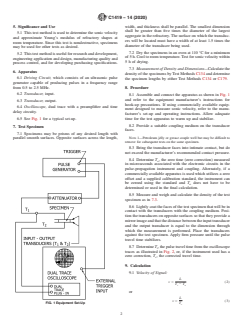
8.1 Assemble and connect the apparatus as shown in Fig. 1
and refer to the equipment manufacturer’s instructions for
6.3 Transducer, output.
hook-up precautions. If using commercially available equip-
6.4 Oscilloscope, dual trace with a preamplifier and time
ment designed to measure sonic velocity, refer to the manu-
delay circuity.
facturer’s set-up and operating instructions. Allow adequate
6.5 See Fig. 1 for a typical set-up.
time for the test apparatus to warm up and stabilize.
8.2 Provide a suitable coupling medium on the transd
...