

ASTM D5275-20
(Test Method)Standard Test Method for Fuel Injector Shear Stability Test (FISST) for Polymer Containing Fluids
General Information
- Abstract
SIGNIFICANCE AND USE
4.1 This test method evaluates the percent viscosity loss for polymer-containing fluids resulting from polymer degradation in the high shear nozzle device. Minimum interference from thermal or oxidative effects are anticipated.
4.2 This test method is not intended to predict viscosity loss in field service for different polymer classes or for different field equipment. Some correlation for a specific polymer type in specific field equipment can be possible.
SCOPE
1.1 This test method covers the measurement of the percent viscosity loss at 100 °C of polymer-containing fluids using fuel injector shear stability test (FISST) equipment. The viscosity loss reflects polymer degradation due to shear at the nozzle.
Note 1: Test Method D2603 has been used for similar evaluation of this property. It has many of the same limitations as indicated in the significance statement. No detailed attempt has been undertaken to correlate the results by the sonic and the diesel injector methods.
Note 2: This test method was originally published as Procedure B of Test Methods D3945. The FISST method was made a separate test method after tests of a series of polymer-containing fluids showed that Procedures A and B of Test Methods D3945 often give different results.
1.2 The values stated in SI units are to be regarded as standard. No other units of measurement are included in this standard.
1.2.1 Exception—PSI is mentioned in parentheses for instruments that have only PSI gauges. Horsepower, HP, is listed in parentheses since the motor labels display this value.
1.3 This standard does not purport to address all of the safety concerns, if any, associated with its use. It is the responsibility of the user of this standard to establish appropriate safety, health, and environmental practices and determine the applicability of regulatory limitations prior to use. Specific precautionary statements are given in Section 7.
1.4 This international standard was developed in accordance with internationally recognized principles on standardization established in the Decision on Principles for the Development of International Standards, Guides and Recommendations issued by the World Trade Organization Technical Barriers to Trade (TBT) Committee.
- Status
- Published
- Publication Date
- 30-Apr-2020
- Technical Committee
- D02 - Petroleum Products, Liquid Fuels, and Lubricants
- Drafting Committee
- D02.07 - Flow Properties
Buy Documents
ASTM D5275-20 - Standard Test Method for Fuel Injector Shear Stability Test (FISST) for Polymer Containing Fluids
REDLINE ASTM D5275-20 - Standard Test Method for Fuel Injector Shear Stability Test (FISST) for Polymer Containing Fluids
Overview
ASTM D5275-20, titled Standard Test Method for Fuel Injector Shear Stability Test (FISST) for Polymer Containing Fluids, is a widely recognized method developed by ASTM International. This test measures the percent viscosity loss at 100 °C in polymer-containing fluids as a result of shear-induced polymer degradation, utilizing specialized fuel injector apparatus (FISST). The primary value of this method is in evaluating the shear stability of polymers in lubricants, ensuring reliable performance in various applications where fluid viscosity is critical.
By focusing on shear degradation at a fuel injector nozzle, ASTM D5275-20 helps isolate the effects of mechanical stress on viscosity, with minimal interference from thermal or oxidative effects. The test is best suited for comparing fluids containing similar polymers or for quality control in the formulation of lubricants and hydraulic fluids.
Key Topics
Shear Stability Evaluation
The test determines percentage viscosity loss, which reflects the degree of polymer breakdown under high-shear conditions, using a diesel injector nozzle. Results are reported as the reduction in kinematic viscosity after 20 cycles through the injector apparatus.Test Apparatus
The method relies on a system consisting of fluid reservoirs, a diesel injection pump, a pintle-type nozzle, and automated operation. Kinematic viscosity is measured using viscometers conforming to ASTM D445 or ASTM D7042 before and after the shear test.Calibration and Safety
Calibration fluid and diesel fuel are used to adjust apparatus and verify operation within prescribed limits. The standard emphasizes safety due to high-pressure operation and requires proper shielding and protocols to avoid injury.Scope and Limitations
ASTM D5275-20 is specifically designed for laboratory evaluation and is not intended to directly predict viscosity loss in actual field service for all polymer types or equipment. Correlation may exist for specific polymers and applications, but results should not be universally extrapolated.
Applications
ASTM D5275-20 is used in several practical scenarios within the lubricants and petroleum products industries:
- Quality Control and Product Development
- Assess the shear stability of engine oils, transmission fluids, and hydraulic fluids containing viscosity index improvers (VII).
- Compare the performance of different polymer additives in candidate fluid formulations.
- Specification and Compliance Testing
- Ensure that finished lubricants meet the viscosity loss criteria set by engine or equipment manufacturers.
- Support claims regarding the durability and reliability of lubricant fluids under high-shear mechanical conditions.
- Research and Comparative Evaluation
- Benchmark results against other shear stability methods, such as ASTM D2603, for further understanding of polymer performance.
- Establish consistency in manufacturing, particularly for fluids intended for high-performance or demanding service.
Related Standards
Several ASTM standards are referenced in or related to ASTM D5275-20:
- ASTM D445 - Test Method for Kinematic Viscosity of Transparent and Opaque Liquids (and Calculation of Dynamic Viscosity)
- ASTM D2603 - Test Method for Sonic Shear Stability of Polymer-Containing Oils
- ASTM D3945 - Test Method for Shear Stability of Polymer-Containing Fluids Using a Diesel Injector Nozzle (Withdrawn)
- ASTM D7042 - Test Method for Dynamic Viscosity and Density of Liquids by Stabinger Viscometer
These related standards provide additional methodologies for viscosity measurement and alternative shear stability assessment, offering complementary approaches for the evaluation of polymer-containing fluids in lubricants and functional fluids.
Keywords: ASTM D5275-20, fuel injector shear stability test, FISST, polymer-containing fluids, viscosity loss, lubricant shear stability, kinematic viscosity, ASTM standards, engine oil testing, hydraulic fluid testing
Relations
- Effective Date
- 01-May-2020
- Effective Date
- 01-Apr-2024
- Effective Date
- 01-Nov-2023
- Effective Date
- 01-May-2020
- Effective Date
- 01-Jun-2019
- Effective Date
- 15-Dec-2016
- Effective Date
- 01-Jul-2014
- Effective Date
- 01-Jul-2014
- Effective Date
- 01-May-2014
- Refers
ASTM D2603-01(2013) - Standard Test Method for Sonic Shear Stability of Polymer-Containing Oils - Effective Date
- 01-May-2013
- Effective Date
- 01-Nov-2012
- Effective Date
- 15-Apr-2012
- Effective Date
- 15-Apr-2012
- Effective Date
- 15-Apr-2012
- Effective Date
- 01-Oct-2011
Buy Documents
ASTM D5275-20 - Standard Test Method for Fuel Injector Shear Stability Test (FISST) for Polymer Containing Fluids
REDLINE ASTM D5275-20 - Standard Test Method for Fuel Injector Shear Stability Test (FISST) for Polymer Containing Fluids
Get Certified
Connect with accredited certification bodies for this standard

TÜV Rheinland
TÜV Rheinland is a leading international provider of technical services.

TÜV SÜD
TÜV SÜD is a trusted partner of choice for safety, security and sustainability solutions.

DEKRA Certification Inc.
DEKRA US certification services.
Sponsored listings
Frequently Asked Questions
ASTM D5275-20 is a standard published by ASTM International. Its full title is "Standard Test Method for Fuel Injector Shear Stability Test (FISST) for Polymer Containing Fluids". This standard covers: SIGNIFICANCE AND USE 4.1 This test method evaluates the percent viscosity loss for polymer-containing fluids resulting from polymer degradation in the high shear nozzle device. Minimum interference from thermal or oxidative effects are anticipated. 4.2 This test method is not intended to predict viscosity loss in field service for different polymer classes or for different field equipment. Some correlation for a specific polymer type in specific field equipment can be possible. SCOPE 1.1 This test method covers the measurement of the percent viscosity loss at 100 °C of polymer-containing fluids using fuel injector shear stability test (FISST) equipment. The viscosity loss reflects polymer degradation due to shear at the nozzle. Note 1: Test Method D2603 has been used for similar evaluation of this property. It has many of the same limitations as indicated in the significance statement. No detailed attempt has been undertaken to correlate the results by the sonic and the diesel injector methods. Note 2: This test method was originally published as Procedure B of Test Methods D3945. The FISST method was made a separate test method after tests of a series of polymer-containing fluids showed that Procedures A and B of Test Methods D3945 often give different results. 1.2 The values stated in SI units are to be regarded as standard. No other units of measurement are included in this standard. 1.2.1 Exception—PSI is mentioned in parentheses for instruments that have only PSI gauges. Horsepower, HP, is listed in parentheses since the motor labels display this value. 1.3 This standard does not purport to address all of the safety concerns, if any, associated with its use. It is the responsibility of the user of this standard to establish appropriate safety, health, and environmental practices and determine the applicability of regulatory limitations prior to use. Specific precautionary statements are given in Section 7. 1.4 This international standard was developed in accordance with internationally recognized principles on standardization established in the Decision on Principles for the Development of International Standards, Guides and Recommendations issued by the World Trade Organization Technical Barriers to Trade (TBT) Committee.
SIGNIFICANCE AND USE 4.1 This test method evaluates the percent viscosity loss for polymer-containing fluids resulting from polymer degradation in the high shear nozzle device. Minimum interference from thermal or oxidative effects are anticipated. 4.2 This test method is not intended to predict viscosity loss in field service for different polymer classes or for different field equipment. Some correlation for a specific polymer type in specific field equipment can be possible. SCOPE 1.1 This test method covers the measurement of the percent viscosity loss at 100 °C of polymer-containing fluids using fuel injector shear stability test (FISST) equipment. The viscosity loss reflects polymer degradation due to shear at the nozzle. Note 1: Test Method D2603 has been used for similar evaluation of this property. It has many of the same limitations as indicated in the significance statement. No detailed attempt has been undertaken to correlate the results by the sonic and the diesel injector methods. Note 2: This test method was originally published as Procedure B of Test Methods D3945. The FISST method was made a separate test method after tests of a series of polymer-containing fluids showed that Procedures A and B of Test Methods D3945 often give different results. 1.2 The values stated in SI units are to be regarded as standard. No other units of measurement are included in this standard. 1.2.1 Exception—PSI is mentioned in parentheses for instruments that have only PSI gauges. Horsepower, HP, is listed in parentheses since the motor labels display this value. 1.3 This standard does not purport to address all of the safety concerns, if any, associated with its use. It is the responsibility of the user of this standard to establish appropriate safety, health, and environmental practices and determine the applicability of regulatory limitations prior to use. Specific precautionary statements are given in Section 7. 1.4 This international standard was developed in accordance with internationally recognized principles on standardization established in the Decision on Principles for the Development of International Standards, Guides and Recommendations issued by the World Trade Organization Technical Barriers to Trade (TBT) Committee.
ASTM D5275-20 is classified under the following ICS (International Classification for Standards) categories: 43.060.40 - Fuel systems. The ICS classification helps identify the subject area and facilitates finding related standards.
ASTM D5275-20 has the following relationships with other standards: It is inter standard links to ASTM D5275-17, ASTM D445-24, ASTM D445-23, ASTM D2603-20, ASTM D2603-19, ASTM D445-16, ASTM D445-14e1, ASTM D445-14, ASTM D7042-14, ASTM D2603-01(2013), ASTM D7042-12a, ASTM D445-12, ASTM D7042-12e1, ASTM D7042-12, ASTM D7042-11a. Understanding these relationships helps ensure you are using the most current and applicable version of the standard.
ASTM D5275-20 is available in PDF format for immediate download after purchase. The document can be added to your cart and obtained through the secure checkout process. Digital delivery ensures instant access to the complete standard document.
Standards Content (Sample)
This international standard was developed in accordance with internationally recognized principles on standardization established in the Decision on Principles for the
Development of International Standards, Guides and Recommendations issued by the World Trade Organization Technical Barriers to Trade (TBT) Committee.
Designation: D5275 − 20
Standard Test Method for
Fuel Injector Shear Stability Test (FISST) for Polymer
Containing Fluids
This standard is issued under the fixed designation D5275; the number immediately following the designation indicates the year of
original adoption or, in the case of revision, the year of last revision. A number in parentheses indicates the year of last reapproval. A
superscript epsilon (´) indicates an editorial change since the last revision or reapproval.
1. Scope* 2. Referenced Documents
1.1 This test method covers the measurement of the percent 2.1 ASTM Standards:
viscositylossat100 °Cofpolymer-containingfluidsusingfuel D445 Test Method for Kinematic Viscosity of Transparent
injector shear stability test (FISST) equipment. The viscosity and Opaque Liquids (and Calculation of Dynamic Viscos-
loss reflects polymer degradation due to shear at the nozzle. ity)
D2603 Test Method for Sonic Shear Stability of Polymer-
NOTE 1—Test Method D2603 has been used for similar evaluation of
Containing Oils
this property. It has many of the same limitations as indicated in the
D3945 Test Method for Shear Stability of Polymer-
significance statement. No detailed attempt has been undertaken to
correlate the results by the sonic and the diesel injector methods.
Containing Fluids Using a Diesel Injector Nozzle (With-
NOTE 2—This test method was originally published as Procedure B of
drawn 1998)
TestMethodsD3945.TheFISSTmethodwasmadeaseparatetestmethod
D7042 Test Method for Dynamic Viscosity and Density of
after tests of a series of polymer-containing fluids showed that Procedures
Liquids by Stabinger Viscometer (and the Calculation of
A and B of Test Methods D3945 often give different results.
Kinematic Viscosity)
1.2 The values stated in SI units are to be regarded as
standard. No other units of measurement are included in this
3. Summary of Test Method
standard.
3.1 The polymer-containing fluid is passed through a diesel
1.2.1 Exception—PSI is mentioned in parentheses for in-
injector nozzle at a shear rate that causes the less shear stable
struments that have only PSI gauges. Horsepower, HP, is listed
polymer molecules to degrade. The resultant degradation
in parentheses since the motor labels display this value.
reduces the kinematic viscosity of the fluid under test. The
1.3 This standard does not purport to address all of the
reduction in kinematic viscosity, reported as percent loss of the
safety concerns, if any, associated with its use. It is the
initial kinematic viscosity, is a measure of the shear stability of
responsibility of the user of this standard to establish appro-
the polymer-containing fluid.
priate safety, health, and environmental practices and deter-
mine the applicability of regulatory limitations prior to use.
4. Significance and Use
Specific precautionary statements are given in Section 7.
4.1 This test method evaluates the percent viscosity loss for
1.4 This international standard was developed in accor-
polymer-containing fluids resulting from polymer degradation
dance with internationally recognized principles on standard-
in the high shear nozzle device. Minimum interference from
ization established in the Decision on Principles for the
thermal or oxidative effects are anticipated.
Development of International Standards, Guides and Recom-
mendations issued by the World Trade Organization Technical
4.2 This test method is not intended to predict viscosity loss
Barriers to Trade (TBT) Committee.
in field service for different polymer classes or for different
1 2
This test method is under the jurisdiction of ASTM Committee D02 on For referenced ASTM standards, visit the ASTM website, www.astm.org, or
Petroleum Products, Liquid Fuels, and Lubricants and is the direct responsibility of contact ASTM Customer Service at service@astm.org. For Annual Book of ASTM
Subcommittee D02.07 on Flow Properties. Standards volume information, refer to the standard’s Document Summary page on
Current edition approved May 1, 2020. Published May 2020. Originally the ASTM website.
approved in 1992. Last previous edition approved in 2017 as D5275 – 17. DOI: The last approved version of this historical standard is referenced on
10.1520/D5275-20. www.astm.org.
*A Summary of Changes section appears at the end of this standard
Copyright © ASTM International, 100 Barr Harbor Drive, PO Box C700, West Conshohocken, PA 19428-2959. United States
D5275 − 20
field equipment. Some correlation for a specific polymer type 9.2 Set the delivery rate of the pump to 534 cm 6
in specific field equipment can be possible. 12 cm /min by the procedure described in Annex A1.
9.3 Verify the shearing severity of the apparatus by running
5. Apparatus
the standard test procedure, described in 9.3.1, with reference
5.1 The apparatus consists of two fluid reservoirs, a single-
oil. Make this check every twentieth run when the apparatus is
plungerdieselfuelinjectionpumpwithanelectricmotordrive,
used frequently. Make this check before any other samples are
a pintle-type fuel injection nozzle installed in a nozzle holder,
tested if the apparatus has been idle for a week or more. The
and instrumentation for automatic operation. Annex A1 con-
kinematic viscosity at 100 °C for the sheared reference oil is to
4,5
tains a more complete description of the apparatus.
be within the limits prescribed for the specific batch of the
6,5
reference oil in use. Reference oil TL-11074 shall have a
5.2 Viscometer—Any viscometer and bath meeting the re-
2 2
total shear loss between 2.0 mm and 2.2 mm /s at 100 °C.
quirementsofTestMethodD445orD7042.Whichevermethod
This total shear loss is the difference between the reference oil
is chosen, that same method must be used for the before and
kinematic viscosity at 100 °C before and after shear.
after samples as well as the calibration samples.
9.3.1 If the viscosity of the sheared oil does not fall within
6. Reference Fluids
theabovelimits,makeanothersheartestofthereferenceoilby
the standard procedure. If the viscosity of the sheared oil still
6.1 Diesel fuel is required for adjusting the nozzle valve
does not fall within the limits, take steps to correct the rating
assembly to the prescribed valve opening pressure.
level of the test. Either mechanical difficulty or test technique
6,5
6.2 Calibration fluid TL-11074 is used to verify that the
is at fault.
shearing severity of the apparatus is within the prescribed
limits.
10. Procedure
7. Precautions
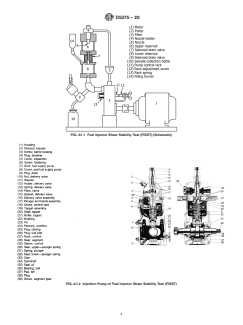
10.1 Shearing is accomplished by pumping the entire
100 cm test oil charge through the nozzle in successive passes
7.1 During operation, the line between the pump and the
orcycles.Onecycleconsistsofpumpingtheoilfromthelower
nozzle holder is under high pressure. The safety shield should
reservoir (8)in Fig. A1.1, through the nozzle (5), and into the
be in place when the apparatus is running. Stop the apparatus
upper reservoir (6). At the end of each cycle, when the entire
before tightening any fitting that is not properly sealed.
test oil charge has been collected in the upper reservoir (6), the
7.2 During operation and during the setting of the valve
pump (2) stops and the solenoid-operated drain valve (7)
opening pressure, the fluid is discharged from the nozzle at
opens, draining the oil into the lower reservoir (8). The pump
high velocity and can inflict a serious wound if it strikes a part
then restarts automatically for the next cycle. This process
of the human body. Therefore, secure the nozzle assembly in
repeatsforthenumberofcyclesthathavebeensetonthecycle
positionbeforethetestapparatusisstarted.Similarly,takecare
counter. At the end of the last cycle, both solenoid-operated
to shield the operator from the nozzle discharge during the
drain valves, (7) and (9)in Fig. A1.1, open and the test oil
pressure-setting step.
drains into the sample collection bottle (10).
8. Sampling
10.2 Flush the apparatus with four separate 20 cm portions
of the test oil as described in 10.2.1 and drain. Do not use
8.1 The test fluid shall be at room temperature, uniform in
solvent as part of the flush at any time because it could cause
appearance and free of any visible insoluble material prior to
contamination.
placing in the test equipment.
10.2.1 Pour the first 20 cm charge of test oil into the lower
8.2 After the test fluid has completed its twentieth cycle
reservoir, (8)in Fig. A1.1, through the funnel (14). Set the
through the apparatus, drain it into a bottle for transfer to the
cyclecounterforfivecyclesofthefluidthroughthenozzle,the
kinematic viscosity measurement.
pump timer for 15 s and the valve time for 20 s.
10.2.2 Repeat 10.2.1 three more times, draining and dis-
9. Calibration
carding each flush.
9.1 Set the valve opening pressure of the diesel injector
NOTE 3—These timer settings have been found satisfactory for all oils
nozzle assembly to 20.7 MPa 6 0.35 MPa (3000 psi 6 50 psi)
7,5
normally tested. The pump time should be sufficient for all oil to be
by means of a hand-actuated pump and diesel fuel.
pumped through the nozzle and into the upper reservoir, (6)in Fig.A1.1.
Thevalvetimeshouldbesufficientfortheoiltodraincompletelyfromthe
upper reservoir to the lower reservoir.
The sole source of supply of the entire apparatus and spare parts (injectors)
known to the committee at this time is Falex Corporation, 1020 Airpark Dr., Sugar
10.3 Pour 100 cm of the test oil into the lower reservoir
Grove, IL 60554.
through the funnel. Set the cycle counter for 20 cycles. Set a
If you are aware of alternative suppliers, please provide this information to
clean 120 cm bottle, (10)in Fig.A1.1, under the drain tube of
ASTM International Headquarters. Your comments will receive careful consider-
the lower reservoir to receive the sheared sample. Start the
ation at a meeting of the responsible technical committee, which you may attend.
The sole source of supply of the apparatus known to the committee at this time
pump and run until the 20 cycles have been completed. At the
is Tannas Co., 4800 James Savage Rd., Midland, MI 48642.
endofthetwentiethcycle,bothdrainvalves,(7)and(9)inFig.
The sole source of supply of the apparatus known to the committee at this time
A1.1, open automatically and the sample drains into the
is Waukesha Engine Div., 1000 W. St. Paul Ave., Waukesha, WI 53188. Part No.
G-818–7. collection bottle, (10).
D5275 − 20
10.4 Measure the kinematic viscosity of the sheared oil and 13. Precision and Bias
a sample of the unsheared oil at 100 °C by Test Method D445
13.1 The following criteria should be used for judging the
or D7042.
acceptability of results:
10.4.1 If a method other than D445 is used to generate the
13.1.1 Repeatability—The difference between successive
kinematic viscosity data, apply appropriate relative-bias cor-
test results, obtained by the same operator with the same
rection factors as found in the precision section of that method
apparatus under constant operating conditions on identical test
used before performing the calculations of this method.
material would, in the long run, and in the normal and correct
operation of the test method, exceed the following value only
11. Calculation
in one case in twenty: 1.19 %.
13.1.2 Reproducibility—The difference between two single
11.1 Calculate the percentage loss of viscosity of the
and independent results, obtained by different operators work-
sheared oil as follows:
ing in different laboratories on identical test material would, in
VL 5 100 3 ~V 2 V !/V (1)
u s u
the long run, and in the normal a
...
This document is not an ASTM standard and is intended only to provide the user of an ASTM standard an indication of what changes have been made to the previous version. Because
it may not be technically possible to adequately depict all changes accurately, ASTM recommends that users consult prior editions as appropriate. In all cases only the current version
of the standard as published by ASTM is to be considered the official document.
Designation: D5275 − 17 D5275 − 20
Standard Test Method for
Fuel Injector Shear Stability Test (FISST) for Polymer
Containing Fluids
This standard is issued under the fixed designation D5275; the number immediately following the designation indicates the year of
original adoption or, in the case of revision, the year of last revision. A number in parentheses indicates the year of last reapproval. A
superscript epsilon (´) indicates an editorial change since the last revision or reapproval.
1. Scope*
1.1 This test method covers the measurement of the percent viscosity loss at 100 °C of polymer-containing fluids using fuel
injector shear stability test (FISST) equipment. The viscosity loss reflects polymer degradation due to shear at the nozzle.
NOTE 1—Test Method D2603 has been used for similar evaluation of this property. It has many of the same limitations as indicated in the significance
statement. No detailed attempt has been undertaken to correlate the results by the sonic and the diesel injector methods.
NOTE 2—This test method was originally published as Procedure B of Test Methods D3945. The FISST method was made a separate test method after
tests of a series of polymer-containing fluids showed that Procedures A and B of Test Methods D3945 often give different results.
1.2 The values stated in SI units are to be regarded as standard. No other units of measurement are included in this standard.
1.2.1 Exception—PSI is mentioned in parentheses for instruments that have only PSI gauges. Horsepower, HP, is listed in
parentheses since the motor labels display this value.
1.3 This standard does not purport to address all of the safety concerns, if any, associated with its use. It is the responsibility
of the user of this standard to establish appropriate safety safety, health, and healthenvironmental practices and determine the
applicability of regulatory limitations prior to use. Specific precautionary statements are given in Section 7.
1.4 This international standard was developed in accordance with internationally recognized principles on standardization
established in the Decision on Principles for the Development of International Standards, Guides and Recommendations issued
by the World Trade Organization Technical Barriers to Trade (TBT) Committee.
2. Referenced Documents
2.1 ASTM Standards:
D445 Test Method for Kinematic Viscosity of Transparent and Opaque Liquids (and Calculation of Dynamic Viscosity)
D2603 Test Method for Sonic Shear Stability of Polymer-Containing Oils
D3945 Test Method for SheerShear Stability of Ploymer-ContainingPolymer-Containing Fluids Using a Diesel Injector Nozzle
(Withdrawn 1998)
D7042 Test Method for Dynamic Viscosity and Density of Liquids by Stabinger Viscometer (and the Calculation of Kinematic
Viscosity)
3. Summary of Test Method
3.1 The polymer-containing fluid is passed through a diesel injector nozzle at a shear rate that causes the less shear stable
polymer molecules to degrade. The resultant degradation reduces the kinematic viscosity of the fluid under test. The reduction in
kinematic viscosity, reported as percent loss of the initial kinematic viscosity, is a measure of the shear stability of the
polymer-containing fluid.
4. Significance and Use
4.1 This test method evaluates the percent viscosity loss for polymer-containing fluids resulting from polymer degradation in
the high shear nozzle device. Minimum interference from thermal or oxidative effects are anticipated.
This test method is under the jurisdiction of ASTM Committee D02 on Petroleum Products, Liquid Fuels, and Lubricants and is the direct responsibility of Subcommittee
D02.07 on Flow Properties.
Current edition approved May 1, 2017May 1, 2020. Published May 2017May 2020. Originally approved in 1992. Last previous edition approved in 20162017 as
D5275 – 16.D5275 – 17. DOI: 10.1520/D5275-17.10.1520/D5275-20.
For referenced ASTM standards, visit the ASTM website, www.astm.org, or contact ASTM Customer Service at service@astm.org. For Annual Book of ASTM Standards
volume information, refer to the standard’s Document Summary page on the ASTM website.
The last approved version of this historical standard is referenced on www.astm.org.
*A Summary of Changes section appears at the end of this standard
Copyright © ASTM International, 100 Barr Harbor Drive, PO Box C700, West Conshohocken, PA 19428-2959. United States
D5275 − 20
4.2 This test method is not intended to predict viscosity loss in field service for different polymer classes or for different field
equipment. Some correlation for a specific polymer type in specific field equipment can be possible.
5. Apparatus
5.1 The apparatus consists of two fluid reservoirs, a single-plunger diesel fuel injection pump with an electric motor drive, a
pintle-type fuel injection nozzle installed in a nozzle holder, and instrumentation for automatic operation. Annex A1 contains a
4,5
more complete description of the apparatus.
5.2 Viscometer—Any viscometer and bath meeting the requirements of Test Method D445 or D7042. Whichever method is
chosen, that same method must be used for the before and after samples as well as the calibration samples.
6. Reference Fluids
6.1 Diesel fuel is required for adjusting the nozzle valve assembly to the prescribed valve opening pressure.
6,5
6.2 Calibration fluid TL-11074 is used to verify that the shearing severity of the apparatus is within the prescribed limits.
7. Precautions
7.1 During operation, the line between the pump and the nozzle holder is under high pressure. The safety shield should be in
place when the apparatus is running. Stop the apparatus before tightening any fitting that is not properly sealed.
7.2 During operation and during the setting of the valve opening pressure, the fluid is discharged from the nozzle at high
velocity and can inflict a serious wound if it strikes a part of the human body. Therefore, secure the nozzle assembly in position
before the test apparatus is started. Similarly, take care to shield the operator from the nozzle discharge during the pressure-setting
step.
8. Sampling
8.1 The test fluid shall be at room temperature, uniform in appearance and free of any visible insoluble material prior to placing
in the test equipment.
8.2 After the test fluid has completed its twentieth cycle through the apparatus, drain it into a bottle for transfer to the kinematic
viscosity measurement.
9. Calibration
9.1 Set the valve opening pressure of the diesel injector nozzle assembly to 20.7 MPa 6 0.35 MPa (3000 psi 6 50 psi) by means
7,5
of a hand-actuated pump and diesel fuel.
3 3
9.2 Set the delivery rate of the pump to 534 cm 6 12 cm /min by the procedure described in Annex A1.
9.3 Verify the shearing severity of the apparatus by running the standard test procedure, described in 9.3.1, with reference oil.
Make this check every twentieth run when the apparatus is used frequently. Make this check before any other samples are tested
if the apparatus has been idle for a week or more. The kinematic viscosity at 100 °C for the sheared reference oil is to be within
6,5
the limits prescribed for the specific batch of the reference oil in use. Reference oil TL-11074 shall have a total shear loss
2 2
between 2.0 mm and 2.2 mm /s at 100 °C. This total shear loss is the difference between the reference oil kinematic viscosity at
100 °C before and after shear.
9.3.1 If the viscosity of the sheared oil does not fall within the above limits, make another shear test of the reference oil by the
standard procedure. If the viscosity of the sheared oil still does not fall within the limits, take steps to correct the rating level of
the test. Either mechanical difficulty or test technique is at fault.
10. Procedure
10.1 Shearing is accomplished by pumping the entire 100 cm test oil charge through the nozzle in successive passes or cycles.
One cycle consists of pumping the oil from the lower reservoir (8) in Fig. A1.1, through the nozzle (5), and into the upper reservoir
(6). At the end of each cycle, when the entire test oil charge has been collected in the upper reservoir (6), the pump (2) stops and
the solenoid-operated drain valve (7) opens, draining the oil into the lower reservoir (8). The pump then restarts automatically for
the next cycle. This process repeats for the number of cycles that have been set on the cycle counter. At the end of the last cycle,
both solenoid-operated drain valves, (7) and (9) in Fig. A1.1, open and the test oil drains into the sample collection bottle (10).
The sole source of supply of the entire apparatus and spare parts (injectors) known to the committee at this time is Falex Corporation, 1020 Airpark Dr., Sugar Grove,
IL 60554.
If you are aware of alternative suppliers, please provide this information to ASTM International Headquarters. Your comments will receive careful consideration at a
meeting of the responsible technical committee, which you may attend.
The sole source of supply of the apparatus known to the committee at this time is Tannas Co., 4800 James Savage Rd., Midland, MI 48642.
The sole source of supply of the apparatus known to the committee at this time is Waukesha Engine Div., 1000 W. St. Paul Ave., Waukesha, WI 53188. Part No. G-818–7.
D5275 − 20
10.2 Flush the apparatus with four separate 20 cm portions of the test oil as described in 10.2.1 and drain. Do not use solvent
as part of the flush at any time because it could cause contamination.
10.2.1 Pour the first 20 cm charge of test oil into the lower reservoir, (8) in Fig. A1.1, through the funnel (14). Set the cycle
counter for five cycles of the fluid through the nozzle, the pump timer for 15 s and the valve time for 20 s.
10.2.2 Repeat 10.2.1 three more times, draining and discarding each flush.
NOTE 3—These timer settings have been found satisfactory for all oils normally tested. The pump time should be sufficient for all oil to be pumped
through the nozzle and into the upper reservoir, (6) in Fig. A1.1. The valve time should be sufficient for the oil to drain completely from the upper reservoir
to the lower reservoir.
10.3 Pour 100 cm of the test oil into the lower reservoir through the funnel. Set the cycle counter for 20 cycles. Set a clean
120 cm bottle, (10) in Fig. A1.1, under the drain tube of the lower reservoir to receive the sheared sample. Start the pump and
run until the 20 cycles have been completed. At the end of the twentieth cycle, both drain valves, (7) and (9) in Fig. A1.1, open
automatically and the sample drains into the collection bottle, (10).
10.4 Measure the kinematic viscosity of the sheared oil and a sample of the unsheared oil at 100 °C by Test Method D445 or
D7042.
10.4.1 If a method other than D445 is used to generate the kinematic viscosity data, apply appropriate relative-bias correction
factors as found in the precision section of that method used before performing the calculations of this method.
11. Calculation
11.1 Calculate the percentage loss of viscosity of the sheared oil as follows:
VL 5 100 3~V 2 V !/V (1)
u s u
where:
VL = viscosity loss, %,
V = kinematic viscosity of unsheared oil at 100 °C, mm /s, and
u
V = kinematic viscosity of sheared oil at 100 °C, mm /s.
s
12. Report
12.1 Report the following information:
12.1.1 Percentage viscosity loss as calculated in 11.1,
12.1.2 Kinematic viscosity of the unsheared oil at 100 °C,
12.1.3 Kinematic viscosity of the sheared oil at 100 °C,
12.1.4 Number of cycles,
12.1.5 For reference oil runs, the batch number of the reference oil, and
12.1.6 Specify this test method (ASTM D5275).
13. Precision and Bias
13.1 The following criteria should be used for judging the acceptability of results:
13.1.1 Repeatability—The difference between successive test results, obtained by the same operator with the same apparatus
under constant operating condi
...