

ASTM D8009-22
(Practice)Standard Practice for Manual Piston Cylinder Sampling for Volatile Crude Oils, Condensates, and Liquid Petroleum Products
General Information
- Abstract
SIGNIFICANCE AND USE
5.1 This practice allows the collection of a representative sample of crude oil and/or condensate that may contain trace volatile dissolved components such as methane, ethane, propane, and fixed gases that would normally be lost using conventional atmospheric sampling methods. These highly volatile components can result in vapor pressure conditions above atmospheric pressure. This practice is recommended whenever accurate determination of vapor pressure, flash point, or other properties are required and where loss of volatile components can affect the test results.
5.2 This practice is intended for capturing samples of crude oil and/or condensate for testing for the purpose of classification for transportation of dangerous goods as UN Class 3 Flammable Liquids, but is not limited to classification testing. Other test methods with sensitivities to light end loss may also utilize this sampling practice.
5.3 Practice D3700 using a floating piston cylinder is recommended whenever true vapor pressures greater than 300 kPa at 50 °C are anticipated.
SCOPE
1.1 This practice includes the equipment and procedures for obtaining a representative sample of “live” or high vapor pressure crude oils, condensates, and/or liquid petroleum products from low pressure sample points, where there is insufficient sample point pressure to use a Floating Piston Cylinder (FPC) as described in Practice D3700.
1.2 This practice is intended for use with sample types, such as UN Class 3 Flammable Liquids, that might have been collected and transported using open containers. The use of a manual piston cylinder in place of open containers is intended to prevent the loss of volatile (light end) components, which can impact subsequent test results.
1.3 This practice is suitable for sampling crude oils, condensates, and/or liquid petroleum products having true vapor pressures less than 300 kPa (43 psia nominal) at 50 °C. This practice applies to samples that will typically fall between Practices D4057 (API MPMS Chapter 8.1) and D3700. This practice shall not be used for materials classified as UN Class 2 Gases2 (“…having a vapor pressure greater than 300 kPa at 50 °C or is completely gaseous at 20 °C at 101.3 kPa.”).
1.4 This practice allows for sampling of crude oils that flow freely at the conditions of sampling.
1.5 It is the responsibility of the user to ensure that the sampling point is located so as to obtain a representative sample.
1.6 The values stated in SI units are to be regarded as standard.
1.6.1 Exception—The values given in parentheses are for information only.
1.7 This standard does not purport to address all of the safety concerns, if any, associated with its use. It is the responsibility of the user of this standard to establish appropriate safety, health, and environmental practices and determine the applicability of regulatory limitations prior to use.
1.8 This international standard was developed in accordance with internationally recognized principles on standardization established in the Decision on Principles for the Development of International Standards, Guides and Recommendations issued by the World Trade Organization Technical Barriers to Trade (TBT) Committee.
- Status
- Published
- Publication Date
- 30-Jun-2022
- Technical Committee
- D02 - Petroleum Products, Liquid Fuels, and Lubricants
- Drafting Committee
- D02.02 - Hydrocarbon Measurement for Custody Transfer (Joint ASTM-API)
Buy Documents
ASTM D8009-22 - Standard Practice for Manual Piston Cylinder Sampling for Volatile Crude Oils, Condensates, and Liquid Petroleum Products
REDLINE ASTM D8009-22 - Standard Practice for Manual Piston Cylinder Sampling for Volatile Crude Oils, Condensates, and Liquid Petroleum Products
Overview
ASTM D8009-22, Standard Practice for Manual Piston Cylinder Sampling for Volatile Crude Oils, Condensates, and Liquid Petroleum Products, establishes procedures and equipment requirements for obtaining representative samples of “live” or high vapor pressure petroleum liquids. This method is essential for accurate sampling of materials with volatile components, such as methane, ethane, propane, and other light ends, which are easily lost in conventional open container sampling. The standard focuses on products with true vapor pressures less than 300 kPa (43 psia) at 50 °C, typically classified as UN Class 3 Flammable Liquids, and outlines handling practices to maintain sample integrity for reliable testing and classification.
Key Topics
- Representative Sampling: Guidance on collecting samples of volatile crude oil, condensates, and liquid petroleum products to prevent loss of light ends and gases.
- Manual Piston Cylinder (MPC) Usage: Defines equipment requirements, operational procedures, and best practices for using MPCs to sample fluids at low-pressure sampling points.
- Sample Integrity: Emphasizes the importance of preventing vaporization, contamination, or loss of volatile components throughout the sampling and transfer process.
- Classification and Transport: Supports accurate testing for the classification and safe transportation of petroleum products as hazardous materials (e.g., UN Class 3 Flammable Liquids).
- Safety and Compliance: Highlights the need to address safety, health, and environmental concerns, ensuring that equipment and sampling procedures comply with relevant regulations and standards.
Applications
ASTM D8009-22 is widely applied in the petroleum sector for:
- Crude Oil and Condensate Sampling: Ensuring that samples taken from tanks, pipelines, trucks, or other vessels accurately reflect the product’s true composition, especially where light ends must be preserved for analysis.
- Hazardous Material Classification: Providing reliable samples for laboratory analysis to determine properties such as vapor pressure, flash point, and composition - crucial for correct hazardous material labeling and regulatory compliance during transportation.
- Quality Control and Product Characterization: Used in custody transfer, production monitoring, and laboratory settings to verify product quality and specifications without bias from volatilized components.
- Supplementary to Other Standards: Applied when sample conditions or product vapor pressures do not meet the criteria for other ASTM methods, bridging the gap between floating piston cylinder (FPC) and open container techniques.
Related Standards
- ASTM D4057: Practice for Manual Sampling of Petroleum and Petroleum Products (API MPMS Chapter 8.1)
- ASTM D3700: Practice for Obtaining LPG Samples Using a Floating Piston Cylinder (recommended for vapor pressures above 300 kPa at 50 °C)
- ASTM D4177: Practice for Automatic Sampling of Petroleum and Petroleum Products
- ASTM D6377, D6378, D7975: Test methods for determination of vapor pressure of crude oil and petroleum products
- API MPMS Chapter 8.1 and 8.2: Guidance for manual and automatic sampling in petroleum measurement
- UN Recommendations, Chapter 2.2.1.1: Criteria for classification of dangerous goods for transportation
Practical Value
- Prevents Loss of Volatile Components: Ensures samples are not depleted of light ends, leading to more accurate test results and classification.
- Supports Regulatory Compliance: Facilitates adherence to transport and hazardous material regulations by delivering representative, properly classified samples.
- Enhances Safety: By avoiding open container sampling for volatile products, it reduces risk of uncontrolled vapor release and ensures safety of personnel and environment.
- Versatile in the Field: Applicable to a wide range of petroleum products and sampling scenarios, especially when sample point pressures are too low for FPC use.
For organizations handling, transporting, or testing volatile crude oils, condensates, or petroleum liquids, ASTM D8009-22 provides essential guidance to ensure the integrity of samples and compliance with industry and regulatory standards.
Relations
- Refers
ASTM D4175-23a - Standard Terminology Relating to Petroleum Products, Liquid Fuels, and Lubricants - Effective Date
- 15-Dec-2023
- Refers
ASTM D4175-23e1 - Standard Terminology Relating to Petroleum Products, Liquid Fuels, and Lubricants - Effective Date
- 01-Jul-2023
- Effective Date
- 01-Dec-2018
- Effective Date
- 01-Jun-2018
- Effective Date
- 01-Oct-2015
- Effective Date
- 01-Oct-2014
- Effective Date
- 01-Nov-2012
- Refers
ASTM D4057-06(2011) - Standard Practice for Manual Sampling of Petroleum and Petroleum Products - Effective Date
- 01-Jun-2011
- Effective Date
- 01-Oct-2010
- Effective Date
- 01-Oct-2010
- Effective Date
- 15-Oct-2008
- Effective Date
- 01-Jul-2008
- Effective Date
- 01-May-2007
- Effective Date
- 15-Feb-2007
- Effective Date
- 01-Aug-2006
Buy Documents
ASTM D8009-22 - Standard Practice for Manual Piston Cylinder Sampling for Volatile Crude Oils, Condensates, and Liquid Petroleum Products
REDLINE ASTM D8009-22 - Standard Practice for Manual Piston Cylinder Sampling for Volatile Crude Oils, Condensates, and Liquid Petroleum Products
Get Certified
Connect with accredited certification bodies for this standard

Element Materials Technology
Materials testing and product certification.

ABS Group Brazil
ABS Group certification services in Brazil.

ABS Quality Evaluations Inc.
American Bureau of Shipping quality certification.
Sponsored listings
Frequently Asked Questions
ASTM D8009-22 is a standard published by ASTM International. Its full title is "Standard Practice for Manual Piston Cylinder Sampling for Volatile Crude Oils, Condensates, and Liquid Petroleum Products". This standard covers: SIGNIFICANCE AND USE 5.1 This practice allows the collection of a representative sample of crude oil and/or condensate that may contain trace volatile dissolved components such as methane, ethane, propane, and fixed gases that would normally be lost using conventional atmospheric sampling methods. These highly volatile components can result in vapor pressure conditions above atmospheric pressure. This practice is recommended whenever accurate determination of vapor pressure, flash point, or other properties are required and where loss of volatile components can affect the test results. 5.2 This practice is intended for capturing samples of crude oil and/or condensate for testing for the purpose of classification for transportation of dangerous goods as UN Class 3 Flammable Liquids, but is not limited to classification testing. Other test methods with sensitivities to light end loss may also utilize this sampling practice. 5.3 Practice D3700 using a floating piston cylinder is recommended whenever true vapor pressures greater than 300 kPa at 50 °C are anticipated. SCOPE 1.1 This practice includes the equipment and procedures for obtaining a representative sample of “live” or high vapor pressure crude oils, condensates, and/or liquid petroleum products from low pressure sample points, where there is insufficient sample point pressure to use a Floating Piston Cylinder (FPC) as described in Practice D3700. 1.2 This practice is intended for use with sample types, such as UN Class 3 Flammable Liquids, that might have been collected and transported using open containers. The use of a manual piston cylinder in place of open containers is intended to prevent the loss of volatile (light end) components, which can impact subsequent test results. 1.3 This practice is suitable for sampling crude oils, condensates, and/or liquid petroleum products having true vapor pressures less than 300 kPa (43 psia nominal) at 50 °C. This practice applies to samples that will typically fall between Practices D4057 (API MPMS Chapter 8.1) and D3700. This practice shall not be used for materials classified as UN Class 2 Gases2 (“…having a vapor pressure greater than 300 kPa at 50 °C or is completely gaseous at 20 °C at 101.3 kPa.”). 1.4 This practice allows for sampling of crude oils that flow freely at the conditions of sampling. 1.5 It is the responsibility of the user to ensure that the sampling point is located so as to obtain a representative sample. 1.6 The values stated in SI units are to be regarded as standard. 1.6.1 Exception—The values given in parentheses are for information only. 1.7 This standard does not purport to address all of the safety concerns, if any, associated with its use. It is the responsibility of the user of this standard to establish appropriate safety, health, and environmental practices and determine the applicability of regulatory limitations prior to use. 1.8 This international standard was developed in accordance with internationally recognized principles on standardization established in the Decision on Principles for the Development of International Standards, Guides and Recommendations issued by the World Trade Organization Technical Barriers to Trade (TBT) Committee.
SIGNIFICANCE AND USE 5.1 This practice allows the collection of a representative sample of crude oil and/or condensate that may contain trace volatile dissolved components such as methane, ethane, propane, and fixed gases that would normally be lost using conventional atmospheric sampling methods. These highly volatile components can result in vapor pressure conditions above atmospheric pressure. This practice is recommended whenever accurate determination of vapor pressure, flash point, or other properties are required and where loss of volatile components can affect the test results. 5.2 This practice is intended for capturing samples of crude oil and/or condensate for testing for the purpose of classification for transportation of dangerous goods as UN Class 3 Flammable Liquids, but is not limited to classification testing. Other test methods with sensitivities to light end loss may also utilize this sampling practice. 5.3 Practice D3700 using a floating piston cylinder is recommended whenever true vapor pressures greater than 300 kPa at 50 °C are anticipated. SCOPE 1.1 This practice includes the equipment and procedures for obtaining a representative sample of “live” or high vapor pressure crude oils, condensates, and/or liquid petroleum products from low pressure sample points, where there is insufficient sample point pressure to use a Floating Piston Cylinder (FPC) as described in Practice D3700. 1.2 This practice is intended for use with sample types, such as UN Class 3 Flammable Liquids, that might have been collected and transported using open containers. The use of a manual piston cylinder in place of open containers is intended to prevent the loss of volatile (light end) components, which can impact subsequent test results. 1.3 This practice is suitable for sampling crude oils, condensates, and/or liquid petroleum products having true vapor pressures less than 300 kPa (43 psia nominal) at 50 °C. This practice applies to samples that will typically fall between Practices D4057 (API MPMS Chapter 8.1) and D3700. This practice shall not be used for materials classified as UN Class 2 Gases2 (“…having a vapor pressure greater than 300 kPa at 50 °C or is completely gaseous at 20 °C at 101.3 kPa.”). 1.4 This practice allows for sampling of crude oils that flow freely at the conditions of sampling. 1.5 It is the responsibility of the user to ensure that the sampling point is located so as to obtain a representative sample. 1.6 The values stated in SI units are to be regarded as standard. 1.6.1 Exception—The values given in parentheses are for information only. 1.7 This standard does not purport to address all of the safety concerns, if any, associated with its use. It is the responsibility of the user of this standard to establish appropriate safety, health, and environmental practices and determine the applicability of regulatory limitations prior to use. 1.8 This international standard was developed in accordance with internationally recognized principles on standardization established in the Decision on Principles for the Development of International Standards, Guides and Recommendations issued by the World Trade Organization Technical Barriers to Trade (TBT) Committee.
ASTM D8009-22 is classified under the following ICS (International Classification for Standards) categories: 75.080 - Petroleum products in general. The ICS classification helps identify the subject area and facilitates finding related standards.
ASTM D8009-22 has the following relationships with other standards: It is inter standard links to ASTM D4175-23a, ASTM D4175-23e1, ASTM D6378-18a, ASTM D6378-18, ASTM D6377-15, ASTM D6377-14, ASTM D3700-12, ASTM D4057-06(2011), ASTM D6378-10, ASTM D6377-10, ASTM D6378-08, ASTM D6377-08, ASTM D6378-07, ASTM D3700-07, ASTM D6378-06. Understanding these relationships helps ensure you are using the most current and applicable version of the standard.
ASTM D8009-22 is available in PDF format for immediate download after purchase. The document can be added to your cart and obtained through the secure checkout process. Digital delivery ensures instant access to the complete standard document.
Standards Content (Sample)
This international standard was developed in accordance with internationally recognized principles on standardization established in the Decision on Principles for the
Development of International Standards, Guides and Recommendations issued by the World Trade Organization Technical Barriers to Trade (TBT) Committee.
Designation: D8009 − 22
Manual of Petroleum Measurement Standards (MPMS), Chapter 8.5
Standard Practice for
Manual Piston Cylinder Sampling for Volatile Crude Oils,
Condensates, and Liquid Petroleum Products
This standard is issued under the fixed designation D8009; the number immediately following the designation indicates the year of
original adoption or, in the case of revision, the year of last revision. A number in parentheses indicates the year of last reapproval. A
superscript epsilon (´) indicates an editorial change since the last revision or reapproval.
1. Scope* 1.6.1 Exception—The values given in parentheses are for
information only.
1.1 This practice includes the equipment and procedures for
obtaining a representative sample of “live” or high vapor
1.7 This standard does not purport to address all of the
pressure crude oils, condensates, and/or liquid petroleum
safety concerns, if any, associated with its use. It is the
products from low pressure sample points, where there is
responsibility of the user of this standard to establish appro-
insufficient sample point pressure to use a Floating Piston
priate safety, health, and environmental practices and deter-
Cylinder (FPC) as described in Practice D3700.
mine the applicability of regulatory limitations prior to use.
1.2 Thispracticeisintendedforusewithsampletypes,such
1.8 This international standard was developed in accor-
as UN Class 3 Flammable Liquids, that might have been
dance with internationally recognized principles on standard-
collected and transported using open containers. The use of a
ization established in the Decision on Principles for the
manual piston cylinder in place of open containers is intended
Development of International Standards, Guides and Recom-
to prevent the loss of volatile (light end) components, which
mendations issued by the World Trade Organization Technical
can impact subsequent test results.
Barriers to Trade (TBT) Committee.
1.3 This practice is suitable for sampling crude oils,
condensates, and/or liquid petroleum products having true 2. Referenced Documents
vapor pressures less than 300 kPa (43 psia nominal) at 50 °C.
2.1 ASTM Standards:
This practice applies to samples that will typically fall between
D3700 Practice for Obtaining LPG Samples Using a Float-
Practices D4057 (API MPMS Chapter 8.1) and D3700. This
ing Piston Cylinder
practice shall not be used for materials classified as UN Class
2 D4057 Practice for Manual Sampling of Petroleum and
2 Gases (“…having a vapor pressure greater than 300 kPa at
Petroleum Products
50 °C or is completely gaseous at 20 °C at 101.3 kPa.”).
D4175 Terminology Relating to Petroleum Products, Liquid
1.4 This practice allows for sampling of crude oils that flow
Fuels, and Lubricants
freely at the conditions of sampling.
D4177 Practice for Automatic Sampling of Petroleum and
1.5 It is the responsibility of the user to ensure that the
Petroleum Products
sampling point is located so as to obtain a representative
D6377 Test Method for Determination of Vapor Pressure of
sample.
Crude Oil: VPCR (Expansion Method)
x
1.6 The values stated in SI units are to be regarded as D6378 Test Method for Determination of Vapor Pressure
standard. (VP ) of Petroleum Products, Hydrocarbons, and
X
Hydrocarbon-Oxygenate Mixtures (Triple Expansion
Method)
This practice is under the jurisdiction ofASTM Committee D02 on Petroleum
Products, Liquid Fuels, and Lubricants and the API Committee on Petroleum D7975 Test Method for Determination of Vapor Pressure of
Measurement, and is the direct responsibility of Subcommittee D02.02 /COMQ the
Crude Oil: VPCR -F(Tm°C) (Manual Expansion Field
x
joint ASTM-API Committee on Hydrocarbon Measurement for Custody Transfer
Method)
(Joint ASTM-API). This practice has been approved by the sponsoring committees
and accepted by the Cooperating Societies in accordance with established proce-
dures. This practice was issued as a joint ASTM-API standard in 2015.
Current edition approved July 1, 2022. Published August 2022. Originally
approved in 2015. Last previous edition approved in 2015 as D8009 – 15. DOI: For referenced ASTM standards, visit the ASTM website, www.astm.org, or
10.1520/D8009-22. contact ASTM Customer Service at service@astm.org. For Annual Book of ASTM
UN Recommendations of the Transportation of Dangerous Goods, Chapter Standards volume information, refer to the standard’s Document Summary page on
2.2.1.1. the ASTM website.
*A Summary of Changes section appears at the end of this standard
© Jointly copyrighted by ASTM International, 100 Barr Harbor Drive, PO Box C700, West Conshohocken, PA 19428-2959, USA and the American Petroleum Institute (API), 1220 L Street NW, Washington DC 20005, USA
D8009 − 22
2.2 API Standards: 3.1.4.1 Discussion—This includes any materials that have
MPMSChapter 1 Terms and Definitions Database atmospheric boiling points below 0 °C including methane,
MPMSChapter 8.1 Manual Sampling of Petroleum and Pe- ethane, propane, butane.
troleum Products
3.1.4.2 Discussion—Fixed gases, such as CO, CO,H ,
2 2
MPMS Chapter 8.2 Automatic Sampling of Petroleum and
H S, N , and O , will also contribute to the composition and
2 2 2
Petroleum Products
vapor pressure of the sample.
3.1.5 maximum fill volume (reduced fill volume), n—the
3. Terminology
volume of a container occupied by the sample, usually ex-
3.1 Definitions:
pressed as a percentage of the total capacity.
3.1.1 For definitions of terms used in this standard practice,
3.1.5.1 Discussion—Some regulatory agencies use the ex-
refer to Terminology D4175 and the API MPMS Chapter 1
pressions “maximum fill density” and “reduced fill density.”
Terms and Definitions Database.
3.1.6 open container, n—a container designed for use with
3.1.2 dead crude oil, n—crude oil with sufficiently low
samples at atmospheric pressure conditions.
vapor pressure that, when exposed to normal atmospheric
3.1.6.1 Discussion—This includes glass and plastic bottles.
pressure at room temperature, does not result in boiling of the
These containers are not suitable for samples expected to have
sample.
vapor pressures above atmospheric pressure.
3.1.2.1 Discussion—These crudes will have vapor pressures
3.2 Definitions of Terms Specific to This Standard:
below atmospheric pressure at room temperature.
3.1.2.2 Discussion—A crude oil is normally considered
3.2.1 dead volume, n—the fixed volume required to fill the
“live” until the vapor pressure can be established using Test void spaces in the manual piston cylinder when the piston is
Methods D6377, D6378,or D7975. Sampling and handling of
pushed firmly against the sample chamber end cap.
dead crude oils can usually be performed without concern in
3.2.1.1 Discussion—The dead volume includes the annular
open, non-pressurized sample containers, such as cans, bottles,
volumearoundthepiston,channelvolumewithintheendcaps,
and other atmospheric containers as described in Practice
and volume within the pressure relief device and valves.
D4057 (API MPMS Chapter 8.1).
3.2.2 manual piston cylinder (MPC), n—a pressurized
3.1.3 live crude oil, n—crudeoilwithsufficientlyhighvapor
sample container, with an internal piston that effectively
pressure that it would boil if exposed to normal atmospheric
divides the container into two separate compartments and that
pressure at room temperature.
isattachedtoarodwhichallowstheusertomanuallymovethe
3.1.3.1 Discussion—Sampling and handling of samples of
piston in order to collect volatile liquid samples.
live crude oils will necessitate the use of the closed sample
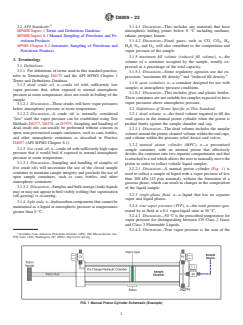
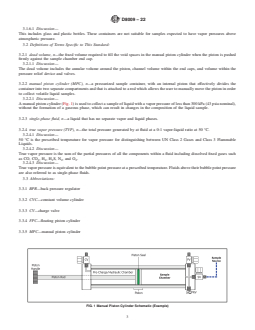
3.2.2.1 Discussion—A manual piston cylinder (Fig. 1)is
container to maintain sample integrity and preclude the use of
used to collect a sample of liquid with a vapor pressure of less
open sample containers, such as cans, bottles, and other
than 300 kPa (43 psia nominal), without the formation of a
atmospheric containers.
gaseous phase, which can result in changes in the composition
3.1.3.2 Discussion—Samplesandbulkstorage(tank)liquids
of the liquid sample.
mayormaynotappeartoboilvisibly(rolling)butvaporization
3.2.3 single-phase fluid, n—a liquid that has no separate
(off-gassing) is occurring.
vapor and liquid phases.
3.1.4 light ends, n—hydrocarbon components that cannot be
3.2.4 true vapor pressure (TVP), n—the total pressure gen-
maintained as a liquid at atmospheric pressure at temperatures
erated by at fluid at a 0:1 vapor:liquid ratio at 50 °C.
greater than 0 °C.
3.2.4.1 Discussion—50 °C is the prescribed temperature for
vapor pressure for distinguishing between UN Class 2 Gases
and Class 3 Flammable Liquids.
3.2.4.2 Discussion—True vapor pressure is the sum of the
Available from American Petroleum Institute (API), 200 Massachusetts Ave.
NW, Suite 1100, Washington, DC 20001, http://www.api.org.
FIG. 1 Manual Piston Cylinder Schematic (Example)
D8009 − 22
partial pressures of all the components within a fluid including 5.2 This practice is intended for capturing samples of crude
dissolved fixed gases such as CO, CO,H,H S, N , and O . oil and/or condensate for testing for the purpose of classifica-
2 2 2 2 2
tion for transportation of dangerous goods as UN Class 3
3.2.4.3 Discussion—Truevaporpressureisequivalenttothe
Flammable Liquids, but is not limited to classification testing.
bubblepointpressureataprescribedtemperature.Fluidsabove
Other test methods with sensitivities to light end loss may also
their bubble point pressure are also referred to as single-phase
utilize this sampling practice.
fluids.
5.3 Practice D3700 using a floating piston cylinder is
3.3 Abbreviations:
recommended whenever true vapor pressures greater than
3.3.1 BPR—back pressure regulator
300 kPa at 50 °C are anticipated.
3.3.2 CVC—constant volume cylinder
3.3.3 CV—charge valve
6. Interferences
3.3.4 FPC—floating piston cylinder
6.1 Interference in a sampling procedure is anything that
3.3.5 MPC—manual piston cylinder compromises the integrity of the sample.
3.3.6 psia—pounds per square inch absolute (psia = psig + 6.2 Incorrect choice of a sample point location can result in
barometric pressure) a non-representative sample due to solid or liquid
contaminants, separate phases, storage tank stratification, and
3.3.7 psig—pounds per square inch gauge (psig = psia –
so forth.
barometric pressure)
6.3 Reactivity of steel surfaces can result in the chemical
3.3.8 PRV—pressure relief valve
alteration of trace reactive components such as H S, COS, and
3.3.9 PSV—pressure safety valve
mercaptans.
3.3.10 PV—purge valve
6.4 A lubricant, used on the piston or other internal wetted
3.3.11 PTFE —polytetrafluoroethylene
parts, that is soluble in hydrocarbon can contaminate the
sample and analytical equipment.
3.3.12 SV—sampling valve
6.5 Leakage can result in loss of sample. Consult the
3.3.13 TVP—True Vapor Pressure (0:1 vapor/liquid ratio at
manufacturer’s guidelines for suitable procedures to verify a
50 °C)
leak-free cylinder, such as vacuum or pressure testing.
4. Summary of Practice
6.6 Failure to flush sample lines and dead volumes can
result in contaminated and non-representative samples.
4.1 A crude oil or condensate sample is transferred as a
single-phase liquid under pressure from a sample point into a
6.7 Sampling from stratified tanks, dead zones in flowing
manual piston cylinder. The manual piston cylinder (MPC) is
systems, or inappropriate time periods can result in non-
designed to collect liquid samples with no vaporization or loss
representative samples.
of volatile components by displacing a piston against the
6.8 Any material that can create carryover contamination
mechanical backpressure of the user. The piston serves as a
from one sample to the next shall be removed from the
physical barrier between the sample and the atmosphere. The
cylinder, and the cylinder thoroughly cleaned before collection
manual movement of the piston allows the user to pull sample
of subsequent samples. In addition to cleaning the interior
into the cylinder as well as compress the sample for injection
metal surfaces and cleaning the soft parts (O-rings, for
intoaninstrumentforanalysis.Thepositionofthepistonatthe
example), consideration should be given to replacing the soft
end of sampling indicates the percent fill of the sample
parts if they might have absorbed any contamination. Ex-
cylinder.
amples of contaminants include glycol, amine, lubricants,
4.2 It is the responsibility of the user of this practice to sulfur species, solvents, methanol, etc.
locate the sample point at a suitable location and orientation
where the product being sampled is a representative, single 7. Apparatus
phase, homogeneous liquid.
7.1 Manual Piston Cylinder (MPC):
7.1.1 Construction, typically fabricated from corrosion-
5. Significance and Use
resistant material such as 316 stainless steel or aluminum.
5.1 This practice allows the collection of a representative Protective internal coatings or surface treatments are accept-
sample of crude oil and/or condensate that may contain trace able provided that they do not adversely affect the free
movement of the piston or effectiveness of the seals (see Fig.
volatile dissolved components such as methane, ethane,
propane, and fixed gases that would normally be lost using 1).
conventional atmospheric sampling methods. These highly 7.1.2 Users should consult with the manufacturer of the
volatile components can result in vapor pressure conditions MPC and sample collection systems any time ambient or
above atmospheric pressure. This practice is recommended product temperatures, or both, exceed the range of –30 °C to
wheneveraccuratedeterminationofvaporpressure,flashpoint, 60 °C (–22°F to 140 °F). Extreme temperature effects upon
or other properties are required and where loss of volatile metal, O-rings, valve seats, seals, gauges, relief devices,
components can affect the test results. sample pump components, and other devices and components
D8009 − 22
in the system should be assessed in a hazards analysis before 7.1.6.1 Intheeventthataself-resettingPRVisactivateddue
any sampling takes place. to an overpressure condition, sample integrity can be compro-
7.1.3 Cylinder shall have provision for moving the piston, mised without alerting the user that a release has occurred. If a
both in and out, by means of a rod connected directly to the self-resetting PRV is used, a release indicator is recommended
piston. In some instances an FPC may be equipped with a to alert the user that the sample has been compromised and to
mixing rod that can be fixed to the piston to meet the capture a new sample or use testing results with caution.
movement criteria, and therefore such an FPC may also be
NOTE 1—Pressure relief valve (PRV) may also be referred to as a
used as an MPC.
pressure safety valve (PSV).
7.1.4 Piston Position Indicator—The MPC shall be
7.1.7 Users should not alter the release pressure of safety
equipped with a piston position indicator such as a marking on
relief devices.
the piston rod or equivalent mechanism, that indicates the
sample volume to comply with the maximum percent fill
7.2 Vacuum Pump—Capable of maintaining 13 kPa
(maximum fill volume) allowed for storage and transportation.
(100 mm Hg nominal).
A volumetric guide inserted over the piston rod may also be
7.3 Sampling System—It is not possible to provide a single
used (see Fig. 2).
procedure that will be applicable for all sampling situations.
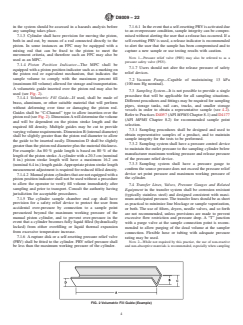
7.1.4.1 Volumetric Fill Guide—If used, shall be made of
Different procedures and fittings may be required for sampling
brass, aluminum, or other suitable material that will perform
pipes, storage tanks, rail cars, trucks, and smaller storage
without deforming over time or damaging the piston rod.
vessels in order to obtain a representative sample (see 4.2).
Guides shall be “C-Channel” type to allow insertion over the
Refer to Practices D4057 (API MPMS Chapter 8.1) and D4177
pistonrod(seeFig.2).DimensionAwilldeterminethevolume
(API MPMS Chapter 8.2) for recommended sample point
and will be dependent on the piston stroke length and the
selection.
required fill density. Multiple guides may be cut to provide
7.3.1 Sampling procedures shall be designed and used to
varyingvolumerequirements.DimensionB(internaldiameter)
obtain representative samples of a product, and to maintain
shall be slightly greater than the piston rod diameter to allow
sample integrity for the tests to be performed.
the guide to be inserted easily. Dimension D shall be slightly
7.3.2 Sampling system shall have a pressure control device
greaterthanthepistonroddiameterplusthematerialthickness.
to maintain the outlet pressure to the sampling cylinder below
For example: An 80 % guide length is based on 80 % of the
manufacturer maximum working pressure and release pressure
length of the piston stroke.Acylinder with a 20.3 cm (nominal
of the pressure relief device.
8 in.) piston stroke length will have a maximum 16.2 cm
7.3.3 Sampling system shall have a pressure gauge to
(nominal6.4in.)lengthguide.Appropriatepistonstrokelength
confirm the source pressure does not exceed the pressure relief
measurement adjustment is required for reduced filled density.
device set point pressure and maximum working pressure of
7.1.4.2 Manual piston cylinders that are not equipped with a
the cylinder.
piston position indicator shall not be used without a procedure
to allow the operator to verify fill volume immediately after
7.4 Transfer Lines, Valves, Pressure Gauges and Related
sampling and prior to transport. Consult the authority having
Equipment in the transfer system shall be corrosion resistant
jurisdiction for acceptable procedures.
(typically stainless steel) and designed consistent with maxi-
7.1.5 The cylinder sample chamber end cap shall have
mum anticipated pressure.The transfer lines should be as short
provision for a safety relief device to protect the user from
as practical to minimize line blockage or sample vaporization,
accidental over-pressure by connection to a sample point
or both. The use of filters, dryers, needle valves, and so forth
pressurized beyond the maximum working pressure of the
are not recommended, unless provisions are made to prevent
manual piston cylinder, and to prevent over-pressure in the
excessive flow restriction and pressure drop. A “T” junction
event that a cylinder becomes fully liquid filled (hydraulically
with a purge valve at the sample connection point is recom-
locked) from either overfilling or liquid thermal expansion
mended to allow purging of the dead volume at the sampler
from excessive temperature increase.
connection. Flexible hose or tubing with adequate pressure
7.1.6 A rupture disk or a self-resetting pressure relief valve
rating may be used.
(PRV) shall be fitted to the cylinder. PRV relief pressure shall
NOTE 2—While not required by this practice, the use of non-reactive
be less than the maximum working pressure of the cylinder. and non-absorptive materials is recommended, especially when sampling
FIG. 2 Volumetric Fill Guide (Example)
D8009 − 22
to determine trace levels of reactive or polar materials such as H S and
9.3 Sampling Procedure A—Manual Piston Cylinder (MPC)
water.
without Pre-Charge Gas—This procedure is applicable to
7.5 Samplingpumpsorothermeansofcontrollingpressures sample points that have sufficiently low pressure to allow the
higher than the vapor pressure of the sample may be manual movement of the piston by the user during sampling
acceptable, and may be used to flush the lines or the cylinder operations. If the sample point pressure is high enough that a
dead volume, or both, if any, prior to sample collection. The user is unable to control the movement of the piston manually,
cylinder may be partially filled and then emptied prior to then Procedure B should be used.
collection of the sample as an alternative to venting hydrocar- 9.3.1 CLOSE valve (SV).
bon to flush lines.
9.3.2 OPEN valve (PV).
9.3.3 OPEN valve (CV) to allow air to move in and out of
8. Reagents and Materials
the pre-charge/hydraulic chamber.
8.1 Seal Lubricants: 9.3.4 PUSH the piston fully into cylinder to expel any
8.1.1 Lubricants used to lubricate or seal the piston, O-ring residual air. See Fig. 3-A.
seals, and other components shall be inert and insoluble in 9.3.5 CLOSE valve (PV).
crude oil or condensates. 9.3.6 Cylinder Leak Test (Vacuum Test).
8.1.2 PTFE lubricants have been found to be suitable in
9.3.6.1 PULLthe piston a far as possible to create a vacuum
manualpistoncylindersformostapplications.Theselubricants
condition within the sample chamber.
are insoluble in aliphatic/aromatic hydrocarbons, water,
9.3.6.2 Slowly allow the piston to self-retract into the
caustic, amines, and glycols. Use of excessive lubricant on the
cylinder.
sample chamber side of the piston seal can result in contami-
(1) The piston shall self-retract fully into the cylinder with
nation of the sample, which can lead to contamination of
the piston firmly against the sample chamber end cap. This
analytical instruments with lubricant. Excess lubricant may be
position may be confirmed by gently pushing on the piston to
used in the pre-charge/hydraulic chamber only to replace
confirm there is no inward movement, indicating the piston is
lubricant lost by wall coating during piston movement.
seated against the end cap. This confirms the apparatus is
8.1.3 Some common grades of silicone based O-ring lubri-
properly sealed and that no high volatility material remains.
cantsarequicklyremovedbyaromatichydrocarbonsandcrude
(2) If the piston does not self-retract fully, which will be
oils, and are not recommended for this service. If used,
indicated by either the visual position of the piston or the
frequent re-lubrication will be required to maintain seal integ-
ability to push the piston further into the cylinder, clean the
rity.
apparatus and repeat 9.3.1 to 9.3.6. Both scenarios indicate a
possible leak or that high volatility material remains in the
NOTE 3—The use of lubricants that are soluble in hydrocarbon samples
apparatus. If the check fails again, then the apparatus needs to
will result in contamination of the sample and loss of sealing integrity of
the piston requiring frequent re-lubrication. be disassembled to confirm the seals are intact and appropri-
ately lubricated.
9. Procedure
9.3.7 CONFIRM the sample source pressure does not ex-
9.1 Preparation of the Manual Piston Cylinder: ceed the pressure relief valve set point pressure and the
9.1.1 Thoroughly clean the cylinder prior to use or after maximum working pressure of the MPC.
change of service or repair, with an appropriate cleaning agent,
9.3.8 CLOSE valve (CV).
following the manufacturer’s recommendations. Remove any
9.3.9 CONNECT valve (SV) to the source valve using low
traces of cleaning agent by evacuation, gas purge, or solvent
volume, high-pressure, flexible tubing.
wash, as appropriate.The use of steam is not recommended for
9.3.10 SLOWLY OPEN the source valve to pressurize the
cleaning piston-type cylinders.
tubing to valve (SV).
9.3.11 POSITIONtheapparatustoensurethepistonisfaced
NOTE 4—Residual hydrocarbon-based cleaning agents, such as toluene
away from the user. Make note of the pressure relief device
and mineral spirits, can appear in compositional analysis.
orientation and ensure the PSV outlet is facing away from the
9.2 Disassembly of Manual Piston Cylinders:
user in the event of release.
9.2.1 Consult the manufacturer’s instructions. (Warning—
9.3.12 While holding the piston firmly in place SLOWLY
Disassembly of a piston cylinder for maintenance requires
OPEN valve (SV) to pressurize the apparatus and fill the dead
special precautions. User shall ensure both sample and pre-
volume.
charge/hydraulic chambers are opened to the atmosphere to
relieve any residual pressure prior to removing either end cap.
NOTE 5—Use caution as the piston is now under source pressure and
Failure to do so could result in ejection of the piston with can be forced out to its full extension if not handled carefully. DO NOT
pressurize the apparatus with the piston handle facing directly towards the
sufficientforcetocauseseriousinjurytopersonnelanddamage
operator.
to equipment.)
9.3.13 PUSH the piston tightly against the sample chamber
9.2.2 User shall lubricate the piston to ensure piston seal
effectiveness.To ensure the piston is thoroughly lubricated, the end cap.
pre-charge/hydraulicchamberdeadvolume(volumeremaining 9.3.14 While still holding the piston firmly in place,
in the pre-charge/hydraulic chamber when the piston rod is SLOWLYOPEN valve (PV) to purge the sample fluid through
fully extended) may be filled with lubricant (several millilitres the cylinder end cap (see Fig. 3-B). PURGE an equivalent of
may be required). three (3) times the line volume connected to the sample source
D8009 − 22
FIG. 3 Sampling Procedure A Images
then CLOSE valve (PV). Line volume can be calculated based
L = length of tubing (cm).
on the tubing internal diameter and length of tubing using Eq
9.3.15 Allow the piston handle to move out SLOWLYusing
1.
the sample point pressure to drive the piston so air in the
9.3.14.1 Purging of fluids shall follow all site-specific and
pre-charge/hydraulic chamber is compressed until it equals the
jurisdictional requirements for fluid release. If necessary,
sample point pressure, at which point the piston will no longer
connect valve (PV) to a flare line or alternate container for
move. Exercise caution not to exceed the fill rate allowed by
venting/capture of purged material.
the size of the lines and valves, resulting in rapid depressur-
ID
V 5 π 3 3 L 33 (1)
F S D G ization of the sample and formation of a vapor phase during
sampling. See Fig. 3-C.
where:
V = purge volume (mL),
ID = tubing internal diameter (cm), and
D8009 − 22
and can be used to calculate maximum fill volume at low temperatures.
9.3.15.1 If the desired fill volume has not been reached,
NOTE 8—The 80 % guide length is based on 80 % of the length of the
SLOWLYOPEN valve (CV) to slowly release the compressed
pistonstroke.Forexample:acylinderwitha20.3cm(nominal8in)piston
air, creating a differential pressure, which will allow the piston
stroke length will have a 16.2 cm (nominal 6.4 in) guide. Appropriate
to continue to move until the cylinder is completely full.
pistonstrokelengthmeasurementadjustmentisrequiredforreducedfilled
Proceed to 9.3.16.
density. Follow manufacturer’s instructions for fill guide use.
9.3.15.2 If the piston will not move freely, OPEN valve
9.3.18 With the volumetric guide held firmly in place,
(CV) and PULL piston handle back slowly and allow the
CLOSE valve (SV) to isolate the sample source from the
cylinder to FILL completely. Proceed to 9.3.16.
apparatus.
9.3.19 SLOWLY release the piston handle and
...
This document is not an ASTM standard and is intended only to provide the user of an ASTM standard an indication of what changes have been made to the previous version. Because
it may not be technically possible to adequately depict all changes accurately, ASTM recommends that users consult prior editions as appropriate. In all cases only the current version
of the standard as published by ASTM is to be considered the official document.
Designation: D8009 − 15 D8009 − 22
Manual of Petroleum Measurement Standards (MPMS), Chapter 8.5
Standard Practice for
Manual Piston Cylinder Sampling for Volatile Crude Oils,
Condensates, and Liquid Petroleum Products
This standard is issued under the fixed designation D8009; the number immediately following the designation indicates the year of
original adoption or, in the case of revision, the year of last revision. A number in parentheses indicates the year of last reapproval. A
superscript epsilon (´) indicates an editorial change since the last revision or reapproval.
1. Scope Scope*
1.1 This practice includes the equipment and procedures for obtaining a representative sample of “live” or high vapor pressure
crude oils, condensates, and/or liquid petroleum products from low pressure sample points, where there is insufficient sample point
pressure to use a Floating Piston Cylinder (FPC) as described in Practice D3700.
1.2 This practice is intended for use with sample types, such as UN Class 3 Flammable Liquids, that might have been collected
and transported using open containers. The use of a manual piston cylinder in place of open containers is intended to prevent the
loss of volatile (light end) components, which can impact subsequent test results.
1.3 This practice is suitable for sampling crude oils, condensates, and/or liquid petroleum products having true vapor pressures
less than 300 kPa (43 psia nominal) at 50 °C. This practice applies to samples that will typically fall between Practices D4057 (API
MPMS Chapter 8.1) and D3700. This practice shall not be used for materials classified as UN Class 2 Gases (“…having a vapor
pressure greater than 300 kPa at 50 °C or is completely gaseous at 20 °C at 101.3 kPa.”).
1.4 This practice allows for sampling of crude oils that flow freely at the conditions of sampling.
1.5 It is the responsibility of the user to ensure that the sampling point is located so as to obtain a representative sample.
1.6 The values stated in SI units are to be regarded as standard.
1.6.1 Exception—The values given in parentheses are for information only.
1.7 This standard does not purport to address all of the safety concerns, if any, associated with its use. It is the responsibility
of the user of this standard to establish appropriate safety safety, health, and healthenvironmental practices and determine the
applicability of regulatory limitations prior to use.
1.8 This international standard was developed in accordance with internationally recognized principles on standardization
established in the Decision on Principles for the Development of International Standards, Guides and Recommendations issued
by the World Trade Organization Technical Barriers to Trade (TBT) Committee.
This practice is under the jurisdiction of ASTM Committee D02 on Petroleum Products, Liquid Fuels, and Lubricants and the API Committee on Petroleum Measurement,
and is the direct responsibility of Subcommittee D02.02 /COMQ the joint ASTM-API Committee on Hydrocarbon Measurement for Custody Transfer (Joint ASTM-API).
This practice has been approved by the sponsoring committees and accepted by the Cooperating Societies in accordance with established procedures. This practice was issued
as a joint ASTM-API standard in 2015.
Current edition approved Dec. 1, 2015July 1, 2022. Published December 2015August 2022. Originally approved in 2015. Last previous edition approved in 2015 as
D8009 – 15. DOI: 10.1520/D8009-15.10.1520/D8009-22.
UN Recommendations of the Transportation of Dangerous Goods, Chapter 2.2.1.1.
*A Summary of Changes section appears at the end of this standard
© Jointly copyrighted by ASTM International, 100 Barr Harbor Drive, PO Box C700, West Conshohocken, PA 19428-2959, USA and the American Petroleum Institute (API), 1220 L Street NW, Washington DC 20005, USA
D8009 − 22
2. Referenced Documents
2.1 ASTM Standards:
D3700 Practice for Obtaining LPG Samples Using a Floating Piston Cylinder
D4057 Practice for Manual Sampling of Petroleum and Petroleum Products
D4175 Terminology Relating to Petroleum Products, Liquid Fuels, and Lubricants
D4177 Practice for Automatic Sampling of Petroleum and Petroleum Products
D6377 Test Method for Determination of Vapor Pressure of Crude Oil: VPCR (Expansion Method)
x
D6378 Test Method for Determination of Vapor Pressure (VP ) of Petroleum Products, Hydrocarbons, and Hydrocarbon-
X
Oxygenate Mixtures (Triple Expansion Method)
D7975 Test Method for Determination of Vapor Pressure of Crude Oil: VPCR -F(Tm°C) (Manual Expansion Field Method)
x
2.2 API Standards:
MPMSChapter 1 Terms and Definitions Database
MPMSChapter 8.1 Manual Sampling of Petroleum and Petroleum Products
MPMS Chapter 8.2 Automatic Sampling of Petroleum and Petroleum Products
3. Terminology
3.1 Definitions:
3.1.1 For definitions of terms used in this standard practice, refer to Terminology D4175 and the API MPMS Chapter 1 Terms and
Definitions Database.
3.1.2 dead crude oil, n—crude oil with sufficiently low vapor pressure that, when exposed to normal atmospheric pressure at room
temperature, does not result in boiling of the sample.
3.1.2.1 Discussion—
These crudes will have vapor pressures below atmospheric pressure at room temperature.
3.1.2.2 Discussion—
A crude oil is normally considered “live” until the vapor pressure can be established using Test Methods D6377, D6378, or D7975.
Sampling and handling of dead crude oils can usually be performed without concern in open, non-pressurized sample containers,
such as cans, bottles, and other atmospheric containers as described in Practice D4057 (API MPMS Chapter 8.1).
3.1.3 live crude oil, n—crude oil with sufficiently high vapor pressure that it would boil if exposed to normal atmospheric pressure
at room temperature.
3.1.3.1 Discussion—
Sampling and handling of samples of live crude oils will necessitate the use of the closed sample container to maintain sample
integrity and preclude the use of open sample containers, such as cans, bottles, and other atmospheric containers.
3.1.3.2 Discussion—
Samples and bulk storage (tank) liquids may or may not appear to boil visibly (rolling) but vaporization (off-gassing) is occurring.
3.1.4 light ends, n—hydrocarbon components that cannot be maintained as a liquid at atmospheric pressure at temperatures greater
than 0 °C.
3.1.4.1 Discussion—
This includes any materials that have atmospheric boiling points below 0 °C including methane, ethane, propane, butane.
3.1.4.2 Discussion—
Fixed gases, such as CO, CO , H , H S, N , and O , will also contribute to the composition and vapor pressure of the sample.
2 2 2 2 2
3.1.5 maximum fill volume (reduced fill volume), n—the volume of a container occupied by the sample, usually expressed as a
percentage of the total capacity.
3.1.5.1 Discussion—
Some regulatory agencies use the expressions “maximum fill density” and “reduced fill density.”
3.1.6 open container, n—a container designed for use with samples at atmospheric pressure conditions.
For referenced ASTM standards, visit the ASTM website, www.astm.org, or contact ASTM Customer Service at service@astm.org. For Annual Book of ASTM Standards
volume information, refer to the standard’s Document Summary page on the ASTM website.
Available from American Petroleum Institute (API), 1220 L. St., NW, 200 Massachusetts Ave. NW, Suite 1100, Washington, DC 20005-4070,20001, http://www.api.org.
D8009 − 22
3.1.6.1 Discussion—
This includes glass and plastic bottles. These containers are not suitable for samples expected to have vapor pressures above
atmospheric pressure.
3.2 Definitions of Terms Specific to This Standard:
3.2.1 dead volume, n—the fixed volume required to fill the void spaces in the manual piston cylinder when the piston is pushed
firmly against the sample chamber end cap.
3.2.1.1 Discussion—
The dead volume includes the annular volume around the piston, channel volume within the end caps, and volume within the
pressure relief device and valves.
3.2.2 manual piston cylinder (MPC), n—a pressurized sample container, with an internal piston that effectively divides the
container into two separate compartments and that is attached to a rod which allows the user to manually move the piston in order
to collect volatile liquid samples.
3.2.2.1 Discussion—
A manual piston cylinder (Fig. 1) is used to collect a sample of liquid with a vapor pressure of less than 300 kPa (43 psia nominal),
without the formation of a gaseous phase, which can result in changes in the composition of the liquid sample.
3.2.3 single-phase fluid, n—a liquid that has no separate vapor and liquid phases.
3.2.4 true vapor pressure (TVP), n—the total pressure generated by at fluid at a 0:1 vapor:liquid ratio at 50 °C.
3.2.4.1 Discussion—
50 °C is the prescribed temperature for vapor pressure for distinguishing between UN Class 2 Gases and Class 3 Flammable
Liquids.
3.2.4.2 Discussion—
True vapor pressure is the sum of the partial pressures of all the components within a fluid including dissolved fixed gases such
as CO, CO , H , H S, N , and O .
2 2 2 2 2
3.2.4.3 Discussion—
True vapor pressure is equivalent to the bubble point pressure at a prescribed temperature. Fluids above their bubble point pressure
are also referred to as single-phase fluids.
3.3 Abbreviations:
3.3.1 BPR—back pressure regulator
3.3.2 CVC—constant volume cylinder
3.3.3 CV—charge valve
3.3.4 FPC—floating piston cylinder
3.3.5 MPC—manual piston cylinder
FIG. 1 Manual Piston Cylinder Schematic (Example)
D8009 − 22
3.3.6 psia—pounds per square inch absolute (psia = psig + barometric pressure)
3.3.7 psig—pounds per square inch gauge (psig = psia – barometric pressure)
3.3.8 PRV—pressure relief valve
3.3.9 PSV—pressure safety valve
3.3.10 PV—purge valve
3.3.11 PTFE —polytetrafluoroethylene
3.3.12 SV—sampling valve
3.3.13 TVP—True Vapor Pressure (0:1 vapor/liquid ratio at 50 °C)
4. Summary of Practice
4.1 A crude oil or condensate sample is transferred as a single-phase liquid under pressure from a sample point into a manual
piston cylinder. The manual piston cylinder (MPC) is designed to collect liquid samples with no vaporization or loss of volatile
components by displacing a piston against the mechanical backpressure of the user. The piston serves as a physical barrier between
the sample and the atmosphere. The manual movement of the piston allows the user to pull sample into the cylinder as well as
compress the sample for injection into an instrument for analysis. The position of the piston at the end of sampling indicates the
percent fill of the sample cylinder.
4.2 It is the responsibility of the user of this practice to locate the sample point at a suitable location and orientation where the
product being sampled is a representative, single phase, homogeneous liquid.
5. Significance and Use
5.1 This practice allows the collection of a representative sample of crude oil and/or condensate that may contain trace volatile
dissolved components such as methane, ethane, propane, and fixed gases that would normally be lost using conventional
atmospheric sampling methods. These highly volatile components can result in vapor pressure conditions above atmospheric
pressure. This practice is recommended whenever accurate determination of vapor pressure, flash point, or other properties are
required and where loss of volatile components can affect the test results.
5.2 This practice is intended for capturing samples of crude oil and/or condensate for testing for the purpose of classification for
transportation of dangerous goods as UN Class 3 Flammable Liquids, but is not limited to classification testing. Other test methods
with sensitivities to light end loss may also utilize this sampling practice.
5.3 Practice D3700 using a floating piston cylinder is recommended whenever true vapor pressures greater than 300 kPa at 50 °C
are anticipated.
6. Interferences
6.1 Interference in a sampling procedure is anything that compromises the integrity of the sample.
6.2 Incorrect choice of a sample point location can result in a non-representative sample due to solid or liquid contaminants,
separate phases, storage tank stratification, and so forth.
6.3 Reactivity of steel surfaces can result in the chemical alteration of trace reactive components such as H S, COS, and
mercaptans.
D8009 − 22
6.4 A lubricant, used on the piston or other internal wetted parts, that is soluble in hydrocarbon can contaminate the sample and
analytical equipment.
6.5 Leakage can result in loss of sample. Consult the manufacturer’s guidelines for suitable procedures to verify a leak-free
cylinder, such as vacuum or pressure testing.
6.6 Failure to flush sample lines and dead volumes can result in contaminated and non-representative samples.
6.7 Sampling from stratified tanks, dead zones in flowing systems, or inappropriate time periods can result in non-representative
samples.
6.8 Any material that can create carryover contamination from one sample to the next shall be removed from the cylinder, and
the cylinder thoroughly cleaned before collection of subsequent samples. In addition to cleaning the interior metal surfaces and
cleaning the soft parts (O-rings, for example), consideration should be given to replacing the soft parts if they might have absorbed
any contamination. Examples of contaminants include glycol, amine, lubricants, sulfur species, solvents, methanol, etc.
7. Apparatus
7.1 Manual Piston Cylinder (MPC):
7.1.1 Construction, typically fabricated from corrosion-resistant material such as 316 stainless steel or aluminum. Protective
internal coatings or surface treatments are acceptable provided that they do not adversely affect the free movement of the piston
or effectiveness of the seals (see Fig. 1).
7.1.2 Users should consult with the manufacturer of the MPC and sample collection systems any time ambient or product
temperatures, or both, exceed the range of –30 °C to 60 °C (–22°F to 140 °F). Extreme temperature effects upon metal, O-rings,
valve seats, seals, gauges, relief devices, sample pump components, and other devices and components in the system should be
assessed in a hazards analysis before any sampling takes place.
7.1.3 Cylinder shall have provision for moving the piston, both in and out, by means of a rod connected directly to the piston. In
some instances an FPC may be equipped with a mixing rod that can be fixed to the piston to meet the movement criteria, and
therefore such an FPC may also be used as an MPC.
7.1.4 Piston Position Indicator—The MPC shall be equipped with a piston position indicator such as a marking on the piston rod
or equivalent mechanism, that indicates the sample volume to comply with the maximum percent fill (maximum fill volume)
allowed for storage and transportation. A volumetric guide inserted over the piston rod may also be used (see Fig. 2).
7.1.4.1 Volumetric Fill Guide—If used, shall be made of brass, aluminum, or other suitable material that will perform without
deforming over time or damaging the piston rod. Guides shall be “C-Channel” type to allow insertion over the piston rod (see Fig.
2). Dimension A will determine the volume and will be dependent on the piston stroke length and the required fill density. Multiple
guides may be cut to provide varying volume requirements. Dimension B (internal diameter) shall be slightly greater than the
piston rod diameter to allow the guide to be inserted easily. Dimension D shall be slightly greater than the piston rod diameter plus
the material thickness. For example: An 80 % guide length is based on 80 % of the length of the piston stroke. A cylinder with
a 20.3 cm (nominal 8 in.) piston stroke length will have a maximum 16.2 cm (nominal 6.4 in.) length guide. Appropriate piston
stroke length measurement adjustment is required for reduced filled density.
FIG. 2 Volumetric Fill Guide (Example)
D8009 − 22
7.1.4.2 Manual piston cylinders that are not equipped with a piston position indicator shall not be used without a procedure to
allow the operator to verify fill volume immediately after sampling and prior to transport. Consult the authority having jurisdiction
for acceptable procedures.
7.1.5 The cylinder sample chamber end cap shall have provision for a safety relief device to protect the user from accidental
over-pressure by connection to a sample point pressurized beyond the maximum working pressure of the manual piston cylinder,
and to prevent over-pressure in the event that a cylinder becomes fully liquid filled (hydraulically locked) from either overfilling
or liquid thermal expansion from excessive temperature increase.
7.1.6 A rupture disk or a self-resetting pressure relief valve (PRV) shall be fitted to the cylinder. PRV relief pressure shall be less
than the maximum working pressure of the cylinder.
7.1.6.1 In the event that a self-resetting PRV is activated due to an overpressure condition, sample integrity can be compromised
without alerting the user that a release has occurred. If a self-resetting PRV is used, a release indicator is recommended to alert
the user that the sample has been compromised and to capture a new sample or use testing results with caution.
NOTE 1—Pressure relief valve (PRV) may also be referred to as a pressure safety valve (PSV).
7.1.7 Users should not alter the release pressure of safety relief devices.
7.2 Vacuum Pump—Capable of maintaining 13 kPa (100 mm Hg nominal).
7.3 Sampling System—It is not possible to provide a single procedure that will be applicable for all sampling situations. Different
procedures and fittings may be required for sampling pipes, storage tanks, rail cars, trucks, and smaller storage vessels in order
to obtain a representative sample (see 4.2). Refer to Practices D4057 (API MPMS Chapter 8.1) and D4177 (API MPMS Chapter
8.2) for recommended sample point selection.
7.3.1 Sampling procedures shall be designed and used to obtain representative samples of a product, and to maintain sample
integrity for the tests to be performed.
7.3.2 Sampling system shall have a pressure control device to maintain the outlet pressure to the sampling cylinder below
manufacturer maximum working pressure and release pressure of the pressure relief device.
7.3.3 Sampling system shall have a pressure gauge to confirm the source pressure does not exceed the pressure relief device set
point pressure and maximum working pressure of the cylinder.
7.4 Transfer Lines, Valves, Pressure Gauges and Related Equipment in the transfer system shall be corrosion resistant (typically
stainless steel) and designed consistent with maximum anticipated pressure. The transfer lines should be as short as practical to
minimize line blockage or sample vaporization, or both. The use of filters, dryers, needle valves, and so forth are not recommended,
unless provisions are made to prevent excessive flow restriction and pressure drop. A “T” junction with a purge valve at the sample
connection point is recommended to allow purging of the dead volume at the sampler connection. Flexible hose or tubing with
adequate pressure rating may be used.
NOTE 2—While not required by this practice, the use of non-reactive and non-absorptive materials is recommended, especially when sampling to
determine trace levels of reactive or polar materials such as H S and water.
7.5 Sampling pumps or other means of controlling pressures higher than the vapor pressure of the sample may be acceptable, and
may be used to flush the lines or the cylinder dead volume, or both, if any, prior to sample collection. The cylinder may be partially
filled and then emptied prior to collection of the sample as an alternative to venting hydrocarbon to flush lines.
8. Reagents and Materials
8.1 Seal Lubricants:
8.1.1 Lubricants used to lubricate or seal the piston, O-ring seals, and other components shall be inert and insoluble in crude oil
or condensates.
D8009 − 22
8.1.2 PTFE lubricants have been found to be suitable in manual piston cylinders for most applications. These lubricants are
insoluble in aliphatic/aromatic hydrocarbons, water, caustic, amines, and glycols. Use of excessive lubricant on the sample
chamber side of the piston seal can result in contamination of the sample, which can lead to contamination of analytical instruments
with lubricant. Excess lubricant may be used in the pre-charge/hydraulic chamber only to replace lubricant lost by wall coating
during piston movement.
8.1.3 Some common grades of silicone based O-ring lubricants are quickly removed by aromatic hydrocarbons and crude oils, and
are not recommended for this service. If used, frequent re-lubrication will be required to maintain seal integrity.
NOTE 3—The use of lubricants that are soluble in hydrocarbon samples will result in contamination of the sample and loss of sealing integrity of the piston
requiring frequent re-lubrication.
9. Procedure
9.1 Preparation of the Manual Piston Cylinder:
9.1.1 Thoroughly clean the cylinder prior to use or after change of service or repair, with an appropriate cleaning agent, following
the manufacturer’s recommendations. Remove any traces of cleaning agent by evacuation, gas purge, or solvent wash, as
appropriate. The use of steam is not recommended for cleaning piston-type cylinders.
NOTE 4—Residual hydrocarbon-based cleaning agents, such as toluene and mineral spirits, can appear in compositional analysis.
9.2 Disassembly of Manual Piston Cylinders:
9.2.1 Consult the manufacturer’s instructions. (Warning—Disassembly of a piston cylinder for maintenance requires special
precautions. User shall ensure both sample and pre-charge/hydraulic chambers are opened to the atmosphere to relieve any residual
pressure prior to removing either end cap. Failure to do so could result in ejection of the piston with sufficient force to cause serious
injury to personnel and damage to equipment.)
9.2.2 User shall lubricate the piston to ensure piston seal effectiveness. To ensure the piston is thoroughly lubricated, the
pre-charge/hydraulic chamber dead volume (volume remaining in the pre-charge/hydraulic chamber when the piston rod is fully
extended) may be filled with lubricant (several millilitres may be required).
9.3 Sampling Procedure A—Manual Piston Cylinder (MPC) without Pre-Charge Gas—This procedure is applicable to sample
points that have sufficiently low pressure to allow the manual movement of the piston by the user during sampling operations. If
the sample point pressure is high enough that a user is unable to control the movement of the piston manually, then Procedure B
should be used.
9.3.1 CLOSE valve (SV).
9.3.2 OPEN valve (PV).
9.3.3 OPEN valve (CV) to allow air to move in and out of the pre-charge/hydraulic chamber.
9.3.4 PUSH the piston fully into cylinder to expel any residual air. See Fig. 3-A.
9.3.5 CLOSE valve (PV).
9.3.6 Cylinder Leak Test (Vacuum Test).
9.3.6.1 PULL the piston a far as possible to create a vacuum condition within the sample chamber.
9.3.6.2 Slowly allow the piston to self-retract into the cylinder.
(1) The piston shall self-retract fully into the cylinder with the piston firmly against the sample chamber end cap. This position
may be confirmed by gently pushing on the piston to confirm there is no inward movement, indicating the piston is seated against
the end cap. This confirms the apparatus is properly sealed and that no high volatility material remains.
D8009 − 22
FIG. 3 Sampling Procedure A Images
(2) If the piston does not self-retract fully, which will be indicated by either the visual position of the piston or the ability to
push the piston further into the cylinder, clean the apparatus and repeat 9.3.1 to 9.3.6. Both scenarios indicate a possible leak or
that high volatility material remains in the apparatus. If the check fails again, then the apparatus needs to be disassembled to
confirm the seals are intact and appropriately lubricated.
9.3.7 CONFIRM the sample source pressure does not exceed the pressure relief valve set point pressure and the maximum
working pressure of the MPC.
9.3.8 CLOSE valve (CV).
9.3.9 CONNECT valve (SV) to the source valve using low volume, high-pressure, flexible tubing.
9.3.10 SLOWLY OPEN the source valve to pressurize the tubing to valve (SV).
D8009 − 22
9.3.11 POSITION the apparatus to ensure the piston is faced away from the user. Make note of the pressure relief device
orientation and ensure the PSV outlet is facing away from the user in the event of release.
9.3.12 While holding the piston firmly in place SLOWLY OPEN valve (SV) to pressurize the apparatus and fill the dead volume.
NOTE 5—Use caution as the piston is now under source pressure and can be forced out to its full extension if not handled carefully. DO NOT pressurize
the apparatus with the piston handle facing directly towards the operator.
9.3.13 PUSH the piston tightly against the sample chamber end cap.
9.3.14 While still holding the piston firmly in place, SLOWLY OPEN valve (PV) to purge the sample fluid through the cylinder
end cap (see Fig. 3-B). PURGE an equivalent of three (3) times the line volume connected to the sample source then CLOSE valve
(PV). Line volume can be calculated based on the tubing internal diameter and length of tubing using Eq 1.
9.3.14.1 Purging of fluids shall follow all site-specific and jurisdictional requirements for fluid release. If necessary, connect valve
(PV) to a flare line or alternate container for venting/capture of purged material.
ID
V 5 π 3 3 L 33 (1)
F S D G
where:
V = purge volume (mL),
ID = tubing internal diameter (cm), and
L = length of tubing (cm).
9.3.15 Allow the piston handle to move out SLOWLY using the sample point pressure to drive the piston so air in the
pre-charge/hydraulic chamber is compressed until it equals the sample point pressure, at which point the piston will no longer
move. Exercise caution not to exceed the fill rate allowed by the size of the lines and valves, resulting in rapid depressurization
of the sample and formation of a vapor phase during sampling. See Fig. 3-C.
9.3.15.1 If the desired fill volume has not been reached, SLOWLY OPEN valve (CV) to slowly release the compressed air, creating
a differential pressure, which will allow the piston to continue to move until the cylinder is completely full. Proceed to 9.3.16.
9.3.15.2 If the piston will not move freely, OPEN valve (CV) and PULL piston handle back slowly and allow the cylinder to FILL
completely. Proceed to 9.3.16.
NOTE 6—With experience, a user will be able to feel the sample conditions within the cylinder through the piston handle as sampling is occurring and
will be able to adjust the fill rate accordingly to avoid depressurization. A handle pulled too quickly will have a tendency to retract if released, indicating
a slight vacuum was present. It is recommended that users new to sampling be trained by experienced personnel.
9.3.16 CLOSE valve (SV) and push on the piston handle to confirm liquid fill.
9.3.16.1 If the cylinder is full of single-phase liquid (no vapor present), t
...