

ASTM D7546-24
(Test Method)Standard Test Method for Determination of Moisture in New and In-Service Lubricating Oils and Additives by Relative Humidity Sensor
General Information
- Abstract
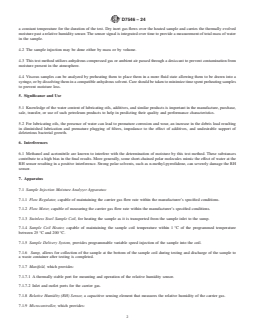
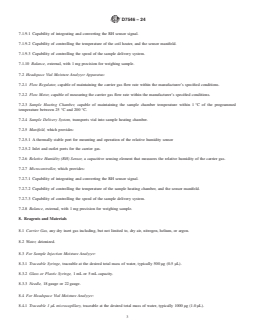
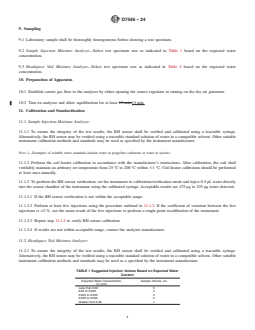
SIGNIFICANCE AND USE
5.1 Knowledge of the water content of lubricating oils, additives, and similar products is important in the manufacture, purchase, sale, transfer, or use of such petroleum products to help in predicting their quality and performance characteristics.
5.2 For lubricating oils, the presence of water can lead to premature corrosion and wear, an increase in the debris load resulting in diminished lubrication and premature plugging of filters, impedance to the effect of additives, and undesirable support of deleterious bacterial growth.
SCOPE
1.1 This test method covers the quantitative determination of water in new and in-service lubricating oils and additives in the range of 10 mg/kg to 100 000 mg/kg (0.001 wt./wt. to 10 % wt./wt.) using a relative humidity (RH) sensor. Methanol, acetonitrile, and other compounds are known to interfere with this test method.
1.2 The values stated in SI units are to be regarded as standard. No other units of measurement are included in this standard.
1.3 Warning—Samples tested in this test method can be flammable, explosive, and toxic. Use caution when handling them before and after testing.
1.4 This standard does not purport to address all of the safety concerns, if any, associated with its use. It is the responsibility of the user of this standard to establish appropriate safety, health, and environmental practices and determine the applicability of regulatory limitations prior to use.
1.5 This international standard was developed in accordance with internationally recognized principles on standardization established in the Decision on Principles for the Development of International Standards, Guides and Recommendations issued by the World Trade Organization Technical Barriers to Trade (TBT) Committee.
- Status
- Published
- Publication Date
- 31-Jan-2024
- Technical Committee
- D02 - Petroleum Products, Liquid Fuels, and Lubricants
- Drafting Committee
- D02.96.02 - Chemistry for the Evaluation of In-Service Lubricants
Buy Documents

ASTM D7546-24 - Standard Test Method for Determination of Moisture in New and In-Service Lubricating Oils and Additives by Relative Humidity Sensor
REDLINE ASTM D7546-24 - Standard Test Method for Determination of Moisture in New and In-Service Lubricating Oils and Additives by Relative Humidity Sensor
Overview
ASTM D7546-24 is a standard test method developed by ASTM International for the determination of moisture content in new and in-service lubricating oils and additives using a relative humidity (RH) sensor. This method quantitatively measures water in samples within the range of 10 mg/kg to 100,000 mg/kg (0.001 wt./wt. to 10 wt./wt.%)-a critical parameter for ensuring lubrication performance and longevity of petroleum products. The method applies to both laboratory and operational environments, providing industry professionals with a reliable tool to assess and control moisture levels that can adversely affect lubricant effectiveness.
Key Topics
- Significance of Moisture Determination: Accurate knowledge of water content in lubricating oils and additives is essential for product quality management, purchase decisions, process control, and predicting service life.
- Measurement Range & Sensitivity: The method covers a broad concentration range, suitable for diverse lubricant types and uses.
- Relative Humidity Sensor Technology: Utilizes a capacitive RH sensor to detect moisture released from samples when heated, offering direct and quantitative results.
- Specimen Handling: Proper sample preparation, including homogenization and temperature control, is emphasized to reduce moisture loss or contamination.
- Safety Considerations: Highlights the potentially hazardous nature of oil samples, with recommendations to establish appropriate laboratory safety practices and comply with relevant regulations.
- Interferences: The test is sensitive to certain polar solvents (e.g., methanol, acetonitrile), which must be considered when interpreting results.
Applications
ASTM D7546-24 is widely used in sectors where lubricating oil quality is critical, such as:
- Industrial and Power Generation Operations: Routine monitoring of hydraulic and turbine oils to prevent premature equipment corrosion, wear, and filter clogging caused by water contamination.
- Manufacturing: Ensures that both new and in-service lubricants meet required specifications, reducing the risk of product failure due to moisture-induced degradation or bacterial growth.
- Quality Control Laboratories: Supports reliable testing protocols during procurement, sales, or transfer of oil products, providing confidence in compliance and performance claims.
- Maintenance of Automotive, Marine, and Aerospace Machinery: Early detection of elevated water levels allows for timely maintenance actions, averting costly downtime and repairs.
- R&D and Formulation of Additives: Facilitates the evaluation of new formulations with respect to hygroscopic behavior and compatibility with existing lubricant systems.
Related Standards
Professionals using ASTM D7546-24 may also reference the following standards for complementary guidance:
- ASTM D4175 – Terminology Relating to Petroleum Products, Liquid Fuels, and Lubricants, for definitions and standardized terminology.
- Other ASTM Lubricant and Moisture Test Methods: Provides broader context for moisture analysis and comparison with alternative determination techniques.
- ISO Lubricant Testing Standards: For harmonized international approaches to lubricant testing and quality assurance.
Practical Value
Implementing ASTM D7546-24 ensures:
- Accurate moisture measurement for both new and used lubricating oils and additives.
- Operational efficiency by minimizing downtime associated with water-induced lubricant failure.
- Enhanced product reliability and extended equipment life through timely detection and correction of moisture-related issues.
- Compliance with industry requirements and best practices in lubricant management.
By offering a standardized, reproducible method for moisture determination using RH sensors, ASTM D7546-24 remains a cornerstone in oil quality testing and process optimization.
Relations
- Effective Date
- 01-Feb-2024
- Effective Date
- 01-Feb-2024
- Effective Date
- 01-Feb-2024
- Effective Date
- 01-Feb-2024
- Effective Date
- 01-Feb-2024
- Effective Date
- 01-Feb-2024
- Effective Date
- 01-Feb-2024
Buy Documents
ASTM D7546-24 - Standard Test Method for Determination of Moisture in New and In-Service Lubricating Oils and Additives by Relative Humidity Sensor
REDLINE ASTM D7546-24 - Standard Test Method for Determination of Moisture in New and In-Service Lubricating Oils and Additives by Relative Humidity Sensor
Get Certified
Connect with accredited certification bodies for this standard

Element Materials Technology
Materials testing and product certification.

ABS Group Brazil
ABS Group certification services in Brazil.

ABS Quality Evaluations Inc.
American Bureau of Shipping quality certification.
Sponsored listings
Frequently Asked Questions
ASTM D7546-24 is a standard published by ASTM International. Its full title is "Standard Test Method for Determination of Moisture in New and In-Service Lubricating Oils and Additives by Relative Humidity Sensor". This standard covers: SIGNIFICANCE AND USE 5.1 Knowledge of the water content of lubricating oils, additives, and similar products is important in the manufacture, purchase, sale, transfer, or use of such petroleum products to help in predicting their quality and performance characteristics. 5.2 For lubricating oils, the presence of water can lead to premature corrosion and wear, an increase in the debris load resulting in diminished lubrication and premature plugging of filters, impedance to the effect of additives, and undesirable support of deleterious bacterial growth. SCOPE 1.1 This test method covers the quantitative determination of water in new and in-service lubricating oils and additives in the range of 10 mg/kg to 100 000 mg/kg (0.001 wt./wt. to 10 % wt./wt.) using a relative humidity (RH) sensor. Methanol, acetonitrile, and other compounds are known to interfere with this test method. 1.2 The values stated in SI units are to be regarded as standard. No other units of measurement are included in this standard. 1.3 Warning—Samples tested in this test method can be flammable, explosive, and toxic. Use caution when handling them before and after testing. 1.4 This standard does not purport to address all of the safety concerns, if any, associated with its use. It is the responsibility of the user of this standard to establish appropriate safety, health, and environmental practices and determine the applicability of regulatory limitations prior to use. 1.5 This international standard was developed in accordance with internationally recognized principles on standardization established in the Decision on Principles for the Development of International Standards, Guides and Recommendations issued by the World Trade Organization Technical Barriers to Trade (TBT) Committee.
SIGNIFICANCE AND USE 5.1 Knowledge of the water content of lubricating oils, additives, and similar products is important in the manufacture, purchase, sale, transfer, or use of such petroleum products to help in predicting their quality and performance characteristics. 5.2 For lubricating oils, the presence of water can lead to premature corrosion and wear, an increase in the debris load resulting in diminished lubrication and premature plugging of filters, impedance to the effect of additives, and undesirable support of deleterious bacterial growth. SCOPE 1.1 This test method covers the quantitative determination of water in new and in-service lubricating oils and additives in the range of 10 mg/kg to 100 000 mg/kg (0.001 wt./wt. to 10 % wt./wt.) using a relative humidity (RH) sensor. Methanol, acetonitrile, and other compounds are known to interfere with this test method. 1.2 The values stated in SI units are to be regarded as standard. No other units of measurement are included in this standard. 1.3 Warning—Samples tested in this test method can be flammable, explosive, and toxic. Use caution when handling them before and after testing. 1.4 This standard does not purport to address all of the safety concerns, if any, associated with its use. It is the responsibility of the user of this standard to establish appropriate safety, health, and environmental practices and determine the applicability of regulatory limitations prior to use. 1.5 This international standard was developed in accordance with internationally recognized principles on standardization established in the Decision on Principles for the Development of International Standards, Guides and Recommendations issued by the World Trade Organization Technical Barriers to Trade (TBT) Committee.
ASTM D7546-24 is classified under the following ICS (International Classification for Standards) categories: 75.100 - Lubricants, industrial oils and related products. The ICS classification helps identify the subject area and facilitates finding related standards.
ASTM D7546-24 has the following relationships with other standards: It is inter standard links to ASTM D7546-15, ASTM D7918-23, ASTM D6224-23, ASTM D4174-23, ASTM D6439-23, ASTM D4304-22, ASTM D4293-22. Understanding these relationships helps ensure you are using the most current and applicable version of the standard.
ASTM D7546-24 is available in PDF format for immediate download after purchase. The document can be added to your cart and obtained through the secure checkout process. Digital delivery ensures instant access to the complete standard document.
Standards Content (Sample)
This international standard was developed in accordance with internationally recognized principles on standardization established in the Decision on Principles for the
Development of International Standards, Guides and Recommendations issued by the World Trade Organization Technical Barriers to Trade (TBT) Committee.
Designation: D7546 − 24
Standard Test Method for
Determination of Moisture in New and In-Service Lubricating
Oils and Additives by Relative Humidity Sensor
This standard is issued under the fixed designation D7546; the number immediately following the designation indicates the year of
original adoption or, in the case of revision, the year of last revision. A number in parentheses indicates the year of last reapproval. A
superscript epsilon (´) indicates an editorial change since the last revision or reapproval.
1. Scope* 3.1.1 For definitions of terms used in this test method, refer
to Terminology D4175.
1.1 This test method covers the quantitative determination
of water in new and in-service lubricating oils and additives in
4. Summary of Test Method
the range of 10 mg/kg to 100 000 mg ⁄kg (0.001 wt. ⁄wt. to
4.1 An aliquot of sample is heated to a temperature between
10 % wt./wt.) using a relative humidity (RH) sensor. Methanol,
25 °C to 200 °C with 1 °C resolution. The sample is maintained
acetonitrile, and other compounds are known to interfere with
at a constant temperature for the duration of the test. Dry inert
this test method.
gas flows over the heated sample and carries the thermally
1.2 The values stated in SI units are to be regarded as
evolved moisture past a relative humidity sensor. The sensor
standard. No other units of measurement are included in this
signal is integrated over time to provide a measurement of total
standard.
mass of water in the sample.
1.3 Warning—Samples tested in this test method can be
4.2 The sample injection may be done either by mass or by
flammable, explosive, and toxic. Use caution when handling
volume.
them before and after testing.
4.3 This test method utilizes anhydrous compressed gas or
1.4 This standard does not purport to address all of the
ambient air passed through a desiccant to prevent contamina-
safety concerns, if any, associated with its use. It is the
tion from moisture present in the atmosphere.
responsibility of the user of this standard to establish appro-
4.4 Viscous samples can be analyzed by preheating them to
priate safety, health, and environmental practices and deter-
place them in a more fluid state allowing them to be drawn into
mine the applicability of regulatory limitations prior to use.
a syringe, or by dissolving them in a compatible anhydrous
1.5 This international standard was developed in accor-
solvent. Care should be taken to minimize time spent preheat-
dance with internationally recognized principles on standard-
ing samples to prevent moisture loss.
ization established in the Decision on Principles for the
Development of International Standards, Guides and Recom-
5. Significance and Use
mendations issued by the World Trade Organization Technical
Barriers to Trade (TBT) Committee.
5.1 Knowledge of the water content of lubricating oils,
additives, and similar products is important in the manufacture,
2. Referenced Documents
purchase, sale, transfer, or use of such petroleum products to
2.1 ASTM Standards: help in predicting their quality and performance characteristics.
D4175 Terminology Relating to Petroleum Products, Liquid
5.2 For lubricating oils, the presence of water can lead to
Fuels, and Lubricants
premature corrosion and wear, an increase in the debris load
resulting in diminished lubrication and premature plugging of
3. Terminology
filters, impedance to the effect of additives, and undesirable
3.1 Definitions:
support of deleterious bacterial growth.
6. Interferences
This test method is under the jurisdiction of ASTM Committee D02 on
Petroleum Products, Liquid Fuels, and Lubricants and is the direct responsibility of
6.1 Methanol and acetonitrile are known to interfere with
Subcommittee D02.96.02 on Chemistry for the Evaluation of In-Service Lubricants.
the determination of moisture by this test method. These
Current edition approved Feb. 1, 2024. Published February 2024. Originally
substances contribute to a high bias in the final results. More
approved in 2009. Last previous edition approved in 2015 as D7546 – 15. DOI:
10.1520/D7546-24.
generally, some short-chained polar molecules mimic the effect
For referenced ASTM standards, visit the ASTM website, www.astm.org, or
of water at the RH sensor resulting in a positive interference.
contact ASTM Customer Service at service@astm.org. For Annual Book of ASTM
Strong polar solvents, such as n-methyl-pyrrolidone, can se-
Standards volume information, refer to the standard’s Document Summary page on
the ASTM website. verely damage the RH sensor.
*A Summary of Changes section appears at the end of this standard
Copyright © ASTM International, 100 Barr Harbor Drive, PO Box C700, West Conshohocken, PA 19428-2959. United States
D7546 − 24
7. Apparatus 8. Reagents and Materials
8.1 Carrier Gas, any dry inert gas including, but not limited
7.1 Sample Injection Moisture Analyzer Apparatus:
to, dry air, nitrogen, helium, or argon.
7.1.1 Flow Regulator, capable of maintaining the carrier gas
flow rate within the manufacturer’s specified conditions.
8.2 Water, deionized.
7.1.2 Flow Meter, capable of measuring the carrier gas flow
8.3 For Sample Injection Moisture Analyzer:
rate within the manufacturer’s specified conditions.
8.3.1 Traceable Syringe, traceable at the desired total mass
7.1.3 Stainless Steel Sample Coil, for heating the sample as
of water, typically 500 μg (0.5 μL).
it is transported from the sample inlet to the sump.
8.3.2 Glass or Plastic Syringe, 1 mL or 5 mL capacity.
7.1.4 Sample Coil Heater, capable of maintaining the
8.3.3 Needle, 18 gauge or 22 gauge.
sample coil temperature within 1 °C of the programmed
8.4 For Headspace Vial Moisture Analyzer:
temperature between 25 °C and 200 °C.
8.4.1 Traceable 1 μL microcapillary, traceable at the desired
7.1.5 Sample Delivery System, provides programmable vari-
total mass of water, typically 1000 μg (1.0 μL).
able speed injection of the sample into the coil.
7.1.6 Sump, allows for collection of the sample at the
9. Sampling
bottom of the sample coil during testing and discharge of the
9.1 Laboratory sample shall be thoroughly homogeneous
sample to a waste container after testing is completed.
before drawing a test specimen.
7.1.7 Manifold, which provides:
7.1.7.1 A thermally stable port for mounting and operation
9.2 Sample Injection Moisture Analyzer—Select test speci-
of the relative humidity sensor.
men size as indicated in Table 1 based on the expected water
7.1.7.2 Inlet and outlet ports for the carrier gas.
concentration.
7.1.8 Relative Humidity (RH) Sensor, a capacitive sensing
9.3 Headspace Vial Moisture Analyzer—Select test speci-
element that measures the relative humidity of the carrier gas.
men size as indicated in Table 2 based on the expected water
7.1.9 Microcontroller, which provides:
concentration.
7.1.9.1 Capability of integrating and converting the RH
sensor signal.
10. Preparation of Apparatus
7.1.9.2 Capability of controlling the temperature of the coil
10.1 Establish carrier gas flow to the analyzer by either
heater, and the sensor manifold.
opening the source regulator or turning on the dry air generator.
7.1.9.3 Capability of controlling the speed of the sample
10.2 Turn on analyzer and allow equilibration for at least
delivery system.
15 min.
7.1.10 Balance, external, with 1 mg precision for weighing
sample.
11. Calibration and Standardization
7.2 Headspace Vial Moisture Analyzer Apparatus:
11.1 Sample Injection Moisture Analyzer:
7.2.1 Flow Regulator, capable of maintaining the carrier gas
11.1.1 To ensure the integrity of the test results, the RH
flow rate within the manufacturer’s specified conditions.
sensor shall be verified and calibrated using a traceable
7.2.2 Flow Meter, capable of measuring the carrier gas flow
syringe. Alternatively, the RH sensor may be verified using a
rate within the manufacturer’s specified conditions.
traceable standard solution of water in a compatible solvent.
7.2.3 Sample Heating Chamber, capable of maintaining the
Other suitable instrument calibration methods and standards
sample chamber temperature within 1 °C of the programmed
may be used as specified by the instrument manufacturer.
temperature between 25 °C and 200 °C.
NOTE 1—Examples of suitable water standards include water in
7.2.4 Sample Delivery System, transports vial into sample
propylene carbonate or water in xylenes.
heating chamber.
11.1.2 Perform
...
This document is not an ASTM standard and is intended only to provide the user of an ASTM standard an indication of what changes have been made to the previous version. Because
it may not be technically possible to adequately depict all changes accurately, ASTM recommends that users consult prior editions as appropriate. In all cases only the current version
of the standard as published by ASTM is to be considered the official document.
Designation: D7546 − 15 D7546 − 24
Standard Test Method for
Determination of Moisture in New and In-Service Lubricating
Oils and Additives by Relative Humidity Sensor
This standard is issued under the fixed designation D7546; the number immediately following the designation indicates the year of
original adoption or, in the case of revision, the year of last revision. A number in parentheses indicates the year of last reapproval. A
superscript epsilon (´) indicates an editorial change since the last revision or reapproval.
1. Scope*
1.1 This test method covers the quantitative determination of water in new and in-service lubricating oils and additives in the range
of 10 mg/kg to 100 000 mg ⁄kg (0.001 wt. ⁄wt. to 10 % wt./wt.) using a relative humidity (RH) sensor. Methanol, acetonitrile, and
other compounds are known to interfere with this test method.
1.2 The values stated in SI units are to be regarded as standard. No other units of measurement are included in this standard.
1.3 Warning—Samples tested in this test method can be flammable, explosive, and toxic. Use caution when handling them before
and after testing.
1.4 This standard does not purport to address all of the safety concerns, if any, associated with its use. It is the responsibility
of the user of this standard to establish appropriate safety and healthsafety, health, and environmental practices and determine
the applicability of regulatory limitations prior to use.
1.5 This international standard was developed in accordance with internationally recognized principles on standardization
established in the Decision on Principles for the Development of International Standards, Guides and Recommendations issued
by the World Trade Organization Technical Barriers to Trade (TBT) Committee.
2. Referenced Documents
2.1 ASTM Standards:
D4175 Terminology Relating to Petroleum Products, Liquid Fuels, and Lubricants
3. Terminology
3.1 For definitions of terms used in this test method, refer to Terminology D4175.
3.1 Definitions:
3.1.1 For definitions of terms used in this test method, refer to Terminology D4175.
4. Summary of Test Method
4.1 An aliquot of sample is heated to a temperature between 25 °C to 200 °C with 1 °C resolution. The sample is maintained at
This test method is under the jurisdiction of ASTM Committee D02 on Petroleum Products, Liquid Fuels, and Lubricants and is the direct responsibility of Subcommittee
D02.96.02 on Chemistry for the Evaluation of In-Service Lubricants.
Current edition approved April 1, 2015Feb. 1, 2024. Published June 2015February 2024. Originally approved in 2009. Last previous edition approved in 20092015 as
D7546 – 09.D7546 – 15. DOI: 10.1520/D7546-15.10.1520/D7546-24.
For referenced ASTM standards, visit the ASTM website, www.astm.org, or contact ASTM Customer Service at service@astm.org. For Annual Book of ASTM Standards
volume information, refer to the standard’s Document Summary page on the ASTM website.
*A Summary of Changes section appears at the end of this standard
Copyright © ASTM International, 100 Barr Harbor Drive, PO Box C700, West Conshohocken, PA 19428-2959. United States
D7546 − 24
a constant temperature for the duration of the test. Dry inert gas flows over the heated sample and carries the thermally evolved
moisture past a relative humidity sensor. The sensor signal is integrated over time to provide a measurement of total mass of water
in the sample.
4.2 The sample injection may be done either by mass or by volume.
4.3 This test method utilizes anhydrous compressed gas or ambient air passed through a desiccant to prevent contamination from
moisture present in the atmosphere.
4.4 Viscous samples can be analyzed by preheating them to place them in a more fluid state allowing them to be drawn into a
syringe, or by dissolving them in a compatible anhydrous solvent. Care should be taken to minimize time spent preheating samples
to prevent moisture loss.
5. Significance and Use
5.1 Knowledge of the water content of lubricating oils, additives, and similar products is important in the manufacture, purchase,
sale, transfer, or use of such petroleum products to help in predicting their quality and performance characteristics.
5.2 For lubricating oils, the presence of water can lead to premature corrosion and wear, an increase in the debris load resulting
in diminished lubrication and premature plugging of filters, impedance to the effect of additives, and undesirable support of
deleterious bacterial growth.
6. Interferences
6.1 Methanol and acetonitrile are known to interfere with the determination of moisture by this test method. These substances
contribute to a high bias in the final results. More generally, some short-chained polar molecules mimic the effect of water at the
RH sensor resulting in a positive interference. Strong polar solvents, such as n-methyl-pyrrolidone, can severely damage the RH
sensor.
7. Apparatus
7.1 Sample Injection Moisture Analyzer Apparatus:
7.1.1 Flow Regulator, capable of maintaining the carrier gas flow rate within the manufacturer’s specified conditions.
7.1.2 Flow Meter, capable of measuring the carrier gas flow rate within the manufacturer’s specified conditions.
7.1.3 Stainless Steel Sample Coil, for heating the sample as it is transported from the sample inlet to the sump.
7.1.4 Sample Coil Heater, capable of maintaining the sample coil temperature within 1 °C of the programmed temperature
between 25 °C and 200 °C.
7.1.5 Sample Delivery System, provides programmable variable speed injection of the sample into the coil.
7.1.6 Sump, allows for collection of the sample at the bottom of the sample coil during testing and discharge of the sample to
a waste container after testing is completed.
7.1.7 Manifold, which provides:
7.1.7.1 A thermally stable port for mounting and operation of the relative humidity sensor.
7.1.7.2 Inlet and outlet ports for the carrier gas.
7.1.8 Relative Humidity (RH) Sensor, a capacitive sensing element that measures the relative humidity of the carrier gas.
7.1.9 Microcontroller, which provides:
D7546 − 24
7.1.9.1 Capability of integrating and converting the RH sensor signal.
7.1.9.2 Capability of controlling the temperature of the coil heater, and the sensor manifold.
7.1.9.3 Capability of controlling the speed of the sample delivery system.
7.1.10 Balance, external, with 1 mg precision for weighing sample.
7.2 Headspace Vial Moisture Analyzer Apparatus:
7.2.1 Flow Regulator, capable of maintaining the carrier gas flow rate within the manufacturer’s specified conditions.
7.2.2 Flow Meter, capable of measuring the carrier gas flow rate within the manufacturer’s specified conditions.
7.2.3 Sample Heating Chamber, capable of maintaining the sample chamber temperature within 1 °C of the programmed
temperature between 25 °C and 200 °C.
7.2.4 Sample Delivery System, transports vial into sample heating chamber.
7.2.5 Manifold, which provides:
7.2.5.1 A thermally stable port for mounting and operation of the relative humidity sensor
7.2.5.2 Inlet and outlet ports for the carrier gas.
7.2.6 Relative Humidity (RH) Sensor, a capacitive sensing element that measures the relative humidity of the carrier gas.
7.2.7 Microcontroller, which provides:
7.2.7.1 Capability of integrating and converting the RH sensor signal.
7.2.7.2 Capability of controlling the temperature of the sample heating chamber, and the sensor manifold.
7.2.7.3 Capability of controlling the speed of the sample delivery system.
7.2.8 Balance, external, with 1 mg precision for weighing sample.
8. Reagents and Materials
8.1 Carrier Gas, any dry inert gas including, but not limited to, dry air, nitrogen, helium, or argon.
8.2 Water, deionized.
8.3 For Sample Injection Moisture Analyzer:
8.3.1 Traceable Syringe, traceable at the desired total mass of water, typically 500 μg (0.5 μL).
8.3.2 Glass or Plastic Syringe, 1 mL or 5 mL capacity.
8.3.3 Needle, 18 gauge or 22 gauge.
8.4 For Headspace Vial Moisture Analyzer:
8.4.1 Traceable 1 μL microcapillary, traceable at the desired total mass of water, typically 1000 μg (1.0 μL).
D7546 − 24
9. Sampling
9.1 Laboratory sample shall be thoroughly homogeneous before drawing a test specimen.
9.2 Sample Injection Moisture Analyzer—Select test specimen size as indicated in Table 1 based on the expected water
concentration.
9.3 Headspace Vial Moisture Analyzer—Select test specimen size as indicated in Table 2 based on the expected water
concentration.
10. Preparation of Apparatus
10.1 Establish carrier gas flow to the
...