


ASTM B706-18
(Specification)Standard Specification for Seamless Copper Alloy (UNS No. C69100) Pipe and Tube
Standard Specification for Seamless Copper Alloy (UNS No. C69100) Pipe and Tube
ABSTRACT
This specification establishes the requirements for standard sized seamless pipes, both regular and extra strong, and seamless tubes in straight lengths produced from copper alloy UNS No. C69100 for general engineering purposes. The materials for manufacture shall be cast or extruded shells of such purity and soundness as to be suitable for processing by hot working, cold working, and annealing to produce a uniform wrought structure in the finished product. Products shall be produced in tempers TB00 (soft-annealed), TF00 (precipitation-hardened), and HR50 (drawn stress relieved). Products shall be sampled and prepared, then tested accordingly to examine their conformance to dimensional (mass, wall thickness, inside and outside diameters, cross-sectional area, nominal weight, length, squareness of cut, and density), mechanical (tensile and yield strengths, Rockwell hardness, and elongation), physical (electrical resistivity and coefficient of thermal expansion), and chemical composition requirements. Products shall also undergo nondestructive eddy-current and hydrostatic tests.
SCOPE
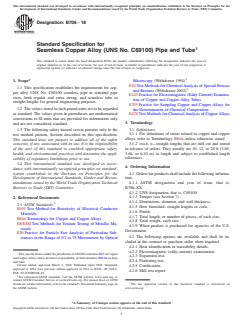
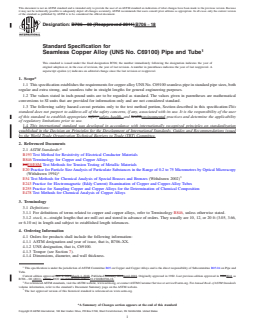
1.1 This specification establishes the requirements for copper alloy UNS No. C69100 seamless pipe in standard pipe sizes, both regular and extra strong, and seamless tube in straight lengths for general engineering purposes.
1.2 The values stated in inch-pound units are to be regarded as standard. The values given in parentheses are mathematical conversions to SI units that are provided for information only and are not considered standard.
1.3 The following safety hazard caveat pertains only to the test method portion, Section described in this specification: This standard does not purport to address all of the safety concerns, if any, associated with its use. It is the responsibility of the user of this standard to establish appropriate safety, health, and environmental practices and determine the applicability of regulatory limitations prior to use.
1.4 This international standard was developed in accordance with internationally recognized principles on standardization established in the Decision on Principles for the Development of International Standards, Guides and Recommendations issued by the World Trade Organization Technical Barriers to Trade (TBT) Committee.
General Information
- Status
- Published
- Publication Date
- 28-Feb-2018
- Technical Committee
- B05 - Copper and Copper Alloys
- Drafting Committee
- B05.04 - Pipe and Tube
Relations
- Replaces
ASTM B706-00(2011) - Standard Specification for Seamless Copper Alloy (UNS No. C69100) Pipe and Tube - Effective Date
- 01-Mar-2018
- Effective Date
- 01-Aug-2019
- Effective Date
- 01-Jan-2019
- Effective Date
- 01-Jun-2018
- Effective Date
- 01-Apr-2016
- Effective Date
- 01-Apr-2014
- Effective Date
- 01-Dec-2013
- Effective Date
- 01-Jun-2011
- Effective Date
- 01-Jan-2011
- Effective Date
- 15-Nov-2009
- Effective Date
- 01-Nov-2009
- Effective Date
- 01-Jun-2009
- Effective Date
- 15-Dec-2008
- Effective Date
- 01-Sep-2008
- Effective Date
- 15-Nov-2007
Overview
ASTM B706-18 is the internationally recognized standard specification for seamless copper alloy pipe and tube, specifically covering the Copper Alloy UNS No. C69100. Developed by ASTM, this standard defines the requirements for producing standard-sized seamless pipes (regular and extra strong) and seamless tubes in straight lengths for general engineering applications. The specification encompasses material composition, manufacturing methods, and performance characteristics to ensure reliable product quality and safety.
This standard is essential for manufacturers, engineers, and procurement professionals involved in the sourcing, application, or assessment of copper alloy pipes and tubes. Key criteria include product dimensions, mechanical and physical properties, chemical composition, and quality control processes, including mandatory testing and marking.
Key Topics
Material Requirements and Composition:
- Specifies Copper Alloy UNS No. C69100.
- Material produced from cast or extruded shells, suitable for hot working, cold working, and annealing.
- Strict chemical composition limits for copper, zinc, aluminum, manganese, silicon, tin, nickel, iron, and lead.
Manufacturing and Tempers:
- Products must be uniform wrought structure, processed through hot/cold working and annealing.
- Available in three tempers:
- TB00 (soft-annealed)
- TF00 (precipitation-hardened)
- HR50 (drawn stress relieved)
Dimensional and Mechanical Properties:
- Covers a full range of nominal pipe sizes up to 3 in.
- Requirements for wall thickness, mass, cross-sectional area, inside/outside diameters, and squareness of cut.
- Mechanical tests include tensile strength, yield strength, hardness, and elongation.
- Physical property requirements such as electrical resistivity and coefficient of thermal expansion can be specified.
Inspection and Quality Testing:
- Mandatory nondestructive eddy-current and hydrostatic tests to ensure product integrity.
- Sampling and testing protocols for chemical composition, mechanical, and physical properties.
- Detailed procedures for retesting and disputes.
Marking and Packaging:
- Clear product marking with manufacturer, alloy, dimensions, and specification reference.
- Preparation for shipment and package marking to facilitate traceability and compliance.
Applications
ASTM B706-18 seamless copper alloy pipe and tube are primarily used in:
- General Engineering: Suitable for a wide range of industrial applications where corrosion resistance, mechanical strength, and precise dimensions are critical.
- Fabrication and Assembly: Used as components in machined parts, heat exchangers, and piping systems exposed to various pressures and temperatures.
- Electrical Applications: Due to specified electrical resistivity properties, applicable where both structural integrity and conductivity are required.
- Manufacturing: The alloy’s consistency and mechanical properties make it suitable for further forming, machining, and joining operations within controlled processes.
The standard’s comprehensive property and testing requirements ensure that products meet the demanding needs of engineering projects, maximizing safety, efficiency, and longevity.
Related Standards
Organizations working with ASTM B706-18 should be aware of the following related standards:
- ASTM B193: Test Method for Resistivity of Electrical Conductor Materials
- ASTM B846: Terminology for Copper and Copper Alloys
- ASTM E8/E8M: Test Methods for Tension Testing of Metallic Materials
- ASTM E243: Practice for Electromagnetic (Eddy-Current) Examination of Copper and Copper-Alloy Tubes
- ASTM E255: Practice for Sampling Copper and Copper Alloys for Chemical Composition Determination
- ASTM E478: Test Methods for Chemical Analysis of Copper Alloys
Adhering to ASTM B706-18 and its referenced standards helps ensure quality, compliance, and consistency in the use and supply of seamless copper alloy pipes and tubes. This fosters confidence in material performance across a wide variety of industrial and engineering applications.
Buy Documents
ASTM B706-18 - Standard Specification for Seamless Copper Alloy (UNS No. C69100) Pipe and Tube
REDLINE ASTM B706-18 - Standard Specification for Seamless Copper Alloy (UNS No. C69100) Pipe and Tube
Get Certified
Connect with accredited certification bodies for this standard

Element Materials Technology
Materials testing and product certification.

Inštitut za kovinske materiale in tehnologije
Institute of Metals and Technology. Materials testing, metallurgical analysis, NDT.
Institut za varilstvo d.o.o. (Welding Institute)
Slovenia's leading welding institute since 1952. ISO 3834, EN 1090, pressure equipment certification, NDT personnel, welder qualification. Only IIW Au
Sponsored listings
Frequently Asked Questions
ASTM B706-18 is a technical specification published by ASTM International. Its full title is "Standard Specification for Seamless Copper Alloy (UNS No. C69100) Pipe and Tube". This standard covers: ABSTRACT This specification establishes the requirements for standard sized seamless pipes, both regular and extra strong, and seamless tubes in straight lengths produced from copper alloy UNS No. C69100 for general engineering purposes. The materials for manufacture shall be cast or extruded shells of such purity and soundness as to be suitable for processing by hot working, cold working, and annealing to produce a uniform wrought structure in the finished product. Products shall be produced in tempers TB00 (soft-annealed), TF00 (precipitation-hardened), and HR50 (drawn stress relieved). Products shall be sampled and prepared, then tested accordingly to examine their conformance to dimensional (mass, wall thickness, inside and outside diameters, cross-sectional area, nominal weight, length, squareness of cut, and density), mechanical (tensile and yield strengths, Rockwell hardness, and elongation), physical (electrical resistivity and coefficient of thermal expansion), and chemical composition requirements. Products shall also undergo nondestructive eddy-current and hydrostatic tests. SCOPE 1.1 This specification establishes the requirements for copper alloy UNS No. C69100 seamless pipe in standard pipe sizes, both regular and extra strong, and seamless tube in straight lengths for general engineering purposes. 1.2 The values stated in inch-pound units are to be regarded as standard. The values given in parentheses are mathematical conversions to SI units that are provided for information only and are not considered standard. 1.3 The following safety hazard caveat pertains only to the test method portion, Section described in this specification: This standard does not purport to address all of the safety concerns, if any, associated with its use. It is the responsibility of the user of this standard to establish appropriate safety, health, and environmental practices and determine the applicability of regulatory limitations prior to use. 1.4 This international standard was developed in accordance with internationally recognized principles on standardization established in the Decision on Principles for the Development of International Standards, Guides and Recommendations issued by the World Trade Organization Technical Barriers to Trade (TBT) Committee.
ABSTRACT This specification establishes the requirements for standard sized seamless pipes, both regular and extra strong, and seamless tubes in straight lengths produced from copper alloy UNS No. C69100 for general engineering purposes. The materials for manufacture shall be cast or extruded shells of such purity and soundness as to be suitable for processing by hot working, cold working, and annealing to produce a uniform wrought structure in the finished product. Products shall be produced in tempers TB00 (soft-annealed), TF00 (precipitation-hardened), and HR50 (drawn stress relieved). Products shall be sampled and prepared, then tested accordingly to examine their conformance to dimensional (mass, wall thickness, inside and outside diameters, cross-sectional area, nominal weight, length, squareness of cut, and density), mechanical (tensile and yield strengths, Rockwell hardness, and elongation), physical (electrical resistivity and coefficient of thermal expansion), and chemical composition requirements. Products shall also undergo nondestructive eddy-current and hydrostatic tests. SCOPE 1.1 This specification establishes the requirements for copper alloy UNS No. C69100 seamless pipe in standard pipe sizes, both regular and extra strong, and seamless tube in straight lengths for general engineering purposes. 1.2 The values stated in inch-pound units are to be regarded as standard. The values given in parentheses are mathematical conversions to SI units that are provided for information only and are not considered standard. 1.3 The following safety hazard caveat pertains only to the test method portion, Section described in this specification: This standard does not purport to address all of the safety concerns, if any, associated with its use. It is the responsibility of the user of this standard to establish appropriate safety, health, and environmental practices and determine the applicability of regulatory limitations prior to use. 1.4 This international standard was developed in accordance with internationally recognized principles on standardization established in the Decision on Principles for the Development of International Standards, Guides and Recommendations issued by the World Trade Organization Technical Barriers to Trade (TBT) Committee.
ASTM B706-18 is classified under the following ICS (International Classification for Standards) categories: 23.040.15 - Non-ferrous metal pipes; 77.150.30 - Copper products. The ICS classification helps identify the subject area and facilitates finding related standards.
ASTM B706-18 has the following relationships with other standards: It is inter standard links to ASTM B706-00(2011), ASTM B846-19a, ASTM B846-19, ASTM E243-18, ASTM B193-16, ASTM B193-02(2014), ASTM E243-13, ASTM B846-11a, ASTM B846-11, ASTM B846-09a, ASTM B846-09, ASTM E243-09, ASTM E478-08, ASTM B193-02(2008), ASTM E255-07. Understanding these relationships helps ensure you are using the most current and applicable version of the standard.
ASTM B706-18 is available in PDF format for immediate download after purchase. The document can be added to your cart and obtained through the secure checkout process. Digital delivery ensures instant access to the complete standard document.
Standards Content (Sample)
This international standard was developed in accordance with internationally recognized principles on standardization established in the Decision on Principles for the
Development of International Standards, Guides and Recommendations issued by the World Trade Organization Technical Barriers to Trade (TBT) Committee.
Designation:B706 −18
Standard Specification for
Seamless Copper Alloy (UNS No. C69100) Pipe and Tube
This standard is issued under the fixed designation B706; the number immediately following the designation indicates the year of
original adoption or, in the case of revision, the year of last revision.Anumber in parentheses indicates the year of last reapproval.A
superscript epsilon (´) indicates an editorial change since the last revision or reapproval.
1. Scope* Microscopy (Withdrawn 1994)
E54Test Methods for ChemicalAnalysis of Special Brasses
1.1 This specification establishes the requirements for cop-
and Bronzes (Withdrawn 2002)
per alloy UNS No. C69100 seamless pipe in standard pipe
E243PracticeforElectromagnetic(EddyCurrent)Examina-
sizes, both regular and extra strong, and seamless tube in
tion of Copper and Copper-Alloy Tubes
straight lengths for general engineering purposes.
E255Practice for Sampling Copper and Copper Alloys for
1.2 The values stated in inch-pound units are to be regarded
the Determination of Chemical Composition
as standard. The values given in parentheses are mathematical
E478Test Methods for ChemicalAnalysis of CopperAlloys
conversions to SI units that are provided for information only
and are not considered standard. 3. Terminology
3.1 Definitions:
1.3 The following safety hazard caveat pertains only to the
3.1.1 For definitions of terms related to copper and copper
test method portion, Section described in this specification:
alloys, refer to Terminology B846, unless otherwise stated.
This standard does not purport to address all of the safety
3.1.2 stock, n—straight lengths that are mill cut and stored
concerns, if any, associated with its use. It is the responsibility
in advance of orders. They usually are 10, 12, or 20 ft (3.05,
of the user of this standard to establish appropriate safety,
3.66, or 6.10 m) in length and subject to established length
health, and environmental practices and determine the appli-
tolerances.
cability of regulatory limitations prior to use.
1.4 This international standard was developed in accor-
4. Ordering Information
dance with internationally recognized principles on standard-
4.1 Ordersforproductsshallincludethefollowinginforma-
ization established in the Decision on Principles for the
Development of International Standards, Guides and Recom- tion:
mendations issued by the World Trade Organization Technical 4.1.1 ASTM designation and year of issue, that is,
Barriers to Trade (TBT) Committee. B706–XX.
4.1.2 UNS designation, that is, C69100.
2. Referenced Documents 4.1.3 Temper (see Section 7).
4.1.4 Dimensions, diameter, and wall thickness.
2.1 ASTM Standards:
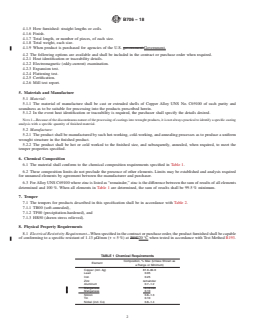
4.1.5 How furnished: straight lengths or coils.
B193Test Method for Resistivity of Electrical Conductor
4.1.6 Finish.
Materials
4.1.7 Total length, or number of pieces, of each size.
B846Terminology for Copper and Copper Alloys
4.1.8 Total weight, each size.
E8/E8MTest Methods for Tension Testing of Metallic Ma-
4.1.9 When product is purchased for agencies of the U.S.
terials
Government.
E20Practice for Particle Size Analysis of Particulate Sub-
4.2 The following options are available and shall be in-
stances in the Range of 0.2 to 75 Micrometres by Optical
cluded in the contract or purchase order when required.
4.2.1 Heat identification or traceability details.
4.2.2 Electromagnetic (eddy-current) examination.
ThisspecificationisunderthejurisdictionofASTMCommitteeB05onCopper
4.2.3 Expansion test.
and CopperAlloys and is the direct responsibility of Subcommittee B05.04 on Pipe
4.2.4 Flattening test.
and Tube.
Current edition approved March 1, 2018. Published April 2018. Originally
4.2.5 Certification.
approved in 1982. Last previous edition approved in 2011 as B706–00 (2011).
4.2.6 Mill test report.
DOI: 10.1520/B0706-18.
For referenced ASTM standards, visit the ASTM website, www.astm.org, or
contact ASTM Customer Service at service@astm.org. For Annual Book of ASTM
Standards volume information, refer to the standard’s Document Summary page on The last approved version of this historical standard is referenced on
the ASTM website. www.astm.org.
*A Summary of Changes section appears at the end of this standard
Copyright © ASTM International, 100 Barr Harbor Drive, PO Box C700, West Conshohocken, PA 19428-2959. United States
B706−18
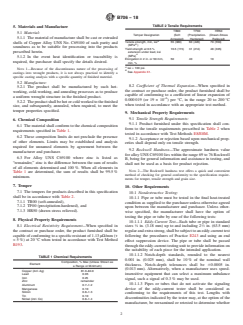
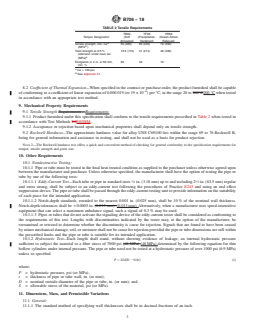
TABLE 2 Tensile Requirements
5. Materials and Manufacture
TB00 TF00 HR50
5.1 Material:
Temper Designation (Soft (Precipitation- (Drawn-Stress
5.1.1 The material of manufacture shall be cast or extruded
Annealed) Hardened) Relieved)
A
Tensile strength, min, ksi 55 (380) 60 (420) 79 (550)
shells of Copper Alloy UNS No. C69100 of such purity and
B
(MPa )
soundness as to be suitable for processing into the products
Yield strength at 0.5 % 16.5 (115) 31 (214) 48 (335)
extension under load, ksi
prescribed herein.
A
(MPa)
5.1.2 In the event heat identification or traceability is
Elongation in 2 in. or 50 mm, 50 40 10
required, the purchaser shall specify the details desired.
min, %
A
ksi = 100 psi.
NOTE 1—Because of the discontinuous nature of the processing of
B
See Appendix X1.
castings into wrought products, it is not always practical to identify a
specific casting analysis with a specific quantity of finished material.
5.2 Manufacture:
8.2 Coeffıcient of Thermal Expansion—When specified in
5.2.1 The product shall be manufactured by such hot-
the contract or purchase order, the product furnished shall be
working, cold-working, and annealing processes as to produce
capable of conforming to a coefficient of linear expansion of
a uniform wrought structure in the finished product.
−6
0.000019 (or 19 × 10 ) per °C, in the range 20 to 200°C
5.2.2 Theproductshallbehotorcoldworkedtothefinished
when tested in accordance with an appropriate test method.
size, and subsequently, annealed, when required, to meet the
temper properties specified.
9. Mechanical Property Requirements
9.1 Tensile Strength Requirements:
6. Chemical Composition
9.1.1 Product furnished under this specification shall con-
6.1 The material shall conform to the chemical composition
form to the tensile requirements prescribed in Table 2 when
requirements specified in Table 1.
tested in accordance with Test Methods E8/E8M.
6.2 These composition limits do not preclude the presence
9.1.2 Acceptance or rejection based upon mechanical prop-
of other elements. Limits may be established and analysis
erties shall depend only on tensile strength.
required for unnamed elements by agreement between the
9.2 Rockwell Hardness—The approximate hardness value
manufacturer and purchaser.
for alloy UNS C69100 lies within the range 69 to 76 Rockwell
6.3 For Alloy UNS C69100 where zinc is listed as
B, being for general information and assistance in testing, and
“remainder,” zinc is the difference between the sum of results
shall not be used as a basis for product rejection.
of all elements determined and 100%. When all elements in
NOTE 2—The Rockwell hardness test offers a quick and convenient
Table 1 are determined, the sum of results shall be 99.5%
method of checking for general conformity to the specification require-
minimum.
ments for temper, tensile strength and grain size.
7. Temper
10. Other Requirements
7.1 The tempers for products described in this specification
10.1 Nondestructive Testing:
shall be in accordance with Table 2.
10.1.1 Pipe or tube must be tested in the final heat-treated
7.1.1 TB00 (soft-annealed),
condition as supplied to the purchaser unless otherwise agreed
7.1.2 TF00 (precipitation-hardened), and
upon between the manufacturer and purchaser. Unless other-
7.1.3 HR50 (drawn stress relieved).
wise specified, the manufacturer shall have the option of
testing the pipe or tube by one of the following tests:
8. Physical Property Requirements
10.1.1.1 Eddy-Current Test—Each tube or pipe in standard
1 1
8.1 Electrical Resistivity Requirement—When specified in
sizes ⁄8 in. (3.18 mm) up to and including 2 ⁄2 in. (63.5 mm)
the contract or purchase order, the product furnished shall be
regularandextrastrong,shallbesubjecttoaneddy-currenttest
capableofconformingtoaspecificresistantof1.13µΩ/mm(+
following the procedures of Practice E243 and using an end
< 5%) at 20°C when tested in accordance with Test Method
effect suppression device. The pipe or tube shall be passed
B193.
throughtheeddy-currenttestingunittoprovideinformationon
the suitability of each piece for the intended application.
10.1.1.2 Notch-depth standards, rounded to the nearest
TABLE 1 Chemical Requirements
0.001 in. (0.025 mm), shall be 10% of the nominal wall
Composition, % Max (Unless Shown as
Element
thickness. Notch-depth tolerances shall be 60.0005 in.
a Range or Minimum)
(0.013mm). Alternatively, when a manufacturer uses speed-
Copper (incl. Ag) 81.0–84.0
Lead 0.05 insensitive equipment that can select a maximum unbalance
Iron 0.25
signal, such a signal of 0.3% may be used.
Zinc remainder
10.1.1.3 Pipes or tubes that do not activate the signaling
Aluminum 0.7–1.2
Manganese 0.10 device of the eddy-current tester shall be considered as
Silicon 0.8–1.3
conforming to the requirements of this test. Lengths with
Tin 0.10
discontinuities indicated by the tester may, at the option of the
Nickel (incl. Co) 0.8–1.4
manufacturer, be reexamined or retested to determine whether
B706−18
the discontinuity is cause for rejection. Signals that are found 11.3 Wall Thickness Tolerances—Wall thickness tolerances
to have been caused by minor mechanical damage, soil, or shall be in accordance with Table 4. Wall thickness tolerances
moisture shall not be cause for rejection provided the pipe or for tube shall be in accordance with Table 5.
tube dimensions are still within the prescribed limits and the
11.4 Diameter Tolerances—Diameter tolerances for pipe
pipe or tube is suitable for its intended application.
shall be as follows:
10.1.2 Hydrostatic Test—Each length shall stand, without
11.4.1 Nominal Pipe Size 1 ⁄2 in. (38 mm) and Under—
showing evidence of leakage, an internal hydrostatic pressure
+0.016, −0.031 in. (+0.40, −0.79 mm).
sufficient to subject the material to a fiber stress of 7000 psi
11.4.2 Nominal Pipe Size Over 1 ⁄2 in. (38 mm)—61%of
(48MPa)determinedbythefollowingequationforthinhollow
specified diameter.
cylinders under internal pressure.The pipe or tube need not be
11.4.3 The dimensional limits of standard pipe sizes are
tested at a hydrostatic pressure of over 1000 psi (6.9 MPa)
shown in Table 4.
unless so specified.
11.4.4 Diameter tolerances of tube shall be in accordance
P 52St/~D 20.8t! (1)
with Table 6.
where:
11.5 Length Tolerances:
P = hydrostatic pressure, psi (or MPa);
11.5.1 Length tolerances shall be in accordance with Table
t = thickness of pipe or tube wall, in. (or mm);
7.
D = nominal outside diameter of the pipe or tube, in. (or
mm); and 11.5.2 Schedule of Tube Lengths—Specific and stock
S = allowable stress of the material, psi (or MPa). lengths with ends shall be in accordance with Table 8.
11.6 Squareness of Cut—For pipe and tube in straight
11. Dimensions, Mass, and Permissible Variations
lengths, the departure from squareness of the end of any pipe
11.1 General:
or tube shall not exceed the following:
11.1.1 The standard method of specifying wall thicknesses
11.6.1 Pipe:
shall be in decimal fractions of an inch.
Nominal Outside Diameter,
11.1.2 Forthepurposeofdeterminingconformancewiththe
Tolerance
in. (mm)
dimensional requirements prescribed in this specification, any
measure value outside the specified limiting values for any
Up to ⁄8 in. (15.9 mm) incl 0.010 in. (0.25 mm)
Over ⁄8 in. (15.9 mm) 0.016 in./in. (0.016 mm/mm) of dia
dimension may be cause for rejection.
11.1.3 Tolerances on any given tube shall be specified with
11.6.2 Tube:
respect to any two, but not all three, of the following: outside
Specified Outside Diameter,
Tolerance
diameter, inside diameter, and wall thickness.
in. (mm)
11.2 Dimensions—Nominal dimensions and nominal
Up to ⁄8 in. (15.9 mm) incl. 0.010 in. (0.25 mm)
weights of standard pipe sizes shall be in accordance with Over ⁄8 in. (15.9 mm) 0.016 in./in. (0.016 mm/mm) of
dia
Table 3.
A
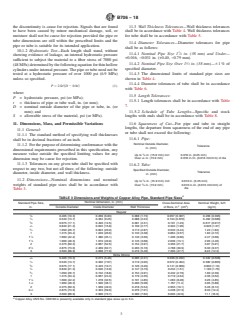
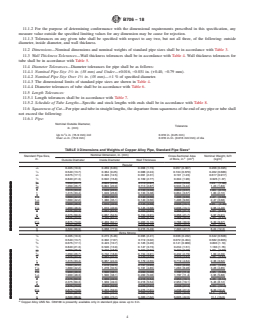
TABLE 3 Dimensions and Weights of Copper Alloy Pipe, Standard Pipe Sizes
Nominal Dimension, in. (mm)
Standard Pipe Size, Cross-Sectional Area Nominal Weight, lb/ft
2 2
in. of Bore, in. (cm ) (kg/m)
Outside Diameter Inside Diameter Wall Thickness
Regular
⁄8 0.405 (10.3) 0.269 (6.83) 0.068 (1.73) 0.057 (0.367) 0.266 (0.395)
⁄4 0.540 (13.7) 0.364 (9.25) 0.088 (2.24) 0.104 (0.670) 0.462 (0.686)
⁄8 0.675 (17.1) 0.493 (12.5) 0.091 (2.31) 0.191 (1.23) 0.617 (0.917)
⁄2 0.840 (21.3) 0.622 (15.8) 0.109 (2.77) 0.304 (1.96) 0.925 (1.37)
⁄4 1.050 (26.7) 0.824 (20.9) 0.113 (2.87) 0.533 (3.44) 1.23 (1.83)
1 1.315 (33.4) 1.049 (26.6) 0.133 (3.38) 0.864 (3.57) 1.83 (2.72)
1 ⁄4 1.660 (42.2) 1.380 (35.1) 0.140 (3.56) 1.496 (9.66) 2.47 (3.68)
1 ⁄2 1.900 (48.3) 1.610 (40.9) 0.145 (3.68) 2.036 (13.1) 2.95 (4.40)
2 2.375 (60.3) 2.067 (52.5) 0.154 (3.91) 3.356 (21.7) 3.97 (5.91)
2 ⁄2 2.875 (73.0) 2.469 (62.7) 0.203 (5.16) 4.788 (30.9) 6.30 (9.37)
3 3.500 (88.9) 3.068 (77.9) 0.216 (5.49) 7.393 (47.7) 8.24 (12.3)
Extra Strong
⁄8 0.405 (10.3) 0.215 (5.46) 0.095 (2.41) 0.036 (0.232) 0.342 (0.508)
⁄4 0.540 (13.7) 0.302 (7.67) 0.119 (3.02) 0.072 (0.464) 0.582 (0.865)
⁄8 0.675 (17.1) 0.423 (10.7) 0.126 (3.20) 0.141 (0.909) 0.803 (1.19)
⁄2 0.840 (21.3) 0.546 (13.9) 0.147 (3.73) 0.234 (1.51) 1.183 (1.76)
⁄4 1.050 (26.7) 0.742 (18.8) 0.154 (3.91) 0.432 (2.79) 1.60 (2.39)
1 1.315 (33.4) 0.957 (24.3) 0.179 (4.55) 0.719 (4.64) 2.36 (3.52)
1 ⁄4 1.660 (42.2) 1.278 (32.5) 0.191 (4.85) 1.283 (8.28) 3.26 (4.85)
1 ⁄2 1.900 (48.3) 1.500 (38.1) 0.200 (5.08) 1.767 (11.4) 3.95 (5.88)
2 2.375 (60.3) 1.939 (49.3) 0.218 (5.54) 2.953 (19.1) 5.46 (8.12)
2 ⁄2 2.875 (73.0) 2.323 (59.0) 0.276 (7.01) 4.238 (27.3) 8.33 (12.4)
3 3.500 (88.9) 2.900 (73.7) 0.300 (7.62) 6.605 (42.6) 11.1 (16.6)
A
Copper Alloy UNS No. C69100 is presently available only in standard pipe sizes up to 3 in.
B706−18
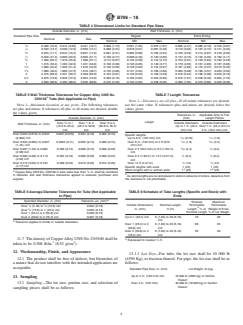
TABLE 4 Dimensional Limits for Standard Pipe Sizes
Outside Diameter, in. (mm) Wall Thickness, in. (mm)
Standard Pipe Size Regular Extra Strong
Nominal Min Max
Nominal Min Max Nominal Min Max
⁄8 0.405 (10.3) 0.374 (9.50) 0.421 (10.7) 0.068 (1.73) 0.061 (1.55) 0.075 (1.91) 0.095 (2.41) 0.086 (2.18) 0.105 (2.67)
⁄4 0.540 (13.7) 0.509 (12.9) 0.556 (14.1) 0.088 (2.24) 0.079 (2.01) 0.097 (2.46) 0.119 (3.02) 0.107 (2.72) 0.131 (3.33)
⁄8 0.675 (17.1) 0.644 (16.4) 0.691 (17.6) 0.091 (2.31) 0.082 (2.08) 0.100 (2.54) 0.126 (3.20) 0.113 (2.87) 0.139 (3.53)
⁄2 0.840 (21.3) 0.809 (20.5) 0.856 (21.7) 0.109 (2.77) 0.098 (2.49) 0.120 (3.05) 0.147 (3.73) 0.132 (3.35) 0.162 (4.11)
⁄4 1.050 (26.7) 1.019 (25.9) 1.066 (27.1) 0.113 (2.87) 0.102 (2.59) 0.124 (3.15) 0.154 (3.91) 0.139 (3.53) 0.169 (4.29)
1 1.315 (33.4) 1.284 (32.6) 1.331 (33.8) 0.133 (3.38) 0.120 (3.05) 0.146 (3.71) 0.179 (4.55) 0.161 (4.09) 0.197 (5.00)
1 ⁄4 1.660 (42.2) 1.629 (41.4) 1.676 (42.6) 0.140 (3.56) 0.126 (3.20) 0.154 (3.91) 0.191 (4.85) 0.172 (4.37) 0.210 (5.33)
1 ⁄2 1.900 (48.3) 1.869 (47.5) 1.916 (48.7) 0.145 (3.68) 0.131 (3.33) 0.160 (4.06) 0.200 (5.08) 0.180 (4.57) 0.220 (5.59)
2 2.375 (60.3) 2.351 (59.7) 2.399 (60.9) 0.154 (3.91) 0.139 (3.53) 0.169 (4.29) 0.218 (5.54) 0.196 (4.98) 0.240 (6.10)
2 ⁄2 2.875 (73.0) 2.846 (72.3) 2.904 (73.8) 0.203 (5.16) 0.183 (4.65) 0.223 (5.66) 0.276 (7.01) 0.248 (6.30) 0.304 (7.72)
3 3.500 (88.9) 3.465 (88.0)
...
This document is not an ASTM standard and is intended only to provide the user of an ASTM standard an indication of what changes have been made to the previous version. Because
it may not be technically possible to adequately depict all changes accurately, ASTM recommends that users consult prior editions as appropriate. In all cases only the current version
of the standard as published by ASTM is to be considered the official document.
Designation: B706 − 00 (Reapproved 2011) B706 − 18
Standard Specification for
Seamless Copper Alloy (UNS No. C69100) Pipe and Tube
This standard is issued under the fixed designation B706; the number immediately following the designation indicates the year of
original adoption or, in the case of revision, the year of last revision. A number in parentheses indicates the year of last reapproval. A
superscript epsilon (´) indicates an editorial change since the last revision or reapproval.
1. Scope*
1.1 This specification establishes the requirements for copper alloy UNS No. C69100 seamless pipe in standard pipe sizes, both
regular and extra strong, and seamless tube in straight lengths for general engineering purposes.
1.2 The values stated in inch-pound units are to be regarded as standard. The values given in parentheses are mathematical
conversions to SI units that are provided for information only and are not considered standard.
1.3 The following safety hazard caveat pertains only to the test method portion, Section described in this specification:This
standard does not purport to address all of the safety concerns, if any, associated with its use. It is the responsibility of the user
of this standard to establish appropriate safety safety, health, and healthenvironmental practices and determine the applicability
of regulatory limitations prior to use.
1.4 This international standard was developed in accordance with internationally recognized principles on standardization
established in the Decision on Principles for the Development of International Standards, Guides and Recommendations issued
by the World Trade Organization Technical Barriers to Trade (TBT) Committee.
2. Referenced Documents
2.1 ASTM Standards:
B193 Test Method for Resistivity of Electrical Conductor Materials
B846 Terminology for Copper and Copper Alloys
E8E8/E8M Test Methods for Tension Testing of Metallic Materials
E20 Practice for Particle Size Analysis of Particulate Substances in the Range of 0.2 to 75 Micrometres by Optical Microscopy
(Withdrawn 1994)
E54 Test Methods for Chemical Analysis of Special Brasses and Bronzes (Withdrawn 2002)
E243 Practice for Electromagnetic (Eddy Current) Examination of Copper and Copper-Alloy Tubes
E255 Practice for Sampling Copper and Copper Alloys for the Determination of Chemical Composition
E478 Test Methods for Chemical Analysis of Copper Alloys
3. Terminology
3.1 Definitions:
3.1.1 For definitions of terms related to copper and copper alloys, refer to Terminology B846, unless otherwise stated.
3.1.2 stock, n—straight lengths that are mill cut and stored in advance of orders. They usually are 10, 12, or 20 ft (3.05, 3.66,
or 6.10 m) in length and subject to established length tolerances.
4. Ordering Information
4.1 Orders for products shall include the following information:
4.1.1 ASTM designation and year of issue, that is, B706–XX.
4.1.2 UNS designation, that is, C69100.
4.1.3 Temper (see Section 7).
4.1.4 Dimensions, diameter, and wall thickness.
This specification is under the jurisdiction of ASTM Committee B05 on Copper and Copper Alloys and is the direct responsibility of Subcommittee B05.04 on Pipe and
Tube.
Current edition approved Oct. 1, 2011March 1, 2018. Published February 2012April 2018. Originally approved in 1982. Last previous edition approved in 20062011 as
B706 – 00 (2011). (2006). DOI: 10.1520/B0706-00R11.10.1520/B0706-18.
For referenced ASTM standards, visit the ASTM website, www.astm.org, or contact ASTM Customer Service at service@astm.org. For Annual Book of ASTM Standards
volume information, refer to the standard’s Document Summary page on the ASTM website.
The last approved version of this historical standard is referenced on www.astm.org.
*A Summary of Changes section appears at the end of this standard
Copyright © ASTM International, 100 Barr Harbor Drive, PO Box C700, West Conshohocken, PA 19428-2959. United States
B706 − 18
4.1.5 How furnished: straight lengths or coils.
4.1.6 Finish.
4.1.7 Total length, or number of pieces, of each size.
4.1.8 Total weight, each size.
4.1.9 When product is purchased for agencies of the U.S. government.Government.
4.2 The following options are available and shall be included in the contract or purchase order when required.
4.2.1 Heat identification or traceability details.
4.2.2 Electromagnetic (eddy-current) examination.
4.2.3 Expansion test.
4.2.4 Flattening test.
4.2.5 Certification.
4.2.6 Mill test report.
5. Materials and Manufacture
5.1 Material:
5.1.1 The material of manufacture shall be cast or extruded shells of Copper Alloy UNS No. C69100 of such purity and
soundness as to be suitable for processing into the products prescribed herein.
5.1.2 In the event heat identification or traceability is required, the purchaser shall specify the details desired.
NOTE 1—Because of the discontinuous nature of the processing of castings into wrought products, it is not always practical to identify a specific casting
analysis with a specific quantity of finished material.
5.2 Manufacture:
5.2.1 The product shall be manufactured by such hot-working, cold-working, and annealing processes as to produce a uniform
wrought structure in the finished product.
5.2.2 The product shall be hot or cold worked to the finished size, and subsequently, annealed, when required, to meet the
temper properties specified.
6. Chemical Composition
6.1 The material shall conform to the chemical composition requirements specified in Table 1.
6.2 These composition limits do not preclude the presence of other elements. Limits may be established and analysis required
for unnamed elements by agreement between the manufacturer and purchaser.
6.3 For Alloy UNS C69100 where zinc is listed as “remainder,” zinc is the difference between the sum of results of all elements
determined and 100 %. When all elements in Table 1 are determined, the sum of results shall be 99.5 % minimum.
7. Temper
7.1 The tempers for products described in this specification shall be in accordance with Table 2.
7.1.1 TB00 (soft-annealed),
7.1.2 TF00 (precipitation-hardened), and
7.1.3 HR50 (drawn stress relieved).
8. Physical Property Requirements
8.1 Electrical Resistivity Requirement—When specified in the contract or purchase order, the product furnished shall be capable
of conforming to a specific resistant of 1.13 μΩ/mm (+ < 5 %) at 20°C20 °C when tested in accordance with Test Method B193.
TABLE 1 Chemical Requirements
Composition, % Max (Unless Shown as
Element
a Range or Minimum)
Copper (incl. Ag) 81.0–84.0
Lead 0.05
Iron 0.25
Zinc remainder
Aluminum 0.7–1.2
Manganese 0.10 min
Manganese 0.10
Silicon 0.8–1.3
Tin 0.10
Nickel (incl. Co) 0.8–1.4
B706 − 18
TABLE 2 Tensile Requirements
TB00 TF00 HR50
Temper Designation (Soft (Precipitation- (Drawn-Stress
Annealed) Hardened) Relieved)
A
Tensile strength, min, ksi 55 (380) 60 (420) 79 (550)
B
(MPa )
Yield strength at 0.5 % 16.5 (115) 31 (214) 48 (335)
extension under load, ksi
A
(MPa)
Elongation in 2 in. or 50 mm, 50 40 10
min, %
A
ksi = 100 psi.
B
See Appendix X1.
8.2 Coeffıcient of Thermal Expansion—When specified in the contract or purchase order, the product furnished shall be capable
−6
of conforming to a coefficient of linear expansion of 0.000 019 (or 19 × 10 ) per °C, in the range 20 to 200°C200 °C when tested
in accordance with an appropriate test method.
9. Mechanical Property Requirements
9.1 Tensile Strength Requirements : Requirements:
9.1.1 Product furnished under this specification shall conform to the tensile requirements prescribed in Table 2 when tested in
accordance with Test Methods E8E8/E8M.
9.1.2 Acceptance or rejection based upon mechanical properties shall depend only on tensile strength.
9.2 Rockwell Hardness—The approximate hardness value for alloy UNS C69100 lies within the range 69 to 76 Rockwell B,
being for general information and assistance in testing, and shall not be used as a basis for product rejection.
NOTE 2—The Rockwell hardness test offers a quick and convenient method of checking for general conformity to the specification requirements for
temper, tensile strength and grain size.
10. Other Requirements
10.1 Nondestructive Testing:
10.1.1 Pipe or tube must be tested in the final heat-treated condition as supplied to the purchaser unless otherwise agreed upon
between the manufacturer and purchaser. Unless otherwise specified, the manufacturer shall have the option of testing the pipe or
tube by one of the following tests:
1 1
10.1.1.1 Eddy-Current Test—Each tube or pipe in standard sizes ⁄8 in. (3.18 mm) up to and including 2 ⁄2 in. (63.5 mm) regular
and extra strong, shall be subject to an eddy-current test following the procedures of Practice E243 and using an end effect
suppression device. The pipe or tube shall be passed through the eddy-current testing unit to provide information on the suitability
of each piece for the intended application.
10.1.1.2 Notch-depth standards, rounded to the nearest 0.001 in. (0.025 mm), shall be 10 % of the nominal wall thickness.
Notch-depth tolerances shall be 60.0005 in. (0.013 mm). (0.013 mm). Alternatively, when a manufacturer uses speed-insensitive
equipment that can select a maximum unbalance signal, such a signal of 0.3 % may be used.
10.1.1.3 Pipes or tubes that do not activate the signaling device of the eddy-current tester shall be considered as conforming to
the requirements of this test. Lengths with discontinuities indicated by the tester may, at the option of the manufacturer, be
reexamined or retested to determine whether the discontinuity is cause for rejection. Signals that are found to have been caused
by minor mechanical damage, soil, or moisture shall not be cause for rejection provided the pipe or tube dimensions are still within
the prescribed limits and the pipe or tube is suitable for its intended application.
10.1.2 Hydrostatic Test—Each length shall stand, without showing evidence of leakage, an internal hydrostatic pressure
sufficient to subject the material to a fiber stress of 7000 psi (48 MPa) (48 MPa) determined by the following equation for thin
hollow cylinders under internal pressure. The pipe or tube need not be tested at a hydrostatic pressure of over 1000 psi (6.9 MPa)
unless so specified.
P 5 2St/~D 2 0.8t! (1)
where:
P = hydrostatic pressure, psi (or MPa);
t = thickness of pipe or tube wall, in. (or mm);
D = nominal outside diameter of the pipe or tube, in. (or mm); and
S = allowable stress of the material, psi (or MPa).
11. Dimensions, Mass, and Permissible Variations
11.1 General:
11.1.1 The standard method of specifying wall thicknesses shall be in decimal fractions of an inch.
B706 − 18
11.1.2 For the purpose of determining conformance with the dimensional requirements prescribed in this specification, any
measure value outside the specified limiting values for any dimension may be cause for rejection.
11.1.3 Tolerances on any given tube shall be specified with respect to any two, but not all three, of the following: outside
diameter, inside diameter, and wall thickness.
11.2 Dimensions—Nominal dimensions and nominal weights of standard pipe sizes shall be in accordance with Table 3.
11.3 Wall Thickness Tolerances—Wall thickness tolerances shall be in accordance with Table 4. Wall thickness tolerances for
tube shall be in accordance with Table 5.
11.4 Diameter Tolerances—Diameter tolerances for pipe shall be as follows:
11.4.1 Nominal Pipe Size 1 ⁄2 in. (38 mm) and Under—+0.016, −0.031 in. (+0.40, −0.79 mm).
11.4.2 Nominal Pipe Size Over 1 ⁄2 in. (38 mm)—61 % of specified diameter.
11.4.3 The dimensional limits of standard pipe sizes are shown in Table 4.
11.4.4 Diameter tolerances of tube shall be in accordance with Table 6.
11.5 Length Tolerances:
11.5.1 Length tolerances shall be in accordance with Table 7.
11.5.2 Schedule of Tube Lengths—Specific and stock lengths with ends shall be in accordance with Table 8.
11.6 Squareness of Cut—For pipe and tube in straight lengths, the departure from squareness of the end of any pipe or tube shall
not exceed the following:
11.6.1 Pipe:
Nominal Outside Diameter,
Tolerance
in. (mm)
Up to ⁄8 in. (15.9 mm) incl 0.010 in. (0.25 mm)
Over ⁄8 in. (15.9 mm) 0.016 in./in. (0.016 mm/mm) of dia
A
TABLE 3 Dimensions and Weights of Copper Alloy Pipe, Standard Pipe Sizes
Nominal Dimension, in. (mm)
Standard Pipe Size, Cross-Sectional Area Nominal Weight, lb/ft
2 2
in. of Bore, in. (cm ) (kg/m)
Outside Diameter Inside Diameter Wall Thickness
Regular
⁄8 0.405 (10.3) 0.269 (6.83) 0.068 (1.73) 0.057 (0.367) 0.266 (0.395)
⁄4 0.540 (13.7) 0.364 (9.25) 0.088 (2.24) 0.104 (0.670) 0.462 (0.686)
⁄8 0.675 (17.1) 0.493 (12.5) 0.091 (2.31) 0.191 (1.23) 0.617 (0.917)
⁄2 0.840 (21.3) 0.622 (15.8) 0.109 (2.77) 0.304 (1.96) 0.925 (1.37)
⁄4 1.050 (26.7) 0.824 (20.9) 0.113 (2.87) 0.533 (3.44) 1.23 (1.83)
⁄4 1.050 (26.7) 0.824 (20.9) 0.113 (2.87) 0.533 (3.44) 1.23 (1.83)
1 1.315 (33.4) 1.049 (26.6) 0.133 (3.38) 0.864 (3.57) 1.83 (2.72)
1 1.315 (33.4) 1.049 (26.6) 0.133 (3.38) 0.864 (3.57) 1.83 (2.72)
1 ⁄4 1.660 (42.2) 1.380 (35.1) 0.140 (3.56) 1.496 (9.66) 2.47 (3.68)
1 ⁄4 1.660 (42.2) 1.380 (35.1) 0.140 (3.56) 1.496 (9.66) 2.47 (3.68)
1 ⁄2 1.900 (48.3) 1.610 (40.9) 0.145 (3.68) 2.036 (13.1) 2.95 (4.40)
1 ⁄2 1.900 (48.3) 1.610 (40.9) 0.145 (3.68) 2.036 (13.1) 2.95 (4.40)
2 2.375 (60.3) 2.067 (52.5) 0.154 (3.91) 3.356 (21.7) 3.97 (5.91)
2 2.375 (60.3) 2.067 (52.5) 0.154 (3.91) 3.356 (21.7) 3.97 (5.91)
2 ⁄2 2.875 (73.0) 2.469 (62.7) 0.203 (5.16) 4.788 (30.9) 6.30 (9.37)
2 ⁄2 2.875 (73.0) 2.469 (62.7) 0.203 (5.16) 4.788 (30.9) 6.30 (9.37)
3 3.500 (88.9) 3.068 (77.9) 0.216 (5.49) 7.393 (47.7) 8.24 (12.3)
3 3.500 (88.9) 3.068 (77.9) 0.216 (5.49) 7.393 (47.7) 8.24 (12.3)
Extra Strong
⁄8 0.405 (10.3) 0.215 (5.46) 0.095 (2.41) 0.036 (0.232) 0.342 (0.508)
⁄4 0.540 (13.7) 0.302 (7.67) 0.119 (3.02) 0.072 (0.464) 0.582 (0.865)
⁄8 0.675 (17.1) 0.423 (10.7) 0.126 (3.20) 0.141 (0.909) 0.803 (1.19)
⁄2 0.840 (21.3) 0.546 (13.9) 0.147 (3.73) 0.234 (1.51) 1.183 (1.76)
⁄4 1.050 (26.7) 0.742 (18.8) 0.154 (3.91) 0.432 (2.79) 1.60 (2.39)
⁄4 1.050 (26.7) 0.742 (18.8) 0.154 (3.91) 0.432 (2.79) 1.60 (2.39)
1 1.315 (33.4) 0.957 (24.3) 0.179 (4.55) 0.719 (4.64) 2.36 (3.52)
1 1.315 (33.4) 0.957 (24.3) 0.179 (4.55) 0.719 (4.64) 2.36 (3.52)
1 ⁄4 1.660 (42.2) 1.278 (32.5) 0.191 (4.85) 1.283 (8.28) 3.26 (4.85)
1 ⁄4 1.660 (42.2) 1.278 (32.5) 0.191 (4.85) 1.283 (8.28) 3.26 (4.85)
1 ⁄2 1.900 (48.3) 1.500 (38.1) 0.200 (5.08) 1.767 (11.4) 3.95 (5.88)
1 ⁄2 1.900 (48.3) 1.500 (38.1) 0.200 (5.08) 1.767 (11.4) 3.95 (5.88)
2 2.375 (60.3) 1.939 (49.3) 0.218 (5.54) 2.953 (19.1) 5.46 (8.12)
2 2.375 (60.3) 1.939 (49.3) 0.218 (5.54) 2.953 (19.1) 5.46 (8.12)
2 ⁄2 2.875 (73.0) 2.323 (59.0) 0.276 (7.01) 4.238 (27.3) 8.33 (12.4)
2 ⁄2 2.875 (73.0) 2.323 (59.0) 0.276 (7.01) 4.238 (27.3) 8.33 (12.4)
3 3.500 (88.9) 2.900 (73.7) 0.300 (7.62) 6.605 (42.6) 11.1 (16.6)
3 3.500 (88.9) 2.900 (73.7) 0.300 (7.62) 6.605 (42.6) 11.1 (16.6)
A
Copper Alloy UNS No. C69100 is presently available only in standard pipe sizes up to 3 in.
B706 − 18
TABLE 4 Dimensional Limits for Standard Pipe Sizes
Outside Diameter, in. (mm) Wall Thickness, in. (mm)
Standard Pipe Size Regular Extra Strong
Nominal Min Max
Nominal Min Max Nominal Min Max
⁄8 0.405 (10.3) 0.374 (9.50) 0.421 (10.7) 0.068 (1.73) 0.061 (1.55) 0.075 (1.91) 0.095 (2.41) 0.086 (2.18) 0.105 (2.67)
⁄4 0.540 (13.7) 0.509 (12.9) 0.556 (14.1) 0.088 (2.24) 0.079 (2.01) 0.097 (2.46) 0.119 (3.02) 0.107 (2.72) 0.131 (3.33)
⁄8 0.675 (17.1) 0.644 (16.4) 0.691 (17.6) 0.091 (2.31) 0.082 (2.08) 0.100 (2.54) 0.126 (3.20) 0.113 (2.87) 0.139 (3.53)
⁄2 0.840 (21.3) 0.809 (20.5) 0.856 (21.7) 0.109 (2.77) 0.098 (2.49) 0.120 (3.05) 0.147 (3.73) 0.132 (3.35) 0.162 (4.11)
⁄4 1.050 (26.7) 1.019 (25.9) 1.066 (27.1) 0.113 (2.87) 0.102 (2.59) 0.124 (3.15) 0.154 (3.91) 0.139 (3.53) 0.169 (4.29)
1 1.315 (33.4) 1.284 (32.6) 1.331 (33.8) 0.133 (3.38) 0.120 (3.05) 0.146 (3.71) 0.179 (4.55) 0.161 (4.09) 0.197 (5.00)
1 ⁄4 1.660 (42.2) 1.629 (41.4) 1.676 (42.6) 0.140 (3.56) 0.126 (3.20) 0.154 (3.91) 0.191 (4.85) 0.172 (4.37) 0.210 (5.33)
1 ⁄2 1.900 (48.3) 1.869 (47.5) 1.916 (48.7) 0.145 (3.68) 0.131 (3.33) 0.160 (4.06) 0.200 (5.08) 0.180 (4.57) 0.220 (5.59)
2 2.375 (60.3) 2.351 (59.7) 2.399 (60.9) 0.154 (3.91) 0.139 (3.53) 0.169 (4.29)
...
Questions, Comments and Discussion
Ask us and Technical Secretary will try to provide an answer. You can facilitate discussion about the standard in here.
Loading comments...