

ASTM E1545-22
(Test Method)Standard Test Method for Assignment of the Glass Transition Temperature by Thermomechanical Analysis
General Information
- Abstract
SIGNIFICANCE AND USE
5.1 The glass transition is dependent on the thermal history of the material to be tested. For amorphous and semicrystalline materials the assignment of the glass transition temperature may lead to important information about thermal history, processing conditions, stability, progress of chemical reactions, and mechanical and electrical behavior.
5.2 Thermomechanical analysis provides a rapid means of detecting changes in hardness or linear expansion associated with the glass transition.
5.3 This test method is useful for research and development, quality control, and specification acceptance.
SCOPE
1.1 This test method describes procedures for the assignment of the glass transition temperature of materials on heating using thermomechanical measurements under compression experimental conditions.
1.2 This test method is applicable to amorphous or to partially crystalline materials that are sufficiently rigid below the glass transition to inhibit indentation by the sensing probe.
1.3 The normal operating temperature range is from −100 °C to 600 °C. This temperature range may be extended depending upon the instrumentation used.
1.4 The values stated in SI units are to be regarded as standard. No other units of measurement are included in this standard.
1.5 This standard does not purport to address all of the safety concerns, if any, associated with its use. It is the responsibility of the user of this standard to establish appropriate safety, health, and environmental practices and determine the applicability of regulatory limitations prior to use. Specific precautionary statements are given in Section 7.
1.6 This international standard was developed in accordance with internationally recognized principles on standardization established in the Decision on Principles for the Development of International Standards, Guides and Recommendations issued by the World Trade Organization Technical Barriers to Trade (TBT) Committee.
- Status
- Published
- Publication Date
- 31-Mar-2022
- Technical Committee
- E37 - Thermal Measurements
- Drafting Committee
- E37.10 - Fundamental, Statistical and Mechanical Properties
Buy Documents
ASTM E1545-22 - Standard Test Method for Assignment of the Glass Transition Temperature by Thermomechanical Analysis
REDLINE ASTM E1545-22 - Standard Test Method for Assignment of the Glass Transition Temperature by Thermomechanical Analysis
Overview
ASTM E1545-22 is the Standard Test Method for Assignment of the Glass Transition Temperature by Thermomechanical Analysis (TMA). Developed by ASTM, this international standard outlines procedures for determining the glass transition temperature (Tg) of amorphous and partially crystalline materials. The technique involves thermomechanical measurements, primarily under compression conditions, to detect physical changes associated with the glass transition. This measurement is critical for evaluating material performance and is widely applied in research, quality control, and specification compliance across industries dealing with polymers, plastics, and composites.
Key Topics
- Glass Transition Temperature (Tg): The temperature at which a material transitions from a rigid, glassy state to a softer, pliable state. This property is essential for understanding the material’s thermal history and mechanical behavior.
- Thermomechanical Analysis (TMA): A technique used for measuring dimensional changes of materials as a function of temperature, time, and force.
- Experimental Scope: Suitable for materials that are sufficiently rigid below Tg to prevent probe indentation. The standard can be applied over a temperature range from −100°C to 600°C, depending on instrumentation.
- Measurement Procedures: Includes detailed steps for both expansion mode (detects change in expansion) and penetration mode (detects softening point), ensuring accurate Tg assignment.
- Data Reporting and Calibration: Emphasizes the importance of proper specimen preparation, instrument calibration, and thorough reporting for reproducibility and data integrity.
- Precision and Bias: Describes intra- and interlaboratory repeatability and reproducibility, adding confidence to the validity of results.
Applications
ASTM E1545-22 is widely adopted for the following practical applications:
- Material Research and Development: Enables scientists and engineers to characterize and compare thermal properties of new polymer blends, composites, and advanced materials.
- Process Optimization: Provides crucial insights into how manufacturing processes and thermal treatments affect a material’s glass transition and overall stability.
- Quality Control: Supports production monitoring and specification compliance by ensuring materials meet Tg requirements for their intended use.
- Failure Analysis: Identifies deviations in glass transition behavior, which can indicate degradation, improper material selection, or issues with processing history.
- Electrical and Mechanical Component Design: Critical for industries such as electronics, automotive, and aerospace, where Tg influences performance and durability in demanding environments.
Related Standards
For organizations and laboratories utilizing ASTM E1545-22, the following related standards and references may also be relevant:
- ASTM E473: Terminology Relating to Thermal Analysis and Rheology
- ASTM E691: Practice for Conducting an Interlaboratory Study to Determine the Precision of a Test Method
- ASTM E1142: Terminology Relating to Thermophysical Properties
- ASTM E1363: Test Method for Temperature Calibration of Thermomechanical Analyzers
- ISO 11359-2: Plastics-Thermomechanical Analysis-Part 2: Determination of Coefficient of Linear Thermal Expansion and Glass Transition Temperature
- IEC 61006: Test Methods for the Determination of Glass Transition Temperature of Electrical Insulating Materials
Conclusion
ASTM E1545-22 offers a robust framework for the assignment of glass transition temperatures using thermomechanical analysis, serving as an essential reference for scientists, engineers, and quality assurance professionals. By providing standardized methods and clear guidelines, it supports the development and reliable use of advanced materials across critical industries. Employing this standard ensures consistent evaluation, enhances product reliability, and facilitates international compliance in material testing protocols.
Relations
- Effective Date
- 01-Oct-2023
- Effective Date
- 01-Oct-2023
- Refers
ASTM E1363-16 - Standard Test Method for Temperature Calibration of Thermomechanical Analyzers - Effective Date
- 01-Dec-2016
- Effective Date
- 01-May-2015
- Effective Date
- 15-Aug-2014
- Effective Date
- 15-Aug-2014
- Effective Date
- 01-Apr-2014
- Effective Date
- 15-Feb-2014
- Effective Date
- 01-May-2013
- Refers
ASTM E1363-13 - Standard Test Method for Temperature Calibration of Thermomechanical Analyzers - Effective Date
- 01-Apr-2013
- Effective Date
- 01-Sep-2012
- Effective Date
- 01-Nov-2011
- Effective Date
- 01-Aug-2011
- Effective Date
- 15-Jun-2011
- Effective Date
- 15-Jun-2011
Buy Documents
ASTM E1545-22 - Standard Test Method for Assignment of the Glass Transition Temperature by Thermomechanical Analysis
REDLINE ASTM E1545-22 - Standard Test Method for Assignment of the Glass Transition Temperature by Thermomechanical Analysis
Frequently Asked Questions
ASTM E1545-22 is a standard published by ASTM International. Its full title is "Standard Test Method for Assignment of the Glass Transition Temperature by Thermomechanical Analysis". This standard covers: SIGNIFICANCE AND USE 5.1 The glass transition is dependent on the thermal history of the material to be tested. For amorphous and semicrystalline materials the assignment of the glass transition temperature may lead to important information about thermal history, processing conditions, stability, progress of chemical reactions, and mechanical and electrical behavior. 5.2 Thermomechanical analysis provides a rapid means of detecting changes in hardness or linear expansion associated with the glass transition. 5.3 This test method is useful for research and development, quality control, and specification acceptance. SCOPE 1.1 This test method describes procedures for the assignment of the glass transition temperature of materials on heating using thermomechanical measurements under compression experimental conditions. 1.2 This test method is applicable to amorphous or to partially crystalline materials that are sufficiently rigid below the glass transition to inhibit indentation by the sensing probe. 1.3 The normal operating temperature range is from −100 °C to 600 °C. This temperature range may be extended depending upon the instrumentation used. 1.4 The values stated in SI units are to be regarded as standard. No other units of measurement are included in this standard. 1.5 This standard does not purport to address all of the safety concerns, if any, associated with its use. It is the responsibility of the user of this standard to establish appropriate safety, health, and environmental practices and determine the applicability of regulatory limitations prior to use. Specific precautionary statements are given in Section 7. 1.6 This international standard was developed in accordance with internationally recognized principles on standardization established in the Decision on Principles for the Development of International Standards, Guides and Recommendations issued by the World Trade Organization Technical Barriers to Trade (TBT) Committee.
SIGNIFICANCE AND USE 5.1 The glass transition is dependent on the thermal history of the material to be tested. For amorphous and semicrystalline materials the assignment of the glass transition temperature may lead to important information about thermal history, processing conditions, stability, progress of chemical reactions, and mechanical and electrical behavior. 5.2 Thermomechanical analysis provides a rapid means of detecting changes in hardness or linear expansion associated with the glass transition. 5.3 This test method is useful for research and development, quality control, and specification acceptance. SCOPE 1.1 This test method describes procedures for the assignment of the glass transition temperature of materials on heating using thermomechanical measurements under compression experimental conditions. 1.2 This test method is applicable to amorphous or to partially crystalline materials that are sufficiently rigid below the glass transition to inhibit indentation by the sensing probe. 1.3 The normal operating temperature range is from −100 °C to 600 °C. This temperature range may be extended depending upon the instrumentation used. 1.4 The values stated in SI units are to be regarded as standard. No other units of measurement are included in this standard. 1.5 This standard does not purport to address all of the safety concerns, if any, associated with its use. It is the responsibility of the user of this standard to establish appropriate safety, health, and environmental practices and determine the applicability of regulatory limitations prior to use. Specific precautionary statements are given in Section 7. 1.6 This international standard was developed in accordance with internationally recognized principles on standardization established in the Decision on Principles for the Development of International Standards, Guides and Recommendations issued by the World Trade Organization Technical Barriers to Trade (TBT) Committee.
ASTM E1545-22 is classified under the following ICS (International Classification for Standards) categories: 81.040.01 - Glass in general. The ICS classification helps identify the subject area and facilitates finding related standards.
ASTM E1545-22 has the following relationships with other standards: It is inter standard links to ASTM E1142-23b, ASTM E473-23b, ASTM E1363-16, ASTM E1142-15, ASTM E1142-14b, ASTM E473-14, ASTM E1142-14a, ASTM E1142-14, ASTM E691-13, ASTM E1363-13, ASTM E1142-12, ASTM E691-11, ASTM E1142-11b, ASTM E473-11a, ASTM E1142-11a. Understanding these relationships helps ensure you are using the most current and applicable version of the standard.
ASTM E1545-22 is available in PDF format for immediate download after purchase. The document can be added to your cart and obtained through the secure checkout process. Digital delivery ensures instant access to the complete standard document.
Standards Content (Sample)
This international standard was developed in accordance with internationally recognized principles on standardization established in the Decision on Principles for the
Development of International Standards, Guides and Recommendations issued by the World Trade Organization Technical Barriers to Trade (TBT) Committee.
Designation: E1545 − 22
Standard Test Method for
Assignment of the Glass Transition Temperature by
Thermomechanical Analysis
This standard is issued under the fixed designation E1545; the number immediately following the designation indicates the year of
original adoption or, in the case of revision, the year of last revision.Anumber in parentheses indicates the year of last reapproval.A
superscript epsilon (´) indicates an editorial change since the last revision or reapproval.
1. Scope* E691Practice for Conducting an Interlaboratory Study to
Determine the Precision of a Test Method
1.1 This test method describes procedures for the assign-
E1142Terminology Relating to Thermophysical Properties
mentoftheglasstransitiontemperatureofmaterialsonheating
E1363Test Method forTemperature Calibration ofThermo-
using thermomechanical measurements under compression
mechanical Analyzers
experimental conditions.
2.2 Other Standards:
1.2 This test method is applicable to amorphous or to
IEC 61006Methods of Test for the Determination of the
partially crystalline materials that are sufficiently rigid below
Glass Transition Temperature of Electrical Insulating Ma-
the glass transition to inhibit indentation by the sensing probe. 3
terials
1.3 The normal operating temperature range is
3. Terminology
from−100°C to 600°C. This temperature range may be
3.1 Definitions—The following terms are applicable to this
extended depending upon the instrumentation used.
test method and can be found in Terminologies E473 and
1.4 The values stated in SI units are to be regarded as
E1142: thermomechanical analysis (TMA), thermomechanical
standard. No other units of measurement are included in this
measurement, thermodilatometry, glass transition, glass tran-
standard.
sition temperature, and linear thermal expansion.
1.5 This standard does not purport to address all of the
4. Summary of Test Method
safety concerns, if any, associated with its use. It is the
responsibility of the user of this standard to establish appro-
4.1 Thistestmethodusesthermomechanicalanalysisequip-
priate safety, health, and environmental practices and deter-
ment (thermomechanical analyzer, dilatometer, or similar de-
mine the applicability of regulatory limitations prior to use.
vice)toassignthechangeindimensionofaspecimenobserved
Specific precautionary statements are given in Section 7.
when the material is subjected to a constant heating rate
1.6 This international standard was developed in accor-
through its glass transition. This change in dimension associ-
dance with internationally recognized principles on standard-
atedwiththechangefromvitreoussolidtoamorphousliquidis
ization established in the Decision on Principles for the
observed as movement of the sensing probe in direct contact
Development of International Standards, Guides and Recom-
withthespecimenandisrecordedasafunctionoftemperature.
mendations issued by the World Trade Organization Technical
The intersection of the extrapolation of the slope of the probe
Barriers to Trade (TBT) Committee.
displacement curve before and after the transition is used to
determine the glass transition temperature.
2. Referenced Documents
5. Significance and Use
2.1 ASTM Standards:
5.1 The glass transition is dependent on the thermal history
E473Terminology Relating to Thermal Analysis and Rhe-
ofthematerialtobetested.Foramorphousandsemicrystalline
ology
materials the assignment of the glass transition temperature
may lead to important information about thermal history,
processingconditions,stability,progressofchemicalreactions,
ThistestmethodisunderthejurisdictionofASTMCommitteeE37onThermal
Measurements and is the direct responsibility of Subcommittee E37.10 on
and mechanical and electrical behavior.
Fundamental, Statistical and Mechanical Properties.
5.2 Thermomechanical analysis provides a rapid means of
Current edition approved April 1, 2022. Published April 2022. Originally
approved in 1993. Last previous edition approved in 2016 as E1545–11 (2016).
detecting changes in hardness or linear expansion associated
DOI: 10.1520/E1545-22.
with the glass transition.
For referenced ASTM standards, visit the ASTM website, www.astm.org, or
contact ASTM Customer Service at service@astm.org. For Annual Book of ASTM
Standards volume information, refer to the standard’s Document Summary page on Available from International Electrotechnical Commission (IEC), 3 rue de
the ASTM website. Varembé, Case postale 131, CH-1211, Geneva 20, Switzerland, http://www.iec.ch.
*A Summary of Changes section appears at the end of this standard
Copyright © ASTM International, 100 Barr Harbor Drive, PO Box C700, West Conshohocken, PA 19428-2959. United States
E1545 − 22
Unlesseffectsofmoisturearetobestudied,drypurgegasisrecommended
5.3 Thistestmethodisusefulforresearchanddevelopment,
and is essential for operation at subambient temperatures.
quality control, and specification acceptance.
6.1.9 A data collection device, to provide a means of
6. Apparatus
acquiring, storing, and displaying measured or calculated
6.1 Thermomechanical Analyzer (TMA)—The essential in-
signals, or both. The minimum output signals required for
strumentation required to provide the minimum thermome- thermomechanical analysis are change in linear dimension,
chanical analytical capability for this test method includes the
temperature, and time.
following:
6.2 Micrometer or other measuring device to determine
6.1.1 A rigid specimen holder, composed of inert low
specimen dimensions of up to 8 mm readable to within
–1 –1
expansivity material ≤1µmm °C , to center the specimen
610µm.
in the furnace and to fix the specimen to mechanical ground.
6.1.2 A rigid circular expansion probe, 2 mm to 6 mm in
7. Hazards
diameter, composed of inert low expansivity material
–1 –1
≤1µmm °C , that contacts the specimen with an applied 7.1 This test method may be used for amorphous and
compressive force. semicrystalline materials having a glass transition that is at or
6.1.3 A linear sensing element with a nominal range of below room temperature providing care is taken to avoid
2mm capable of measuring the displacement in length of the contacting the specimen with a loaded probe prior to cooling
specimen readable to within 650 nm. the specimen below its glass transition. Applying a loaded
6.1.4 A weight or force transducer to generate a constant probetoaspecimenthatisaboveitsglasstransitionmaycause
force of 0 mN to 50 mN that is applied through the rigid
partial penetration by the probe which can lead to probe
compression probe to the specimen. stickinguponcoolingbelowtheglasstransition.Thiscondition
6.1.5 A furnace capable of providing uniform controlled has been known to yield erroneous results during the heating
heating (cooling) of a specimen to a constant temperature or at cycle.
a constant rate over the temperature range of –100°C to
7.2 With some materials a transient may be observed
600°C.
between the pre-transition slope and the final slope (Run 1 of
6.1.6 A temperature controller capable of executing a spe-
Fig. 1).This may occur due to settling, residual stresses within
cific temperature program by operating the furnace between
the specimen, or alteration of the specimen morphology. Refer
selected temperature limits at a rate of temperature change of
to Note 5 for directions when this is encountered.
5°C⁄min 6 0.5°C⁄min.
6.1.7 A temperature sensor that can be attached to, in 7.3 Specimens of thickness less than 0.2 mm may be very
difficulttohandle.Thinfilms(50µmto200µm)onasubstrate
contact with, or reproducibly placed in close proximity to the
specimen to provide an indication of the specimen/furnace may be considered for this test method providing the substrate
is mechanically stable in the temperature region of the film
temperature readable to 0.3°C.
6.1.8 A means of sustaining an environment around the glass transition.
specimenofadryinertpurgegasof45mL/minto55mL/min.
7.4 Forspecimensofthicknessgreaterthan5mm,tempera-
NOTE 1—Typically, 99.9+% pure nitrogen, argon, or helium is used. turenonuniformitiesofsufficientextentcandevelopwithinthe
FIG. 1 Glass Transition Temperature from Expansion Mode
E1545 − 22
specimen as to yield erroneously high values of the glass softening point, T . For most materials T is close to the T as
s s g
transition temperature using this test method. measuredintheexpansionmodeorasmeasuredbydifferential
scanningcalorimetry.Itisacommonpracticeinmanypolymer
8. Sampling
laboratoriestoreport T for T .Thevalueof T maybeaffected
s g s
by the applied force and the probe contact area. Hence, those
8.1 Analyze samples as received or after pretreatment. If
values should also be reported when using this procedure.
some treatment is applied to
...
This document is not an ASTM standard and is intended only to provide the user of an ASTM standard an indication of what changes have been made to the previous version. Because
it may not be technically possible to adequately depict all changes accurately, ASTM recommends that users consult prior editions as appropriate. In all cases only the current version
of the standard as published by ASTM is to be considered the official document.
Designation: E1545 − 11 (Reapproved 2016) E1545 − 22
Standard Test Method for
Assignment of the Glass Transition Temperature by
Thermomechanical Analysis
This standard is issued under the fixed designation E1545; the number immediately following the designation indicates the year of
original adoption or, in the case of revision, the year of last revision. A number in parentheses indicates the year of last reapproval. A
superscript epsilon (´) indicates an editorial change since the last revision or reapproval.
1. Scope Scope*
1.1 This test method describes procedures for the assignment of the glass transition temperature of materials on heating using
thermomechanical measurements under compression experimental conditions.
1.2 This test method is applicable to amorphous or to partially crystalline materials that are sufficiently rigid below the glass
transition to inhibit indentation by the sensing probe.
1.3 The normal operating temperature range is from − 100from −100 °C to 600°C.600 °C. This temperature range may be
extended depending upon the instrumentation used.
1.4 The values stated in SI units are to be regarded as standard. No other units of measurement are included in this standard.
1.5 This test method is related to ISO 11359-2. ISO 11359-2 additionally covers the determination of coefficient of linear thermal
expansion not covered by this test method. This test method is related to IEC 61006 but uses a slower heating rate.
1.5 This standard does not purport to address all of the safety concerns, if any, associated with its use. It is the responsibility
of the user of this standard to establish appropriate safety safety, health, and healthenvironmental practices and determine the
applicability of regulatory limitations prior to use. Specific precautionary statements are given in Section 7.
1.6 This international standard was developed in accordance with internationally recognized principles on standardization
established in the Decision on Principles for the Development of International Standards, Guides and Recommendations issued
by the World Trade Organization Technical Barriers to Trade (TBT) Committee.
2. Referenced Documents
2.1 ASTM Standards:
E473 Terminology Relating to Thermal Analysis and Rheology
E691 Practice for Conducting an Interlaboratory Study to Determine the Precision of a Test Method
E1142 Terminology Relating to Thermophysical Properties
E1363 Test Method for Temperature Calibration of Thermomechanical Analyzers
This test method is under the jurisdiction of ASTM Committee E37 on Thermal Measurements and is the direct responsibility of Subcommittee E37.10 on Fundamental,
Statistical and Mechanical Properties.
Current edition approved Sept. 1, 2016April 1, 2022. Published September 2016April 2022. Originally approved in 1993. Last previous edition approved in 20112016 as
E1545 – 11.E1545 – 11 (2016). DOI: 10.1520/E1545-11R16.10.1520/E1545-22.
For referenced ASTM standards, visit the ASTM website, www.astm.org, or contact ASTM Customer Service at service@astm.org. For Annual Book of ASTM Standards
volume information, refer to the standard’s Document Summary page on the ASTM website.
*A Summary of Changes section appears at the end of this standard
Copyright © ASTM International, 100 Barr Harbor Drive, PO Box C700, West Conshohocken, PA 19428-2959. United States
E1545 − 22
2.2 Other Standards:
ISO 11359-2 Plastics—Thermomechanical Analysis (TMA) – Part 2: Determination of Coefficient of Linear Thermal Expansion
and Glass Transition Temperature
IEC 61006 Methods of Test for the Determination of the Glass Transition Temperature of Electrical Insulating Materials
3. Terminology
3.1 Definitions—The following terms are applicable to this test method and can be found in Terminologies E473 and E1142:
thermomechanical analysis (TMA), thermomechanical measurement,thermodilatometry,glass transition,glass transition
temperature, and linear thermal expansion.
4. Summary of Test Method
4.1 This test method uses thermomechanical analysis equipment (thermomechanical analyzer, dilatometer, or similar device) to
assign the change in dimension of a specimen observed when the material is subjected to a constant heating rate through its glass
transition. This change in dimension associated with the change from vitreous solid to amorphous liquid is observed as movement
of the sensing probe in direct contact with the specimen and is recorded as a function of temperature. The intersection of the
extrapolation of the slope of the probe displacement curve before and after the transition is used to determine the glass transition
temperature.
5. Significance and Use
5.1 The glass transition is dependent on the thermal history of the material to be tested. For amorphous and semicrystalline
materials the assignment of the glass transition temperature may lead to important information about thermal history, processing
conditions, stability, progress of chemical reactions, and mechanical and electrical behavior.
5.2 Thermomechanical analysis provides a rapid means of detecting changes in hardness or linear expansion associated with the
glass transition.
5.3 This test method is useful for research and development, quality control, and specification acceptance.
6. Apparatus
6.1 Thermomechanical Analyzer (TMA)—The essential instrumentation required to provide the minimum thermomechanical
analytical capability for this test method includes the following:
–1 –1
6.1.1 A rigid specimen holder, composed of inert low expansivity material ≤1 μm mμm m °C °C , to center the specimen in the
furnace and to fix the specimen to mechanical ground.
–1
6.1.2 A rigid circular expansion probe, 2 mm to 6 mm in diameter, composed of inert low expansivity material ≤1 μm m≤1 μm m
–1
°C °C , that contacts the specimen with an applied compressive force.
6.1.3 A linear sensing element with a nominal range of 2-mm2 mm capable of measuring the displacement in length of the
specimen readable to within 650 nm.
6.1.4 A weight or force transducer to generate a constant force of 0 mN to 50 mN that is applied through the rigid compression
probe to the specimen.
6.1.5 A furnace capable of providing uniform controlled heating (cooling) of a specimen to a constant temperature or at a constant
rate over the temperature range of –100–100 °C to 600°C.600 °C.
6.1.6 A temperature controller capable of executing a specific temperature program by operating the furnace between selected
temperature limits at a rate of temperature change of 55 °C ⁄min 6 0.5°C/minute.0.5 °C ⁄min.
6.1.7 A temperature sensor that can be attached to, in contact with, or reproducibly placed in close proximity to the specimen to
provide an indication of the specimen/furnace temperature readable to 60.1°C.0.3 °C.
Available from American National Standards Institute (ANSI), 25 W. 43rd St., 4th Floor, New York, NY 10036, http://www.ansi.org.
Available from International Electrotechnical Commission (IEC), 3 rue de Varembé, Case postale 131, CH-1211, Geneva 20, Switzerland, http://www.iec.ch.
E1545 − 22
6.1.8 A means of sustaining an environment around the specimen of a dry inert purge gas of 45 mL/min to 55 mL/minute.mL/min.
NOTE 1—Typically, 99.9+ % pure nitrogen, argon, or helium is used. Unless effects of moisture are to be studied, dry purge gas is recommended and is
essential for operation at subambient temperatures.
6.1.9 A data collection device, to provide a means of acquiring, storing, and displaying measured or calculated signals, or both.
The minimum output signals required for thermomechanical analysis are change in linear dimension, temperature, and time.
6.2 Micrometer or other measuring device to determine specimen dimensions of up to 8 mm readable to within 6 of 10
μm.610 μm.
7. Hazards
7.1 This test method may be used for amorphous and semicrystalline materials having a glass transition that is at or below room
temperature providing care is taken to avoid contacting the specimen with a loaded probe prior to cooling the specimen below its
glass transition. Applying a loaded probe to a specimen that is above its glass transition may cause partial penetration by the probe
which can lead to probe sticking upon cooling below the glass transition. This condition has been known to yield erroneous results
during the heating cycle.
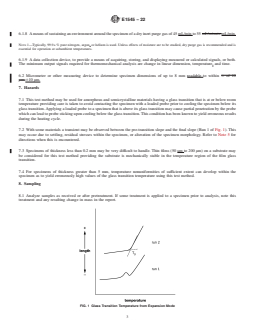
7.2 With some materials a transient may be observed between the pre-transition slope and the final slope (Run 1 of Fig. 1). This
may occur due to settling, residual stresses within the specimen, or alteration of the specimen morphology. Refer to Note 5 for
directions when this is encountered.
7.3 Specimens of thickness less than 0.2 mm may be very difficult to handle. Thin films (50 μm to 200 μm) on a substrate may
be considered for this test method providing the substrate is mechanically stable in the temperature region of the film glass
transition.
7.4 For specimens of thickness greater than 5 mm, temperature nonuniformities of sufficient extent can develop within the
specimen as to yield erroneously high values of the glass transition temperature using this test method.
8. Sampling
8.1 Analyze samples as received or after pretreatment. If some treatment is applied to a specimen prior to analysis, note this
treatment and any resulting change in mass in the report.
FIG. 1 Glass Transition Temperature from Expansion M
...