

ASTM F3398-21
(Specification)Standard Specification for Face and Ear Protective Devices for Air Soft Sports
General Information
- Abstract
SCOPE
1.1 This specification applies to face and ear protective devices (FEPDs) designed for use by participants in the sport of air soft with 6-mm air soft projectiles. These FEPDs are designed to be used in conjunction or in some cases include the eye protection discussed in Specification F2879 to minimize or significantly reduce injury to the face and ears as a result of impact and penetration of air soft projectiles.
1.2 FEPDs meeting the requirements of this specification offer protection to portions of the face and ears of the user and not necessarily the entire head.
1.3 Units—The values stated in SI units are to be regarded as the standard. No other units of measurement are included in this standard.
1.4 The following information is provided for the laboratory conducting the test for the protection of their personnel: This standard does not purport to address all of the safety concerns, if any, associated with its use. It is the responsibility of the user of this standard to establish appropriate safety, health, and environmental practices and determine the applicability of regulatory limitations prior to use.
1.5 This international standard was developed in accordance with internationally recognized principles on standardization established in the Decision on Principles for the Development of International Standards, Guides and Recommendations issued by the World Trade Organization Technical Barriers to Trade (TBT) Committee.
- Status
- Published
- Publication Date
- 30-Apr-2021
- Technical Committee
- F08 - Sports Equipment, Playing Surfaces, and Facilities
- Drafting Committee
- F08.57 - Eye Safety for Sports
Overview
ASTM F3398-21: Standard Specification for Face and Ear Protective Devices for Air Soft Sports is an internationally recognized standard developed by ASTM International. This standard specifies the requirements and performance criteria for face and ear protective devices (FEPDs) designed for participants in air soft sports that use 6-mm air soft projectiles. The standard ensures FEPDs provide reliable protection to portions of the face and ears, significantly reducing the risk of injury from impact and penetration by air soft projectiles. It also references complementary standards for eye protection and testing methods to establish a comprehensive framework of safety for air soft sport participants.
Key Topics
- Scope of Protection: The standard covers devices specifically engineered to shield the face and ears but does not require coverage of the entire head. FEPDs may be used in conjunction with or include certified eye protection.
- Types of Protective Devices: It categorizes FEPDs by coverage levels:
- Basic Protection: Non-rigid, form-fitting barriers covering nasal and mouth openings, possibly including ear coverage.
- Moderate Protection: Partially rigid or rigid protectors for the nasal and mouth area.
- Full Protection: Rigid systems covering nasal, mouth, and ears.
- Integrated Protection: FEPDs that include eye protection and are partially or fully assembled by the manufacturer.
- Performance and Mechanical Requirements: Specifies test methods for impact, penetration, and retention, requiring devices to withstand direct impact from air soft projectiles without allowing penetration, fracture, or significant component dislodgement.
- Materials and Construction: Requires materials to be durable, resistant to sunlight, and non-irritating to the skin. Products must remain stable under various environmental conditions, including changes in temperature.
- Product Marking and Labeling: Includes strict guidelines for product identification, manufacturing date, instructional information, and mandatory warnings about the importance of continued protection, appropriate cleaning, and usage procedures.
Applications
FEPDs specified by ASTM F3398-21 are primarily intended for:
- Air Soft Sports: Used in recreational and tactical sport environments where participants engage in simulated combat using 6-mm air soft guns.
- Youth and Adult Leagues: Appropriate for a range of user head sizes (youth to adult), ensuring safety for all age groups.
- Field and Indoor Arenas: Essential for commercial air soft fields, event organizers, and facility operators to ensure participant safety and regulatory compliance.
- Consumer Safety: Provides manufacturers, retailers, and consumers with clear benchmarks for product safety, selection, and usage in air soft sporting activities.
Related Standards
For comprehensive eye, face, and ear protection in air soft sports, ASTM F3398-21 references several related international standards:
- ASTM F2879: Specification for Eye Protective Devices for Airsoft Sports
- ASTM F2679: Specification for 6 mm Projectiles Used with Airsoft Guns
- ASTM F2748: Specification for Airsoft Guns
- CSA Z262.6-02 / Z262.6-14: Specifications for Facially Featured Head Forms (Canadian Standards Association)
- EN 168: Personal Eye Protection - Non-Optical Test Method (European Standard)
These referenced standards collectively ensure an integrated approach to safety, taking into account not only impact resistance but also compatibility between face, ear, and eye protection systems.
Keywords: ASTM F3398-21, face and ear protective devices, FEPD, air soft sports safety, airsoft mask standard, protective equipment for airsoft, airsoft face mask, ASTM airsoft standard, airsoft goggles, low-energy air guns, sporting equipment safety, impact protection, safety certifications for airsoft.
Relations
- Effective Date
- 01-Oct-2019
- Effective Date
- 15-May-2019
- Effective Date
- 01-Apr-2018
- Effective Date
- 01-Nov-2016
- Effective Date
- 01-Apr-2015
- Effective Date
- 01-Apr-2015
- Effective Date
- 01-Apr-2015
- Effective Date
- 01-Dec-2014
- Effective Date
- 01-May-2014
- Refers
ASTM F2679-13 - Standard Specification for 6 mm Projectiles Used with Low Energy Air Guns - Effective Date
- 01-May-2013
- Effective Date
- 01-Nov-2008
- Effective Date
- 01-Oct-2007
Get Certified
Connect with accredited certification bodies for this standard

CIS Institut d.o.o.
Personal Protective Equipment (PPE) certification body. Notified Body NB-2890 for EU Regulation 2016/425 PPE.

Kiwa BDA Testing
Building and construction product certification.
Kmetijski inštitut Slovenije
Agricultural Institute of Slovenia. Soil testing, plant health, agricultural product analysis.
Sponsored listings
Frequently Asked Questions
ASTM F3398-21 is a technical specification published by ASTM International. Its full title is "Standard Specification for Face and Ear Protective Devices for Air Soft Sports". This standard covers: SCOPE 1.1 This specification applies to face and ear protective devices (FEPDs) designed for use by participants in the sport of air soft with 6-mm air soft projectiles. These FEPDs are designed to be used in conjunction or in some cases include the eye protection discussed in Specification F2879 to minimize or significantly reduce injury to the face and ears as a result of impact and penetration of air soft projectiles. 1.2 FEPDs meeting the requirements of this specification offer protection to portions of the face and ears of the user and not necessarily the entire head. 1.3 Units—The values stated in SI units are to be regarded as the standard. No other units of measurement are included in this standard. 1.4 The following information is provided for the laboratory conducting the test for the protection of their personnel: This standard does not purport to address all of the safety concerns, if any, associated with its use. It is the responsibility of the user of this standard to establish appropriate safety, health, and environmental practices and determine the applicability of regulatory limitations prior to use. 1.5 This international standard was developed in accordance with internationally recognized principles on standardization established in the Decision on Principles for the Development of International Standards, Guides and Recommendations issued by the World Trade Organization Technical Barriers to Trade (TBT) Committee.
SCOPE 1.1 This specification applies to face and ear protective devices (FEPDs) designed for use by participants in the sport of air soft with 6-mm air soft projectiles. These FEPDs are designed to be used in conjunction or in some cases include the eye protection discussed in Specification F2879 to minimize or significantly reduce injury to the face and ears as a result of impact and penetration of air soft projectiles. 1.2 FEPDs meeting the requirements of this specification offer protection to portions of the face and ears of the user and not necessarily the entire head. 1.3 Units—The values stated in SI units are to be regarded as the standard. No other units of measurement are included in this standard. 1.4 The following information is provided for the laboratory conducting the test for the protection of their personnel: This standard does not purport to address all of the safety concerns, if any, associated with its use. It is the responsibility of the user of this standard to establish appropriate safety, health, and environmental practices and determine the applicability of regulatory limitations prior to use. 1.5 This international standard was developed in accordance with internationally recognized principles on standardization established in the Decision on Principles for the Development of International Standards, Guides and Recommendations issued by the World Trade Organization Technical Barriers to Trade (TBT) Committee.
ASTM F3398-21 is classified under the following ICS (International Classification for Standards) categories: 13.340.20 - Head protective equipment. The ICS classification helps identify the subject area and facilitates finding related standards.
ASTM F3398-21 has the following relationships with other standards: It is inter standard links to ASTM F2748-19, ASTM F2748-15(2019), ASTM F2879-18, ASTM F2879-16, ASTM F2679-15e1, ASTM F2748-15, ASTM F2679-15, ASTM F2879-14, ASTM F2748-14, ASTM F2679-13, ASTM F2748-08, ASTM F2679-07. Understanding these relationships helps ensure you are using the most current and applicable version of the standard.
ASTM F3398-21 is available in PDF format for immediate download after purchase. The document can be added to your cart and obtained through the secure checkout process. Digital delivery ensures instant access to the complete standard document.
Standards Content (Sample)
This international standard was developed in accordance with internationally recognized principles on standardization established in the Decision on Principles for the
Development of International Standards, Guides and Recommendations issued by the World Trade Organization Technical Barriers to Trade (TBT) Committee.
Designation: F3398 −21
Standard Specification for
Face and Ear Protective Devices for Air Soft Sports
This standard is issued under the fixed designation F3398; the number immediately following the designation indicates the year of
original adoption or, in the case of revision, the year of last revision. A number in parentheses indicates the year of last reapproval. A
superscript epsilon (´) indicates an editorial change since the last revision or reapproval.
1. Scope F2879 Specification for Eye Protective Devices for Airsoft
Sports
1.1 This specification applies to face and ear protective
devices (FEPDs) designed for use by participants in the sport 2.2 CSA Standards:
of air soft with 6-mm air soft projectiles. These FEPDs are Z262.6-02 Specifications for Facially Featured Head Forms
designedtobeusedinconjunctionorinsomecasesincludethe Z262.6-14 Specifications for Facially Featured Head Forms
eye protection discussed in Specification F2879 to minimize or 4
2.3 EN Standard:
significantly reduce injury to the face and ears as a result of
EN 168 Personal Eye Protection—Non-Optical Test
impact and penetration of air soft projectiles.
Method—Section 17 Head Forms
1.2 FEPDs meeting the requirements of this specification
offer protection to portions of the face and ears of the user and 3. Terminology
not necessarily the entire head.
3.1 Definitions of Terms Specific to This Standard:
1.3 Units—The values stated in SI units are to be regarded 3.1.1 air soft field, n—areawhereparticipantsactivelytarget
as the standard. No other units of measurement are included in and shoot each other with air soft projectiles using air soft
this standard. guns.
1.4 Thefollowinginformationisprovidedforthelaboratory 3.1.2 air soft gun, n—device specifically designed to expel
conducting the test for the protection of their personnel: This air soft projectiles as the result of the release of energy by
standard does not purport to address all of the safety concerns, compressed air, compressed carbon dioxide (CO ), mechanical
if any, associated with its use. It is the responsibility of the user springs, battery, or a combination thereof as defined in Speci-
of this standard to establish appropriate safety, health, and fication F2748.
environmental practices and determine the applicability of
3.1.3 air soft projectile, n—6 mm projectiles used with an
regulatory limitations prior to use.
air soft gun which is defined in Specification F2679.
1.5 This international standard was developed in accor-
3.1.4 cleanable, adv—abilityofanFEPDtobemadereadily
dance with internationally recognized principles on standard-
free of dirt or grime without being damaged during an
ization established in the Decision on Principles for the
appropriatecleaningprocess,suchastheuseofsoapandwater.
Development of International Standards, Guides and Recom-
3.1.5 dislodgement, n—relating to the movement or shifting
mendations issued by the World Trade Organization Technical
during impact testing as described in Section 7 that would
Barriers to Trade (TBT) Committee.
result in a gap between the eye protection device used in
conjunction with the FEPD of more than 3.0 mm that did not
2. Referenced Documents
exist prior to the testing or the breaking free of any FEPD
2.1 ASTM Standards:
components.
F2679 Specification for 6 mm Projectiles Used with Airsoft
3.1.6 eye protective device (EPD), n—device that provides
Guns
protectiontothewearer’seyesagainstspecifichazardsencoun-
F2748 Specification for Airsoft Guns
tered in sports.
3.1.7 face and ear protective device (FEPD), n—device that
provides protection to the wearer’s face and ears against
This specification is under the jurisdiction ofASTM Committee F08 on Sports
specific hazards encountered in sports.
Equipment, Playing Surfaces, and Facilities and is the direct responsibility of
Subcommittee F08.57 on Eye Safety for Sports.
Current edition approved May 1, 2021. Published June 2021. DOI: 10.1520/
F3398-21.
2 3
For referenced ASTM standards, visit the ASTM website, www.astm.org, or Available from Canadian Standards Association (CSA), 178 Rexdale Blvd.,
contact ASTM Customer Service at service@astm.org. For Annual Book of ASTM Toronto, ON M9W 1R3, Canada, http://www.csagroup.org.
Standards volume information, refer to the standard’s Document Summary page on Available from European Committee for Standardization (CEN), Avenue
the ASTM website. Marnix 17, B-1000, Brussels, Belgium, http://www.cen.eu.
Copyright © ASTM International, 100 Barr Harbor Drive, PO Box C700, West Conshohocken, PA 19428-2959. United States
F3398 − 21
3.1.8 FEPD retention component(s), n—components that 5.2.1 All openings in the FEPD, such as those for
are designed to retain FEPD on the users face and ears. ventilation, shall not allow the passage of a 4.5 mm diameter
probe +0.10 mm and –0.10. In cases where a foam or air
3.1.9 fracture, n—any breach, rip, rupture, or visible crack
permeable barrier is used to cover ventilation openings of the
in the FEPDs components.
FEPD, the underlying structure (under the foam or air perme-
3.1.10 head form, n—as utilized within this standard for the
able barrier) shall not allow the passage of a 4.5 mm diameter
as-worn assessment of FEPDs, key dimensions of which are as
probe +0.10 mm and –0.10.
provided in CSA Z262.6-02, CSA Z262.6-14 (see notations in
5.2.2 All opening for ventilation on the FEPD shall be
6.4.2.1 and 6.4.2.2 related to this head form) or EN 168.
inspected by the method described in 4.2.
3.1.11 tactical sport, n—within the context of this standard,
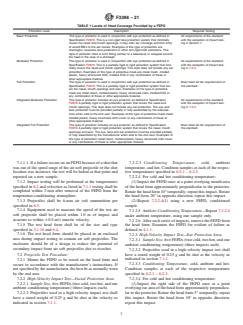
5.3 Level of Head Coverage—The level of head coverage
an activity in which participants actively target and shoot at
provided by a FEPD will be described as indicated in Table 1.
each other with air soft projectiles using an air soft gun.
The testing and requirements for each level of coverage is
referenced on this chart as well.
4. Performance Requirements
6. Sample Preparation
4.1 Mechanical Requirements:
6.1 Face and Ear Protective Devices:
4.1.1 When tested in accordance with 7.2 (Projectile Test
6.1.1 Only new and complete FEPDs as offered for sale
Procedure):
shall be tested.
4.1.1.1 Any visible damage of the FEPD that results in any
6.1.2 A minimum of five FEPDs will be required for the
component of the FEPD to become dislodged or allows the
tests.
passing through the protector of an air soft projectile as defined
6.1.3 The FEPD and the air soft projectiles shall be condi-
in 3.1.3 constitutes a failure.
tioned for a minimum of4hatthe specified conditioning
4.1.1.2 Any dislodging of a retention component from the
temperature before each test.
FEPD constitutes a failure.
4.1.1.3 Any opening in the FEPD that would permit contact
6.2 Conditioning Temperatures:
of a 4.5 mm diameter +0.10 mm and –0.10 probe to the face or
6.2.1 Cold Conditioning, –12.2 6 2°C.
inner ear canal area of the head form constitutes a failure. No
6.2.2 Ambient Conditioning, 23 6 2°C.
significant force is to be applied to force the probe through any
6.2.3 Hot Conditioning, 37.8 6 2°C.
opening.
6.3 Air Soft Projectiles—Airsoftprojectilesusedinthetests
4.1.1.4 Any visible fracture of any FEPD component con-
contained within this specification shall be in conformity with
stitutes a failure.
Specification F2679 with a stated weight of 0.25 g. A manu-
4.1.1.5 Any dislodging of any FEPD component constitutes
facturer’s declaration of compliance with the standard will be
a failure.
considered acceptable verification.
4.2 Ventilation Openings Requirements—Any ventilation
6.4 Head Form:
opening in the FEPD that would permit direct contact of a 4.5
6.4.1 The manufacturer shall normally specify to the testing
mmdiameterprobe+0.10mmand–0.10totheprotectedfacial
facility the type and size of head form to be used for testing
area of the head form constitutes a failure. No significant force
within this standard. This selection will be based upon the
is to be applied to force the probe through any opening. Any
design and size of the FEPD.
evaluation must be conducted with the FEPD installed in
6.4.2 In the case where the head form referenced in CSA
accordance with the manufacturer’s instruction manual on the
Z262.6-14 is used, the following information may serve as
head form as specified in 6.4.
guidance:
6.4.2.1 Youth (Small)—50th percentile 6-year-old child
5. General Requirements
(CSA Z262.6-14 Size 515, 50 Shore A Cadex Head Form Part
5.1 Materials of Construction: Number DM185-5150).
6.4.2.2 Adult (Medium)—50th percentile 25-year old adult
5.1.1 The manufacturer is responsible that the materials
female (CSA Z262.6-14 Size 535, 50 Shore A Cadex Head
selected meet the following criteria and may confirm compli-
Form Part Number DM185-5350).
ance by providing the testing laboratory with a declaration
6.4.3 In the case where the manufacturer does not specify a
letter regarding the suitability of the materials for inclusion
specific head form or size the testing laboratory may select the
with the final test report:
head form based on availability and suitability.
5.1.1.1 Materials exposed to sunlight shall not undergo
significant loss of physical properties.
TEST METHODS
5.1.1.2 Materials coming into contact with the wearer’s face
shall not be of a type known to cause skin irritation.
7. Mechanical Tests
5.1.1.3 Materials coming into contact with the wearer’s face
7.1 Test Equipment:
shall not undergo significant loss of strength, flexibility, or
7.1.1 The propelling device(s) shall be capable of hurling
other physical change as a result of perspiration, oil, or grease
0.25-g air soft projectiles horizontally at 175 –0/+3 m/s. Each
from the wearer’s skin and hair.
test velocity shall be measured and, if not within this tolerance,
5.2 Openings: that impact is not valid.
F3398 − 21
TABLE 1 Levels of Head Coverage Provided by a FEPD
Protection Level Description Required Testing
Basic Protection This type of protector is used in conjunction with eye protection as defined in All requirements of the standard
Specification F2879. This is a non-rigid face protection system that minimally with the exception of impact test-
covers the nasal and mouth openings. It may offer ear coverage and limit entry ing in Section 7.
of airsoft BB’s to the ear canals. Examples of this type of protection are
shemaghs, neoprene face protectors or other non-rigid cloth protectors. This
style of protector often is form fitting (similar to a balaclava) or wrapped around
the head in the case of a shemagh.
Moderate Protection This type of protector is used in conjunction with eye protection as defined in All requirements of the standard
Specification F2879. This is a partially rigid or rigid protection system that mini- with the exception of impact test-
mally covers the nasal and mouth openings. This style does not include any ear ing in 7.2.3.
protection. Examples of this type of protective mask are metal mesh, molded
plastic, heavy structured cloth, molded EVA or any combination of these or
other appropriate material.
Full Protection This type of protector is used in co
...