

ASTM D7088-17(2023)
(Practice)Standard Practice for Resistance to Hydrostatic Pressure for Coatings Used in Below Grade Applications Applied to Masonry
General Information
- Abstract
SIGNIFICANCE AND USE
4.1 This test is meant to simulate the ability of a coating applied to a basement or other below grade masonry walls to prevent the intrusion of water through the coating caused by hydrostatic pressure from water on the outside of the structure.
SCOPE
1.1 This practice is for the evaluation of coatings used in below grade applications to resist the passage of water through concrete block.
1.2 The values stated in SI units are to be regarded as the standard. The values given in parentheses are for information only.
1.3 This standard does not purport to address all of the safety concerns, if any, associated with its use. It is the responsibility of the user of this standard to establish appropriate safety, health, and environmental practices and determine the applicability of regulatory limitations prior to use.
1.4 This international standard was developed in accordance with internationally recognized principles on standardization established in the Decision on Principles for the Development of International Standards, Guides and Recommendations issued by the World Trade Organization Technical Barriers to Trade (TBT) Committee.
- Status
- Published
- Publication Date
- 30-Jun-2023
- Technical Committee
- D01 - Paint and Related Coatings, Materials, and Applications
- Drafting Committee
- D01.47 - Concrete, Stone and Masonry Treatments


Overview
ASTM D7088-17(2023): Standard Practice for Resistance to Hydrostatic Pressure for Coatings Used in Below Grade Applications Applied to Masonry establishes a standardized method for evaluating coatings designed to prevent water intrusion in concrete masonry structures below ground level. This practice helps manufacturers, specifiers, and end users assess the effectiveness of protective coatings applied to basement walls and other below-grade environments where resistance to hydrostatic pressure is crucial.
The standard outlines a test procedure that simulates real-world conditions, measuring the ability of the applied coating to resist water penetration through masonry exposed to sustained pressure from external water sources. Its adoption supports consistent quality assurance in waterproofing products for concrete and masonry substrates.
Key Topics
- Evaluation of Below-Grade Coatings: Focused on coatings used to protect concrete block or masonry units in sub-grade environments, such as basements and foundation walls.
- Hydrostatic Pressure Testing: Details a procedure to measure a coating's ability to prevent water transmission due to hydrostatic forces.
- Test Apparatus and Materials: Specifies use of commercially available concrete blocks, gaskets, air compressors, and sealants to replicate actual construction conditions.
- Result Interpretation: Assessment based on visible indicators such as blistering, water droplet size and frequency, adhesion loss, film softening, and discoloration.
- Reporting Requirements: Documentation includes coating type, application rate, curing conditions, test pressure, and any visual or physical changes post-test.
Applications
This ASTM standard is applied widely in the construction and building materials industries to:
- Product Development and Quality Control: Manufacturers can evaluate and benchmark new or existing waterproof coatings for below-grade masonry, ensuring product claims are substantiated through standardized hydrostatic pressure resistance tests.
- Specification and Purchasing: Architects, engineers, and contractors reference ASTM D7088 to specify performance requirements for waterproofing coatings on concrete and masonry structures below ground level.
- Building Code and Compliance: Provides guidance for regulatory bodies and inspectors to ensure that only coatings meeting recognized resistance to hydrostatic pressure are used in critical below-grade applications.
Typical use cases include:
- Waterproofing coatings for basement and retaining walls
- Protective barriers for underground parking structures or tunnels
- Masonry wall coatings in environments subject to groundwater infiltration
Related Standards
For more robust evaluation and comprehensive compliance, ASTM D7088-17(2023) is often used alongside or with reference to additional standards, including:
- ASTM D714: Test Method for Evaluating Degree of Blistering of Paints
- ASTM D1475: Test Method for Density of Liquid Coatings, Inks, and Related Products
- ASTM D3924: Specification for Standard Environment for Conditioning and Testing Paint, Varnish, Lacquer, and Related Materials
- ASTM D3925: Practice for Sampling Liquid Paints and Related Pigmented Coatings
- US Federal Standard TT-P-1411A: Paint, Copolymer-Resin, Cementitious (for Waterproofing Concrete and Masonry Walls)
Practical Value
Implementing ASTM D7088 ensures that below-grade waterproof coatings provide effective protection against water ingress due to hydrostatic pressure, reducing risks of structural damage, mold, or failure associated with moisture infiltration. Regular use of this standard supports durability, safety, and compliance across new builds and renovations in both residential and commercial construction. By referencing ASTM D7088-17(2023), stakeholders can confidently evaluate, select, and rely on high-performance waterproofing solutions for masonry substrates in challenging, moisture-exposed environments.
Relations
- Effective Date
- 01-Apr-2016
- Effective Date
- 01-Nov-2012
- Effective Date
- 01-Jun-2011
- Refers
ASTM D3925-02(2010) - Standard Practice for Sampling Liquid Paints and Related Pigmented Coatings - Effective Date
- 01-Dec-2010
- Effective Date
- 01-Jul-2009
- Effective Date
- 01-Jun-2008
- Effective Date
- 01-Feb-2005
- Effective Date
- 01-Dec-2003
- Effective Date
- 10-Dec-2002
- Effective Date
- 10-Dec-2002
- Effective Date
- 10-Aug-2002
- Effective Date
- 10-Nov-2000
- Refers
ASTM D1475-98 - Standard Test Method for Density of Liquid Coatings, Inks, and Related Products - Effective Date
- 10-Oct-1998
- Effective Date
- 01-Jan-1996
- Effective Date
- 15-Nov-1994
Get Certified
Connect with accredited certification bodies for this standard

DIBt (Deutsches Institut für Bautechnik)
German Institute for Building Technology.
DIN CERTCO
DIN Group product certification.

Aboma Certification B.V.
Specialized in construction, metal, and transport sectors.
Sponsored listings
Frequently Asked Questions
ASTM D7088-17(2023) is a standard published by ASTM International. Its full title is "Standard Practice for Resistance to Hydrostatic Pressure for Coatings Used in Below Grade Applications Applied to Masonry". This standard covers: SIGNIFICANCE AND USE 4.1 This test is meant to simulate the ability of a coating applied to a basement or other below grade masonry walls to prevent the intrusion of water through the coating caused by hydrostatic pressure from water on the outside of the structure. SCOPE 1.1 This practice is for the evaluation of coatings used in below grade applications to resist the passage of water through concrete block. 1.2 The values stated in SI units are to be regarded as the standard. The values given in parentheses are for information only. 1.3 This standard does not purport to address all of the safety concerns, if any, associated with its use. It is the responsibility of the user of this standard to establish appropriate safety, health, and environmental practices and determine the applicability of regulatory limitations prior to use. 1.4 This international standard was developed in accordance with internationally recognized principles on standardization established in the Decision on Principles for the Development of International Standards, Guides and Recommendations issued by the World Trade Organization Technical Barriers to Trade (TBT) Committee.
SIGNIFICANCE AND USE 4.1 This test is meant to simulate the ability of a coating applied to a basement or other below grade masonry walls to prevent the intrusion of water through the coating caused by hydrostatic pressure from water on the outside of the structure. SCOPE 1.1 This practice is for the evaluation of coatings used in below grade applications to resist the passage of water through concrete block. 1.2 The values stated in SI units are to be regarded as the standard. The values given in parentheses are for information only. 1.3 This standard does not purport to address all of the safety concerns, if any, associated with its use. It is the responsibility of the user of this standard to establish appropriate safety, health, and environmental practices and determine the applicability of regulatory limitations prior to use. 1.4 This international standard was developed in accordance with internationally recognized principles on standardization established in the Decision on Principles for the Development of International Standards, Guides and Recommendations issued by the World Trade Organization Technical Barriers to Trade (TBT) Committee.
ASTM D7088-17(2023) is classified under the following ICS (International Classification for Standards) categories: 91.080.40 - Concrete structures. The ICS classification helps identify the subject area and facilitates finding related standards.
ASTM D7088-17(2023) has the following relationships with other standards: It is inter standard links to ASTM D3924-16, ASTM D1475-98(2012), ASTM D3924-80(2011), ASTM D3925-02(2010), ASTM D714-02(2009), ASTM D1475-98(2008), ASTM D3924-80(2005), ASTM D1475-98(2003), ASTM D714-02, ASTM D714-02e1, ASTM D3925-02, ASTM D714-87(2000), ASTM D1475-98, ASTM D3924-80(1996), ASTM D714-87(1994)e1. Understanding these relationships helps ensure you are using the most current and applicable version of the standard.
ASTM D7088-17(2023) is available in PDF format for immediate download after purchase. The document can be added to your cart and obtained through the secure checkout process. Digital delivery ensures instant access to the complete standard document.
Standards Content (Sample)
This international standard was developed in accordance with internationally recognized principles on standardization established in the Decision on Principles for the
Development of International Standards, Guides and Recommendations issued by the World Trade Organization Technical Barriers to Trade (TBT) Committee.
Designation: D7088 − 17 (Reapproved 2023)
Standard Practice for
Resistance to Hydrostatic Pressure for Coatings Used in
Below Grade Applications Applied to Masonry
This standard is issued under the fixed designation D7088; the number immediately following the designation indicates the year of
original adoption or, in the case of revision, the year of last revision. A number in parentheses indicates the year of last reapproval. A
superscript epsilon (´) indicates an editorial change since the last revision or reapproval.
1. Scope 2.2 U. S. Federal Standards
TT-P-1411A Paint, Copolymer-Resin, Cementitious (for
1.1 This practice is for the evaluation of coatings used in
Waterproofing Concrete and Masonry Walls)
below grade applications to resist the passage of water through
concrete block.
3. Summary of Practice
1.2 The values stated in SI units are to be regarded as the 3.1 Commercially available concrete blocks or concrete
standard. The values given in parentheses are for information masonry units, typically 20 cm by 20 cm by 20 cm (8 in. by
only. 8 in. by 8 in.) in outside dimensions with a hollow inside area
(cell) of a nominal 10 cm by 13 cm by 20 cm (4 in. by 5 in. by
1.3 This standard does not purport to address all of the
8 in.) with a nominal wall thickness of 4 cm (1 ⁄2 in.) are coated
safety concerns, if any, associated with its use. It is the
on all four faces with the test paint and allowed to cure. Rubber
responsibility of the user of this standard to establish appro-
gaskets are sealed to the top and bottom of the test blocks
priate safety, health, and environmental practices and deter-
typically with an epoxy or sealant. Water is then used to fill
mine the applicability of regulatory limitations prior to use.
each coated test block. They are allowed to sit for seven days.
1.4 This international standard was developed in accor-
Air pressure is then introduced and the face of the blocks is
dance with internationally recognized principles on standard-
evaluated for the size and frequency of water droplets on the
ization established in the Decision on Principles for the
face of the coating, any blistering, loss of adhesion, softening,
Development of International Standards, Guides and Recom-
discoloration or other film irregularities.
mendations issued by the World Trade Organization Technical
Barriers to Trade (TBT) Committee.
4. Significance and Use
4.1 This test is meant to simulate the ability of a coating
2. Referenced Documents
applied to a basement or other below grade masonry walls to
prevent the intrusion of water through the coating caused by
2.1 ASTM Standards:
hydrostatic pressure from water on the outside of the structure.
D714 Test Method for Evaluating Degree of Blistering of
Paints
5. Apparatus
D1475 Test Method for Density of Liquid Coatings, Inks,
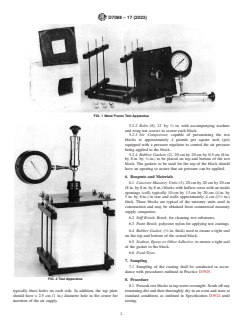
5.1 The metal frame test apparatus used in this practice (See
and Related Products
Fig. 1) consists of a series of bolts and wing nuts used for
D3924 Specification for Standard Environment for Condi-
clamping the plate tightly against the gasket and the test block.
tioning and Testing Paint, Varnish, Lacquer, and Related
The top metal plate has an opening in the center into which a
Materials
pipe cap is drilled and tapped to receive an air supply from a
D3925 Practice for Sampling Liquid Paints and Related
compressor tank or hand pump to increase in inside pressure.
Pigmented Coatings
(See Fig. 2.)
5.2 The test apparatus typically consists of the following:
5.2.1 Galvanized Steel Top and Bottom Plates, measuring
This practice is under the jurisdiction of ASTM Committee D01 on Paint and
Related Coatings, Materials, and Applications and is the direct responsibility of
28 cm by 28 cm by 0.3 cm (11 in. by 11 in. by ⁄8 in.), each
Subcommittee D01.47 on Concrete, Stone and Masonry Treatments.
with ⁄4 in. holes drilled along the outer edges of the plates for
Current edition approved July 1, 2023. Published August 2023. Originally
insertion of screws and bolts to secure the blocks. There are
approved in 2004. Last previous edition approved in 2017 as D7088 – 17. DOI:
10.1520/D7088-17R23.
For referenced ASTM standards, visit the ASTM website, www.astm.org, or
contact ASTM Customer Service at service@astm.org. For Annual Book of ASTM Available from U.S. Government Printing Office Superintendent of Documents,
Standards volume information, refer to the standard’s Document Summary page on 732 N. Capitol St., NW, Mail Stop: SDE, Washington, DC 20401, http://
the ASTM website. www.access.gpo.gov.
Copyright © ASTM International, 100 Barr Harbor Drive, PO Box C700, West Conshohocken, PA 19428-2959. United States
D7088 − 17 (2023)
FIG. 1 Metal Frame Test Apparatus
5.2.2 Bolts (8), 12 by ⁄4 in. with accompanying washers
and wing nut screws to secure each block.
5.2.3 Air Compressor, capable of pressurizing the test
blocks to approximately 4 pounds per square inch (psi)
equipped with a pressure regulator to control the air pressure
being applied to the block.
5.2.4 Rubber Gaskets (2), 20 cm by 20 cm by 0.5 cm (8 in.
by 8 in. by ⁄4 in.) to be placed on top and bottom of the test
block. The gaskets to be used for the top of the block should
have an opening to assure that air pressure can be applied.
6. Reagents and Materials
6.1 Concrete Masonry Units (3), 20 cm by 20 cm by 20 cm
(8 in. by 8 in. by 8 in.) blocks with hollow cores with an inside
openings (cell) typically 10 cm by 13 cm by 20 cm (4 in. by
5 in. by 8 in.) in size and walls approximately 4 cm (1 ⁄2 in.)
thick. These blocks are typical of the masonry units used in
construction and may be obtained from commercial masonry
supply companies.
6.2 Stiff Bristle Brush, for cleaning test substrates.
6.3 Paint Brush, polyester nylon for applying test coatings.
6.4 Rubber Gasket, ( ⁄4 in. thick) used to ensure a tight seal
on the top and bottom of the coated block.
6.5 Sealant, Epoxy or Other Adhesive, to ensure a tight seal
of the gasket to the block.
6.6 Food Dyes.
7. Sampling
7.1 Sampling of the coating shall be conducted in accor-
dance with procedures outlined in Practice D
...