


ASTM D6530-19
(Test Method)Standard Test Method for Total Active Biomass in Cooling Tower Waters (Kool Kount Assay; KKA)
Standard Test Method for Total Active Biomass in Cooling Tower Waters (Kool Kount Assay; KKA)
SIGNIFICANCE AND USE
5.1 This test method is useful for rapid determination of viable active biomass concentrations in cooling tower waters. The efficiency of cooling towers is directly affected by the concentration of biomass in the cooling tower waters. As biomass concentrations increase, biofilm formation occurs resulting in a decrease in the efficiency of heat exchange in the tower. Current tests for monitoring the biomass concentration in cooling towers require at least 36 h for growth of the microorganisms on a solid agar surface for counting. Replication of microorganisms over the 36-h period before results are available creates an aqueous environment which is no longer represented by the data generated. Timely test results can assist in minimizing biocide addition to control biomass concentrations. Kool Kount provides data within hours to allow for more precise control of active biomass concentrations in the waters.
SCOPE
1.1 This test method covers the determination of viable active biomass in cooling tower water in the range from 102 to 108 cfu/mL. It is a semiquantitative test method.
1.2 This test method was used successfully with reagent water, physiologic saline, and cooling tower waters. It is the user’s responsibility to ensure the validity of this test method for waters of untested matrices.
1.3 The values stated in SI units are to be regarded as standard. The values given in parentheses after SI units are provided for information only and are not considered standard.
1.4 This standard does not purport to address all of the safety concerns, if any, associated with its use. It is the responsibility of the user of this standard to establish appropriate safety, health, and environmental practices and determine the applicability of regulatory limitations prior to use. For specific hazard statements, see Section 9.
1.5 This international standard was developed in accordance with internationally recognized principles on standardization established in the Decision on Principles for the Development of International Standards, Guides and Recommendations issued by the World Trade Organization Technical Barriers to Trade (TBT) Committee.
General Information
- Status
- Published
- Publication Date
- 30-Nov-2019
- Technical Committee
- D19 - Water
- Drafting Committee
- D19.24 - Water Microbiology
Relations
- Effective Date
- 01-Dec-2019
- Effective Date
- 01-May-2020
- Effective Date
- 15-Jun-2012
- Effective Date
- 01-Dec-2010
- Effective Date
- 01-Mar-2010
- Effective Date
- 01-Oct-2008
- Effective Date
- 15-Jan-2008
- Effective Date
- 01-Dec-2007
- Effective Date
- 01-Sep-2006
- Effective Date
- 01-Sep-2006
- Effective Date
- 15-Aug-2006
- Effective Date
- 01-Mar-2006
- Effective Date
- 15-Feb-2006
- Effective Date
- 01-Mar-2004
- Effective Date
- 01-Mar-2004
Overview
ASTM D6530-19 – Standard Test Method for Total Active Biomass in Cooling Tower Waters (Kool Kount Assay; KKA) provides a rapid and effective procedure for the determination of viable active biomass concentrations in cooling tower water systems. Effective management of biomass is critical for maintaining cooling tower performance, minimizing biofilm formation, and ensuring efficient heat exchange. Unlike conventional microbial monitoring techniques that can require up to 36 hours, the Kool Kount Assay delivers actionable results within hours, enabling timely adjustments to biocide dosing and improved microbial control.
This standard is widely recognized for supporting timely decision-making in industrial water treatment, advancing both operational efficiency and water quality in cooling tower maintenance.
Key Topics
- Rapid assessment of viable biomass: The Kool Kount Assay (KKA) is a semiquantitative colorimetric bioassay that measures colony-forming units per milliliter (cfu/mL) in the range from 10² to 10⁸ cfu/mL. Results are based on the rate of visible color change from yellow (negative) to orange (positive) after incubation.
- Efficient cooling tower operation: Increased biomass leads to biofilm development, which decreases heat exchange efficiency. Prompt biomass measurement helps prevent operational losses and facilitates optimal biocide use.
- User responsibility and application range: The method has been validated for reagent water, physiological saline, and typical cooling tower waters. Users must determine suitability for untested environmental matrices.
- Interference control: The test method specifies precautions against halogen residuals and reducing agents, which may interfere with test results. Thiosulfate is used to neutralize halogens.
- Safety and compliance: Users are responsible for establishing appropriate safety, health, and environmental practices, and must review applicable regulatory requirements when using the standard.
Applications
- Industrial cooling towers: On-site technicians and water treatment professionals use ASTM D6530-19 to monitor and manage biomass levels, minimizing the risk of biofilm formation and ensuring energy-efficient operation.
- Water quality monitoring: The Kool Kount Assay supports water quality management protocols by providing a rapid screening tool for microbial contamination.
- Biocide optimization: Quick results allow for more precise application of biocides, reducing chemical overuse while maintaining microbial control.
- Process water systems: The method is adaptable for use in various recirculating or process water systems where microbial growth must be closely managed to sustain operational reliability.
Related Standards
For comprehensive water quality management in cooling towers and process water environments, the following ASTM standards are relevant:
- ASTM D1129 – Terminology Relating to Water
- ASTM D1192 – Guide for Equipment for Sampling Water and Steam in Closed Conduits
- ASTM D1193 – Specification for Reagent Water
- ASTM D2777 – Practice for Determination of Precision and Bias of Applicable Test Methods of Committee D19 on Water
- ASTM D3370 – Practices for Sampling Water from Flowing Process Streams
Summary: ASTM D6530-19 provides a practical, rapid, and semiquantitative method for monitoring total active biomass in cooling tower waters. Implementing this standard supports efficient cooling tower performance, timely water quality assessment, and optimized use of biocides, contributing to effective industrial water management and operational excellence.
Buy Documents
ASTM D6530-19 - Standard Test Method for Total Active Biomass in Cooling Tower Waters (Kool Kount Assay; KKA)
REDLINE ASTM D6530-19 - Standard Test Method for Total Active Biomass in Cooling Tower Waters (Kool Kount Assay; KKA)
Get Certified
Connect with accredited certification bodies for this standard

DNV
DNV is an independent assurance and risk management provider.

Lloyd's Register
Lloyd's Register is a global professional services organisation specialising in engineering and technology.
DNV Energy Systems
Energy and renewable energy certification.
Sponsored listings
Frequently Asked Questions
ASTM D6530-19 is a standard published by ASTM International. Its full title is "Standard Test Method for Total Active Biomass in Cooling Tower Waters (Kool Kount Assay; KKA)". This standard covers: SIGNIFICANCE AND USE 5.1 This test method is useful for rapid determination of viable active biomass concentrations in cooling tower waters. The efficiency of cooling towers is directly affected by the concentration of biomass in the cooling tower waters. As biomass concentrations increase, biofilm formation occurs resulting in a decrease in the efficiency of heat exchange in the tower. Current tests for monitoring the biomass concentration in cooling towers require at least 36 h for growth of the microorganisms on a solid agar surface for counting. Replication of microorganisms over the 36-h period before results are available creates an aqueous environment which is no longer represented by the data generated. Timely test results can assist in minimizing biocide addition to control biomass concentrations. Kool Kount provides data within hours to allow for more precise control of active biomass concentrations in the waters. SCOPE 1.1 This test method covers the determination of viable active biomass in cooling tower water in the range from 102 to 108 cfu/mL. It is a semiquantitative test method. 1.2 This test method was used successfully with reagent water, physiologic saline, and cooling tower waters. It is the user’s responsibility to ensure the validity of this test method for waters of untested matrices. 1.3 The values stated in SI units are to be regarded as standard. The values given in parentheses after SI units are provided for information only and are not considered standard. 1.4 This standard does not purport to address all of the safety concerns, if any, associated with its use. It is the responsibility of the user of this standard to establish appropriate safety, health, and environmental practices and determine the applicability of regulatory limitations prior to use. For specific hazard statements, see Section 9. 1.5 This international standard was developed in accordance with internationally recognized principles on standardization established in the Decision on Principles for the Development of International Standards, Guides and Recommendations issued by the World Trade Organization Technical Barriers to Trade (TBT) Committee.
SIGNIFICANCE AND USE 5.1 This test method is useful for rapid determination of viable active biomass concentrations in cooling tower waters. The efficiency of cooling towers is directly affected by the concentration of biomass in the cooling tower waters. As biomass concentrations increase, biofilm formation occurs resulting in a decrease in the efficiency of heat exchange in the tower. Current tests for monitoring the biomass concentration in cooling towers require at least 36 h for growth of the microorganisms on a solid agar surface for counting. Replication of microorganisms over the 36-h period before results are available creates an aqueous environment which is no longer represented by the data generated. Timely test results can assist in minimizing biocide addition to control biomass concentrations. Kool Kount provides data within hours to allow for more precise control of active biomass concentrations in the waters. SCOPE 1.1 This test method covers the determination of viable active biomass in cooling tower water in the range from 102 to 108 cfu/mL. It is a semiquantitative test method. 1.2 This test method was used successfully with reagent water, physiologic saline, and cooling tower waters. It is the user’s responsibility to ensure the validity of this test method for waters of untested matrices. 1.3 The values stated in SI units are to be regarded as standard. The values given in parentheses after SI units are provided for information only and are not considered standard. 1.4 This standard does not purport to address all of the safety concerns, if any, associated with its use. It is the responsibility of the user of this standard to establish appropriate safety, health, and environmental practices and determine the applicability of regulatory limitations prior to use. For specific hazard statements, see Section 9. 1.5 This international standard was developed in accordance with internationally recognized principles on standardization established in the Decision on Principles for the Development of International Standards, Guides and Recommendations issued by the World Trade Organization Technical Barriers to Trade (TBT) Committee.
ASTM D6530-19 is classified under the following ICS (International Classification for Standards) categories: 27.200 - Refrigerating technology. The ICS classification helps identify the subject area and facilitates finding related standards.
ASTM D6530-19 has the following relationships with other standards: It is inter standard links to ASTM D6530-00(2013), ASTM D1129-13(2020)e2, ASTM D2777-12, ASTM D3370-10, ASTM D1129-10, ASTM D3370-08, ASTM D2777-08, ASTM D3370-07, ASTM D1129-06ae1, ASTM D1129-06a, ASTM D2777-06, ASTM D1193-06, ASTM D1129-06, ASTM D1129-04, ASTM D1129-04e1. Understanding these relationships helps ensure you are using the most current and applicable version of the standard.
ASTM D6530-19 is available in PDF format for immediate download after purchase. The document can be added to your cart and obtained through the secure checkout process. Digital delivery ensures instant access to the complete standard document.
Standards Content (Sample)
This international standard was developed in accordance with internationally recognized principles on standardization established in the Decision on Principles for the
Development of International Standards, Guides and Recommendations issued by the World Trade Organization Technical Barriers to Trade (TBT) Committee.
Designation: D6530 − 19
Standard Test Method for
Total Active Biomass in Cooling Tower Waters (Kool Kount
Assay; KKA)
This standard is issued under the fixed designation D6530; the number immediately following the designation indicates the year of
original adoption or, in the case of revision, the year of last revision.Anumber in parentheses indicates the year of last reapproval.A
superscript epsilon (´) indicates an editorial change since the last revision or reapproval.
1. Scope* D2777Practice for Determination of Precision and Bias of
Applicable Test Methods of Committee D19 on Water
1.1 This test method covers the determination of viable
2 D3370Practices for Sampling Water from Flowing Process
active biomass in cooling tower water in the range from 10 to
8 Streams
10 cfu/mL. It is a semiquantitative test method.
1.2 This test method was used successfully with reagent
3. Terminology
water, physiologic saline, and cooling tower waters. It is the
3.1 Definitions:
user’s responsibility to ensure the validity of this test method
3.1.1 For definitions of terms used in this standard, refer to
for waters of untested matrices.
Terminology D1129.
1.3 The values stated in SI units are to be regarded as
3.2 Definitions of Terms Specific to This Standard:
standard. The values given in parentheses after SI units are
3.2.1 cfu/mL, n—colony forming units per millilitre.
provided for information only and are not considered standard.
3.2.2 snapping cup, n—container provided for holding the
1.4 This standard does not purport to address all of the
sample and snapping tip of the vial.
safety concerns, if any, associated with its use. It is the
3.2.3 vial, n—sealed glass ampoule under vacuum contain-
responsibility of the user of this standard to establish appro-
ing reagents for the Kool Kount Test.
priate safety, health, and environmental practices and deter-
mine the applicability of regulatory limitations prior to use.
4. Summary of Test Method
For specific hazard statements, see Section 9.
1.5 This international standard was developed in accor-
4.1 Thistestmethodconsistsofaddingaspecificvolumeof
dance with internationally recognized principles on standard-
water to nutrients and a color indicator contained in a glass
ization established in the Decision on Principles for the
vial. The contents of the vial are then mixed and incubated at
Development of International Standards, Guides and Recom-
35 6 3°C (95°F); that is, in a shirt pocket, incubator, or heat
mendations issued by the World Trade Organization Technical
block. The color of the sample after addition into the vial
Barriers to Trade (TBT) Committee.
containing the nutrients and color indicator is yellow. Viable
active biomass in the sample replicates using the nutrients
2. Referenced Documents
provided and reduces the color indicator.At a critical biomass
2.1 ASTM Standards:
concentration, sufficient quantities of the color indicator are
D1129Terminology Relating to Water
reduced resulting in a visible change in the indicator from the
D1192Guide for Equipment for Sampling Water and Steam
original yellow sample color to orange. The time required for
in Closed Conduits (Withdrawn 2003)
conversion of the oxidized indicator to the reduced indicator
D1193Specification for Reagent Water
resulting in an orange color as directly correlated with the
concentration of viable active biomass in the water sample
tested. High concentrations of active biomass in the sample
produce the positive orange color more rapidly than low
This test method is under the jurisdiction of ASTM Committee D19 on Water
concentrations of viable biomass.
and is the direct responsibility of Subcommittee D19.24 on Water Microbiology.
Current edition approved Dec. 1, 2019. Published December 2019. Originally
approved in 2000. Last previous edition approved in 2013 as D6530– 00 (2013).
5. Significance and Use
DOI: 10.1520/D6530-19.
5.1 This test method is useful for rapid determination of
For referenced ASTM standards, visit the ASTM website, www.astm.org, or
contact ASTM Customer Service at service@astm.org. For Annual Book of ASTM
viable active biomass concentrations in cooling tower waters.
Standards volume information, refer to the standard’s Document Summary page on
The efficiency of cooling towers is directly affected by the
the ASTM website.
concentration of biomass in the cooling tower waters. As
The last approved version of this historical standard is referenced on
www.astm.org. biomass concentrations increase, biofilm formation occurs
*A Summary of Changes section appears at the end of this standard
Copyright © ASTM International, 100 Barr Harbor Drive, PO Box C700, West Conshohocken, PA 19428-2959. United States
D6530 − 19
resulting in a decrease in the efficiency of heat exchange in the 8.3 Reagents—KoolKountTestKit:FischerScientific,Cole
tower. Current tests for monitoring the biomass concentration Parmer, Calgon, Sodium thiosulfate: [Na O S ]
2 3 2
in cooling towers require at least 36 h for growth of the
microorganisms on a solid agar surface for counting. Replica- 9. Precautions
tion of microorganisms over the 36-h period before results are
9.1 Precautionsshouldbetakenwhensnappingtheglasstip
available creates an aqueous environment which is no longer
from the glass vial containing the reagents. The tip must be
representedbythedatagenerated.Timelytestresultscanassist
submerged for the vial to completely fill as a result of the
in minimizing biocide addition to control biomass concentra-
vacuum in the vial.Aprotective sleeve is provided with the kit
tions.KoolKountprovidesdatawithinhourstoallowformore
to cover any rough glass edges on the neck of the vial during
precise control of active biomass concentrations in the waters.
incubation.
6. Interferences
10. Sampling
6.1 Halogens interfere with this test method by inhibiting
10.1 Collect the sample in accordance with Guide D1192
microbialgrowthresultinginlengthyincubationperiodsbefore
and Practices D3370 as applicable.
a positive orange color is produced suggesting better water
quality.Addition of thiosulfate eliminates this interference and
11. Procedure
allows for testing of waters previously treated with halogens
(not immediately prior to testing).
11.1 Rinse snapping cup at least twice with sample to be
tested. Place at least 20 mL of the sample to be tested in the
6.2 Reducing agents (that is, beta mercaptoethanol) may
snapping cup. Add two drops of the thiosulfate solution
interfere in this test method by reducing the color indicator
provided. Mix and allow sample to sit quiescently in the
chemically. Rapid color development upon filling of the vials
snapping cup for 15 min.
suggests a chemical rather than a biological reaction. Waters
containingreducingagentswhichreactwiththecolorindicator
11.2 Submerge the tip of glassVialAcontaining reagents in
are not suitable for testing with Kool Kount.
the sample to be tested (in the snapping cup). Place the tip in
oneofthegroovesinthebottomofthesnappingcup.Carefully
6.3 Avoidprolongedexposure(greaterthan30min)offilled
press the vial toward the opposite wall of the cup to snap the
or unopened KKA vials to sunlight to avoid false positive
tipallowingthevialtofillasaresultofthevacuum in the vial.
reactions.
11.3 Submerge the tip of control glass Vial B (no glass rod)
6.4 Testing must not take place within 24 h of biocide
in the same sample. Place the tip in one of the grooves in the
addition.
bottomofthesnappingcup.Carefullypressthevialtowardthe
7. Apparatus
wall of the cup to snap the tip allowing the vial to fill.
7.1 TheschematicarrangementoftheKKAtestkitisshown
11.4 Place a protective sleeve on the neck of each vial to
in Fig. 1.
cover the sharp edges. Carefully invert vials several times to
completely mix the reagent powders with the water sample.
7.2 (Parts) of the KKA Test K—VialA(test vial), vial under
vacuum containing nutrient and reagent on glass rod; Vial B
11.5 Prepare the label with the sample designation, sample
(control vial), vial under vacuum containing nutrient only
pH, sample tem
...
This document is not an ASTM standard and is intended only to provide the user of an ASTM standard an indication of what changes have been made to the previous version. Because
it may not be technically possible to adequately depict all changes accurately, ASTM recommends that users consult prior editions as appropriate. In all cases only the current version
of the standard as published by ASTM is to be considered the official document.
Designation: D6530 − 00 (Reapproved 2013) D6530 − 19
Standard Test Method for
Total Active Biomass in Cooling Tower Waters (Kool Kount
Assay; KKA)
This standard is issued under the fixed designation D6530; the number immediately following the designation indicates the year of
original adoption or, in the case of revision, the year of last revision. A number in parentheses indicates the year of last reapproval. A
superscript epsilon (´) indicates an editorial change since the last revision or reapproval.
1. Scope Scope*
2 8
1.1 This test method covers the determination of viable active biomass in cooling tower water in the range from 10 to 10
cfu/mL (1). cfu/mL. It is a semiquantitative test method.
1.2 This test method was used successfully with reagent water, physiologic saline, and cooling tower waters. It is the
user’suser’s responsibility to ensure the validity of this test method for waters of untested matrices.
1.3 The values stated in SI units are to be regarded as standard. The values given in parentheses after SI units are provided for
information only and are not considered standard.
1.4 This standard does not purport to address all of the safety concerns, if any, associated with its use. It is the responsibility
of the user of this standard to establish appropriate safety safety, health, and healthenvironmental practices and determine the
applicability of regulatory limitations prior to use. For specific hazard statements, see Section 9.
1.5 This international standard was developed in accordance with internationally recognized principles on standardization
established in the Decision on Principles for the Development of International Standards, Guides and Recommendations issued
by the World Trade Organization Technical Barriers to Trade (TBT) Committee.
2. Referenced Documents
2.1 ASTM Standards:
D1129 Terminology Relating to Water
D1192 Guide for Equipment for Sampling Water and Steam in Closed Conduits (Withdrawn 2003)
D1193 Specification for Reagent Water
This test method is under the jurisdiction of ASTM Committee D19 on Water and is the direct responsibility of Subcommittee D19.24 on Water Microbiology.
Current edition approved June 1, 2013Dec. 1, 2019. Published July 2013December 2019. Originally approved in 2000. Last previous edition approved in 20062013 as
D6530 – 00 (2006).(2013). DOI: 10.1520/D6530-00R13.10.1520/D6530-19.
For referenced ASTM standards, visit the ASTM website, www.astm.org, or contact ASTM Customer Service at service@astm.org. For Annual Book of ASTM Standards
volume information, refer to the standard’sstandard’s Document Summary page on the ASTM website.
The last approved version of this historical standard is referenced on www.astm.org.
*A Summary of Changes section appears at the end of this standard
Copyright © ASTM International, 100 Barr Harbor Drive, PO Box C700, West Conshohocken, PA 19428-2959. United States
D6530 − 19
D2777 Practice for Determination of Precision and Bias of Applicable Test Methods of Committee D19 on Water
D3370 Practices for Sampling Water from Flowing Process Streams
3. Terminology
3.1 Definitions—Definitions: For definitions of terms used in this test method, refer to Terminology D1129.
3.1.1 For definitions of terms used in this standard, refer to Terminology D1129.
3.2 Definitions of Terms Specific to This Standard:
3.2.1 cfu/mL, n—colony forming units per millilitre.
3.2.2 snapping cup—cup, n—container provided for holding the sample and snapping tip of the vial.
3.2.3 vial—vial, n—sealed glass ampoule under vacuum containing reagents for the Kool Kount Test.
3.3 Symbols:
3.3.1 cfu/mL—colony forming units per millilitre.
4. Summary of Test Method
4.1 This test method consists of adding a specific volume of water to nutrients and a color indicator contained in a glass vial.
The contents of the vial are then mixed and incubated at 95°F (35 6 3°C; 35 6 3°C (95°F); that is, in a shirt pocket, incubator,
or heat block).block. The color of the sample after addition into the vial containing the nutrients and color indicator is yellow.
Viable active biomass in the sample replicates using the nutrients provided and reduces the color indicator. At a critical biomass
concentration, sufficient quantities of the color indicator are reduced resulting in a visible change in the indicator from the original
yellow sample color to orange. The time required for conversion of the oxidized indicator to the reduced indicator resulting in an
orange color as directly correlated with the concentration of viable active biomass in the water sample tested. High concentrations
of active biomass in the sample produce the positive orange color more rapidly than low concentrations of viable biomass.
5. Significance and Use
5.1 This test method is useful for rapid determination of viable active biomass concentrations in cooling tower waters. The
efficiency of cooling towers is directly affected by the concentration of biomass in the cooling tower waters. As biomass
concentrations increase, biofilm formation occurs resulting in a decrease in the efficiency of heat exchange in the tower. Current
tests for monitoring the biomass concentration in cooling towers require at least 36 h for growth of the microorganisms on a solid
agar surface for counting. Replication of microorganisms over the 36-h period before results are available creates an aqueous
environment which is no longer represented by the data generated. Timely test results can assist in minimizing biocide addition
to control biomass concentrations. Kool Kount provides data within hours to allow for more precise control of active biomass
concentrations in the waters.
6. Interferences
6.1 Halogens interfere with this test method by inhibiting microbial growth resulting in lengthy incubation periods before a
positive orange color is produced suggesting better water quality. Addition of thiosulfate eliminates this interference and allows
for testing of waters previously treated with halogens (not immediately prior to testing).
6.2 Reducing agents (that is, beta mercaptoethanol) may interfere in this test method by reducing the color indicator chemically.
Rapid color development upon filling of the vials suggests a chemical rather than a biological reaction. Waters containing reducing
agents which react with the color indicator are not suitable for testing with Kool Kount.
6.3 Avoid prolonged exposure (greater than 30 min) of filled or unopened KKA vials to sunlight to avoid false positive
reactions.
6.4 Testing must not take place within 24 h of biocide addition.
7. Apparatus
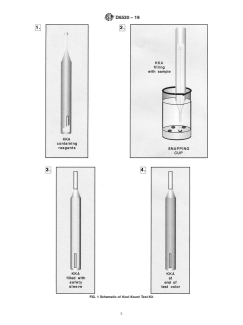
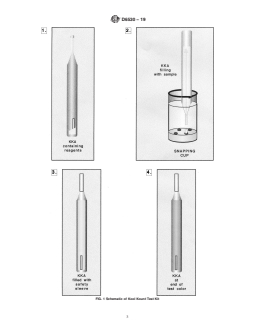
7.1 The schematic arrangement of the KKA test kit is shown in Fig. 1.
7.2 (Parts) of the KKA Test K—Vial A (test vial), vial under vacuum containing nutrient and reagent on glass rod; Vial B (control
vial), vial under vacuum containing nutrient only (does not contain a glass rod); snapping cup; and plastic safety sleeve.
8. Reagents and Materials
8.1 Purity of Reagents—Reagent grade chemicals shall be used in all tests. Unless otherwise indicated, it is intended that all
reagents shall conform to the specifications of the Committee on Analytical Reagents of the American Chemical Society where
D6530 − 19
FIG. 1 Schematic of Kool Kount Test Kit
D6530 − 19
such specifications are available. Other grades may be used, provided it is first ascertained that the reagent is of sufficiently high
purity to permit its use without lessening the accuracy of the determination.
8.2 Purity of Water—Unless otherwise indicated, references to water shall be understood to mean reagent water as defined by
Type III of Specification D1193.
8.3 Reagents—Kool Kount Test Kit: Fischer Scientific, Cole Parmer, Calgon, Sodium thiosulfate: [Na O S ]
2 3 2
9. Precautions
9.1 Precautions should be taken when snapping the glass tip from the glass vial containing the reagents. The tip must be
submerged for the vial to completely fill as a result of the vacuum in the vial. A protective sleeve is provided with the kit to cover
any rough glass edges on the neck of the vial during incubation.
10. Sampling
10.1 Collect the sample in accordance with SpecificationGuide D1192, and Practices D3370 as applicable.
11. Procedure
11.1 Rinse snapping cup at least twice with watersample to be tested. Place a
...
Questions, Comments and Discussion
Ask us and Technical Secretary will try to provide an answer. You can facilitate discussion about the standard in here.
Loading comments...