

ASTM D5305-23
(Test Method)Standard Test Method for Determination of Ethyl Mercaptan in LP-Gas Vapor
General Information
- Abstract
SIGNIFICANCE AND USE
5.1 LP-gas is colorless and odorless, and not detectable by normal human senses. To provide an olfactory warning in the event of a leak, LP-gas intended for domestic or commercial fuel use is intentionally odorized so as to be readily detectable well below flammable or suffocating concentration levels of LP-gas in air. (See Appendix X1 for important explanations.) The most common odorant for LP-gas is ethyl mercaptan. The field use of this test method will rapidly determine the presence and concentration of ethyl mercaptan in LP-gas vapor without the necessity for complex laboratory equipment.
SCOPE
1.1 This test method describes a rapid and simple procedure using length-of-stain tubes for field measurement of ethyl mercaptan in the vapor phase of LP-gas systems. Although length-of-stain tubes are available to detect ethyl mercaptan concentrations in the range of 0.5 to 120 parts per million by volume, this test method is specifically applicable to systems containing 5 ppm by volume or more of ethyl mercaptan in LP-gas vapors.
Note 1: A chromatographic technique can be used for more precise, quantitative determination of ethyl mercaptan in LP-gas.
1.2 The values stated in SI units are to be regarded as standard. The values given in parentheses after SI units are provided for information only and are not considered standard.
1.3 This standard does not purport to address all of the safety concerns, if any, associated with its use. It is the responsibility of the user of this standard to establish appropriate safety, health, and environmental practices and determine the applicability of regulatory limitations prior to use.
1.4 This international standard was developed in accordance with internationally recognized principles on standardization established in the Decision on Principles for the Development of International Standards, Guides and Recommendations issued by the World Trade Organization Technical Barriers to Trade (TBT) Committee.
- Status
- Published
- Publication Date
- 28-Feb-2023
- Technical Committee
- D02 - Petroleum Products, Liquid Fuels, and Lubricants
- Drafting Committee
- D02.H0 - Liquefied Petroleum Gas
Overview
ASTM D5305-23 specifies the standard test method for the determination of ethyl mercaptan in LP-gas vapor. Ethyl mercaptan is a commonly used odorant in liquefied petroleum gas (LPG or LP-gas) to provide a distinct olfactory warning in case of leaks since LP-gas is inherently colorless and odorless. This test method describes a rapid and straightforward field procedure using length-of-stain detector tubes to measure ethyl mercaptan concentrations in the vapor phase of LP-gas systems, applicable primarily for levels at or above 5 parts per million by volume (ppm).
Key Topics
- Purpose of Ethyl Mercaptan in LP-Gas: Ethyl mercaptan is added to LP-gas to ensure leaks can be detected well before concentrations become hazardous. Adequate odorization is a critical safety measure for both domestic and commercial applications.
- Field Measurement: The test method enables quick, on-site determination of ethyl mercaptan levels in LPG vapor without the need for complex laboratory equipment. This helps facilities comply with odorization requirements and safety standards.
- Applicable Concentration Range: Although detector tubes can measure from 0.5 to 120 ppm, ASTM D5305-23 focuses on the effective and reliable detection when concentrations are 5 ppm or higher.
- Procedure Overview: LP-gas vapor is drawn through a calibrated detector tube using a manual vacuum pump. The length of the color change in the tube is proportional to the ethyl mercaptan concentration and is compared to the provided calibration scale.
- Interferences: The method cautions against possible interferences, such as those from methyl mercaptan or propylene (propene), and recommends using appropriately calibrated tubes and following manufacturer instructions.
- Equilibrium Considerations: The accuracy of the result rests on vapor phase ethyl mercaptan being in equilibrium with the liquid phase. Excessive venting or recent vapor withdrawal may skew results.
Applications
- LPG Distribution and Storage: Used by LPG distributors, storage facilities, and regulatory inspectors to confirm that LP-gas is sufficiently odorized before distribution or use.
- Safety Compliance: Helps organizations comply with regulatory requirements, such as those established by NFPA 58 in the United States, which mandate the detectability of odorants in LPG.
- Leak Detection Readiness: By measuring ethyl mercaptan levels in vapor phase, this method ensures that, in the event of a leak, the gas can be detected by smell at concentrations significantly below hazardous thresholds.
- Routine Maintenance and Quality Assurance: Supports routine inspection protocols and quality control in LPG handling and storage operations.
- Field Testing: The test method is especially valuable for field scenarios where laboratory analysis is not practical or available.
Related Standards
- ASTM D4175: Terminology Relating to Petroleum Products, Liquid Fuels, and Lubricants - provides key definitions for consistent interpretation.
- NFPA 58: Standard for the Storage and Handling of Liquefied Petroleum Gases - outlines requirements for odorization and safety practices.
- CAN/CGSB-3.0 No. 18.5: Test Method for Ethyl Mercaptan Odorant in Propane, Field Method - a comparable Canadian standard focused on liquid phase testing.
Keywords: ASTM D5305-23, ethyl mercaptan, LP-gas vapor, LPG odorization, field test, safety compliance, detector tube, NFPA 58, liquefied petroleum gas, odorant concentration, leak detection.
Relations
- Refers
ASTM D4175-23a - Standard Terminology Relating to Petroleum Products, Liquid Fuels, and Lubricants - Effective Date
- 15-Dec-2023
- Refers
ASTM D4175-23e1 - Standard Terminology Relating to Petroleum Products, Liquid Fuels, and Lubricants - Effective Date
- 01-Jul-2023
Get Certified
Connect with accredited certification bodies for this standard

Element Materials Technology
Materials testing and product certification.

ABS Group Brazil
ABS Group certification services in Brazil.

ABS Quality Evaluations Inc.
American Bureau of Shipping quality certification.
Sponsored listings
Frequently Asked Questions
ASTM D5305-23 is a standard published by ASTM International. Its full title is "Standard Test Method for Determination of Ethyl Mercaptan in LP-Gas Vapor". This standard covers: SIGNIFICANCE AND USE 5.1 LP-gas is colorless and odorless, and not detectable by normal human senses. To provide an olfactory warning in the event of a leak, LP-gas intended for domestic or commercial fuel use is intentionally odorized so as to be readily detectable well below flammable or suffocating concentration levels of LP-gas in air. (See Appendix X1 for important explanations.) The most common odorant for LP-gas is ethyl mercaptan. The field use of this test method will rapidly determine the presence and concentration of ethyl mercaptan in LP-gas vapor without the necessity for complex laboratory equipment. SCOPE 1.1 This test method describes a rapid and simple procedure using length-of-stain tubes for field measurement of ethyl mercaptan in the vapor phase of LP-gas systems. Although length-of-stain tubes are available to detect ethyl mercaptan concentrations in the range of 0.5 to 120 parts per million by volume, this test method is specifically applicable to systems containing 5 ppm by volume or more of ethyl mercaptan in LP-gas vapors. Note 1: A chromatographic technique can be used for more precise, quantitative determination of ethyl mercaptan in LP-gas. 1.2 The values stated in SI units are to be regarded as standard. The values given in parentheses after SI units are provided for information only and are not considered standard. 1.3 This standard does not purport to address all of the safety concerns, if any, associated with its use. It is the responsibility of the user of this standard to establish appropriate safety, health, and environmental practices and determine the applicability of regulatory limitations prior to use. 1.4 This international standard was developed in accordance with internationally recognized principles on standardization established in the Decision on Principles for the Development of International Standards, Guides and Recommendations issued by the World Trade Organization Technical Barriers to Trade (TBT) Committee.
SIGNIFICANCE AND USE 5.1 LP-gas is colorless and odorless, and not detectable by normal human senses. To provide an olfactory warning in the event of a leak, LP-gas intended for domestic or commercial fuel use is intentionally odorized so as to be readily detectable well below flammable or suffocating concentration levels of LP-gas in air. (See Appendix X1 for important explanations.) The most common odorant for LP-gas is ethyl mercaptan. The field use of this test method will rapidly determine the presence and concentration of ethyl mercaptan in LP-gas vapor without the necessity for complex laboratory equipment. SCOPE 1.1 This test method describes a rapid and simple procedure using length-of-stain tubes for field measurement of ethyl mercaptan in the vapor phase of LP-gas systems. Although length-of-stain tubes are available to detect ethyl mercaptan concentrations in the range of 0.5 to 120 parts per million by volume, this test method is specifically applicable to systems containing 5 ppm by volume or more of ethyl mercaptan in LP-gas vapors. Note 1: A chromatographic technique can be used for more precise, quantitative determination of ethyl mercaptan in LP-gas. 1.2 The values stated in SI units are to be regarded as standard. The values given in parentheses after SI units are provided for information only and are not considered standard. 1.3 This standard does not purport to address all of the safety concerns, if any, associated with its use. It is the responsibility of the user of this standard to establish appropriate safety, health, and environmental practices and determine the applicability of regulatory limitations prior to use. 1.4 This international standard was developed in accordance with internationally recognized principles on standardization established in the Decision on Principles for the Development of International Standards, Guides and Recommendations issued by the World Trade Organization Technical Barriers to Trade (TBT) Committee.
ASTM D5305-23 is classified under the following ICS (International Classification for Standards) categories: 75.160.30 - Gaseous fuels. The ICS classification helps identify the subject area and facilitates finding related standards.
ASTM D5305-23 has the following relationships with other standards: It is inter standard links to ASTM D4175-23a, ASTM D4175-23e1. Understanding these relationships helps ensure you are using the most current and applicable version of the standard.
ASTM D5305-23 is available in PDF format for immediate download after purchase. The document can be added to your cart and obtained through the secure checkout process. Digital delivery ensures instant access to the complete standard document.
Standards Content (Sample)
This international standard was developed in accordance with internationally recognized principles on standardization established in the Decision on Principles for the
Development of International Standards, Guides and Recommendations issued by the World Trade Organization Technical Barriers to Trade (TBT) Committee.
Designation: D5305 − 23
Standard Test Method for
Determination of Ethyl Mercaptan in LP-Gas Vapor
This standard is issued under the fixed designation D5305; the number immediately following the designation indicates the year of
original adoption or, in the case of revision, the year of last revision. A number in parentheses indicates the year of last reapproval. A
superscript epsilon (´) indicates an editorial change since the last revision or reapproval.
1. Scope* 3. Terminology
1.1 This test method describes a rapid and simple procedure
3.1 Definitions:
using length-of-stain tubes for field measurement of ethyl
3.1.1 For definitions of terms used in this test method, refer
mercaptan in the vapor phase of LP-gas systems. Although to Terminology D4175.
length-of-stain tubes are available to detect ethyl mercaptan
3.1.2 liquefied petroleum gas (LP Gas, LPG), n—a narrow
concentrations in the range of 0.5 to 120 parts per million by boiling range mixture of hydrocarbons consisting of propane,
volume, this test method is specifically applicable to systems
propylene, butanes and butylenes, individually or in specified
containing 5 ppm by volume or more of ethyl mercaptan in combinations, with limited amounts of other hydrocarbons
LP-gas vapors.
(such as ethane) and may contain naturally occurring,
petroleum-derived, non-hydrocarbons.
NOTE 1—A chromatographic technique can be used for more precise,
quantitative determination of ethyl mercaptan in LP-gas.
4. Summary of Test Method
1.2 The values stated in SI units are to be regarded as
4.1 Using a manually-operated vacuum pump, a sample of
standard. The values given in parentheses after SI units are
LP-gas from the vapor space of an LP-gas cylinder, storage
provided for information only and are not considered standard.
tank or other closed containment system is drawn through a
1.3 This standard does not purport to address all of the
detector tube made specifically for detection of ethyl mercap-
safety concerns, if any, associated with its use. It is the
tan. The length-of-stain (color change) produced in the detector
responsibility of the user of this standard to establish appro-
tube when exposed to a measured volume of sample is directly
priate safety, health, and environmental practices and deter-
proportional to the amount of ethyl mercaptan present in the
mine the applicability of regulatory limitations prior to use.
sample being tested. The length-of-stain produced in the
1.4 This international standard was developed in accor-
detector tube is converted to concentration, in parts per million
dance with internationally recognized principles on standard-
by volume, by comparison with a calibration scale provided by
ization established in the Decision on Principles for the
the manufacturer of the stain tube.
Development of International Standards, Guides and Recom-
mendations issued by the World Trade Organization Technical
5. Significance and Use
Barriers to Trade (TBT) Committee.
5.1 LP-gas is colorless and odorless, and not detectable by
normal human senses. To provide an olfactory warning in the
2. Referenced Documents
2 event of a leak, LP-gas intended for domestic or commercial
2.1 ASTM Standards:
fuel use is intentionally odorized so as to be readily detectable
D4175 Terminology Relating to Petroleum Products, Liquid
well below flammable or suffocating concentration levels of
Fuels, and Lubricants
3 LP-gas in air. (See Appendix X1 for important explanations.)
2.2 NFPA Standard:
The most common odorant for LP-gas is ethyl mercaptan. The
NFPA 58 Standard for the Storage and Handling of Liquefied
field use of this test method will rapidly determine the presence
Petroleum Gases
and concentration of ethyl mercaptan in LP-gas vapor without
the necessity for complex laboratory equipment.
This test method is under the jurisdiction of ASTM Committee D02 on
Petroleum Products, Liquid Fuels, and Lubricants and is the direct responsibility of
6. Interferences
Subcommittee D02.H0 on Liquefied Petroleum Gas.
Current edition approved March 1, 2023. Published March 2023. Originally
6.1 Detector tubes can be subject to interferences from
ɛ1
approved in 1992. Last previous edition approved in 2018 as D5305 – 18 . DOI:
materials other than the target substance. Methyl mercaptan
10.1520/D5305-23.
will likely interfere with tubes designed to measure ethyl
For referenced ASTM standards, visit the ASTM website, www.astm.org, or
contact ASTM Customer Service at service@astm.org. For Annual Book of ASTM
mercaptan. Because of different detection chemistry by differ-
Standards volume information, refer to the standard’s Document Summary page on
ent manufacturers, interferences can vary. Consult the manu-
the ASTM website.
facturer’s instructions for specific interference information and
Available from National Fire Protection Association (NFPA), 1 Batterymarch
Park, Quincy, MA 02169-7471, http://www.nfpa.org. observe any instructions given.
*A Summary of Changes section appears at the end of this standard
Copyright © ASTM International, 100 Barr Harbor Drive, PO Box C700, West Conshohocken, PA 19428-2959. United States
D5305 − 23
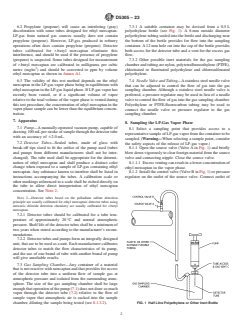
6.2 Propylene (propene) will cause an interfering (gray) 7.3.1 A suitable container may be devised from a 0.5 L
discoloration with some tubes designed for ethyl mercaptan. polyethylene bottle (see Fig. 1). A 6 mm outside diameter
LP-gas from natural gas sources usually does not contain polyethylene tubing sealed into the bottle and discharging near
propylene (propene). However, LP-gas produced in refinery the bottom of the bottle provides for flow into the sampling
operations often does contain propylene (propene). Detector container. A 12 mm hole cut into the cap of the bottle provides
tubes calibrated for t-butyl mercaptan eliminate this both access for the detector tube and a vent for the excess gas
interference, and should be used if the presence of propylene flow.
(propene) is suspected. Some tubes designed for measurement 7.3.2 Other possible inert materials for the gas sampling
of t-butyl mercaptan are calibrated in milligrams per cubic chamber and tubing are nylon, polytetrafluoroethylene (PTFE),
metre (mg/m ) and should be converted to ppm by volume chlorinated or fluorinated polyethylene and chlorosulfonated
ethyl mercaptan as shown in Annex A1. polyethylene.
6.3 The validity of this test method depends on the ethyl
7.4 Needle Valve and Tubing—A stainless steel needle valve
mercaptan in the LP-gas vapor phase being in equilibrium with that can be adjusted to control the flow of gas into the gas
ethyl mercaptan in the LP-gas liquid phase. If LP-gas vapor has
sampling chamber. Although a stainless steel needle valve is
recently been vented, or if a significant volume of vapor preferred, a pressure regulator may be used in lieu of a needle
relative to the total volume of the vapor phase is vented during valve to control the flow of gas into the gas sampling chamber.
this test procedure, the concentration of ethyl mercaptan in the Polyethylene or PTFE-fluorocarbon tubing may be used to
vapor phase sample can be lower than the equilibrium concen- connect the needle valve or pressure regulator to the gas
tration.
sampling chamber.
7. Apparatus
8. Sampling the LP-Gas Vapor Phase
7.1 Pump—A manually-operated vacuum pump, capable of
8.1 Select a sampling point that provides access to a
drawing 100 mL per stroke of sample through the detector tube
representative sample of LP-gas vapor from the container to be
with an accuracy of 62.0 mL.
sampled. (Warning—When selecting a sample point, consider
7.2 Detector Tubes—Sealed tubes, made of glass with
the safety aspects of the release of LP-gas vapor.)
break-off tips sized to fit the orifice of the pump used (tubes 8.1.1 Open the source valve (Valve A in Fig. 1) and briefly
and pumps from different manufacturers shall not be inter-
blow down vigorously to clear foreign material from the source
changed). The tube used shall be appropriate for the determi-
valve and connecting nipple. Close the source valve.
nation of ethyl mercaptan and shall produce a distinct color
8.1.1.1 Excess venting can result in a lower concentration of
change when exposed to a sample of LP-gas containing ethyl
ethyl mercaptan in the vapor phase.
mercaptan. Any substance known to interfere shall be listed in 8.1.2 Install the control valve (Valve B in Fig. 1) or pressure
instructions accompanying the tubes. A calibration scale or
regulator on the outlet of the source valve. Connect outlet of
other markings referenced to a scale shall be etched directly on
the tube to allow direct interpretation of ethyl mercaptan
concentration. See Note 2.
NOTE 2—Detector tubes based on the palladium sulfate detection
principle are usually calibrated for ethyl mercaptan; detector tubes using
mercuric chloride detection chemistry are usually calibrated for t-butyl
mercaptan.
7.2.1 Detector tubes should be calibrated for a tube tem-
perature of approximately 20 °C and normal atmospheric
pressure. Shelf life of the detector tubes shall be a minimum of
two years when stored according to the manufacturer’s recom-
mendations.
7.2.2 Detector tubes and pumps form an integrally designed
unit, that are to be used as a unit. Each manufacturer calibrates
detector tubes to match the flow characteristics of its pump,
and the use of one brand of tube with another brand of pump
will give unreliable results.
7.3 Gas Sampling Chamber—Any container of a material
that is not reactive with mercaptan and that provides for access
of the detector tube into a uniform flow of sample gas at
atmospheric pressure and isolated from the surrounding atmo-
sphere. The size of the gas sampling chamber shall be large
enough that operation of the pump (7.1) does not draw so much
vapor through the detector tube (7.2) relative to the flow of
sample vapor that atmospheric air is sucked into the sample
chamber, diluting the sample being tested (see 8.1.3.2). FIG. 1 Half Litre Polyethylene or Other Inert Bottle
D5305 − 23
the control valve to the gas sampling chamber using the corrected ethyl mercaptan concentration (1)
shortest length practicable of suitable tubing.
5scale reading×~specified strokes/actual strokes!
8.1.3 Open the source valve and then the control valve to
obtain a slight positive flow through the gas sampling chamber,
11.2 Some detector tubes that may be used in this test
venting to atmosphere through the tube access and vent (Vent
method may be calibrated for other mercaptans in milligrams
3 3
C in Fig. 1).
per cubic metre (mg/m ). Perform the conversion from mg/m
8.1.3.1 Purged gas shall be vented at a suitable rate so that
of t-butyl mercaptan to ppm by volume of ethyl mercaptan as
pressure does not build up in the sampling chamber and
documented in Annex A1.
increase the flow rate through the detector tube.
11.3 Correct the reading for barometric pressure, especially
8.1.3.2 Conversely, the positive flow of LP-gas vapor shall
at high altitudes. For details of this correction, see Annex A1.
be sufficient so that operation of the detector tube pump does
not pull ambient air into the gas sampling chamber which
11.4 Readings of concentrations below 5 ppm by volume
would dilute the LP-gas vapor.
may not be reliable, and may warrant further investigation.
8.1.4 Purge the gas sampling chamber for at least 3 min to
(See Appendix X2.)
displace air.
8.1.5 Maintain flow of LP-gas during the test procedure in NOTE 3—This test method is a direct measure of the concentration of
ethyl mercaptan in the vapor phase of LP-gas. If the temperature of the
Section 10.
system is known, results can be used to obtain an approximation of the
concentration of ethyl mercaptan in the liquid phase. (See Appendix X1.)
9. Preparation of Apparatus
9.1 Before sampling, all sampling equipment should be
12. Report
thoroughly clean and dry.
12.1 Report the observed tube reading and corrected con-
9.2 Immediately before each series of tests, test the pump
centration of ethyl mercaptan in parts per million by volume to
for leak-free operation in accordance with manufacturer’s
the nearest 0.5 ppm by volume, and reference this test method.
instructions. A loss in vacuum on the pump within 60 s
indicates a leak. If a leak occurs, follow the pump manufac-
13. Precision and Bias
turer’s instructions for resealing the pump and retest. If the
pump vacuum cannot be maintained
...
This document is not an ASTM standard and is intended only to provide the user of an ASTM standard an indication of what changes have been made to the previous version. Because
it may not be technically possible to adequately depict all changes accurately, ASTM recommends that users consult prior editions as appropriate. In all cases only the current version
of the standard as published by ASTM is to be considered the official document.
´1
Designation: D5305 − 18 D5305 − 23
Standard Test Method for
Determination of Ethyl Mercaptan in LP-Gas Vapor
This standard is issued under the fixed designation D5305; the number immediately following the designation indicates the year of
original adoption or, in the case of revision, the year of last revision. A number in parentheses indicates the year of last reapproval. A
superscript epsilon (´) indicates an editorial change since the last revision or reapproval.
ε NOTE—Editorially corrected 7.3 in December 2020.
1. Scope*
1.1 This test method describes a rapid and simple procedure using length-of-stain tubes for field measurement of ethyl mercaptan
in the vapor phase of LP-gas systems. Although length-of-stain tubes are available to detect ethyl mercaptan concentrations in the
range of 0.5 to 120 parts per million by volume, this test method is specifically applicable to systems containing 5 ppm by volume
or more of ethyl mercaptan in LP-gas vapors.
NOTE 1—A chromatographic technique can be used for more precise, quantitative determination of ethyl mercaptan in LP-gas.
1.2 The values stated in SI units are to be regarded as standard. The values given in parentheses after SI units are provided for
information only and are not considered standard.
1.3 This standard does not purport to address all of the safety concerns, if any, associated with its use. It is the responsibility
of the user of this standard to establish appropriate safety, health, and environmental practices and determine the applicability of
regulatory limitations prior to use.
1.4 This international standard was developed in accordance with internationally recognized principles on standardization
established in the Decision on Principles for the Development of International Standards, Guides and Recommendations issued
by the World Trade Organization Technical Barriers to Trade (TBT) Committee.
2. Referenced Documents
2.1 ASTM Standards:
D4175 Terminology Relating to Petroleum Products, Liquid Fuels, and Lubricants
2.2 NFPA Standard:
NFPA 58 Standard for the Storage and Handling of Liquefied Petroleum Gases
3. Terminology
3.1 Abbreviations:Definitions:
3.1.1 EM—ethyl mercaptan
This test method is under the jurisdiction of ASTM Committee D02 on Petroleum Products, Liquid Fuels, and Lubricants and is the direct responsibility of Subcommittee
D02.H0 on Liquefied Petroleum Gas.
Current edition approved April 1, 2018March 1, 2023. Published May 2018March 2023. Originally approved in 1992. Last previous edition approved in 20122018 as
ɛ1
D5305 – 12.D5305 – 18 . DOI: 10.1520/D5305-18E01.10.1520/D5305-23.
For referenced ASTM standards, visit the ASTM website, www.astm.org, or contact ASTM Customer Service at service@astm.org. For Annual Book of ASTM Standards
volume information, refer to the standard’s Document Summary page on the ASTM website.
Available from National Fire Protection Association (NFPA), 1 Batterymarch Park, Quincy, MA 02169-7471, http://www.nfpa.org.
*A Summary of Changes section appears at the end of this standard
Copyright © ASTM International, 100 Barr Harbor Drive, PO Box C700, West Conshohocken, PA 19428-2959. United States
D5305 − 23
3.1.1 For definitions of terms used in this test method, refer to Terminology D4175.
3.1.2 LP-Gas, LPG—liquefied petroleum gas (LP Gas, LPG), n—liquefied petroleum gasa narrow boiling range mixture of
hydrocarbons consisting of propane, propylene, butanes and butylenes, individually or in specified combinations, with limited
amounts of other hydrocarbons (such as ethane) and may contain naturally occurring, petroleum-derived, non-hydrocarbons.
3.1.3 PTFE—polytetrafluoroethylene
3.1.4 TBM—t-butyl mercaptan
4. Summary of Test Method
4.1 Using a manually-operated vacuum pump, a sample of LP-gas from the vapor space of an LP-gas cylinder, storage tank or
other closed containment system is drawn through a detector tube made specifically for detection of ethyl mercaptan. The
length-of-stain (color change) produced in the detector tube when exposed to a measured volume of sample is directly proportional
to the amount of ethyl mercaptan present in the sample being tested. The length-of-stain produced in the detector tube is converted
to concentration, in parts per million by volume, by comparison with a calibration scale provided by the manufacturer of the stain
tube.
5. Significance and Use
5.1 LP-gas is colorless and odorless, and not detectable by normal human senses. To provide an olfactory warning in the event
of a leak, LP-gas intended for domestic or commercial fuel use is intentionally odorized so as to be readily detectable well below
flammable or suffocating concentration levels of LP-gas in air. (See Appendix X1 for important explanations.) The most common
odorant for LP-gas is ethyl mercaptan. The field use of this test method will rapidly determine the presence and concentration of
ethyl mercaptan in LP-gas vapor without the necessity for complex laboratory equipment.
6. Interferences
6.1 Detector tubes can be subject to interferences from materials other than the target substance. Methyl mercaptan will likely
interfere with tubes designed to measure ethyl mercaptan. Because of different detection chemistry by different manufacturers,
interferences can vary. Consult the manufacturer’s instructions for specific interference information and observe any instructions
given.
6.2 Propylene (propene) will cause an interfering (gray) discoloration with some tubes designed for ethyl mercaptan. LP-gas from
natural gas sources usually does not contain propylene (propene). However, LP-gas produced in refinery operations often does
contain propylene (propene). Detector tubes calibrated for t-butyl mercaptan eliminate this interference, and should be used if the
presence of propylene (propene) is suspected. Some tubes designed for measurement of t-butyl mercaptan are calibrated in
milligrams per cubic metre (mg/m ) and should be converted to ppm by volume ethyl mercaptan as shown in Annex A1.
6.3 The validity of this test method depends on the ethyl mercaptan in the LP-gas vapor phase being in equilibrium with ethyl
mercaptan in the LP-gas liquid phase. If LP-gas vapor has recently been vented, or if a significant volume of vapor relative to the
total volume of the vapor phase is vented during this test procedure, the concentration of ethyl mercaptan in the vapor phase sample
can be lower than the equilibrium concentration.
7. Apparatus
7.1 Pump—A manually-operated vacuum pump, capable of drawing 100 mL per stroke of sample through the detector tube with
an accuracy of 62.0 mL.
7.2 Detector Tubes—Sealed tubes, made of glass with break-off tips sized to fit the orifice of the pump used (tubes and pumps from
different manufacturers shall not be interchanged). The tube used shall be appropriate for the determination of ethyl mercaptan and
shall produce a distinct color change when exposed to a sample of LP-gas containing ethyl mercaptan. Any substance known to
interfere shall be listed in instructions accompanying the tubes. A calibration scale or other markings referenced to a scale shall
be etched directly on the tube to allow direct interpretation of ethyl mercaptan concentration. See Note 2.
D5305 − 23
NOTE 2—Detector tubes based on the palladium sulfate detection principle are usually calibrated for ethyl mercaptan; detector tubes using mercuric
chloride detection chemistry are usually calibrated for t-butyl mercaptan.
7.2.1 Detector tubes should be calibrated for a tube temperature of approximately 20 °C and normal atmospheric pressure. Shelf
life of the detector tubes shall be a minimum of two years when stored according to the manufacturer’s recommendations.
7.2.2 Detector tubes and pumps form an integrally designed unit, that are to be used as a unit. Each manufacturer calibrates
detector tubes to match the flow characteristics of its pump, and the use of one brand of tube with another brand of pump will give
unreliable results.
7.3 Gas Sampling Chamber—Any container of a material that is not reactive with mercaptan and that provides for access of the
detector tube into a uniform flow of sample gas at atmospheric pressure and isolated from the surrounding atmosphere. The size
of the gas sampling chamber shall be large enough that operation of the pump (7.1) does not draw so much vapor through the
detector tube (7.2) relative to the flow of sample vapor that atmospheric air is sucked into the sample chamber, diluting the sample
being tested (see 8.1.3.2).
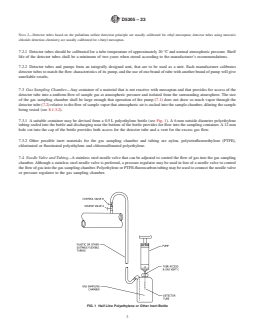
7.3.1 A suitable container may be devised from a 0.5 L polyethylene bottle (see Fig. 1). A 6 mm outside diameter polyethylene
tubing sealed into the bottle and discharging near the bottom of the bottle provides for flow into the sampling container. A 12 mm
hole cut into the cap of the bottle provides both access for the detector tube and a vent for the excess gas flow.
7.3.2 Other possible inert materials for the gas sampling chamber and tubing are nylon, polytetrafluoroethylene (PTFE),
chlorinated or fluorinated polyethylene and chlorosulfonated polyethylene.
7.4 Needle Valve and Tubing—A stainless steel needle valve that can be adjusted to control the flow of gas into the gas sampling
chamber. Although a stainless steel needle valve is preferred, a pressure regulator may be used in lieu of a needle valve to control
the flow of gas into the gas sampling chamber. Polyethylene or PTFE-fluorocarbon tubing may be used to connect the needle valve
or pressure regulator to the gas sampling chamber.
FIG. 1 Half Litre Polyethylene or Other Inert Bottle
D5305 − 23
8. Sampling the LP-Gas Vapor Phase
8.1 Select a sampling point that provides access to a representative sample of LP-gas vapor from the container to be sampled.
(Warning—When selecting a sample point, consider the safety aspects of the release of LP-gas vapor.)
8.1.1 Open the source valve (Valve A in Fig. 1) and briefly blow down vigorously to clear foreign material from the source valve
and connecting nipple. Close the source valve.
8.1.1.1 Excess venting can result in a lower concentration of ethyl mercaptan in the vapor phase.
8.1.2 Install the control valve (Valve B in Fig. 1) or pressure regulator on the outlet of the source valve. Connect outlet of the
control valve to the gas sampling chamber using the shortest length practicable of suitable tubing.
8.1.3 Open the source valve and then the control valve to obtain a slight positive flow through the gas sampling chamber, venting
to atmosphere through the tube access and vent (Vent C in Fig. 1).
8.1.3.1 Purged gas shall be vented at a suitable rate so that pressure does not build up in the sampling chamber and increase the
flow rate through the detector tube.
8.1.3.2 Conversely, the positive flow of LP-gas vapor shall be sufficient so that operation of the detector tube pump does not pull
ambient air into the gas sampling chamber which would dilute the LP-gas vapor.
8.1.4 Purge the gas sampling chamber for at least 3 min to displace air.
8.1.5 Maintain flow of LP-gas during the test procedure in Section 10.
9. Preparation of Apparatus
9.1 Before sampling, all sampling equipment should be thoroughly clean and dry.
9.2 Immediately before each series of tests, test the pump for leak-free operation in accordance with manufacturer’s instructions.
A loss in vacuum on the pump within 60 s indicates a leak. If a leak occurs, follow the pump manufacturer’s instructions for
resealing the pump and retest. If the pump vacuum cannot be maintained, do not use the pump for testing.
10. Procedure
10.1 Select the tube range that includes the expected concentration of ethyl mercaptan present in the sample. Reading accuracy
is improved when the stain extends at least one-half of the tube length. Consider multiple strokes or a lower range tube, or both,
to achieve this length of stain.
10.2 Break off both tips of the glass stain tube and insert the outlet of the tube (indicated by arrow in direction of flow) snugly
into the pump head. Temperature of tube shall be maintained in the 0 °C to 40 °C range throughout the test.
10.3 Insert the detector tube well into the gas sampling chamber through the tube access and vent (Vent C).
10.4 Operate the pump to draw a measured amount of sample through the detector tube. Within any limits set by the
manufacturer’s instructions, use multiple strokes to achieve a stain extending to approximately one-half the tube length.
10.5 Remove the tube from the pump and follow the manufacturer’s instructions if further handling of the tube is necessary.
10.6 Within 30 s, read the concentrati
...