

ASTM D7995-19
(Test Method)Standard Test Method for Total Water in Liquid Butane by Liquefied Gas Sampler and Coulometric Karl Fischer Titration
General Information
- Abstract
SIGNIFICANCE AND USE
5.1 High water concentrations can have a detrimental effect on the many uses of liquefied petroleum gas (LPG). Wet butane, propane, and other low molecular weight hydrocarbon products can cause operational issues in customer equipment and downstream processes. Water can cause corrosion problems and create safety hazards during the storage, distribution and use of liquefied petroleum gas (LPG) and pressurized low molecular weight hydrocarbon samples.
5.2 While the dryness of propane may be monitored with a “functional” test such as the valve freeze Test Method D2713, this test method provides an analytical method to directly measure water content in LPG and pressurized low molecular weight hydrocarbons and their mixtures.
SCOPE
1.1 This test method describes the use of a specialized liquefied gas sampler coupled to a coulometric Karl Fischer (KF) titrator for the determination of water in liquid butane with water concentrations from 1 mg/kg to 100 mg/kg.
Note 1: Other liquefied petroleum gases described in Specification D1835 including propane, propene (propylene), butylenes and mixtures of these materials and other light hydrocarbons, and dimethyl ether described in Specification D7901, can be analyzed by this method but the precision has not been studied and therefore the stated precision has not been validated for these materials.
1.2 The values stated in SI units are to be regarded as standard. The values given in parentheses after SI units are provided for information only and are not considered standard.
1.3 This standard does not purport to address all of the safety concerns, if any, associated with its use. It is the responsibility of the user of this standard to establish appropriate safety, health, and environmental practices and determine the applicability of regulatory limitations prior to use. See Section 10 for specific warning statements.
1.4 This international standard was developed in accordance with internationally recognized principles on standardization established in the Decision on Principles for the Development of International Standards, Guides and Recommendations issued by the World Trade Organization Technical Barriers to Trade (TBT) Committee.
- Status
- Published
- Publication Date
- 14-Jul-2019
- Technical Committee
- D02 - Petroleum Products, Liquid Fuels, and Lubricants
- Drafting Committee
- D02.H0 - Liquefied Petroleum Gas
Overview
ASTM D7995-19: Standard Test Method for Total Water in Liquid Butane by Liquefied Gas Sampler and Coulometric Karl Fischer Titration is a globally recognized standard developed by ASTM International. This test method specifies the procedure for accurately determining total water content in liquid butane using a combination of a specialized liquefied gas sampler and coulometric Karl Fischer titration. High water concentrations in liquefied petroleum gas (LPG) and related products can result in operational disruptions, equipment corrosion, and significant safety concerns during storage, distribution, and end-use. By providing a direct and analytical approach to water measurement, ASTM D7995-19 helps industry professionals ensure the quality and safety of LPG and low molecular weight hydrocarbon products.
Key Topics
- Significance of Water Measurement in LPG:
Water contamination in LPG, such as liquid butane or propane, can lead to corrosion, equipment malfunction, freezing issues, and increased safety risks due to the formation of hydrates or corrosion byproducts. - Test Method Description:
The standard details a method where a pressurized sample of liquid butane is introduced into a liquefied gas sampler, fully vaporized, and then carried into a coulometric Karl Fischer titrator for water quantification. The method covers a water concentration range of 1 to 100 mg/kg. - Analytical Precision:
This procedure enables direct measurement of water in LPG, overcoming limitations of functional tests and improving the reliability of quality control in hydrocarbon sampling. - Equipment and Safety Precautions:
The use of pressurized, flammable LPG samples requires specialized, rated equipment for sampling and transfer, as well as strict adherence to safety, health, and environmental practices. - Applicability to Other Hydrocarbons:
While validated for liquid butane, the method can also be applied to propane, propene (propylene), butylenes, their mixtures, and dimethyl ether as described in related ASTM specifications, although precision data for these substances is not fully established.
Applications
- LPG Production and Distribution:
The standard is essential for producers and distributors of liquid butane and LPG, allowing them to maintain strict moisture control to reduce the risk of corrosion and ensure compliance with safety standards throughout the supply chain. - Quality Assurance in Petrochemical Industries:
Laboratories and refineries use this method for routine quality control, particularly where direct measurement of water in pressurized samples is required. This helps avoid operational problems linked to water contamination. - Regulatory Compliance:
Compliance with ASTM D7995-19 supports adherence to industry regulations and international trade requirements, including those set by the WTO Technical Barriers to Trade (TBT) Committee. - Safety Management:
Implementation of this method helps prevent equipment failure and safety incidents associated with water-laden LPG, especially in cold climates or sensitive applications.
Related Standards
Professionals working with ASTM D7995-19 may also reference the following related standards for comprehensive quality control and safer handling of LPG and hydrocarbon products:
- ASTM D1265: Practice for Sampling Liquefied Petroleum (LP) Gases, Manual Method
- ASTM D1835: Specification for Liquefied Petroleum (LP) Gases
- ASTM D2713: Test Method for Dryness of Propane (Valve Freeze Method)
- ASTM D3700: Practice for Obtaining LPG Samples Using a Floating Piston Cylinder
- ASTM D6304: Test Method for Determination of Water in Petroleum Products by Karl Fischer Titration
- ASTM D6299: Practice for Applying Statistical Quality Assurance
- ASTM D6300: Practice for Determination of Precision and Bias Data
- ASTM D5623: Test Method for Sulfur Compounds in Light Petroleum Liquids
- ASTM D7901: Specification for Dimethyl Ether for Fuel Purposes
Summary
ASTM D7995-19 is a vital resource for ensuring the quality and operational safety of LPG and related hydrocarbon products. By providing a reliable and precise test method for water determination via Karl Fischer titration, it supports robust quality assurance, equipment longevity, regulatory compliance, and safe industry practices. For laboratories and operations focused on moisture analysis in butane and other LPGs, adoption of this standard is essential for maintaining best practices and protecting infrastructure and personnel.
Relations
- Effective Date
- 01-Mar-2024
- Effective Date
- 01-Mar-2024
- Effective Date
- 01-Jan-2024
- Effective Date
- 01-Dec-2023
- Effective Date
- 01-Dec-2023
- Effective Date
- 01-Dec-2023
- Effective Date
- 01-Oct-2023
- Effective Date
- 01-Dec-2019
- Effective Date
- 15-Dec-2017
- Effective Date
- 15-Nov-2017
- Effective Date
- 01-Jan-2017
- Effective Date
- 01-Apr-2016
- Effective Date
- 01-Jun-2015
- Effective Date
- 15-Oct-2014
- Effective Date
- 01-Jun-2014
Get Certified
Connect with accredited certification bodies for this standard

Element Materials Technology
Materials testing and product certification.

ABS Group Brazil
ABS Group certification services in Brazil.

ABS Quality Evaluations Inc.
American Bureau of Shipping quality certification.
Sponsored listings
Frequently Asked Questions
ASTM D7995-19 is a standard published by ASTM International. Its full title is "Standard Test Method for Total Water in Liquid Butane by Liquefied Gas Sampler and Coulometric Karl Fischer Titration". This standard covers: SIGNIFICANCE AND USE 5.1 High water concentrations can have a detrimental effect on the many uses of liquefied petroleum gas (LPG). Wet butane, propane, and other low molecular weight hydrocarbon products can cause operational issues in customer equipment and downstream processes. Water can cause corrosion problems and create safety hazards during the storage, distribution and use of liquefied petroleum gas (LPG) and pressurized low molecular weight hydrocarbon samples. 5.2 While the dryness of propane may be monitored with a “functional” test such as the valve freeze Test Method D2713, this test method provides an analytical method to directly measure water content in LPG and pressurized low molecular weight hydrocarbons and their mixtures. SCOPE 1.1 This test method describes the use of a specialized liquefied gas sampler coupled to a coulometric Karl Fischer (KF) titrator for the determination of water in liquid butane with water concentrations from 1 mg/kg to 100 mg/kg. Note 1: Other liquefied petroleum gases described in Specification D1835 including propane, propene (propylene), butylenes and mixtures of these materials and other light hydrocarbons, and dimethyl ether described in Specification D7901, can be analyzed by this method but the precision has not been studied and therefore the stated precision has not been validated for these materials. 1.2 The values stated in SI units are to be regarded as standard. The values given in parentheses after SI units are provided for information only and are not considered standard. 1.3 This standard does not purport to address all of the safety concerns, if any, associated with its use. It is the responsibility of the user of this standard to establish appropriate safety, health, and environmental practices and determine the applicability of regulatory limitations prior to use. See Section 10 for specific warning statements. 1.4 This international standard was developed in accordance with internationally recognized principles on standardization established in the Decision on Principles for the Development of International Standards, Guides and Recommendations issued by the World Trade Organization Technical Barriers to Trade (TBT) Committee.
SIGNIFICANCE AND USE 5.1 High water concentrations can have a detrimental effect on the many uses of liquefied petroleum gas (LPG). Wet butane, propane, and other low molecular weight hydrocarbon products can cause operational issues in customer equipment and downstream processes. Water can cause corrosion problems and create safety hazards during the storage, distribution and use of liquefied petroleum gas (LPG) and pressurized low molecular weight hydrocarbon samples. 5.2 While the dryness of propane may be monitored with a “functional” test such as the valve freeze Test Method D2713, this test method provides an analytical method to directly measure water content in LPG and pressurized low molecular weight hydrocarbons and their mixtures. SCOPE 1.1 This test method describes the use of a specialized liquefied gas sampler coupled to a coulometric Karl Fischer (KF) titrator for the determination of water in liquid butane with water concentrations from 1 mg/kg to 100 mg/kg. Note 1: Other liquefied petroleum gases described in Specification D1835 including propane, propene (propylene), butylenes and mixtures of these materials and other light hydrocarbons, and dimethyl ether described in Specification D7901, can be analyzed by this method but the precision has not been studied and therefore the stated precision has not been validated for these materials. 1.2 The values stated in SI units are to be regarded as standard. The values given in parentheses after SI units are provided for information only and are not considered standard. 1.3 This standard does not purport to address all of the safety concerns, if any, associated with its use. It is the responsibility of the user of this standard to establish appropriate safety, health, and environmental practices and determine the applicability of regulatory limitations prior to use. See Section 10 for specific warning statements. 1.4 This international standard was developed in accordance with internationally recognized principles on standardization established in the Decision on Principles for the Development of International Standards, Guides and Recommendations issued by the World Trade Organization Technical Barriers to Trade (TBT) Committee.
ASTM D7995-19 is classified under the following ICS (International Classification for Standards) categories: 75.160.30 - Gaseous fuels. The ICS classification helps identify the subject area and facilitates finding related standards.
ASTM D7995-19 has the following relationships with other standards: It is inter standard links to ASTM D6300-24, ASTM D5623-24, ASTM E203-24, ASTM D6299-23a, ASTM D1265-23a, ASTM D6300-23a, ASTM D7901-23, ASTM D6300-19a, ASTM D6299-17b, ASTM D6299-17a, ASTM D6299-17, ASTM D6300-16, ASTM D6300-15, ASTM D7901-14b, ASTM D6300-14ae1. Understanding these relationships helps ensure you are using the most current and applicable version of the standard.
ASTM D7995-19 is available in PDF format for immediate download after purchase. The document can be added to your cart and obtained through the secure checkout process. Digital delivery ensures instant access to the complete standard document.
Standards Content (Sample)
This international standard was developed in accordance with internationally recognized principles on standardization established in the Decision on Principles for the
Development of International Standards, Guides and Recommendations issued by the World Trade Organization Technical Barriers to Trade (TBT) Committee.
Designation:D7995 −19
Standard Test Method for
Total Water in Liquid Butane by Liquefied Gas Sampler and
Coulometric Karl Fischer Titration
This standard is issued under the fixed designation D7995; the number immediately following the designation indicates the year of
original adoption or, in the case of revision, the year of last revision. A number in parentheses indicates the year of last reapproval. A
superscript epsilon (´) indicates an editorial change since the last revision or reapproval.
1. Scope D3700 Practice for Obtaining LPG Samples Using a Float-
ing Piston Cylinder
1.1 This test method describes the use of a specialized
D5623 Test Method for Sulfur Compounds in Light Petro-
liquefied gas sampler coupled to a coulometric Karl Fischer
leum Liquids by Gas Chromatography and Sulfur Selec-
(KF) titrator for the determination of water in liquid butane
tive Detection
with water concentrations from 1 mg⁄kg to 100 mg⁄kg.
D6299 Practice for Applying Statistical Quality Assurance
NOTE 1—Other liquefied petroleum gases described in Specification
and Control Charting Techniques to Evaluate Analytical
D1835includingpropane,propene(propylene),butylenesandmixturesof
thesematerialsandotherlighthydrocarbons,anddimethyletherdescribed
Measurement System Performance
in Specification D7901, can be analyzed by this method but the precision
D6300 Practice for Determination of Precision and Bias
has not been studied and therefore the stated precision has not been
Data for Use in Test Methods for Petroleum Products and
validated for these materials.
Lubricants
1.2 The values stated in SI units are to be regarded as
D6304 Test Method for Determination of Water in Petro-
standard. The values given in parentheses after SI units are
leum Products, Lubricating Oils, and Additives by Cou-
provided for information only and are not considered standard.
lometric Karl Fischer Titration
1.3 This standard does not purport to address all of the
D7901 Specification for Dimethyl Ether for Fuel Purposes
safety concerns, if any, associated with its use. It is the
E177 Practice for Use of the Terms Precision and Bias in
responsibility of the user of this standard to establish appro-
ASTM Test Methods
priate safety, health, and environmental practices and deter-
E203 Test Method for Water Using Volumetric Karl Fischer
mine the applicability of regulatory limitations prior to use.
Titration
See Section 10 for specific warning statements.
2.2 Occupational Safety and Health Administration Docu-
1.4 This international standard was developed in accor-
ment:
dance with internationally recognized principles on standard-
OSHA Regulations—29 CFR paragraphs 1910.1000 and
ization established in the Decision on Principles for the
1910.1200
Development of International Standards, Guides and Recom-
2.3 Other Standards:
mendations issued by the World Trade Organization Technical
UOP 163 Hydrogen Sulfide and Mercaptan Sulfur in Liquid
Barriers to Trade (TBT) Committee.
Hydrocarbons by Potentiometric Titration
2. Referenced Documents
3. Terminology
2.1 ASTM Standards:
3.1 Definitions:
D1265 Practice for Sampling Liquefied Petroleum (LP)
3.1.1 liquefied petroleum gas, (LP Gas, LPG), n—a narrow
Gases, Manual Method
boiling range mixture of hydrocarbons consisting of propane,
D1835 Specification for Liquefied Petroleum (LP) Gases
propylene, butanes and butylenes, individually or in specified
D2713 Test Method for Dryness of Propane (Valve Freeze
combinations, with limited amounts of other hydrocarbons and
Method)
naturally occurring non-hydrocarbons.
3.1.2 dimethyl ether (DME), n—the chemical compound
CH OCH .
This test method is under the jurisdiction of ASTM Committee D02 on
3 3
Petroleum Products, Liquid Fuels, and Lubricants and is the direct responsibility of
3.2 Definitions of Terms Specific to This Standard:
Subcommittee D02.H0 on Liquefied Petroleum Gas.
Current edition approved July 15, 2019. Published August 2019. DOI: 10.1520/
D7995-19.
2 3
For referenced ASTM standards, visit the ASTM website, www.astm.org, or Available from U.S. Government Printing Office, Superintendent of
contact ASTM Customer Service at service@astm.org. For Annual Book of ASTM Documents, 732 N. Capitol St., NW, Washington, DC 20401-0001, http://
Standards volume information, refer to the standard’s Document Summary page on www.access.gpo.gov.
the ASTM website. Available from https://www.astm.org/
Copyright © ASTM International, 100 Barr Harbor Drive, PO Box C700, West Conshohocken, PA 19428-2959. United States
D7995−19
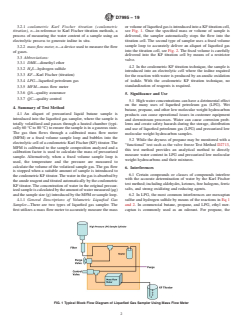
3.2.1 coulometric Karl Fischer titration (coulometric orvolumeofliquefiedgasisintroducedintoaKFtitrationcell,
titration), n—in reference to Karl Fischer titration methods, a see Fig. 1. Once the specified mass or volume of sample is
process of measuring the water content of a sample using an delivered, the sampler automatically stops the flow into the
electrolytic process to generate iodine in situ. titration cell. The second type of sampler uses a fixed volume
sample loop to accurately deliver an aliquot of liquefied gas
3.2.2 mass flow meter, n—a device used to measure the flow
into the titration cell, see Fig. 2. The fixed volume is carefully
of gases.
delivered into the KF titration cell by means of a restrictor
3.3 Abbreviations:
valve.
3.3.1 DME—dimethyl ether
4.2 In the coulometric KF titration technique, the sample is
3.3.2 H S—hydrogen sulfide
introduced into an electrolytic cell where the iodine required
3.3.3 KF—Karl Fischer (titration)
for the reaction with water is produced by an anodic oxidation
3.3.4 LPG—liquefied petroleum gas of iodide. With the coulometric KF titration technique, no
standardization of reagents is required.
3.3.5 MFM—mass flow meter
3.3.6 QA—quality assurance
5. Significance and Use
3.3.7 QC—quality control
5.1 High water concentrations can have a detrimental effect
on the many uses of liquefied petroleum gas (LPG). Wet
4. Summary of Test Method
butane, propane, and other low molecular weight hydrocarbon
4.1 An aliquot of pressurized liquid butane sample is
products can cause operational issues in customer equipment
introduced into the liquefied gas sampler, where the sample is
and downstream processes. Water can cause corrosion prob-
totally volatilized and passes through a heated chamber (typi-
lems and create safety hazards during the storage, distribution
cally 60 °C to 80 °C) to ensure the sample is in a gaseous state.
and use of liquefied petroleum gas (LPG) and pressurized low
The gas then flows through a calibrated mass flow meter
molecular weight hydrocarbon samples.
(MFM) or a fixed volume sample loop and bubbles into the
5.2 While the dryness of propane may be monitored with a
electrolyticcellofacoulometricKarlFischer(KF)titrator.The
“functional” test such as the valve freeze Test Method D2713,
MFM is calibrated to the sample composition analyzed and a
this test method provides an analytical method to directly
calibration factor is used to calculate the mass of pressurized
measure water content in LPG and pressurized low molecular
sample. Alternatively, when a fixed volume sample loop is
weight hydrocarbons and their mixtures.
used, the temperature and the pressure are measured to
calculate the volume of the volatized sample gas. The gas flow
6. Interferences
is stopped when a suitable amount of sample is introduced to
6.1 Certain compounds or classes of compounds interfere
thecoulometricKFtitrator.Thewaterinthegasisabsorbedby
with the accurate determination of water by the Karl Fischer
theanodereagentandtitratedautomaticallybythecoulometric
testmethod;includingaldehydes,ketones,freehalogens,ferric
KF titrator. The concentration of water in the original pressur-
salts, and strong oxidizing and reducing agents.
izedsampleiscalculatedbytheamountofwatermeasured(µg)
andthesamplesize(g)introducedbytheMFMorsampleloop. 6.2 In LPG, the most common interferences are mercaptan
4.1.1 General Descriptions of Volumetric Liquefied Gas sulfur and hydrogen sulfide by means of the reactions in Eq 1
Sampler—There are two types of liquefied gas sampler. The and 2. In commercial butane, propane, and LPG, ethyl mer-
first utilizes a mass flow meter to accurately measure the mass captan is commonly used as an odorant. For propane, the
FIG. 1Typical Block Flow Diagram of Liquefied Gas Sampler Using Mass Flow Meter
D7995−19
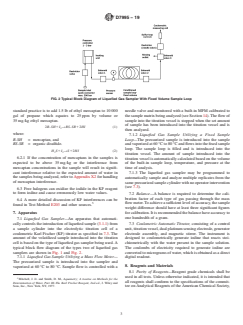
FIG. 2Typical Block Diagram of Liquefied Gas Sampler With Fixed Volume Sample Loop
standard practice is to add 1.5 lb of ethyl mercaptan to 10 000 needle valve and monitored with a built-in MFM calibrated to
gal of propane which equates to 25 ppm by volume or the sample matrix being analyzed (see Section14).The flow of
35 mg⁄kg ethyl mercaptan. sample into the titration vessel is stopped when the set amount
of sample has been introduced into the titration vessel and is
2R-SH1I →RS-SR12HI (1)
then analyzed.
where:
7.1.2 Liquefied Gas Sample Utilizing a Fixed Sample
R-SH = mercaptan, and
Loop—The pressurized sample is introduced into the sample
RS-SR = organic disulfide.
andvaporizedat60°Cto80°Candflowsintothefixedsample
loop. The sample loop is filled and is introduced into the
H S1I →S12HI (2)
2 2
titration vessel. The amount of sample introduced into the
6.2.1 If the concentration of mercaptans in the samples is
titrationvesselisautomaticallycalculatedbasedonthevolume
expected to be above 35 mg⁄kg or the interference from
of the built-in sample loop, temperature, and pressure at the
mercaptan concentrations in the sample will result in signifi-
time of analysis.
cant interference relative to the expected amount of water in
7.1.3 The liquefied gas sampler may be programmed to
the samples being analyzed, refer to Appendix X2 for handling
automatically sample and analyze multiple replicates from the
of mercaptan interference.
samepressurizedsamplecylinderwithnooperatorintervention
(see 7.3).
6.3 Free halogens can oxidize the iodide in the KF reagent
to form iodine and cause erroneously low water values.
7.2 Balance—A balance is required to determine the cali-
bration factor of each type of gas passing through the mass
6.4 A more detailed discussion of KF interferences can be
flowmeter.Toachieveasufficientlevelofaccuracy,thesample
found in Test Method E203 and other sources.
weight difference should have at least three significant figures
7. Apparatus forcalibration.Itisrecommendedthebalancehaveaccuracyto
one hundredth of a gram.
7.1 Liquefied Gas Sampler—An apparatus that automati-
cally controls the introduction of liquefied sample (3.1.1) from 7.3 Coulometric Automatic Titrator, consisting of a control
a sample cylinder into the electrolytic titration cell of a unit,titrationvessel,dualplatinumsensingelectrode,generator
coulometric Karl Fischer (KF) titrator as specified in 7.3. The electrode assembly, and magnetic stirrer. The instrument is
amount of the volatilized sample introduced into the titration designed to coulometrically generate iodine that reacts stoi-
cell is based on the type of liquefied gas sampler being used.A chiometrically with the water present in the sample solution.
typical block flow diagram of the types two of liquefied gas The coulombs of electricity required to generate iodine are
samplers are shown in Fig. 1 and Fig. 2. convertedtomicrogramsofwater,whichisobtainedasadirect
7.1.1 Liquefied Gas Sample Utilizing a Mass Flow Meter— digital readout.
The pressurized sample is introduced into the sampler and
8. Reagents and Materials
vaporized at 60 °C to 80 °C. Sample flow is controlled with a
8.1 Purity of Reagents—Reagent grade chemicals shall be
used in all tests. Unless otherwise indicated, it is intended that
Mitchell, J. Jr. and Smith, D. M., Aquametry; A treatise on Methods for the
all reagents shall conform to the specifications of the commit-
Determination of Water, Part III–The Karl Fischer Reagent, 2nd ed., J. Wiley and
Sons, Inc., New York, NY, 1977. tee onAnalytical Reagents of theAmerican Chemical Society,
D7995−19
where such specifications are available. Other grades may be 9.2 It is recommended that a control chart measuring a QC
used, provided it is pure enough to be used without lessening standard sample be established and maintained according to
the accuracy of the determination. generally accepted guidelines. Practice D6299 may be used for
this purpose. Measure the titration control sample each day
8.2 Certified Water Standard—A certified standard solution
samples are tested. If the measured value exceeds 610%of
that contains 0.1% water dissolved in an appropriate solvent.
the known amount, take appropriate action before proceeding
Commercial certified water standards are acceptable for use.
with the sample test.
8.3 Certified Gas Standard—A certified standard gas that
contains a definite water concentration (<100 mg⁄kg). Com-
10. Hazards
mercial certified water in gas standards based on nitrogen,
10.1 Consult suppliers’Safety Data Sheets (SDS) for mate-
methane, or LPG are acceptable for use.
rials used in this test method as well as any appropriate OSHA
8.4 Anode Reagent, for dual chamber (Fritted or Dia-
orequivalentUSAorinternationalsafetyrulesandregulations.
phragm)titrationusereagentrecommendedbymanufacturerof
10.2 Liquid butane, LPGs, and low molecular weight hy-
titrator.
drocarbons gases under high pressures occur in the test
8.5 Cathode Reagent, for dual chamber (Fritted or Dia-
method. Use cylinders and materials that are rated for contain-
phragm)titrationusereagentrecommendedbymanufacturerof
ing these pressurized gases in all sample containers, tubing,
titrator.
and sample transfer apparatus that are exposed to these high
8.6 Single Chamber Reagent—Use single chamber (Fritless pressures.
or Diaphragm Free) reagent recommended by manufacturer of
10.3 LPG and pressurized low molecular weight hydrocar-
titrator.
bons and their volatilized gases are extremely flammable. The
NOTE 2—Pyridine was the organic amine that was traditionally used in
gas vapors generated during the sampling and purging process
Karl Fischer reagents; however, pyridine-free formulations from various
of the liquefied gas sampler shall be safely vented to avoid
manufacturers are now available and preferred by most KF instrument
potential fire and explosion conditions to occur.
manufacturers. Pyridine-free reagents are less toxic, less odorous, and
more stable than pyridine-based reagents.
11. Sampling, Test Specimens, and Test Units
8.7 Methanol, dry, water content <150 mg⁄kg, may be used
to maintain constant volume of titration cell due to reagent
11.1 Obtain a pressurized test sample in accordance with
volume loss by evaporation.
Practice D1265 or D3700. Since LPG normally contains a low
concentration of water, ensure that sampling equipment is dry
8.8 Inert Gas (Nitrogen, Helium or Argon), minimum
and is not exposed to atmospheric moisture. Sampling equip-
99.999 % purity, used to pressurize the sample cylinders prior,
ment may be dried with a dry inert gas.
to and after analysis.
11.2 When running replicate analyses from the same
8.9 Gas-tight Luer-Lock Syringe, fitted with a cannula
cylinder, ensure there is enough sample to support the number
needle of appropriate length and gauge for introducing water
of replicates to be analyzed. See Table 1 for estimated sample
standardintothetitrationchamberorremovingexcesssolution
amounts required based on expected water content.
from titration chamber. The volume of the syringe will depend
on the sample size. Sample should occupy at least 25 % of the
11.3 It is recommended to pressurize all sample cylinders to
syringe volume.
the same pressure, nominally 1300 kPa to 2750 kPa (200 psi to
8.9.1 It is recommended to rinse all glass syringes and
400 psi), with an inert gas (8.6) and maintain sufficient
needles with dry methanol or ethanol after cleaning, and then
pressure in the sample cylinder during the analytical process to
dry in an oven at 100 °C for at least 1 h and store in a
ensure representative and consistent samples for the number of
desiccator.
replicate analyses being performed.
9. Quality Guidelines
12. Preparation of Apparatus
9.1 Autotitratorsvaryincalibrationproceduresbymanufac-
12.1 The recommended amount of coulometric reagents
turer. Consult the operating manual for the autotitrator in use.
added to the electrolytic titration cell of a coulometric KF
Stable, prepackaged Quality Control (QC) water standards are
titrator usually has the capacity to react with up to 1000 mg of
commercially available with 0.1 % by mass water content for
water. Replace these reagents when they are depleted by
thispurpose.Itisdesirabletoverifycalibrationwithastandard
following manufacturer’s instructions.
solution that approximates the same range of water expected to
be in the samples.
9.1.1 Certified water in gas standards are commercially
available and may be used to verify system functionality.
TABLE 1 Recommended Sample Size versus Expected Water
Concentration
Reagent Chemicals, American Chemical Society Specifications, American
Expected Water Concentration Sample Size
Chemical Society, Washington, DC. For suggestions on the testing of reagents not
(mg/kg) (g)
listed by the American Chemical Society, see Analar Standards for Laboratory
Chemicals, BDH Ltd., Poole, Dorset, U.K., and the United States Pharmacopeia
0 to 50 1.5 to 10.0
and National Formulary, U.S. Pharmacopeial Convention, Inc. (USPC), Rockville, 50 to 150 0.5 to 5.0
MD.
D7995−19
12.2 Coulometric reagents are hygroscopic and shall be 14. Determination of the Calibration Factor for Mass
stored in tightly capped containers to reduce the absorption of Flow Meter
atmospheric moisture.
14.1 The calibration factor is used to convert volume of gas
into ma
...