

ASTM D8355-21
(Test Method)Standard Test Methods for Flammability of Electrical Insulating Materials Used for Sleeving or Tubing
General Information
- Abstract
SIGNIFICANCE AND USE
5.1 Test Method A is the required flammability test for: crosslinked chlorinated polyolefin heat-shrinkable tubing for electrical insulation (Specification D2903), crosslinked poly(vinylidene fluoride) heat-shrinkable tubing for electrical insulation (Specification D3144), and crosslinked and noncrosslinked poly(vinyl chloride) heat-shrinkable tubing for electrical insulation (Specification D3150).
5.2 Test Method A is also one of the flammability tests used for nonrigid vinyl chloride polymer tubing used for electrical insulation (in Test Methods D876), flexible treated sleeving used for electrical insulation (Test Methods D350), and heat-shrinkable tubing for electrical use (Test Methods D2671).
5.3 Test Method B is another flammability test (together with Test Method A) used for flexible treated sleeving used for electrical insulation (Test Methods D350).
5.4 Test Methods C and D are other flammability tests (together with Test Method A) used for heat-shrinkable tubing for electrical use (Test Methods D2671). In both tests the electrical insulating material is fitted with a metallic core. The electrical insulating material is tested after shrinking, but using different mandrels.
5.5 In these test methods, the test specimens are subjected to one or more specific sets of laboratory test conditions. If different test conditions are substituted or the end-use conditions are changed, it is not always possible by or from this test to predict changes in the fire-test-response characteristics measured. The results are therefore valid only for the fire-test-exposure conditions described in this procedure.
SCOPE
1.1 This is a fire-test-response standard.
1.2 This fire test response standard contains various tests applicable to electrical insulation materials used for sleeving or for tubing (including heat-shrinkable tubing).
1.2.1 Test methods C and D are applicable to heat-shrinkable tubing only.
1.3 Use the values stated in SI units in referee decisions; see IEEE/ASTM SI-10. The values given in parentheses after SI units are provided for information only and are not considered standard.
1.4 This standard is used to measure and describe the response of materials, products, or assemblies to heat and flame under controlled conditions, but does not by itself incorporate all factors required for fire hazard or fire risk assessment of the materials, products, or assemblies under actual fire conditions.
1.5 Fire testing is inherently hazardous. Adequate safeguards for personnel and property shall be employed in conducting these tests.
1.6 This standard does not purport to address all of the safety concerns, if any, associated with its use. It is the responsibility of the user of this standard to establish appropriate safety, health, and environmental practices and determine the applicability of regulatory limitations prior to use.
1.7 This international standard was developed in accordance with internationally recognized principles on standardization established in the Decision on Principles for the Development of International Standards, Guides and Recommendations issued by the World Trade Organization Technical Barriers to Trade (TBT) Committee.
- Status
- Published
- Publication Date
- 30-Mar-2021
- Technical Committee
- D09 - Electrical and Electronic Insulating Materials
- Drafting Committee
- D09.17 - Fire and Thermal Properties
Overview
ASTM D8355-21 is the international standard for assessing the flammability of electrical insulating materials used in sleeving and tubing applications, including heat-shrinkable varieties. Developed by ASTM International, this standard outlines a series of controlled laboratory test methods designed to measure how different electrical insulation materials respond to exposure to heat and flame. The primary focus is on understanding the fire-test-response characteristics rather than predicting real-world fire hazards.
These comprehensive test methods are essential tools for manufacturers, product developers, and quality assurance professionals in the electrical and electronics industries. Following ASTM D8355-21 ensures that sleeving and tubing materials meet important safety and performance requirements related to flammability.
Key Topics
- Scope and Applicability: Covers various types of electrical insulation used as sleeving or tubing, including nonrigid vinyl chloride, flexible treated sleeving, and heat-shrinkable tubing.
- Test Methods: Four distinct laboratory tests (Methods A, B, C, D) each assess specific fire-response characteristics, such as flame spread, burning duration, and the generation of flaming particles:
- Test Methods A and B: Applicable to both sleeving and tubing types.
- Test Methods C and D: Specifically for heat-shrinkable tubing, with tests simulating use on metallic cores.
- Evaluation Criteria: Tests measure burn length, duration, upward flame spread, and the potential for igniting nearby materials due to falling flaming particles.
- Safety: Highlights precautions for conducting inherently hazardous flammability tests, emphasizing proper safeguards for personnel and property.
- Units of Measurement: SI units must be used in referee decisions, with inch-pound values provided for reference.
Applications
- Electrical Insulation Quality Control: This standard is vital for assessing the safety and compliance of materials used to insulate wires, cables, and electrical components in consumer electronics, industrial equipment, and automotive wiring harnesses.
- Product Certification: Manufacturers use ASTM D8355-21 to verify that their insulating products meet regulatory and safety requirements before market release or certification.
- Material Comparison: R&D teams compare different insulating materials to select the best option for flame resistance, ensuring the highest standards of safety in end-use conditions.
- Reference for Regulatory Compliance: Test results based on this standard support compliance with local, national, and international fire safety regulations for electrical installations.
Related Standards
The ASTM D8355-21 standard references and interrelates with several other key test methods and specifications, including:
- ASTM D2903: Specification for crosslinked chlorinated polyolefin heat-shrinkable tubing.
- ASTM D3144: Specification for crosslinked poly(vinylidene fluoride) heat-shrinkable tubing.
- ASTM D3150: Specification for crosslinked and noncrosslinked poly(vinyl chloride) heat-shrinkable tubing.
- ASTM D876: Test methods for nonrigid vinyl chloride polymer tubing for electrical insulation.
- ASTM D350: Test methods for flexible treated sleeving.
- ASTM D2671: Test methods for heat-shrinkable tubing for electrical use.
- UL 224, UL 1441, UL 2556: Underwriters Laboratories standards for coated electrical sleeving and wire and cable test methods using similar flammability assessments.
- ISO 13943: Fire safety vocabulary.
Practical Value
Implementing ASTM D8355-21 ensures that manufacturers and users of electrical insulating sleeving and tubing can reliably evaluate product safety in relation to fire. These test methods help identify materials that minimize the risk of ignition and flame propagation in electrical systems, enhancing overall fire safety and supporting compliance with international standards.
Keywords: ASTM D8355-21, electrical insulation, flammability test, insulating sleeving, heat-shrinkable tubing, flame spread, fire safety standard, electrical tubing testing, product compliance, laboratory fire-tests.
Relations
- Effective Date
- 01-Mar-2024
- Effective Date
- 01-Jan-2024
- Effective Date
- 01-Mar-2020
- Effective Date
- 01-Feb-2020
- Effective Date
- 15-Dec-2018
- Effective Date
- 01-Mar-2018
- Effective Date
- 01-Nov-2015
- Effective Date
- 01-Aug-2015
- Effective Date
- 01-Aug-2015
- Effective Date
- 01-Feb-2015
- Effective Date
- 01-Nov-2014
- Effective Date
- 01-Oct-2014
- Effective Date
- 15-Aug-2014
- Effective Date
- 01-Aug-2014
- Effective Date
- 01-Jul-2014
Get Certified
Connect with accredited certification bodies for this standard

IMQ S.p.A. (Certification)
Italian electrical product certification.

SLG Prüf- und Zertifizierungs GmbH
German testing and certification body.

UL Solutions
Global safety science company with testing, inspection and certification.
Sponsored listings
Frequently Asked Questions
ASTM D8355-21 is a standard published by ASTM International. Its full title is "Standard Test Methods for Flammability of Electrical Insulating Materials Used for Sleeving or Tubing". This standard covers: SIGNIFICANCE AND USE 5.1 Test Method A is the required flammability test for: crosslinked chlorinated polyolefin heat-shrinkable tubing for electrical insulation (Specification D2903), crosslinked poly(vinylidene fluoride) heat-shrinkable tubing for electrical insulation (Specification D3144), and crosslinked and noncrosslinked poly(vinyl chloride) heat-shrinkable tubing for electrical insulation (Specification D3150). 5.2 Test Method A is also one of the flammability tests used for nonrigid vinyl chloride polymer tubing used for electrical insulation (in Test Methods D876), flexible treated sleeving used for electrical insulation (Test Methods D350), and heat-shrinkable tubing for electrical use (Test Methods D2671). 5.3 Test Method B is another flammability test (together with Test Method A) used for flexible treated sleeving used for electrical insulation (Test Methods D350). 5.4 Test Methods C and D are other flammability tests (together with Test Method A) used for heat-shrinkable tubing for electrical use (Test Methods D2671). In both tests the electrical insulating material is fitted with a metallic core. The electrical insulating material is tested after shrinking, but using different mandrels. 5.5 In these test methods, the test specimens are subjected to one or more specific sets of laboratory test conditions. If different test conditions are substituted or the end-use conditions are changed, it is not always possible by or from this test to predict changes in the fire-test-response characteristics measured. The results are therefore valid only for the fire-test-exposure conditions described in this procedure. SCOPE 1.1 This is a fire-test-response standard. 1.2 This fire test response standard contains various tests applicable to electrical insulation materials used for sleeving or for tubing (including heat-shrinkable tubing). 1.2.1 Test methods C and D are applicable to heat-shrinkable tubing only. 1.3 Use the values stated in SI units in referee decisions; see IEEE/ASTM SI-10. The values given in parentheses after SI units are provided for information only and are not considered standard. 1.4 This standard is used to measure and describe the response of materials, products, or assemblies to heat and flame under controlled conditions, but does not by itself incorporate all factors required for fire hazard or fire risk assessment of the materials, products, or assemblies under actual fire conditions. 1.5 Fire testing is inherently hazardous. Adequate safeguards for personnel and property shall be employed in conducting these tests. 1.6 This standard does not purport to address all of the safety concerns, if any, associated with its use. It is the responsibility of the user of this standard to establish appropriate safety, health, and environmental practices and determine the applicability of regulatory limitations prior to use. 1.7 This international standard was developed in accordance with internationally recognized principles on standardization established in the Decision on Principles for the Development of International Standards, Guides and Recommendations issued by the World Trade Organization Technical Barriers to Trade (TBT) Committee.
SIGNIFICANCE AND USE 5.1 Test Method A is the required flammability test for: crosslinked chlorinated polyolefin heat-shrinkable tubing for electrical insulation (Specification D2903), crosslinked poly(vinylidene fluoride) heat-shrinkable tubing for electrical insulation (Specification D3144), and crosslinked and noncrosslinked poly(vinyl chloride) heat-shrinkable tubing for electrical insulation (Specification D3150). 5.2 Test Method A is also one of the flammability tests used for nonrigid vinyl chloride polymer tubing used for electrical insulation (in Test Methods D876), flexible treated sleeving used for electrical insulation (Test Methods D350), and heat-shrinkable tubing for electrical use (Test Methods D2671). 5.3 Test Method B is another flammability test (together with Test Method A) used for flexible treated sleeving used for electrical insulation (Test Methods D350). 5.4 Test Methods C and D are other flammability tests (together with Test Method A) used for heat-shrinkable tubing for electrical use (Test Methods D2671). In both tests the electrical insulating material is fitted with a metallic core. The electrical insulating material is tested after shrinking, but using different mandrels. 5.5 In these test methods, the test specimens are subjected to one or more specific sets of laboratory test conditions. If different test conditions are substituted or the end-use conditions are changed, it is not always possible by or from this test to predict changes in the fire-test-response characteristics measured. The results are therefore valid only for the fire-test-exposure conditions described in this procedure. SCOPE 1.1 This is a fire-test-response standard. 1.2 This fire test response standard contains various tests applicable to electrical insulation materials used for sleeving or for tubing (including heat-shrinkable tubing). 1.2.1 Test methods C and D are applicable to heat-shrinkable tubing only. 1.3 Use the values stated in SI units in referee decisions; see IEEE/ASTM SI-10. The values given in parentheses after SI units are provided for information only and are not considered standard. 1.4 This standard is used to measure and describe the response of materials, products, or assemblies to heat and flame under controlled conditions, but does not by itself incorporate all factors required for fire hazard or fire risk assessment of the materials, products, or assemblies under actual fire conditions. 1.5 Fire testing is inherently hazardous. Adequate safeguards for personnel and property shall be employed in conducting these tests. 1.6 This standard does not purport to address all of the safety concerns, if any, associated with its use. It is the responsibility of the user of this standard to establish appropriate safety, health, and environmental practices and determine the applicability of regulatory limitations prior to use. 1.7 This international standard was developed in accordance with internationally recognized principles on standardization established in the Decision on Principles for the Development of International Standards, Guides and Recommendations issued by the World Trade Organization Technical Barriers to Trade (TBT) Committee.
ASTM D8355-21 is classified under the following ICS (International Classification for Standards) categories: 13.220.40 - Ignitability and burning behaviour of materials and products; 29.035.01 - Insulating materials in general. The ICS classification helps identify the subject area and facilitates finding related standards.
ASTM D8355-21 has the following relationships with other standards: It is inter standard links to ASTM D1711-24, ASTM E176-24, ASTM D5025-20a, ASTM D5025-20, ASTM E176-18a, ASTM E176-18, ASTM D1711-15, ASTM E176-15a, ASTM E176-15ae1, ASTM E176-15, ASTM D1711-14a, ASTM E176-14c, ASTM E176-14b, ASTM E176-14a, ASTM E176-14. Understanding these relationships helps ensure you are using the most current and applicable version of the standard.
ASTM D8355-21 is available in PDF format for immediate download after purchase. The document can be added to your cart and obtained through the secure checkout process. Digital delivery ensures instant access to the complete standard document.
Standards Content (Sample)
This international standard was developed in accordance with internationally recognized principles on standardization established in the Decision on Principles for the
Development of International Standards, Guides and Recommendations issued by the World Trade Organization Technical Barriers to Trade (TBT) Committee.
Designation: D8355 − 21
Standard Test Methods for
Flammability of Electrical Insulating Materials Used for
Sleeving or Tubing
This standard is issued under the fixed designation D8355; the number immediately following the designation indicates the year of
original adoption or, in the case of revision, the year of last revision. A number in parentheses indicates the year of last reapproval. A
superscript epsilon (´) indicates an editorial change since the last revision or reapproval.
NOTE—Subsection 1.2.1 was added and the yeardate was changed on March 31, 2021.
1. Scope 2. Referenced Documents
2.1 ASTM Standards:
1.1 This is a fire-test-response standard.
D350 Test Methods for Flexible Treated Sleeving Used for
1.2 This fire test response standard contains various tests
Electrical Insulation
applicabletoelectricalinsulationmaterialsusedforsleevingor
D876 Test Methods for Nonrigid Vinyl Chloride Polymer
for tubing (including heat-shrinkable tubing).
Tubing Used for Electrical Insulation
1.2.1 Test methods C and D are applicable to heat- D1711 Terminology Relating to Electrical Insulation
D2671 Test Methods for Heat-Shrinkable Tubing for Elec-
shrinkable tubing only.
trical Use
1.3 Use the values stated in SI units in referee decisions; see
D2903 Specification for Crosslinked Chlorinated Polyolefin
IEEE/ASTM SI-10. The values given in parentheses after SI
Heat-Shrinkable Tubing for Electrical Insulation
units are provided for information only and are not considered
D3144 Specification for Crosslinked Poly(Vinylidene Fluo-
standard.
ride) Heat-Shrinkable Tubing for Electrical Insulation
D3150 Specification for Crosslinked and Noncrosslinked
1.4 This standard is used to measure and describe the
Poly(Vinyl Chloride) Heat-Shrinkable Tubing for Electri-
response of materials, products, or assemblies to heat and
cal Insulation
flame under controlled conditions, but does not by itself
D5025 Specification for Laboratory Burner Used for Small-
incorporate all factors required for fire hazard or fire risk
Scale Burning Tests on Plastic Materials
assessment of the materials, products, or assemblies under
D5207 Practice for Confirmation of 20-mm (50-W) and
actual fire conditions.
125-mm (500-W) Test Flames for Small-Scale Burning
1.5 Fire testing is inherently hazardous. Adequate safe-
Tests on Plastic Materials
guards for personnel and property shall be employed in
E176 Terminology of Fire Standards
conducting these tests.
2.2 ISO Standard:
1.6 This standard does not purport to address all of the
ISO 13943 Fire Safety – Vocabulary
safety concerns, if any, associated with its use. It is the 4
2.3 Federal Standard:
responsibility of the user of this standard to establish appro-
PPP-T-45D Federal Specification for Tape; Paper, Gummed
priate safety, health, and environmental practices and deter-
(Kraft)
mine the applicability of regulatory limitations prior to use.
2.4 UL Standards:
1.7 This international standard was developed in accor-
UL 224 Extruded Insulated Tubing
dance with internationally recognized principles on standard-
UL 1441 Coated Electrical Sleeving
ization established in the Decision on Principles for the
Development of International Standards, Guides and Recom-
For referenced ASTM standards, visit the ASTM website, www.astm.org, or
mendations issued by the World Trade Organization Technical
contact ASTM Customer Service at service@astm.org. For Annual Book of ASTM
Barriers to Trade (TBT) Committee.
Standards volume information, refer to the standard’s Document Summary page on
the ASTM website.
Available from International Organization for Standardization (ISO), ISO
Central Secretariat, BIBC II, Chemin de Blandonnet 8, CP 401, 1214 Vernier,
These test methods are under the jurisdiction of ASTM Committee D09 on Geneva, Switzerland, http://www.iso.org.
Electrical and Electronic Insulating Materials and are the direct responsibility of AvailablefromStandardizationDocumentsOrderDesk,Bldg.4SectionD,700
Subcommittee D09.17 on Fire and Thermal Properties. Robbins Ave., Philadelphia, PA 19111-5094, Attn: NPODS.
Current edition approved March 31, 2021. Published April 2021. Last previous Available from Underwriters Laboratories (UL), UL Headquarters, 333 Pfing-
edition approved in 2020 as D8355 – 20. DOI: 10.1520/D8355-21. sten Road, Northbrook, IL, 60062, http://www.ul.com.
Copyright © ASTM International, 100 Barr Harbor Drive, PO Box C700, West Conshohocken, PA 19428-2959. United States
D8355 − 21
UL 2556 Wire and Cable Test Methods falling flaming particles ignite a cotton indicator placed under-
neath the test specimen. Test Method D is a more severe
3. Terminology
flammability test than Test Method C. This test method was
originally contained as Procedure C in Test Methods D2671
3.1 Definitions:
(where it applied to heat-shrinkable tubing).
3.1.1 For definitions of terms relating to electrical and
electronic insulating materials, the definitions in these test
5. Significance and Use
methodsareinaccordancewithTerminologyD1711.Forterms
relating to fire, the definitions in this test method are in 5.1 Test Method A is the required flammability test for:
crosslinked chlorinated polyolefin heat-shrinkable tubing for
accordance with Terminology E176 and ISO 13943. In case of
conflict, the definitions given in Terminology E176 shall electrical insulation (Specification D2903), crosslinked poly-
(vinylidene fluoride) heat-shrinkable tubing for electrical insu-
prevail.
3.2 Definitions of Terms Specific to This Standard: lation (Specification D3144), and crosslinked and noncross-
linkedpoly(vinylchloride)heat-shrinkabletubingforelectrical
3.2.1 heat-shrinkable tubing, n—tubing that will reduce in
insulation (Specification D3150).
diameter from an expanded size to a predetermined size by the
application of heat.
5.2 Test MethodAis also one of the flammability tests used
for nonrigid vinyl chloride polymer tubing used for electrical
4. Summary of Test Methods
insulation (in Test Methods D876), flexible treated sleeving
4.1 This standard incorporates four test methods suitable for used for electrical insulation (Test Methods D350), and heat-
assessing fire-test-response characteristics of electrical insulat-
shrinkable tubing for electrical use (Test Methods D2671).
ing materials exposed in the form of sleeving or tubing
5.3 Test Method B is another flammability test (together
(including heat-shrinkable tubing). In all the tests the electrical
with Test MethodA) used for flexible treated sleeving used for
insulating material is exposed to the flame from a gas-fueled
electrical insulation (Test Methods D350).
burner.
5.4 Test Methods C and D are other flammability tests
4.1.1 Test Methods A and B are applicable to sleeving and
(together with Test Method A) used for heat-shrinkable tubing
tubing (including heat-shrinkable tubing), but Test Methods C
for electrical use (Test Methods D2671). In both tests the
and D are applicable to heat-shrinkable tubing only.
electrical insulating material is fitted with a metallic core. The
4.2 Test MethodAassesses the resistance to spread of flame
electrical insulating material is tested after shrinking, but using
of the material, by measuring burn length and duration of
different mandrels.
burning. This test method was originally contained as Method
5.5 Inthesetestmethods,thetestspecimensaresubjectedto
A in Test Methods D350 (where it applied to sleeving), as
one or more specific sets of laboratory test conditions. If
ProcedureAinTestMethodsD876(whereitappliedtotubing),
different test conditions are substituted or the end-use condi-
andasProcedureAinTestMethodsD2671(whereitappliedto
tions are changed, it is not always possible by or from this test
heat-shrinkable tubing). This test method is referenced in
to predict changes in the fire-test-response characteristics
Specifications D2903 (for crosslinked chlorinated polyolefin
measured. The results are therefore valid only for the fire-test-
heat-shrinkable tubing), D3144 (for poly(vinylidene fluoride)
exposure conditions described in this procedure.
heat-shrinkable tubing), and D3150 (for crosslinked and non-
crosslinked poly(vinyl chloride) heat-shrinkable tubing).
4.3 Test Method B assesses the rate of upward flame spread TEST METHOD A
of the material. This test method was originally contained as
6. Scope
MethodBinTestMethodsD350(whereitappliedtosleeving).
6.1 This test method assesses the resistance to spread of
4.4 Test Method C applies to electrical insulating material
flameofthematerial,bymeasuringburnlengthanddurationof
used for heat-shrinkable tubing. It assesses the propagation of
burning.
flame in an upward direction, the duration of burning and the
formation of flaming or glowing particles. The electrical
7. Apparatus
insulating material, in contact with a metallic core, is exposed
by placing it in contact with an internal metallic conductor 7.1 Chamber—The chamber shall be a three-walled sheet
simulating a common end use condition, while supported on a metal enclosure 300 6 10 mm (12 6 0.4 in.) wide by 360 6
mandrel. This test method was originally contained as Proce- 10 mm (14 6 0.4 in.) deep by 740 6 10 mm (29 6 0.4 in.)
dure B in Test Methods D2671 (where it applied to heat- high, open at the top. It shall be equipped with two parallel
shrinkable tubing). horizontalmetalrodsplaced410 610mm(16 60.4in.)apart,
and situated such that a wire stretched perpendicularly across
4.5 Test Method D applies to electrical insulating material
each rod shall be at a 70° angle with the horizontal. The lower
used for heat-shrinkable tubing. It is similar to Test Method C,
rod shall be approximately 50 6 10 mm (2 6 0.4 in.) from the
in 4.3, but differs from it in the specimen support mandrel.The
rear wall.
electrical insulating material is in contact with a metallic core.
Test Method D assesses the same fire-test-response character- 7.2 Bare Steel Wire—A length of bare steel wire, approxi-
istics as Test Method C, but it also determines the tendency to mately 0.74 mm (0.029 in.) in diameter, shall be used for
ignite nearby flammable materials by determining whether any supporting the test specimens during the test.
D8355 − 21
7.3 Burner—The burner shall meet the requirements of tilted 25° from the horizontal during the period that the flame
Specification D5025. is applied to the test specimen, and the flame shall impinge
7.3.1 Adjust the burner barrel height, as indicated in Prac-
upon the test specimen at an angle of 45°. The system shall
tice D5207 to confirm that the overall height of the gas flame contain a gas regulating valve as well as a shutoff valve.
is 125 6 10 mm (4 ⁄8 6 0.4 in.) and that the blue inner cone is
7.5 Gas Supply—The fuel gas to be used shall be natural
40 62mm(1 ⁄16 60.08in.)high.Agassupplygaugepressure
2 gas, methane gas, or propane gas. For referee purposes,
of 69 to 138 kPa (10 to 20 lbf/in. ) has been found to be
commercial grade propane gas having a nominal heating value
adequatetomaintaintherequiredflame.Acylindershallnotbe
3 3
of 94 MJ/m (2521 BTU/ft ) and a relative specific gravity of
used when this range of pressure is no longer sustainable at
0.508 (to that of air) at a temperature of 15.5 ºC (60 °F) shall
room temperature.
be used at a line pressure of 2.74 kPa (11 in., or 279 mm of
7.3.2 The burner shall be designed to provide a flame that is
water).
125 6 10 mm (4 ⁄8 6 0.4 in.) long, with an intensity of 500 W
7.5.1 The methane gas shall be technical grade, 98.0 %
(1700 BTU/h).
minimumpurity.Theheatingvalueofeithermethaneornatural
7.4 Burner Mounting—The burner shall be mounted upon a
3 3
gas shall be 37 6 1 MJ/m or 8.9 kcal (thermochemical)/m or
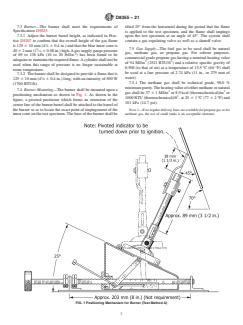
positioning mechanism as shown in Fig. 1. As shown in the
1000 BTU (thermochemical)/ft ,at25 61ºC(77 6 2 ºF) and
figure, a pivoted positioner which forms an extension of the
101 kPa (14.7 psi).
center line of the burner barrel shall be attached to the barrel of
the burner so as to locate the exact point of impingement of the
NOTE1—Ifnoregulardeliverylinesareavailableforpropanegasorfor
innerconeonthetestspecimen.Thebaseoftheburnershallbe methane gas, the use of small tanks is an acceptable alternate.
FIG. 1 Positioning Mechanism for Burner (Test Method A)
D8355 − 21
7.6 Timing Device—The timing device shall be a stopwatch 9.8 Apply the flame to the test specimen for 15 s and then
or other suitable timing device capable of measuring the extinguish it by turning off the gas supply from outside the test
duration of flame application and of test specimen burning to cabinet.
within 0.5 s.
9.9 Determine the duration of burning of the test specimen
7.7 Flame Indicator Flag—Strips of gummed paper shall be as the time between turning off the gas supply and the time of
used to determine the length of test specimen burned. extinction of the gas flame.
7.7.1 The flame indicator flag shall be constructed of kraft
9.10 Determine the length of test specimen burned either by
paper, made from a commercially available plain cellulose
direct measurement or by subtracting the length of the un-
paper tape. The tape shall have an area density of 98 g/m
burned portion from 254 mm (10 in.).
(60 lb/3000 ft ), and a nominal thickness of 0.13 mm
9.11 Repeat this procedure for a total of five test specimens.
(0.005 in.). It shall be gummed on one side, not reinforced, and
not exposed to flame retardant treatment cellulose paper tape.
10. Report
The flag shall have a nominal 10 mm (0.39 in.) width and a
10.1 Report the following information:
nominal 40 mm (1.57 in.) length longer than the outside
10.1.1 Identification of the tubing or sleeving tested.
circumference of the test specimen.
10.1.2 Insidediameterandaveragewallthicknessofthetest
NOTE 2—The paper used for the indicators is that known to the trade as
specimens, in mm (in.).
60-lb stock, and is material substantially the same as that described in
10.1.3 The duration of burning, in seconds, for each of the
Federal Specification PPP-T-45D.
five test specimens.
10.1.4 Exclude the tests with the highest and the lowest
8. Test Specimens
duration of burning. Then report the average duration of
8.1 Prepare five test specimens approximately 560 6
burning based on three tests, after the exclusion of the
10 mm (22 6 0.4 in.) in length.
maximum and minimum values.
8.1.1 Ifthetestistobeconductedonheat-shrinkabletubing,
10.1.5 The length of material burnt, in mm (inches) for each
use tubing in the expanded state.
of the five test specimens.
10.1.6 Exclude the tests with the highest and the lowest
9. Procedure
length of test specimen burnt.Then report the average duration
9.1 Test Environment—Place the test chamber in a labora-
of length of material burnt based on three tests, after the
tory hood free of induced or forced draft. If a ventilated hood
exclusion of the maximum and minimum values.
is used, ensure that the air currents do not affect the test flame.
10.1.7 The actual reported results shall be the average
duration of burning (from 10.1.3) and the average burned
9.2 Draw the test specimen onto the wire.
length (from 10.1.5) based on three tests.
9.3 Attach the test specimen and the wire at one end to the
middle of the upper horizontal bar by kinking the tubing or
11. Precision and Bias
sleeving and clamping it, so as to provide a closed end to the
11.1 The precision of this test method has not been deter-
test specimen, thus preventing any chimney effects during the
mined due to inadequate voluntary participation and funding
test.
needed to conduct the round-robin testing.
9.4 Pass the lower end of the wire protruding from the open
11.2 This test method has no bias because the results are
end of the tubing or sleeving over the middle of the lower
expressed purely in terms of this test method.
horizontal bar, and hold it taut against the bar by a weight of at
least 500 g (1 lb), attached to the free end of the wire.
9.4.1 If the material does not have a circular cross section,
TEST METHOD B
position the edge with the smallest radius of curvature nearest
12. Scope
the flame.
12.1 This test method assesses the rate of upward flame
9.5 Attach the paper indicator to the test specimen so that
spread of the material.
the lower edge is 250 6 10 mm (10 6 0.4 in.) above the point
of flame application.
13. Apparatus
9.6 Withtheburnerinaverticalpositionadjusttheheightof
13.1 The apparatus, and the gas supply, shall be the same as
the flame to 125 6 10 mm (4 ⁄8 6 0.4 in.) and the blue inner
that for Test Method A (Section 7).
cone to 40 6 2mm(1 ⁄16 6 0.08 in.) high. The distance
betweentheendoftheburnerandtheedgeofthetestspecimen 14. Test Specimens
shallbe40mm(1 ⁄2in.),measuredalongtheaxisoftheburner.
14.1 Prepare three test specimens 560 6 10 mm (22 6
9.7 After preliminary positioning of the burner and before 0.4 in.) in length.
lighting the burner, in preparation to applying the flame to the
15. Procedure
test specimen, pivot the positioner away from the flame area.
The burner shall be in an upright position when ignited and 15.1 Mark a gauge length of 25 62mm(1 6 0.08 in.) on
shall be dropped into testing position at the instant that the each test specimen approximately 13 mm (0.5 in.) from one
timer is started. end of the test specimen.
D8355 − 21
15.2 Using a method that
...