

ASTM D5537-23a
(Test Method)Standard Test Method for Heat Release, Flame Spread, Smoke Obscuration, and Mass Loss Testing of Insulating Materials Contained in Electrical or Optical Fiber Cables When Burning in a Vertical Cable Tray Configuration
General Information
- Abstract
SIGNIFICANCE AND USE
5.1 This test method provides a means to measure a variety of fire-test-response characteristics associated with heat and smoke release and resulting from burning the materials insulating electrical or optical fiber cables, when made into cables and installed on a vertical cable tray. The specimens are allowed to burn freely under well ventilated conditions after ignition by means of a propane gas burner. The ignition source used in this test method is also described as a premixed flame flaming ignition source in Practice E3020, which contains an exhaustive compilation of ignition sources.
5.2 The rate of heat release often serves as an indication of the intensity of the fire generated. General considerations of the importance of heat release rate are discussed in Appendix X1 and considerations for heat release calculations are in Appendix X2.
5.3 Other fire-test-response characteristics that are measurable by this test method are useful to make decisions on fire safety. The test method is also used for measuring smoke obscuration. The apparatus described here is also useful to measure gaseous components of smoke; the most important gaseous components of smoke are the carbon oxides, present in all fires. The carbon oxides are major indicators of the completeness of combustion and are often used as part of fire hazard assessment calculations and to improve the accuracy of heat release measurements.
5.4 Test Limitations:
5.4.1 The fire-test-response characteristics measured in this test are a representation of the manner in which the specimens tested behave under certain specific conditions. Do not assume they are representative of a generic fire performance of the materials tested when made into cables of the construction under consideration.
5.4.2 In particular, it is unlikely that this test is an adequate representation of the fire behavior of cables in confined spaces, without abundant circulation of air.
5.4.3 This is an intermediate-scale test...
SCOPE
1.1 This is a fire-test-response standard.
1.2 This test method provides a means to measure the heat released and smoke obscuration by burning the electrical insulating materials contained in electrical or optical fiber cables when the cable specimens, excluding accessories, are subjected to a specified flaming ignition source and burn freely under well ventilated conditions. Flame propagation cable damage, by char length, and mass loss are also measured.
1.3 This test method provides two different protocols for exposing the materials, when made into cable specimens, to an ignition source (approximately 20 kW), for a 20 min test duration. Use it to determine the heat release, smoke release, flame propagation and mass loss characteristics of the materials contained in single and multiconductor electrical or optical fiber cables.
1.4 This test method does not provide information on the fire performance of materials insulating electrical or optical fiber cables in fire conditions other than the ones specifically used in this test method nor does it measure the contribution of the materials in those cables to a developing fire condition.
1.5 Data describing the burning behavior from ignition to the end of the test are obtained.
1.6 This test equipment is suitable for measuring the concentrations of certain toxic gas species in the combustion gases (see Appendix X4).
1.7 The values stated in SI units are to be regarded as standard (see IEEE/ASTM SI-10). The values given in parentheses are mathematical conversions to inch-pound units that are provided for information only and are not considered standard.
1.8 This standard measures and describes the response of materials, products, or assemblies to heat and flame under controlled conditions, but does not by itself incorporate all factors required for fire hazard or fire risk assessment of the materials, products or assemblies under actual fire conditions
...
- Status
- Published
- Publication Date
- 30-Apr-2023
- Technical Committee
- D09 - Electrical and Electronic Insulating Materials
- Drafting Committee
- D09.17 - Fire and Thermal Properties
Buy Documents
ASTM D5537-23a - Standard Test Method for Heat Release, Flame Spread, Smoke Obscuration, and Mass Loss Testing of Insulating Materials Contained in Electrical or Optical Fiber Cables When Burning in a Vertical Cable Tray Configuration
REDLINE ASTM D5537-23a - Standard Test Method for Heat Release, Flame Spread, Smoke Obscuration, and Mass Loss Testing of Insulating Materials Contained in Electrical or Optical Fiber Cables When Burning in a Vertical Cable Tray Configuration
Overview
ASTM D5537-23a, titled Standard Test Method for Heat Release, Flame Spread, Smoke Obscuration, and Mass Loss Testing of Insulating Materials Contained in Electrical or Optical Fiber Cables When Burning in a Vertical Cable Tray Configuration, provides a comprehensive fire test method to assess the fire-response characteristics of cable insulation materials under controlled, well-ventilated conditions. Developed by ASTM International, this standard is designed to evaluate how insulating materials in electrical or optical fiber cables perform when exposed to fire, specifically measuring heat release, flame spread, smoke production, and mass loss.
Key Topics
This standard focuses on essential aspects of fire safety for electrical and optical fiber cables, including:
- Heat Release Measurement: Determines the rate and total amount of heat generated during combustion, a key factor in fire hazard assessment.
- Flame Spread: Assesses how far and quickly flames propagate along the cable specimens, offering insight into the potential for fire growth.
- Smoke Obscuration: Measures the reduction in visibility due to smoke, essential for evaluating the impact of cable fires on evacuation and safety.
- Mass Loss: Tracks the weight loss of the specimen during burning, which helps assess the degree of material consumption.
- Combustion Gas Analysis: Enables measurement of concentrations of gases like carbon oxides, which are important indicators of combustion completeness and fire hazard.
Test protocols: ASTM D5537-23a specifies two exposure protocols, differing in burner configuration and cable loading, to accommodate various cable types and real-world scenarios.
Limitations: The test results are specific to the conditions used in the method (e.g., vertical cable tray, free burning in a ventilated enclosure) and are not directly representative of cable performance in other fire situations, especially in confined spaces.
Applications
ASTM D5537-23a is highly relevant to:
- Manufacturers of Cables: For testing and certifying the fire performance of insulating materials in both electrical and optical fiber cables.
- Fire Safety Engineers: To inform design strategies and hazard assessments for cable installations in commercial, industrial, and data center environments.
- Compliance and Regulatory Bodies: As a basis for code compliance and product approval where fire performance of cables is critical.
- Insurance and Risk Assessment Professionals: For evaluating the potential impact of cable fires in building safety planning.
- Standard Test Facilities and Laboratories: As a standardized method for routine assessment and R&D on cable materials.
The test provides practical data to guide decisions on material selection, cable tray configurations, and risk mitigation for cable installations susceptible to fire.
Related Standards
ASTM D5537-23a leverages terminology and methodology from several related standards, ensuring consistency and comparability. These include:
- ASTM D1711: Terminology Relating to Electrical Insulation
- ASTM D5424: Smoke Obscuration of Insulating Materials in Cable Trays
- ASTM E84: Surface Burning Characteristics of Building Materials
- UL 1581, UL 1685, UL 2556: Fire testing and evaluation methods for cables
- CSA FT4: Vertical Flame Tests for Cables in Trays
- IEEE 1202: Flame Testing of Cables in Cable Trays
- ISO 9705: Full-Scale Room Fire Tests for Surface Products
- NFPA 70 (NEC): National Electrical Code
Practical Value
By following ASTM D5537-23a, users gain:
- Quantitative fire performance data on heat and smoke release, essential for product development and fire safety engineering.
- Standardized comparison metrics across products and suppliers.
- Guidance in meeting international fire safety regulations for cable installations.
- Support for building safer electrical infrastructure through informed material and design selections.
Keywords: ASTM D5537, cable fire testing, heat release, flame spread, smoke obscuration, mass loss, cable insulation fire safety, vertical cable tray, combustibility of cables, fire hazard assessment.
Relations
- Effective Date
- 01-Mar-2024
- Effective Date
- 01-Jan-2024
- Effective Date
- 01-Dec-2023
- Effective Date
- 01-Nov-2023
- Effective Date
- 01-Sep-2023
- Effective Date
- 01-Jul-2020
- Effective Date
- 01-Jul-2019
- Effective Date
- 15-Apr-2019
- Effective Date
- 01-Mar-2019
- Effective Date
- 15-Dec-2018
- Effective Date
- 01-Oct-2018
- Effective Date
- 01-Jul-2018
- Effective Date
- 01-Mar-2018
- Effective Date
- 01-Mar-2018
- Effective Date
- 01-Nov-2017
Buy Documents
ASTM D5537-23a - Standard Test Method for Heat Release, Flame Spread, Smoke Obscuration, and Mass Loss Testing of Insulating Materials Contained in Electrical or Optical Fiber Cables When Burning in a Vertical Cable Tray Configuration
REDLINE ASTM D5537-23a - Standard Test Method for Heat Release, Flame Spread, Smoke Obscuration, and Mass Loss Testing of Insulating Materials Contained in Electrical or Optical Fiber Cables When Burning in a Vertical Cable Tray Configuration
Get Certified
Connect with accredited certification bodies for this standard

IMQ S.p.A. (Certification)
Italian electrical product certification.

SLG Prüf- und Zertifizierungs GmbH
German testing and certification body.

UL Solutions
Global safety science company with testing, inspection and certification.
Sponsored listings
Frequently Asked Questions
ASTM D5537-23a is a standard published by ASTM International. Its full title is "Standard Test Method for Heat Release, Flame Spread, Smoke Obscuration, and Mass Loss Testing of Insulating Materials Contained in Electrical or Optical Fiber Cables When Burning in a Vertical Cable Tray Configuration". This standard covers: SIGNIFICANCE AND USE 5.1 This test method provides a means to measure a variety of fire-test-response characteristics associated with heat and smoke release and resulting from burning the materials insulating electrical or optical fiber cables, when made into cables and installed on a vertical cable tray. The specimens are allowed to burn freely under well ventilated conditions after ignition by means of a propane gas burner. The ignition source used in this test method is also described as a premixed flame flaming ignition source in Practice E3020, which contains an exhaustive compilation of ignition sources. 5.2 The rate of heat release often serves as an indication of the intensity of the fire generated. General considerations of the importance of heat release rate are discussed in Appendix X1 and considerations for heat release calculations are in Appendix X2. 5.3 Other fire-test-response characteristics that are measurable by this test method are useful to make decisions on fire safety. The test method is also used for measuring smoke obscuration. The apparatus described here is also useful to measure gaseous components of smoke; the most important gaseous components of smoke are the carbon oxides, present in all fires. The carbon oxides are major indicators of the completeness of combustion and are often used as part of fire hazard assessment calculations and to improve the accuracy of heat release measurements. 5.4 Test Limitations: 5.4.1 The fire-test-response characteristics measured in this test are a representation of the manner in which the specimens tested behave under certain specific conditions. Do not assume they are representative of a generic fire performance of the materials tested when made into cables of the construction under consideration. 5.4.2 In particular, it is unlikely that this test is an adequate representation of the fire behavior of cables in confined spaces, without abundant circulation of air. 5.4.3 This is an intermediate-scale test... SCOPE 1.1 This is a fire-test-response standard. 1.2 This test method provides a means to measure the heat released and smoke obscuration by burning the electrical insulating materials contained in electrical or optical fiber cables when the cable specimens, excluding accessories, are subjected to a specified flaming ignition source and burn freely under well ventilated conditions. Flame propagation cable damage, by char length, and mass loss are also measured. 1.3 This test method provides two different protocols for exposing the materials, when made into cable specimens, to an ignition source (approximately 20 kW), for a 20 min test duration. Use it to determine the heat release, smoke release, flame propagation and mass loss characteristics of the materials contained in single and multiconductor electrical or optical fiber cables. 1.4 This test method does not provide information on the fire performance of materials insulating electrical or optical fiber cables in fire conditions other than the ones specifically used in this test method nor does it measure the contribution of the materials in those cables to a developing fire condition. 1.5 Data describing the burning behavior from ignition to the end of the test are obtained. 1.6 This test equipment is suitable for measuring the concentrations of certain toxic gas species in the combustion gases (see Appendix X4). 1.7 The values stated in SI units are to be regarded as standard (see IEEE/ASTM SI-10). The values given in parentheses are mathematical conversions to inch-pound units that are provided for information only and are not considered standard. 1.8 This standard measures and describes the response of materials, products, or assemblies to heat and flame under controlled conditions, but does not by itself incorporate all factors required for fire hazard or fire risk assessment of the materials, products or assemblies under actual fire conditions ...
SIGNIFICANCE AND USE 5.1 This test method provides a means to measure a variety of fire-test-response characteristics associated with heat and smoke release and resulting from burning the materials insulating electrical or optical fiber cables, when made into cables and installed on a vertical cable tray. The specimens are allowed to burn freely under well ventilated conditions after ignition by means of a propane gas burner. The ignition source used in this test method is also described as a premixed flame flaming ignition source in Practice E3020, which contains an exhaustive compilation of ignition sources. 5.2 The rate of heat release often serves as an indication of the intensity of the fire generated. General considerations of the importance of heat release rate are discussed in Appendix X1 and considerations for heat release calculations are in Appendix X2. 5.3 Other fire-test-response characteristics that are measurable by this test method are useful to make decisions on fire safety. The test method is also used for measuring smoke obscuration. The apparatus described here is also useful to measure gaseous components of smoke; the most important gaseous components of smoke are the carbon oxides, present in all fires. The carbon oxides are major indicators of the completeness of combustion and are often used as part of fire hazard assessment calculations and to improve the accuracy of heat release measurements. 5.4 Test Limitations: 5.4.1 The fire-test-response characteristics measured in this test are a representation of the manner in which the specimens tested behave under certain specific conditions. Do not assume they are representative of a generic fire performance of the materials tested when made into cables of the construction under consideration. 5.4.2 In particular, it is unlikely that this test is an adequate representation of the fire behavior of cables in confined spaces, without abundant circulation of air. 5.4.3 This is an intermediate-scale test... SCOPE 1.1 This is a fire-test-response standard. 1.2 This test method provides a means to measure the heat released and smoke obscuration by burning the electrical insulating materials contained in electrical or optical fiber cables when the cable specimens, excluding accessories, are subjected to a specified flaming ignition source and burn freely under well ventilated conditions. Flame propagation cable damage, by char length, and mass loss are also measured. 1.3 This test method provides two different protocols for exposing the materials, when made into cable specimens, to an ignition source (approximately 20 kW), for a 20 min test duration. Use it to determine the heat release, smoke release, flame propagation and mass loss characteristics of the materials contained in single and multiconductor electrical or optical fiber cables. 1.4 This test method does not provide information on the fire performance of materials insulating electrical or optical fiber cables in fire conditions other than the ones specifically used in this test method nor does it measure the contribution of the materials in those cables to a developing fire condition. 1.5 Data describing the burning behavior from ignition to the end of the test are obtained. 1.6 This test equipment is suitable for measuring the concentrations of certain toxic gas species in the combustion gases (see Appendix X4). 1.7 The values stated in SI units are to be regarded as standard (see IEEE/ASTM SI-10). The values given in parentheses are mathematical conversions to inch-pound units that are provided for information only and are not considered standard. 1.8 This standard measures and describes the response of materials, products, or assemblies to heat and flame under controlled conditions, but does not by itself incorporate all factors required for fire hazard or fire risk assessment of the materials, products or assemblies under actual fire conditions ...
ASTM D5537-23a is classified under the following ICS (International Classification for Standards) categories: 13.220.40 - Ignitability and burning behaviour of materials and products; 29.035.01 - Insulating materials in general. The ICS classification helps identify the subject area and facilitates finding related standards.
ASTM D5537-23a has the following relationships with other standards: It is inter standard links to ASTM D1711-24, ASTM E176-24, ASTM E84-23d, ASTM E2067-23, ASTM E84-23c, ASTM E800-20, ASTM E84-19b, ASTM E84-19a, ASTM E84-19, ASTM E176-18a, ASTM E84-18b, ASTM E84-18a, ASTM E84-18, ASTM E176-18, ASTM E84-17a. Understanding these relationships helps ensure you are using the most current and applicable version of the standard.
ASTM D5537-23a is available in PDF format for immediate download after purchase. The document can be added to your cart and obtained through the secure checkout process. Digital delivery ensures instant access to the complete standard document.
Standards Content (Sample)
This international standard was developed in accordance with internationally recognized principles on standardization established in the Decision on Principles for the
Development of International Standards, Guides and Recommendations issued by the World Trade Organization Technical Barriers to Trade (TBT) Committee.
Designation: D5537 − 23a
Standard Test Method for
Heat Release, Flame Spread, Smoke Obscuration, and Mass
Loss Testing of Insulating Materials Contained in Electrical
or Optical Fiber Cables When Burning in a Vertical Cable
Tray Configuration
This standard is issued under the fixed designation D5537; the number immediately following the designation indicates the year of
original adoption or, in the case of revision, the year of last revision. A number in parentheses indicates the year of last reapproval. A
superscript epsilon (´) indicates an editorial change since the last revision or reapproval.
1. Scope* 1.8 This standard measures and describes the response of
materials, products, or assemblies to heat and flame under
1.1 This is a fire-test-response standard.
controlled conditions, but does not by itself incorporate all
1.2 This test method provides a means to measure the heat
factors required for fire hazard or fire risk assessment of the
released and smoke obscuration by burning the electrical
materials, products or assemblies under actual fire conditions
insulating materials contained in electrical or optical fiber
1.9 Fire testing is inherently hazardous. Adequate safe-
cables when the cable specimens, excluding accessories, are
guards for personnel and property shall be employed in
subjected to a specified flaming ignition source and burn freely
conducting these tests.
under well ventilated conditions. Flame propagation cable
1.10 This standard does not purport to address all of the
damage, by char length, and mass loss are also measured.
safety concerns, if any, associated with its use. It is the
1.3 This test method provides two different protocols for
responsibility of the user of this standard to establish appro-
exposing the materials, when made into cable specimens, to an
priate safety, health, and environmental practices and deter-
ignition source (approximately 20 kW), for a 20 min test
mine the applicability of regulatory limitations prior to use.
duration. Use it to determine the heat release, smoke release,
1.11 This international standard was developed in accor-
flame propagation and mass loss characteristics of the materials
dance with internationally recognized principles on standard-
contained in single and multiconductor electrical or optical
ization established in the Decision on Principles for the
fiber cables.
Development of International Standards, Guides and Recom-
1.4 This test method does not provide information on the
mendations issued by the World Trade Organization Technical
fire performance of materials insulating electrical or optical
Barriers to Trade (TBT) Committee.
fiber cables in fire conditions other than the ones specifically
2. Referenced Documents
used in this test method nor does it measure the contribution of
the materials in those cables to a developing fire condition.
2.1 ASTM Standards:
D1711 Terminology Relating to Electrical Insulation
1.5 Data describing the burning behavior from ignition to
D5424 Test Method for Smoke Obscuration of Insulating
the end of the test are obtained.
Materials Contained in Electrical or Optical Fiber Cables
1.6 This test equipment is suitable for measuring the con-
When Burning in a Vertical Cable Tray Configuration
centrations of certain toxic gas species in the combustion gases
E84 Test Method for Surface Burning Characteristics of
(see Appendix X4).
Building Materials
1.7 The values stated in SI units are to be regarded as
E176 Terminology of Fire Standards
standard (see IEEE/ASTM SI-10). The values given in paren-
E603 Guide for Room Fire Experiments
theses are mathematical conversions to inch-pound units that
E800 Guide for Measurement of Gases Present or Generated
are provided for information only and are not considered
During Fires
standard.
E1354 Test Method for Heat and Visible Smoke Release
Rates for Materials and Products Using an Oxygen Con-
sumption Calorimeter
This test method is under the jurisdiction of ASTM Committee D09 on
Electrical and Electronic Insulating Materials and is the direct responsibility of
Subcommittee D09.17 on Fire and Thermal Properties. For referenced ASTM standards, visit the ASTM website, www.astm.org, or
Current edition approved May 1, 2023. Published May 2023. Originally contact ASTM Customer Service at service@astm.org. For Annual Book of ASTM
approved in 1994. Last previous edition approved in 2023 as D5537 – 23. DOI: Standards volume information, refer to the standard’s Document Summary page on
10.1520/D5537-23A. the ASTM website.
*A Summary of Changes section appears at the end of this standard
Copyright © ASTM International, 100 Barr Harbor Drive, PO Box C700, West Conshohocken, PA 19428-2959. United States
D5537 − 23a
E1537 Test Method for Fire Testing of Upholstered Furni- 3.2.3 smoke obscuration, n—reduction of light transmission
ture by smoke, as measured by light attenuation.
E2067 Practice for Full-Scale Oxygen Consumption Calo-
3.2.4 specimen, n—the individual length of cable, or cable
rimetry Fire Tests
bundle, to be placed in the cable tray, which is representative
E3020 Practice for Ignition Sources
of the product to be tested.
IEEE/ASTM SI-10 International System of Units (SI), The
Modernized Metric System
4. Summary of Test Method
2.2 NFPA Standards:
4.1 This fire-test-response standard determines a number of
NFPA 70 National Electrical Code
fire-test-response characteristics associated with burning the
NFPA 265 Standard Methods of Fire Tests for Evaluating
materials insulating electrical or optical fiber cables, made into
Room Fire Growth Contribution of Textile Wall Coverings
cable specimens, and located in a vertical cable tray and ignited
NFPA 286 Standard Methods of Fire Tests for Evaluating
with a propane gas burner. The main fire properties measured
Contribution of Wall and Ceiling Interior Finish to Room
are the rate of heat release and its amount. Associated with
Fire Growth
these measurements, the test procedure also determines flame
NFPA 289 Standard Method of Fire Test for Individual Fuel
propagation cable damage (by char length), smoke obscuration,
Packages
and mass loss of specimen. The apparatus described in this test
2.3 Underwriters Laboratories Standards:
method is also suitable for measuring rates and concentrations
UL 1581 Reference Standard for Electrical Wires, Cables,
of gaseous combustion products released.
and Flexible Cords
4.2 The vertical cable tray that holds the specimen is located
UL 1685 Vertical Tray Fire Propagation and Smoke Release
in an enclosure of specified dimensions.
Test for Electrical and Optical Fiber Cables
4.3 A hood, connected to a duct is located above the fire
UL 2556 Wire and Cable Test Methods
enclosure. Heat and gas release analysis instrumentation is
2.4 Canadian Standards Association Standard:
placed in the duct. Smoke release instrumentation (optional) is
CSA FT4, Vertical Flame Tests: Cables in Cable Trays,
also placed in the duct.
Section 4.11.4 in Standard C 22.2 No. 0.3, Test Methods
4.4 Two different test procedures are specified (Protocol A
for Electrical Wires and Cables
6 and Protocol B), which differ in the burner used and in the
2.5 IEEE Standard:
electrical or optical fiber cable loading. These reflect details of
IEEE 1202 Standard for Flame Testing of Cables for Use in
four existing test methods: UL 1581 (vertical tray flammability
Cable Tray in Industrial and Commercial Occupancies
test, now transferred to UL 2556; corresponding to Protocol A)
2.6 ISO Standard:
and CSA Standard C 22.2 No. 0.3 (FT4 vertical tray flamma-
ISO 9705 Fire Tests—Full Scale Room Test for Surface
bility test) or IEEE 1202 (both corresponding to protocol B)
Products
and UL 1685 and Test Method D5424 (corresponding to both
ISO 13943 Fire Safety—Vocabulary
protocols). Test Method D5424 is for smoke obscuration only.
Both test procedures described in detail in this test method are
3. Terminology
also identified in UL 2556.
3.1 For definitions of terms used in this test method and
4.5 Information specific to the individual protocols is found
associated with fire issues refer to Terminology E176 and ISO
in 7.7, 7.9, and 11.1.
13943. In case of conflict, the terminology in Terminology
E176 shall prevail. For definitions of terms used in this test
5. Significance and Use
method and associated with electrical insulation refer to
5.1 This test method provides a means to measure a variety
Terminology D1711.
of fire-test-response characteristics associated with heat and
3.2 Definitions of Terms Specific to This Standard:
smoke release and resulting from burning the materials insu-
3.2.1 heat release rate, n—the heat evolved from the
lating electrical or optical fiber cables, when made into cables
specimen, per unit of time.
and installed on a vertical cable tray. The specimens are
3.2.2 sample, n—an amount of the cable type and construc-
allowed to burn freely under well ventilated conditions after
tion to be tested, which is representative of the product for test.
ignition by means of a propane gas burner. The ignition source
used in this test method is also described as a premixed flame
flaming ignition source in Practice E3020, which contains an
Available from National Fire Protection Association (NFPA), 1 Batterymarch
exhaustive compilation of ignition sources.
Park, Quincy, MA 02169-7471, http://www.nfpa.org.
5.2 The rate of heat release often serves as an indication of
Available from Underwriters Laboratories (UL), 333 Pfingsten Rd.,
Northbrook, IL 60062-2096, http://www.ul.com.
the intensity of the fire generated. General considerations of the
Available from Canadian Standards Association (CSA), 5060 Spectrum Way,
importance of heat release rate are discussed in Appendix X1
Mississauga, ON L4W 5N6, Canada, http://www.csa.ca.
and considerations for heat release calculations are in Appen-
Available from Institute of Electrical and Electronics Engineers, Inc. (IEEE),
445 Hoes Ln., P.O. Box 1331, Piscataway, NJ 08854-1331, http://www.ieee.org. dix X2.
Available from International Organization for Standardization (ISO), 1, ch. de
5.3 Other fire-test-response characteristics that are measur-
la Voie-Creuse, Case postale 56, CH-1211, Geneva 20, Switzerland, http://
www.iso.ch. able by this test method are useful to make decisions on fire
D5537 − 23a
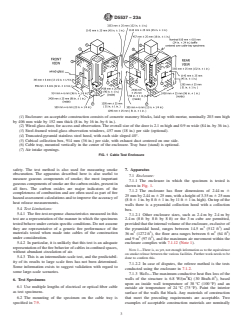
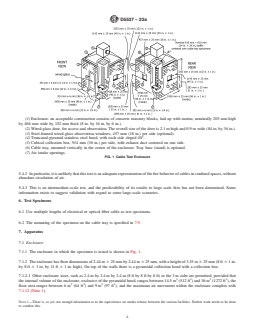
(1) Enclosure: an acceptable construction consists of concrete masonry blocks, laid up with mortar, nominally 203 mm high
by 406 mm wide by 152 mm thick (8 in. by 16 in. by 6 in.).
(2) Wired-glass door, for access and observation. The overall size of the door is 2.1 m high and 0.9 m wide (84 in. by 36 in.).
(3) Steel-framed wired-glass observation windows, 457 mm (18 in.) per side (optional).
(4) Truncated-pyramid stainless steel hood, with each side sloped 40°.
(5) Cubical collection box, 914 mm (36 in.) per side, with exhaust duct centered on one side.
(6) Cable tray, mounted vertically in the center of the enclosure. Tray base (stand) is optional.
(7) Air intake openings.
FIG. 1 Cable Test Enclosure
safety. The test method is also used for measuring smoke 7. Apparatus
obscuration. The apparatus described here is also useful to
7.1 Enclosure:
measure gaseous components of smoke; the most important
7.1.1 The enclosure in which the specimen is tested is
gaseous components of smoke are the carbon oxides, present in
shown in Fig. 1.
all fires. The carbon oxides are major indicators of the
7.1.2 The enclosure has floor dimensions of 2.44 m 6
completeness of combustion and are often used as part of fire
25 mm by 2.44 m 6 25 mm, with a height of 3.35 m 6 25 mm
hazard assessment calculations and to improve the accuracy of
(8 ft 6 1 in. by 8 ft 6 1 in. by 11 ft 6 1 in. high). On top of the
heat release measurements.
walls there is a pyramidal collection hood with a collection
5.4 Test Limitations:
box.
5.4.1 The fire-test-response characteristics measured in this
7.1.2.1 Other enclosure sizes, such as 2.4 m by 2.4 m by
test are a representation of the manner in which the specimens
2.4 m (8 ft by 8 ft by 8 ft) or the 3 m cube are permitted,
tested behave under certain specific conditions. Do not assume
provided that the internal volume of the enclosure, exclusive of
3 3
they are representative of a generic fire performance of the
the pyramidal hood, ranges between 14.5 m (512 ft ) and
3 3 2 2
materials tested when made into cables of the construction
36 m (1272 ft ), the floor area ranges between 6 m (64 ft )
2 2
under consideration.
and 9 m (97 ft ), and the maximum air movement within the
5.4.2 In particular, it is unlikely that this test is an adequate
enclosure complies with 7.1.12 (Note 1).
representation of the fire behavior of cables in confined spaces,
NOTE 1—There is, as yet, not enough information as to the equivalence
without abundant circulation of air.
on smoke release between the various facilities. Further work needs to be
5.4.3 This is an intermediate-scale test, and the predictabil-
done to confirm this.
ity of its results to large scale fires has not been determined.
7.1.2.2 In case of disputes, the referee method is the tests
Some information exists to suggest validation with regard to
conducted using the enclosure in 7.1.2.
some large-scale scenarios.
7.1.3 Walls—The maximum conductive heat flux loss of the
2 2
walls of the structure is 6.8 W/(m K) (30 Btu/h-ft ), based
6. Test Specimens
upon an inside wall temperature of 38 °C (100 °F) and an
6.1 Use multiple lengths of electrical or optical fiber cable
outside air temperature of 24 °C (75 °F). Paint the interior
as test specimens.
surface of the walls flat black. Any materials of construction
6.2 The mounting of the specimen on the cable tray is that meet the preceding requirements are acceptable. Two
specified in 7.9. examples of acceptable construction materials are nominally
D5537 − 23a
152 mm (6 in.) thick concrete masonry blocks (density:
−3 −3
1700 kg m (106 lb ft ) and thermal conductivity nominally
k = 1.75 W/(mK), at 21 °C; 12.13 Btu in./ft h°F, at 70 °F) or
nominally 13 mm (0.5 in.) gypsum board, with 89 mm 6 6 mm
(3.5 in. 6 0.25 in.) of standard fiberglass insulation, with an R
value of 1.94 m K/W (which corresponds in practical units to
an R value of 11 hft °F/Btu). Windows for observation of the
fire test are allowed in the walls; ensure that the total area of the
2 2
windows does not exceed 1.86 m (20 ft ).
7.1.3.1 Select materials of construction which can withstand
the high temperatures and presence of open flame within the
test enclosure and duct.
7.1.4 Provide air intakes at the base of two opposite walls,
one of which contains the access door. Ensure that the total
2 2
cross sectional area of the air intakes is 1.45 m 6 0.03 m
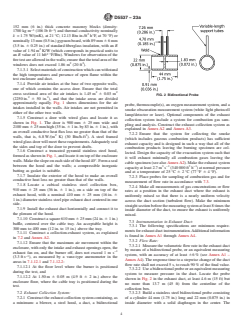
FIG. 2 Bidirectional Probe
2 2
(2250 in. 6 50 in. ), and that the intake areas are divided
approximately equally. Fig. 1 shows dimensions for the air
probe, thermocouple(s), an oxygen measurement system, and a
intakes installed in the walls. Air intakes are not permitted in
smoke obscuration measurement system (white light photocell
either of the other two walls.
lamp/detector or laser). Optional components of the exhaust
7.1.5 Construct a door with wired glass and locate it as
collection system include a system for combustion gas sam-
shown in Fig. 1. The door is 900 mm 6 25 mm wide and
pling and analysis. Construct the exhaust collection system as
2100 mm 6 25 mm high (35 in. 6 1 in. by 83 in. 6 1 in.), with
explained in Annex A2 and Annex A3.
an overall conductive heat flux loss no greater than that of the
7.2.2 Ensure that the system for collecting the smoke
2 2
walls, that is, 6.8 W ⁄(m K) (30 Btu/h-ft ). A steel framed
(which includes gaseous combustion products) has sufficient
wired glass door will meet these requirements. Adequately seal
exhaust capacity and is designed in such a way that all of the
the sides and top of the door to prevent drafts.
combustion products leaving the burning specimen are col-
7.1.6 Construct a truncated pyramid stainless steel hood,
lected. Design the capacity of the evacuation system such that
formed as shown in Fig. 1, and locate it on top of the enclosure
it will exhaust minimally all combustion gases leaving the
walls. Make the slope on each side of the hood 40°. Form a seal
cable specimen (see also Annex A2). Make the exhaust system
between the hood and the walls; a compressible inorganic 3 −1 3 −1
capacity at least 2.7 m s (340 000 ft h ) at normal pressure
batting as gasket is suitable.
and at a temperature of 25 °C 6 2 °C (77 °F 6 4 °F).
7.1.7 Insulate the exterior of the hood to make an overall
7.2.3 Place probes for sampling of combustion gas and for
conductive heat loss no greater than that of the walls.
measurement of flow rate in accordance with 7.3.
7.1.8 Locate a cubical stainless steel collection box,
7.2.4 Make all measurements of gas concentrations or flow
910 mm 6 25 mm (36 in. 6 1 in.), on a side on top of the
rates at a position in the exhaust duct where the exhaust is
exhaust hood, with a nominal 410 mm 6 25 mm (16 in. 6
uniformly mixed so that there is a nearly uniform velocity
1 in.) diameter stainless steel pipe exhaust duct centered in one
across the duct section (turbulent flow). Make the minimum
side.
straight section before the measuring system at least 8 times the
7.1.9 Install the exhaust duct horizontally and connect it to
inside diameter of the duct, to ensure the exhaust is uniformly
the plenum of the hood.
mixed.
7.1.10 Construct a square 610 mm 6 25 mm (24 in. 6 1 in.)
7.3 Instrumentation in Exhaust Duct:
baffle, centered over the cable tray. An acceptable height is
7.3.1 The following specifications are minimum require-
300 mm to 400 mm (12 in. to 15 in.) above the tray.
ments for exhaust duct instrumentation. Additional information
7.1.11 Construct a collection-exhaust system, as explained
is found in Annex A1 through Annex A4.
in 7.2 and Annex A2.
7.3.2 Flow Rate:
7.1.12 Ensure that the maximum air movement within the
7.3.2.1 Measure the volumetric flow rate in the exhaust duct
enclosure, with only the intake and exhaust openings open, the
by means of a bidirectional probe, or an equivalent measuring
−1
exhaust fan on, and the burner off, does not exceed 1 m s
system, with an accuracy of at least 66 % (see Annex A1 –
−1
(3.3 ft s ), as measured by a vane-type anemometer in the
Annex A4). The response time to a stepwise change of the duct
areas in 7.1.12.1 and 7.1.12.2:
flow rate shall not exceed 5 s, to reach 90 % of the final value.
7.1.12.1 At the floor level where the burner is positioned
7.3.2.2 Use a bidirectional probe or an equivalent measuring
during the test, and
system to measure pressure in the duct. Locate the probe
7.1.12.2 At 1.50 m 6 0.05 m (4.9 ft 6 2 in.) above the
shown in Fig. 2 in the exhaust duct, at least 4.6 m (15 ft) but
enclosure floor, where the cable tray is positioned during the
no more than 13.7 m (45 ft) from the centerline of the
test.
collection box.
7.2 Exhaust Collection System: 7.3.2.3 Build a stainless steel bidirectional probe consisting
7.2.1 Construct the exhaust collection system containing, as of a cylinder 44 mm (1.75 in.) long and 22 mm (0.875 in.) in
a minimum: a blower, a steel hood, a duct, a bidirectional inside diameter with a solid diaphragm in the center. The
D5537 − 23a
7.5.1.1 Construct the sampling line tubes using a material
which is not affected by the combustion gas species, thereby
influencing the concentration of the combustion gas species to
be analyzed. The recommended sequence of the gas train is:
sampling probe, soot filter, cold trap, gas path pump, vent
valve, plastic drying column and carbon dioxide removal
columns (if used), flow controller and oxygen analyzer. Each
analyzer in the gas train shall also include appropriate spanning
and zeroing facilities.
7.5.1.2 Locate the sampling probe in a position where the
exhaust duct flow is well mixed. Use a probe with a cylindrical
cross section to minimize disturbance of the air flow in the
duct. Collect the gas samples along the whole diameter of the
exhaust duct.
7.5.1.3 Manufacture the sampling line, see Fig. 5, from
corrosion resistant material, for example polytetrafluoroethyl-
FIG. 3 Optical System
ene. Remove the particulates contained in the combustion
gases with inert filters to the degree required by the gas
analysis equipment. Preferably filter the gases in more than one
pressure taps on either side of the diaphragm also provide
step. Cool the gas mixture to a maximum of 10 °C and dry the
support for mounting the probe. Position the long axis of the
gas samples completely before the smoke reaches each ana-
probe along the centerline of the duct. Connect the taps to a
lyzer.
pressure transducer which can detect pressure differences as
7.5.1.4 Use a pump for the combustion gases which does
small as 0.25 Pa (0.001 in. of water).
not allow the gases to contact oil, grease or similar products, all
7.3.2.4 Measure the mass flow rate as indicated in Annex
of which can contaminate the gas mixture. A membrane pump
A4.
is suitable.
7.3.2.5 Measure gas temperatures in the vicinity of the
7.5.1.5 A suitable sampling probe is shown in Fig. 6. This
probe with Inconel sheathed Chromel-Alumel thermocouples.
sampling probe is of the bar type. Ring type sampling probes
Ensure that the thermocouple does not disturb the flow pattern
are also acceptable, although they do not collect gas samples
around the bidirectional probe. Further details are discussed in
across the full diameter of the duct. The sampling line is shown
A1.3.
−1
in Fig. 5. A suitable pump has a capacity of 10 L min to 50
−1
7.4 Smoke Obscuration Measurements:
L min at 10 kPa (minimum), as each gas analysis instrument
7.4.1 Install an optical system for measurement of light −1
consumes about 1 L min . A pressure differential of at least
obscuration across the centerline of the exhaust duct. Deter-
10 kPa, as generated by the pump, reduces the risk of smoke
mine the optical density of the smoke by measuring the light
clogging of the filters. Turn the intake of the sampling probe
transmitted with a photometer system consisting of a white
downstream to avoid soot clogging the probe.
light source and a photocell/detector or a laser system for
7.5.1.6 Install a soot filter, capable of removing all particles
measurement of light obscuration across the centerline of the
>25 μm in size.
exhaust duct. Locate the system so that it is preceded by at least
7.5.1.7 A refrigerated column is the most successful ap-
eight diameters of duct without bends, to ensure a nearly
proach to cool and dry the gases. Provide a drain plug to
uniform velocity across the duct section. If the system is
remove the collected water from time to time. Alternative
positioned at a different location, demonstrate the achievement
devices are also acceptable.
of equivalent results.
7.5.1.8 If carbon dioxide is to be removed, it is important to
7.4.2 One photometer system found suitable consists of a
use carbon dioxide removal media, as indicated in Fig. 5.
lamp, lenses, an aperture and a photocell (see Fig. 3 and Annex
7.5.2 Oxygen Measurement:
A3). Construct the system so that soot deposits on the optics
7.5.2.1 Measure the oxygen concentration with an accuracy
during a test do not reduce the light transmission by more than
of at least6 0.04 % of full scale in the output range of 0 to
5 %.
21 vol % oxygen, or 60.01 vol % oxygen, in order to have
7.4.2.1 Alternatively, instrumentation constructed using a
adequate measurements of rate of heat release. Take the
0.5 mW to 2.0 mW helium-neon laser, instead of a white light
combustion gas sample from the end of the sampling line.
system is also acceptable. See Fig. 4 and Annex A3 for further
Calculate the time delay, including the time constant of the
details. White light and laser systems give similar results
8 instrument, from the test room; it is a function of the exhaust
(1-5) .
duct flow rate. This time delay shall not exceed 60 s.
7.5 Combustion Gas Analysis:
7.5.2.2 Use an oxygen analyzer, meeting the specifications
7.5.1 Sampling Line:
of 7.5.2.1, preferably of the paramagnetic type.
7.6 Cable Tray:
7.6.1 Use a steel ladder cable tray, 300 mm 6 25 mm (12 in.
The boldface numbers in parentheses refer to the list of references at the end of
this test method. 6 1 in.) wide, 75 mm 6 6 mm (3 in. 6 0.25 in.) deep, and
D5537 − 23a
FIG. 4 Laser Extinction Beam
FIG. 5 Schematic Diagram of Gas Analysis System
2440 mm 6 25 mm (8 ft 6 1 in.) long. Arrange the tray so that
the burner flame will impinge on the cables midway between
rungs.
7.6.1.1 Each rung in the tray is to measure 25 mm 6 6 mm
(1 in. 6 0.25 in.) in the direction parallel to the length of the
tray and 13 mm 6 3 mm (0.5 in. 6 0.125 in.) in the direction
parallel to the depth of the tray.
7.6.1.2 Space the rungs 230 mm 6 13 mm (9 in. 6 0.5 in.)
apart (measured center to center).
7.6.1.3 Attach the rungs to the side rails.
FIG. 6 Sampling Probe
7.6.1.4 Mount the cable tray vertically in the center of the
enclosure. Position the tray on a tray base (stand) which is to
be no higher than 150 mm 6 25 mm (6 in. 6 1 in.).
D5537 − 23a
FIG. 7 Burner Holes
7.7 Burner:
7.7.1 Use a 254 mm (10-in.) strip or ribbon type propane
gas burner with an air/gas Venturi mixer.
7.7.2 The flame producing surface of the burner consists
essentially of a flat metal plate that is 341 mm (13 ⁄16 in.) long
and 30 mm (1 ⁄32 in.) wide. The plate has an array of 242 holes
drilled in it. The holes are 1.35 mm (metric drill size: 1.35 mm)
or 0.052 in. (No. 55 drill) in diameter, on 3.2 mm (0.125-in.)
centers in three staggered rows of 81, 80, and 81 holes each, to
1 3
form an array measuring 257 mm (10 ⁄8 in.) by 5 mm ( ⁄16 in.).
Center the array of holes on the plate (see Fig. 7).
7.7.3 Protocol A:
7.7.3.1 Position the burner behind the cable tray containing
the specimen, with the flame-producing surface (face) of the
burner vertical and its long dimension horizontal and with the
257 mm (10 ⁄8-in.) dimension of the array of holes spaced
76 mm 6 5 mm (3.0 in. 6 0.2 in.) from the specimens in the
tray and centered midway between the side rails of the tray.
FIG. 8 Protocol B Cable Tray
Position the centerpoint of the array of holes at 460 mm (18 in.)
above the bottom end of the tray and specimen and midway
7.7.8 Use air with a dew point no greater than 0 °C (32 °F),
between two rungs. Support the burner in a manner that allows
as measured by a dew point measuring device.
it quick removal and precise repositioning of the burner to the
7.7.9 Use CP grade propane (99 % pure), having a heat
position described. The tray faces the door.
−1 −1
content of approximately 50.8 MJ kg (21.7 k Btu lb )
7.7.4 Protocol B:
−3
(93.0 MJ m at 20 °C, 101 kPa), for the burner.
7.7.4.1 Mount the burner on a stand and place it 20° 6 2°
3 −1 3 −1
7.7.10 Use a propane flow rate of 220 cm s 6 8 cm s
from the horizontal with the burner ports up, in front of the
3 −1 3 −1
(28 ft h 6 1 ft h ) when corrected to standard temperature
cable tray. Locate the major axis of the burner ports 305 mm 6
and pressure (20 °C, 101 kPa). This propane flow will provide
25 mm (12 in. 6 1 in.) above the base of the cable tray and
a theoretical heat output of 20 kW (approximately 70 000 Btu
parallel to the cable tray rungs during the fire test (Fig. 8). The
−1
h ). The actual heat output is less, due to incomplete combus-
tray faces away from the door.
tion of the propane at the burner. Accurate flow rates of
7.7.4.2 Attach a guide to the burner or stand such that the
propane gas are calculated using the mass flow rate equations.
leading edge of the burner face is located quickly and accu-
3 −1
7.7.11 Use an air flow rate to the burner of 1280 cm s 6
rately 75 mm 6 5 mm (3 in. 6 0.2 in.) horizontally away from
3 −1 3 −1 3 −1
80 cm s (163 ft h 6 10 ft h ) when corrected to standard
the nearest surface of the cables during the burn period of the
temperature and pressure.
test.
7.7.5 Insert a flowmeter in both the propane and the air lines 7.8 Mass Loss Measuring Device:
feeding the burner to measure the flow rates of these gases 7.8.1 Use a mass measuring device, such as a load cell, to
during the test. continuously measure the mass loss of the burning specimen.
7.7.6 Use a propane flowmeter capable of measuring at least 7.8.2 The mass measuring device needs to measure the
3 −1 3 −1
230 cm s (29 ft h ) and an air flowmeter of at least specimen mass with an accuracy of at least 645 g (1.6 oz) up
−1 3 −1
1330 cm s (170 ft h ). Make flow rate measurements with to at least 90 kg (198 lb) of specimen mass. Install it in such a
an accuracy of 63 %. Mass flow controllers with recordable way that the heat from the burning specimen and any eccen-
outputs are permitted alternatives. tricity of the load does not affect the accuracy. Avoid range
7.7.7 Supply compressed air to the burner, either bottled or shifts during measurements. Protect all parts of the weight
from a compressed air system. Filter the air supply sufficiently measuring device by a thermal barrier.
so as to eliminate any contaminants that might affect the test 7.8.3 There are two alternative locations for the mass
results. measuring device, as described in 7.8.4 – 7.8.6.
D5537 − 23a
TABLE 1 Tray Loading for Circular Cables Smaller than 13 mm
7.8.4 Alternative 1—Place the mass measuring device under
(0.5 in.) in Diameter
a platform, with a thermal barrier of dimensions 0.3 m 6
Cable Diameter, mm
0.05 m by 0.3 m 6 0.05 m (1 ft 6 2 in. by 1 ft 6 2 in.) and of Number of Cables Number of Bundles
in Each Bundle in Tray
From But Less Than
a non-combustible material, for example calcium silicate
11 13 3 7
boards. Provide the platform with sides of 0.1 m 6 10 mm
9 11 3 8
(4 in. 6 0.4 in.) height in order to prevent melting or falling
6 9 3 10
material from the tested specimens from falling off the thermal
5 6 7 9
3 5 19 8
barrier.
0 3 19 13
7.8.5 Do not exceed 0.5 m (20 in.) from the upper surface of
the thermal barrier to floor level. Shield the area between the
thermal barrier and the floor level to avoid lifting forces due to
fire induced air flow that could influence the measurement.
rung of the cable tray using one wrap of a copper or steel wire
Ensure that there are virtually no obstructions to the air supply
tie not larger than 2.1 mm (14 AWG) in diameter.
for the test set-up.
7.9.2.1 For cables smaller in diameter than 13 mm (0.5 in.),
7.8.6 Alternative 2—Place the mass measuring device in the
group the specimens into untwisted bundles (nominally circu-
hood and hang the cable tray from it. Thermal and combustion
lar) as shown in Table 1. Space the bundles one-half bundle
gas protection of the mass measuring equipment is still
diameter apart on the cable tray as measured at the point of
required.
attachment to the cable tray.
7.8.7 Place a square galvanized steel platform under the
7.9.2.2 For cables 13 mm (0.5 in.) in diameter and larger,
cable tray. The platform shall be constructed of nominally
attach the individual specimens to the cable tray with spacings
1.6 mm ( ⁄16 in.) thick steel, and have dimensions of no less
of ⁄2 cable diameter, except do not exceed a spacing of 15 mm
than 1.0 m by 1.0 m (approximately 39 in. by 39 in.), with a
(0.6 in.). Table 2 shows the tray loading.
uniform raised lip, 100 mm (approximately 4 in.) high, on each
7.9.3 On flat cables, calculate the equivalent cable diameter
side, to catch falling material. The platform shall be covered by
using Eq 2
a tight fitting sheet of standard gypsum board, of nominally
D 5 1.128 ×=~T × W! (2)
13 mm (0.5 in.) thickness. The platform shall protect the load
cell, if it is placed underneath the cable tray. The gypsum board
where:
shall be clean before the start of a test. If the sheet used has
D = calculated equivalent cable diameter,
been damaged it shall be replaced.
T = minor axis of the cable, and
W = major axis of the cable.
NOTE 2—A square galvanized steel platform of dimensions of up to
1.22 m by 1.22 m (approximately 4 ft by 4 ft) with a raised lip is also
acceptable. 8. Calibration
7.9 Cable Mounting: 8.1 Calibrate all instruments carefully with standard sources
7.9.1 Protocol A—Fasten 2440 mm 6 10 mm (96-in. 6 after initial installation. Among the instruments to be calibrated
0.5-in.) specimen lengths of finished cable in a single layer in are load cells or weighing platforms, smoke meters, flow or
the tray by means of steel or copper wire, not larger than velocity transducers, and gas analyzers. Perform recalibration
2.1 mm (14 AWG) in cross section, at their upper and lower tests on the entire system, for example using standard output
ends and at two other equally spaced points along their lengths, burners.
with each cable vertical. Install as many specimens in the tray
8.2 Heat Release:
as will fit, spaced one half cable diameter apart, to fill the
8.2.1 Perform the calibration of the heat release instrumen-
center 150 mm (6 in.) of the tray width.
tation in the exhaust duct by burning propane gas and compar-
7.9.1.1 Determine the number of specimen lengths for test
ing the heat release rates calculated from the metered gas input,
using Eq 1:
and those calculated from the measured oxygen consumption.
The value of net heat of combustion for propane is 46.5 MJ/kg.
N 5 @~4 × 25.4!/D#10.33 (1)
Position the burner in the same location that the cable tray will
where:
occupy during the test. Measure the gas flow rate at a pressure
N = number of cables (rounded up to the nearest whole
of 101 kPa 6 5 kPa (standard atmospheric pressure, measured
number), and
at the flow gage) and a temperature of 20 °C 6 5 °C. Use Eq
D = diameter of the cable, mm.
A5.7 for calculation of heat release rate during calibration.
7.9.2 Protocol B—Fasten 2440 mm 6 10 mm (96 in. 6 8.2.2 Obtain a minimum of two calibration points. Obtain a
0.5 in.) specimen lengths of finished cable in the tray. Depend- lower heat release rate value of 40 kW and then a higher heat
ing upon the outside diameter of the individual cables, the test release rate value of 160 kW. Approximate propane flow rates
specimen is to be either an individual length or a bundle of for any required heat release rate value are estimated using the
individual lengths. Center the specimens or specimen bundles following constant: 1.485 kW min/L, determined at a pressure
in a single layer between the side rails of the cable tray. Ensure of 101 kPa 6 5 kPa (standard atmospheric pressure; measured
that the lower end of each specimen is no more than 100 mm at the flow gage) and a temperature of 20 °C 6 5 °C.
(4 in.) above the bottom end of the cable tray. Attach each 8.2.3 Take measurements at least once every 6 s and start
individual specimen or bundle of specimens separately to each 1 min prior to ignition of the burner. Determine the average
D5537 − 23a
TABLE 2 Tray Loading for Cables 13 mm (0.5 in.) in Diameter and
6 10 °F) with a relative humidity of less than 55 %. Test cables
Larger
within 10 min of removal from such conditions if test room
Cable Diameter, mm
conditions differ from the preceding conditions.
Number of Cables in Tray
From But Less Than
13 15 11
10. Procedure
15 19 9
19 21 8
10.1 Do not carry out the test if the temperature of the
21 26 7
chamber wall is below 5 °C (41 °F) or above 30 °C (86 °F).
26 28 6
28 39 5 3 −1
10.2 Establish an initial volumetric flow rate of 0.65 m s
39 52 4
3 −1 3 −1 3 −1
6 0.05 m s (23 ft s 6 2 ft s ) through the duct. See
52 73 3
73 120 2
Annex A1 for the measuring techniques and for the equation to
calculate volumetric flow rate of the gas in the duct (Eq A1.1).
Record the volumetric flow rate as a function of time, starting
rate of heat release over a period of at least 1 min by (1) the 1 min prior to the test. Do not change the flow rate once the
oxygen consumption method, and (2) calculating the heat
initial flow rate is established.
release rate from the gas mass flow rate and the net heat of
10.3 Position the prepared cable tray vertically inside the
combustion. The two values must agree within 5 %. Make this
enclosure with the open front of the cable tray facing the front
comparison only after steady state conditions are reached.
of the enclosure. Fix the cable tray firmly in position.
8.2.4 Perform a calibration test in accordance with 8.2.1 and
8.2.3 prior to each continuous test series. Perform a full basic 10.4 Start all recording and measuring devices before start-
ing the ignition burner, to ensure they are stabilized.
calibration on a new system or when modifications are intro-
duced.
10.5 Ignite the gas mixture in the burner and adjust the gas
8.2.5 When calibrating a new system, or when modifica-
flows to the values specified in 7.7.10 and 7.7.11. Position the
tions are introduced, check the response time of the measuring
burner as indicated in 7.7.3 (Protocol A) or 7.7.4 (Protocol B).
system by the following test sequence:
See Fig. 8 for the relative positions of the cable tray and burner
Time Burner Output
in the enclosure.
0 to 5 min 0 kW
5 to 10 min 40 kW
10.6 Allow the burner flame to impinge on the cable
10 to 15 min 160 kW
specimen for a continuous period of 20 min.
15 to 20 min 0 kW
The response of the system to a stepwise change of the heat
10.7 At 20 min, extinguish the burner flame, but allow the
output from the burner shall be a maximum of 12 s to 90 % of cable fire (if any) to burn out.
final value.
10.8 Optionally, photograph or video record before and
8.2.6 Perform the calibration in 8.2.5 at a duct air flow rate
during the test. Include a clock, giving time to the nearest 1 s,
comparable to that to be used in the test procedure.
in all photographic records.
8.2.7 Determine the time average value, over 1 min, of rate
10.9 During the test, record the following events and the
of heat release at each minute. The difference between these
time averaged measured rate of heat release values and the time interval when they occur (beginning and end).
actual heat output from the burner, shall not be more than 10 % 10.9.1 Ignition of the specimen,
of the actual value.
10.9.2 Position of flame front,
10.9.3 Melting and dripping,
8.3 Mass Loss:
8.3.1 Perform calibration of the mass measuring device by 10.9.4 Occurrence of pool fire under the specimen,
loading the weighing platform with known masses correspond- 10.9.5 General description of the burning behavior,
ing to the measuring range of interest, to ensure that the
10.9.6 Time of afterburn, after extinguishing the propane,
requirements of accuracy in 7.8.2 are fulfilled. Carry out this
and
calibration daily, prior to testing.
10.9.7 Any other event of special interest.
8.4 Smoke Release:
NOTE 3—It is possible for ignition of the cables to occur almost
8.4.1 Prior to the start of each day of testing, verify the
immediately after ignition of the burner. However, time to ignition of the
linearity of the photometer system by interrupting the light cables is occasionally difficult to determine.
beam with multiple calibrated neutral density filters to cover
10.10 Conduct the procedure in duplicate. Conduct each
the range of the recording instrument. Use at least two neutral
procedure (burn) on untested cable specimens.
density filters of significantly different values, and also one for
10.11 Evaluation of Damage:
100 % transmission. Ensure that the transmittance values
measured by the photometer, using neutral density filters, are 10.11.1 After burning has ceased, let the cables and tray
cool to room temperature, then wipe the cables clean with a
within 6 3 % of the specified value for each filter.
cloth and determine cable damage.
9. Conditioning
10.11.1.1 Protocol A—Determine the maximum height of
9.1 Prior to testing, condition the cable specimen for at least cable damage by measuring the blistering, char, and other
3 h in an atmosphere at a temperature of 23 °C 6 5 °C (73 °F damage upward from the bottom of the vertical tray.
D5537 − 23a
10.11.1.2 Protocol B—Determine the maximum height of 12.1.1.11 Test number, Protocol (A or B) and any special
cable damage by measuring the blistering, char, and other remarks.
damage from the lower edge of the burner face. 12.1.2 Test Results:
10.11.2 Determine the limit of charring by pressing against 12.1.3 Table of Mandatory Numerical Results Containing:
the cable surface with a sharp object. Where the surface of the 12.1.3.1 Maximum char damage, m,
cable (outer jacket, if any) changes from a resilient surface to 12.1.3.2 Peak rate of heat release, kW, and the appropriate
a brittle (crumbling) surface determines the limit of charring. time at which it occurred,
Include distortion of the outer surface of the cable, such as 12.1.3.3 Total heat released, MJ,
blistering or melting, immediately above the char, in the 12.1.3.4 Time of afterburn, s,
2 –1
damage measurement. 12.1.3.5 Peak rate of smoke release, m s , and the appro-
10.11.3 Record the cable damage (char) to the nearest priate time at which it occurred,
25 mm (1 in.). On cable constructions that do not have 12.1.3.6 Total smoke released, m ,
charring, define the limit for the affected portion as the point 12.1.3.7 Total mass loss, g,
where the overall diameter is visibly reduced or increased. 12.1.3.8 Percentage of mass loss, %,
10.11.4 For engineering information, record damage such as 12.1.3.9 Peak flame height, m, and the appropriate time at
blistering, or softening/melting of combustible material above which it occurs,
−1
the char. 12.1.3.10 Peak mass loss rate, g s ,
−1
12.1.3.11 Average mass loss rate, over the entire burn, g s ,
10.12 Heat Release Measurements:
and
10.12.1 Make continuous measurements of heat release by
12.1.3.12 Equation used to calculate rate of heat release.
measuring oxygen concentration and mass flow rate in the
12.1.4 Additional Table of Mandatory Numerical Results
exhaust duct.
Containing:
10.12.2 From these measurements and the equations in
12.1.4.1 Total heat release data after every minute,
Annex A5 determine the rates and amounts of heat release.
12.1.4.2 Rate of heat release data after every minute,
These values together with the visual recordings constitute the
12.1.4.3 Total smoke release data after every minute,
results from the test.
12.1.4.4 Rate of smoke release data after every minute,
12.1.4.5 Mass loss rate data after every minute, and
11. Calculation
12.1.4.6 Volumetric flow rate after every minute.
11.1 Considerations for heat release measurements are pre-
12.1.5 Mandatory Graphical Results:
sented in Appendix X2. The corresponding equations for heat
12.1.5.1 Plot of rate of heat release versus time,
release calculations are presented in Annex A5. The testing
12.1.5.2 Plot of total heat released versus time,
laboratory shall choose which of the equations in Annex A5 it
12.1.5.3 Plot of rate of smoke release versus time,
wishes to use for the heat release calculations. Equations for
12.1.5.4 Plot of total smoke released versus time, and
smoke release calculations are presented in Annex A6.
12.1.5.5 Plot of mass loss rate versus time.
12.1.6 Descriptive Results:
12. Report
12.1.6.1 Photographs or videotape, if available, of the fire
12.1 Report the following information: development, and
12.1.1 Descriptive Information:
12.1.6.2 All available information listed in 10.9.
12.1.1.1 Name and address of the testing laboratory,
13. Precision and Bias
12.1.1.2 Inside dimensions of enclosure,
13.1 Precision—The precision of this test method has not
12.1.1.3 Date and identification number of the report,
been determined. Results of a planned interlaboratory test
12.1.1.4 Methods of sampling for selecting the test
series will be included when available.
specimens,
12.1.1.5 Name of product manufacturer or supplier, if
13.2 Bias—The true value of fire performance of electrical
known,
or optical fiber cables can only be defined in terms of a test
12.1.1.6 Name or other identification marks and description
method. Within this limitation, this test method has no known
of the product,
bias and can be accepted as a reference method.
12.1.1.7 Density, or weight per unit surface, and total mass,
14. Keywords
thickness of the main components in the product (including
jacket and insulation), and mass of combustible portion of 14.1 cable; cable tray; cal
...
This document is not an ASTM standard and is intended only to provide the user of an ASTM standard an indication of what changes have been made to the previous version. Because
it may not be technically possible to adequately depict all changes accurately, ASTM recommends that users consult prior editions as appropriate. In all cases only the current version
of the standard as published by ASTM is to be considered the official document.
Designation: D5537 − 23 D5537 − 23a
Standard Test Method for
Heat Release, Flame Spread, Smoke Obscuration, and Mass
Loss Testing of Insulating Materials Contained in Electrical
or Optical Fiber Cables When Burning in a Vertical Cable
Tray Configuration
This standard is issued under the fixed designation D5537; the number immediately following the designation indicates the year of
original adoption or, in the case of revision, the year of last revision. A number in parentheses indicates the year of last reapproval. A
superscript epsilon (´) indicates an editorial change since the last revision or reapproval.
1. Scope*
1.1 This is a fire-test-response standard.
1.2 This test method provides a means to measure the heat released and smoke obscuration by burning the electrical insulating
materials contained in electrical or optical fiber cables when the cable specimens, excluding accessories, are subjected to a
specified flaming ignition source and burn freely under well ventilated conditions. Flame propagation cable damage, by char
length, and mass loss are also measured.
1.3 This test method provides two different protocols for exposing the materials, when made into cable specimens, to an ignition
source (approximately 20 kW), for a 20 min test duration. Use it to determine the heat release, smoke release, flame propagation
and mass loss characteristics of the materials contained in single and multiconductor electrical or optical fiber cables.
1.4 This test method does not provide information on the fire performance of materials insulating electrical or optical fiber cables
in fire conditions other than the ones specifically used in this test method nor does it measure the contribution of the materials in
those cables to a developing fire condition.
1.5 Data describing the burning behavior from ignition to the end of the test are obtained.
1.6 This test equipment is suitable for measuring the concentrations of certain toxic gas species in the combustion gases (see
Appendix X4).
1.7 The values stated in SI units are to be regarded as standard (see IEEE/ASTM SI-10). The values given in parentheses are
mathematical conversions to inch-pound units that are provided for information only and are not considered standard.
1.8 This standard measures and describes the response of materials, products, or assemblies to heat and flame under controlled
conditions, but does not by itself incorporate all factors required for fire hazard or fire risk assessment of the materials, products
or assemblies under actual fire conditions
This test method is under the jurisdiction of ASTM Committee D09 on Electrical and Electronic Insulating Materials and is the direct responsibility of Subcommittee
D09.17 on Fire and Thermal Properties.
Current edition approved Feb. 1, 2023May 1, 2023. Published February 2023May 2023. Originally approved in 1994. Last previous edition approved in 20182023 as
D5537 – 18.D5537 – 23. DOI: 10.1520/D5537-23.10.1520/D5537-23A.
*A Summary of Changes section appears at the end of this standard
Copyright © ASTM International, 100 Barr Harbor Drive, PO Box C700, West Conshohocken, PA 19428-2959. United States
D5537 − 23a
1.9 Fire testing is inherently hazardous. Adequate safeguards for personnel and property shall be employed in conducting these
tests.
1.10 This standard does not purport to address all of the safety concerns, if any, associated with its use. It is the responsibility
of the user of this standard to establish appropriate safety, health, and environmental practices and determine the applicability of
regulatory limitations prior to use.
1.11 This international standard was developed in accordance with internationally recognized principles on standardization
established in the Decision on Principles for the Development of International Standards, Guides and Recommendations issued
by the World Trade Organization Technical Barriers to Trade (TBT) Committee.
2. Referenced Documents
2.1 ASTM Standards:
D1711 Terminology Relating to Electrical Insulation
D5424 Test Method for Smoke Obscuration of Insulating Materials Contained in Electrical or Optical Fiber Cables When
Burning in a Vertical Cable Tray Configuration
E84 Test Method for Surface Burning Characteristics of Building Materials
E176 Terminology of Fire Standards
E603 Guide for Room Fire Experiments
E800 Guide for Measurement of Gases Present or Generated During Fires
E1354 Test Method for Heat and Visible Smoke Release Rates for Materials and Products Using an Oxygen Consumption
Calorimeter
E1537 Test Method for Fire Testing of Upholstered Furniture
E2067 Practice for Full-Scale Oxygen Consumption Calorimetry Fire Tests
E3020 Practice for Ignition Sources
IEEE/ASTM SI-10 International System of Units (SI), The Modernized Metric System
2.2 NFPA Standards:
NFPA 70 National Electrical Code
NFPA 265 Standard Methods of Fire Tests for Evaluating Room Fire Growth Contribution of Textile Wall Coverings
NFPA 286 Standard Methods of Fire Tests for Evaluating Contribution of Wall and Ceiling Interior Finish to Room Fire Growth
NFPA 289 Standard Method of Fire Test for Individual Fuel Packages
2.3 Underwriters Laboratories Standards:
UL 1581 Reference Standard for Electrical Wires, Cables, and Flexible Cords
UL 1685 Vertical Tray Fire Propagation and Smoke Release Test for Electrical and Optical Fiber Cables
UL 2556 Wire and Cable Test Methods
2.4 Canadian Standards Association Standard:
CSA FT4, Vertical Flame Tests: Cables in Cable Trays, Section 4.11.4 in Standard C 22.2 No. 0.3, Test Methods for Electrical
Wires and Cables
2.5 IEEE Standard:
IEEE 1202 Standard for Flame Testing of Cables for Use in Cable Tray in Industrial and Commercial Occupancies
2.6 ISO Standard:
ISO 9705 Fire Tests—Full Scale Room Test for Surface Products
ISO 13943 Fire Safety—Vocabulary
3. Terminology
3.1 For definitions of terms used in this test method and associated with fire issues refer to Terminology E176 and ISO 13943.
In case of conflict, the terminology in Terminology E176 shall prevail. For definitions of terms used in this test method and
associated with electrical insulation refer to Terminology D1711.
3.2 Definitions of Terms Specific to This Standard:
For referenced ASTM standards, visit the ASTM website, www.astm.org, or contact ASTM Customer Service at service@astm.org. For Annual Book of ASTM Standards
volume information, refer to the standard’s Document Summary page on the ASTM website.
Available from National Fire Protection Association (NFPA), 1 Batterymarch Park, Quincy, MA 02169-7471, http://www.nfpa.org.
Available from Underwriters Laboratories (UL), 333 Pfingsten Rd., Northbrook, IL 60062-2096, http://www.ul.com.
Available from Canadian Standards Association (CSA), 5060 Spectrum Way, Mississauga, ON L4W 5N6, Canada, http://www.csa.ca.
Available from Institute of Electrical and Electronics Engineers, Inc. (IEEE), 445 Hoes Ln., P.O. Box 1331, Piscataway, NJ 08854-1331, http://www.ieee.org.
Available from International Organization for Standardization (ISO), 1, ch. de la Voie-Creuse, Case postale 56, CH-1211, Geneva 20, Switzerland, http://www.iso.ch.
D5537 − 23a
3.2.1 heat release rate, n—the heat evolved from the specimen, per unit of time.
3.2.2 sample, n—an amount of the cable type and construction to be tested, which is representative of the product for test.
3.2.3 smoke obscuration, n—reduction of light transmission by smoke, as measured by light attenuation.
3.2.4 specimen, n—the individual length of cable, or cable bundle, to be placed in the cable tray, which is representative of the
product to be tested.
4. Summary of Test Method
4.1 This fire-test-response standard determines a number of fire-test-response characteristics associated with burning the materials
insulating electrical or optical fiber cables, made into cable specimens, and located in a vertical cable tray and ignited with a
propane gas burner. The main fire properties measured are the rate of heat release and its amount. Associated with these
measurements, the test procedure also determines flame propagation cable damage (by char length), smoke obscuration, and mass
loss of specimen. The apparatus described in this test method is also suitable for measuring rates and concentrations of gaseous
combustion products released.
4.2 The vertical cable tray that holds the specimen is located in an enclosure of specified dimensions.
4.3 A hood, connected to a duct is located above the fire enclosure. Heat and gas release analysis instrumentation is placed in the
duct. Smoke release instrumentation (optional) is also placed in the duct.
4.4 Two different test procedures are specified, specified (Protocol A and Protocol B), which differ in the burner used and in the
electrical or optical fiber cable loading. These reflect details of four existing test methods: UL 1581 (vertical tray flammability test,
protocol now transferred to UL 2556; corresponding to Protocol A) and CSA Standard C 22.2 C 22.2 No. 0.3 (FT4 vertical tray
flammability test) or IEEE 1202 (protocol (both corresponding to protocol B) and UL 1685 and Test Method D5424 (both
protocols, (corresponding to both protocols). Test Method D5424 is for smoke obscuration only).only. Both test procedures
described in detail in this test method are also identified in UL 2556.
4.5 Information specific to the individual protocols is found in 7.7, 7.9, and 11.1.
5. Significance and Use
5.1 This test method provides a means to measure a variety of fire-test-response characteristics associated with heat and smoke
release and resulting from burning the materials insulating electrical or optical fiber cables, when made into cables and installed
on a vertical cable tray. The specimens are allowed to burn freely under well ventilated conditions after ignition by means of a
propane gas burner. The ignition source used in this test method is also described as a premixed flame flaming ignition source in
Practice E3020, which contains an exhaustive compilation of ignition sources.
5.2 The rate of heat release often serves as an indication of the intensity of the fire generated. General considerations of the
importance of heat release rate are discussed in Appendix X1 and considerations for heat release calculations are in Appendix X2.
5.3 Other fire-test-response characteristics that are measurable by this test method are useful to make decisions on fire safety. The
test method is also used for measuring smoke obscuration. The apparatus described here is also useful to measure gaseous
components of smoke; the most important gaseous components of smoke are the carbon oxides, present in all fires. The carbon
oxides are major indicators of the completeness of combustion and are often used as part of fire hazard assessment calculations
and to improve the accuracy of heat release measurements.
5.4 Test Limitations:
5.4.1 The fire-test-response characteristics measured in this test are a representation of the manner in which the specimens tested
behave under certain specific conditions. Do not assume they are representative of a generic fire performance of the materials tested
when made into cables of the construction under consideration.
D5537 − 23a
(1) Enclosure: an acceptable construction consists of concrete masonry blocks, laid up with mortar, nominally 203 mm high
by 406 mm wide by 152 mm thick (8 in. by 16 in. by 6 in.).
(2) Wired-glass door, for access and observation. The overall size of the door is 2.1 m high and 0.9 m wide (84 in. by 36 in.).
(3) Steel-framed wired-glass observation windows, 457 mm (18 in.) per side (optional).
(4) Truncated-pyramid stainless steel hood, with each side sloped 40°.
(5) Cubical collection box, 914 mm (36 in.) per side, with exhaust duct centered on one side.
(6) Cable tray, mounted vertically in the center of the enclosure. Tray base (stand) is optional.
(7) Air intake openings.
FIG. 1 Cable Test Enclosure
5.4.2 In particular, it is unlikely that this test is an adequate representation of the fire behavior of cables in confined spaces, without
abundant circulation of air.
5.4.3 This is an intermediate-scale test, and the predictability of its results to large scale fires has not been determined. Some
information exists to suggest validation with regard to some large-scale scenarios.
6. Test Specimens
6.1 Use multiple lengths of electrical or optical fiber cable as test specimens.
6.2 The mounting of the specimen on the cable tray is specified in 7.9.
7. Apparatus
7.1 Enclosure:
7.1.1 The enclosure in which the specimen is tested is shown in Fig. 1.
7.1.2 The enclosure has floor dimensions of 2.44 m 6 25 mm by 2.44 m 6 25 mm, with a height of 3.35 m 6 25 mm (8 ft 6 1 in.
by 8 ft 6 1 in. by 11 ft 6 1 in. high). On top of the walls there is a pyramidal collection hood with a collection box.
7.1.2.1 Other enclosure sizes, such as 2.4 m by 2.4 m by 2.4 m (8 ft by 8 ft by 8 ft) or the 3 m cube are permitted, provided that
3 3 3 3
the internal volume of the enclosure, exclusive of the pyramidal hood, ranges between 14.5 m (512 ft ) and 36 m (1272 ft ), the
2 2 2 2
floor area ranges between 6 m (64 ft ) and 9 m (97 ft ), and the maximum air movement within the enclosure complies with
7.1.12 (Note 1).
NOTE 1—There is, as yet, not enough information as to the equivalence on smoke release between the various facilities. Further work needs to be done
to confirm this.
D5537 − 23a
7.1.2.2 In case of disputes, the referee method is the tests conducted using the enclosure in 7.1.2.
2 2
7.1.3 Walls—The maximum conductive heat flux loss of the walls of the structure is 6.8 W/(m K) (30 Btu/h-ft ), based upon an
inside wall temperature of 38 °C (100 °F) and an outside air temperature of 24 °C (75 °F). Paint the interior surface of the walls
flat black. Any materials of construction that meet the preceding requirements are acceptable. Two examples of acceptable
−3 −3
construction materials are nominally 152 mm (6 in.) thick concrete masonry blocks (density: 1700 kg m (106 lb ft ) and thermal
conductivity nominally k = 1.75 W/(mK), at 21 °C; 12.13 Btu in./ft h°F, at 70 °F) or nominally 13 mm (0.5 in.) gypsum board,
with 89 mm 6 6 mm (3.5 in. 6 0.25 in.) of standard fiberglass insulation, with an R value of 1.94 m K/W (which corresponds
in practical units to an R value of 11 hft °F/Btu). Windows for observation of the fire test are allowed in the walls; ensure that
2 2
the total area of the windows does not exceed 1.86 m (20 ft ).
7.1.3.1 Select materials of construction which can withstand the high temperatures and presence of open flame within the test
enclosure and duct.
7.1.4 Provide air intakes at the base of two opposite walls, one of which contains the access door. Ensure that the total cross
2 2 2 2
sectional area of the air intakes is 1.45 m 6 0.03 m (2250 in. 6 50 in. ), and that the intake areas are divided approximately
equally. Fig. 1 shows dimensions for the air intakes installed in the walls. Air intakes are not permitted in either of the other two
walls.
7.1.5 Construct a door with wired glass and locate it as shown in Fig. 1. The door is 900 mm 6 25 mm wide and 2100 mm 6
25 mm high (35 in. 6 1 in. by 83 in. 6 1 in.), with an overall conductive heat flux loss no greater than that of the walls, that is,
2 2
6.8 W ⁄(m K) (30 Btu/h-ft ). A steel framed wired glass door will meet these requirements. Adequately seal the sides and top of
the door to prevent drafts.
7.1.6 Construct a truncated pyramid stainless steel hood, formed as shown in Fig. 1, and locate it on top of the enclosure walls.
Make the slope on each side of the hood 40°. Form a seal between the hood and the walls; a compressible inorganic batting as
gasket is suitable.
7.1.7 Insulate the exterior of the hood to make an overall conductive heat loss no greater than that of the walls.
7.1.8 Locate a cubical stainless steel collection box, 910 mm 6 25 mm (36 in. 6 1 in.), on a side on top of the exhaust hood, with
a nominal 410 mm 6 25 mm (16 in. 6 1 in.) diameter stainless steel pipe exhaust duct centered in one side.
7.1.9 Install the exhaust duct horizontally and connect it to the plenum of the hood.
7.1.10 Construct a square 610 mm 6 25 mm (24 in. 6 1 in.) baffle, centered over the cable tray. An acceptable height is 300 mm
to 400 mm (12 in. to 15 in.) above the tray.
7.1.11 Construct a collection-exhaust system, as explained in 7.2 and Annex A2.
7.1.12 Ensure that the maximum air movement within the enclosure, with only the intake and exhaust openings open, the exhaust
−1 −1
fan on, and the burner off, does not exceed 1 m s (3.3 ft s ), as measured by a vane-type anemometer in the areas in 7.1.12.1
and 7.1.12.2:
7.1.12.1 At the floor level where the burner is positioned during the test, and
7.1.12.2 At 1.50 m 6 0.05 m (4.9 ft 6 2 in.) above the enclosure floor, where the cable tray is positioned during the test.
7.2 Exhaust Collection System:
7.2.1 Construct the exhaust collection system containing, as a minimum: a blower, a steel hood, a duct, a bidirectional probe,
thermocouple(s), an oxygen measurement system, and a smoke obscuration measurement system (white light photocell
lamp/detector or laser). Optional components of the exhaust collection system include a system for combustion gas sampling and
analysis. Construct the exhaust collection system as explained in Annex A2 and Annex A3.
7.2.2 Ensure that the system for collecting the smoke (which includes gaseous combustion products) has sufficient exhaust
capacity and is designed in such a way that all of the combustion products leaving the burning specimen are collected. Design the
D5537 − 23a
FIG. 2 Bidirectional Probe
capacity of the evacuation system such that it will exhaust minimally all combustion gases leaving the cable specimen (see also
3 −1 3 −1
Annex A2). Make the exhaust system capacity at least 2.7 m s (340 000 ft h ) at normal pressure and at a temperature of 25 °C
6 2 °C (77 °F 6 4 °F).
7.2.3 Place probes for sampling of combustion gas and for measurement of flow rate in accordance with 7.3.
7.2.4 Make all measurements of gas concentrations or flow rates at a position in the exhaust duct where the exhaust is uniformly
mixed so that there is a nearly uniform velocity across the duct section (turbulent flow). Make the minimum straight section before
the measuring system at least 8 times the inside diameter of the duct, to ensure the exhaust is uniformly mixed.
7.3 Instrumentation in Exhaust Duct:
7.3.1 The following specifications are minimum requirements for exhaust duct instrumentation. Additional information is found
in Annex A1 through Annex A4.
7.3.2 Flow Rate:
7.3.2.1 Measure the volumetric flow rate in the exhaust duct by means of a bidirectional probe, or an equivalent measuring system,
with an accuracy of at least 66 % (see Annex A1 – Annex A4). The response time to a stepwise change of the duct flow rate shall
not exceed 5 s, to reach 90 % of the final value.
7.3.2.2 Use a bidirectional probe or an equivalent measuring system to measure pressure in the duct. Locate the probe shown in
Fig. 2 in the exhaust duct, at least 4.6 m (15 ft) but no more than 13.7 m (45 ft) from the centerline of the collection box.
7.3.2.3 Build a stainless steel bidirectional probe consisting of a cylinder 44 mm (1.75 in.) long and 22 mm (0.875 in.) in inside
diameter with a solid diaphragm in the center. The pressure taps on either side of the diaphragm also provide support for mounting
the probe. Position the long axis of the probe along the centerline of the duct. Connect the taps to a pressure transducer which can
detect pressure differences as small as 0.25 Pa (0.001 in. of water).
7.3.2.4 Measure the mass flow rate as indicated in Annex A4.
7.3.2.5 Measure gas temperatures in the vicinity of the probe with Inconel sheathed Chromel-Alumel thermocouples. Ensure that
the thermocouple does not disturb the flow pattern around the bidirectional probe. Further details are discussed in A1.3.
7.4 Smoke Obscuration Measurements:
7.4.1 Install an optical system for measurement of light obscuration across the centerline of the exhaust duct. Determine the optical
density of the smoke by measuring the light transmitted with a photometer system consisting of a white light source and a
photocell/detector or a laser system for measurement of light obscuration across the centerline of the exhaust duct. Locate the
system so that it is preceded by at least eight diameters of duct without bends, to ensure a nearly uniform velocity across the duct
section. If the system is positioned at a different location, demonstrate the achievement of equivalent results.
D5537 − 23a
FIG. 3 Optical System
7.4.2 One photometer system found suitable consists of a lamp, lenses, an aperture and a photocell (see Fig. 3 and Annex A3).
Construct the system so that soot deposits on the optics during a test do not reduce the light transmission by more than 5 %.
7.4.2.1 Alternatively, instrumentation constructed using a 0.5 mW to 2.0 mW helium-neon laser, instead of a white light system
is also acceptable. See Fig. 4 and Annex A3 for further details. White light and laser systems give similar results (1-5) .
7.5 Combustion Gas Analysis:
7.5.1 Sampling Line:
7.5.1.1 Construct the sampling line tubes using a material which is not affected by the combustion gas species, thereby influencing
the concentration of the combustion gas species to be analyzed. The recommended sequence of the gas train is: sampling probe,
soot filter, cold trap, gas path pump, vent valve, plastic drying column and carbon dioxide removal columns (if used), flow
controller and oxygen analyzer. Each analyzer in the gas train shall also include appropriate spanning and zeroing facilities.
7.5.1.2 Locate the sampling probe in a position where the exhaust duct flow is well mixed. Use a probe with a cylindrical cross
section to minimize disturbance of the air flow in the duct. Collect the gas samples along the whole diameter of the exhaust duct.
7.5.1.3 Manufacture the sampling line, see Fig. 5, from corrosion resistant material, for example polytetrafluoroethylene. Remove
the particulates contained in the combustion gases with inert filters to the degree required by the gas analysis equipment. Preferably
filter the gases in more than one step. Cool the gas mixture to a maximum of 10 °C and dry the gas samples completely before
the smoke reaches each analyzer.
7.5.1.4 Use a pump for the combustion gases which does not allow the gases to contact oil, grease or similar products, all of which
can contaminate the gas mixture. A membrane pump is suitable.
7.5.1.5 A suitable sampling probe is shown in Fig. 6. This sampling probe is of the bar type. Ring type sampling probes are also
acceptable, although they do not collect gas samples across the full diameter of the duct. The sampling line is shown in Fig. 5.
−1 −1
A suitable pump has a capacity of 10 L min to 50 L min at 10 kPa (minimum), as each gas analysis instrument consumes about
−1
1 L min . A pressure differential of at least 10 kPa, as generated by the pump, reduces the risk of smoke clogging of the filters.
Turn the intake of the sampling probe downstream to avoid soot clogging the probe.
7.5.1.6 Install a soot filter, capable of removing all particles >25 μm in size.
7.5.1.7 A refrigerated column is the most successful approach to cool and dry the gases. Provide a drain plug to remove the
collected water from time to time. Alternative devices are also acceptable.
The boldface numbers in parentheses refer to the list of references at the end of this test method.
D5537 − 23a
FIG. 4 Laser Extinction Beam
FIG. 5 Schematic Diagram of Gas Analysis System
D5537 − 23a
FIG. 6 Sampling Probe
7.5.1.8 If carbon dioxide is to be removed, it is important to use carbon dioxide removal media, as indicated in Fig. 5.
7.5.2 Oxygen Measurement:
7.5.2.1 Measure the oxygen concentration with an accuracy of at least6 0.04 % of full scale in the output range of 0 to 21 vol
% oxygen, or 60.01 vol % oxygen, in order to have adequate measurements of rate of heat release. Take the combustion gas
sample from the end of the sampling line. Calculate the time delay, including the time constant of the instrument, from the test
room; it is a function of the exhaust duct flow rate. This time delay shall not exceed 60 s.
7.5.2.2 Use an oxygen analyzer, meeting the specifications of 7.5.2.1, preferably of the paramagnetic type.
7.6 Cable Tray:
7.6.1 Use a steel ladder cable tray, 300 mm 6 25 mm (12 in. 6 1 in.) wide, 75 mm 6 6 mm (3 in. 6 0.25 in.) deep, and 2440 mm
6 25 mm (8 ft 6 1 in.) long. Arrange the tray so that the burner flame will impinge on the cables midway between rungs.
7.6.1.1 Each rung in the tray is to measure 25 mm 6 6 mm (1 in. 6 0.25 in.) in the direction parallel to the length of the tray and
13 mm 6 3 mm (0.5 in. 6 0.125 in.) in the direction parallel to the depth of the tray.
7.6.1.2 Space the rungs 230 mm 6 13 mm (9 in. 6 0.5 in.) apart (measured center to center).
7.6.1.3 Attach the rungs to the side rails.
7.6.1.4 Mount the cable tray vertically in the center of the enclosure. Position the tray on a tray base (stand) which is to be no
higher than 150 mm 6 25 mm (6 in. 6 1 in.).
7.7 Burner:
7.7.1 Use a 254 mm (10-in.) strip or ribbon type propane gas burner with an air/gas Venturi mixer.
7.7.2 The flame producing surface of the burner consists essentially of a flat metal plate that is 341 mm (13 ⁄16 in.) long and 30
mm (1 ⁄32 in.) wide. The plate has an array of 242 holes drilled in it. The holes are 1.35 mm (metric drill size: 1.35 mm) or 0.052
in. (No. 55 drill) in diameter, on 3.2 mm (0.125-in.) centers in three staggered rows of 81, 80, and 81 holes each, to form an array
1 3
measuring 257 mm (10 ⁄8 in.) by 5 mm ( ⁄16 in.). Center the array of holes on the plate (see Fig. 7).
7.7.3 Protocol A:
7.7.3.1 Position the burner behind the cable tray containing the specimen, with the flame-producing surface (face) of the burner
vertical and its long dimension horizontal and with the 257 mm (10 ⁄8-in.) dimension of the array of holes spaced 76 mm 6 5 mm
(3.0 in. 6 0.2 in.) from the specimens in the tray and centered midway between the side rails of the tray. Position the centerpoint
of the array of holes at 460 mm (18 in.) above the bottom end of the tray and specimen and midway between two rungs. Support
the burner in a manner that allows it quick removal and precise repositioning of the burner to the position described. The tray faces
the door.
D5537 − 23a
FIG. 7 Burner Holes
7.7.4 Protocol B:
7.7.4.1 Mount the burner on a stand and place it 20° 6 2° from the horizontal with the burner ports up, in front of the cable tray.
Locate the major axis of the burner ports 305 mm 6 25 mm (12 in. 6 1 in.) above the base of the cable tray and parallel to the
cable tray rungs during the fire test (Fig. 8). The tray faces away from the door.
7.7.4.2 Attach a guide to the burner or stand such that the leading edge of the burner face is located quickly and accurately 75 mm
6 5 mm (3 in. 6 0.2 in.) horizontally away from the nearest surface of the cables during the burn period of the test.
7.7.5 Insert a flowmeter in both the propane and the air lines feeding the burner to measure the flow rates of these gases during
the test.
3 −1 3 −1 3
7.7.6 Use a propane flowmeter capable of measuring at least 230 cm s (29 ft h ) and an air flowmeter of at least 1330 cm
−1 3 −1
s (170 ft h ). Make flow rate measurements with an accuracy of 63 %. Mass flow controllers with recordable outputs are
permitted alternatives.
7.7.7 Supply compressed air to the burner, either bottled or from a compressed air system. Filter the air supply sufficiently so as
to eliminate any contaminants that might affect the test results.
7.7.8 Use air with a dew point no greater than 0 °C (32 °F), as measured by a dew point measuring device.
−1 −1 −3
7.7.9 Use CP grade propane (99 % pure), having a heat content of approximately 50.8 MJ kg (21.7 k Btu lb ) (93.0 MJ m
at 20 °C, 101 kPa), for the burner.
3 −1 3 −1 3 −1 3 −1
7.7.10 Use a propane flow rate of 220 cm s 6 8 cm s (28 ft h 6 1 ft h ) when corrected to standard temperature and
−1
pressure (20 °C, 101 kPa). This propane flow will provide a theoretical heat output of 20 kW (approximately 70 000 Btu h ). The
actual heat output is less, due to incomplete combustion of the propane at the burner. Accurate flow rates of propane gas are
calculated using the mass flow rate equations.
3 −1 3 −1 3 −1 3 −1
7.7.11 Use an air flow rate to the burner of 1280 cm s 6 80 cm s (163 ft h 6 10 ft h ) when corrected to standard
temperature and pressure.
7.8 Mass Loss Measuring Device:
7.8.1 Use a mass measuring device, such as a load cell, to continuously measure the mass loss of the burning specimen.
7.8.2 The mass measuring device needs to measure the specimen mass with an accuracy of at least 645 g (1.6 oz) up to at least
90 kg (198 lb) of specimen mass. Install it in such a way that the heat from the burning specimen and any eccentricity of the load
does not affect the accuracy. Avoid range shifts during measurements. Protect all parts of the weight measuring device by a thermal
barrier.
7.8.3 There are two alternative locations for the mass measuring device, as described in 7.8.4 – 7.8.6.
7.8.4 Alternative 1—Place the mass measuring device under a platform, with a thermal barrier of dimensions 0.3 m 6 0.05 m by
0.3 m 6 0.05 m (1 ft 6 2 in. by 1 ft 6 2 in.) and of a non-combustible material, for example calcium silicate boards. Provide the
D5537 − 23a
FIG. 8 Protocol B Cable Tray
platform with sides of 0.1 m 6 10 mm (4 in. 6 0.4 in.) height in order to prevent melting or falling material from the tested
specimens from falling off the thermal barrier.
7.8.5 Do not exceed 0.5 m (20 in.) from the upper surface of the thermal barrier to floor level. Shield the area between the thermal
barrier and the floor level to avoid lifting forces due to fire induced air flow that could influence the measurement. Ensure that there
are virtually no obstructions to the air supply for the test set-up.
7.8.6 Alternative 2—Place the mass measuring device in the hood and hang the cable tray from it. Thermal and combustion gas
protection of the mass measuring equipment is still required.
7.8.7 Place a square galvanized steel platform under the cable tray. The platform shall be constructed of nominally 1.6 mm ( ⁄16
in.) thick steel, and have dimensions of no less than 1.0 m by 1.0 m (approximately 39 in. by 39 in.), with a uniform raised lip,
100 mm (approximately 4 in.) high, on each side, to catch falling material. The platform shall be covered by a tight fitting sheet
of standard gypsum board, of nominally 13 mm (0.5 in.) thickness. The platform shall protect the load cell, if it is placed
underneath the cable tray. The gypsum board shall be clean before the start of a test. If the sheet used has been damaged it shall
be replaced.
NOTE 2—A square galvanized steel platform of dimensions of up to 1.22 m by 1.22 m (approximately 4 ft by 4 ft) with a raised lip is also acceptable.
7.9 Cable Mounting:
7.9.1 Protocol A—Fasten 2440 mm 6 10 mm (96-in. 6 0.5-in.) specimen lengths of finished cable in a single layer in the tray
by means of steel or copper wire, not larger than 2.1 mm (14 AWG) in cross section, at their upper and lower ends and at two
other equally spaced points along their lengths, with each cable vertical. Install as many specimens in the tray as will fit, spaced
one half cable diameter apart, to fill the center 150 mm (6 in.) of the tray width.
7.9.1.1 Determine the number of specimen lengths for test using Eq 1:
D5537 − 23a
TABLE 1 Tray Loading for Circular Cables Smaller than 13 mm
(0.5 in.) in Diameter
Cable Diameter, mm
Number of Cables Number of Bundles
in Each Bundle in Tray
From But Less Than
11 13 3 7
9 11 3 8
6 9 3 10
5 6 7 9
3 5 19 8
0 3 19 13
N 5 4 ×25.4 /D 10.33 (1)
@~ ! #
where:
N = number of cables (rounded up to the nearest whole number), and
D = diameter of the cable, mm.
7.9.2 Protocol B—Fasten 2440 mm 6 10 mm (96 in. 6 0.5 in.) specimen lengths of finished cable in the tray. Depending upon
the outside diameter of the individual cables, the test specimen is to be either an individual length or a bundle of individual lengths.
Center the specimens or specimen bundles in a single layer between the side rails of the cable tray. Ensure that the lower end of
each specimen is no more than 100 mm (4 in.) above the bottom end of the cable tray. Attach each individual specimen or bundle
of specimens separately to each rung of the cable tray using one wrap of a copper or steel wire tie not larger than 2.1 mm (14
AWG) in diameter.
7.9.2.1 For cables smaller in diameter than 13 mm (0.5 in.), group the specimens into untwisted bundles (nominally circular) as
shown in Table 1. Space the bundles one-half bundle diameter apart on the cable tray as measured at the point of attachment to
the cable tray.
7.9.2.2 For cables 13 mm (0.5 in.) in diameter and larger, attach the individual specimens to the cable tray with spacings of ⁄2
cable diameter, except do not exceed a spacing of 15 mm (0.6 in.). Table 2 shows the tray loading.
7.9.3 On flat cables, calculate the equivalent cable diameter using Eq 2
D 5 1.128 ×= T ×W (2)
~ !
where:
D = calculated equivalent cable diameter,
T = minor axis of the cable, and
W = major axis of the cable.
8. Calibration
8.1 Calibrate all instruments carefully with standard sources after initial installation. Among the instruments to be calibrated are
load cells or weighing platforms, smoke meters, flow or velocity transducers, and gas analyzers. Perform recalibration tests on the
entire system, for example using standard output burners.
8.2 Heat Release:
8.2.1 Perform the calibration of the heat release instrumentation in the exhaust duct by burning propane gas and comparing the
heat release rates calculated from the metered gas input, and those calculated from the measured oxygen consumption. The value
of net heat of combustion for propane is 46.5 MJ/kg. Position the burner in the same location that the cable tray will occupy during
the test. Measure the gas flow rate at a pressure of 101 kPa 6 5 kPa (standard atmospheric pressure, measured at the flow gage)
and a temperature of 20 °C 6 5 °C. Use Eq A5.7 for calculation of heat release rate during calibration.
8.2.2 Obtain a minimum of two calibration points. Obtain a lower heat release rate value of 40 kW and then a higher heat release
rate value of 160 kW. Approximate propane flow rates for any required heat release rate value are estimated using the following
constant: 1.485 kW min/L, determined at a pressure of 101 kPa 6 5 kPa (standard atmospheric pressure; measured at the flow
gage) and a temperature of 20 °C 6 5 °C.
D5537 − 23a
TABLE 2 Tray Loading for Cables 13 mm (0.5 in.) in Diameter and
Larger
Cable Diameter, mm
Number of Cables in Tray
From But Less Than
13 15 11
15 19 9
19 21 8
21 26 7
26 28 6
28 39 5
39 52 4
52 73 3
73 120 2
8.2.3 Take measurements at least once every 6 s and start 1 min prior to ignition of the burner. Determine the average rate of heat
release over a period of at least 1 min by (1) the oxygen consumption method, and (2) calculating the heat release rate from the
gas mass flow rate and the net heat of combustion. The two values must agree within 5 %. Make this comparison only after steady
state conditions are reached.
8.2.4 Perform a calibration test in accordance with 8.2.1 and 8.2.3 prior to each continuous test series. Perform a full basic
calibration on a new system or when modifications are introduced.
8.2.5 When calibrating a new system, or when modifications are introduced, check the response time of the measuring system by
the following test sequence:
Time Burner Output
0 to 5 min 0 kW
5 to 10 min 40 kW
10 to 15 min 160 kW
15 to 20 min 0 kW
The response of the system to a stepwise change of the heat output from the burner shall be a maximum of 12 s to 90 % of final
value.
8.2.6 Perform the calibration in 8.2.5 at a duct air flow rate comparable to that to be used in the test procedure.
8.2.7 Determine the time average value, over 1 min, of rate of heat release at each minute. The difference between these time
averaged measured rate of heat release values and the actual heat output from the burner, shall not be more than 10 % of the actual
value.
8.3 Mass Loss:
8.3.1 Perform calibration of the mass measuring device by loading the weighing platform with known masses corresponding to
the measuring range of interest, to ensure that the requirements of accuracy in 7.8.2 are fulfilled. Carry out this calibration daily,
prior to testing.
8.4 Smoke Release:
8.4.1 Prior to the start of each day of testing, verify the linearity of the photometer system by interrupting the light beam with
multiple calibrated neutral density filters to cover the range of the recording instrument. Use at least two neutral density filters of
significantly different values, and also one for 100 % transmission. Ensure that the transmittance values measured by the
photometer, using neutral density filters, are within 6 3 % of the specified value for each filter.
9. Conditioning
9.1 Prior to testing, condition the cable specimen for at least 3 h in an atmosphere at a temperature of 23 °C 6 5 °C (73 °F 6
10 °F) with a relative humidity of less than 55 %. Test cables within 10 min of removal from such conditions if test room conditions
differ from the preceding conditions.
D5537 − 23a
10. Procedure
10.1 Do not carry out the test if the temperature of the chamber wall is below 5 °C (41 °F) or above 30 °C (86 °F).
3 −1 3 −1 3 −1 3 −1
10.2 Establish an initial volumetric flow rate of 0.65 m s 6 0.05 m s (23 ft s 6 2 ft s ) through the duct. See Annex A1
for the measuring techniques and for the equation to calculate volumetric flow rate of the gas in the duct (Eq A1.1). Record the
volumetric flow rate as a function of time, starting 1 min prior to the test. Do not change the flow rate once the initial flow rate
is established.
10.3 Position the prepared cable tray vertically inside the enclosure with the open front of the cable tray facing the front of the
enclosure. Fix the cable tray firmly in position.
10.4 Start all recording and measuring devices before starting the ignition burner, to ensure they are stabilized.
10.5 Ignite the gas mixture in the burner and adjust the gas flows to the values specified in 7.7.10 and 7.7.11. Position the burner
as indicated in 7.7.3 (Protocol A) or 7.7.4 (Protocol B). See Fig. 8 for the relative positions of the cable tray and burner in the
enclosure.
10.6 Allow the burner flame to impinge on the cable specimen for a continuous period of 20 min.
10.7 At 20 min, extinguish the burner flame, but allow the cable fire (if any) to burn out.
10.8 Optionally, photograph or video record before and during the test. Include a clock, giving time to the nearest 1 s, in all
photographic records.
10.9 During the test, record the following events and the time interval when they occur (beginning and end).
10.9.1 Ignition of the specimen,
10.9.2 Position of flame front,
10.9.3 Melting and dripping,
10.9.4 Occurrence of pool fire under the specimen,
10.9.5 General description of the burning behavior,
10.9.6 Time of afterburn, after extinguishing the propane, and
10.9.7 Any other event of special interest.
NOTE 3—It is possible for ignition of the cables to occur almost immediately after ignition of the burner. However, time to ignition of the cables is
occasionally difficult to determine.
10.10 Conduct the procedure in duplicate. Conduct each procedure (burn) on untested cable specimens.
10.11 Evaluation of Damage:
10.11.1 After burning has ceased, let the cables and tray cool to room temperature, then wipe the cables clean with a cloth and
determine cable damage.
10.11.1.1 Protocol A—Determine the maximum height of cable damage by measuring the blistering, char, and other damage
upward from the bottom of the vertical tray.
D5537 − 23a
10.11.1.2 Protocol B—Determine the maximum height of cable damage by measuring the blistering, char, and other damage from
the lower edge of the burner face.
10.11.2 Determine the limit of charring by pressing against the cable surface with a sharp object. Where the surface of the cable
(outer jacket, if any) changes from a resilient surface to a brittle (crumbling) surface determines the limit of charring. Include
distortion of the outer surface of the cable, such as blistering or melting, immediately above the char, in the damage measurement.
10.11.3 Record the cable damage (char) to the nearest 25 mm (1 in.). On cable constructions that do not have charring, define the
limit for the affected portion as the point where the overall diameter is visibly reduced or increased.
10.11.4 For engineering information, record damage such as blistering, or softening/melting of combustible material above the
char.
10.12 Heat Release Measurements:
10.12.1 Make continuous measurements of heat release by measuring oxygen concentration and mass flow rate in the exhaust duct.
10.12.2 From these measurements and the equations in Annex A5 determine the rates and amounts of heat release. These values
together with the visual recordings constitute the results from the test.
11. Calculation
11.1 Considerations for heat release measurements are presented in Appendix X2. The corresponding equations for heat release
calculations are presented in Annex A5. The testing laboratory shall choose which of the equations in Annex A5 it wishes to use
for the heat release calculations. Equations for smoke release calculations are presented in Annex A6.
12. Report
12.1 Report the following information:
12.1.1 Descriptive Information:
12.1.1.1 Name and address of the testing laboratory,
12.1.1.2 Inside dimensions of enclosure,
12.1.1.3 Date and identification number of the report,
12.1.1.4 Methods of sampling for selecting the test specimens,
12.1.1.5 Name of product manufacturer or supplier, if known,
12.1.1.6 Name or other identification marks and description of the product,
12.1.1.7 Density, or weight per unit surface, and total mass, thickness of the main components in the product (including jacket and
insulation), and mass of combustible portion of product, if known,
12.1.1.8 Description of the samples,
12.1.1.9 Conditioning of the specimens,
12.1.1.10 Date of test, and
12.1.1.11 Test number, Protocol (A or B) and any special remarks.
12.1.2 Test Results:
D5537 − 23a
12.1.3 Table of Mandatory Numerical Results Containing:
12.1.3.1 Maximum char damage, m,
12.1.3.2 Peak rate of heat release, kW, and the appropriate time at which it occurred,
12.1.3.3 Total heat released, MJ,
12.1.3.4 Time of afterburn, s,
2 –1
12.1.3.5 Peak rate of smoke release, m s , and the appropriate time at which it occurred,
12.1.3.6 Total smoke released, m ,
12.1.3.7 Total mass loss, g,
12.1.3.8 Percentage of mass loss, %,
12.1.3.9 Peak flame height, m, and the appropriate time at which it occurs,
−1
12.1.3.10 Peak mass loss rate, g s ,
−1
12.1.3.11 Average mass loss rate, over the entire burn, g s , and
12.1.3.12 Equation used to calculate rate of heat release.
12.1.4 Additional Table of Mandatory Numerical Results Containing:
12.1.4.1 Total heat release data after every minute,
12.1.4.2 Rate of heat release data after every minute,
12.1.4.3 Total smoke release data after every minute,
12.1.4.4 Rate of smoke release data after every minute,
12.1.4.5 Mass loss rate data after every minute, and
12.1.4.6 Volumetric flow rate after every minute.
12.1.5 Mandatory Graphical Results:
12.1.5.1 Plot of rate of heat release versus time,
12.1.5.2 Plot of total heat released versus time,
12.1.5.3
...