

ASTM D6194-23
(Test Method)Standard Test Method for Glow-Wire Ignition of Materials
General Information
- Abstract
SIGNIFICANCE AND USE
5.1 During operation of electrical equipment, including wires, resistors, and other conductors, it is possible for overheating to occur under certain conditions of operation, or when malfunctions occur. When this happens, a possible result is ignition of the adjacent insulation material.
5.2 This test method assesses the susceptibility of electrical insulating materials to ignition as a result of exposure to a glowing wire.
5.3 This test method determines the minimum temperature required to ignite a material by the effect of a glowing heat source, under the specified conditions of test.
5.4 This method is suitable, subject to the appropriate limitations of an expected precision of ±15 %, to categorize materials.
5.5 In this procedure, the specimens are subjected to one or more specific sets of laboratory conditions. If different test conditions are substituted or the end-use conditions are changed, it is not always possible by or from this test to predict changes in the fire-test-response characteristics measured. Therefore, the results are valid only for the fire test exposure conditions described in this procedure.
SCOPE
1.1 This test method covers the minimum temperature required to ignite insulating materials using a glowing heat source. In a preliminary fashion, this test method differentiates between the susceptibilities of different materials with respect to their resistance to ignition due to an electrically-heated source.
1.2 This test method applies to molded or sheet materials available in thicknesses ranging from 0.25 mm to 6.4 mm.
1.3 This test method is not valid for determining the ignition behavior of complete electrotechnical equipment, since the design of the electrotechnical product influences the heat transfer between adjacent parts.
1.4 This test method measures and describes the response or materials, products, or assemblies to heat and flame under controlled conditions, but does not by itself incorporate all factors required for fire hazard or fire risk assessment of the materials, products, or assemblies under actual fire conditions.
1.5 The values stated in SI units are to be regarded as standard. No other units of measurement are included in this standard. (See IEEE/ASTM SI-10 for further details.)For specific precautionary statements, see Section 9.
1.6 This standard does not purport to address all of the safety concerns, if any, associated with its use. It is the responsibility of the user of this standard to establish appropriate safety, health, and environmental practices and determine the applicability of regulatory limitations prior to use. For specific precautionary statements, see Section 9.
1.7 Fire testing is inherently hazardous. Adequate safeguards for personnel and property shall be employed in conducting these tests.
Note 1: Although this test method and IEC 60695-2-12 differ in approach and in detail, data obtained to determine the glow-wire flammability index (GWFI) using either test method are technically similar. Although this test method and IEC 60695-2-13 differ in approach and in detail, data obtained to determine the glow-wire ignition temperature (GWIT) using either test method are technically similar.
1.8 This international standard was developed in accordance with internationally recognized principles on standardization established in the Decision on Principles for the Development of International Standards, Guides and Recommendations issued by the World Trade Organization Technical Barriers to Trade (TBT) Committee.
- Status
- Published
- Publication Date
- 31-Jan-2023
- Technical Committee
- D09 - Electrical and Electronic Insulating Materials
- Drafting Committee
- D09.17 - Fire and Thermal Properties
Overview
ASTM D6194-23: Standard Test Method for Glow-Wire Ignition of Materials is a globally recognized method developed by ASTM International for evaluating the ignitability of electrical insulating materials. This standard is vital in the electrical and electronics industries, providing a consistent laboratory procedure to determine the minimum temperature at which a material ignites when exposed to a glowing heat source.
By measuring the glow-wire ignition temperature (GWIT) and glow-wire flammability index (GWFI), ASTM D6194-23 enables manufacturers and safety engineers to categorize materials based on their resistance to ignition, thereby enhancing fire safety in electrical devices.
Key Topics
Ignition Susceptibility Assessment
- Evaluates how electrical insulating materials respond to an electrically-heated glow-wire.
- Determines the minimum ignition temperature of the test specimen.
- Assesses materials in thicknesses from 0.25 mm to 6.4 mm.
Glow-Wire Test Parameters
- Standardized wire dimensions and controlled heating ensure repeatable and comparable results.
- Test procedures specify specimen size, conditioning, and test environment for reliability.
- Ignition is indicated by sustained flaming lasting over 5 seconds, or ignition of an indicator tissue due to falling particles.
Meaning of Results
- GWIT: The minimum temperature at which ignition occurs under prescribed conditions.
- GWFI: The highest temperature at which the material does not ignite or self-extinguishes within 30 seconds post-exposure and no underlying tissue ignition.
Test Limitations
- Valid only for laboratory conditions as described.
- Not suitable for assessing the fire behavior of complete products, where design complexities may alter heat transfer.
- Does not encompass all criteria required for comprehensive fire risk assessment.
Safety and Environmental Precautions
- Fire testing can be hazardous; adequate personnel and equipment safeguards are essential.
- Operators must follow all relevant health, safety, and environmental regulations.
Applications
Material Selection for Electrical Insulation
- Used by manufacturers of electrical and electronic equipment to assess and select insulating materials with suitable ignition resistance.
Product Safety Qualification
- Supports compliance with regulatory and industry safety standards for household appliances, circuit boards, connectors, and other components.
Quality Control in Manufacturing
- Ensures batch consistency by regularly testing electrical insulating materials.
- Enables categorization and improvement of materials based on fire resistance properties.
Comparison and Certification
- Provides standardized results useful for certifications, customer specifications, and global supply chain requirements.
- Frequently referenced in product submissions to regulatory agencies.
Research and Development
- Facilitates the development of new insulating materials and flame-retardant polymers by offering a reproducible measurement of ignition resistance.
Related Standards
- IEC 60695-2-12: Glow-wire flammability test methods - similar purpose and comparable results for GWFI.
- IEC 60695-2-13: Glow-wire test for ignition temperature - comparable to GWIT results.
- ISO 13943: Fire safety vocabulary - definitions relevant to fire testing.
- ASTM D1711: Terminology for electrical insulating materials.
- ASTM E176: Terminology of fire standards.
- ASTM E220/E230: Thermocouple calibration and temperature measurement for accurate glow-wire heating.
- IEEE/ASTM SI-10: Reference for International System of Units (SI).
Keywords: glow-wire ignition, electrical insulation materials, ASTM D6194-23, GWIT, GWFI, fire safety, flame resistance, material testing, ignition temperature, electrical equipment safety
This standard is an essential resource for advancing the safety and compliance of materials used in electrical insulation, helping to mitigate fire hazards in a wide range of applications.
Relations
- Effective Date
- 01-Mar-2024
- Effective Date
- 01-Jan-2024
- Effective Date
- 01-Nov-2023
- Effective Date
- 01-May-2023
- Effective Date
- 15-Dec-2018
- Effective Date
- 01-Mar-2018
- Effective Date
- 01-Nov-2015
- Effective Date
- 01-Aug-2015
- Effective Date
- 01-Aug-2015
- Effective Date
- 01-Feb-2015
- Effective Date
- 01-Nov-2014
- Effective Date
- 01-Oct-2014
- Effective Date
- 15-Aug-2014
- Effective Date
- 01-Aug-2014
- Effective Date
- 01-Jul-2014
Get Certified
Connect with accredited certification bodies for this standard

IMQ S.p.A. (Certification)
Italian electrical product certification.

SLG Prüf- und Zertifizierungs GmbH
German testing and certification body.

UL Solutions
Global safety science company with testing, inspection and certification.
Sponsored listings
Frequently Asked Questions
ASTM D6194-23 is a standard published by ASTM International. Its full title is "Standard Test Method for Glow-Wire Ignition of Materials". This standard covers: SIGNIFICANCE AND USE 5.1 During operation of electrical equipment, including wires, resistors, and other conductors, it is possible for overheating to occur under certain conditions of operation, or when malfunctions occur. When this happens, a possible result is ignition of the adjacent insulation material. 5.2 This test method assesses the susceptibility of electrical insulating materials to ignition as a result of exposure to a glowing wire. 5.3 This test method determines the minimum temperature required to ignite a material by the effect of a glowing heat source, under the specified conditions of test. 5.4 This method is suitable, subject to the appropriate limitations of an expected precision of ±15 %, to categorize materials. 5.5 In this procedure, the specimens are subjected to one or more specific sets of laboratory conditions. If different test conditions are substituted or the end-use conditions are changed, it is not always possible by or from this test to predict changes in the fire-test-response characteristics measured. Therefore, the results are valid only for the fire test exposure conditions described in this procedure. SCOPE 1.1 This test method covers the minimum temperature required to ignite insulating materials using a glowing heat source. In a preliminary fashion, this test method differentiates between the susceptibilities of different materials with respect to their resistance to ignition due to an electrically-heated source. 1.2 This test method applies to molded or sheet materials available in thicknesses ranging from 0.25 mm to 6.4 mm. 1.3 This test method is not valid for determining the ignition behavior of complete electrotechnical equipment, since the design of the electrotechnical product influences the heat transfer between adjacent parts. 1.4 This test method measures and describes the response or materials, products, or assemblies to heat and flame under controlled conditions, but does not by itself incorporate all factors required for fire hazard or fire risk assessment of the materials, products, or assemblies under actual fire conditions. 1.5 The values stated in SI units are to be regarded as standard. No other units of measurement are included in this standard. (See IEEE/ASTM SI-10 for further details.)For specific precautionary statements, see Section 9. 1.6 This standard does not purport to address all of the safety concerns, if any, associated with its use. It is the responsibility of the user of this standard to establish appropriate safety, health, and environmental practices and determine the applicability of regulatory limitations prior to use. For specific precautionary statements, see Section 9. 1.7 Fire testing is inherently hazardous. Adequate safeguards for personnel and property shall be employed in conducting these tests. Note 1: Although this test method and IEC 60695-2-12 differ in approach and in detail, data obtained to determine the glow-wire flammability index (GWFI) using either test method are technically similar. Although this test method and IEC 60695-2-13 differ in approach and in detail, data obtained to determine the glow-wire ignition temperature (GWIT) using either test method are technically similar. 1.8 This international standard was developed in accordance with internationally recognized principles on standardization established in the Decision on Principles for the Development of International Standards, Guides and Recommendations issued by the World Trade Organization Technical Barriers to Trade (TBT) Committee.
SIGNIFICANCE AND USE 5.1 During operation of electrical equipment, including wires, resistors, and other conductors, it is possible for overheating to occur under certain conditions of operation, or when malfunctions occur. When this happens, a possible result is ignition of the adjacent insulation material. 5.2 This test method assesses the susceptibility of electrical insulating materials to ignition as a result of exposure to a glowing wire. 5.3 This test method determines the minimum temperature required to ignite a material by the effect of a glowing heat source, under the specified conditions of test. 5.4 This method is suitable, subject to the appropriate limitations of an expected precision of ±15 %, to categorize materials. 5.5 In this procedure, the specimens are subjected to one or more specific sets of laboratory conditions. If different test conditions are substituted or the end-use conditions are changed, it is not always possible by or from this test to predict changes in the fire-test-response characteristics measured. Therefore, the results are valid only for the fire test exposure conditions described in this procedure. SCOPE 1.1 This test method covers the minimum temperature required to ignite insulating materials using a glowing heat source. In a preliminary fashion, this test method differentiates between the susceptibilities of different materials with respect to their resistance to ignition due to an electrically-heated source. 1.2 This test method applies to molded or sheet materials available in thicknesses ranging from 0.25 mm to 6.4 mm. 1.3 This test method is not valid for determining the ignition behavior of complete electrotechnical equipment, since the design of the electrotechnical product influences the heat transfer between adjacent parts. 1.4 This test method measures and describes the response or materials, products, or assemblies to heat and flame under controlled conditions, but does not by itself incorporate all factors required for fire hazard or fire risk assessment of the materials, products, or assemblies under actual fire conditions. 1.5 The values stated in SI units are to be regarded as standard. No other units of measurement are included in this standard. (See IEEE/ASTM SI-10 for further details.)For specific precautionary statements, see Section 9. 1.6 This standard does not purport to address all of the safety concerns, if any, associated with its use. It is the responsibility of the user of this standard to establish appropriate safety, health, and environmental practices and determine the applicability of regulatory limitations prior to use. For specific precautionary statements, see Section 9. 1.7 Fire testing is inherently hazardous. Adequate safeguards for personnel and property shall be employed in conducting these tests. Note 1: Although this test method and IEC 60695-2-12 differ in approach and in detail, data obtained to determine the glow-wire flammability index (GWFI) using either test method are technically similar. Although this test method and IEC 60695-2-13 differ in approach and in detail, data obtained to determine the glow-wire ignition temperature (GWIT) using either test method are technically similar. 1.8 This international standard was developed in accordance with internationally recognized principles on standardization established in the Decision on Principles for the Development of International Standards, Guides and Recommendations issued by the World Trade Organization Technical Barriers to Trade (TBT) Committee.
ASTM D6194-23 is classified under the following ICS (International Classification for Standards) categories: 13.220.40 - Ignitability and burning behaviour of materials and products; 29.035.01 - Insulating materials in general. The ICS classification helps identify the subject area and facilitates finding related standards.
ASTM D6194-23 has the following relationships with other standards: It is inter standard links to ASTM D1711-24, ASTM E176-24, ASTM E230/E230M-23a, ASTM E230/E230M-23, ASTM E176-18a, ASTM E176-18, ASTM D1711-15, ASTM E176-15a, ASTM E176-15ae1, ASTM E176-15, ASTM D1711-14a, ASTM E176-14c, ASTM E176-14b, ASTM E176-14a, ASTM E176-14. Understanding these relationships helps ensure you are using the most current and applicable version of the standard.
ASTM D6194-23 is available in PDF format for immediate download after purchase. The document can be added to your cart and obtained through the secure checkout process. Digital delivery ensures instant access to the complete standard document.
Standards Content (Sample)
This international standard was developed in accordance with internationally recognized principles on standardization established in the Decision on Principles for the
Development of International Standards, Guides and Recommendations issued by the World Trade Organization Technical Barriers to Trade (TBT) Committee.
Designation: D6194 − 23
Standard Test Method for
Glow-Wire Ignition of Materials
This standard is issued under the fixed designation D6194; the number immediately following the designation indicates the year of
original adoption or, in the case of revision, the year of last revision. A number in parentheses indicates the year of last reapproval. A
superscript epsilon (´) indicates an editorial change since the last revision or reapproval.
(GWIT) using either test method are technically similar.
1. Scope*
1.8 This international standard was developed in accor-
1.1 This test method covers the minimum temperature
dance with internationally recognized principles on standard-
required to ignite insulating materials using a glowing heat
ization established in the Decision on Principles for the
source. In a preliminary fashion, this test method differentiates
Development of International Standards, Guides and Recom-
between the susceptibilities of different materials with respect
mendations issued by the World Trade Organization Technical
to their resistance to ignition due to an electrically-heated
Barriers to Trade (TBT) Committee.
source.
1.2 This test method applies to molded or sheet materials
2. Referenced Documents
available in thicknesses ranging from 0.25 mm to 6.4 mm.
2.1 ASTM Standards:
1.3 This test method is not valid for determining the ignition
D1711 Terminology Relating to Electrical Insulation
behavior of complete electrotechnical equipment, since the
E176 Terminology of Fire Standards
design of the electrotechnical product influences the heat
E220 Test Method for Calibration of Thermocouples By
transfer between adjacent parts.
Comparison Techniques
E230/E230M Specification for Temperature-Electromotive
1.4 This test method measures and describes the response or
Force (emf) Tables for Standardized Thermocouples
materials, products, or assemblies to heat and flame under
IEEE/ASTM SI-10 International System of Units (SI), The
controlled conditions, but does not by itself incorporate all
Modernized Metric System
factors required for fire hazard or fire risk assessment of the
materials, products, or assemblies under actual fire conditions.
2.2 IEC Standard:
IEC 60695-4 Fire Hazard Testing—Part 4: Terminology
1.5 The values stated in SI units are to be regarded as
Concerning Fire Tests for Electrotechnical Products
standard. No other units of measurement are included in this
IEC 60695-2-12 Fire Hazard Testing—Part 2–12: Glowing/
standard. (See IEEE/ASTM SI-10 for further details.)For
Hot-Wire Based Test Methods—Glow-Wire Flammability
specific precautionary statements, see Section 9.
(GWFI) Test Method for Materials
1.6 This standard does not purport to address all of the
IEC 60695-2-13 Fire Hazard Testing—Section 20: Glowing/
safety concerns, if any, associated with its use. It is the
Hot-Wire Based Test Methods—Glow-Wire Ignition Tem-
responsibility of the user of this standard to establish appro-
perature (GWIT) Test Method for Materials
priate safety, health, and environmental practices and deter-
2.3 ISO Standard:
mine the applicability of regulatory limitations prior to use.
ISO 13943 Fire Safety—Vocabulary
For specific precautionary statements, see Section 9.
1.7 Fire testing is inherently hazardous. Adequate safe-
3. Terminology
guards for personnel and property shall be employed in
3.1 Definitions:
conducting these tests.
3.1.1 Use Terminology E176, ISO 13943, and IEC 60695-4
NOTE 1—Although this test method and IEC 60695-2-12 differ in
for definitions of terms used in this test method and associated
approach and in detail, data obtained to determine the glow-wire flam-
with fire issues. Where differences exist in definitions, those
mability index (GWFI) using either test method are technically similar.
Although this test method and IEC 60695-2-13 differ in approach and in
detail, data obtained to determine the glow-wire ignition temperature
For referenced ASTM standards, visit the ASTM website, www.astm.org, or
contact ASTM Customer Service at service@astm.org. For Annual Book of ASTM
This test method is under the jurisdiction of ASTM Committee D09 on Standards volume information, refer to the standard’s Document Summary page on
Electrical and Electronic Insulating Materials and is the direct responsibility of the ASTM website.
Subcommittee D09.17 on Fire and Thermal Properties. Available from International Electrotechnical Commission (IEC), 3 Rue de
Current edition approved Feb. 1, 2023. Published February 2023. Originally Varembé, Case postale 131, CH-1211, Geneva 20, Switzerland, http://www.iec.ch.
4 2
approved in 1997. Last previous edition approved in 2018 as D6194 – 18. DOI: Use undyed, soft, strong, lightweight tissue paper weighing between 12 g ⁄m
10.1520/D6194-23. and 30 g ⁄m .
*A Summary of Changes section appears at the end of this standard
Copyright © ASTM International, 100 Barr Harbor Drive, PO Box C700, West Conshohocken, PA 19428-2959. United States
D6194 − 23
contained in Terminology E176 shall be used. Use Terminol- changed, it is not always possible by or from this test to predict
ogy D1711 for definitions of terms used in this test method and changes in the fire-test-response characteristics measured.
associated with electrical insulation materials. The 2017 edi- Therefore, the results are valid only for the fire test exposure
tion of ISO 13943 has incorporated many of the relevant terms conditions described in this procedure.
of IEC 60695-4.
3.1.2 ignition, n—the initiation of combustion (Terminology 6. Apparatus
E176).
6.1 Glow-wire—The glow-wire shall be a Nichrome
3.1.2.1 Discussion—The combustion may be evidenced by (Nickel-Chrome) wire that is iron free, with the following
glow, flame, detonation, or explosion. The combustion may be nominal properties: a wire composition of 20 % chromium-
sustained or transient (Terminology E176). 80 % nickel, a diameter of 4 mm, and it shall be formed to the
3.2 Definitions of Terms Specific to This Standard: dimensions shown in Fig. 1, which describes the glow wire and
3.2.1 glow-wire, n—a wire of specified dimensions that can its positioning.
be controllably heated electrically to determine ignitability of a
6.2 Thermocouple—Use Type K sheathed fine-wire
material.
thermocouple, having an overall diameter of 1.0 mm max, and
3.2.2 glow-wire flammability index (GWFI), n—the highest
wires suitable for continuous operation at temperatures up to
test temperature, during three subsequent tests for a test
960 °C, with the welded point located inside the sheath, for
specimen of a given thickness, at which one of the following
measuring the temperature of the glow-wire. Examples of
conditions are fulfilled: a) flames or glowing of the test
suitable wire compositions are Nickel-Chromium (NiCr) and
specimen extinguish within 30 s after removal of the glow-wire
Nickel-Aluminum (NiAl).
and there is no ignition of the wrapping tissue placed under-
6.2.1 Construct the thermocouple sheath of a metal that will
neath the test specimen; b) there is no ignition of the test
allow the thermocouple to perform its function in air at sheath
specimen.
temperatures of at least 1050 °C. Arrange the thermocouple in
3.2.3 glow-wire ignition temperature (GWIT), n—the tem-
a pocket hole, drilled in the tip of the glow-wire, as shown in
perature which is 25 °C (30 °C between 900 and 960 °C)
Fig. 1. Maintain the thermal contact between the walls of the
higher than the GWFI.
bored hole in the glow-wire by pinning the sheathed thermo-
couple in place. Ensure that the thermocouple follows the
4. Summary of Test Method
movement of the tip of the glow-wire resulting from elongation
4.1 In this test method, a standardized test specimen (either
caused by thermal heating.
square or round), is supported vertically and is exposed to
6.3 Temperature Indicator—Use a temperature indicator for
electrical heating from a glow-wire set at pre-determined
Type K thermocouples capable of reading up to 1000 °C.
temperatures. The minimum temperature for glow-wire igni-
Calibrate the combination thermocouple and temperature indi-
tion is assessed through testing at incremental temperatures.
cator in accordance with the general procedures outlined in
4.2 In this test method, ignition is deemed to have taken
Test Method E220. The initial calibration tolerance is defined
place when the first of the following occurs: sustained flaming
in the tables of Specification and Temperature-Electromotive
on the test specimen surface for over 5 s, or falling particles
Force (EMF) Tables E230/E230M.
causing the appearance of flames on a tissue paper placed
6.4 Supply Circuit—The supply circuit shall be
...
This document is not an ASTM standard and is intended only to provide the user of an ASTM standard an indication of what changes have been made to the previous version. Because
it may not be technically possible to adequately depict all changes accurately, ASTM recommends that users consult prior editions as appropriate. In all cases only the current version
of the standard as published by ASTM is to be considered the official document.
Designation: D6194 − 18 D6194 − 23
Standard Test Method for
Glow-Wire Ignition of Materials
This standard is issued under the fixed designation D6194; the number immediately following the designation indicates the year of
original adoption or, in the case of revision, the year of last revision. A number in parentheses indicates the year of last reapproval. A
superscript epsilon (´) indicates an editorial change since the last revision or reapproval.
1. Scope*
1.1 This test method covers the minimum temperature required to ignite insulating materials using a glowing heat source. In a
preliminary fashion, this test method differentiates between the susceptibilities of different materials with respect to their resistance
to ignition due to an electrically-heated source.
1.2 This test method applies to molded or sheet materials available in thicknesses ranging from 0.250.25 mm to 6.4 mm.
1.3 This test method is not valid for determining the ignition behavior of complete electrotechnical equipment, since the design
of the electrotechnical product influences the heat transfer between adjacent parts.
1.4 This test method measures and describes the response or materials, products, or assemblies to heat and flame under controlled
conditions, but does not by itself incorporate all factors required for fire hazard or fire risk assessment of the materials, products,
or assemblies under actual fire conditions.
1.5 The values stated in SI units are to be regarded as standard. No other units of measurement are included in this standard. (See
IEEE/ASTM SI-10 for further details.)For specific precautionary statements, see Section 9.
1.6 This standard does not purport to address all of the safety concerns, if any, associated with its use. It is the responsibility
of the user of this standard to establish appropriate safety, health, and environmental practices and determine the applicability of
regulatory limitations prior to use. For specific precautionary statements, see Section 9.
1.7 Fire testing is inherently hazardous. Adequate safeguards for personnel and property shall be employed in conducting these
tests.
NOTE 1—Although this test method and IEC 60695-2-12 differ in approach and in detail, data obtained to determine the glow-wire flammability index
(GWFI) using either test method are technically similar. Although this test method and IEC 60695-2-13 differ in approach and in detail, data obtained
using either are technically equivalent. to determine the glow-wire ignition temperature (GWIT) using either test method are technically similar.
1.8 This international standard was developed in accordance with internationally recognized principles on standardization
established in the Decision on Principles for the Development of International Standards, Guides and Recommendations issued
by the World Trade Organization Technical Barriers to Trade (TBT) Committee.
This test method is under the jurisdiction of ASTM Committee D09 on Electrical and Electronic Insulating Materials and is the direct responsibility of Subcommittee
D09.17 on Fire and Thermal Properties.
Current edition approved Nov. 1, 2018Feb. 1, 2023. Published December 2018February 2023. Originally approved in 1997. Last previous edition approved in 20142018
as D6194 – 14.D6194 – 18. DOI: 10.1520/D6194-18.10.1520/D6194-23.
*A Summary of Changes section appears at the end of this standard
Copyright © ASTM International, 100 Barr Harbor Drive, PO Box C700, West Conshohocken, PA 19428-2959. United States
D6194 − 23
2. Referenced Documents
2.1 ASTM Standards:
D1711 Terminology Relating to Electrical Insulation
E176 Terminology of Fire Standards
E220 Test Method for Calibration of Thermocouples By Comparison Techniques
E230/E230M Specification for Temperature-Electromotive Force (emf) Tables for Standardized Thermocouples
IEEE/ASTM SI-10 International System of Units (SI), The Modernized Metric System
2.2 IEC Standard:
IEC 60695-4 Fire Hazard Testing—Part 4: Terminology Concerning Fire Tests for Electrotechnical Products
IEC 60695-2-12 Fire Hazard Testing—Part 2–12: Glowing/Hot-Wire Based Test Methods—Glow-Wire Flammability (GWFI)
Test Method for Materials
IEC 60695-2-13 Fire Hazard Testing—Section 20: Glowing/Hot-Wire Based Test Methods—Glow-Wire Coil Ignitability
Ignition Temperature (GWIT) Test Method for Materials
2.3 ISO Standard:
ISO 13943 Fire Safety—Vocabulary
3. Terminology
3.1 Definitions:
3.1.1 Use Terminology E176, ISO 13943, and IEC 60695-4 for definitions of terms used in this test method and associated with
fire issues. Where differences exist in definitions, those contained in Terminology E176 shall be used. Use Terminology D1711 for
definitions of terms used in this test method and associated with electrical insulation materials. The 2017 edition of ISO 13943 has
incorporated many of the relevant terms of IEC 60695-4.
3.1.2 ignition, n—the initiation of combustion (Terminology E176).
3.1.2.1 Discussion—
The combustion may be evidenced by glow, flame, detonation, or explosion. The combustion may be sustained or transient
(Terminology E176).
3.2 Definitions of Terms Specific to This Standard:
3.2.1 glow-wire, n—a wire of specified dimensions that can be controllably heated electrically to determine ignitability of a
material.
3.2.2 glow-wire flammability index (GWFI), n—the highest test temperature, during three subsequent tests for a test specimen of
a given thickness, at which one of the following conditions are fulfilled: a) flames or glowing of the test specimen extinguish within
30 s after removal of the glow-wire and there is no ignition of the wrapping tissue placed underneath the test specimen; b) there
is no ignition of the test specimen.
3.2.3 glow-wire ignition temperature (GWIT), n—the temperature which is 25°C (30°C25 °C (30 °C between 900 and
960°C)960 °C) higher than the GWFI.
4. Summary of Test Method
4.1 In this test method, a standardized test specimen (either square or round), is supported vertically and is exposed to electrical
heating from a glow-wire set at pre-determined temperatures. The minimum temperature for glow-wire ignition is assessed through
testing at incremental temperatures.
4.2 In this test method, ignition is deemed to have taken place when the first of the following occurs: sustained flaming on the
test specimen surface for over 5 s, or falling particles causing the appearance of flames on a tissue paper placed underneath the
test specimen.
For referenced ASTM standards, visit the ASTM website, www.astm.org, or contact ASTM Customer Service at service@astm.org. For Annual Book of ASTM Standards
volume information, refer to the standard’s Document Summary page on the ASTM website.
Available from International Electrotechnical Commission (IEC), 3 Rue de Varembé, Case postale 131, CH-1211, Geneva 20, Switzerland, http://www.iec.ch.
2 2
Use undyed, soft, strong, lightweight tissue paper weighing between 1212 g ⁄m and 30 g ⁄m .
D6194 − 23
5. Significance and Use
5.1 During operation of electrical equipment, including wires, resistors, and other conductors, it is possible for overheating to
occur under certain conditions of operation, or when malfunctions occur. When this happens, a possible result is ignition of the
adjacent insulation material.
5.2 This test method assesses the susceptibility of electrical insulating materials to ignition as a result of exposure to a glowing
wire.
5.3 This test method determines the minimum temperature required to ignite a material by the effect of a glowing heat source,
under the specified conditions of test.
5.4 This method is suitable, subject to the appropriate limitations of an expected precision of 615 %, to categorize materials.
5.5 In this procedure, the specimens are subjected to one or more specific sets of laboratory conditions. If different test conditions
are substituted or the end-use conditions are changed, it is not always possible by or from this test to predict changes in the
fire-test-response characteristics measured. Therefore, the results are valid only for the fire test exposure conditions described in
this procedure.
6. Apparatus
6.1 Glow-wire—The glow-wire shall be a Nichrome (Nickel-Chrome) wire that is iron free, with the following nominal properties:
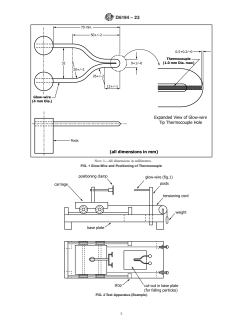
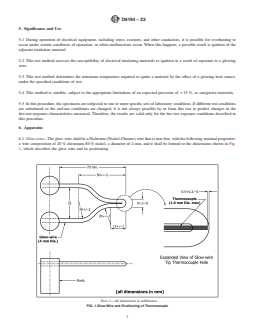
a wire composition of 20 % chromium-80 % nickel, a diameter of 4 mm, and it shall be formed to the dimensions shown in Fig.
1, which describes the glow wire and its positioning.
NOTE 1—All dimensions in millimetres.
FIG. 1 Glow-Wire and Positioning of Thermocouple
D6194 − 23
6.2 Thermocouple—Use Type K sheathed fine-wire thermocouple, having an overall diameter of 1.0 mm max, and wires suitable
for continuous operat
...