

ASTM E2726/E2726M-12a(2017)
(Test Method)Standard Test Method for Evaluating the Fire-Test-Response of Deck Structures to Burning Brands
General Information
- Abstract
SIGNIFICANCE AND USE
4.1 This test method is intended to establish the test protocol for decking materials and systems. This test method is intended to address a fire caused by exterior sources that involves the upper surface of the deck or structure.
4.2 This test is a practical assessment of fire-test-response characteristics under a prescribed fire loading. This test method is a variation of Test Method E108.
SCOPE
1.1 This test method determines the fire-test-response characteristics of deck structures attached to or in close proximity to primary structures. The burning brand exposures test is intended to determine the degradation modes of decking materials when exposed to a burning brand on the upper surface of a deck structure.
1.2 The use of paints, coatings, stains, or other surface treatments for fire protection purposes are beyond the scope of this test method. This test method excludes the use of paints, stains, or coatings for this fire-test-response determination.
1.3 The values stated in either SI units or inch-pound units are to be regarded separately as standard. The values stated in each system may not be exact equivalents; therefore, each system shall be used independently of the other. Combining values from the two systems may result in non-conformance with the standard.
1.4 This standard is used to measure and describe the response of materials, products, or assemblies to heat and flame under controlled conditions, but does not by itself incorporate all factors required for fire-hazard or fire-risk assessment of the materials, products, or assemblies under actual fire conditions.
1.5 Fire testing of products and materials is inherently hazardous. Adequate safeguards for personnel and property shall be employed in conducting these tests.
1.6 This standard does not purport to address all of the safety concerns, if any, associated with its use. It is the responsibility of the user of this standard to establish appropriate safety, health, and environmental practices and determine the applicability of regulatory limitations prior to use.
1.7 This international standard was developed in accordance with internationally recognized principles on standardization established in the Decision on Principles for the Development of International Standards, Guides and Recommendations issued by the World Trade Organization Technical Barriers to Trade (TBT) Committee.
- Status
- Published
- Publication Date
- 14-Dec-2017
- Technical Committee
- E05 - Fire Standards
- Drafting Committee
- E05.14 - External Fire Exposures
Overview
ASTM E2726/E2726M-12a(2017) is a standard test method developed by ASTM International for evaluating the fire-test-response of deck structures, particularly when exposed to burning brands. This standard plays a crucial role in assessing decking materials and systems subjected to fire from exterior sources, specifically targeting the upper surface of the deck or structure. It provides a practical, controlled laboratory assessment to determine how deck assemblies degrade and respond when exposed to burning brands simulating real-world wildfire scenarios. The method establishes guidelines for testing without incorporating paints, coatings, stains, or other surface treatments designed for fire protection.
Key Topics
- Fire-Test-Response of Deck Structures: The primary focus is on how exterior deck structures perform under fire exposure, emphasizing the vulnerability of decks attached to or near primary buildings.
- Burning Brand Exposure: The method replicates the impact of embers or burning debris ("brands") landing on the deck surface, assessing material degradation, ignition, and structural changes.
- Test Protocol and Apparatus: Specifies replicable test conditions, including sample preparation, air flow, ignition methods, and observation criteria to ensure consistent results.
- Accelerated Aging/Weathering: Provides an option to evaluate how aged or weathered deck materials respond to fire loading, promoting a realistic understanding of long-term performance.
- Safety and Compliance: Emphasizes the need for adequate safety measures during testing, and requires users to consider local safety, health, and environmental regulations.
- Non-equivalence of SI and Inch-Pound Units: The standard permits the use of either measurement system but prohibits mixing the two to avoid non-conformance.
Applications
ASTM E2726/E2726M is highly relevant for:
- Manufacturers of Decking Materials: Enables verification of product fire performance, supporting claims of compliance or superiority for marketing and regulatory purposes.
- Building Code Officials and Regulatory Authorities: Provides a standardized test to assess the suitability of deck materials in wildfire-prone areas, helping enforce fire safety regulations in residential and commercial settings.
- Architects and Design Professionals: Assists in material selection by understanding the likely fire-test-response of specified deck systems, especially in regions with strict external fire exposure requirements.
- Property Owners and Developers: Encourages the use of fire-resilient deck materials, reducing risk and potential liability from fire hazards.
- Research and Product Development: Supports ongoing innovation and improvement of composite, wood-plastic, and traditional wood decking products by providing measurable criteria for fire resistance.
- Third-party Assessment and Certification Bodies: Facilitates independent evaluation of products to recognized international standards.
Related Standards
- ASTM E108: Standard Test Methods for Fire Tests of Roof Coverings – Provides foundational procedures adopted and adapted by ASTM E2726/E2726M.
- ASTM E84: Test Method for Surface Burning Characteristics of Building Materials.
- ASTM D2898: Practice for Accelerated Weathering of Fire-Retardant-Treated Wood for Fire Testing – Supports the optional weathering of test specimens.
- ASTM D6662: Specification for Polyolefin-Based Plastic Lumber Decking Boards.
- ASTM D7032: Specification for Performance Ratings of Wood-Plastic Composite and Plastic Lumber Deck Boards, Stair Treads, Guards, and Handrails.
- ICC-ES AC109 & AC174: Criteria for evaluating thermoplastic composite lumber products and deck board span ratings.
- ASTM E176: Terminology of Fire Standards – Provides definitions relevant to fire test standards.
Keywords: ASTM E2726, deck fire test, burning brand exposure, decking fire resistance, wildfire safety, exterior fire testing, building materials, fire-test-response, accelerated weathering.
By adhering to ASTM E2726/E2726M, stakeholders across the construction, manufacturing, and regulatory industries can demonstrate a commitment to fire safety and resilience in deck designs, especially in wildfire-prone environments.
Relations
- Effective Date
- 15-Dec-2017
- Effective Date
- 01-Jan-2024
- Effective Date
- 01-Dec-2023
- Effective Date
- 01-Sep-2023
- Effective Date
- 01-Apr-2020
- Effective Date
- 15-Mar-2020
- Effective Date
- 01-Jul-2019
- Effective Date
- 15-Apr-2019
- Effective Date
- 01-Mar-2019
- Effective Date
- 15-Dec-2018
- Effective Date
- 01-Oct-2018
- Effective Date
- 01-Jul-2018
- Effective Date
- 01-Mar-2018
- Effective Date
- 01-Mar-2018
- Effective Date
- 01-Nov-2017
Get Certified
Connect with accredited certification bodies for this standard

CIS Institut d.o.o.
Personal Protective Equipment (PPE) certification body. Notified Body NB-2890 for EU Regulation 2016/425 PPE.
Gozdarski inštitut Slovenije
Slovenian Forestry Institute. Forest management certification support, timber testing.

Kiwa BDA Testing
Building and construction product certification.
Sponsored listings
Frequently Asked Questions
ASTM E2726/E2726M-12a(2017) is a standard published by ASTM International. Its full title is "Standard Test Method for Evaluating the Fire-Test-Response of Deck Structures to Burning Brands". This standard covers: SIGNIFICANCE AND USE 4.1 This test method is intended to establish the test protocol for decking materials and systems. This test method is intended to address a fire caused by exterior sources that involves the upper surface of the deck or structure. 4.2 This test is a practical assessment of fire-test-response characteristics under a prescribed fire loading. This test method is a variation of Test Method E108. SCOPE 1.1 This test method determines the fire-test-response characteristics of deck structures attached to or in close proximity to primary structures. The burning brand exposures test is intended to determine the degradation modes of decking materials when exposed to a burning brand on the upper surface of a deck structure. 1.2 The use of paints, coatings, stains, or other surface treatments for fire protection purposes are beyond the scope of this test method. This test method excludes the use of paints, stains, or coatings for this fire-test-response determination. 1.3 The values stated in either SI units or inch-pound units are to be regarded separately as standard. The values stated in each system may not be exact equivalents; therefore, each system shall be used independently of the other. Combining values from the two systems may result in non-conformance with the standard. 1.4 This standard is used to measure and describe the response of materials, products, or assemblies to heat and flame under controlled conditions, but does not by itself incorporate all factors required for fire-hazard or fire-risk assessment of the materials, products, or assemblies under actual fire conditions. 1.5 Fire testing of products and materials is inherently hazardous. Adequate safeguards for personnel and property shall be employed in conducting these tests. 1.6 This standard does not purport to address all of the safety concerns, if any, associated with its use. It is the responsibility of the user of this standard to establish appropriate safety, health, and environmental practices and determine the applicability of regulatory limitations prior to use. 1.7 This international standard was developed in accordance with internationally recognized principles on standardization established in the Decision on Principles for the Development of International Standards, Guides and Recommendations issued by the World Trade Organization Technical Barriers to Trade (TBT) Committee.
SIGNIFICANCE AND USE 4.1 This test method is intended to establish the test protocol for decking materials and systems. This test method is intended to address a fire caused by exterior sources that involves the upper surface of the deck or structure. 4.2 This test is a practical assessment of fire-test-response characteristics under a prescribed fire loading. This test method is a variation of Test Method E108. SCOPE 1.1 This test method determines the fire-test-response characteristics of deck structures attached to or in close proximity to primary structures. The burning brand exposures test is intended to determine the degradation modes of decking materials when exposed to a burning brand on the upper surface of a deck structure. 1.2 The use of paints, coatings, stains, or other surface treatments for fire protection purposes are beyond the scope of this test method. This test method excludes the use of paints, stains, or coatings for this fire-test-response determination. 1.3 The values stated in either SI units or inch-pound units are to be regarded separately as standard. The values stated in each system may not be exact equivalents; therefore, each system shall be used independently of the other. Combining values from the two systems may result in non-conformance with the standard. 1.4 This standard is used to measure and describe the response of materials, products, or assemblies to heat and flame under controlled conditions, but does not by itself incorporate all factors required for fire-hazard or fire-risk assessment of the materials, products, or assemblies under actual fire conditions. 1.5 Fire testing of products and materials is inherently hazardous. Adequate safeguards for personnel and property shall be employed in conducting these tests. 1.6 This standard does not purport to address all of the safety concerns, if any, associated with its use. It is the responsibility of the user of this standard to establish appropriate safety, health, and environmental practices and determine the applicability of regulatory limitations prior to use. 1.7 This international standard was developed in accordance with internationally recognized principles on standardization established in the Decision on Principles for the Development of International Standards, Guides and Recommendations issued by the World Trade Organization Technical Barriers to Trade (TBT) Committee.
ASTM E2726/E2726M-12a(2017) is classified under the following ICS (International Classification for Standards) categories: 13.220.50 - Fire-resistance of building materials and elements; 79.060.01 - Wood-based panels in general. The ICS classification helps identify the subject area and facilitates finding related standards.
ASTM E2726/E2726M-12a(2017) has the following relationships with other standards: It is inter standard links to ASTM E2726/E2726M-12a, ASTM E176-24, ASTM E84-23d, ASTM E84-23c, ASTM E108-20a, ASTM E108-20, ASTM E84-19b, ASTM E84-19a, ASTM E84-19, ASTM E176-18a, ASTM E84-18b, ASTM E84-18a, ASTM E84-18, ASTM E176-18, ASTM E84-17a. Understanding these relationships helps ensure you are using the most current and applicable version of the standard.
ASTM E2726/E2726M-12a(2017) is available in PDF format for immediate download after purchase. The document can be added to your cart and obtained through the secure checkout process. Digital delivery ensures instant access to the complete standard document.
Standards Content (Sample)
This international standard was developed in accordance with internationally recognized principles on standardization established in the Decision on Principles for the
Development of International Standards, Guides and Recommendations issued by the World Trade Organization Technical Barriers to Trade (TBT) Committee.
Designation: E2726/E2726M − 12a (Reapproved 2017) An American National Standard
Standard Test Method for
Evaluating the Fire-Test-Response of Deck Structures to
Burning Brands
ThisstandardisissuedunderthefixeddesignationE2726/E2726M;thenumberimmediatelyfollowingthedesignationindicatestheyear
of original adoption or, in the case of revision, the year of last revision. A number in parentheses indicates the year of last reapproval.
A superscript epsilon (´) indicates an editorial change since the last revision or reapproval.
1. Scope Development of International Standards, Guides and Recom-
mendations issued by the World Trade Organization Technical
1.1 This test method determines the fire-test-response char-
Barriers to Trade (TBT) Committee.
acteristics of deck structures attached to or in close proximity
to primary structures. The burning brand exposures test is
2. Referenced Documents
intended to determine the degradation modes of decking
2.1 ASTM Standards:
materials when exposed to a burning brand on the upper
D2898 Practice for Accelerated Weathering of Fire-
surface of a deck structure.
Retardant-Treated Wood for Fire Testing
1.2 The use of paints, coatings, stains, or other surface
D6662 Specification for Polyolefin-Based Plastic Lumber
treatments for fire protection purposes are beyond the scope of
Decking Boards
this test method. This test method excludes the use of paints,
D7032 Specification for Establishing Performance Ratings
stains, or coatings for this fire-test-response determination.
for Wood-Plastic Composite and Plastic Lumber Deck
1.3 The values stated in either SI units or inch-pound units Boards, Stair Treads, Guards, and Handrails
are to be regarded separately as standard. The values stated in E84 Test Method for Surface Burning Characteristics of
each system may not be exact equivalents; therefore, each Building Materials
system shall be used independently of the other. Combining E108 Test Methods for Fire Tests of Roof Coverings
values from the two systems may result in non-conformance E176 Terminology of Fire Standards
with the standard. 2.2 ICC Evaluation Services, Inc.:
AC 109 Acceptance Criteria for Thermoplastic Composite
1.4 This standard is used to measure and describe the
Lumber Products
response of materials, products, or assemblies to heat and
AC 174 Acceptance Criteria for Deck Board Span Ratings
flame under controlled conditions, but does not by itself
and Guardrail Systems (Guards and Handrails)
incorporate all factors required for fire-hazard or fire-risk
assessment of the materials, products, or assemblies under
3. Terminology
actual fire conditions.
3.1 Definitions—For definitions of terms used in this test
1.5 Fire testing of products and materials is inherently
method, refer to Terminology E176.
hazardous. Adequate safeguards for personnel and property
3.2 Definitions of Terms Specific to This Standard:
shall be employed in conducting these tests.
3.2.1 deck structure, n—exterior structures comprised of
1.6 This standard does not purport to address all of the
deck boards or panels, stair treads, risers, and landings of
safety concerns, if any, associated with its use. It is the
decks, porches, and balconies.
responsibility of the user of this standard to establish appro-
3.2.2 test material, n—members that constitute the exposed
priate safety, health, and environmental practices and deter-
surface of the deck structures.
mine the applicability of regulatory limitations prior to use.
1.7 This international standard was developed in accor-
4. Significance and Use
dance with internationally recognized principles on standard-
4.1 Thistestmethodisintendedtoestablishthetestprotocol
ization established in the Decision on Principles for the
fordeckingmaterialsandsystems.Thistestmethodisintended
1 2
This test method is under the jurisdiction of ASTM Committee E05 on Fire For referenced ASTM standards, visit the ASTM website, www.astm.org, or
Standards and is the direct responsibility of Subcommittee E05.14 on External Fire contact ASTM Customer Service at service@astm.org. For Annual Book of ASTM
Exposures. Standards volume information, refer to the standard’s Document Summary page on
Current edition approved Dec. 15, 2017. Published December 2017. Originally the ASTM website.
approved in 2012. Last previous edition approved in 2012 as E2726/E2726M–12a. Available from International Code Council Evaluation Service, 5600 Workman
DOI:10.1520/E2726_E2726M–12AR17. Mill Road, Whittier, CA.
Copyright © ASTM International, 100 Barr Harbor Drive, PO Box C700, West Conshohocken, PA 19428-2959. United States
E2726/E2726M − 12a (2017)
to address a fire caused by exterior sources that involves the 5.5 Burner—Gas-fueled burner for brand ignition. The
upper surface of the deck or structure. flame temperature of the igniting flame shall be 888 6 28°C
[1630 6 50°F] measured 59 mm [2 ⁄16 in.] above the top of the
4.2 This test is a practical assessment of fire-test-response
burner, which is shielded from drafts.
characteristicsunderaprescribedfireloading.Thistestmethod
is a variation of Test Method E108.
6. Test Specimens (see Fig. 2)
5. Test Apparatus
6.1 The test specimen shall consist of joists as specified in
6.3 and test material as specified in 6.4.
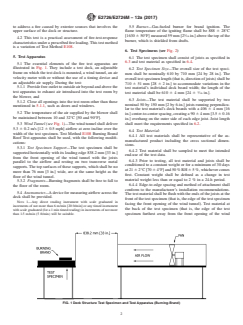
5.1 The essential elements of the fire test apparatus are
illustrated in Fig. 1. They include a test deck, an adjustable
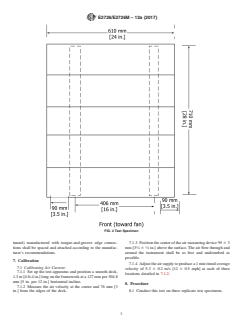
6.2 Test Specimen Size—The overall size of the test speci-
frame on which the test deck is mounted, a wind tunnel, an air
men shall be nominally 610 by 710 mm [24 by 28 in.]. The
velocity meter with or without the use of a timing device and
overalltestspecimenlength(thatis,directionofjoists)shallbe
an adjustable air supply. During the test:
710 6 51 mm [28 6 2 in.] to accommodate variations in the
5.1.1 Providefreeoutlettooutsideairbeyondandabovethe
test material’s individual deck board width; the length of the
test apparatus to exhaust air introduced into the test room by
test material shall be 610 64mm[24 6 ⁄16 in.].
the blower, and
6.3 Joists—The test material shall be supported by two
5.1.2 Close all openings into the test room other than those
nominal 50 by 150 mm [2 by 6-in.] joists running perpendicu-
mentioned in 5.1.1, such as doors and windows.
lar to the test material’s deck boards with a 406 64mm[16
5.2 The temperature of the air supplied by the blower shall
in.]center-to-centerspacing,creatinga90 64mm[3.5 60.16
be maintained between 10 and 32°C [50 and 90°F].
in.] overhang on the outer side of each edge joist. Joist length
shall meet the requirements specified in 6.2.
5.3 Wind Tunnel (see Fig. 1)—The wind tunnel shall deliver
5.3 6 0.2 m/s [12 6 0.5 mph] airflow at zero incline over the
6.4 Test Material:
width of the test specimen. Test Method E108 Burning Brand
6.4.1 All test materials shall be representative of the as-
Roof Test apparatus shall be used, with the following modifi-
manufactured product including the cross sectional dimen-
cations:
sions.
5.3.1 Test Specimen Support—The test specimen shall be
6.4.2 Test material shall be sampled to meet the intended
supported horizontally with its leading edge 838.2 mm [33 in.]
end-use of the test data.
from the front opening of the wind tunnel with the joists
6.4.3 Prior to testing, all test material and joists shall be
parallel to the airflow and resting on two transverse metal
conditioned to a constant weight or for a minimum of 30 days
supports. The top surfaces of these supports, which shall be no
at21 62°C[70 64°F]and50%RH 65%,whichevercomes
more than 76 mm [3 in.] wide, are at the same height as the
first. Constant weight shall be defined as a change in test
floor of the wind tunnel.
material weight less than or equal to2%ina 24-h period.
5.3.2 Fragments—Burning fragments shall be free to fall to
6.4.4 Edge-to-edge spacing and method of attachment shall
the floor of the room.
conform to the manufacturer’s installation recommendations.
5.4 Anemometer—Adeviceformeasuringairflowacrossthe
The test material shall be flush with the ends of the joists at the
deck shall be provided.
front of the test specimen (that is, the edge of the test specimen
NOTE 1—Any direct reading instrument with scale graduated in
facing the front opening of the wind tunnel). Test material at
increments of not more than 6 m/min [20 ft/min] or any timed instrument
the back of the test specimen (that is, the edge of the test
withscalegraduated(fora1mintimedreading)inincrementsofnotmore
specimen furthest away from the front opening of the wind
than 1.5 m/min (5 ft/min) will be suitable.
FIG. 1 Deck Structure Test Specimen and Test Apparatus (Burning-Brand)
E2726/E2726M − 12a (2017)
FIG. 2 Test Specimen
tunnel) manufactured with tongue-and-groove edge connec- 7.1.3 Position the center of the air measuring device 95 6 3
3 1
tions shall be spaced and attached according to the manufac-
mm [3 ⁄4 6 ⁄8 in.] above the surface. The air flow through and
turer’s recommendations.
around the instrument shall be as free and undisturbed as
possible.
7. Calibration
7.1.4 Adjusttheairsupplytoproducea1mintimedaverage
7.1 Calibrating Air Current:
velocity of 5.3 6 0.2 m/s [12 6 0.5 mph] at each of three
7.1.1 Set up the test apparatus and position a smooth deck,
locations detailed in 7.1.2.
1.3 m [4 ft-4 in.] long on the framework at a 127 mm per 304.8
mm [5 in. per 12 in.] horizontal incline.
8. Procedure
7.1.2 Measure the air velocity at the center and 76 mm [3
in.] from the edges of the deck. 8.1 Conduct this test on three replicate test specimens.
E2726/E2726M − 12a (2017)
8.2 Mount each test specimen in the manner described in igniting flame shall be 888 6 28°C [1630 6 50°F] measured
5.1.1 with the framework 838.2 mm [33 in.] from the air duct 59 mm [2 ⁄16 in.] above the top of the burner, which is shielded
outlet.
from drafts.
8.4.1 Expose Class A test brand to the flame for 5 min,
8.3 Size and Construction of Brands—Construct each brand
(Fig. 3), as follows, and condition in an oven at 41 to 49°C during which time it shall be rotated to present each surface to
[105 to120°F] for at least 24 h. the flame in the following manner and sequence: Each 305 by
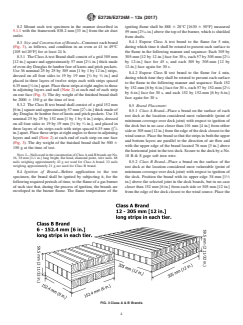
8.3.1 The ClassAtest Brand shall consist of a grid 305 mm
305-mm [12 by 12-in.] face for 30 s, each 57 by 305-mm [2 ⁄4
[12 in.] square and approximately 57 mm [2 ⁄4 in.] thick made
by 12-in.] face for 45 s, and each 305 by 305-mm [12 by
of oven dry Douglas fir lumber free of knots and pitch pockets.
12-in.] face again for 30 s.
Use 36 nominal 25 by 25 by 305 mm [1 by 1 by 12 in.] strips,
8.4.2 Expose Class B test brand to the flame for 4 min,
3 3
dressed on all four sides to 19 by 19 mm [ ⁄4 by ⁄4 in.] and
during which time they shall be rotated to present each surface
placed in three layers of twelve strips each with strips spaced
to the flame in the following manner and sequence: Each 152
6.35mm[ ⁄4in.]apart.Placethesestripsatrightanglestothose
by 152-mm [6 by 6-in.] face for 30 s, each 57 by 152-mm [2 ⁄4
in adjoining layers and nail (Note 2) at each end of each strip
by 6-in.] face for 30 s, and each 152 by 152-mm [6 by 6-in.]
on one face (Fig. 3). The dry weight of the finished brand shall
face again for 30 s.
be 2000 6 150 g at the time of test.
8.3.2 The Class B test brand shall consist of a grid 152 mm
8.5 Brand Placement:
[6in.]squareandapproximately57mm[2 ⁄4in.]thickmadeof
8.5.1 Class A Brand—Place a brand on the surface of each
dry Douglas fir lumber free of knots and pitch pockets. Use 18
test deck at the location considered most vulnerable (point of
nominal 25 by 25 by 152 mm [1 by 1 by 6 in.] strips, dressed
minimum coverage over deck joint) with respect to ignition of
3 3
on all four sides to 19 by 19 mm [ ⁄4 by ⁄4 in.], and placed in
the deck but in no case closer than 101 mm [4 in.] from either
three layers of six strips each with strips spaced 6.35 mm ([ ⁄4
sideor305mm[12in.]fromtheedgeofthedeckclosesttothe
in.]apart.Placethesestripsatrightanglestothoseinadjoining
wind source. Place the brand so that the strips in both the upper
layers and nail (Note 2) at each end of each strip on one face
and bottom layers are parallel to the direction of air flow and
(Fig. 3). The dry weight of the finished brand shall be 500 6
with the upper edge of the brand located 76 mm [3 in.] above
150 g at the time of test.
thehorizontaljointinthetestdeck.SecuretothedeckbyaNo.
NOTE2—NailsusedintheconstructionofClassAandBbrandsareNo.
18B&S gage soft iron wire.
16, 38 mm [1 ⁄2 in.] long bright, flat head, diamond point, wire nails. 68
8.5.2 Class B Brand—Place a brand on the surface of the
nails weighing approximately 42 g are used for Class A brand. 32 nails
weighing approximately 21 g are used for Class B brand.
test deck at the location considered most vulnerable (point of
minimum coverage over deck joint) with respect to ignition of
8.4 Ignition of Brand—Before application to the test
the deck. Position the brand with its upper edge 38 mm [1 ⁄2
specimen, the brand shall be ignited by subjecting it, for the
in.] above the selected joint in the deck boards, but in no case
following required peri
...