

ASTM F72-24
(Specification)Standard Specification for Gold Wire for Semiconductor Lead Bonding
General Information
- Abstract
ABSTRACT
This specification covers round drawn/extruded gold wires for internal semiconductor device electrical connections. The wires are available in four classifications, namely: copper-modified wire, beryllium-modified wire, high-strength wire, and special purpose wire. Aptly sampled wires shall be examined by test methods suggested herein, and each class shall conform correspondingly to specified requirements for chemical composition, mechanical properties (breaking load and elongation), dimension (diameter and weight), and workmanship and finish. The wires shall also undergo wire curl, wire axial twist, and wire roundness tests.
SCOPE
1.1 This specification covers round drawn/extruded gold wire for internal semiconductor device electrical connections. Four classifications of wire are distinguished, (1) copper-modified wire, (2) beryllium-modified wire, (3) high-strength wire, and (4) special purpose wire.
Note 1: Trace metallic elements have a significant effect upon the mechanical properties and thermal stability of high-purity gold wire. It is customary in manufacturing to add controlled amounts of selected impurities to gold to modify or stabilize bonding wire properties, or both. This practice is known variously as “modifying,” “stabilizing,” or “doping.” The first two wire classifications denoted in this specification refer to wire made with either of two particular modifiers, copper or beryllium, in general use. In the third and fourth wire classifications, “high-strength” and “special purpose” wire, the identity of modifying additives is not restricted.
1.2 The values stated in SI units are to be regarded as standard. The values given in parentheses after SI units are provided for information only and are not considered standard.
1.3 The following hazard caveat pertains only to the test method portion, Section 9, of this specification. This standard does not purport to address all of the safety concerns, if any, associated with its use. It is the responsibility of the user of this standard to establish appropriate safety, health, and environmental practices and determine the applicability of regulatory limitations prior to use.
1.4 This international standard was developed in accordance with internationally recognized principles on standardization established in the Decision on Principles for the Development of International Standards, Guides and Recommendations issued by the World Trade Organization Technical Barriers to Trade (TBT) Committee.
- Status
- Published
- Publication Date
- 31-Mar-2024
- Technical Committee
- B02 - Nonferrous Metals and Alloys
Overview
ASTM F72-24: Standard Specification for Gold Wire for Semiconductor Lead Bonding establishes requirements for round drawn or extruded gold wire specifically used for internal electrical connections in semiconductor devices. The standard defines four classifications of gold wire: copper-modified, beryllium-modified, high-strength, and special purpose wire. It ensures each class meets stringent compliance for chemical composition, mechanical properties, dimensions, and appearance, supporting reliable performance in semiconductor manufacturing and assembly processes.
ASTM F72-24 is issued by ASTM International and aligns with globally recognized standardization principles set by the World Trade Organization Technical Barriers to Trade (TBT) Committee.
Key Topics
- Classifications: The standard specifies four types:
- Copper-modified wire
- Beryllium-modified wire
- High-strength wire
- Special purpose wire
- Chemical Composition: Gold wires must meet specified purity and controlled levels of modifiers or dopants to tailor bonding and thermal properties.
- Mechanical Properties: Criteria include breaking load and elongation for both hard (as drawn/extruded) and annealed wires.
- Dimensions: Tight tolerances for wire diameter ensure suitability for advanced electronics, with measurements in micrometers (µm).
- Workmanship and Finish: Surface cleanliness and condition are critical. Wires must be free from oils, residues, and physical defects such as nicks or bends that could impair performance.
- Testing and Sampling: Includes methods for evaluating wire curl, axial twist, and roundness, as well as mechanical and chemical tests.
- Spooling and Packaging: Requirements cover multi-layer winding, spool types, labeling, color coding for wire diameter, protective packaging, and marking for traceability.
Applications
- Semiconductor Device Manufacturing: Gold bonding wires are essential for making precise internal electrical connections in integrated circuits, transistors, and other microelectronic devices.
- Automated and Manual Wire Bonding: The different classes of wire support various wire bonding techniques, such as thermocompression, thermosonic, and ultrasonic bonding, facilitating both high-speed automation and specialized manual assembly.
- Specialty Electronics: Special purpose gold wires enable advanced or custom applications requiring tailored properties not covered by standard modifiers.
- Quality Assurance & Traceability: Standardized packaging, labeling, and certification requirements assist in ensuring product reliability throughout the supply chain.
Related Standards
- ASTM F16: Test Methods for Measuring Diameter or Thickness of Wire and Ribbon for Electronic Devices and Lamps
- ASTM F584: Practice for Visual Inspection of Semiconductor Lead-Bonding Wire
- ASTM F205: Test Method for Measuring Diameter of Fine Wire by Weighing (Withdrawn)
- ASTM F219: Test Methods of Testing Fine Round and Flat Wire for Electron Devices and Lamps (Withdrawn)
Manufacturers, suppliers, and semiconductor assembly facilities should refer to ASTM F72-24 to select, test, and deliver gold wire that meets the high-reliability requirements of the electronics industry. Adhering to this standard ensures performance consistency, improved device yield, and compatibility across global supply chains. For the most up-to-date details and referenced documents, consult the ASTM website.
Relations
- Replaces
ASTM F72-21 - Standard Specification for Gold Wire for Semiconductor Lead Bonding (Withdrawn 2024) - Effective Date
- 01-Apr-2024
Frequently Asked Questions
ASTM F72-24 is a technical specification published by ASTM International. Its full title is "Standard Specification for Gold Wire for Semiconductor Lead Bonding". This standard covers: ABSTRACT This specification covers round drawn/extruded gold wires for internal semiconductor device electrical connections. The wires are available in four classifications, namely: copper-modified wire, beryllium-modified wire, high-strength wire, and special purpose wire. Aptly sampled wires shall be examined by test methods suggested herein, and each class shall conform correspondingly to specified requirements for chemical composition, mechanical properties (breaking load and elongation), dimension (diameter and weight), and workmanship and finish. The wires shall also undergo wire curl, wire axial twist, and wire roundness tests. SCOPE 1.1 This specification covers round drawn/extruded gold wire for internal semiconductor device electrical connections. Four classifications of wire are distinguished, (1) copper-modified wire, (2) beryllium-modified wire, (3) high-strength wire, and (4) special purpose wire. Note 1: Trace metallic elements have a significant effect upon the mechanical properties and thermal stability of high-purity gold wire. It is customary in manufacturing to add controlled amounts of selected impurities to gold to modify or stabilize bonding wire properties, or both. This practice is known variously as “modifying,” “stabilizing,” or “doping.” The first two wire classifications denoted in this specification refer to wire made with either of two particular modifiers, copper or beryllium, in general use. In the third and fourth wire classifications, “high-strength” and “special purpose” wire, the identity of modifying additives is not restricted. 1.2 The values stated in SI units are to be regarded as standard. The values given in parentheses after SI units are provided for information only and are not considered standard. 1.3 The following hazard caveat pertains only to the test method portion, Section 9, of this specification. This standard does not purport to address all of the safety concerns, if any, associated with its use. It is the responsibility of the user of this standard to establish appropriate safety, health, and environmental practices and determine the applicability of regulatory limitations prior to use. 1.4 This international standard was developed in accordance with internationally recognized principles on standardization established in the Decision on Principles for the Development of International Standards, Guides and Recommendations issued by the World Trade Organization Technical Barriers to Trade (TBT) Committee.
ABSTRACT This specification covers round drawn/extruded gold wires for internal semiconductor device electrical connections. The wires are available in four classifications, namely: copper-modified wire, beryllium-modified wire, high-strength wire, and special purpose wire. Aptly sampled wires shall be examined by test methods suggested herein, and each class shall conform correspondingly to specified requirements for chemical composition, mechanical properties (breaking load and elongation), dimension (diameter and weight), and workmanship and finish. The wires shall also undergo wire curl, wire axial twist, and wire roundness tests. SCOPE 1.1 This specification covers round drawn/extruded gold wire for internal semiconductor device electrical connections. Four classifications of wire are distinguished, (1) copper-modified wire, (2) beryllium-modified wire, (3) high-strength wire, and (4) special purpose wire. Note 1: Trace metallic elements have a significant effect upon the mechanical properties and thermal stability of high-purity gold wire. It is customary in manufacturing to add controlled amounts of selected impurities to gold to modify or stabilize bonding wire properties, or both. This practice is known variously as “modifying,” “stabilizing,” or “doping.” The first two wire classifications denoted in this specification refer to wire made with either of two particular modifiers, copper or beryllium, in general use. In the third and fourth wire classifications, “high-strength” and “special purpose” wire, the identity of modifying additives is not restricted. 1.2 The values stated in SI units are to be regarded as standard. The values given in parentheses after SI units are provided for information only and are not considered standard. 1.3 The following hazard caveat pertains only to the test method portion, Section 9, of this specification. This standard does not purport to address all of the safety concerns, if any, associated with its use. It is the responsibility of the user of this standard to establish appropriate safety, health, and environmental practices and determine the applicability of regulatory limitations prior to use. 1.4 This international standard was developed in accordance with internationally recognized principles on standardization established in the Decision on Principles for the Development of International Standards, Guides and Recommendations issued by the World Trade Organization Technical Barriers to Trade (TBT) Committee.
ASTM F72-24 has the following relationships with other standards: It is inter standard links to ASTM F72-21. Understanding these relationships helps ensure you are using the most current and applicable version of the standard.
ASTM F72-24 is available in PDF format for immediate download after purchase. The document can be added to your cart and obtained through the secure checkout process. Digital delivery ensures instant access to the complete standard document.
Standards Content (Sample)
This international standard was developed in accordance with internationally recognized principles on standardization established in the Decision on Principles for the
Development of International Standards, Guides and Recommendations issued by the World Trade Organization Technical Barriers to Trade (TBT) Committee.
Designation: F72 − 24
Standard Specification for
Gold Wire for Semiconductor Lead Bonding
This standard is issued under the fixed designation F72; the number immediately following the designation indicates the year of original
adoption or, in the case of revision, the year of last revision. A number in parentheses indicates the year of last reapproval. A superscript
epsilon (´) indicates an editorial change since the last revision or reapproval.
1. Scope F16 Test Methods for Measuring Diameter or Thickness of
Wire and Ribbon for Electronic Devices and Lamps
1.1 This specification covers round drawn/extruded gold
(Withdrawn 2023)
wire for internal semiconductor device electrical connections.
F205 Test Method for Measuring Diameter of Fine Wire by
Four classifications of wire are distinguished, (1) copper-
Weighing (Withdrawn 2023)
modified wire, (2) beryllium-modified wire, (3) high-strength
F219 Test Methods of Testing Fine Round and Flat Wire for
wire, and (4) special purpose wire.
Electron Devices and Lamps (Withdrawn 2023)
NOTE 1—Trace metallic elements have a significant effect upon the
F584 Practice for Visual Inspection of Semiconductor Lead-
mechanical properties and thermal stability of high-purity gold wire. It is
Bonding Wire (Withdrawn 2015)
customary in manufacturing to add controlled amounts of selected
impurities to gold to modify or stabilize bonding wire properties, or both.
This practice is known variously as “modifying,” “stabilizing,” or
3. Ordering Information
“doping.” The first two wire classifications denoted in this specification
refer to wire made with either of two particular modifiers, copper or
3.1 Orders for material under this specification shall include
beryllium, in general use. In the third and fourth wire classifications,
the following information:
“high-strength” and “special purpose” wire, the identity of modifying
additives is not restricted. 3.1.1 Classification: copper-modified, beryllium-modified,
high strength, or special purpose,
1.2 The values stated in SI units are to be regarded as
standard. The values given in parentheses after SI units are 3.1.2 Quantity,
provided for information only and are not considered standard.
3.1.3 Purity (Section 4),
1.3 The following hazard caveat pertains only to the test
3.1.4 Type, hard, stress relieved, or annealed (Section 5),
method portion, Section 9, of this specification. This standard
3.1.5 Breaking load and percentage elongation range (Sec-
does not purport to address all of the safety concerns, if any,
tion 5),
associated with its use. It is the responsibility of the user of this
3.1.6 Wire diameter (Section 6),
standard to establish appropriate safety, health, and environ-
3.1.7 Spool type, length of wire per spool, and type of wind
mental practices and determine the applicability of regulatory
(Section 11),
limitations prior to use.
1.4 This international standard was developed in accor-
3.1.8 Despooling, left-handed unwind or right-handed un-
dance with internationally recognized principles on standard-
wind (Section 11), and,
ization established in the Decision on Principles for the
3.1.9 Packaging and marking (Section 12).
Development of International Standards, Guides and Recom-
mendations issued by the World Trade Organization Technical
4. Chemical Composition
Barriers to Trade (TBT) Committee.
4.1 Beryllium-modified material shall conform to the
2. Referenced Documents
chemical requirements specified in Table 1.
2.1 ASTM Standards:
4.2 High-strength material shall conform to the chemical
requirements specified in Table 2.
This specification is under the jurisdiction of ASTM Committee B02 on
Nonferrous Metals and Alloys and is the direct responsibility of Subcommittee
4.3 Special purpose material shall be in accordance with
B02.05 on Precious Metals and Electrical Contact Materials and Test Methods.
Table 3.
Current edition approved April 1, 2024. Published April 2024. Originally
approved in 1966. Last previous edition approved in 2021 as F72 – 21 which was
withdrawn January 2024 and reinstated in April 2024. DOI: 10.1520/F0072-24.
For referenced ASTM standards, visit the ASTM website, www.astm.org, or
contact ASTM Customer Service at service@astm.org. For Annual Book of ASTM
Standards volume information, refer to the standard’s Document Summary page on The last approved version of this historical standard is referenced on
the ASTM website. www.astm.org.
Copyright © ASTM International, 100 Barr Harbor Drive, PO Box C700, West Conshohocken, PA 19428-2959. United States
F72 − 24
TABLE 1 Chemical Requirements, Beryllium-Modified Gold TABLE 5 Breaking Load and Elongation of Stress Relieved/
A
Bonding Wire Annealed Wire—Beryllium-Modified Gold
Nominal Breaking Load, Elongation in
Element Composition, Weight, %
Diameter, min, 254 mm (10.0 in.), %
Gold, min 99.99
μm (in.) N (gf) B
Min Max Range
Beryllium 0.0003–0.0010
Other impurities, max each 0.003
13 (0.00050) 0.020 (2.0) 0.5 3.0 2
Total of all detectable impurities, max 0.01
18 (0.00070) 0.029 (3.0) 0.5 7.0 3
20 (0.00080) 0.039 (4.0) 0.5 8.0 3
23 (0.00090) 0.059 (6.0) 0.5 8.0 3
25 (0.0010) 0.069 (7.0) 0.5 10.0 3
TABLE 2 Chemical Requirements, High-Strength Gold Bonding
28 (0.0011) 0.078 (8.0) 0.5 10.0 3
Wire
30 (0.0012) 0.0981 (10.0) 0.5 10.0 3
31.8 (0.00125) 0.108 (11.0) 0.5 10.0 3
Element Composition, Weight, %
33 (0.0013) 0.118 (12.0) 0.5 10.0 3
Gold, min 99.99
38 (0.0015) 0.147 (15.0) 0.5 12.0 4
Total of all detectable impurities, max 0.01
51 (0.0020) 0.245 (25.0) 0.5 15.0 4
A
All modern wires are expected to have a somewhat longer shelf life, but each
manufacturer’s product will be slightly different.
B
TABLE 3 Chemical Requirements, Special Purpose Gold Bonding
A range of permissible elongation of at least the number of percentage points
Wire
shown shall be selected from within the overall range designated by the minimum
and maximum values for the given diameter. For example, for wire of 25 μm
Element Composition, Weight, %
(0.0010 in.) diameter, permissible elongation of 4.0 % to 7.0 %, 6.0 % to 9.0 %,
Gold Not restricted
7.0 % to 10.0 %, etc., may be selected.
Other principal elements Not restricted
Total of all detectable elements Not restricted
TABLE 6 Breaking Load and Elongation of Stress Relieved/
A
Annealed Wire—High-Strength Gold
Elongation in
Nominal Diameter, Breaking Load, min, B
254 mm (10.0 in.), %
μm (in.) N (gf)
NOTE 2—Copper-modified wire is used on thermocompression wire
Min Max
bonding machines. Beryllium-modified material is often preferred on
13 (0.00050) 0.020 (2.0) 0.5 3.0
high-speed automated thermocompression or thermosonic bonding equip-
18 (0.00070) 0.039 (4.0) 0.5 5.0
ment. High-strength wire was developed for use on some very high speed
20 (0.00080) 0.040 (5.0) 0.5 6.0
automated thermosonic bonders.
23 (0.00090) 0.064 (6.5) 0.5 6.0
25 (0.0010) 0.078 (8.0) 0.5 6.0
28 (0.0011) 0.093 (9.5) 0.5 6.0
5. Mechanical Properties
30 (0.0012) 0.113 (11.5) 0.5 6.0
5.1 Material specified by this standard may be either of two 31.8 (0.00125) 0.123 (12.5) 0.5 6.0
33 (0.0013) 0.132 (13.5) 0.5 6.0
types:
38 (0.0015) 0.176 (18.0) 0.5 7.0
5.1.1 Hard—Wire, as drawn/as extruded.
51 (0.0020) 0.314 (32.0) 0.5 7.0
5.1.2 Annealed—Wire, annealed after drawing/extruding.
A
All modern wires are expected to have a somewhat longer shelf life, but each
manufacturer’s product will be slightly different.
5.2 Breaking Load and Elongation—The tension test shall
B
Except for 13 μm, 38 μm, and 51 μm, the minimum-maximum range is usually 3
be the standard test for determining the mechanical properties,
percentage points, for example, 2 % to 5 %, 3 % to 6 %, and 4 % to 7 %. For
13 μm it is usually 1.5 percentages points, for example, 0.5 % to 2 %, 1 % to
and acceptance or rejection shall depend on the breaking load
2.5 %, and 1.5 % to 3 %. For 38 μm and 51 μm it is usually 4 percentage points,
and percent elongation at failure of a 254 mm (10.0 in.) length
for example, 0.5 % to 4.5 %, 1 % to 5 %, 2 % to 6 %, and 3 % to 7 %.
of wire.
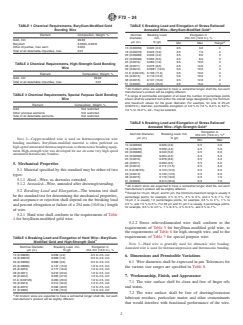
5.2.1 Hard wire shall conform to the requirements of Table
4 for beryllium-modified gold wire.
5.2.2 Stress relieved/annealed wire shall conform to the
requirements of Table 5 for beryllium-modified gold wire, to
the requirements of Table 6 for high-strength wire, and to the
requirements of Table 7 for special purpose wire.
TABLE 4 Breaking Load and Elongation of Hard Wire—Beryllium-
A
Modified Gold and High-Strength Gold
NOTE 3—Hard wire is generally used for ultrasonic wire bonding.
Nominal Diameter, Breaking Load, min, Elongation in
Annealed wire is used for thermocompression and thermosonic bonding.
μm (in.) N (gf) 254 mm (10.0 in.), %
13 (0.00050) 0.039 (4.0) 0.5 to 2.0, incl
6. Dimensions and Permissible Variations
18 (0.00070) 0.069 (7.0) 0.5 to 2.0, incl
20 (0.00080) 0.088 (9.0) 0.5 to 2.0, incl
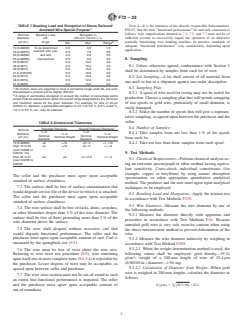
6.1 Wire diameters shall be expressed in μm. Tolerances for
23 (0.00090) 0.147 (15.0) 1.0 to 2.5, incl
the various size ranges are specified in Table 8.
25 (0.0010) 0.177 (18.0) 1.0 to 2.5, incl
28 (0.0011) 0.216 (22.0) 1.0 to 2.5, incl
7. Workmanship, Finish, and Appearance
30 (0.0012) 0.265 (27.0) 1.0 to 2.5, incl
31.8 (0.00125) 0.284 (29.0) 1.0 to 2.5, incl
7.1 The wire surface shall be clean and free of finger oils
33 (0.0013) 0.314 (32.0) 1.0 to 2.5, incl
38 (0.0015) 0.392 (40.0) 1.0 to 2.5, incl and stains.
51 (0.0020) 0.736 (75.0) 1.0 to 3.0, incl
7.2 The wire surface shall be free of drawing/extrusion
A
All modern wires are expected to have a somewhat longer shelf life, but each
lubricant residues, particulate matter and other contaminants
manufacturer’s product will be slightly different.
that would interfere with functional performance of the wire.
F72 − 24
TABLE 7 Breaking Load and Elongation of Stress Relieved/ NOTE 4—It is the intention of the directly responsible Subcommittee,
A
Annealed Wire-Special Purpose
F01.07, that the term “functional performance” be narrowly construed as
follows: wire imperfections denoted in 7.2, 7.5, and 7.7 must not be of
Nominal Breaking Load, Elongation in
Diameter, min, 254 mm (10.0 in.), % sufficient severity to excessively impair the operation of an otherwise
μm (in.) N (gf) B normally functioning wire bonding machine. In practice, standards of
Min Max Range
adequate “functional performance” vary considerably, depending upon
13 (0.00050) To be determined 0.5 3.0 1.5
application.
18 (0.00070) between wire user 0.5 7.0 2.0
and wire
20 (0.00080) 0.5 8.0 2.0
23 (0.00090) manufacturer 0.5 8.0 2.0
8. Sampling
25 (0.0010) 0.5 10.0 2.0
28 (0.0011) 0.5 10.0 2.0 8.1 Unless otherwise agreed, conformance with Section 5
30 (0.0012) 0.5 10.0 2.0
shall be determined by samples from each lot of wire.
31.8 (0.00125) 0.5 10.0 2.0
33 (0.0013) 0.5 10.0 2.0
8.2 Lot Sampling—A lot shall consist of all material from
38 (0.0015) 0.5 12.0 2.0
one melt or bar in a shipment against one order description.
51 (0.0020) 0.5 15.0 2.0
A
8.3 Sampling Plan:
All modern wires are expected to have a somewhat longer shelf life, but each
manufacturer’s product will be slightly different.
8.3.1 A spool of wire used for testing may not be useful for
B
A range of permissible elongation of at least the number of percentage points
production. Choose a sampling plan that will permit scrapping
shown shall be selected from within the overall range designated by the minimum
of test spools as gold wire, particularly of small diameter, is
and maximum values for the given diameter. For example, for wire of 25 μm
(0.0010 in.) diameter, a permissible elongation of 4.0 % to 6.0 %, 6.0 % to 8.0 %,
easily damaged.
7.0 % to 9.0 %, etc., may be selected.
8.3.2 Select the number of spools that will give a represen-
tative sampling, as agreed upon between the purchaser and the
seller.
TABLE 8 Dimensional Tolerances
Standard Tolerance Special Purpose Tolerance 8.4 Number of Samples:
Nominal
% of % of
8.4.1 Take samples from not less than 1 % of the spools
Diameter, % of % of
Nominal Nominal
μm (in.)
Nominal Weight Nominal Weight
from each lot.
Diameter Diameter
13 (0.00050) ±6 ±15 +6 ⁄−2 +1 ⁄−10
8.4.2 Take not less than three samples from each spool.
Over 13 to 25 ±3 ±10 +6 ⁄−2 +1 ⁄−6
(over 0.0005 to
9. Test Methods
0.0010), incl
Over 25 to 51 ±3 ±6 +3 ⁄−0.5 +1 ⁄−4
9.1 Chemical Requirements—Perform chemical analysis us-
(over 0.0010 to
0.0020) ing an emission spectrograph or other method having equiva-
lent sensitivity. Cross-check individual constituents (for
example, copper or beryllium) by using atomic absorption
The seller and the purchaser must agree upon acceptable
spectrometric or other appropriate quantitative analytical
standard of surface cleanliness.
method. The producer and the user must agree upon analytical
7.3 The surface shall be free of surface contamination that
techniques to be employed.
would degrade service life of the device to which it is attached.
9.2 Breaking Load and Elongation—Apply the tension test
The seller and the purchaser must agree upon acceptable
in accordance with Test Methods F219.
standard of surface cleanliness.
9.3 Wire Diameter—Measure the wire diameter by one of
7.4 The wire surface shall be free of nicks, dents, scratches,
the following methods:
or other blemishes deeper than 5 % of the wire diameter. The
9.3.1 Measure the diameter directly with apparatus and
surface shall be free of flaws protruding more than 5 % of the
procedure in accordance with Test Methods F16. Because
wire diameter above the surface.
annealed gold wire is very soft, exercise caution when using
7.5 The wire shall despool without excessive curl that
the direct-measurement method to prevent deformation of the
would degrade functional performance. The seller and the
wire.
purchaser must agree upon acceptable amount of curl. Curl is
9.3.2 Measure the wire diameter indirectly
...