

ASTM D1169-19a
(Test Method)Standard Test Method for Specific Resistance (Resistivity) of Electrical Insulating Liquids
General Information
- Abstract
SIGNIFICANCE AND USE
4.1 The resistivity of a liquid is a measure of its electrical insulating properties under conditions comparable to those of the test. High resistivity reflects low content of free ions and ion-forming particles, and normally indicates a low concentration of conductive contaminants.
SCOPE
1.1 This test method covers the determination of specific resistance (resistivity) applied to new electrical insulating liquids, as well as to liquids in service, or subsequent to service, in cables, transformers, circuit breakers, and other electrical apparatus.
1.2 This test method covers a procedure for making referee tests with dc potential.
1.3 When it is desired to make routine determinations requiring less accuracy, certain modifications to this test method are permitted as described in Sections 19 – 26.
1.4 The values stated in SI units are to be regarded as standard. No other units of measurement are included in this standard.
1.5 This standard does not purport to address all of the safety concerns, if any, associated with its use. It is the responsibility of the user of this standard to establish appropriate safety, health, and environmental practices and determine the applicability of regulatory limitations prior to use. See 17.4.3 for a specific warning statement.
1.6 This international standard was developed in accordance with internationally recognized principles on standardization established in the Decision on Principles for the Development of International Standards, Guides and Recommendations issued by the World Trade Organization Technical Barriers to Trade (TBT) Committee.
- Status
- Published
- Publication Date
- 30-Sep-2019
- Technical Committee
- D27 - Electrical Insulating Liquids and Gases
- Drafting Committee
- D27.05 - Electrical Test
Buy Documents
ASTM D1169-19a - Standard Test Method for Specific Resistance (Resistivity) of Electrical Insulating Liquids
REDLINE ASTM D1169-19a - Standard Test Method for Specific Resistance (Resistivity) of Electrical Insulating Liquids
Overview
ASTM D1169-19a is the internationally recognized standard test method for measuring the specific resistance (resistivity) of electrical insulating liquids. Published by ASTM International, this standard provides detailed procedures for evaluating the electrical insulating properties of both new and in-service insulating liquids, which are used in electrical apparatus such as cables, transformers, and circuit breakers. High liquid resistivity is crucial for preventing leakage currents and ensuring the reliability and longevity of electrical equipment.
Key Topics
- Scope of Measurement: ASTM D1169-19a covers the determination of the specific resistance (resistivity) of electrical insulating liquids using a direct current (dc) potential. The method applies both to new liquids and those that have been in service.
- Significance of Resistivity: Resistivity is a critical quality that reflects the presence of free ions, conductive contaminants, or degradation in the liquid. High resistivity indicates good insulating performance.
- Testing Conditions: The standard outlines rigorous conditions for conducting referee and routine tests, including controlled temperature, low humidity, and the use of suitable instrumentation.
- Test Equipment:
- Voltmeter (accuracy of 2% or better)
- Sensitive current-measuring devices (picoammeters or galvanometers)
- Specific test cells designed for accurate measurement of resistivity in liquids
- Sample Handling: Detailed guidance is provided for sampling, handling, and storage to avoid contamination or changes to liquid characteristics.
- Calculation and Reporting: The standard defines methods for calculating resistivity and specifies requirements for reporting results, including temperature, humidity, measurement details, and test conditions.
Applications
ASTM D1169-19a is essential in industries that rely on high-voltage electrical equipment and require reliable insulating fluids, such as:
- Power Transmission and Distribution
- Quality assurance of transformer and cable oils during production and in-service maintenance
- Monitoring of insulating fluids in circuit breakers for preventive maintenance
- Manufacturing of Electrical Apparatus
- Testing new insulating liquids intended for use in high-voltage equipment to ensure compliance with safety and performance standards
- Research and Development
- Assessing the suitability and stability of new insulating liquid formulations
- Investigating fluid degradation and contamination effects in operational environments
- Routine Service Testing
- Identifying potential contaminant ingress or early signs of fluid deterioration in operational equipment
- Supporting troubleshooting and failure analysis for electrical insulation systems
Related Standards
ASTM D1169-19a is often used alongside other ASTM standards and test methods related to electrical insulating liquids, including:
- ASTM D923: Practices for Sampling Electrical Insulating Liquids
- ASTM D150: Test Methods for AC Loss Characteristics and Permittivity (Dielectric Constant) of Solid Electrical Insulation
- ASTM D924: Test Method for Dissipation Factor (or Power Factor) and Relative Permittivity (Dielectric Constant) of Electrical Insulating Liquids
- ASTM D257: Test Methods for DC Resistance or Conductance of Insulating Materials
- ASTM D2864: Terminology Relating to Electrical Insulating Liquids and Gases
Practical Value
Implementing ASTM D1169-19a ensures accurate determination of insulating liquid resistivity, supporting:
- Improved reliability and safety of electrical equipment
- Early detection of contaminants or fluid degradation
- Compliance with industry and regulatory requirements
- Data-driven maintenance and procurement decisions
In summary, ASTM D1169-19a provides a robust framework for resistivity testing, helping industries maintain high standards for electrical insulation and operational performance.
Relations
- Effective Date
- 01-Oct-2019
- Effective Date
- 01-Dec-2023
- Effective Date
- 01-Dec-2023
- Effective Date
- 01-Mar-2017
- Effective Date
- 01-Feb-2017
- Effective Date
- 01-Oct-2015
- Effective Date
- 15-May-2010
- Effective Date
- 15-May-2010
- Effective Date
- 01-Jan-2009
- Effective Date
- 15-Jul-2007
- Effective Date
- 01-Jul-2007
- Effective Date
- 15-May-2007
- Effective Date
- 15-Jun-2006
- Refers
ASTM D257-99(2005) - Standard Test Methods for DC Resistance or Conductance of Insulating Materials - Effective Date
- 01-Sep-2005
- Effective Date
- 01-Oct-2004
Buy Documents
ASTM D1169-19a - Standard Test Method for Specific Resistance (Resistivity) of Electrical Insulating Liquids
REDLINE ASTM D1169-19a - Standard Test Method for Specific Resistance (Resistivity) of Electrical Insulating Liquids
Get Certified
Connect with accredited certification bodies for this standard

IMQ S.p.A. (Certification)
Italian electrical product certification.

SLG Prüf- und Zertifizierungs GmbH
German testing and certification body.

UL Solutions
Global safety science company with testing, inspection and certification.
Sponsored listings
Frequently Asked Questions
ASTM D1169-19a is a standard published by ASTM International. Its full title is "Standard Test Method for Specific Resistance (Resistivity) of Electrical Insulating Liquids". This standard covers: SIGNIFICANCE AND USE 4.1 The resistivity of a liquid is a measure of its electrical insulating properties under conditions comparable to those of the test. High resistivity reflects low content of free ions and ion-forming particles, and normally indicates a low concentration of conductive contaminants. SCOPE 1.1 This test method covers the determination of specific resistance (resistivity) applied to new electrical insulating liquids, as well as to liquids in service, or subsequent to service, in cables, transformers, circuit breakers, and other electrical apparatus. 1.2 This test method covers a procedure for making referee tests with dc potential. 1.3 When it is desired to make routine determinations requiring less accuracy, certain modifications to this test method are permitted as described in Sections 19 – 26. 1.4 The values stated in SI units are to be regarded as standard. No other units of measurement are included in this standard. 1.5 This standard does not purport to address all of the safety concerns, if any, associated with its use. It is the responsibility of the user of this standard to establish appropriate safety, health, and environmental practices and determine the applicability of regulatory limitations prior to use. See 17.4.3 for a specific warning statement. 1.6 This international standard was developed in accordance with internationally recognized principles on standardization established in the Decision on Principles for the Development of International Standards, Guides and Recommendations issued by the World Trade Organization Technical Barriers to Trade (TBT) Committee.
SIGNIFICANCE AND USE 4.1 The resistivity of a liquid is a measure of its electrical insulating properties under conditions comparable to those of the test. High resistivity reflects low content of free ions and ion-forming particles, and normally indicates a low concentration of conductive contaminants. SCOPE 1.1 This test method covers the determination of specific resistance (resistivity) applied to new electrical insulating liquids, as well as to liquids in service, or subsequent to service, in cables, transformers, circuit breakers, and other electrical apparatus. 1.2 This test method covers a procedure for making referee tests with dc potential. 1.3 When it is desired to make routine determinations requiring less accuracy, certain modifications to this test method are permitted as described in Sections 19 – 26. 1.4 The values stated in SI units are to be regarded as standard. No other units of measurement are included in this standard. 1.5 This standard does not purport to address all of the safety concerns, if any, associated with its use. It is the responsibility of the user of this standard to establish appropriate safety, health, and environmental practices and determine the applicability of regulatory limitations prior to use. See 17.4.3 for a specific warning statement. 1.6 This international standard was developed in accordance with internationally recognized principles on standardization established in the Decision on Principles for the Development of International Standards, Guides and Recommendations issued by the World Trade Organization Technical Barriers to Trade (TBT) Committee.
ASTM D1169-19a is classified under the following ICS (International Classification for Standards) categories: 29.040.10 - Insulating oils. The ICS classification helps identify the subject area and facilitates finding related standards.
ASTM D1169-19a has the following relationships with other standards: It is inter standard links to ASTM D1169-19, ASTM D923-15(2023), ASTM D924-23, ASTM D2864-17a, ASTM D2864-17, ASTM D923-15, ASTM D2864-10e1, ASTM D2864-10, ASTM D2864-09, ASTM D923-07, ASTM D2864-07, ASTM D257-07, ASTM D2864-06, ASTM D257-99(2005), ASTM D924-04. Understanding these relationships helps ensure you are using the most current and applicable version of the standard.
ASTM D1169-19a is available in PDF format for immediate download after purchase. The document can be added to your cart and obtained through the secure checkout process. Digital delivery ensures instant access to the complete standard document.
Standards Content (Sample)
This international standard was developed in accordance with internationally recognized principles on standardization established in the Decision on Principles for the
Development of International Standards, Guides and Recommendations issued by the World Trade Organization Technical Barriers to Trade (TBT) Committee.
Designation: D1169 −19a
Standard Test Method for
Specific Resistance (Resistivity) of Electrical Insulating
Liquids
This standard is issued under the fixed designation D1169; the number immediately following the designation indicates the year of
original adoption or, in the case of revision, the year of last revision.Anumber in parentheses indicates the year of last reapproval.A
superscript epsilon (´) indicates an editorial change since the last revision or reapproval.
This standard has been approved for use by agencies of the U.S. Department of Defense.
1. Scope tivity (Dielectric Constant) of Solid Electrical Insulation
D257Test Methods for DC Resistance or Conductance of
1.1 This test method covers the determination of specific
Insulating Materials
resistance (resistivity) applied to new electrical insulating
D923Practices for Sampling Electrical Insulating Liquids
liquids, as well as to liquids in service, or subsequent to
D924Test Method for Dissipation Factor (or Power Factor)
service, in cables, transformers, circuit breakers, and other
and Relative Permittivity (Dielectric Constant) of Electri-
electrical apparatus.
cal Insulating Liquids
1.2 This test method covers a procedure for making referee
D2864Terminology Relating to Electrical Insulating Liq-
tests with dc potential.
uids and Gases
1.3 When it is desired to make routine determinations
requiring less accuracy, certain modifications to this test 3. Terminology
method are permitted as described in Sections19–26.
3.1 Definitions – Definitions of terms used in this test
1.4 The values stated in SI units are to be regarded as
method are given in Terminology D2864.
standard. No other units of measurement are included in this
standard.
4. Significance and Use
1.5 This standard does not purport to address all of the
4.1 The resistivity of a liquid is a measure of its electrical
safety concerns, if any, associated with its use. It is the
insulating properties under conditions comparable to those of
responsibility of the user of this standard to establish appro-
the test. High resistivity reflects low content of free ions and
priate safety, health, and environmental practices and deter-
ion-forming particles, and normally indicates a low concentra-
mine the applicability of regulatory limitations prior to use.
tion of conductive contaminants.
See 17.4.3 for a specific warning statement.
1.6 This international standard was developed in accor-
5. General Considerations
dance with internationally recognized principles on standard-
5.1 Theory and measuring equipment pertaining to this
ization established in the Decision on Principles for the
method shall be in accordance with Test Methods D257.
Development of International Standards, Guides and Recom-
mendations issued by the World Trade Organization Technical
5.2 Where both ac loss characteristic (dissipation factor or
Barriers to Trade (TBT) Committee.
power factor) and resistivity measurements are to be made
consecutivelyonthesamespecimen,maketheacmeasurement
2. Referenced Documents
before applying the dc potential to the specimen, and short
circuit the cell electrodes for 1 min immediately prior to
2.1 ASTM Standards:
making the resistivity measurements.
D150Test Methods forAC Loss Characteristics and Permit-
5.3 Make referee tests for resistivity in an atmosphere of
less than 50% relative humidity. For repeatable results make
This test method is under the jurisdiction of ASTM Committee D27 on
these tests under carefully controlled atmospheric conditions.
Electrical Insulating Liquids and Gases and is the direct responsibility of Subcom-
mittee D27.05 on Electrical Test.
5.4 Aside from the adverse influence of contamination on
Current edition approved Oct. 1, 2019. Published October 2019. Originally
results of the resistivity test, there are other factors that can
approved in 1951 as D1169–51T. Last previous edition approved in 2019 as
D1169–19. DOI: 10.1520/D1169-19A.
contribute to variations in the test results as follows:
For referenced ASTM standards, visit the ASTM website, www.astm.org, or
5.4.1 Theuseofaninstrumentnothavinganadequaterange
contact ASTM Customer Service at service@astm.org. For Annual Book of ASTM
foraccuratelymeasuringthecurrentflowinginthecircuit.(See
Standards volume information, refer to the standard’s Document Summary page on
the ASTM website. Section 6 for two types of recommended instruments.)
Copyright © ASTM International, 100 Barr Harbor Drive, PO Box C700, West Conshohocken, PA 19428-2959. United States
D1169 − 19a
5.4.2 When the time of electrification is not exactly the 6.1.3 Time-MeasuringDevice,accurateto0.5s,formeasur-
same for every test. Upon the application of voltage, the ing the time of electrification.
current flow through the specimen decreases asymptotically 6.1.4 Batteries or other stable direct-voltage supplies are
toward a limiting value. Variation in the time of electrification recommended for the steady voltage source.
can result in appreciable variation in the test results.
NOTE 1—Rectified high-frequency power supplies cannot be used
5.4.3 Unduelengthoftimerequiredforthetestspecimenin
because the high frequency ripple in these supplies can cause the ac
thecelltoattainthedesiredtesttemperature.Thisisoneofthe component of current to equal or exceed the dc current being measured.
Theaccomponentofcurrentisequalto2πtimestheproductoftheripple
main sources of erroneous results. For optimum results, attain
voltage, the ripple frequency, and the capacitance of the test cell in farads
the test temperature within 20 min.
−10
(whereπ=3.14). If the capacitance of the test cell is 100 pF (10 F), the
5.4.4 Fluctuations in the test voltage (see 6.1.4).
ripple frequency is 100 kHz, and the ripple voltage is 5 mV (0.001% of
−7
a 500 V test voltage), the alternating component of current is 3.14×10
6. Instrumentation amperes. The meter would be unreadable under these conditions.
6.1 Instrumentation listed inTest Methods D257 is suitable,
7. Test Circuit
with the exception of the Voltage Rate-of-Change Method.
7.1 Aschematic diagram of the test circuit is shown in Fig.
However,inordertoobtainthegreatestprecisionwhenmaking
1.
this test, use the voltage-current method with the following
7.2 Construct the circuitry so that leakage is minimal. To
instruments:
this end, mount the transfer switches on polystyrene or
6.1.1 Voltmeter, having an accuracy of 2% or better, oper-
TFE-fluorocarbon insulation of sufficient thickness to mini-
ated in the upper one third of its scale range for measuring the
mize possible leakage. Make all soldered connections with
voltage supply.
low-thermal-emf solder using a soldering flux of resin and
6.1.2 Current-Measuring Device—Any type of instrument
alcohol.
having adequate sensitivity and precision and with a suitable
range for measurement of the wide spread of currents encoun-
NOTE 2—The use of ordinary solder and flux can result in spurious
tered when making this test on new or used liquids will be thermal emf’s that will cause erroneous indications.
−9
satisfactory. For currents greater than 10 A an Ayrton shunt
7.3 Completely shield the test circuit. Make connections to
andgalvanometer,anappropriateelectrometerorpicoammeter
the current-measuring instrument with shielded leads. TFE-
−12
having a sensitivity of 50 pA (50×10 A) per division has
fluorocarbon-insulated shielded leads are recommended for
been found convenient and satisfactory. The galvanometer
connecting the high-voltage electrode and measuring electrode
deflection shall be not less than 20 divisions for the applicable
of the test cell to the test circuit.
−9
Ayrton shunt ratio. For currents less than 10 Aan electronic
8. Sampling
picoammeter has been found suitable. In using this instrument
the multiplier selected shall be such as to give at least one-half 8.1 Sample liquids for use in this test in accordance with
full-scale deflection on the indicating instrument. Practices D923. When possible, obtain samples for testing
−9
NOTE 1—For measurements of current less than 10 A replace galvanometer and shunt with picoammeter.
NOTE 2—With the S.P.D.T. switch on C terminal the galvanometer may be calibrated while the electrodes of the test cell are short-circuited.
FIG. 1 Circuit Diagram and Connections with Complete Shielding for Measuring Specific Resistance (Resistivity) of Electrical
Insulating Liquids
D1169 − 19a
throughaclosedsystem.Ifexposedtoatmosphericconditions, 11.1.2 Provide the test chamber with an opening in the wall
take the sample when the relative humidity is 50% or less. through which two lengths of TFE-fluorocarbon-insulated
Some liquids, in certain applications, require special handling shieldedcablewillpasstomakeelectricalconnectionfromthe
and processes in the sampling, and these will be found in the measuring equipment and voltage source, respectively, to the
governingprocedures.Consultsuchproceduresbeforesamples test cell. Use a perforated ceramic plate or disk to insulate the
are taken. testcellfromthemetalflooringoftheoveniftheflooringisnot
insulated from the oven
8.2 Take a sufficient quantity of sample for this test for at
11.1.3 Provide a safety interlock on the door of the test
least three separate resistivity determinations.
chamber so that the electrical circuit supplying voltage to the
9. Galvanometer Calibration and Sensitivity
test cell will be broken when the door is opened.
11.1.4 A cross-sectional view of the test chamber with a
9.1 When a dc galvanometer is used to measure the current,
three-electrodetestcellinplaceandwithtestcablesconnected
it shall first be calibrated to ensure that it is properly balanced,
is shown in Fig. 1.
thatis,thatthedeflectionsoneithersideofzeroareequalwhen
the galvanometer is energized with “direct” and “reverse”
11.2 Automatic Thermo-Regulator Cell:
polarities of the test potential. 11.2.1 When tests are to be made above room temperature
but below the flash point, an automatic thermos-regulator cell
NOTE 3—Throughout this test method the terms “direct polarity” and
canbeusedaslongasitprovesuniformheatingofthetestcell.
“reverse polarity” are used to indicate when the positive and negative
11.2.2 The automatic thermo-regulator cell must be able to
potential leads, respectively, are connected to the outer electrode of the
test cell.
provide rapid, controlled rate of temperature rise, and be able
to maintain a liquid temperature constant to within 61°C.
9.2 The galvanometer sensitivity, G , in amperes per
s
division, is used in computing the resistivity and is derived
12. Test Temperature
from the following equation:
12.1 Thetemperatureatwhicharefereetestismadeshallbe
G 5 E/R 3 S/D
~ ! ~ !
s
mutually agreed upon between the purchaser and the seller.
where:
Resistivity measurements are made at many different tempera-
E = test voltage, V,
tures. For acceptance tests, it is generally made at a tempera-
R = calibrating resistor,Ω ,
ture of 100°C, while for routine testing, it is usually made at
S = shunt multiplying factor (ratio of galvanometer current
room temperature, 85, or 100°C. In some research
to total current), and
investigations, tests may be made at considerably higher
D = galvanometer deflection, in divisions.
temperatures, while in other cases, particularly for tests on
cable oils in service, tests may be made over a range of
10. Test Cells
temperatures.
10.1 The design of test cells that conform to the general
requirementsgivenintheAnnexareconsideredsuitableforuse
13. Test Voltage
in making these tests.
13.1 The average electrical stress to which the specimen is
10.2 Atwo-electrodecellsuitableformakingroutinetestsis
subjected shall be not less than 200V/mm nor more than 1200
shown in Fig.A1.1.Abrief description of this cell is given in
V/mm. The upper limit has been set with the purpose of
the Annex.
avoiding possible ionization if higher stresses were permitted.
For acceptance testing, the stress and time of electrification
10.3 Because the configuration of the electrodes of these
shouldbemutuallyagreeduponbythepurchaserandtheseller.
test cells is such that their effective area and the distance
The time of electrification in general usage is 1 min.
between them are difficult to measure, each test cell constant,
K, can be derived from the following equation:
NOTE 4—The dc volume resistivity of new oil, particularly at room
temperature, has been shown to be a function of both electrical stress and
K 53.6π C 511.3C
electrode spacing. The resistivity has been found to have a maximum
where: value when the applied electrical stress is about 2000 V/mm; electrical
stresses either below or above this critical value yield lower values of
K = test cell constant, cm, and
3,4
volume resistivity.
C = capacitance, pF, of the electrode system with air as the
dielectric. (For methods of measuring C, see Test
14. Conditioning
Methods D150).
14.1 Store the sample in its original sealed container and
11. Test Chamber shield it from light. Some liquids, such as oils of petroleum
origin, undergo changes when exposed to sunlight. Allow the
11.1 Forced-Draft Oven:
sealedcontainertostandundisturbed,intheroominwhichthe
11.1.1 When the tests are to be made above room tempera-
ture but below 300°C, use a forced-draft, thermostatically
controlled oven that conforms to the requirements of Section
Gänger,B.,andMaier,G.,“TheResistivityofInsulatingOilinaDirectVoltage
17 as the test chamber. For tests at room temperature the
Field,” Brown-Boveri Review, Vol 56, October 1969, pp. 525–533.
unenergized oven can be conveniently used as the test cham-
Harrison, N. L., “Resistivity of Transformer Oil at Low and Medium Field
ber. Strengths,” Proceedings IEEE, IEEEA, Vol 115, May 1968, pp. 736–741.
D1169 − 19a
test is to be made, for a sufficient period of time to permit the maybereflectedintheresistivityresults.Itisthereforedesired
sample to attain room temperature before it is opened. that the elapsed time necessary for the test specimen to attain
temperature equilibrium with the test cell be held to a mini-
15. Storing Test Cell mum. For optimum procedure do not exceed 20 min for this
time.Itisessentialthereforethattheprocedureoutlinedin17.4
15.1 Clean and dry the test cell, when not in use, in
to 17.5 be closely followed.
accordancewithSection16.Storeitinadust-freecabinetuntil
it is to be used again, at which time clean and dry as directed 17.3 When the resistivity test is to be made subsequent to
by Section 16. the ac loss characteristic measurement, it follows that the
precautions to be observed in preparation of the test specimen
16. Cleaning Test Cell and filling the test cell have already been met. In the event,
however, that the resistivity test is to be made without making
16.1 The cleanliness of the test cell is of paramount impor-
the a-c loss characteristic measurement, use the procedure for
tance when making resistivity measurements because of the
preparationofthetestspecimenandfillingthetestcelloutlined
inherent susceptibility of most insulating liquids to contami-
in 17.4 to 17.5.
nating influences of the most minute nature. For this reason
clean and dry the cell immediately prior to making the test. It 17.4 Forced-Draft Oven:
isessentialthattheproceduresandprecautionsoutlinedin16.2 17.4.1 In order that representative test specimens may be
– 16.5 be strictly observed. obtained,gentlytiltorinvertthesamplecontainerandswirlthe
liquidseveraltimes.Immediatelyaftermixingthesample,pour
16.2 Dismantle the cell completely and wash all the com-
a quantity of liquid sufficient for four fillings of the test cell
ponent parts thoroughly with a technical grade of a suitable
into a chemically clean, dry beaker and heat on a hot plate to
solvent (such as acetone or pentane). Wash the component
atemperature2°belowthedesiredtesttemperature.Duringthe
parts with a mild abrasive soap or detergent. Take care not to
heating period, stir the liquid frequently.
lay the electrodes on any surface. Rinse all parts thoroughly
17.4.2 Remove the cell from the test oven, lift out the inner
with hot tap water, then with cold tap water, followed by
electrode,butdonotrestiton
...
This document is not an ASTM standard and is intended only to provide the user of an ASTM standard an indication of what changes have been made to the previous version. Because
it may not be technically possible to adequately depict all changes accurately, ASTM recommends that users consult prior editions as appropriate. In all cases only the current version
of the standard as published by ASTM is to be considered the official document.
Designation: D1169 − 19 D1169 − 19a
Standard Test Method for
Specific Resistance (Resistivity) of Electrical Insulating
Liquids
This standard is issued under the fixed designation D1169; the number immediately following the designation indicates the year of
original adoption or, in the case of revision, the year of last revision. A number in parentheses indicates the year of last reapproval. A
superscript epsilon (´) indicates an editorial change since the last revision or reapproval.
This standard has been approved for use by agencies of the U.S. Department of Defense.
1. Scope
1.1 This test method covers the determination of specific resistance (resistivity) applied to new electrical insulating liquids, as
well as to liquids in service, or subsequent to service, in cables, transformers, circuit breakers, and other electrical apparatus.
1.2 This test method covers a procedure for making referee tests with dc potential.
1.3 When it is desired to make routine determinations requiring less accuracy, certain modifications to this test method are
permitted as described in Sections 19 – 26.
1.4 The values stated in SI units are to be regarded as standard. No other units of measurement are included in this standard.
1.5 This standard does not purport to address all of the safety concerns, if any, associated with its use. It is the responsibility
of the user of this standard to establish appropriate safety, health, and environmental practices and determine the applicability of
regulatory limitations prior to use. See 17.4.3 for a specific warning statement.
1.6 This international standard was developed in accordance with internationally recognized principles on standardization
established in the Decision on Principles for the Development of International Standards, Guides and Recommendations issued
by the World Trade Organization Technical Barriers to Trade (TBT) Committee.
2. Referenced Documents
2.1 ASTM Standards:
D150 Test Methods for AC Loss Characteristics and Permittivity (Dielectric Constant) of Solid Electrical Insulation
D257 Test Methods for DC Resistance or Conductance of Insulating Materials
D923 Practices for Sampling Electrical Insulating Liquids
D924 Test Method for Dissipation Factor (or Power Factor) and Relative Permittivity (Dielectric Constant) of Electrical
Insulating Liquids
D2864 Terminology Relating to Electrical Insulating Liquids and Gases
3. Terminology
3.1 Definitions – Definitions of terms used in this test method are given in Terminology D2864.
4. Significance and Use
4.1 The resistivity of a liquid is a measure of its electrical insulating properties under conditions comparable to those of the test.
High resistivity reflects low content of free ions and ion-forming particles, and normally indicates a low concentration of
conductive contaminants.
5. General Considerations
5.1 Theory and measuring equipment pertaining to this method shall be in accordance with Test Methods D257.
This test method is under the jurisdiction of ASTM Committee D27 on Electrical Insulating Liquids and Gases and is the direct responsibility of Subcommittee D27.05
on Electrical Test.
Current edition approved April 1, 2019Oct. 1, 2019. Published May 2019October 2019. Originally approved in 1951 as D1169 – 51 T. Last previous edition approved in
20112019 as D1169 – 11.D1169 – 19. DOI: 10.1520/D1169-19.10.1520/D1169-19A.
For referenced ASTM standards, visit the ASTM website, www.astm.org, or contact ASTM Customer Service at service@astm.org. For Annual Book of ASTM Standards
volume information, refer to the standard’s Document Summary page on the ASTM website.
Copyright © ASTM International, 100 Barr Harbor Drive, PO Box C700, West Conshohocken, PA 19428-2959. United States
D1169 − 19a
5.2 Where both ac loss characteristic (dissipation factor or power factor) and resistivity measurements are to be made
consecutively on the same specimen, make the ac measurement before applying the dc potential to the specimen, and short circuit
the cell electrodes for 1 min immediately prior to making the resistivity measurements.
5.3 Make referee tests for resistivity in an atmosphere of less than 50 % relative humidity. For repeatable results make these
tests under carefully controlled atmospheric conditions.
5.4 Aside from the adverse influence of contamination on results of the resistivity test, there are other factors that can contribute
to variations in the test results as follows:
5.4.1 The use of an instrument not having an adequate range for accurately measuring the current flowing in the circuit. (See
Section 6 for two types of recommended instruments.)
5.4.2 When the time of electrification is not exactly the same for every test. Upon the application of voltage, the current flow
through the specimen decreases asymptotically toward a limiting value. Variation in the time of electrification can result in
appreciable variation in the test results.
5.4.3 Undue length of time required for the test specimen in the cell to attain the desired test temperature. This is one of the
main sources of erroneous results. For optimum results, attain the test temperature within 20 min.
5.4.4 Fluctuations in the test voltage (see 6.1.4).
6. Instrumentation
6.1 Instrumentation listed in Test Methods D257 is suitable, with the exception of the Voltage Rate-of-Change Method.
However, in order to obtain the greatest precision when making this test, use the voltage-current method with the following
instruments:
6.1.1 Voltmeter, having an accuracy of 2 % or better, operated in the upper one third of its scale range for measuring the voltage
supply.
6.1.2 Current-Measuring Device—Any type of instrument having adequate sensitivity and precision and with a suitable range
for measurement of the wide spread of currents encountered when making this test on new or used liquids will be satisfactory. For
−9
currents greater than 10 A an Ayrton shunt and galvanometer, an appropriate electrometer or picoammeter having a sensitivity
−12
of 50 pA (50 × 10 A) per division has been found convenient and satisfactory. The galvanometer deflection shall be not less
−9
than 20 divisions for the applicable Ayrton shunt ratio. For currents less than 10 A an electronic picoammeter has been found
suitable. In using this instrument the multiplier selected shall be such as to give at least one-half full-scale deflection on the
indicating instrument.
6.1.3 Time-Measuring Device, accurate to 0.5 s, for measuring the time of electrification.
6.1.4 Batteries or other stable direct-voltage supplies are recommended for the steady voltage source.
NOTE 1—Rectified high-frequency power supplies cannot be used because the high frequency ripple in these supplies can cause the ac component of
current to equal or exceed the dc current being measured. The ac component of current is equal to 2 π times the product of the ripple voltage, the ripple
−10
frequency, and the capacitance of the test cell in farads (where π = 3.14). If the capacitance of the test cell is 100 pF (10 F), the ripple frequency is
−7
100 kHz, and the ripple voltage is 5 mV (0.001 % of a 500 V test voltage), the alternating component of current is 3.14 × 10 amperes. The meter would
be unreadable under these conditions.
7. Test Circuit
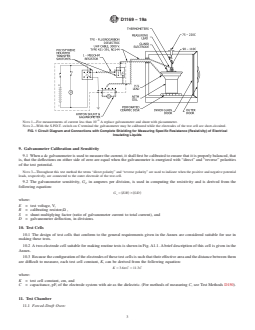
7.1 A schematic diagram of the test circuit is shown in Fig. 1.
7.2 Construct the circuitry so that leakage is minimal. To this end, mount the transfer switches on polystyrene or
TFE-fluorocarbon insulation of sufficient thickness to minimize possible leakage. Make all soldered connections with
low-thermal-emf solder using a soldering flux of resin and alcohol.
NOTE 2—The use of ordinary solder and flux can result in spurious thermal emf’s that will cause erroneous indications.
7.3 Completely shield the test circuit. Make connections to the current-measuring instrument with shielded leads. TFE-
fluorocarbon-insulated shielded leads are recommended for connecting the high-voltage electrode and measuring electrode of the
test cell to the test circuit.
8. Sampling
8.1 Sample liquids for use in this test in accordance with Practices D923. When possible, obtain samples for testing through
a closed system. If exposed to atmospheric conditions, take the sample when the relative humidity is 50 % or less. Some liquids,
in certain applications, require special handling and processes in the sampling, and these will be found in the governing procedures.
Consult such procedures before samples are taken.
8.2 Take a sufficient quantity of sample for this test for at least three separate resistivity determinations.
D1169 − 19a
−9
NOTE 1—For measurements of current less than 10 A replace galvanometer and shunt with picoammeter.
NOTE 2—With the S.P.D.T. switch on C terminal the galvanometer may be calibrated while the electrodes of the test cell are short-circuited.
FIG. 1 Circuit Diagram and Connections with Complete Shielding for Measuring Specific Resistance (Resistivity) of Electrical
Insulating Liquids
9. Galvanometer Calibration and Sensitivity
9.1 When a dc galvanometer is used to measure the current, it shall first be calibrated to ensure that it is properly balanced, that
is, that the deflections on either side of zero are equal when the galvanometer is energized with “direct” and “reverse” polarities
of the test potential.
NOTE 3—Throughout this test method the terms “direct polarity” and “reverse polarity” are used to indicate when the positive and negative potential
leads, respectively, are connected to the outer electrode of the test cell.
9.2 The galvanometer sensitivity, G , in amperes per division, is used in computing the resistivity and is derived from the
s
following equation:
G 5 ~E/R! 3~S/D!
s
where:
E = test voltage, V,
R = calibrating resistor,Ω ,
S = shunt multiplying factor (ratio of galvanometer current to total current), and
D = galvanometer deflection, in divisions.
10. Test Cells
10.1 The design of test cells that conform to the general requirements given in the Annex are considered suitable for use in
making these tests.
10.2 A two-electrode cell suitable for making routine tests is shown in Fig. A1.1. A brief description of this cell is given in the
Annex.
10.3 Because the configuration of the electrodes of these test cells is such that their effective area and the distance between them
are difficult to measure, each test cell constant, K, can be derived from the following equation:
K 5 3.6π C 5 11.3C
where:
K = test cell constant, cm, and
C = capacitance, pF, of the electrode system with air as the dielectric. (For methods of measuring C, see Test Methods D150).
11. Test Chamber
11.1 Forced-Draft Oven:
D1169 − 19a
11.1.1 When the tests are to be made above room temperature but below 300°C, use a forced-draft, thermostatically controlled
oven that conforms to the requirements of Section 17 as the test chamber. For tests at room temperature the unenergized oven can
be conveniently used as the test chamber.
11.1.2 Provide the test chamber with an opening in the wall through which two lengths of TFE-fluorocarbon-insulated shielded
cable will pass to make electrical connection from the measuring equipment and voltage source, respectively, to the test cell. Use
a perforated ceramic plate or disk to insulate the test cell from the metal flooring of the oven if the flooring is not insulated from
the oven
11.1.3 Provide a safety interlock on the door of the test chamber so that the electrical circuit supplying voltage to the test cell
will be broken when the door is opened.
11.1.4 A cross-sectional view of the test chamber with a three-electrode test cell in place and with test cables connected is shown
in Fig. 1.
11.2 Automatic Thermo-Regulator Cell:
11.2.1 When tests are to be made above room temperature but below the flash point, an automatic thermos-regulator cell can
be used as long as it proves uniform heating of the test cell.
11.2.2 The automatic thermo-regulator cell must be able to provide rapid, controlled rate of temperature rise, and be able to
maintain a liquid temperature constant to within 61 °C.
12. Test Temperature
12.1 The temperature at which a referee test is made shall be mutually agreed upon between the purchaser and the seller.
Resistivity measurements are made at many different temperatures. For acceptance tests, it is generally made at a temperature of
100°C, while for routine testing, it is usually made at room temperature, 85, or 100°C. In some research investigations, tests may
be made at considerably higher temperatures, while in other cases, particularly for tests on cable oils in service, tests may be made
over a range of temperatures.
13. Test Voltage
13.1 The average electrical stress to which the specimen is subjected shall be not less than 200 V/mm (5 V/mil) nor more than
1200 V/mm (30 V/mil). V/mm. The upper limit has been set with the purpose of avoiding possible ionization if higher stresses
were permitted. For acceptance testing, the stress and time of electrification should be mutually agreed upon by the purchaser and
the seller. The time of electrification in general usage is 1 min.
NOTE 4—The dc volume resistivity of new oil, particularly at room temperature, has been shown to be a function of both electrical stress and electrode
spacing. The resistivity has been found to have a maximum value when the applied electrical stress is about 50 V/mil;2000 V/mm; electrical stresses either
3,4
below or above this critical value yield lower values of volume resistivity.
14. Conditioning
14.1 Store the sample in its original sealed container and shield it from light. Some liquids, such as oils of petroleum origin,
undergo changes when exposed to sunlight. Allow the sealed container to stand undisturbed, in the room in which the test is to
be made, for a sufficient period of time to permit the sample to attain room temperature before it is opened.
15. Storing Test Cell
15.1 Clean and dry the test cell, when not in use, in accordance with Section 16. Store it in a dust-free cabinet until it is to be
used again, at which time clean and dry as directed by Section 16.
16. Cleaning Test Cell
16.1 The cleanliness of the test cell is of paramount importance when making resistivity measurements because of the inherent
susceptibility of most insulating liquids to contaminating influences of the most minute nature. For this reason clean and dry the
cell immediately prior to making the test. It is essential that the procedures and precautions outlined in 16.2 – 16.5 be strictly
observed.
16.2 Dismantle the cell completely and wash all the component parts thoroughly with a technical grade of a suitable solvent
(such as acetone or pentane). Wash the component parts with a mild abrasive soap or detergent. Take care not to lay the electrodes
on any surface. Rinse all parts thoroughly with hot tap water, then with cold tap water, followed by several rinses with distilled
water. Take extreme care during the washing and rinsing of the test cell shown in Fig. 2cells having a thermometer well to prevent
any moisture from entering the thermometer well in the inner electrode. As a precaution against this eventuality, use a suitable
stopper to plug this opening prior to starting the cleaning operation.
Gänger, B., and Maier, G., “The Resistivity of Insulating Oil in a Direct Voltage Field,” Brown-Boveri Review, Vol 56, October 1969, pp. 525–533.
Harrison, N. L., “Resistivity of Transformer Oil at Low and Medium Field Strengths,” Proceedings IEEE,IEEEA, Vol 115, May 1968, pp. 736–741.
D1169 − 19a
16.3 After the surfaces of the electrodes and guard have been washed, take care not to touch these surfaces during the rinsing
or any subsequent operation.
16.4 Place the component parts of the test cell in an oven maintained at 110°C for a period of not less than 60 min. Do not dry
test cells made of Monel at this elevated temperature for more than 90 min as oxidation will take place, causing erroneous results.
Take care to place the component parts of the cell on a clean surface of the oven.
16.5 At the expiration of the drying period, assemble the cell in the oven, using clean cotton gloves to protect the hands. Observe
the precaution given in 16.3.
16.6 Quickly transfer the assembled test cell to the test chamber maintained at a temperature above the desired test temperature.
The exact temperature will depend on both the oven an
...