

ASTM D8422-21
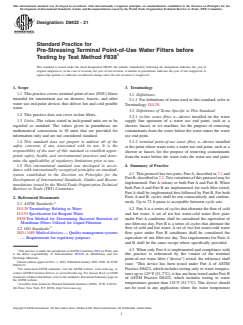
(Practice)Standard Practice for Pre-Stressing Terminal Point-of-Use Water Filters before Testing by Test Method F838
General Information
- Abstract
SIGNIFICANCE AND USE
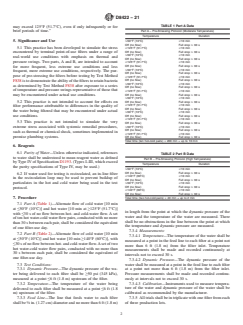
5.1 This practice has been developed to simulate the stress encountered by terminal point-of-use filters under a range of real-world use conditions with emphasis on thermal and pressure swings. Two parts, A and B, are intended to account for more frequent, less extreme use conditions and less frequent, more extreme use conditions, respectively. The purpose of pre-stressing the filters before testing by Test Method F838 is to demonstrate the ability of the filters to retain bacteria as determined by Test Method F838 after exposure to a series of temperature and pressure swings representative of those that may be encountered under actual use conditions.
5.2 This practice is not intended to account for effects on filter performance attributable to differences in the quality of the water being filtered that may be encountered under actual use conditions.
5.3 This practice is not intended to simulate the very extreme stress associated with systemic remedial procedures, such as thermal or chemical shock, sometimes implemented in premise plumbing systems.
SCOPE
1.1 This practice covers terminal point-of-use (POU) filters intended for intermittent use on showers, faucets, and other water use end-point devices that deliver hot and cold potable water.
1.2 This practice does not cover in-line filters.
1.3 Units—The values stated in inch-pound units are to be regarded as standard. The values given in parentheses are mathematical conversions to SI units that are provided for information only and are not considered standard.
1.4 This standard does not purport to address all of the safety concerns, if any, associated with its use. It is the responsibility of the user of this standard to establish appropriate safety, health, and environmental practices and determine the applicability of regulatory limitations prior to use.
1.5 This international standard was developed in accordance with internationally recognized principles on standardization established in the Decision on Principles for the Development of International Standards, Guides and Recommendations issued by the World Trade Organization Technical Barriers to Trade (TBT) Committee.
- Status
- Published
- Publication Date
- 31-Oct-2021
- Technical Committee
- D19 - Water
- Drafting Committee
- D19.08 - Membranes and Ion Exchange Materials
Overview
ASTM D8422-21 is a standard practice developed by ASTM International for pre-stressing terminal point-of-use (POU) water filters prior to testing their bacterial retention performance using ASTM F838. The protocol is designed to simulate real-world stress conditions that water filters encounter in typical end-user environments, specifically focusing on thermal and pressure variations. This standard supports manufacturers, testing laboratories, and regulatory authorities in evaluating the reliability and safety of terminal POU water filters installed on showers, faucets, and other potable water end-point devices.
Key Topics
Scope of Use:
- Covers terminal point-of-use filters for showers, faucets, and other hot and cold water delivery fixtures.
- Excludes in-line water filters installed upstream of the end-point device.
Pre-Stressing Protocols:
- Divides testing into two parts:
- Part A: Simulates more frequent, less severe temperature and pressure cycles (e.g., daily use).
- Part B: Simulates less frequent, more severe conditions (e.g., occasional high temperature exposures).
- Filters are subjected to cycles of hot and cold water, demonstrating their ability to endure shifts in temperature and pressure before bacterial retention testing by Method F838.
- Divides testing into two parts:
Testing Conditions:
- Recommends dynamic water pressure at or above 50 psi (345 kPa).
- Specifies hot and cold water temperature ranges and cycling durations.
- Protocols are conducted consecutively with minimal interruption, mirroring real-life use.
Safety and Compliance:
- Does not address variances in water quality or effects of extreme remedial procedures like thermal or chemical shocks.
- Calls for safety, health, and environmental assessments before implementation.
- Testing is to be conducted in ISO 13485 accredited facilities and documented according to ISO quality management requirements.
Applications
ASTM D8422-21 has practical benefits for a range of stakeholders:
Manufacturers:
- Use the standard practice to qualify the robustness of terminal point-of-use filters under variable installation conditions.
- Demonstrate compliance and support product claims regarding bacterial retention and durability.
Testing Laboratories:
- Provide consistent, repeatable, and internationally recognized testing protocols for evaluating terminal POU filters.
- Facilitate comparative analysis across filter brands and product lines.
Regulatory Bodies and Procurement Teams:
- Rely on the standard for certification, procurement specifications, and quality assurance in public facilities, healthcare, hospitality, and residential projects.
- Ensure product suitability for environments with varying water temperatures and usage frequencies.
End Users:
- Gain confidence in the microbial safety and integrity of filters suited for showers and faucets exposed to temperature and pressure changes.
Related Standards
- ASTM F838: Test Method for Determining Bacterial Retention of Membrane Filters Utilized for Liquid Filtration - referenced for post-stress bacterial performance.
- ASTM D1193: Specification for Reagent Water - referenced for water purity in testing.
- ASTM D1129: Terminology Relating to Water - provides definitions used in this and related standards.
- ISO 13485: Medical devices - Quality management systems - sets requirements for accredited testing facilities handling water filter assessments.
ASTM D8422-21 aligns with international standardization principles under the WTO Technical Barriers to Trade (TBT) Committee, supporting global interoperability and acceptance. This makes it a pivotal reference for anyone involved in the design, specification, and approval of terminal point-of-use water filters subjected to dynamic use conditions.
Relations
- Effective Date
- 01-May-2020
- Effective Date
- 30-Sep-2015
- Effective Date
- 01-May-2015
- Effective Date
- 01-Jun-2013
- Effective Date
- 01-Mar-2010
- Effective Date
- 01-Sep-2006
- Effective Date
- 01-Sep-2006
- Effective Date
- 01-Mar-2006
- Effective Date
- 15-Feb-2006
- Effective Date
- 01-Jan-2005
- Effective Date
- 01-Mar-2004
- Effective Date
- 01-Mar-2004
- Effective Date
- 10-Aug-2003
- Effective Date
- 10-Mar-2003
- Effective Date
- 10-Jul-2002
Get Certified
Connect with accredited certification bodies for this standard

CIS Institut d.o.o.
Personal Protective Equipment (PPE) certification body. Notified Body NB-2890 for EU Regulation 2016/425 PPE.

Kiwa BDA Testing
Building and construction product certification.
Kmetijski inštitut Slovenije
Agricultural Institute of Slovenia. Soil testing, plant health, agricultural product analysis.
Sponsored listings
Frequently Asked Questions
ASTM D8422-21 is a standard published by ASTM International. Its full title is "Standard Practice for Pre-Stressing Terminal Point-of-Use Water Filters before Testing by Test Method F838". This standard covers: SIGNIFICANCE AND USE 5.1 This practice has been developed to simulate the stress encountered by terminal point-of-use filters under a range of real-world use conditions with emphasis on thermal and pressure swings. Two parts, A and B, are intended to account for more frequent, less extreme use conditions and less frequent, more extreme use conditions, respectively. The purpose of pre-stressing the filters before testing by Test Method F838 is to demonstrate the ability of the filters to retain bacteria as determined by Test Method F838 after exposure to a series of temperature and pressure swings representative of those that may be encountered under actual use conditions. 5.2 This practice is not intended to account for effects on filter performance attributable to differences in the quality of the water being filtered that may be encountered under actual use conditions. 5.3 This practice is not intended to simulate the very extreme stress associated with systemic remedial procedures, such as thermal or chemical shock, sometimes implemented in premise plumbing systems. SCOPE 1.1 This practice covers terminal point-of-use (POU) filters intended for intermittent use on showers, faucets, and other water use end-point devices that deliver hot and cold potable water. 1.2 This practice does not cover in-line filters. 1.3 Units—The values stated in inch-pound units are to be regarded as standard. The values given in parentheses are mathematical conversions to SI units that are provided for information only and are not considered standard. 1.4 This standard does not purport to address all of the safety concerns, if any, associated with its use. It is the responsibility of the user of this standard to establish appropriate safety, health, and environmental practices and determine the applicability of regulatory limitations prior to use. 1.5 This international standard was developed in accordance with internationally recognized principles on standardization established in the Decision on Principles for the Development of International Standards, Guides and Recommendations issued by the World Trade Organization Technical Barriers to Trade (TBT) Committee.
SIGNIFICANCE AND USE 5.1 This practice has been developed to simulate the stress encountered by terminal point-of-use filters under a range of real-world use conditions with emphasis on thermal and pressure swings. Two parts, A and B, are intended to account for more frequent, less extreme use conditions and less frequent, more extreme use conditions, respectively. The purpose of pre-stressing the filters before testing by Test Method F838 is to demonstrate the ability of the filters to retain bacteria as determined by Test Method F838 after exposure to a series of temperature and pressure swings representative of those that may be encountered under actual use conditions. 5.2 This practice is not intended to account for effects on filter performance attributable to differences in the quality of the water being filtered that may be encountered under actual use conditions. 5.3 This practice is not intended to simulate the very extreme stress associated with systemic remedial procedures, such as thermal or chemical shock, sometimes implemented in premise plumbing systems. SCOPE 1.1 This practice covers terminal point-of-use (POU) filters intended for intermittent use on showers, faucets, and other water use end-point devices that deliver hot and cold potable water. 1.2 This practice does not cover in-line filters. 1.3 Units—The values stated in inch-pound units are to be regarded as standard. The values given in parentheses are mathematical conversions to SI units that are provided for information only and are not considered standard. 1.4 This standard does not purport to address all of the safety concerns, if any, associated with its use. It is the responsibility of the user of this standard to establish appropriate safety, health, and environmental practices and determine the applicability of regulatory limitations prior to use. 1.5 This international standard was developed in accordance with internationally recognized principles on standardization established in the Decision on Principles for the Development of International Standards, Guides and Recommendations issued by the World Trade Organization Technical Barriers to Trade (TBT) Committee.
ASTM D8422-21 is classified under the following ICS (International Classification for Standards) categories: 13.060.20 - Drinking water. The ICS classification helps identify the subject area and facilitates finding related standards.
ASTM D8422-21 has the following relationships with other standards: It is inter standard links to ASTM D1129-13(2020)e2, ASTM F838-15a, ASTM F838-15, ASTM F838-05(2013), ASTM D1129-10, ASTM D1129-06a, ASTM D1129-06ae1, ASTM D1193-06, ASTM D1129-06, ASTM F838-05, ASTM D1129-04, ASTM D1129-04e1, ASTM D1129-03a, ASTM D1129-03, ASTM D1129-01. Understanding these relationships helps ensure you are using the most current and applicable version of the standard.
ASTM D8422-21 is available in PDF format for immediate download after purchase. The document can be added to your cart and obtained through the secure checkout process. Digital delivery ensures instant access to the complete standard document.
Standards Content (Sample)
This international standard was developed in accordance with internationally recognized principles on standardization established in the Decision on Principles for the
Development of International Standards, Guides and Recommendations issued by the World Trade Organization Technical Barriers to Trade (TBT) Committee.
Designation: D8422 − 21
Standard Practice for
Pre-Stressing Terminal Point-of-Use Water Filters before
Testing by Test Method F838
This standard is issued under the fixed designation D8422; the number immediately following the designation indicates the year of
original adoption or, in the case of revision, the year of last revision.Anumber in parentheses indicates the year of last reapproval.A
superscript epsilon (´) indicates an editorial change since the last revision or reapproval.
1. Scope 3. Terminology
1.1 This practice covers terminal point-of-use (POU) filters
3.1 Definitions:
intended for intermittent use on showers, faucets, and other
3.1.1 For definitions of terms used in this standard, refer to
water use end-point devices that deliver hot and cold potable
Terminology D1129.
water.
3.2 Definitions of Terms Specific to This Standard:
1.2 This practice does not cover in-line filters.
3.2.1 in-line water filter, n—device installed on the water
1.3 Units—The values stated in inch-pound units are to be supply line upstream of a water use end point, such as a
regarded as standard. The values given in parentheses are
shower, faucet, or ice machine, for the purpose of removing
mathematical conversions to SI units that are provided for contaminants from the water before the water enters the water
information only and are not considered standard.
use end point.
1.4 This standard does not purport to address all of the
3.2.2 terminal point-of-use water filter, n—device installed
safety concerns, if any, associated with its use. It is the
at the point where water exits a water use end point, such as a
responsibility of the user of this standard to establish appro-
shower or faucet, for the purpose of removing contaminants
priate safety, health, and environmental practices and deter-
from the water before the water exits the water use end point.
mine the applicability of regulatory limitations prior to use.
1.5 This international standard was developed in accor-
4. Summary of Practice
dance with internationally recognized principles on standard-
4.1 Thisprotocolhastwoparts,PartA,describedin7.1and
ization established in the Decision on Principles for the
PartB,describedin7.2.Twovariationsofthisprotocolmaybe
Development of International Standards, Guides and Recom-
implemented: Part A (alone) or both Part A and Part B. When
mendations issued by the World Trade Organization Technical
both PartAand Part B are implemented: for each filter tested,
Barriers to Trade (TBT) Committee.
PartAshall be implemented first followed by Part B. For both
Parts A and B, cycles shall be run consecutively and continu-
2. Referenced Documents
ously. Up to 72 h pause is acceptable between cycle sets.
2.1 ASTM Standards:
D1129Terminology Relating to Water 4.2 PartAisaseriesofcyclesthatalternatetheflowofcold
D1193Specification for Reagent Water
and hot water. A set of ten hot water-cold water flow pairs
F838Test Method for Determining Bacterial Retention of under Part A conditions shall be considered the equivalent of
Membrane Filters Utilized for Liquid Filtration
one filter-use day. Part B is a series of cycles that alternate the
flow of cold and hot water. A set of two hot water-cold water
2.2 ISO Standards:
flow pairs under Part B conditions shall be considered the
ISO13485Medicaldevices—Qualitymanagementsystems
equivalent of one filter-use day. Test requirements for Parts A
— Requirements for regulatory purposes
and B shall be the same except where specifically provided.
1 4.3 When only PartAis implemented and compliance with
This practice is under the jurisdiction ofASTM Committee D19 on Water and
is the direct responsibility of Subcommittee D19.08 on Membranes and Ion
this practice is referenced by the vendor of the terminal
Exchange Materials.
point-of-use water filter (“device”) tested, the reference shall
Current edition approved Nov. 1, 2021. Published January 2022. DOI: 10.1520/
state: “This device has been tested under Part A of ASTM
D8422-21.
Practice D8422, which includes testing only to water tempera-
For referenced ASTM standards, visit the ASTM website, www.astm.org, or
contact ASTM Customer Service at service@astm.org. For Annual Book of ASTM
tures up to 125°F (51.7°C); it has not been tested under Part B
Standards volume information, refer to the standard’s Document Summary page on
of ASTM Practice D8422, which includes testing to water
the ASTM website.
temperatures greater than 125°F (51.7°C). This device should
Available fromAmerican National Standards Institute (ANSI), 25 W. 43rd St.,
4th Floor, New York, NY 10036, http://www.ansi.org. not be used in any application where the water temperature
Copyright © ASTM International, 100 Barr Harbor Drive, PO Box C700, West Conshohocken, PA 19428-2959. United States
D8422 − 21
TABLE 1 Part A Data
may exceed 125°F (51.7°C), even if only infrequently or for
brief periods of time.” Part A – Pre-Stressing Protocol (Moderate Temperature)
Temperature Duration
5. Significance and Use #50°F (10°C) $10 min
Off (no flow) Full stop# 30 s
5.1 This practice has been developed to simulate the stress
$125°F (51.7°C) $10 min
Off (no flow) Full stop# 30 s
encountered by terminal point-of-use filters under a range of
#50°F (10°C) $10 min
real-world use conditions with emphasis on thermal and
Off (no flow) Full stop# 30 s
pressure swings. Two parts, A and B, are intended to account
$125°F (51.7°C) $10 min
Off (no flow) Full stop# 30 s
for more frequent, less extreme use conditions and less
#50°F (10°C) $10 min
frequent, more extreme use conditions, respectively. The pur-
Off (no flow) Full stop# 30 s
pose of pre-stressing the filters before testing by Test Method
$125°F (51.7°C) $10 min
Off (no flow) Full stop# 30 s
F838istodemonstratetheabilityofthefilterstoretainbacteria
#50°F (10°C) $10 min
as determined by Test Method F838 after exposure to a series
Off (no flow) Full stop# 30 s
oftemperatureandpressureswingsrepresentativeofthosethat
$125°F (51.7°C) $10 min
Off (no flow) Full stop# 30 s
may be encountered under actual use conditions.
#50°F (10°C) $10 min
Off (no flow) Full stop# 30 s
5.2 This practice is not intended to account for effects on
$125°F (51.7°C) $10 min
filter performance attributable to differences in the quality of
Off (no flow) Full stop# 30 s
the water being filtered that may be encountered under actual
#50°F (10°C) $10 min
use conditions. Off (no flow) Full stop#
...