

ASTM F1476-07(2019)
(Specification)Standard Specification for Performance of Gasketed Mechanical Couplings for Use in Piping Applications
General Information
- Abstract
ABSTRACT
This specification provides the performance characteristics and qualification tests required for gasket mechanical couplings (GMCs) including grooved-type mechanical couplings for grooved end pipe, mechanical restraint couplings for plain end pipe and mechanical compression couplings for plain end pipe. These couplings are for use at temperatures within the recommended temperature range of their respective gaskets. The GMCs are classified into two types: Type I which are the groove mechanical couplings and Type II which are plain end mechanical couplings. Also, they can be classified into various grades based on successful completion of testing. They can also be grouped into three classes in accordance to joint characteristics: Class 1 which is rigid and restrained, Class 2 which is flexible and restrained, and Class 3 which is flexible and unrestrained. The housings of grooved GMCs shall be made from either ductile iron, aluminum alloy, or iron-chromium-nickel alloy. Bolts of these couplings shall be made from carbon steel and corrosion resistant materials. As for plain end GMCs, their housings or center sleeves shall be made from either ductile iron or steel materials. Their bolts shall be constructed with carbon steel and corrosion resistant materials. Standard qualification tests for GMC shall consist of the following: performance test, specimen examination, pneumatic proof test, vacuum test, hydrostatic proof test, flexibility test, hydrostatic burst test, rigidity test, bending moment proof test, and bending moment ultimate test.
SCOPE
1.1 This specification provides the performance characteristics and qualification tests required for gasketed mechanical couplings including grooved-type mechanical couplings for grooved end pipe, mechanical restraint couplings for plain end pipe, and mechanical compression couplings for plain end pipe. These couplings are for use at temperatures within the recommended temperature range of their respective gaskets. Consult manufacturer for details.
1.2 Measuring and test equipment (M&TE) used in the performance of the tests described herein shall be calibrated using equipment which is traceable to the National Institute of Standards and Technology (NIST) or calibrated in accordance with the requirements detailed in BS 5781, Part 1, against standards traceable to National Standards.
1.3 As this is not a dimensional standard, nor does it contain component dimensions, the intermixing of sub-components such as gaskets and housings between manufacturers is not recommended and constitutes non-conformance with this standard.
1.4 The values stated in SI units are to be regarded as standard. The values given in parentheses after SI units are provided for information only and are not considered standard.
1.5 This standard does not purport to address all of the safety concerns, if any, associated with its use. It is the responsibility of the user of this standard to establish appropriate safety, health, and environmental practices and determine the applicability of regulatory limitations prior to use.
1.6 This international standard was developed in accordance with internationally recognized principles on standardization established in the Decision on Principles for the Development of International Standards, Guides and Recommendations issued by the World Trade Organization Technical Barriers to Trade (TBT) Committee.
- Status
- Published
- Publication Date
- 30-Nov-2019
- Technical Committee
- F25 - Ships and Marine Technology
- Drafting Committee
- F25.11 - Machinery and Piping Systems
Overview
ASTM F1476-07(2019) - Standard Specification for Performance of Gasketed Mechanical Couplings for Use in Piping Applications defines the essential performance requirements and qualification testing for gasketed mechanical couplings (GMCs) utilized in piping systems. Developed by ASTM International, this standard addresses grooved and plain-end mechanical couplings, ensuring safety, reliability, and quality for various industrial and commercial piping applications. It specifies necessary material properties, manufacturing practices, testing procedures, and classification systems for these key components.
Key Topics
Types and Classes: GMCs are classified as Type I (grooved mechanical couplings) and Type II (plain end mechanical couplings), and further grouped into three classes based on joint characteristics:
- Class 1: Rigid and restrained
- Class 2: Flexible and restrained
- Class 3: Flexible and unrestrained
Material Specifications:
- Grooved coupling housings may be made from ductile iron, aluminum alloy, or iron-chromium-nickel alloy.
- Bolts and nuts must be carbon steel or corrosion-resistant materials.
- Gasket materials must match intended service requirements and meet relevant elastomeric standards.
Testing Requirements: The standard details robust qualification tests for GMCs, including:
- Performance, specimen examination, pneumatic proof, vacuum, hydrostatic proof and burst, flexibility, rigidity, and bending moment tests.
- Test equipment must be calibrated to national or international standards (e.g., NIST traceability or BS 5781).
Non-Interchangeability: Components such as gaskets and housings from different manufacturers should not be intermixed to avoid non-conformance.
Marking and Certification: Each GMC must be clearly marked for identification and traceability, with test records and material certifications maintained and available for inspection.
Applications
ASTM F1476-07(2019) provides guidelines suited for a broad range of piping systems where reliability and leak-resistance are critical. Typical applications include:
- Commercial Building Piping: HVAC, potable water, and fire suppression systems, where flexible and reliable pipe joining is essential.
- Industrial Installations: Petrochemical, process water, and utility piping networks requiring rigorous performance and safety standards.
- Shipboard and Marine Systems: Including supplementary requirements for naval vessel piping, addressing shock, vibration, and salt spray resistance.
- Municipal Water Supply and Wastewater: Ensuring leak-proof operation, accommodating pipe movement, and supporting easy maintenance.
In all cases, gasketed mechanical couplings offer advantages such as simplified installation, adaptability for field adjustments, and minimal requirement for welding or threading.
Related Standards
For comprehensive, standards-based piping system design and installation, consider the following related documents:
- AWWA C606 – Grooved and Shouldered Joints for piping systems
- ASME B36.10/B36.19 – Welded and Seamless Steel Pipe and Stainless Steel Pipe
- ASTM D2000 – Classification System for Rubber Products, guiding gasket materials
- ASTM A395/A536/A47 – Iron casting standards relevant to coupling components
- BS 5781 – Measurement and Calibration Systems for testing traceability
- ANSI/NCSL Z540.1 – Calibration Laboratories for measurement reliability
Practical Value
Adhering to ASTM F1476-07(2019) assists manufacturers, engineers, and specifiers in ensuring that mechanical couplings perform consistently under varied pressures and environmental conditions. The standard's rigorous testing and quality requirements help reduce leakage, improve system reliability, and extend service life across a multitude of piping applications. Maintaining compliance contributes to system safety and operational efficiency while supporting traceable product quality and regulatory compliance.
Relations
- Effective Date
- 01-Mar-2024
- Effective Date
- 01-Mar-2024
- Effective Date
- 01-May-2020
- Effective Date
- 01-May-2019
- Effective Date
- 01-Apr-2019
- Effective Date
- 01-Sep-2018
- Effective Date
- 15-May-2018
- Effective Date
- 01-Nov-2017
- Effective Date
- 15-Mar-2017
- Effective Date
- 01-Dec-2016
- Effective Date
- 01-Oct-2016
- Effective Date
- 01-Oct-2016
- Effective Date
- 01-Dec-2015
- Effective Date
- 01-Nov-2015
- Effective Date
- 01-Jun-2015
Get Certified
Connect with accredited certification bodies for this standard

Institut za varilstvo d.o.o. (Welding Institute)
Slovenia's leading welding institute since 1952. ISO 3834, EN 1090, pressure equipment certification, NDT personnel, welder qualification. Only IIW Au
Sponsored listings
Frequently Asked Questions
ASTM F1476-07(2019) is a technical specification published by ASTM International. Its full title is "Standard Specification for Performance of Gasketed Mechanical Couplings for Use in Piping Applications". This standard covers: ABSTRACT This specification provides the performance characteristics and qualification tests required for gasket mechanical couplings (GMCs) including grooved-type mechanical couplings for grooved end pipe, mechanical restraint couplings for plain end pipe and mechanical compression couplings for plain end pipe. These couplings are for use at temperatures within the recommended temperature range of their respective gaskets. The GMCs are classified into two types: Type I which are the groove mechanical couplings and Type II which are plain end mechanical couplings. Also, they can be classified into various grades based on successful completion of testing. They can also be grouped into three classes in accordance to joint characteristics: Class 1 which is rigid and restrained, Class 2 which is flexible and restrained, and Class 3 which is flexible and unrestrained. The housings of grooved GMCs shall be made from either ductile iron, aluminum alloy, or iron-chromium-nickel alloy. Bolts of these couplings shall be made from carbon steel and corrosion resistant materials. As for plain end GMCs, their housings or center sleeves shall be made from either ductile iron or steel materials. Their bolts shall be constructed with carbon steel and corrosion resistant materials. Standard qualification tests for GMC shall consist of the following: performance test, specimen examination, pneumatic proof test, vacuum test, hydrostatic proof test, flexibility test, hydrostatic burst test, rigidity test, bending moment proof test, and bending moment ultimate test. SCOPE 1.1 This specification provides the performance characteristics and qualification tests required for gasketed mechanical couplings including grooved-type mechanical couplings for grooved end pipe, mechanical restraint couplings for plain end pipe, and mechanical compression couplings for plain end pipe. These couplings are for use at temperatures within the recommended temperature range of their respective gaskets. Consult manufacturer for details. 1.2 Measuring and test equipment (M&TE) used in the performance of the tests described herein shall be calibrated using equipment which is traceable to the National Institute of Standards and Technology (NIST) or calibrated in accordance with the requirements detailed in BS 5781, Part 1, against standards traceable to National Standards. 1.3 As this is not a dimensional standard, nor does it contain component dimensions, the intermixing of sub-components such as gaskets and housings between manufacturers is not recommended and constitutes non-conformance with this standard. 1.4 The values stated in SI units are to be regarded as standard. The values given in parentheses after SI units are provided for information only and are not considered standard. 1.5 This standard does not purport to address all of the safety concerns, if any, associated with its use. It is the responsibility of the user of this standard to establish appropriate safety, health, and environmental practices and determine the applicability of regulatory limitations prior to use. 1.6 This international standard was developed in accordance with internationally recognized principles on standardization established in the Decision on Principles for the Development of International Standards, Guides and Recommendations issued by the World Trade Organization Technical Barriers to Trade (TBT) Committee.
ABSTRACT This specification provides the performance characteristics and qualification tests required for gasket mechanical couplings (GMCs) including grooved-type mechanical couplings for grooved end pipe, mechanical restraint couplings for plain end pipe and mechanical compression couplings for plain end pipe. These couplings are for use at temperatures within the recommended temperature range of their respective gaskets. The GMCs are classified into two types: Type I which are the groove mechanical couplings and Type II which are plain end mechanical couplings. Also, they can be classified into various grades based on successful completion of testing. They can also be grouped into three classes in accordance to joint characteristics: Class 1 which is rigid and restrained, Class 2 which is flexible and restrained, and Class 3 which is flexible and unrestrained. The housings of grooved GMCs shall be made from either ductile iron, aluminum alloy, or iron-chromium-nickel alloy. Bolts of these couplings shall be made from carbon steel and corrosion resistant materials. As for plain end GMCs, their housings or center sleeves shall be made from either ductile iron or steel materials. Their bolts shall be constructed with carbon steel and corrosion resistant materials. Standard qualification tests for GMC shall consist of the following: performance test, specimen examination, pneumatic proof test, vacuum test, hydrostatic proof test, flexibility test, hydrostatic burst test, rigidity test, bending moment proof test, and bending moment ultimate test. SCOPE 1.1 This specification provides the performance characteristics and qualification tests required for gasketed mechanical couplings including grooved-type mechanical couplings for grooved end pipe, mechanical restraint couplings for plain end pipe, and mechanical compression couplings for plain end pipe. These couplings are for use at temperatures within the recommended temperature range of their respective gaskets. Consult manufacturer for details. 1.2 Measuring and test equipment (M&TE) used in the performance of the tests described herein shall be calibrated using equipment which is traceable to the National Institute of Standards and Technology (NIST) or calibrated in accordance with the requirements detailed in BS 5781, Part 1, against standards traceable to National Standards. 1.3 As this is not a dimensional standard, nor does it contain component dimensions, the intermixing of sub-components such as gaskets and housings between manufacturers is not recommended and constitutes non-conformance with this standard. 1.4 The values stated in SI units are to be regarded as standard. The values given in parentheses after SI units are provided for information only and are not considered standard. 1.5 This standard does not purport to address all of the safety concerns, if any, associated with its use. It is the responsibility of the user of this standard to establish appropriate safety, health, and environmental practices and determine the applicability of regulatory limitations prior to use. 1.6 This international standard was developed in accordance with internationally recognized principles on standardization established in the Decision on Principles for the Development of International Standards, Guides and Recommendations issued by the World Trade Organization Technical Barriers to Trade (TBT) Committee.
ASTM F1476-07(2019) is classified under the following ICS (International Classification for Standards) categories: 23.040.60 - Flanges, couplings and joints. The ICS classification helps identify the subject area and facilitates finding related standards.
ASTM F1476-07(2019) has the following relationships with other standards: It is inter standard links to ASTM A53/A53M-24, ASTM A193/A193M-24, ASTM A194/A194M-20, ASTM A536-84(2019)e1, ASTM B580-79(2019), ASTM F837-13(2018), ASTM B26/B26M-18, ASTM A743/A743M-17, ASTM A194/A194M-17, ASTM A194/A194M-16a, ASTM A574-16, ASTM B88-16, ASTM B633-15, ASTM A193/A193M-15a, ASTM A193/A193M-15. Understanding these relationships helps ensure you are using the most current and applicable version of the standard.
ASTM F1476-07(2019) is available in PDF format for immediate download after purchase. The document can be added to your cart and obtained through the secure checkout process. Digital delivery ensures instant access to the complete standard document.
Standards Content (Sample)
This international standard was developed in accordance with internationally recognized principles on standardization established in the Decision on Principles for the
Development of International Standards, Guides and Recommendations issued by the World Trade Organization Technical Barriers to Trade (TBT) Committee.
Designation: F1476 − 07 (Reapproved 2019) An American National Standard
Standard Specification for
Performance of Gasketed Mechanical Couplings for Use in
Piping Applications
This standard is issued under the fixed designation F1476; the number immediately following the designation indicates the year of
original adoption or, in the case of revision, the year of last revision. A number in parentheses indicates the year of last reapproval. A
superscript epsilon (´) indicates an editorial change since the last revision or reapproval.
1. Scope 2. Referenced Documents
1.1 This specification provides the performance character-
2.1 ASTM Standards:
istics and qualification tests required for gasketed mechanical
A47/A47M Specification for Ferritic Malleable Iron Cast-
couplings including grooved-type mechanical couplings for
ings
grooved end pipe, mechanical restraint couplings for plain end
A53/A53M Specification for Pipe, Steel, Black and Hot-
pipe, and mechanical compression couplings for plain end
Dipped, Zinc-Coated, Welded and Seamless
pipe. These couplings are for use at temperatures within the
A135 Specification for Electric-Resistance-Welded Steel
recommended temperature range of their respective gaskets.
Pipe
Consult manufacturer for details.
A153/A153M Specification for Zinc Coating (Hot-Dip) on
Iron and Steel Hardware
1.2 Measuring and test equipment (M&TE) used in the
A183 Specification for Carbon Steel Track Bolts and Nuts
performance of the tests described herein shall be calibrated
A193/A193M Specification for Alloy-Steel and Stainless
using equipment which is traceable to the National Institute of
Steel Bolting for High Temperature or High Pressure
Standards and Technology (NIST) or calibrated in accordance
Service and Other Special Purpose Applications
with the requirements detailed in BS 5781, Part 1, against
A194/A194M Specification for Carbon Steel, Alloy Steel,
standards traceable to National Standards.
and Stainless Steel Nuts for Bolts for High Pressure or
1.3 As this is not a dimensional standard, nor does it contain
High Temperature Service, or Both
component dimensions, the intermixing of sub-components
A325 Specification for Structural Bolts, Steel, Heat Treated,
such as gaskets and housings between manufacturers is not
120/105 ksi Minimum Tensile Strength (Withdrawn
recommended and constitutes non-conformance with this stan-
2016)
dard.
A395/A395M Specification for Ferritic Ductile Iron
1.4 The values stated in SI units are to be regarded as
Pressure-Retaining Castings for Use at Elevated Tempera-
standard. The values given in parentheses after SI units are
tures
provided for information only and are not considered standard.
A536 Specification for Ductile Iron Castings
1.5 This standard does not purport to address all of the
A563/A563M Specification for Carbon and Alloy Steel Nuts
safety concerns, if any, associated with its use. It is the (Inch and Metric)
responsibility of the user of this standard to establish appro-
A574 Specification for Alloy Steel Socket-Head Cap Screws
priate safety, health, and environmental practices and deter- A743/A743M Specification for Castings, Iron-Chromium,
mine the applicability of regulatory limitations prior to use.
Iron-Chromium-Nickel, Corrosion Resistant, for General
1.6 This international standard was developed in accor- Application
dance with internationally recognized principles on standard- B26/B26M Specification for Aluminum-Alloy Sand Cast-
ization established in the Decision on Principles for the ings
Development of International Standards, Guides and Recom- B88 Specification for Seamless Copper Water Tube
mendations issued by the World Trade Organization Technical B580 Specification for Anodic Oxide Coatings on Alumi-
Barriers to Trade (TBT) Committee. num
1 2
This specification is under the jurisdiction of ASTM Committee F25 on Ships For referenced ASTM standards, visit the ASTM website, www.astm.org, or
and Marine Technology and is the direct responsibility of Subcommittee F25.11 on contact ASTM Customer Service at service@astm.org. For Annual Book of ASTM
Machinery and Piping Systems. Standards volume information, refer to the standard’s Document Summary page on
Current edition approved Dec. 1, 2019. Published January 2020. Originally the ASTM website.
approved in 1993. Last previous edition approved in 2013 as F1476 – 07 (2013). The last approved version of this historical standard is referenced on
DOI: 10.1520/F1476-07R19. www.astm.org.
Copyright © ASTM International, 100 Barr Harbor Drive, PO Box C700, West Conshohocken, PA 19428-2959. United States
F1476 − 07 (2019)
B633 Specification for Electrodeposited Coatings of Zinc on 3.1.5 gasketed mechanical coupling (GMC), n—a device
Iron and Steel used to join pipe to pipe, pipe to fitting, or fitting to fitting
D2000 Classification System for Rubber Products in Auto- wherein an elastomeric (gasket) is used to seal the joint.
motive Applications Coupling may or may not provide mechanical restraint of the
F837 Specification for Stainless Steel Socket Head Cap pipe or fitting.
Screws
3.1.6 grade, n—the joint working pressure as established by
2.2 ANSI Standards: tests using representative pipe or tube and the gasketed
ANSI/NCSL Z540.1 Calibration Laboratories in Measuring
mechanical coupling (GMC). Test pipe or tube shall be:
Test Equipment NPS—Standard Weight Steel Pipe in accordance with
ASME B36.10 and Specification A53/A53M, Grade B, or
2.3 ASME Standards:
Specification A135, Grade B.
B36.10 Welded and Seamless Wrought Steel Pipe
AWWA—Class 53 Ductile Iron Pipe in accordance with
B36.19 Stainless Steel Pipe
AWWA C151/A21.51 for 3 to 16 in. For other sizes, consult
2.4 AWWA Standards:
manufacturer.
C151/A21.51 Ductile-Iron Pipe, Centrifugally Cast, for Wa-
Tubing—Type K Copper Tube in accordance with Speci-
ter
fication B88.
C606 Grooved and Shouldered Joints
Other—As agreed to by GMC manufacturer and purchaser.
2.5 ASQ Standards:
3.1.7 grooved mechanical coupling (Type I), n—a device
ASQ/ANSI Z1.4 Sampling Procedures and Tables for In-
which consists of two or more housings, closure members such
spection by Attributes
as sets of bolts and nuts or pins, and a pressure-responsive
2.6 NFPA Standards:
gasket. It is used to mechanically join and seal grooved pipe or
NFPA 13 Sprinkler Systems
fitting, forming a joint. Grooves conform to AWWA C606 – 87
2.7 BSI Standards:
as applicable. Groove dimensions for tubing and other sizes
BS 1706 Method for Specifying Electro Plated Coatings of
and types of pipes shall be as specified by the manufacturer.
Zinc and Cadmium on Iron and Steel
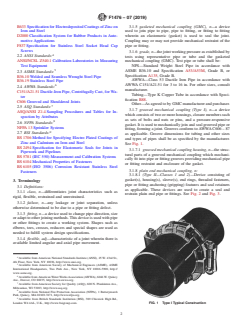
See Fig. 1.
BS 2494 Specification for Elastomeric Seals for Joints in
3.1.7.1 grooved mechanical coupling housing, n—the struc-
Pipework and Pipelines
tural parts of a grooved mechanical coupling which mechani-
BS 5781 (IEC 550) Measurement and Calibration Systems
cally fit into pipe or fitting grooves providing mechanical pipe
BS 6104 Mechanical Properties of Fasteners
or fitting restraint and enclosure of the gasket.
BS 6105 (ISO 3506) Corrosion Resistant Stainless Steel
3.1.8 plain end mechanical coupling, n:
Fasteners
3.1.8.1 (Type II—Classes 1 and 2)—Device consisting of
gasket(s), housing(s), sleeve(s), end rings, threaded fasteners,
3. Terminology
pipe or fitting anchoring (gripping) features and seal retainers
3.1 Definitions:
as applicable. These devices are used to create a seal and
3.1.1 class, n—differentiates joint characteristics such as
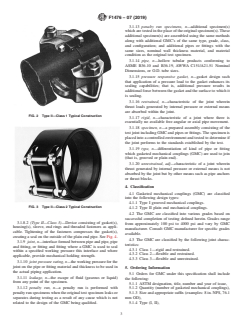
restrain plain end pipe or fittings. See Fig. 2 and Fig. 3.
rigid, flexible, restrained and unrestrained.
3.1.2 failure, n—any leakage or joint separation, unless
otherwise determined to be due to a pipe or fitting defect.
3.1.3 fitting, n—a device used to change pipe direction, size
or adapt to other joining methods. This device is used with pipe
or other fittings to create a working system. Shapes such as
elbows, tees, crosses, reducers and special shapes are used as
needed to fulfill system design specifications.
3.1.4 flexible, adj—characteristic of a joint wherein there is
available limited angular and axial pipe movement.
Available from American National Standards Institute (ANSI), 25 W. 43rd St.,
4th Floor, New York, NY 10036, http://www.ansi.org.
Available from American Society of Mechanical Engineers (ASME), ASME
International Headquarters, Two Park Ave., New York, NY 10016-5990, http://
www.asme.org.
Available from American Water Works Association (AWWA), 6666 W. Quincy
Ave., Denver, CO 80235, http://www.awwa.org.
Available from American Society for Quality (ASQ), 600 N. Plankinton Ave.,
Milwaukee, WI 53203, http://www.asq.org.
Available from National Fire Protection Association (NFPA), 1 Batterymarch
Park, Quincy, MA 02169-7471, http://www.nfpa.org.
Available from British Standards Institution (BSI), 389 Chiswick High Rd.,
London W4 4AL, U.K., http://www.bsigroup.com. FIG. 1 Type I Typical Construction
F1476 − 07 (2019)
3.1.13 penalty run specimens, n—additional specimen(s)
which are tested in the place of the original specimen(s). These
additional specimen(s) are assembled using the same methods
along with additional GMC’s of the same type, grade, class,
and configuration; and additional pipes or fittings with the
same sizes, nominal wall thickness material, and material
condition as the original test specimen.
3.1.14 pipe, n—hollow tubular products conforming to
ASME B36.10 and B36.19, AWWA C151/A21.51 Nominal
Dimensions, or O.D. tube sizes.
3.1.15 pressure responsive gasket, n—gasket design such
that application of a pressure load to the gasket enhances its
sealing capabilities; that is, additional pressure results in
additional force between the gasket and the surface to which it
is sealing.
3.1.16 restrained, n—characteristic of the joint wherein
thrust loads generated by internal pressure or external means
are absorbed within the joint.
FIG. 2 Type II—Class 1 Typical Construction
3.1.17 rigid, n—characteristic of a joint where there is
essentially no available free angular or axial pipe movement.
3.1.18 specimen, n—a prepared assembly consisting of the
test joint including GMC and pipes or fittings. The specimen is
placed into a controlled environment and tested to determine if
the joint performs to the standards established by the test.
3.1.19 type, n—differentiation of kind of pipe or fitting
which gasketed mechanical couplings (GMC) are used to join
(that is, grooved or plain end).
3.1.20 unrestrained, adj—characteristic of a joint wherein
thrust generated by internal pressure or external means is not
absorbed by the joint but by other means such as pipe anchors
or thrust blocks.
4. Classification
4.1 Gasketed mechanical couplings (GMC) are classified
into the following design types:
4.1.1 Type I grooved mechanical couplings.
FIG. 3 Type II—Class 2 Typical Construction
4.1.2 Type II plain end mechanical couplings.
4.2 The GMC are classified into various grades based on
successful completion of testing defined herein. Grades range
3.1.8.2 (Type II—Class 3)—Device consisting of gasket(s),
from approximately 100 psi to 4000 psi and vary by GMC
housing(s), sleeve, end rings and threaded fasteners as appli-
manufacturer. Consult GMC manufacturer for specific grades
cable. Tightening of the fasteners compresses the gasket(s),
available.
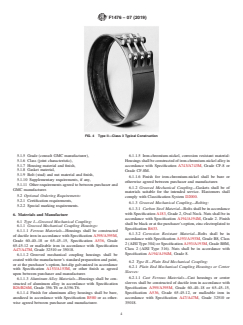
creating a seal on the outside of the plain end pipe. See Fig. 4.
4.3 The GMC are classified by the following joint charac-
3.1.9 joint, n—interface formed between pipe and pipe, pipe
teristics:
and fitting, or fitting and fitting where a GMC is used to seal
4.3.1 Class 1—rigid and restrained.
within a specified working pressure this interface and where
4.3.2 Class 2—flexible and restrained.
applicable, provide mechanical holding strength.
4.3.3 Class 3—flexible and unrestrained.
3.1.10 joint pressure rating, n—the working pressure for the
joint on the pipe or fitting material and thickness to be used in
5. Ordering Information
the actual piping application.
5.1 Orders for GMC under this specification shall include
3.1.11 leakage, n—the escape of fluid (gaseous or liquid)
the following:
from any point of the specimen.
5.1.1 ASTM designation, title, number and year of issue,
3.1.12 penalty run, n—a penalty run is performed with 5.1.2 Quantity (number of gasketed mechanical couplings),
penalty run specimens when the original test specimen leaks or 5.1.3 Size and appropriate suffix (examples: 8 in. NPS, 76.1
separates during testing as a result of any cause which is not mm OD),
related to the design of the GMC being qualified. 5.1.4 Type (I, II),
F1476 − 07 (2019)
FIG. 4 Type II—Class 3 Typical Construction
5.1.5 Grade (consult GMC manufacturer), 6.1.1.5 Iron-chromium-nickel, corrosion resistant material:
5.1.6 Class (joint characteristic),
Housings shall be constructed of iron-chromium-nickel alloy in
5.1.7 Housing material and finish,
accordance with Specification A743/A743M, Grade CF-8 or
5.1.8 Gasket material,
Grade CF-8M.
5.1.9 Bolt (stud) and nut material and finish,
6.1.1.6 Finish for iron-chromium-nickel shall be bare or
5.1.10 Supplementary requirements, if any,
otherwise agreed between purchaser and manufacturer.
5.1.11 Other requirements agreed to between purchaser and
6.1.2 Grooved Mechanical Coupling—Gaskets shall be of
GMC manufacturer.
materials suitable for the intended service. Elastomers shall
5.2 Optional Ordering Requirements:
comply with Classification System D2000.
5.2.1 Certification requirements,
6.1.3 Grooved Mechanical Coupling—Bolting:
5.2.2 Special marking requirements.
6.1.3.1 Carbon Steel Material—Bolts shall be in accordance
with Specification A183, Grade 2, Oval Neck. Nuts shall be in
6. Materials and Manufacture
accordance with Specification A194/A194M, Grade 2. Finish
6.1 Type I—Grooved Mechanical Coupling:
shall be black or at the purchaser’s option, zinc electroplated to
6.1.1 Grooved Mechanical Coupling Housings:
Specification B633.
6.1.1.1 Ferrous Materials—Housings shall be constructed
6.1.3.2 Corrosion Resistant Material—Bolts shall be in
of ductile iron in accordance with Specification A395/A395M,
accordance with Specification A193/A193M, Grade B8, Class
Grade 60–40–18 or 65–45–15, Specification A536, Grade
2 (AISI Type 304) or Specification A193/A193M, Grade B8M,
65-45-12 or malleable iron in accordance with Specification
Class 2 (AISI Type 316). Nuts shall be in accordance with
A47/A47M, Grade 32510 or 35018.
Specification A194/A194M, Grade 8.
6.1.1.2 Grooved mechanical coupling housings shall be
coated with the manufacturer’s standard preparation and paint,
6.2 Type II—Plain End Mechanical Coupling:
or at the purchaser’s option, hot-dip galvanized in accordance
6.2.1 Plain End Mechanical Coupling Housings or Center
with Specification A153/A153M, or other finish as agreed
Sleeves:
upon between purchaser and manufacturer.
6.2.1.1 Cast Ferrous Materials—Cast housings or center
6.1.1.3 Aluminum Alloy Materials—Housings shall be con-
sleeves shall be constructed of ductile iron in accordance with
structed of aluminum alloy in accordance with Specification
Specification A395/A395M, Grade 60–40–18 or 65–45–15,
B26/B26M, Grade 356-T6 or A356-T6.
Specification A536, Grade 65-45-12, or malleable iron in
6.1.1.4 Finish for aluminum alloy housings shall be bare,
accordance with Specification A47/A47M, Grade 32510 or
anodized in accordance with Specification B580 or as other-
wise agreed between purchaser and manufacturer. 35018.
F1476 − 07 (2019)
6.2.1.2 Steel Materials—End rings and sleeves made from 7.2.1 GMC shall be qualified using specimens of the same
carbon or stainless steel shall be made from material with a type, grade, and class. Each type, grade, and class shall be
minimum yield strength of 172 MPa (25 000 psi). tested in order to qualify the design. Qualification of the GMC
requires successful completion of required testing. Each GMC
6.2.1.3 Plain end mechanical couplings shall be coated with
design is only qualified for use on the pipe or fitting material
the manufacturer’s standard preparation and paint or other
and wall thickness on which it was tested.
finish as agreed upon between the purchaser and manufacturer.
Finish for iron chromium-nickel parts shall be bare or other- 7.2.2 All GMC’s tested shall be comprised of an equal
number of specimens from the smallest, most intermediate
wise agreed upon between purchaser and manufacturer.
size, and largest sizes within the size range of the GMC being
6.2.2 Plain End Mechanical Coupling—Gaskets shall be of
qualified.
materials suitable for the intended service (consult manufac-
7.2.3 Through reasonable interpolations between the GMC
turer for recommendation). Elastomer shall comply with Clas-
sizes tested, other sizes of GMC’s within the same type, grade,
sification System D2000 or BS 2494.
and class will be considered qualified if the specimens accord-
6.2.3 Plain End Mechanical Coupling—Bolting:
ing to 7.2.2 pass the testing requirements. Extrapolation shall
6.2.3.1 Carbon Steel Material—Bolts shall be in accordance
not be used for qualification purposes.
with Specification A183, Grade 2, Oval Neck or Specification
A325 — Type 2 Heavy Hex; cap screws shall be in accordance
7.3 Qualification Test Report:
with Specification A574 or BS 6104; female threaded parts,
7.3.1 Upon completion of testing, a qualification test report
other than nuts, shall be in accordance with Specification
shall be written and maintained on file during the life cycle of
A183, Grade 2; nuts, if required, shall conform to Specification
the design. A copy of this report shall be made available for
A183, Grade 2, or Specification A563/A563M — Grade C or
3 inspection at the manufacturer’s facility.
DH , or as otherwise agreed by purchaser and manufacturer.
3 7.3.2 Any failure during qualification testing shall be ana-
Finish shall be zinc electroplated to Specification B633 or
lyzed and the failure analysis and corrective action shall be
BS 1706.
included in the qualification test report.
6.2.3.2 Corrosion Resistant Material—Bolts or threaded
7.3.3 A retest as specified in Section 11 (number of tests and
female parts other than nuts shall be in accordance with
retests) may be allowed when failure to the original joint
Specification A193/A193M, Grade B8, Class 2 (AISI Type
occurs during qualification testing. When retesting is
304) or Grade B8M, Class 2 (AISI Type 316); cap screws shall
permitted, the failure analysis and corrective action shall be
be in accordance with Specification F837 or BS 6105; nuts, if
included in the qualification test report specified in 7.3.1.
required, shall be in accordance with Specification A194/
7.4 Test Equipment and Inspection Facilities:
A194M, Grade 8 or as agreed upon by purchaser and manu-
7.4.1 Test equipment and inspection facilities shall be of
facturer.
sufficient accuracy and quality to permit performance of
6.3 Other Materials—Where other materials are required,
required inspections and tests.
the material and mechanical properties of the product shall be
7.4.2 Calibration System Requirements—The testing and
as agreed upon by the GMC manufacturer and the purchaser.
inspection facilities shall maintain a calibration system for
Measuring and Test Equipment (M&TE) in accordance with
6.4 Material Quality:
ANSI/NCSL Z540.1 with traceability to the National Institute
6.4.1 The material shall be of such quality and purity that
of Standards and Technology (NIST), or shall maintain a
the finished product shall have the properties and characteris-
calibration system in accordance with the requirements de-
tics to meet the performance requirements of this standard.
tailed in BS 5781 Part 1 against standards traceable to National
6.4.2 The manufacturer is encouraged to use materials
Standards.
produced from recovered materials to the maximum extent
7.5 Test Conditions:
practicable without jeopardizing the intended use. The term
7.5.1 Test pressures as specified within each test shall be
“recovered materials” means: “Materials which have been
collected or recovered from solid waste and reprocessed to used.
become a source of raw material, as opposed to virgin raw 7.5.2 Fluid used in the testing of GMC shall be water or air,
materials.” Used or rebuilt products shall not be used. as specified.
7.5.3 Unless otherwise specified herein, GMC shall be
7. Other Requirements tested within the temperature range stated by the type of test
being performed.
7.1 Testing Requirements:
NOTE 1—When no temperature is specified within a test, the test shall
7.1.1 GMC shall be subjected to the tests described in the
be conducted at ambient conditions.
annexes for the purpose of qualifying the GMC design.
7.1.2 These tests shall be repeated when changes are made 7.6 Performance Requirements:
in the design, material, or manufacturing process that degrade 7.6.1 Pass criteria for each test shall require meeting or
the performance of the GMC. Degradation determination is to
exceeding the performance requirements specified in each test.
be made by the manufacturer or at agreement between the
manufacturer and purchaser.
8. Dimensions, Mass, and Permissible Variations
7.2 Qualification Requirements: 8.1 GMC Dimensions:
F1476 − 07 (2019)
8.1.1 Type I GMC dimensions shall be as specified by the 11.3.1.2 If the leak or separation is determined to be
manufacturer and shall provide the degree of axial and angular unrelated to the design, the test specimen shall be rerun. A
deflection (as applicable) specified by the manufacturer when replacement test specimen shall be prepared in accordance with
used on pipe grooved in accordance with AWWA C606 – 87, as the requirement specified in 11.2.
applicable, or manufacturer’s recommendation(s). 11.3.1.3 If the leak or separation cannot be shown to be
8.1.2 Type II GMC dimensions shall be as specified by the either design related or non-design related, the manufacturer
manufacturer. Type II Class 2 shall provide angular deflection shall test three (3) additional penalty specimens. The require-
as specified by the manufacturer. Type II Class 3 GMC shall ments specified in 11.3.2 shall apply.
provide axial movement and angular deflection as specified by 11.3.2 Penalty run specimens shall be prepared when GMC
the manufacturer. has failed any of the tests specified in the annexes.
11.3.2.1 The GMC’s used for penalty run(s) shall be of the
9. Workmanship, Finish, and Appearance
same type, grade, and class as the failed GMC being replaced.
11.3.2.2 The pipe or fitting used in penalty runs shall be of
9.1 GMC Machined Surfaces:
the same material, O.D., and wall thicknesses as the pipe or
9.1.1 Machined surfaces shall be free from burrs, cracks,
fitting being replaced.
laps, and seams which would affect the suitability for the
11.3.2.3 Preparation of the penalty run specimens shall be in
intended service.
accordance with Section 12.
9.1.2 Machined surface finishes shall be as specified by the
11.3.2.4 Penalty run specimens shall be identified in accor-
manufacturer.
dance with 12.3 and 11.3.2.5.
9.2 Unmachined Surfaces:
11.3.2.5 In addition to the part number and test specimen
9.2.1 Unmachined surfaces, such as forging or casting
number, a designator shall be placed after the test specimen
surfaces, shall be free from scale, blisters, fins, folds, seams,
number which allows the specimen to be identified as a penalty
laps, segregations and cracks which would affect suitability for
run specimen. The method used to identify penalty run
the intended service.
specimens shall be at the manufacturer’s option.
10. Sampling
12. Specimen Preparation
10.1 In-Process Inspection Sampling of GMC Products:
12.1 Specimen Preparation and Installation:
10.1.1 Inspection samples of GMC being manufactured or
12.1.1 Specimen preparation and installation on appropriate
processed shall be selected in accordance with ASQ/ANSI
testing apparatus shall be in accordance with the manufactur-
Z1.4. Level of inspection and acceptable quality level (AQL)
er’s recommended procedures.
shall be in accordance with the GMC manufacturer’s quality
12.2 Assembly of Specimens:
assurance procedures. Other inspection or sampling plans may
12.2.1 GMC qualified under the requirements of this speci-
be used upon mutual agreement between the manufacturer and
fication shall be tested and qualified as a completed assembly;
the purchaser.
that is, joint.
10.2 Lot Acceptance:
12.2.2 The intermixing of sub-components of the same type,
10.2.1 Lot acceptance shall be based upon meeting the
grade, and class, but of different brands or trade name,
sampling and pass/fail requirements of ASQ/ANSI Z1.4. Other
constitutes non-compliance with this standard.
inspection or sampling plans may be used upon mutual
12.2.3 Test specimens used in testing shall be assembled
agreement between the manufacturer and the purchaser.
using a GMC of a single type, grade, and class.
12.2.4 The wall thickness and O.D. size of the pipe or fitting
11. Number of Tests and Retest, for Qualification Testing
shall be as specified for the GMC joint being qualified.
11.1 Number of Test Specimens:
12.3 Identification of Test Specimens:
11.1.1 Each test shall be performed on specimens as de-
12.3.1 Each test specimen shall be identified with a unique
noted in Table A1.1.
number to provide traceability back to the test records.
11.2 Replacement of Test Specimens:
12.3.2 Identification of test specimens shall be permanent.
11.2.1 When untested specimens are rejected as a result of
In those cases where size or design does not permit permanent
inferior workmanship or materials, or assembly, the specimens
markings, tagging or bagging may be used.
shall be dispositioned in accordance with the manufacturer’s
12.3.2.1 When, as a result of testing, a test specimen is
quality assurance procedures.
sectioned into two (2) or more pieces, each piece shall be
11.2.1.1 New test specimens of the same type, grade, and
marked with the original unique identification number.
class, and pipe or fittings of the same O.D. size and wall
12.4 Test specimens may be disposed of following approval
thickness shall be prepared in accordance with Section 12.
of the qualification test report by the GMC manufacturer.
11.3 Penalty Runs:
13. Test Methods
11.3.1 In the event of not passing a test, the manufacturer
shall proceed with one of the following options: 13.1 Standard Qualification Tests for GMC shall be as
11.3.1.1 If the leak or separation is determined to be design specified in the annexes. The following tests described herein
related, the manufacturer shall redesign the GMC and start all are required for GMC qualification as applicable to the type,
tests from the beginning. grade and class.
F1476 − 07 (2019)
14.5 Inspection Records:
Name of Test Annex
14.5.1 Inspection records shall be maintained by the manu-
Performance Tests for GMC Annex A1
facturer. The length of time on file shall be in accordance with
Examination of Specimen Annex A2
Pneumatic Proof Testing Annex A3
the manufacturer’s quality assurance procedures.
Vacuum Testing Annex A4
Hydrostatic Proof Testing Annex A5
Flexibility Testing Annex A6 15. Certification
Hydrostatic Burst Testing Annex A7
Rigidity Testing Annex A8 15.1 Certification of Testing (see 13.2).
Bending Moment Proof Testing Annex A9
Bending Moment Ultimate Testing Annex A10 15.2 Certification of Material:
13.2 Certification of Test Results: 15.2.1 A certificate of compliance shall be obtained from
13.2.1 When specified in the purchase order or the contract, the material supplier, when applicable. This certificate shall
the purchaser shall be furnished certification that samples state that applicable requirements for the raw material have
representing the GMC have been tested as directed in this been met. As a minimum, the material specification shall
specification and the requirements have been met. When
specify the chemical and mechanical requirements of the
specified in the purchase order or contract, a report of the material, as applicable.
results shall be available for inspection at the manufacturer’s
facility.
16. Product Marking
13.3 In-Process Material Tests—In-process material tests
16.1 Product Marking:
shall be performed in accordance with manufacturer’s standard
16.1.1 Each GMC shall be marked with the manufacturer’s
in-process test procedures.
name or trademark, size, and markings traceable to the type,
grade and class. When shape or size does not permit inclusion
14. Inspection
of all required markings, the information may be omitted in the
14.1 Terms of Inspection:
reverse order presented.
14.1.1 Inspection of GMC shall be in accordance with
16.2 Additional Markings:
manufacturer’s standard inspection procedure or as agreed
upon between the purchaser and the manufacturer or supplier
16.2.1 When specified in the contract or purchase order,
as part of the purchase contract.
additional markings other than those specified shall be applied,
provided purchaser and supplier have agreed upon such prior to
14.2 Raw Material Inspection:
issuance of the contract or purchase order.
14.2.1 Raw material shall be inspected for compliance with
its material specification. A certificate of compliance or mill
17. Packaging
certificate shall be obtained from the material supplier, as
applicable.
17.1 The GMC shall be boxed, crated, wrapped and other-
wise protected during shipment and storage in accordance with
14.3 Quality Conformance Inspection:
14.3.1 GMC samples shall be visually and dimensionally manufacturer’s standard practice. Care shall be taken to prop-
erly protect the GMC from distortion and other damage during
examined to verify compliance with the manufacturer’s appro-
priate drawings. shipment and storage. GMC’s may be shipped assembled; or
bolts and gaskets may be packaged separately in suitable
14.4 Process Control Inspection:
containers to withstand handling and storage.
14.4.1 GMC shall be inspected throughout the entire manu-
facturing and processing cycle. Methods of inspection shall be
18. Keywords
in compliance with manufacturer’s quality assurance proce-
dures. 18.1 coupling; flexible; gasketed; grooved; plain end; rigid
F1476 − 07 (2019)
SUPPLEMENTARY REQUIREMENTS
GASKETED MECHANICAL COUPLINGS FOR USE IN PIPING APPLICATIONS (NA-
VAL SHIPBOARD USE)
The following supplementary requirements established for naval shipboard application shall apply
when specified in the contract or purchase order. When there is conflict between the standard and this
supplement, the requirements of this supplement shall take precedence for equipment acquired by this
supplement.
TABLE S4.1 Example: F1476S1-GMC-II-150 PSI-2-6 NPS
S1. Scope
F1476S1 GMC II 150 PSI 2 6 NPS
S1.1 This supplement covers Gasketed Mechanical Cou-
Specification Equipment Type Grade Class Size
plings (GMC) for use in non-critical, non-nuclear U.S. Navy
designator
(see (see (see (see (see
surface ship piping systems.
S4.2) S4.3) S4.4) S4.5) S4.6)
S1.2 The U.S. government preferred system of measurement
is the metric (SI) system. However, since this item was
originally designed using inch-pound units of measurement, in
the event of conflict between the metric and inch-pound units,
ASTM F1476-07, Type 2, Class 2 Plain end mechanical
the inch-pound units shall take precedence.
coupling
S4.4 Grade—GMC grades are related to pressure ratings.
S2. Referenced Documents
As coupling size increases, pressure rating decreases. The
S2.1 Commercial Documents:
typical naval installation will require a coupling design pres-
ANSI/ASQC 9001, Quality Systems — Model for Quality
sure between vacuum and 150–200 psig. Consult system
Assurance in Design, Development, Production, Installation,
requirements and manufacturer specifications for determining
and Servicing
Grade designation (see S5.2).
ASTM B117 Standard Practice for Operating Salt Spray
S4.5 Class—GMCs are classified by joint characteristics.
(Fog) Apparatus
The Class 2 joint addressed by this addendum is: Flexible and
ASTM D1141 Standard Practice for the Preparation of
Restrained.
Substitute Ocean Water
S4.6 Size—GMCs accommodate the outside diameter of
ASTM D3951 Standard Practice for Commercial Packag-
standard piping. The following nominal pipe sizes (NPS) in
ing
inches represent shipboard piping system applications: ⁄4, 1,
S2.2 Military Documents: 1 1 1 1
1 ⁄4, 1 ⁄2, 2, 2 ⁄2, 3, 3 ⁄2, 4, 5, 6, 8. Nominal pipe size and
S2.2.1 Military Standards:
appropriate suffix shall be specified in the ordering information
MIL-STD-167-1 Mechanical Vibrations of Shipboard
in inches (see S5.2).
Equipment (Type I – Environmental, and Type II – Internally
S4.7 Application—GMCs may be used, but are not limited
Excited)
to the following applications:
MIL-STD-777 Piping Components C-1, C-2, D-1, D-3,
Fresh water systems
M-1, R-1, R-3, R-4
Plumbing and sanitary systems
S2.2.2 Military Specifications:
Sewage (CHT/VCHT) systems
MIL-S-901 Shock Tests, H.I. (High Impact); Shipboard
Tank vents
Machinery, Equipment and Systems, Requirements for
Chilled water
S3. Terminology
S5. Ordering Information
S3.1 See Section 3.
S5.1 The buyer shall provide the manufacturer with all of
the pertinent application data shown in accordance with S5.2.
S4. Design Classification
If special application operating conditions exist that are not
S4.1 Designation—GMC designation shall consist of a shown in the acquisition requirements, they shall also be
series of designations which shall be assigned and listed in the described.
format as presented in the main body of Specification F1476 S5.2 Acquisition Requirements—Acquisition documents
and represented below is a size that might be used by the Navy should specify the following:
(see Table S4.1). S5.2.1 Title, number and date of this specification,
S4.2 Equipment Designator—The gasketed mechanical S5.2.2 Quantity and designation of GMC (see S4.1),
coupling shall be designated as GMC-Gasketed Mechanical S5.2.3 Type (see S4.3),
Coupling. S5.2.4 Grade: Consult manufacturer for proper identification
S4.3 Type—The type of GMC shall be specified as follows: of required Grade (see S4.4),
F1476 − 07 (2019)
S5.2.5 Class: Flexible and Restrained (see S4.5), mean that the use of used or rebuilt products is allowed under
this specification unless specified.
S5.2.6 Size (see S4.6),
S5.2.7 Housing material and finish,
S7. Physical Properties
S5.2.8 Gasket material and shelf life,
S5.2.9 Bolt (stud) and nut material and finish (see S6.3), S7.1 Design and Construction—GMCs shall be constructed
in accordance with the classes and types described in Section
S5.2.10 System fluid (operating media), system pressure and
3.
system temperature,
S7.1.1 Strip or Band Inserts—For Type II, Class 2 GMCs, a
S5.2.11 Supplementary requirements, if any,
strip or band insert made of a material compatible with the
S5.2.12 When qualification testing is required,
intended fluid, is required for vacuum service, applications
S5.2.13 Final disposition of qualification test samples,
where external pressure exists or installation where excessive
S5.2.14 National Stock Number (NSN) if available,
gap space exists between pipes being coupled. Strip or band
S5.2.15 Unique product marking requirements,
inserts shall be specified in the ordering information (see
S5.2.16 Unique packaging requirements.
S5.2.11). Strip or band type inserts must be a minimum of 10
% wider than the maximum allowable gap between the pipes as
S6. Materials and Manufacture
stated in the manufacturer’s specifications.
Materials used in the construction of GMCs shall be com- S7.2 Temperature—GMCs shall not be used in applications
patible with the intended service piping, operating media and below –20ºC (4°F) nor above 100ºC (212°F).
the rigors of the marine environment. S7.3 Working Pressure—Maximum working pressure for
GMCs shall be 16 Bar (232 lb/in. ) at 100ºC (212°F).
S6.1 Material exclusions—All GMCs under this specifica-
S7.4 Service Life—GMCs shall be designed for a minimum
tion shall be certified to be free of functional mercury. Asbestos
service life of 15 years. GMCs shall be reusable without
and cadmium plating are not permitted. Materials used in the
replacing gasket material with each removal and reinstallation.
manufacture of GMCs shall have no adverse effect on the
S7.5 Interchangeability —Parts, components and attach-
health of personnel when used for its intended purpose
ments shall be interchangeable with parts and components of
including handling, installation use and removal. The materials
the same types and classes produced by the same manufacturer.
shall not cause any environmental problems during waste
disposal.
S8. Performance
S6.2 Housing Material and Finish—Housing material shall
be corrosion resistant (see Section 6). Finishes, paint, or S8.1 Salt Spray—GMCs shall withstand exposure to a salt
coating systems shall be agreed upon between the purchaser
spray marine environment when tested as specified in S12.10.
and the manufacturer. Housing material and finish shall be S8.2 Shock—GMCs shall show no signs of damage when
specified in the ordering information (see S5.2.7).
exposed to Grade A, Class I, Type A shock in accordance with
MIL-S-901 as specified in S12.11.
S6.3 Gasket Material—Gasket material shall be suitable for
the intended service. Gasket material shall be specified in the S8.3 Vibration—GMCs shall show no signs of damage when
exposed to Type I vibration in accordance with MIL-STD-
ordering information (see S5.2.8).
167-1 as specified in S12.12.
S6.3.1 Gasket Material Shelf Life—Shelf life is a limiting
consideration for many gasket materials. Gasket shelf life shall
S9. Workmanship, Finish, and Appearance
be specified in the ordering information (see S5.2.8).
S6.4 Bolt (Stud) and Nut Material and Finish—Bolt (stud)
S9.1 See Section 9.
and nut material shall be corrosion resistant. Fasteners shall be
S10.
of a type, strength and grade suitable for the intended service.
Bolt (stud) and nut material and finish shall be specified in the
S10.1 Inspection System—The testing set forth in this
ordering information (see S5.2.9).
specification shall become a part of the manufacturer’s overall
S6.5 Pipe Sealing Compounds—GMCs shall be installed
inspection system or quality program. The manufacturer’s
directly on piping without the necessity of primers, adhesives
quality system shall comply with the requirements of ANSI/
or sealing compounds.
ASQC 9001 – 1994, Quality Systems – Model for Quality
S6.6 Thread Compounds—Where required, the manufac-
Assurance in Design, Development, Production, Installation,
turer shall recommend thread lubricants, sealants, and locking
and Servicing. Certification and registration is highly desired
compounds.
but not required.
S6.7 Recovered Materials—Unless otherwise specified S10.2 Classification of Inspections—The inspection require-
herein, all equipment, material, and articles incorporated in the ments specified herein are classified as follows:
products covered by this specification shall be new and shall be (a) Qualification testing
fabricated using materials produced from recovered materials (b) Quality conformance testing
to the maximum extent practicable without jeopardizing in- S10.3 Qualification Testing—Qualification testing shall con-
tended use. The term “recovered materials” means materials sist of two samples of each type and size GMC subjected to the
that have been collected or recovered from solid waste and examinations and tests in accordance with Table S10.1 in the
reprocessed to become a source of raw materials, as opposed to order shown. Failure of any GMC to meet the requirements of
virgin raw materials. None of the above shall be interpreted to this specification shall be cause for rejection.
F1476 − 07 (2019)
TABLE S10.1 Qualification and Quality Conformance Testing
S12.3 Vibration—The complete GMC assembly shall be
Quality subjected to vibration in accordance with MIL-STD-167-1,
Examination Qualification
Requirement Conformance
Type I. The GMC assembly shall be filled to the 100 percent
or Test Test Method
Test Method
fluid level and pressurized to normal working pressure during
Salt spray S8.9 S12.10 ---
exposure to vibration. After exposure to vibration, the GMC
Shock S8.10 S12.11 ---
Vibration S8.11 S12.12 ---
assembly shall show no evidence of damage, leakage, or loose
or missing fasteners.
S10.4 Quality Conformance Testing—GMCs which are
S13. Quality Assurance Provisions
produced in the same facilities, using identical materials,
S13.1 Warranty—Special warranty requirements shall be
manufacturing and assembly procedures shall be subjected to
specified in the acquisition requirements. Otherwise, the stan-
the quality conformance tests specified in Table S10.1. GMCs
dard commercial warranty applies.
of the same type, class, and size offered for delivery at one time
shall be considered a lot for purposes of inspections and tests.
S14. Certification
S11. Number of Tests and Retests
S14.1 When specified in the purchase order or contract, the
S11.1 The number of tests and retests, if any, shall be
buyer shall be furnished certification that samples representing
specified in the acquisition requirements. each lot have been either tested or inspected as directed in this
specification and the requirements have been met. When
S12. Test Methods
specified in the purchase order or contract, a report of the test
S12.1 Salt Spray—The complete GMC assembly shall be result shall be furnished. It is recommended that all test data
subjected to a salt spray in accordance with ASTM B117. No remain on file for three years at the manufacturer’s facility for
appreciable corrosion or other damage shall be evident after review by buyer upon request.
exposure to the salt spray.
S12.2 Shock—GMCs shall be subjected to shock in accor-
S15. Product Marking
dance with MIL-S-901, Class I, Grade A. The GMC shall be
S15.1 Unique product marking or identification plate re-
tested as a complete assembly mounted on an approved
quirements shall be specified in the acquisition requirements.
mounting fixture. The shock test shall be performed as follows:
The GMC shall be installed in a suitable test rig filled to 100
S16. Packaging and Package Marking
% fluid level and pressurized to normal working pressure. A
total of nine blows shall be applied; three blows shall be S16.1 Unless otherwise specified, package in accordance
applied parallel to each of the three principal axes. After with the requirements of Section 17 and ASTM D3951. Unique
exposure to shock, the coupling assembly shall show no preservation, packaging and package requirements shall be
evidence of damage, leakage, or loose or missing fasteners. specified in the acquisition requirements.
ANNEXES
(Mandatory Information)
A1. PERFORMANCE TESTS FOR GMC
A1.1 Scope A1.1.4 The test procedures appear in the following order:
Procedure Section
A1.1.1 This section lists the tests to be used in the qualifi-
cation of GMC. In addition, statements that apply to all tests
Examination of Specimen Annex A2
are specified to minimize redundancy.
Pneumatic Proof Testing Annex A3
Vacuum Testing Annex A4
A1.1.2 The values stated in acceptable metric units are to be
Hydrostatic Proof Testing Annex A5
regarded as standard. The values given in parentheses (inch/
Flexibility Testing Annex A6
Hydrostatic Burst Testing Annex A7
pound) are provided for information purposes only.
Rigidity Testing Annex A8
A1.1.3 The tests required to qualify GMC may involve
Bending Moment Proof Testing Annex A9
Bending Moment Ultimate Annex A10
hazardous materials, operations, and equipment. This standard
Testing
does not purport to address all of the safety concerns, if any,
associated with its use. It is the responsibility of the user of this A1.1.5 The sections listed below are from the main body
of this standard and apply to the test specimens used in the
standard to establish appropriate safety, health, and environ-
mental practices and determine the applicability of regulatory performance of the tests listed in A1.1.4.
limitations prior to use.
F1476 − 07 (2019)
TABLE A1.3 Testing Requirements
Title Section
NOTE 1—As far as practical, specimens may be used for more than one
Scope 1
test.
Referenced Documents 2
Terminology 3
Number
Classification 4
of
Description of Test Applicability of Test
Materials and Manufacture 6
Speci
...