

ASTM D3053-23a
(Terminology)Standard Terminology Relating to Carbon Black
General Information
- Abstract
SCOPE
1.1 This terminology covers a compilation of definitions of technical terms used in the carbon black and rubber industries. Terms that are generally understood or adequately defined in other readily available sources are not included.
1.2 This international standard was developed in accordance with internationally recognized principles on standardization established in the Decision on Principles for the Development of International Standards, Guides and Recommendations issued by the World Trade Organization Technical Barriers to Trade (TBT) Committee.
- Status
- Published
- Publication Date
- 14-Dec-2023
- Technical Committee
- D24 - Carbon Black
- Drafting Committee
- D24.41 - Carbon Black Nomenclature and Terminology

Overview
ASTM D3053-23a: Standard Terminology Relating to Carbon Black is an internationally recognized terminology standard developed by ASTM International. This document compiles precise definitions of technical terms commonly used in the carbon black and rubber industries, supporting consistency in communication, testing, and product specification. The standard is maintained by ASTM Committee D24 on Carbon Black and helps stakeholders across manufacturing, quality control, and research understand key properties and test methods for carbon black.
Adhering to internationally recognized standardization principles, ASTM D3053-23a fosters global interoperability and compliance, and aligns with recommendations from the World Trade Organization Technical Barriers to Trade (TBT) Committee.
Key Topics
Carbon Black Morphology
- Defines the hierarchical structure of carbon black, including terms for particles, aggregates, and agglomerates.
- Explains types such as furnace black, thermal black, tread grade, and carcass grade.
Material Properties and Characterization
- Addresses vital properties like nitrogen surface area (NSA), oil absorption number (OAN), pellet size distribution, mass strength, void volume, and more.
- Explains analytical methods such as electron microscopy, heating loss, and iodine adsorption numbers.
Processing and Testing
- Details terminology for preparation and use, such as dispersion, pellet hardness, fines, macro-dispersion, micro-dispersion, and visual dispersion.
- Defines concepts such as “lot sample” and practices for sampling bulk and packaged shipments.
Sustainability and Life Cycle
- Introduces terms relating to life cycle assessment (LCA), cradle-to-gate boundaries, end-of-life concepts, and environmental documentation, referencing ISO standards.
- Defines nanomaterial and nanoparticle in the context of carbon black’s structure.
Applications
ASTM D3053-23a is invaluable across a range of practical applications involving carbon black:
Rubber and Tire Manufacturing
- Used to ensure consistent material descriptions, facilitate specification of carbon black grades, and determine suitability for carcass, tread, or other applications.
Product Testing and Quality Control
- Provides a standardized vocabulary for conducting and reporting carbon black tests, such as oil absorption, surface area analysis, pellet strength, and dispersion evaluation.
Regulatory Compliance
- Supports meeting international regulatory and trade requirements by aligning with global standardization protocols and WTO recommendations.
Sustainability and Environmental Assessment
- Enables accurate life cycle assessment (LCA) documentation, contributing to efforts in reducing carbon footprint and supporting the circular economy.
Technical Communication and Training
- Enhances clarity in technical manuals, research publications, and training materials by offering precise definitions of specialized terminology.
Related Standards
ASTM D3053-23a references and aligns with several important standards for carbon black characterization and testing:
ASTM Standards
- D1508: Pelleted fines and attrition
- D1510: Iodine adsorption number
- D1765: Classification system for carbon blacks used in rubber products
- D2414: Oil absorption number (OAN)
- D2663: Dispersion in rubber
- D3849: Morphological characterization using electron microscopy
- D6556: Surface area by nitrogen adsorption
- D7854: Void volume at mean pressure
- D8178: Terminology relating to recovered carbon black (rCB)
ISO Standards
- ISO 8887: Design for manufacturing, assembling, disassembling, and end-of-life processing
- ISO 14044: Environmental management - Life cycle assessment (LCA)
By utilizing ASTM D3053-23a, organizations benefit from a uniform language that streamlines carbon black research, product development, quality assurance, and compliance. For a comprehensive understanding of test procedures and terminology, consult this standard alongside the referenced documents.
Relations
- Effective Date
- 15-Dec-2023
- Effective Date
- 01-Jan-2024
- Effective Date
- 01-Jan-2024
- Effective Date
- 15-Dec-2023
- Effective Date
- 01-Nov-2023
- Effective Date
- 01-Nov-2023
- Effective Date
- 01-Apr-2023
- Referred By
ASTM D8466-22 - Standard Guide for Recovered Carbon Black-Carbon Black Test Methods for Testing rCB - Effective Date
- 15-Dec-2023
- Effective Date
- 15-Dec-2023
- Effective Date
- 15-Dec-2023
- Effective Date
- 15-Dec-2023
- Effective Date
- 15-Dec-2023
Get Certified
Connect with accredited certification bodies for this standard

DIN CERTCO
DIN Group product certification.

Smithers Quality Assessments
US management systems and product certification.
Sponsored listings
Frequently Asked Questions
ASTM D3053-23a is a standard published by ASTM International. Its full title is "Standard Terminology Relating to Carbon Black". This standard covers: SCOPE 1.1 This terminology covers a compilation of definitions of technical terms used in the carbon black and rubber industries. Terms that are generally understood or adequately defined in other readily available sources are not included. 1.2 This international standard was developed in accordance with internationally recognized principles on standardization established in the Decision on Principles for the Development of International Standards, Guides and Recommendations issued by the World Trade Organization Technical Barriers to Trade (TBT) Committee.
SCOPE 1.1 This terminology covers a compilation of definitions of technical terms used in the carbon black and rubber industries. Terms that are generally understood or adequately defined in other readily available sources are not included. 1.2 This international standard was developed in accordance with internationally recognized principles on standardization established in the Decision on Principles for the Development of International Standards, Guides and Recommendations issued by the World Trade Organization Technical Barriers to Trade (TBT) Committee.
ASTM D3053-23a is classified under the following ICS (International Classification for Standards) categories: 01.040.83 - Rubber and plastics industries (Vocabularies); 83.040.20 - Rubber compounding ingredients. The ICS classification helps identify the subject area and facilitates finding related standards.
ASTM D3053-23a has the following relationships with other standards: It is inter standard links to ASTM D3053-23, ASTM D3265-24, ASTM D1510-24, ASTM D1765-23b, ASTM D1510-23a, ASTM D3265-23a, ASTM D1765-23a, ASTM D8466-22, ASTM D5817-20, ASTM D6602-13(2022)e1, ASTM D5596-03(2021), ASTM D8178-22. Understanding these relationships helps ensure you are using the most current and applicable version of the standard.
ASTM D3053-23a is available in PDF format for immediate download after purchase. The document can be added to your cart and obtained through the secure checkout process. Digital delivery ensures instant access to the complete standard document.
Standards Content (Sample)
This international standard was developed in accordance with internationally recognized principles on standardization established in the Decision on Principles for the
Development of International Standards, Guides and Recommendations issued by the World Trade Organization Technical Barriers to Trade (TBT) Committee.
Designation: D3053 − 23a
Standard Terminology Relating to
Carbon Black
This standard is issued under the fixed designation D3053; the number immediately following the designation indicates the year of
original adoption or, in the case of revision, the year of last revision. A number in parentheses indicates the year of last reapproval. A
superscript epsilon (´) indicates an editorial change since the last revision or reapproval.
1. Scope D1937 Test Method for Carbon Black, Pelleted—Mass
Strength
1.1 This terminology covers a compilation of definitions of
D2414 Test Method for Carbon Black—Oil Absorption
technical terms used in the carbon black and rubber industries.
Number (OAN)
Terms that are generally understood or adequately defined in
D2663 Test Methods for Carbon Black—Dispersion in Rub-
other readily available sources are not included.
ber
1.2 This international standard was developed in accor-
D3265 Test Method for Carbon Black—Tint Strength
dance with internationally recognized principles on standard-
D3493 Test Method for Carbon Black—Oil Absorption
ization established in the Decision on Principles for the
Number of Compressed Sample (COAN)
Development of International Standards, Guides and Recom-
D3849 Test Method for Carbon Black—Morphological
mendations issued by the World Trade Organization Technical
Characterization of Carbon Black Using Electron Micros-
Barriers to Trade (TBT) Committee.
copy
D5230 Test Method for Carbon Black—Automated Indi-
2. Referenced Documents
vidual Pellet Hardness
2.1 ASTM Standards:
D6556 Test Method for Carbon Black—Total and External
D1508 Test Method for Carbon Black, Pelleted Fines and Surface Area by Nitrogen Adsorption
Attrition
D6602 Practice for Sampling and Testing of Possible Carbon
D1509 Test Methods for Carbon Black—Heating Loss Black Fugitive Emissions or Other Environmental
D1510 Test Method for Carbon Black—Iodine Adsorption
Particulate, or Both
Number D7854 Test Method for Carbon Black-Void Volume at Mean
D1511 Test Method for Carbon Black—Pellet Size Distri-
Pressure
bution D8178 Terminology Relating to Recovered Carbon Black
D1513 Test Method for Carbon Black, Pelleted—Pour Den- (rCB)
sity 2.2 ISO Standards:
D1514 Test Method for Carbon Black—Sieve Residue
ISO 8887 Technical product documentation — Design for
D1566 Terminology Relating to Rubber manufacturing, assembling, disassembling and end-of-life
D1618 Test Method for Carbon Black Extractables—
processing — Part 1: General concepts and requirements
Transmittance of Toluene Extract ISO 14044 Environmental management – Life cycle assess-
D1765 Classification System for Carbon Blacks Used in
ment – Requirements and guidelines
Rubber Products
3. Terminology
D1799 Practice for Carbon Black—Sampling Packaged
Shipments
3.1 Definitions:
D1900 Practice for Carbon Black—Sampling Bulk Ship-
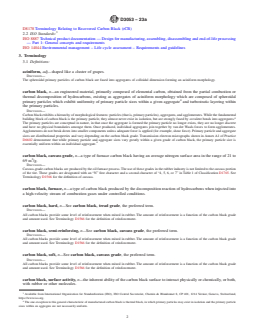
aciniform, adj—shaped like a cluster of grapes.
ments
DISCUSSION—The spheroidal primary particles of carbon black are
fused into aggregates of colloidal dimension forming an aciniform
morphology.
This terminology is under the jurisdiction of ASTM Committee D24 on Carbon carbon black, n—an engineered material, primarily composed
Black and is the direct responsibility of Subcommittee D24.41 on Carbon Black
of elemental carbon, obtained from the partial combustion or
Nomenclature and Terminology.
thermal decomposition of hydrocarbons, existing as aggre-
Current edition approved Dec. 15, 2023. Published January 2024. Originally
gates of aciniform morphology which are composed of
approved in 1972. Last previous edition approved in 2023 as D3053 – 23. DOI:
10.1520/D3053-23A.
For referenced ASTM standards, visit the ASTM website, www.astm.org, or
contact ASTM Customer Service at service@astm.org. For Annual Book of ASTM Available from International Organization for Standardization (ISO), ISO
Standards volume information, refer to the standard’s Document Summary page on Central Secretariat, Chemin de Blandonnet 8, CP 401, 1214 Vernier, Geneva,
the ASTM website. Switzerland, https://www.iso.org.
Copyright © ASTM International, 100 Barr Harbor Drive, PO Box C700, West Conshohocken, PA 19428-2959. United States
D3053 − 23a
spheroidal primary particles which exhibit uniformity of carbon black, target value, n—a consensus value for selected
primary particle sizes within a given aggregate and tur- primary properties on which producers center their manu-
bostratic layering within the primary particles. facturing process and users center their specification.
DISCUSSION—Carbon black exhibits a hierarchy of morphological DISCUSSION—Target values for carbon black properties are shown in
features: particles (that is, primary particles), aggregates, and agglom- Classification D1765 for most rubber grade carbon blacks currently in
erates. While the fundamental building block of carbon black is the commerce.
primary particle, they almost never exist in isolation, but are strongly
carbon black, thermal, n—a type of carbon black produced
fused by covalent bonds into aggregates. The primary particles are
under controlled conditions by the thermal decomposition of
conceptual in nature, in that once the aggregate is formed the primary
particle no longer exists, they are no longer discrete and have no
hydrocarbons in the absence of air or flames.
physical boundaries amongst them. Once produced, individual aggre-
DISCUSSION—These grades are designated with an “N” first character
gates join together by van der Waals forces to form agglomerates.
and a second character of “8 or 9” in Table 1 of Classification D1765.
Agglomerates do not break down into smaller components unless
adequate force is applied (for example, shear force). Primary particle carbon black, thermal, acetylenic, n—a thermal black pro-
and aggregate sizes are distributional properties and vary depending on
duced from acetylene gas.
the carbon black grade. Transmission electron micrographs shown in
Annex A1 of Practice D6602 demonstrate that while primary particle carbon black, tread grade, n—a type of furnace carbon black
and aggregate sizes vary greatly within a given grade of carbon black,
having an average nitrogen surface area of 70 m /g or
the primary particle size is essentially uniform within an individual
greater.
aggregate.
DISCUSSION—Tread grade carbon blacks are produced by the oil
furnace process. The use of these grades in the rubber industry is not
carbon black, carcass grade, n—a type of furnace carbon
limited to the tread portion of the tire. These grades are designated with
black having an average nitrogen surface area in the range of
an “N” first character and a second character of “0, 1, 2, or 3” in Table 1
21 to 69 m /g.
of Classification D1765.
DISCUSSION—Carcass-grade carbon blacks are produced by the oil
furnace process. The use of these grades in the rubber industry is not carbon black, typical value, n—a consensus value for those
limited to the carcass portion of the tire. These grades are designated
carbon black properties that are not specifically targeted for
with an “N” first character and a second character of “4, 5, 6, or 7” in
control in the manufacturing process and that are somewhat
Table 1 of Classification D1765. See Terminology D1566 for the
dependent upon the targeted properties.
definition of carcass.
DISCUSSION—Typical values for carbon black properties are shown in
Classification D1765 for most rubber grade carbon blacks currently in
carbon black, furnace, n—a type of carbon black produced by
commerce. These are consensus values based upon the range in values
the decomposition reaction of hydrocarbons when injected
supplied by the manufacturers. Typical values are useful in making
into a high-velocity stream of combustion gases under
comparisons between grades but they are not the set-point targets for
controlled conditions.
the process and may be expected to differ significantly between
producers.
carbon black, hard, n—See carbon black, tread grade, the
preferred term.
carbon black agglomerate, n—a cluster of physically bound
DISCUSSION—All carbon blacks provide some level of reinforcement and entangled aggregates.
when mixed in rubber. The amount of reinforcement is a function of the
DISCUSSION—See Test Method D3849.
carbon black grade and amount used. See Terminology D1566 for the
definition of reinforcement. carbon black aggregate, n—a discrete, rigid, colloidal mass of
extensively coalesced particles; it is the smallest dispersible
carbon black, semi-reinforcing, n—See carbon black, car-
unit.
cass grade, the preferred term.
DISCUSSION—All carbon blacks provide some level of reinforcement carbon black microstructure, n—arrangement of carbon
when mixed in rubber. The amount of reinforcement is a function of the
atoms within a carbon black particle.
carbon black grade and amount used. See Terminology D1566 for the
definition of reinforcement. carbon black particle, n—a small spheroidally shaped
(paracrystalline, non-discrete) component of a carbon black
carbon black, soft, n—See carbon black, carcass grade, the
aggregate; it is separable from the aggregate only by
preferred term.
fracturing.
DISCUSSION—All carbon blacks provide some level of reinforcement
when mixed in rubber. The amount of reinforcement is a function of the
carbon black particle diameter, n—arithmetic average of the
carbon black grade and amount used. See Terminology D1566 for the
diameters of particles within a carbon black aggregate as
definition of reinforcement.
measured by electron microscopy.
DISCUSSION—See Test Method D3849.
carbon black, surface activity, n—the inherent ability of the
carbon black surface to interact physically or chemically, or
carbon black pellet, n—a relatively large agglomerate mass
both, with rubber or other molecules.
that has been densified in spheroidal form to facilitate
handling and processing.
DISCUSSION—See Test Method D1511.
The one exception to this general characteristic of manufactured carbon black
carbon black reinforcing, n—See carbon black, tread
is thermal black, in which primary particles may exist in isolation and the primary
particle sizes within an aggregate are not necessarily uniform. grade, the preferred term.
D3053 − 23a
DISCUSSION—All carbon blacks provide some level of reinforcement
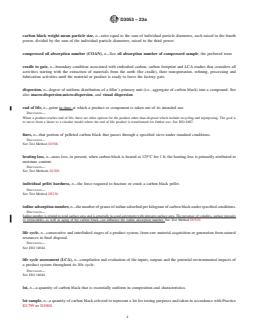
life cycle assessment (LCA), n—compilation and evaluation
when mixed in rubber. The amount of reinforcement is a function of the
of the inputs, outputs and the potential environmental
carbon black grade and amount used. See Terminology D1566 for the
impacts of a product system throughout its life cycle.
definition of reinforcement.
DISCUSSION—See ISO 14044.
carbon black structure, n—the quality of irregularity and
lot, n—a quantity of carbon black that is essentially uniform in
deviation from sphericity of the shape of a carbon
...
This document is not an ASTM standard and is intended only to provide the user of an ASTM standard an indication of what changes have been made to the previous version. Because
it may not be technically possible to adequately depict all changes accurately, ASTM recommends that users consult prior editions as appropriate. In all cases only the current version
of the standard as published by ASTM is to be considered the official document.
Designation: D3053 − 23 D3053 − 23a
Standard Terminology Relating to
Carbon Black
This standard is issued under the fixed designation D3053; the number immediately following the designation indicates the year of
original adoption or, in the case of revision, the year of last revision. A number in parentheses indicates the year of last reapproval. A
superscript epsilon (´) indicates an editorial change since the last revision or reapproval.
1. Scope
1.1 This terminology covers a compilation of definitions of technical terms used in the carbon black and rubber industries. Terms
that are generally understood or adequately defined in other readily available sources are not included.
1.2 This international standard was developed in accordance with internationally recognized principles on standardization
established in the Decision on Principles for the Development of International Standards, Guides and Recommendations issued
by the World Trade Organization Technical Barriers to Trade (TBT) Committee.
2. Referenced Documents
2.1 ASTM Standards:
D1508 Test Method for Carbon Black, Pelleted Fines and Attrition
D1509 Test Methods for Carbon Black—Heating Loss
D1510 Test Method for Carbon Black—Iodine Adsorption Number
D1511 Test Method for Carbon Black—Pellet Size Distribution
D1513 Test Method for Carbon Black, Pelleted—Pour Density
D1514 Test Method for Carbon Black—Sieve Residue
D1566 Terminology Relating to Rubber
D1618 Test Method for Carbon Black Extractables—Transmittance of Toluene Extract
D1765 Classification System for Carbon Blacks Used in Rubber Products
D1799 Practice for Carbon Black—Sampling Packaged Shipments
D1900 Practice for Carbon Black—Sampling Bulk Shipments
D1937 Test Method for Carbon Black, Pelleted—Mass Strength
D2414 Test Method for Carbon Black—Oil Absorption Number (OAN)
D2663 Test Methods for Carbon Black—Dispersion in Rubber
D3265 Test Method for Carbon Black—Tint Strength
D3493 Test Method for Carbon Black—Oil Absorption Number of Compressed Sample (COAN)
D3849 Test Method for Carbon Black—Morphological Characterization of Carbon Black Using Electron Microscopy
D5230 Test Method for Carbon Black—Automated Individual Pellet Hardness
D6556 Test Method for Carbon Black—Total and External Surface Area by Nitrogen Adsorption
D6602 Practice for Sampling and Testing of Possible Carbon Black Fugitive Emissions or Other Environmental Particulate, or
Both
D7854 Test Method for Carbon Black-Void Volume at Mean Pressure
This terminology is under the jurisdiction of ASTM Committee D24 on Carbon Black and is the direct responsibility of Subcommittee D24.41 on Carbon Black
Nomenclature and Terminology.
Current edition approved Feb. 1, 2023Dec. 15, 2023. Published February 2023January 2024. Originally approved in 1972. Last previous edition approved in 20222023
as D3053 – 22.D3053 – 23. DOI: 10.1520/D3053-23.10.1520/D3053-23A.
For referenced ASTM standards, visit the ASTM website, www.astm.org, or contact ASTM Customer Service at service@astm.org. For Annual Book of ASTM Standards
volume information, refer to the standard’s Document Summary page on the ASTM website.
Copyright © ASTM International, 100 Barr Harbor Drive, PO Box C700, West Conshohocken, PA 19428-2959. United States
D3053 − 23a
D8178 Terminology Relating to Recovered Carbon Black (rCB)
2.2 ISO Standards:
ISO 8887 Technical product documentation — Design for manufacturing, assembling, disassembling and end-of-life processing
— Part 1: General concepts and requirements
ISO 14044 Environmental management – Life cycle assessment – Requirements and guidelines
3. Terminology
3.1 Definitions:
aciniform, adj—shaped like a cluster of grapes.
DISCUSSION—
The spheroidal primary particles of carbon black are fused into aggregates of colloidal dimension forming an aciniform morphology.
carbon black, n—an engineered material, primarily composed of elemental carbon, obtained from the partial combustion or
thermal decomposition of hydrocarbons, existing as aggregates of aciniform morphology which are composed of spheroidal
primary particles which exhibit uniformity of primary particle sizes within a given aggregate and turbostratic layering within
the primary particles.
DISCUSSION—
Carbon black exhibits a hierarchy of morphological features: particles (that is, primary particles), aggregates, and agglomerates. While the fundamental
building block of carbon black is the primary particle, they almost never exist in isolation, but are strongly fused by covalent bonds into aggregates.
The primary particles are conceptual in nature, in that once the aggregate is formed the primary particle no longer exists, they are no longer discrete
and have no physical boundaries amongst them. Once produced, individual aggregates join together by van der Waals forces to form agglomerates.
Agglomerates do not break down into smaller components unless adequate force is applied (for example, shear force). Primary particle and aggregate
sizes are distributional properties and vary depending on the carbon black grade. Transmission electron micrographs shown in Annex A1 of Practice
D6602 demonstrate that while primary particle and aggregate sizes vary greatly within a given grade of carbon black, the primary particle size is
essentially uniform within an individual aggregate.
carbon black, carcass grade, n—a type of furnace carbon black having an average nitrogen surface area in the range of 21 to
69 m /g.
DISCUSSION—
Carcass-grade carbon blacks are produced by the oil furnace process. The use of these grades in the rubber industry is not limited to the carcass portion
of the tire. These grades are designated with an “N” first character and a second character of “4, 5, 6, or 7” in Table 1 of Classification D1765. See
Terminology D1566 for the definition of carcass.
carbon black, furnace, n—a type of carbon black produced by the decomposition reaction of hydrocarbons when injected into
a high-velocity stream of combustion gases under controlled conditions.
carbon black, hard, n—See carbon black, tread grade, the preferred term.
DISCUSSION—
All carbon blacks provide some level of reinforcement when mixed in rubber. The amount of reinforcement is a function of the carbon black grade
and amount used. See Terminology D1566 for the definition of reinforcement.
carbon black, semi-reinforcing, n—See carbon black, carcass grade, the preferred term.
DISCUSSION—
All carbon blacks provide some level of reinforcement when mixed in rubber. The amount of reinforcement is a function of the carbon black grade
and amount used. See Terminology D1566 for the definition of reinforcement.
carbon black, soft, n—See carbon black, carcass grade, the preferred term.
DISCUSSION—
All carbon blacks provide some level of reinforcement when mixed in rubber. The amount of reinforcement is a function of the carbon black grade
and amount used. See Terminology D1566 for the definition of reinforcement.
carbon black, surface activity, n—the inherent ability of the carbon black surface to interact physically or chemically, or both,
with rubber or other molecules.
Available from International Organization for Standardization (ISO), ISO Central Secretariat, Chemin de Blandonnet 8, CP 401, 1214 Vernier, Geneva, Switzerland,
https://www.iso.org.
The one exception to this general characteristic of manufactured carbon black is thermal black, in which primary particles may exist in isolation and the primary particle
sizes within an aggregate are not necessarily uniform.
D3053 − 23a
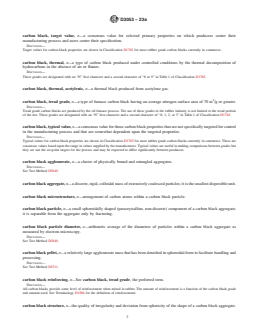
carbon black, target value, n—a consensus value for selected primary properties on which producers center their
manufacturing process and users center their specification.
DISCUSSION—
Target values for carbon black properties are shown in Classification D1765 for most rubber grade carbon blacks currently in commerce.
carbon black, thermal, n—a type of carbon black produced under controlled conditions by the thermal decomposition of
hydrocarbons in the absence of air or flames.
DISCUSSION—
These grades are designated with an “N” first character and a second character of “8 or 9” in Table 1 of Classification D1765.
carbon black, thermal, acetylenic, n—a thermal black produced from acetylene gas.
carbon black, tread grade, n—a type of furnace carbon black having an average nitrogen surface area of 70 m /g or greater.
DISCUSSION—
Tread grade carbon blacks are produced by the oil furnace process. The use of these grades in the rubber industry is not limited to the tread portion
of the tire. These grades are designated with an “N” first character and a second character of “0, 1, 2, or 3” in Table 1 of Classification D1765.
carbon black, typical value, n—a consensus value for those carbon black properties that are not specifically targeted for control
in the manufacturing process and that are somewhat dependent upon the targeted properties.
DISCUSSION—
Typical values for carbon black properties are shown in Classification D1765 for most rubber grade carbon blacks currently in commerce. These are
consensus values based upon the range in values supplied by the manufacturers. Typical values are useful in making comparisons between grades but
they are not the set-point targets for the process and may be expected to differ significantly between producers.
carbon black agglomerate, n—a cluster of physically bound and entangled aggregates.
DISCUSSION—
See Test Method D3849.
carbon black aggregate, n—a discrete, rigid, colloidal mass of extensively coalesced particles; it is the smallest dispersible unit.
carbon black microstructure, n—arrangement of carbon atoms within a carbon black particle.
carbon black particle, n—a small spheroidally shaped (paracrystalline, non-discrete) component of a carbon black aggregate;
it is separable from the aggregate only by fracturing.
carbon black particle diameter, n—arithmetic average of the diameters of particles within a carbon black aggregate as
measured by electron microscopy.
DISCUSSION—
See Test Method D3849.
carbon black pellet, n—a relatively large agglomerate mass that has been densified in spheroidal form to facilitate handling and
processing.
DISCUSSION—
See Test Method D1511.
carbon black reinforcing, n—See carbon black, tread grade, the preferred term.
DISCUSSION—
All carbon blacks provide some level of reinforcement when mixed in rubber. The amount of reinforcement is a function of the carbon black grade
and amount used. See Terminology D1566 for the definition of reinforcement.
carbon black structure, n—the quality of irregularity and deviation from sphericity of the shape of a carbon black aggregate.
D3053 − 23a
carbon black weight mean particle size, n—ratio equal to the sum of individual particle diameters, each raised to the fourth
power, divided by the sum of the individual particle diameters,
...