

ASTM D6009-19
(Guide)Standard Guide for Sampling Waste Piles
General Information
- Abstract
SIGNIFICANCE AND USE
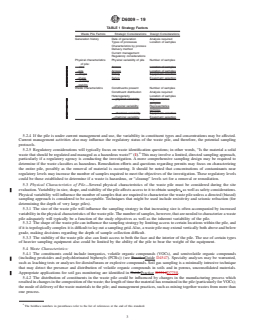
4.1 This guide is intended to provide guidance for sampling waste piles. It can be used to obtain samples for waste characterization related to use, treatment, or disposal; to monitor an active pile; to prepare for closure of the waste pile; or to investigate the contents of an abandoned pile.
4.2 Techniques used to sample include both in-place evaluations of the pile and physically removing a sample. In-place evaluations include techniques such as remote sensing, on-site gas analysis, and permeability.
4.3 Sampling strategy for waste piles is dependent on the following:
4.3.1 Project objectives, including acceptable levels of error when making decisions;
4.3.2 Physical characteristics of the pile, such as its size and configuration, access to all parts of it, and the stability of the pile;
4.3.3 Process that generated the waste and the waste characteristics, such as hazardous chemical or physical properties, whether the waste consists of sludges, dry powders, granules or larger grained materials, and the heterogeneity of the wastes;
4.3.4 History of the pile, including dates of generation, methods of handling and transport, and current management methods;
4.3.5 Regulatory considerations, such as regulatory classification and characterization data; and
4.3.6 Limits and bias of sampling methods, including bias that may be introduced by waste heterogeneity, sampling design, and sampling equipment.
4.4 It is recommended that this guide be used in conjunction with Guide D4687, which addresses sampling design, quality assurance, general sampling considerations, preservation and containerization, cleaning equipment, packaging, and chain of custody.
4.5 A case history of the investigation of a waste pile is included in Appendix X1.
SCOPE
1.1 This guide provides guidance for obtaining representative samples from waste piles. Guidance is provided for site evaluation, sampling design, selection of equipment, and data interpretation.
1.2 Waste piles include areas used primarily for waste storage or disposal, including above-grade dry land disposal units. This guide can be applied to sampling municipal waste piles.
1.3 This guide addresses how the choice of sampling design and sampling methods depends on specific features of the pile.
1.4 The values stated in SI units are to be regarded as standard. No other units of measurement are included in this standard.
1.4.1 Exception—The inch-pound units in parentheses are included for information only and are not considered standard.
1.5 This standard does not purport to address all of the safety concerns, if any, associated with its use. It is the responsibility of the user of this standard to establish appropriate safety, health, and environmental practices and determine the applicability of regulatory limitations prior to use.
1.6 This international standard was developed in accordance with internationally recognized principles on standardization established in the Decision on Principles for the Development of International Standards, Guides and Recommendations issued by the World Trade Organization Technical Barriers to Trade (TBT) Committee.
- Status
- Published
- Publication Date
- 31-Aug-2019
- Technical Committee
- D34 - Waste Management
- Drafting Committee
- D34.01.01 - Planning for Sampling
Overview
ASTM D6009-19: Standard Guide for Sampling Waste Piles is a key international standard developed by ASTM International for obtaining representative samples from waste piles. The guide provides comprehensive direction for site evaluation, sampling design, equipment selection, and data interpretation. Its primary application is in the characterization, monitoring, treatment, and closure or investigation of both active and abandoned waste piles, including those used for municipal waste storage or disposal.
By following ASTM D6009-19, environmental professionals, engineers, and regulatory bodies can ensure robust and defensible waste sampling protocols that meet regulatory requirements and lead to better decisions regarding waste management and remediation.
Key Topics
Guidance on Sampling Waste Piles
- The standard outlines methods for obtaining representative samples from above-grade, unconsolidated waste storage areas.
- Emphasis is placed on developing a sampling strategy based on project objectives, physical and chemical characteristics of the waste, history, management practices, and regulatory drivers.
Sampling Strategies
- Directed (judgmental) sampling
- Simple random sampling
- Stratified random sampling
- Systematic grid sampling
- Systematic sampling over time
Site Evaluation
- Includes initial on-site surveys, historical data review, and nonintrusive inspections such as remote sensing and geophysical techniques.
- Physical aspects (size, shape, access, stability) and waste variability inform the selection of sampling locations and frequency.
Equipment Selection
- Guidance on choosing appropriate samplers for various forms of waste such as powders, granules, sludges, and mixed debris.
- Importance of material compatibility and avoiding sample contamination.
Data Quality and Interpretation
- Approaches for minimizing sampling bias and errors.
- Recommends statistical evaluation of data, including assessment of representativeness and variability.
- Considers regulatory thresholds in data analysis and decision-making.
Applications
ASTM D6009-19 is widely applicable in both public and private sector waste management and environmental site assessment. Key uses include:
- Waste Characterization: Essential for determining chemical and physical properties prior to treatment, reuse, or disposal.
- Regulatory Compliance: Provides industry-accepted methodologies for complying with national and local waste management regulations.
- Site Remediation: Supports environmental consultants and engineers in planning and executing remediation projects for contaminated sites.
- Facility Closure and Abandonment: Guides responsible parties through the proper evaluation and closure of waste piles, protecting human health and the environment.
- Monitoring and Surveillance: Facilitates ongoing evaluation of active waste piles to detect changes in waste composition, potential releases, or migration of contaminants.
Related Standards
ASTM D6009-19 should be used in conjunction with related ASTM standards to ensure comprehensive waste sampling and analysis, including:
- ASTM D4687: General Planning of Waste Sampling - for developing sampling plans, quality assurance, and chain of custody protocols.
- ASTM D4547: Sampling Waste and Soils for Volatile Organic Compounds - for specialized analytical needs.
- ASTM D1452/D1452M, D1586/D1586M, D1587/D1587M, D5451, D4700, D4823: Practices covering specific sampling equipment and methods.
- ASTM D5088: Decontamination of Field Equipment Used at Waste Sites.
- ASTM D7758: Passive Soil Gas Sampling in the Vadose Zone.
- ASTM D5681: Terminology for Waste and Waste Management.
Practical Value
ASTM D6009-19 is an essential reference for anyone involved in environmental site assessment, waste management, or remediation. Adopting this guide ensures that waste sampling campaigns:
- Use scientifically robust, defensible methodologies.
- Minimize sampling errors and bias.
- Meet or exceed regulatory requirements.
- Provide reliable, actionable data to inform waste management decisions and protect environmental and public health.
Incorporating ASTM D6009-19 into waste management projects enhances quality, credibility, and regulatory acceptance of sampling results, streamlining project workflows and supporting successful outcomes.
Relations
- Effective Date
- 01-Sep-2019
- Effective Date
- 01-Nov-2023
- Effective Date
- 01-May-2020
- Effective Date
- 01-Nov-2019
- Effective Date
- 01-Nov-2018
- Effective Date
- 01-Sep-2017
- Effective Date
- 01-Jun-2017
- Effective Date
- 01-Nov-2016
- Effective Date
- 01-Nov-2016
- Effective Date
- 01-Oct-2016
- Effective Date
- 01-Feb-2016
- Effective Date
- 15-Nov-2015
- Effective Date
- 01-Sep-2015
- Effective Date
- 01-Aug-2015
- Effective Date
- 01-Feb-2015
Get Certified
Connect with accredited certification bodies for this standard

CIS Institut d.o.o.
Personal Protective Equipment (PPE) certification body. Notified Body NB-2890 for EU Regulation 2016/425 PPE.

Kiwa BDA Testing
Building and construction product certification.
Kmetijski inštitut Slovenije
Agricultural Institute of Slovenia. Soil testing, plant health, agricultural product analysis.
Sponsored listings
Frequently Asked Questions
ASTM D6009-19 is a guide published by ASTM International. Its full title is "Standard Guide for Sampling Waste Piles". This standard covers: SIGNIFICANCE AND USE 4.1 This guide is intended to provide guidance for sampling waste piles. It can be used to obtain samples for waste characterization related to use, treatment, or disposal; to monitor an active pile; to prepare for closure of the waste pile; or to investigate the contents of an abandoned pile. 4.2 Techniques used to sample include both in-place evaluations of the pile and physically removing a sample. In-place evaluations include techniques such as remote sensing, on-site gas analysis, and permeability. 4.3 Sampling strategy for waste piles is dependent on the following: 4.3.1 Project objectives, including acceptable levels of error when making decisions; 4.3.2 Physical characteristics of the pile, such as its size and configuration, access to all parts of it, and the stability of the pile; 4.3.3 Process that generated the waste and the waste characteristics, such as hazardous chemical or physical properties, whether the waste consists of sludges, dry powders, granules or larger grained materials, and the heterogeneity of the wastes; 4.3.4 History of the pile, including dates of generation, methods of handling and transport, and current management methods; 4.3.5 Regulatory considerations, such as regulatory classification and characterization data; and 4.3.6 Limits and bias of sampling methods, including bias that may be introduced by waste heterogeneity, sampling design, and sampling equipment. 4.4 It is recommended that this guide be used in conjunction with Guide D4687, which addresses sampling design, quality assurance, general sampling considerations, preservation and containerization, cleaning equipment, packaging, and chain of custody. 4.5 A case history of the investigation of a waste pile is included in Appendix X1. SCOPE 1.1 This guide provides guidance for obtaining representative samples from waste piles. Guidance is provided for site evaluation, sampling design, selection of equipment, and data interpretation. 1.2 Waste piles include areas used primarily for waste storage or disposal, including above-grade dry land disposal units. This guide can be applied to sampling municipal waste piles. 1.3 This guide addresses how the choice of sampling design and sampling methods depends on specific features of the pile. 1.4 The values stated in SI units are to be regarded as standard. No other units of measurement are included in this standard. 1.4.1 Exception—The inch-pound units in parentheses are included for information only and are not considered standard. 1.5 This standard does not purport to address all of the safety concerns, if any, associated with its use. It is the responsibility of the user of this standard to establish appropriate safety, health, and environmental practices and determine the applicability of regulatory limitations prior to use. 1.6 This international standard was developed in accordance with internationally recognized principles on standardization established in the Decision on Principles for the Development of International Standards, Guides and Recommendations issued by the World Trade Organization Technical Barriers to Trade (TBT) Committee.
SIGNIFICANCE AND USE 4.1 This guide is intended to provide guidance for sampling waste piles. It can be used to obtain samples for waste characterization related to use, treatment, or disposal; to monitor an active pile; to prepare for closure of the waste pile; or to investigate the contents of an abandoned pile. 4.2 Techniques used to sample include both in-place evaluations of the pile and physically removing a sample. In-place evaluations include techniques such as remote sensing, on-site gas analysis, and permeability. 4.3 Sampling strategy for waste piles is dependent on the following: 4.3.1 Project objectives, including acceptable levels of error when making decisions; 4.3.2 Physical characteristics of the pile, such as its size and configuration, access to all parts of it, and the stability of the pile; 4.3.3 Process that generated the waste and the waste characteristics, such as hazardous chemical or physical properties, whether the waste consists of sludges, dry powders, granules or larger grained materials, and the heterogeneity of the wastes; 4.3.4 History of the pile, including dates of generation, methods of handling and transport, and current management methods; 4.3.5 Regulatory considerations, such as regulatory classification and characterization data; and 4.3.6 Limits and bias of sampling methods, including bias that may be introduced by waste heterogeneity, sampling design, and sampling equipment. 4.4 It is recommended that this guide be used in conjunction with Guide D4687, which addresses sampling design, quality assurance, general sampling considerations, preservation and containerization, cleaning equipment, packaging, and chain of custody. 4.5 A case history of the investigation of a waste pile is included in Appendix X1. SCOPE 1.1 This guide provides guidance for obtaining representative samples from waste piles. Guidance is provided for site evaluation, sampling design, selection of equipment, and data interpretation. 1.2 Waste piles include areas used primarily for waste storage or disposal, including above-grade dry land disposal units. This guide can be applied to sampling municipal waste piles. 1.3 This guide addresses how the choice of sampling design and sampling methods depends on specific features of the pile. 1.4 The values stated in SI units are to be regarded as standard. No other units of measurement are included in this standard. 1.4.1 Exception—The inch-pound units in parentheses are included for information only and are not considered standard. 1.5 This standard does not purport to address all of the safety concerns, if any, associated with its use. It is the responsibility of the user of this standard to establish appropriate safety, health, and environmental practices and determine the applicability of regulatory limitations prior to use. 1.6 This international standard was developed in accordance with internationally recognized principles on standardization established in the Decision on Principles for the Development of International Standards, Guides and Recommendations issued by the World Trade Organization Technical Barriers to Trade (TBT) Committee.
ASTM D6009-19 is classified under the following ICS (International Classification for Standards) categories: 13.030.40 - Installations and equipment for waste disposal and treatment. The ICS classification helps identify the subject area and facilitates finding related standards.
ASTM D6009-19 has the following relationships with other standards: It is inter standard links to ASTM D6009-12, ASTM D5681-23, ASTM D5088-20, ASTM D4823-95(2019), ASTM D5681-18, ASTM D5681-17, ASTM D7758-17, ASTM D1452/D1452M-16, ASTM D5681-16a, ASTM D7758-11(2016), ASTM D5681-16, ASTM D1587/D1587M-15, ASTM D4547-15, ASTM D5088-15a, ASTM D4700-15. Understanding these relationships helps ensure you are using the most current and applicable version of the standard.
ASTM D6009-19 is available in PDF format for immediate download after purchase. The document can be added to your cart and obtained through the secure checkout process. Digital delivery ensures instant access to the complete standard document.
Standards Content (Sample)
This international standard was developed in accordance with internationally recognized principles on standardization established in the Decision on Principles for the
Development of International Standards, Guides and Recommendations issued by the World Trade Organization Technical Barriers to Trade (TBT) Committee.
Designation: D6009 − 19
Standard Guide for
Sampling Waste Piles
This standard is issued under the fixed designation D6009; the number immediately following the designation indicates the year of
original adoption or, in the case of revision, the year of last revision. A number in parentheses indicates the year of last reapproval. A
superscript epsilon (´) indicates an editorial change since the last revision or reapproval.
1. Scope D1586/D1586M Test Method for Standard Penetration Test
(SPT) and Split-Barrel Sampling of Soils
1.1 This guide provides guidance for obtaining representa-
D1587/D1587M Practice for Thin-Walled Tube Sampling of
tive samples from waste piles. Guidance is provided for site
Fine-Grained Soils for Geotechnical Purposes
evaluation, sampling design, selection of equipment, and data
D4547 Guide for Sampling Waste and Soils for Volatile
interpretation.
Organic Compounds
1.2 Waste piles include areas used primarily for waste
D4687 Guide for General Planning of Waste Sampling
storage or disposal, including above-grade dry land disposal
D4700 Guide for Soil Sampling from the Vadose Zone
units. This guide can be applied to sampling municipal waste
D4823 Guide for Core Sampling Submerged, Unconsoli-
piles.
dated Sediments
1.3 This guide addresses how the choice of sampling design D5088 Practice for Decontamination of Field Equipment
Used at Waste Sites
and sampling methods depends on specific features of the pile.
D5451 Practice for Sampling Using a Trier Sampler
1.4 The values stated in SI units are to be regarded as
D5681 Terminology for Waste and Waste Management
standard. No other units of measurement are included in this
D5730 Guide for Site Characterization for Environmental
standard.
Purposes With Emphasis on Soil, Rock, the Vadose Zone
1.4.1 Exception—The inch-pound units in parentheses are
and Groundwater (Withdrawn 2013)
included for information only and are not considered standard.
D7758 Practice for Passive Soil Gas Sampling in theVadose
1.5 This standard does not purport to address all of the
Zone for Source Identification, Spatial Variability
safety concerns, if any, associated with its use. It is the
Assessment, Monitoring, and Vapor Intrusion Evaluations
responsibility of the user of this standard to establish appro-
priate safety, health, and environmental practices and deter-
3. Terminology
mine the applicability of regulatory limitations prior to use.
3.1 Definitions—For definitions of terms used in this guide,
1.6 This international standard was developed in accor-
refer to Terminology D5681.
dance with internationally recognized principles on standard-
3.2 Definitions of Terms Specific to This Standard:
ization established in the Decision on Principles for the
3.2.1 hot spots—strata that contain high concentrations of
Development of International Standards, Guides and Recom-
the characteristic of interest and are relatively small in size
mendations issued by the World Trade Organization Technical
when compared with the total size of the materials being
Barriers to Trade (TBT) Committee.
sampled.
2. Referenced Documents
3.2.2 waste pile—unconfinedstorageofsolidmaterialsinan
2 areaofdistinctboundaries,abovegradeandusuallyuncovered.
2.1 ASTM Standards:
D1452/D1452M Practice for Soil Exploration and Sampling
4. Significance and Use
by Auger Borings
4.1 This guide is intended to provide guidance for sampling
waste piles. It can be used to obtain samples for waste
characterization related to use, treatment, or disposal; to
This guide is under the jurisdiction of ASTM Committee D34 on Waste
monitor an active pile; to prepare for closure of the waste pile;
Management and is the direct responsibility of Subcommittee D34.01.01 on
or to investigate the contents of an abandoned pile.
Planning for Sampling.
Current edition approved Sept. 1, 2019. Published October 2019. Originally
4.2 Techniques used to sample include both in-place evalu-
approved in 1996. Last previous edition approved in 2012 as D6009 – 12. DOI:
ations of the pile and physically removing a sample. In-place
10.1520/D6009-19.
For referenced ASTM standards, visit the ASTM website, www.astm.org, or
contact ASTM Customer Service at service@astm.org. For Annual Book of ASTM
Standards volume information, refer to the standard’s Document Summary page on The last approved version of this historical standard is referenced on
the ASTM website. www.astm.org.
Copyright © ASTM International, 100 Barr Harbor Drive, PO Box C700, West Conshohocken, PA 19428-2959. United States
D6009 − 19
evaluations include techniques such as remote sensing, on-site 5.2 Generation History—The waste pile may have been
gas analysis, and permeability. createdoveranextendedtimeperiod.Aremotesensingmethod
that is very useful in establishing historical management
4.3 Sampling strategy for waste piles is dependent on the
practices for waste piles is aerial imagery. Aerial photographs
following:
and satellite imagery are widely available and may be used to
4.3.1 Project objectives, including acceptable levels of error
determine the history of a waste pile, sources of waste, and the
when making decisions;
presence and distribution of different strata.
4.3.2 Physical characteristics of the pile, such as its size and
5.2.1 Thedateofgenerationcouldbeimportantwithrespect
configuration, access to all parts of it, and the stability of the
to the types of processes that generated the waste, the charac-
pile;
teristics of the waste, the distribution of the constituents, and
4.3.3 Process that generated the waste and the waste
regulatory concerns.
characteristics, such as hazardous chemical or physical
5.2.2 The type of process that generated the waste will
properties, whether the waste consists of sludges, dry powders,
determine the types of constituents that may be present in the
granules or larger grained materials, and the heterogeneity of
waste pile. Chemical variability will influence the number of
the wastes;
samples that are required to characterize the waste pile unless
4.3.4 History of the pile, including dates of generation,
a directed (biased) sampling approach is acceptable.
methods of handling and transport, and current management
5.2.3 The delivery method of the material to the waste pile
methods;
could influence the concentrations of the constituents, affect
4.3.5 Regulatory considerations, such as regulatory classi-
the overall shape of the pile, or create physical dissimilarity
fication and characterization data; and
withinthewastepilethroughsortingbyparticlesizeordensity.
4.3.6 Limits and bias of sampling methods, including bias
5.2.4 If the pile is under current management and use, the
that may be introduced by waste heterogeneity, sampling
variability in constituent types and concentrations may be
design, and sampling equipment.
affected. Current management activities also may influence the
4.4 Itisrecommendedthatthisguidebeusedinconjunction
regulatory status of the waste pile, and therefore, the potential
with Guide D4687, which addresses sampling design, quality
sampling protocols.
assurance, general sampling considerations, preservation and
5.2.5 Regulatory considerations will typically focus on
containerization, cleaning equipment, packaging, and chain of
waste identification questions; in other words, “Is the material
custody.
a solid waste that should be regulated and managed as a
4.5 A case history of the investigation of a waste pile is
hazardous waste?” (1). This may involve a limited, directed
included in Appendix X1.
sampling approach, particularly if a regulatory agency is
conducting the investigation.Amore comprehensive sampling
5. Site Evaluation
design may be required to determine if the waste classifies as
5.1 Site evaluations are performed to assist in designing the
hazardous. Remediation efforts and questions regarding per-
most appropriate sampling strategy.An evaluation may consist
mitsmayfocusoncharacterizingtheentirepile,possiblyasthe
of on-site surveys and inspections, as well as a review of
removal of material is occurring. It should be noted that
historical data. Nonintrusive geophysical and remote sensing
concentrations of contaminants near regulatory levels may
methods are particularly useful at this stage of the investiga-
increase the number of samples required to meet the objectives
tion. Table 1 summarizes the effects that various factors
of the investigation. These regulatory levels could be those
associated with the waste pile, such as the history of how the
established to determine if a waste is hazardous, or “cleanup”
pile was generated, have upon the strategy and design of the
levels set for a removal or remediation.
sampling plan. The strategic and design considerations are
5.3 Physical Characteristics of Pile—Several physical char-
discussed as well.
acteristics of the waste pile must be considered during the site
evaluation. Variability in size, shape, and stability of the pile
TABLE 1 Strategy Factors
affects access to it to obtain samples, as well as safety
Waste Pile Factors Strategic Considerations Design Considerations
considerations. Physical variability will influence the number
Generation history Date of generation Analysis required
of samples that are required to characterize the waste pile
Types of processes Location of samples
unless a directed (biased) sampling approach is considered to
Characteristics by process
Delivery method
beacceptable.Techniquesthatmightbeusedincluderesistivity
Current management
and seismic refraction (for determining the depth of very large
Regulatory considerations
Physical characteristics Physical variability of pile Number of samples piles).
of pile:
5.3.1 The size of the waste pile will influence the sampling
–size Access Location of samples
strategy in that increasing size is often accompanied by
–shape Safety Equipment selection
–stability
increasedvariabilityinthephysicalcharacteristicsofthewaste
Waste characteristics Constituents present Number of samples
pile. The number of samples, however, that are needed to
Constituent distribution Analysis required
Heterogeneity Location of samples
–physical variability Representative
samples
–chemical variability Equipment selection The boldface numbers in parentheses refer to the list of references at the end of
this standard.
D6009 − 19
characterizeawastepileadequatelywilltypicallybeafunction made of with the materials being sampled. For example, the
of the study objectives as well as the inherent variability of the equipment could alter the characteristics of the sample. Some
pile. equipment will bias against the collection of certain particle
5.3.2 Theshapeofthewastepilecaninfluencethesampling sizes, and some equipment cannot penetrate the waste pile
strategy by limiting access to certain locations within the pile, adequately.
and if it is topologically complex it is difficult to lay out a 5.5.2 Equipment, use, and operation can introduce error
sampling grid. Also, a waste pile may extend vertically both
(bias) into the characterization of a waste pile. Sampling errors
above and below grade, making decisions regarding the depth typically are caused when certain particle sizes are excluded,
of sample collection difficult.
when a segment of the waste pile is not sampled, or when a
5.3.3 The stability of the waste pile also can limit access to location outside the pile is inadvertently sampled.
both the face and the interior of the pile. The use of certain
5.5.3 When stratification, layering, or solid phasing occurs
types of heavier sampling equipment also could be limited by
it may be necessary to obtain and analyze samples of each of
the ability of the pile to bear the weight of the equipment.
the distinct phases separately to minimize sampling bias. Care
should be taken when sampling stratified layers to minimize
5.4 Waste Characteristics:
cross contamination. Proper decontamination procedures
5.4.1 The constituents could include inorganics, volatile
should be used for all sampling equipment (see Practice
organic compounds (VOCs), and semivolatile organic com-
D5088).
pounds (including pesticides and polychlorinated biphenyls
5.5.4 Statistical bias includes situations where the data are
(PCBs)) (see Guide D4547). Specialty analyses may be
not normally distributed or when the sampling strategy does
warranted, such as leaching tests or analyses for dioxin/furans
not allow the potential for every portion of the pile to be
or explosive compounds. Soil gas sampling is a minimally
sampled.
intrusive technique that may detect the presence and distribu-
tion of volatile organic compounds in soils and in porous,
6. Sampling Strategy
unconsolidated materials.Appropriate applications for soil gas
monitoring are identified in Practice D7758.
6.1 Developing a strategy for sampling a waste pile requires
5.4.2 The distribution of constituents in the waste pile could
a thorough examination of the site evaluation factors listed in
be influenced by changes in the manufacturing process which
Section 5. The location and frequency of sampling (number of
resulted in changes in the composition of the waste; the length
samples) should be outlined clearly in the sampling plan, as
of time the material has remained in the pile (particularly for
well as provisions for the use of special sampling equipment,
VOCs); the mode of delivery of the waste materials to the pile;
access of heavy equipment to all areas of the pile, if necessary,
and management practices, such as mixing together wastes
and so forth.
from more than one process.
6.1.1 Representative Sampling—The collection of a repre-
5.4.3 Physical and chemical variabilities would include
sentative set of samples from a waste pile typically will be
variabilityinthechemicalcharacteristicsofthematerialwithin
complicated by the presence of a number of the site evaluation
thepile,aswellasvariabilityinparticlesize,density,hardness,
factors (2, 3).
whether brittle or flexible, moisture content, consolidated, or
6.1.2 Heterogeneous Wastes—Waste piles may be
unconsolidated. The variability may be random or found as
homogeneous, for applied purposes, or may be quite heteroge-
strata of materials having different properties or containing
neous in particle size and contaminant distribution. If the
different types or concentrations of constituents.
particle sizes of the material in the waste pile and the
5.4.3.1 Geophysicalsurveymethodsmaybeusedonpilesto
distribution of contaminants are known, or can be estimated,
estimate physical homogeneity, which may or may not be
then less sampling may be necessary to define the properties of
related to chemical homogeneity, and to detect buried objects,
interest in the waste pile. An estimate of the variability in
both of which may need to be considered during the develop-
contaminant distribution may be based on process knowledge
ment of the sampling design and the safety plan for the
or determined by preliminary sampling (4). The more hetero-
investigation. The most suitable technique for detecting non-
geneous the waste pile is, the greater the planning and
metallic objects is electromagnetics. Ground-penetrating radar,
sampling requirements.
a more sophisticated and complex technique, also may be
6.1.3 Strata and Hot Spots—Awaste pile also could contain
considered. Electromagnetic techniques are suited particularly
strata that have less internal variation in physical properties or
to large piles that contain leachate plumes (for example, mine
concentrations of chemical constituents than the remainder of
tailings) or for the detection of large discontinuities in a pile
the waste pile (2, 5). For example, strata may be present in a
(for example, different types of wastes or the transition from a
waste pile due to changes in the process that generated the
disposal area to background soils). For metallic objects, metal
waste, or if different processes at a facility contribute waste to
detectors and magnetometers are useful and relatively easy to
different parts of the waste pile. A stratified sampling strategy
use in the field.
would consider this situation by conducting independent sam-
5.5 Potential Investigation Errors:
pling of each stratum, which could reduce the number of
5.5.1 Equipment selection can bias sampling results even if samples required. These strata could be in specific areas of the
the equipment is used properly. Bias can result from the waste pile (4).Also, hot spots may be present in the waste pile
incompatibility of the materials that the sampling equipment is that are unique in composition (2, 5).
D6009 − 19
6.2 Specific Sampling Strategies:
6.2.1 Although the most appropriate method for evaluating
materialinwastepilesistosampleatorimmediatelyfollowing
the point of generation (for example, conveyor belt), most
sampling problems involve existing or in-place waste piles.
Therefore, the following discussion will focus on in-place
waste piles. Sampling strategies available for waste piles
include directed or judgmental sampling, simple random
sampling, stratified random sampling, systematic grid
sampling, and systematic sampling over time (2, 6). General
concerns about the collection of a representative sample, the
existence of potential heterogeneity in the waste pile, the
presence of strata within the waste pile, and the existence of
distinct hot spots within the waste pile may also influence the
selection of an appropriate sampling strategy and development
of the sampling plan (5). The following paragraphs provide an
introduction to determining the appropriate number of samples
to collect and the sampling strategies available for determining
sample locations.
6.2.2 Determining the Frequency or Number of Samples—
The frequency of sampling or the number of samples to collect
typically will be based on several factors, including the study
objectives, properties of wastes in the pile, degree of confi-
dence required, access to sampling points, and budgetary
constraints. Practical guidance for determining the number of
samples is included in Guide D4687 and Refs (2, 3).
6.2.3 Directed Sampling—Directed sampling (Fig. 1)is
based on the judgment of the investigator and will not
necessarily result in a sample that reflects the characteristics of
the entire waste pile. Directed sampling also is called judg-
mental sampling, authoritative sampling, or nonprobability
sampling. The experience of the investigator is often the basis
for sample collection and, depending on the study objectives,
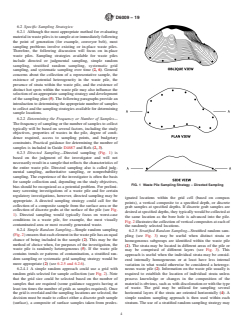
FIG. 1 Waste Pile Sampling Strategy – Directed Sampling
bias should be recognized as a potential problem. For prelimi-
nary screening investigations of a waste pile and for certain
regulatory investigations, however, directed sampling may be
ignated locations within the grid cell (based on compass
appropriate. A directed sampling strategy could call for the
points), a vertical composite to a specified depth, or discrete
collection of a composite sample from the surface area or the
grab samples at specified depths. If discrete grab samples are
collection of discrete grabs at the surface of the pile (see Fig.
desiredatspecifieddepths,theytypicallywouldbecollectedat
1). Directed sampling would typically focus on worst-case
the same location as the bore hole is advanced into the pile.
conditions in a waste pile, for example, the most visually
Fig.2illustratesthecollectionofverticalcompositesateachof
contaminated area or most recently generated waste.
the randomly selected locations.
6.2.4 Simple Random Sampling—Simple random sampling
6.2.5 Stratified Random Sampling—Stratified random sam-
(Fig.2)ensuresthateachelementinthewastepilehasanequal
pling (see Fig. 3) may be useful when distinct strata or
chance of being included in the sample (2). This may be the
homogeneous subgroups are identified within the waste pile
method of choice when, for purposes of the investigation, the
(2). The strata may be located in different areas of the pile or
waste pile is randomly heterogeneous (5). If the waste pile
may be comprised of different layers (see Fig. 3). This
contains trends or patterns of contamination, a stratified ran-
approach is useful when the individual strata may be consid-
dom sampling or systematic grid sampling strategy would be
ered internally homogeneous or at least have less internal
more appropriate (2) (see 6.2.5 and 6.2.6).
variation in what would otherwise be considered a heteroge-
6.2.4.1 A simple random approach could use a grid with neous waste pile (2). Information on the waste pile usually is
random grids selected for sample collection (see Fig. 2). Note required to establish
...
This document is not an ASTM standard and is intended only to provide the user of an ASTM standard an indication of what changes have been made to the previous version. Because
it may not be technically possible to adequately depict all changes accurately, ASTM recommends that users consult prior editions as appropriate. In all cases only the current version
of the standard as published by ASTM is to be considered the official document.
Designation: D6009 − 12 D6009 − 19
Standard Guide for
Sampling Waste Piles
This standard is issued under the fixed designation D6009; the number immediately following the designation indicates the year of
original adoption or, in the case of revision, the year of last revision. A number in parentheses indicates the year of last reapproval. A
superscript epsilon (´) indicates an editorial change since the last revision or reapproval.
1. Scope
1.1 This guide provides guidance for obtaining representative samples from waste piles. Guidance is provided for site
evaluation, sampling design, selection of equipment, and data interpretation.
1.2 Waste piles include areas used primarily for waste storage or disposal, including above-grade dry land disposal units. This
guide can be applied to sampling municipal waste piles.
1.3 This guide addresses how the choice of sampling design and sampling methods depends on specific features of the pile.
1.4 The values stated in SI units are to be regarded as standard. No other units of measurement are included in this standard.
1.4.1 Exception—The inch-pound units in parentheses are included for information only and are not considered standard.
1.5 This standard does not purport to address all of the safety concerns, if any, associated with its use. It is the responsibility
of the user of this standard to establish appropriate safety safety, health, and healthenvironmental practices and determine the
applicability of regulatory limitations prior to use.
1.6 This international standard was developed in accordance with internationally recognized principles on standardization
established in the Decision on Principles for the Development of International Standards, Guides and Recommendations issued
by the World Trade Organization Technical Barriers to Trade (TBT) Committee.
2. Referenced Documents
2.1 ASTM Standards:
D1452D1452/D1452M Practice for Soil Exploration and Sampling by Auger Borings
D1586D1586/D1586M Test Method for Standard Penetration Test (SPT) and Split-Barrel Sampling of Soils
D1587D1587/D1587M Practice for Thin-Walled Tube Sampling of Fine-Grained Soils for Geotechnical Purposes
D4547 Guide for Sampling Waste and Soils for Volatile Organic Compounds
D4687 Guide for General Planning of Waste Sampling
D4700 Guide for Soil Sampling from the Vadose Zone
D4823 Guide for Core Sampling Submerged, Unconsolidated Sediments
D5088 Practice for Decontamination of Field Equipment Used at Waste Sites
D5314 Guide for Soil Gas Monitoring in the Vadose Zone (Withdrawn 2015)
D5451 Practice for Sampling Using a Trier Sampler
D5518 Guide for Acquisition of File Aerial Photography and Imagery for Establishing Historic Site-Use and Surficial Conditions
D5681 Terminology for Waste and Waste Management
D5730 Guide for Site Characterization for Environmental Purposes With Emphasis on Soil, Rock, the Vadose Zone and
Groundwater (Withdrawn 2013)
D7758 Practice for Passive Soil Gas Sampling in the Vadose Zone for Source Identification, Spatial Variability Assessment,
Monitoring, and Vapor Intrusion Evaluations
3. Terminology
3.1 Definitions—For definitions of terms used in this guide, refer to Terminology D5681.
3.2 Definitions of Terms Specific to This Standard: (See also Terminology D5681.)
This guide is under the jurisdiction of ASTM Committee D34 on Waste Management and is the direct responsibility of Subcommittee D34.01.01 on Planning for
Sampling.
Current edition approved Jan. 1, 2012Sept. 1, 2019. Published February 2012October 2019. Originally approved in 1996. Last previous edition approved in 20062012 as
D6009 - 96D6009 – 12.(2006). DOI: 10.1520/D6009-12.10.1520/D6009-19.
For referenced ASTM standards, visit the ASTM website, www.astm.org, or contact ASTM Customer Service at service@astm.org. For Annual Book of ASTM Standards
volume information, refer to the standard’s Document Summary page on the ASTM website.
The last approved version of this historical standard is referenced on www.astm.org.
Copyright © ASTM International, 100 Barr Harbor Drive, PO Box C700, West Conshohocken, PA 19428-2959. United States
D6009 − 19
3.2.1 hot spots—strata that contain high concentrations of the characteristic of interest and are relatively small in size when
compared with the total size of the materials being sampled.
3.1.2 representative sample—a sample collected such that it reflects one or more characteristics of interest (as defined by the
project objectives) of the population from which it was collected.
3.1.2.1 Discussion—
A representative sample can be a single sample, a set of samples, or one or more composite samples.
3.2.2 waste pile—unconfined storage of solid materials in an area of distinct boundaries, above grade and usually uncovered.
This includes the following:
3.1.3.1 chemical manufacturing waste pile—a pile consisting primarily of discarded chemical products (whether marketable or
not), by-products, radioactive wastes, or used or unused feedstocks.
3.1.3.2 scrap metal or junk pile—a pile consisting primarily of scrap metal or discarded durable goods such as appliances,
automobiles, auto parts, or batteries.
3.1.3.3 trash pile—a pile of waste materials from municipal sources, consisting primarily of paper, garbage, or discarded
nondurable goods that contain or have contained hazardous substances. It does not include waste destined for recyclers.
4. Significance and Use
4.1 This guide is intended to provide guidance for sampling waste piles. It can be used to obtain samples for waste
characterization related to use, treatment, or disposal; to monitor an active pile; to prepare for closure of the waste pile; or to
investigate the contents of an abandoned pile.
4.2 Techniques used to sample include both in-place evaluations of the pile and physically removing a sample. In-place
evaluations include techniques such as remote sensing, on-site gas analysis, and permeability.
4.3 Sampling strategy for waste piles is dependent on the following:
4.3.1 Project objectives, including acceptable levels of error when making decisions;
4.3.2 Physical characteristics of the pile, such as its size and configuration, access to all parts of it, and the stability of the pile;
4.3.3 Process that generated the waste and the waste characteristics, such as hazardous chemical or physical properties, whether
the waste consists of sludges, dry powders, granules or larger grained materials, and the heterogeneity of the wastes;
4.3.4 History of the pile, including dates of generation, methods of handling and transport, and current management methods;
4.3.5 Regulatory considerations, such as regulatory classification and characterization data; and
4.3.6 Limits and bias of sampling methods, including bias that may be introduced by waste heterogeneity, sampling design, and
sampling equipment.
4.4 It is recommended that this guide be used in conjunction with Guide D4687, which addresses sampling design, quality
assurance, general sampling considerations, preservation and containerization, cleaning equipment, packaging, and chain of
custody.
4.5 A case history of the investigation of a waste pile is included in Appendix X1.
5. Site Evaluation
5.1 Site evaluations are performed to assist in designing the most appropriate sampling strategy. An evaluation may consist of
on-site surveys and inspections, as well as a review of historical data. Nonintrusive geophysical and remote sensing methods are
particularly useful at this stage of the investigation (see Guide investigation. D5518). Table 1 summarizes the effects that various
factors associated with the waste pile, such as the history of how the pile was generated, have upon the strategy and design of the
sampling plan. The strategic and design considerations are discussed as well.
5.2 Generation History—The waste pile may have been created over an extended time period. A remote sensing method that
is very useful in establishing historical management practices for waste piles is aerial imagery. Aerial photographs and satellite
imagery are widely available and may be used to determine the history of a waste pile, sources of waste, and the presence and
distribution of different strata.
5.2.1 The date of generation could be important with respect to the types of processes that generated the waste, the
characteristics of the waste, the distribution of the constituents, and regulatory concerns.
5.2.2 The type of process that generated the waste will determine the types of constituents that may be present in the waste pile.
Chemical variability will influence the number of samples that are required to characterize the waste pile unless a directed (biased)
sampling approach is acceptable.
5.2.3 The delivery method of the material to the waste pile could influence the concentrations of the constituents, affect the
overall shape of the pile, or create physical dissimilarity within the waste pile through sorting by particle size or density.
D6009 − 19
TABLE 1 Strategy Factors
Waste Pile Factors Strategic Considerations Design Considerations
Generation history Date of generation Analysis required
Types of processes Location of samples
Characteristics by process
Delivery method
Current management
Regulatory considerations
Physical characteristics Physical variability of pile Number of samples
of pile:
– size Access Location of samples
–size Access Location of samples
– shape Safety Equipment selection
–shape Safety Equipment selection
– stability
–stability
Waste characteristics Constituents present Number of samples
Constituent distribution Analysis required
Heterogeneity Location of samples
– physical variability Representative
samples
–physical variability Representative
samples
– chemical variability Equipment selection
–chemical variability Equipment selection
5.2.4 If the pile is under current management and use, the variability in constituent types and concentrations may be affected.
Current management activities also may influence the regulatory status of the waste pile, and therefore, the potential sampling
protocols.
5.2.5 Regulatory considerations will typically focus on waste identification questions; in other words, “Is the material a solid
waste that should be regulated and managed as a hazardous waste?” (1). This may involve a limited, directed sampling approach,
particularly if a regulatory agency is conducting the investigation. A more comprehensive sampling design may be required to
determine if the waste classifies as hazardous. Remediation efforts and questions regarding permits may focus on characterizing
the entire pile, possibly as the removal of material is occurring. It should be noted that concentrations of contaminants near
regulatory levels may increase the number of samples required to meet the objectives of the investigation. These regulatory levels
could be those established to determine if a waste is hazardous, or “cleanup” levels set for a removal or remediation.
5.3 Physical Characteristics of Pile—Several physical characteristics of the waste pile must be considered during the site
evaluation. Variability in size, shape, and stability of the pile affects access to it to obtain samples, as well as safety considerations.
Physical variability will influence the number of samples that are required to characterize the waste pile unless a directed (biased)
sampling approach is considered to be acceptable. Techniques that might be used include resistivity and seismic refraction (for
determining the depth of very large piles).
5.3.1 The size of the waste pile will influence the sampling strategy in that increasing size is often accompanied by increased
variability in the physical characteristics of the waste pile. The number of samples, however, that are needed to characterize a waste
pile adequately will typically be a function of the study objectives as well as the inherent variability of the pile.
5.3.2 The shape of the waste pile can influence the sampling strategy by limiting access to certain locations within the pile, and
if it is topologically complex it is difficult to lay out a sampling grid. Also, a waste pile may extend vertically both above and below
grade, making decisions regarding the depth of sample collection difficult.
5.3.3 The stability of the waste pile also can limit access to both the face and the interior of the pile. The use of certain types
of heavier sampling equipment also could be limited by the ability of the pile to bear the weight of the equipment.
5.4 Waste Characteristics:
5.4.1 The constituents could include inorganics, volatile organic compounds (VOCs), and semivolatile organic compounds
(including pesticides and polychlorinated biphenyls (PCBs)) (see PracticeGuide D4547). Specialty analyses may be warranted,
such as leaching tests or analyses for dioxin/furans or explosive compounds. Soil gas sampling is a minimally intrusive technique
that may detect the presence and distribution of volatile organic compounds in soils and in porous, unconsolidated materials.
Appropriate applications for soil gas monitoring are identified in GuidePractice D5314D7758.
5.4.2 The distribution of constituents in the waste pile could be influenced by changes in the manufacturing process which
resulted in changes in the composition of the waste; the length of time the material has remained in the pile (particularly for VOCs);
the mode of delivery of the waste materials to the pile; and management practices, such as mixing together wastes from more than
one process.
The boldface numbers in parentheses refer to the list of references at the end of this standard.
D6009 − 19
5.4.3 Physical and chemical variabilities would include variability in the chemical characteristics of the material within the pile,
as well as variability in particle size, density, hardness, whether brittle or flexible, moisture content, consolidated, or
unconsolidated. The variability may be random or found as strata of materials having different properties or containing different
types or concentrations of constituents.
5.4.3.1 Geophysical survey methods may be used on piles to estimate physical homogeneity, which may or may not be related
to chemical homogeneity, and to detect buried objects, both of which may need to be considered during the development of the
sampling design and the safety plan for the investigation. The most suitable technique for detecting nonmetallic objects is
electromagnetics. Ground-penetrating radar, a more sophisticated and complex technique, also may be considered. Electromagnetic
techniques are suited particularly to large piles that contain leachate plumes (for example, mine tailings) or for the detection of
large discontinuities in a pile (for example, different types of wastes or the transition from a disposal area to background soils).
For metallic objects, metal detectors and magnetometers are useful and relatively easy to use in the field.
5.5 Potential Investigation Errors:
5.5.1 Equipment selection can bias sampling results even if the equipment is used properly. Bias can result from the
incompatibility of the materials that the sampling equipment is made of with the materials being sampled. For example, the
equipment could alter the characteristics of the sample. Some equipment will bias against the collection of certain particlesparticle
sizes, and some equipment cannot penetrate the waste pile adequately.
5.5.2 Equipment, use, and operation can introduce error (bias) into the characterization of a waste pile. Sampling errors typically
are caused when certain particle sizes are excluded, when a segment of the waste pile is not sampled, or when a location outside
the pile is inadvertently sampled.
5.5.3 When stratification, layering, or solid phasing occurs it may be necessary to obtain and analyze samples of each of the
distinct phases separately to minimize sampling bias. Care should be taken when sampling stratified layers to minimize cross
contamination. Proper decontamination procedures should be used for all sampling equipment (see Practice D5088).
5.5.4 Statistical bias includes situations where the data are not normally distributed or when the sampling strategy does not
allow the potential for every portion of the pile to be sampled.
6. Sampling Strategy
6.1 Developing a strategy for sampling a waste pile requires a thorough examination of the site evaluation factors listed in
Section 5. The location and frequency of sampling (number of samples) should be outlined clearly in the sampling plan, as well
as provisions for the use of special sampling equipment, access of heavy equipment to all areas of the pile, if necessary, and so
forth.
6.1.1 Representative Sampling—The collection of a representative set of samples from a waste pile typically will be complicated
by the presence of a number of the site evaluation factors (2, 3).
6.1.2 Heterogeneous Wastes—Waste piles may be homogeneous, for applied purposes, or may be quite heterogeneous in particle
size and contaminant distribution. If the particle sizes of the material in the waste pile and the distribution of contaminants are
known, or can be estimated, then less sampling may be necessary to define the properties of interest in the waste pile. An estimate
of the variability in contaminant distribution may be based on process knowledge or determined by preliminary sampling (4). The
more heterogeneous the waste pile is, the greater the planning and sampling requirements.
6.1.3 Strata and Hot Spots—A waste pile also could contain strata that have less internal variation in physical properties or
concentrations of chemical constituents than the remainder of the waste pile (2, 5). For example, strata may be present in a waste
pile due to changes in the process that generated the waste, or if different processes at a facility contribute waste to different parts
of the waste pile. A stratified sampling strategy would consider this situation by conducting independent sampling of each stratum,
which could reduce the number of samples required. These strata could be in specific areas of the waste pile (4). Also, hot spots
may be present in the waste pile that are unique in composition (2, 5).
D6009 − 19
6.2 Specific Sampling Strategies:
6.2.1 Although the most appropriate method for evaluating material in waste piles is to sample at or immediately following the
point of generation (for example, conveyor belt), most sampling problems involve existing or in-place waste piles. Therefore, the
following discussion will focus on in-place waste piles. Sampling strategies available for waste piles include directed or judgmental
sampling, simple random sampling, stratified random sampling, systematic grid sampling, and systematic sampling over time (2,
6). General concerns about the collection of a representative sample, the existence of potential heterogeneity in the waste pile, the
presence of strata within the waste pile, and the existence of distinct hot spots within the waste pile may also influence the selection
of an appropriate sampling strategy and development of the sampling plan (5). The following paragraphs provide an introduction
to determining the appropriate number of samples to collect and the sampling strategies available for determining sample locations.
6.2.2 Determining the Frequency or Number of Samples—The frequency of sampling or the number of samples to collect
typically will be based on several factors, including the study objectives, properties of wastes in the pile, degree of confidence
required, access to sampling points, and budgetary constraints. Practical guidance for determining the number of samples is
included in Guide D4687 and Refs (2, 3).
6.2.3 Directed Sampling—Directed sampling (Fig. 1) is based on the judgment of the investigator and will not result necessarily
result in a sample that reflects the characteristics of the entire waste pile. Directed sampling also is called judgmental sampling,
authoritative sampling, or nonprobability sampling. The experience of the investigator often is often the basis for sample
collection,collection and, depending on the study objectives, bias should be recognized as a potential problem. For preliminary
screening investigations of a waste pile and for certain regulatory investigations, however, directed sampling may be appropriate.
A directed sampling strategy could call for the collection of a composite sample from the surface area or the collection of discrete
grabs at the surface of the pile (see Fig. 1). Directed sampling would typically focus on worst case worst-case conditions in a waste
pile, for example, the most visually contaminated area or most recently generated waste.
6.2.4 Simple Random Sampling—Simple random sampling (Fig. 2) ensures that each element in the waste pile has an equal
chance of being included in the sample (2). This may be the method of choice when, for purposes of the investigation, the waste
FIG. 1 Waste Pile Sampling Strategy—Directed Strategy – Directed Sampling
D6009 − 19
FIG. 2 Waste Pile Sampling Strategy—Simple Strategy – Simple Random Sampling
pile is randomly heterogeneous (5). If the waste pile contains trends or patterns of contamination, a stratified random sampling or
systematic grid sampling strategy would be more appropriate (2) (see 6.2.5 and 6.2.6).
6.2.4.1 A simple random approach could use a grid with random grids selected for sample collection (see Fig. 2). Note that the
grid size could be selected based on the number of samples that are required (some guidance suggests having at least ten times
the number of grids as samples required). Once the grid is overlaid and the sampling locations are selected, the decision must be
made to collect either a discrete grab sample (surface), a composite of surface samples taken from predesignated locations within
the grid cell (based on compass points), a vertical composite to a specified depth, or discrete grab samples at specified depths. If
discrete grab samples are desired at specified depths, they typically would be collected at the same location as the bore hole is
advanced into the pile. Fig. 2 illustrates the collection of vertical co
...