


ASTM C286-99(2017)
(Terminology)Standard Terminology Relating to Porcelain Enamel and Ceramic-Metal Systems
Standard Terminology Relating to Porcelain Enamel and Ceramic-Metal Systems
SCOPE
1.1 These definitions pertain to the terminology used in the porcelain enamel and ceramic-coated metal industries.
1.2 Words adequately defined in standard dictionaries are not included. Included are words that are peculiar to these industries.
1.3 Hyphenated words, double words, or phrases are listed alphabetically under the first word; additional important words are cross-referenced.
1.4 When a word or phrase, listed as a synonym, is not separately defined, the defined word or phrase is the accepted or preferred form.
1.5 This international standard was developed in accordance with internationally recognized principles on standardization established in the Decision on Principles for the Development of International Standards, Guides and Recommendations issued by the World Trade Organization Technical Barriers to Trade (TBT) Committee.
General Information
Buy Standard
Standards Content (Sample)
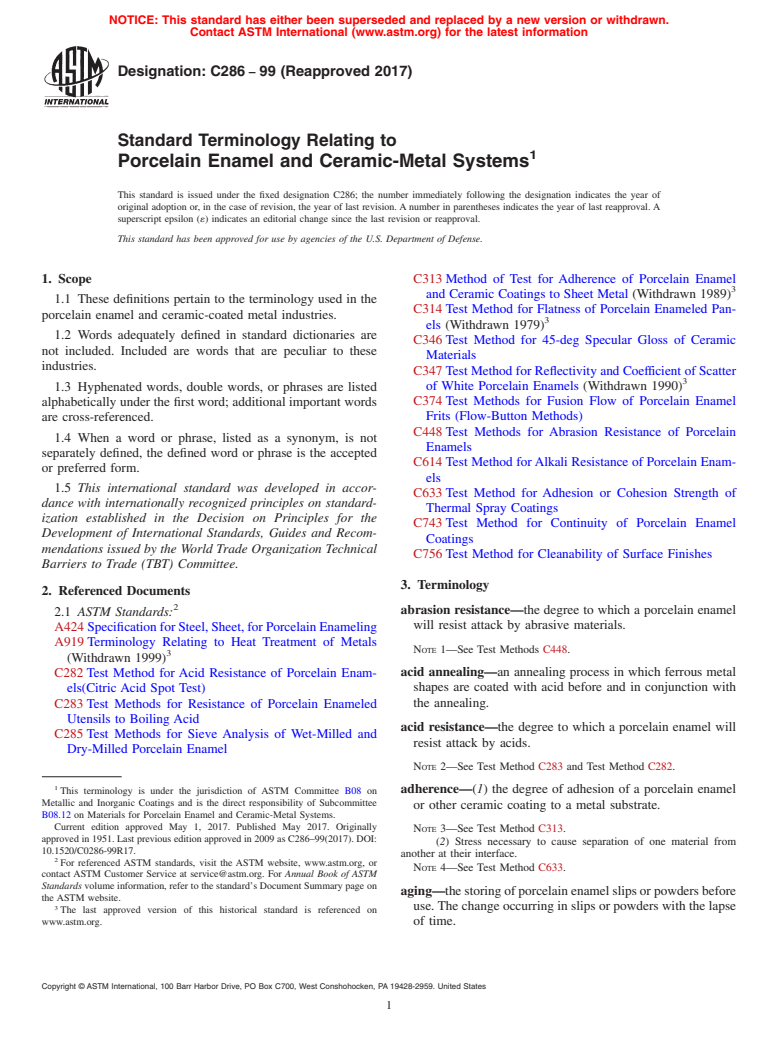
NOTICE: This standard has either been superseded and replaced by a new version or withdrawn.
Contact ASTM International (www.astm.org) for the latest information
Designation: C286 − 99 (Reapproved 2017)
Standard Terminology Relating to
Porcelain Enamel and Ceramic-Metal Systems
This standard is issued under the fixed designation C286; the number immediately following the designation indicates the year of
original adoption or, in the case of revision, the year of last revision. A number in parentheses indicates the year of last reapproval. A
superscript epsilon (´) indicates an editorial change since the last revision or reapproval.
This standard has been approved for use by agencies of the U.S. Department of Defense.
1. Scope C313 Method of Test for Adherence of Porcelain Enamel
and Ceramic Coatings to Sheet Metal (Withdrawn 1989)
1.1 These definitions pertain to the terminology used in the
C314 Test Method for Flatness of Porcelain Enameled Pan-
porcelain enamel and ceramic-coated metal industries.
els (Withdrawn 1979)
1.2 Words adequately defined in standard dictionaries are
C346 Test Method for 45-deg Specular Gloss of Ceramic
not included. Included are words that are peculiar to these
Materials
industries.
C347 Test Method for Reflectivity and Coefficient of Scatter
of White Porcelain Enamels (Withdrawn 1990)
1.3 Hyphenated words, double words, or phrases are listed
alphabetically under the first word; additional important words C374 Test Methods for Fusion Flow of Porcelain Enamel
Frits (Flow-Button Methods)
are cross-referenced.
C448 Test Methods for Abrasion Resistance of Porcelain
1.4 When a word or phrase, listed as a synonym, is not
Enamels
separately defined, the defined word or phrase is the accepted
C614 Test Method forAlkali Resistance of Porcelain Enam-
or preferred form.
els
1.5 This international standard was developed in accor-
C633 Test Method for Adhesion or Cohesion Strength of
dance with internationally recognized principles on standard-
Thermal Spray Coatings
ization established in the Decision on Principles for the
C743 Test Method for Continuity of Porcelain Enamel
Development of International Standards, Guides and Recom-
Coatings
mendations issued by the World Trade Organization Technical
C756 Test Method for Cleanability of Surface Finishes
Barriers to Trade (TBT) Committee.
3. Terminology
2. Referenced Documents
abrasion resistance—the degree to which a porcelain enamel
2.1 ASTM Standards:
will resist attack by abrasive materials.
A424 SpecificationforSteel,Sheet,forPorcelainEnameling
A919 Terminology Relating to Heat Treatment of Metals
NOTE 1—See Test Methods C448.
(Withdrawn 1999)
acid annealing—an annealing process in which ferrous metal
C282 Test Method for Acid Resistance of Porcelain Enam-
shapes are coated with acid before and in conjunction with
els(Citric Acid Spot Test)
the annealing.
C283 Test Methods for Resistance of Porcelain Enameled
Utensils to Boiling Acid
acid resistance—the degree to which a porcelain enamel will
C285 Test Methods for Sieve Analysis of Wet-Milled and
resist attack by acids.
Dry-Milled Porcelain Enamel
NOTE 2—See Test Method C283 and Test Method C282.
This terminology is under the jurisdiction of ASTM Committee B08 on adherence—(1) the degree of adhesion of a porcelain enamel
Metallic and Inorganic Coatings and is the direct responsibility of Subcommittee
or other ceramic coating to a metal substrate.
B08.12 on Materials for Porcelain Enamel and Ceramic-Metal Systems.
Current edition approved May 1, 2017. Published May 2017. Originally
NOTE 3—See Test Method C313.
approved in 1951. Last previous edition approved in 2009 as C286–99(2017). DOI:
(2) Stress necessary to cause separation of one material from
10.1520/C0286-99R17.
another at their interface.
For referenced ASTM standards, visit the ASTM website, www.astm.org, or
NOTE 4—See Test Method C633.
contact ASTM Customer Service at service@astm.org. For Annual Book of ASTM
Standards volume information, refer to the standard’s Document Summary page on
aging—thestoringofporcelainenamelslipsorpowdersbefore
the ASTM website.
use. The change occurring in slips or powders with the lapse
The last approved version of this historical standard is referenced on
www.astm.org. of time.
Copyright © ASTM International, 100 Barr Harbor Drive, PO Box C700, West Conshohocken, PA 19428-2959. United States
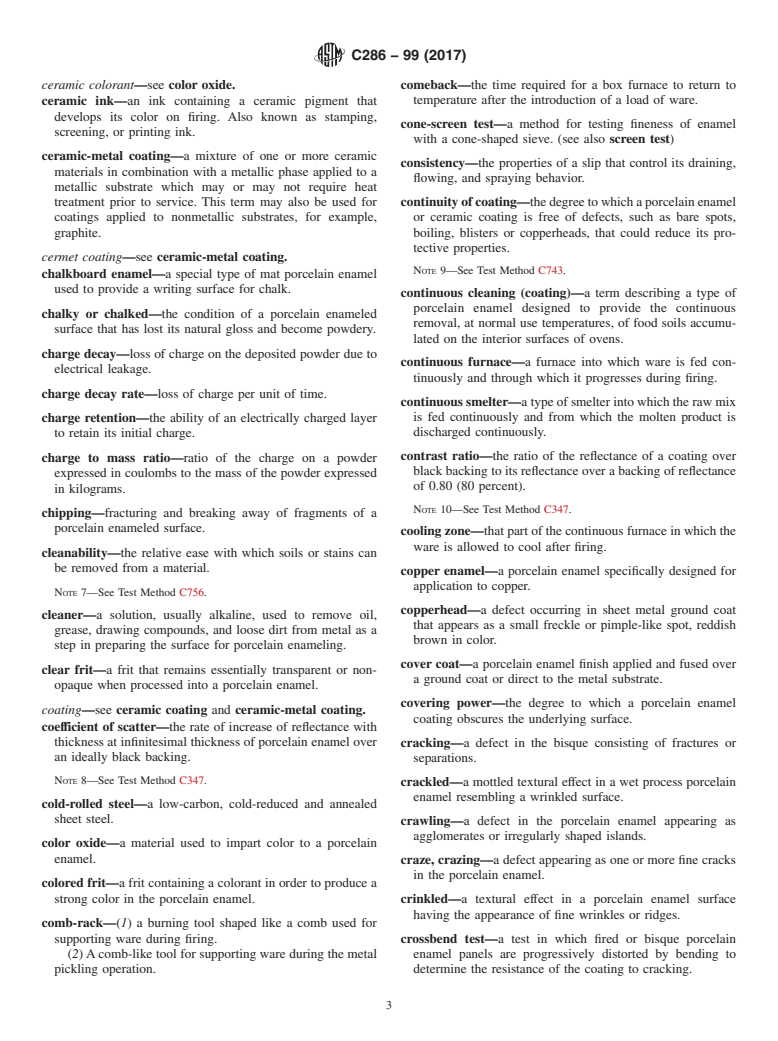
C286 − 99 (2017)
air atomizing—air used to atomize powder and to control black speck—a defect that appears in the fired cover coat as a
powder/air mix and powder cloud density. small dark spot.
air fluidizer—air used to impart fluid-like properties to pow- blank—the piece cut from metal sheet that is to be used in
forming the finished article.
der via a fluid bed.
blemish—in dry process enameling, an insignificant imperfec-
alkali resistance—for porcelain enamels, the degree to which
tion in the porcelain enamel surface.
a porcelain enamel will resist attack by aqueous alkaline
solutions.
blister—a defect caused by gas evolution consisting of a
bubble that forms during fusion and remains when the
NOTE 5—See Test Method C614.
porcelain enamel solidifies.
alligator hide—a defect characterized by an extreme rough-
blow-off resistance—the degree to which a deposited layer of
ness of the porcelain enamel surface: a severe case of orange
powder resists being blown off by a standard jet of air.
peel.
blue enamel—(1) in dry-process porcelain enameling, an area
aluminum enamel—a porcelain enamel specifically designed
of enamel coating so thin that it appears blue in color.
for application to aluminum.
(2) In wet-process enameling, a cover coat applied too
annealing—see Terminology A919.
thin to hide the substrate.
annealing acid—see acid annealing and annealing.
boiling—a defect visible in the fired porcelain enamel caused
anti-scale compound—a preparation that is applied to burning
by gas evolution which results in the formation of blisters,
tools to protect them from scaling in service.
pinholes, black specks, dimples, or spongy surface.
back emission—the electrical breakdown of air due to exces-
bolt-hole brush—a special round brush used to remove
sive charge build-up in the porcelain enamel powder film
porcelain enamel bisque from in and around small openings
during powder application. This is due to the self-limiting
in the ware.
characteristic of electrostatic powders.
bond—see adherence.
back ionization—see back emission.
box furnace—a furnace in which, periodically, a load of ware
ball mill—in porcelain enamels, a dense, ceramic-lined rotat-
is introduced; fired, and removed.
ing cylinder in which ceramic materials are wet or dry
break out—in dry process enameling, a defect characterized
ground, generally using pebbles or porcelain balls as grind-
by an area of blisters with well defined boundaries.
ing media.
bright annealing—see Terminology A919.
base coat—for two coat-one fire application, the thin layer of
brush—to remove bisque in a definite pattern by means of a
bondingfritappliedfirstandusedtopromoteadherenceafter
brush.
firing to the metal substrate.
brush, bolt-hole—see bolt-hole brush.
base metal—the metal to which porcelain enamel is applied.
brushing—see brush.
basis metal—see base metal.
bubble structure—sizeandspatialdistributionofvoidswithin
basket, pickle—see pickle basket and pickling. the fired porcelain enamel.
batch smelter—any smelter that operates as a periodic unit,
buck—a special support for ware during the firing of porcelain
being charged, fired, and discharged according to a prede-
enamel on heavy ware.
termined cycle.
burning—see firing.
beading—(1) the application of porcelain enamel, usually of a
burning bars, points, or tools—equipment used to suspend or
contrasting color, to the edge or rim of porcelain enameled
support ware during the firing operations.
articles.
(2) Removal of excess slip from the edge of dipped ware. burning tool mark—a defect in the porcelain enamel appear-
ing on the surface opposite to the point of contact with the
(3) In dry processing enameling, a bead of porcelain
enamel along the edge of ware. supporting burning tool.
button test—a test designed to determine relative fusibility of
beading enamel—any of the special porcelain enamels used
porcelain enamel frit or powder and so called because the
for beading.
completed specimens resemble buttons.
bisque—a coating of wet-process porcelain enamel that has
NOTE 6—See flow button and Test Methods C374.
been dried, but not fired.
cast iron enamel—a porcelain enamel specifically designed
blackboard enamel— see chalkboard enamel.
for application to cast iron.
black edging—a black porcelain enamel applied over the
ground coat and exposed in specified areas by brushing the ceramic coating—an inorganic, essentially nonmetallic
cover coat bisque prior to firing (see also edging). coating, on metal.
C286 − 99 (2017)
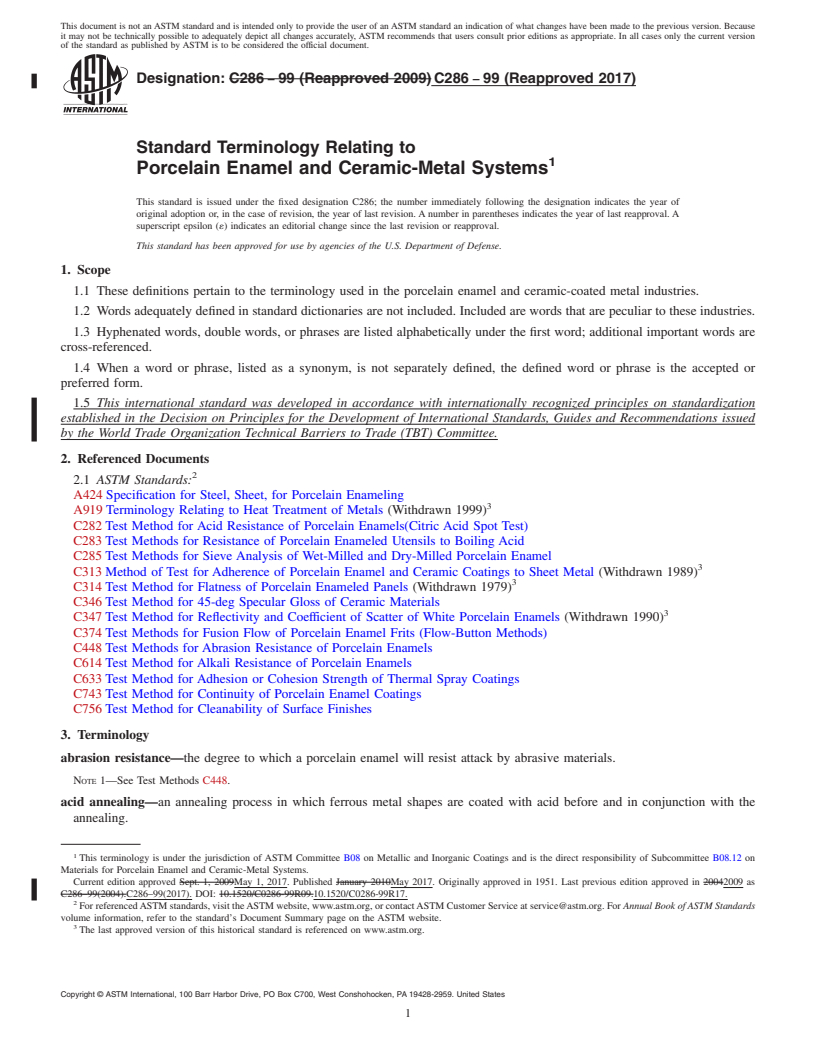
ceramic colorant—see color oxide. comeback—the time required for a box furnace to return to
temperature after the introduction of a load of ware.
ceramic ink—an ink containing a ceramic pigment that
develops its color on firing. Also known as stamping,
cone-screen test—a method for testing fineness of enamel
screening, or printing ink.
with a cone-shaped sieve. (see also screen test)
ceramic-metal coating—a mixture of one or more ceramic
consistency—the properties of a slip that control its draining,
materials in combination with a metallic phase applied to a
flowing, and spraying behavior.
metallic substrate which may or may not require heat
treatment prior to service. This term may also be used for continuity of coating—thedegreetowhichaporcelainenamel
coatings applied to nonmetallic substrates, for example, or ceramic coating is free of defects, such as bare spots,
graphite. boiling, blisters or copperheads, that could reduce its pro-
tective properties.
cermet coating—see ceramic-metal coating.
NOTE 9—See Test Method C743.
chalkboard enamel—a special type of mat porcelain enamel
used to provide a writing surface for chalk.
continuous cleaning (coating)—a term describing a type of
porcelain enamel designed to provide the continuous
chalky or chalked—the condition of a porcelain enameled
removal, at normal use temperatures, of food soils accumu-
surface that has lost its natural gloss and become powdery.
lated on the interior surfaces of ovens.
charge decay—loss of charge on the deposited powder due to
continuous furnace—a furnace into which ware is fed con-
electrical leakage.
tinuously and through which it progresses during firing.
charge decay rate—loss of charge per unit of time.
continuous smelter—a type of smelter into which the raw mix
is fed continuously and from which the molten product is
charge retention—the ability of an electrically charged layer
discharged continuously.
to retain its initial charge.
contrast ratio—the ratio of the reflectance of a coating over
charge to mass ratio—ratio of the charge on a powder
black backing to its reflectance over a backing of reflectance
expressed in coulombs to the mass of the powder expressed
of 0.80 (80 percent).
in kilograms.
NOTE 10—See Test Method C347.
chipping—fracturing and breaking away of fragments of a
porcelain enameled surface.
cooling zone—that part of the continuous furnace in which the
ware is allowed to cool after firing.
cleanability—the relative ease with which soils or stains can
be removed from a material.
copper enamel—a porcelain enamel specifically designed for
application to copper.
NOTE 7—See Test Method C756.
copperhead—a defect occurring in sheet metal ground coat
cleaner—a solution, usually alkaline, used to remove oil,
that appears as a small freckle or pimple-like spot, reddish
grease, drawing compounds, and loose dirt from metal as a
brown in color.
step in preparing the surface for porcelain enameling.
cover coat—a porcelain enamel finish applied and fused over
clear frit—a frit that remains essentially transparent or non-
a ground coat or direct to the metal substrate.
opaque when processed into a porcelain enamel.
covering power—the degree to which a porcelain enamel
coating—see ceramic coating and ceramic-metal coating.
coating obscures the underlying surface.
coefficient of scatter—the rate of increase of reflectance with
thickness at infinitesimal thickness of porcelain enamel over
cracking—a defect in the bisque consisting of fractures or
an ideally black backing. separations.
NOTE 8—See Test Method C347.
crackled—a mottled textural effect in a wet process porcelain
enamel resembling a wrinkled surface.
cold-rolled steel—a low-carbon, cold-reduced and annealed
sheet steel.
crawling—a defect in the porcelain enamel appearing as
agglomerates or irregularly shaped islands.
color oxide—a material used to impart color to a porcelain
enamel.
craze, crazing—a defect appearing as one or more fine cracks
in the porcelain enamel.
colored frit—a frit containing a colorant in order to produce a
strong color in the porcelain enamel.
crinkled—a textural effect in a porcelain enamel surface
having the appearance of fine wrinkles or ridges.
comb-rack—(1) a burning tool shaped like a comb used for
supporting ware during firing. crossbend test—a test in which fired or bisque porcelain
(2)Acomb-like tool for supporting ware during the metal enamel panels are progressively distorted by bending to
pickling operation. determine the resistance of the coating to cracking.
C286 − 99 (2017)
cup gun—aspraygunwithafluidcontainerasanintegralpart. drying crack—a defect characterized by a fissure in the
bisque.
cupping—the pouring of slip over areas of a part during
draining to produce uniform application. dry milling—the grinding of porcelain enamel materials
without a liquid vehicle.
curling—a defect similar to crawling.
dry process enameling—a porcelain enameling process in
curtains—a defect in sheet steel ground coatings characterized
which the metal article is heated to a temperature above the
by a draped pattern of darkened areas that are sometimes
maturing temperature of the coating (usually 1600 to
blistered. May also appear in cover coats applied over the
1750°F, (approximately 870 to 955°C)), the coating materi-
ground coat or direct-on.
als applied to the hot metal as a dry powder, and fired.
decarburized enameling steel—aspecialtypeofsteelsheetof
dry spray—a defect confined to sprayed ware manifesting
extremely low carbon content, suitable for porcelain enamel
itself in the fired porcelain enamel as a rough, sandy texture.
cover coat application direct to the metal (Type I of
dry weight—the weight per unit area of the bisque.
Specification A424).
dust coat—a relatively thin, sprayed coating of slip.
decarburized steel— see decarburized enameling steel.
decking—the multiple layer loading of ware for firing.
dusting—(1) In dry-process enameling, see dredging.
(2) A spraying defect characterized by a p
...
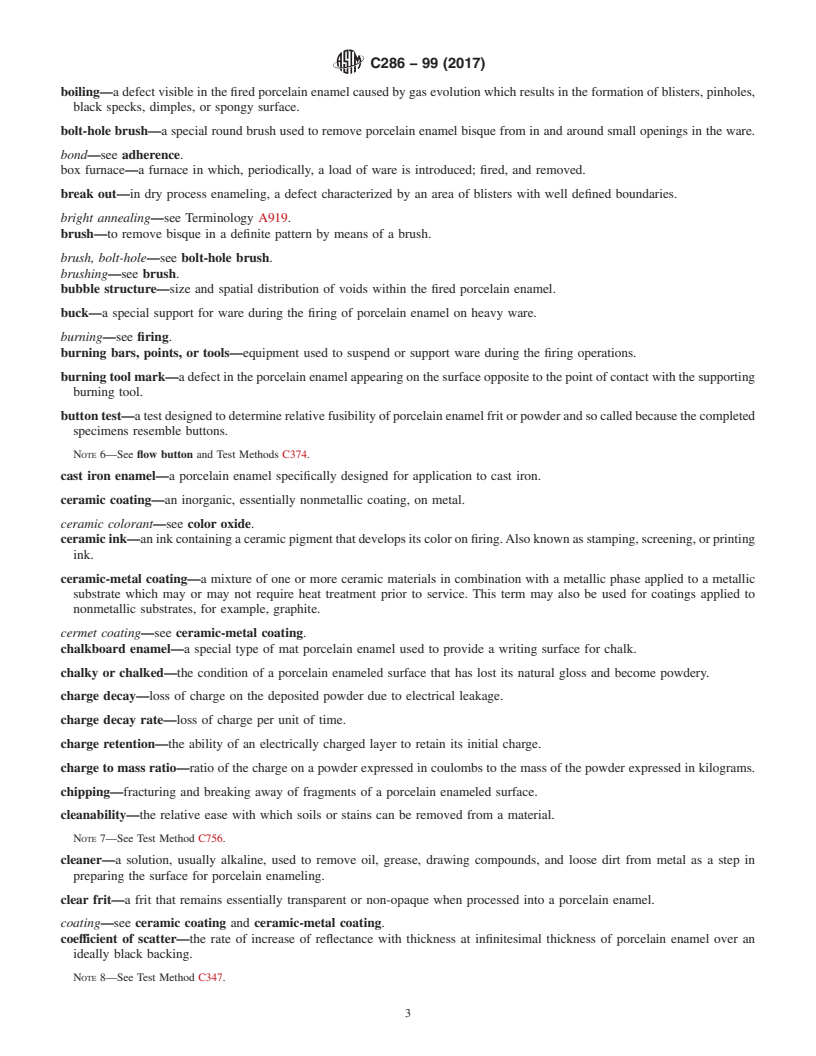
This document is not an ASTM standard and is intended only to provide the user of an ASTM standard an indication of what changes have been made to the previous version. Because
it may not be technically possible to adequately depict all changes accurately, ASTM recommends that users consult prior editions as appropriate. In all cases only the current version
of the standard as published by ASTM is to be considered the official document.
Designation: C286 − 99 (Reapproved 2009) C286 − 99 (Reapproved 2017)
Standard Terminology Relating to
Porcelain Enamel and Ceramic-Metal Systems
This standard is issued under the fixed designation C286; the number immediately following the designation indicates the year of
original adoption or, in the case of revision, the year of last revision. A number in parentheses indicates the year of last reapproval. A
superscript epsilon (´) indicates an editorial change since the last revision or reapproval.
This standard has been approved for use by agencies of the U.S. Department of Defense.
1. Scope
1.1 These definitions pertain to the terminology used in the porcelain enamel and ceramic-coated metal industries.
1.2 Words adequately defined in standard dictionaries are not included. Included are words that are peculiar to these industries.
1.3 Hyphenated words, double words, or phrases are listed alphabetically under the first word; additional important words are
cross-referenced.
1.4 When a word or phrase, listed as a synonym, is not separately defined, the defined word or phrase is the accepted or
preferred form.
1.5 This international standard was developed in accordance with internationally recognized principles on standardization
established in the Decision on Principles for the Development of International Standards, Guides and Recommendations issued
by the World Trade Organization Technical Barriers to Trade (TBT) Committee.
2. Referenced Documents
2.1 ASTM Standards:
A424 Specification for Steel, Sheet, for Porcelain Enameling
A919 Terminology Relating to Heat Treatment of Metals (Withdrawn 1999)
C282 Test Method for Acid Resistance of Porcelain Enamels(Citric Acid Spot Test)
C283 Test Methods for Resistance of Porcelain Enameled Utensils to Boiling Acid
C285 Test Methods for Sieve Analysis of Wet-Milled and Dry-Milled Porcelain Enamel
C313 Method of Test for Adherence of Porcelain Enamel and Ceramic Coatings to Sheet Metal (Withdrawn 1989)
C314 Test Method for Flatness of Porcelain Enameled Panels (Withdrawn 1979)
C346 Test Method for 45-deg Specular Gloss of Ceramic Materials
C347 Test Method for Reflectivity and Coefficient of Scatter of White Porcelain Enamels (Withdrawn 1990)
C374 Test Methods for Fusion Flow of Porcelain Enamel Frits (Flow-Button Methods)
C448 Test Methods for Abrasion Resistance of Porcelain Enamels
C614 Test Method for Alkali Resistance of Porcelain Enamels
C633 Test Method for Adhesion or Cohesion Strength of Thermal Spray Coatings
C743 Test Method for Continuity of Porcelain Enamel Coatings
C756 Test Method for Cleanability of Surface Finishes
3. Terminology
abrasion resistance—the degree to which a porcelain enamel will resist attack by abrasive materials.
NOTE 1—See Test Methods C448.
acid annealing—an annealing process in which ferrous metal shapes are coated with acid before and in conjunction with the
annealing.
This terminology is under the jurisdiction of ASTM Committee B08 on Metallic and Inorganic Coatings and is the direct responsibility of Subcommittee B08.12 on
Materials for Porcelain Enamel and Ceramic-Metal Systems.
Current edition approved Sept. 1, 2009May 1, 2017. Published January 2010May 2017. Originally approved in 1951. Last previous edition approved in 20042009 as
C286–99(2004).C286–99(2017). DOI: 10.1520/C0286-99R09.10.1520/C0286-99R17.
For referenced ASTM standards, visit the ASTM website, www.astm.org, or contact ASTM Customer Service at service@astm.org. For Annual Book of ASTM Standards
volume information, refer to the standard’s Document Summary page on the ASTM website.
The last approved version of this historical standard is referenced on www.astm.org.
Copyright © ASTM International, 100 Barr Harbor Drive, PO Box C700, West Conshohocken, PA 19428-2959. United States
C286 − 99 (2017)
acid resistance—the degree to which a porcelain enamel will resist attack by acids.
NOTE 2—See Test Method C283 and Test Method C282.
adherence—(1) the degree of adhesion of a porcelain enamel or other ceramic coating to a metal substrate.
NOTE 3—See Test Method C313.
(2) Stress necessary to cause separation of one material from another at their interface.
NOTE 4—See Test Method C633.
aging—the storing of porcelain enamel slips or powders before use. The change occurring in slips or powders with the lapse of
time.
air atomizing—air used to atomize powder and to control powder/air mix and powder cloud density.
air fluidizer—air used to impart fluid-like properties to powder via a fluid bed.
alkali resistance—for porcelain enamels, the degree to which a porcelain enamel will resist attack by aqueous alkaline solutions.
NOTE 5—See Test Method C614.
alligator hide—a defect characterized by an extreme roughness of the porcelain enamel surface: a severe case of orange peel.
aluminum enamel—a porcelain enamel specifically designed for application to aluminum.
annealing—see Terminology A919.
annealing acid—see acid annealing and annealing.
anti-scale compound—a preparation that is applied to burning tools to protect them from scaling in service.
back emission—the electrical breakdown of air due to excessive charge build-up in the porcelain enamel powder film during
powder application. This is due to the self-limiting characteristic of electrostatic powders.
back ionization—see back emission.
ball mill—in porcelain enamels, a dense, ceramic-lined rotating cylinder in which ceramic materials are wet or dry ground,
generally using pebbles or porcelain balls as grinding media.
base coat—for two coat-one fire application, the thin layer of bonding frit applied first and used to promote adherence after firing
to the metal substrate.
base metal—the metal to which porcelain enamel is applied.
basis metal—see base metal.
basket, pickle—see pickle basket and pickling.
batch smelter—any smelter that operates as a periodic unit, being charged, fired, and discharged according to a predetermined
cycle.
beading—(1) the application of porcelain enamel, usually of a contrasting color, to the edge or rim of porcelain enameled articles.
(2) Removal of excess slip from the edge of dipped ware.
(3) In dry processing enameling, a bead of porcelain enamel along the edge of ware.
beading enamel—any of the special porcelain enamels used for beading.
bisque—a coating of wet-process porcelain enamel that has been dried, but not fired.
blackboard enamel— see chalkboard enamel.
black edging—a black porcelain enamel applied over the ground coat and exposed in specified areas by brushing the cover coat
bisque prior to firing (see also edging).
black speck—a defect that appears in the fired cover coat as a small dark spot.
blank—the piece cut from metal sheet that is to be used in forming the finished article.
blemish—in dry process enameling, an insignificant imperfection in the porcelain enamel surface.
blister—a defect caused by gas evolution consisting of a bubble that forms during fusion and remains when the porcelain enamel
solidifies.
blow-off resistance—the degree to which a deposited layer of powder resists being blown off by a standard jet of air.
blue enamel—(1) in dry-process porcelain enameling, an area of enamel coating so thin that it appears blue in color.
(2) In wet-process enameling, a cover coat applied too thin to hide the substrate.
C286 − 99 (2017)
boiling—a defect visible in the fired porcelain enamel caused by gas evolution which results in the formation of blisters, pinholes,
black specks, dimples, or spongy surface.
bolt-hole brush—a special round brush used to remove porcelain enamel bisque from in and around small openings in the ware.
bond—see adherence.
box furnace—a furnace in which, periodically, a load of ware is introduced; fired, and removed.
break out—in dry process enameling, a defect characterized by an area of blisters with well defined boundaries.
bright annealing—see Terminology A919.
brush—to remove bisque in a definite pattern by means of a brush.
brush, bolt-hole—see bolt-hole brush.
brushing—see brush.
bubble structure—size and spatial distribution of voids within the fired porcelain enamel.
buck—a special support for ware during the firing of porcelain enamel on heavy ware.
burning—see firing.
burning bars, points, or tools—equipment used to suspend or support ware during the firing operations.
burning tool mark—a defect in the porcelain enamel appearing on the surface opposite to the point of contact with the supporting
burning tool.
button test—a test designed to determine relative fusibility of porcelain enamel frit or powder and so called because the completed
specimens resemble buttons.
NOTE 6—See flow button and Test Methods C374.
cast iron enamel—a porcelain enamel specifically designed for application to cast iron.
ceramic coating—an inorganic, essentially nonmetallic coating, on metal.
ceramic colorant—see color oxide.
ceramic ink—an ink containing a ceramic pigment that develops its color on firing. Also known as stamping, screening, or printing
ink.
ceramic-metal coating—a mixture of one or more ceramic materials in combination with a metallic phase applied to a metallic
substrate which may or may not require heat treatment prior to service. This term may also be used for coatings applied to
nonmetallic substrates, for example, graphite.
cermet coating—see ceramic-metal coating.
chalkboard enamel—a special type of mat porcelain enamel used to provide a writing surface for chalk.
chalky or chalked—the condition of a porcelain enameled surface that has lost its natural gloss and become powdery.
charge decay—loss of charge on the deposited powder due to electrical leakage.
charge decay rate—loss of charge per unit of time.
charge retention—the ability of an electrically charged layer to retain its initial charge.
charge to mass ratio—ratio of the charge on a powder expressed in coulombs to the mass of the powder expressed in kilograms.
chipping—fracturing and breaking away of fragments of a porcelain enameled surface.
cleanability—the relative ease with which soils or stains can be removed from a material.
NOTE 7—See Test Method C756.
cleaner—a solution, usually alkaline, used to remove oil, grease, drawing compounds, and loose dirt from metal as a step in
preparing the surface for porcelain enameling.
clear frit—a frit that remains essentially transparent or non-opaque when processed into a porcelain enamel.
coating—see ceramic coating and ceramic-metal coating.
coefficient of scatter—the rate of increase of reflectance with thickness at infinitesimal thickness of porcelain enamel over an
ideally black backing.
NOTE 8—See Test Method C347.
C286 − 99 (2017)
cold-rolled steel—a low-carbon, cold-reduced and annealed sheet steel.
color oxide—a material used to impart color to a porcelain enamel.
colored frit—a frit containing a colorant in order to produce a strong color in the porcelain enamel.
comb-rack—(1) a burning tool shaped like a comb used for supporting ware during firing.
(2) A comb-like tool for supporting ware during the metal pickling operation.
comeback—the time required for a box furnace to return to temperature after the introduction of a load of ware.
cone-screen test—a method for testing fineness of enamel with a cone-shaped sieve. (see also screen test)
consistency—the properties of a slip that control its draining, flowing, and spraying behavior.
continuity of coating—the degree to which a porcelain enamel or ceramic coating is free of defects, such as bare spots, boiling,
blisters or copperheads, that could reduce its protective properties.
NOTE 9—See Test Method C743.
continuous cleaning (coating)—a term describing a type of porcelain enamel designed to provide the continuous removal, at
normal use temperatures, of food soils accumulated on the interior surfaces of ovens.
continuous furnace—a furnace into which ware is fed continuously and through which it progresses during firing.
continuous smelter—a type of smelter into which the raw mix is fed continuously and from which the molten product is
discharged continuously.
contrast ratio—the ratio of the reflectance of a coating over black backing to its reflectance over a backing of reflectance of 0.80
(80 percent).
NOTE 10—See Test Method C347.
cooling zone—that part of the continuous furnace in which the ware is allowed to cool after firing.
copper enamel—a porcelain enamel specifically designed for application to copper.
copperhead—a defect occurring in sheet metal ground coat that appears as a small freckle or pimple-like spot, reddish brown in
color.
cover coat—a porcelain enamel finish applied and fused over a ground coat or direct to the metal substrate.
covering power—the degree to which a porcelain enamel coating obscures the underlying surface.
cracking—a defect in the bisque consisting of fractures or separations.
crackled—a mottled textural effect in a wet process porcelain enamel resembling a wrinkled surface.
crawling—a defect in the porcelain enamel appearing as agglomerates or irregularly shaped islands.
craze, crazing—a defect appearing as one or more fine cracks in the porcelain enamel.
crinkled—a textural effect in a porcelain enamel surface having the appearance of fine wrinkles or ridges.
crossbend test—a test in which fired or bisque porcelain enamel panels are progressively distorted by bending to determine the
resistance of the coating to cracking.
cup gun—a spray gun with a fluid container as an integral part.
cupping—the pouring of slip over areas of a part during draining to produce uniform application.
curling—a defect similar to crawling.
curtains—a defect in sheet steel ground coatings characterized by a draped pattern of darkened areas that are sometimes blistered.
May also appear in cover coats applied over the ground coat or direct-on.
decarburized enameling steel—a special type of steel sheet of extremely low carbon content, suitable for porcelain enamel cover
coat application direct to the metal (Type I of Specification A424).
decarburized steel— see decarburized enameling steel.
decking—the multiple layer loading of ware for firing.
de-enameling—the removal of porcelain enamel from the base metal.
C286 − 99 (2017)
deflocculating—the thinning of the consistency of a slip by adding a suitable electrolyte.
delayed fishscaling—a fishscaling defect that occurs after the final porcelain enamel processing (see also fishscaling).
devitr
...
Questions, Comments and Discussion
Ask us and Technical Secretary will try to provide an answer. You can facilitate discussion about the standard in here.