

ASTM D3123-09(2017)
(Test Method)Standard Test Method for Spiral Flow of Low-Pressure Thermosetting Molding Compounds
General Information
- Abstract
SIGNIFICANCE AND USE
4.1 The spiral flow of a thermosetting molding compound is a measure of the combined characteristics of fusion under pressure, melt viscosity, and gelation rate under specific conditions.
4.2 This test method is useful as a quality control test and as an acceptance criterion.
4.3 This test method, by itself, is not a valid means for comparing the moldability of similar or different molding compounds because it cannot duplicate actual conditions prevalent in different types of production molds.
4.4 This test method is presently intended for use at a transfer pressure of 6.9 MPa (1000 psi) and a mold temperature of 423 ± 3 K (150 ± 3°C (302 ± 5°F)).
SCOPE
1.1 This test method covers a procedure for measuring the spiral flow of thermosetting molding compounds (soft or very soft) designed for molding pressures under 6.9 MPa (1000 psi). It is especially suited for those compounds used for encapsulation or other low pressure molding techniques. It involves the use of a standard spiral flow mold in a transfer molding press under specified conditions of applied temperature and pressure with a controlled charge mass.
1.2 The values stated in SI units are to be regarded as standard.
1.3 This standard does not purport to address all of the safety concerns, if any, associated with its use. It is the responsibility of the user of this standard to establish appropriate safety and health practices and determine the applicability of regulatory limitations prior to use.
Note 1: There is no known ISO equivalent to this test method.
1.4 This international standard was developed in accordance with internationally recognized principles on standardization established in the Decision on Principles for the Development of International Standards, Guides and Recommendations issued by the World Trade Organization Technical Barriers to Trade (TBT) Committee.
- Status
- Published
- Publication Date
- 31-Jul-2017
- Technical Committee
- D20 - Plastics
- Drafting Committee
- D20.30 - Thermal Properties

Overview
ASTM D3123-09(2017) – Standard Test Method for Spiral Flow of Low-Pressure Thermosetting Molding Compounds is a widely recognized testing procedure developed by ASTM International. This standard provides a method to measure the spiral flow of thermosetting molding compounds under controlled low-pressure conditions. The spiral flow test is vital for assessing key compound properties, including fusion under pressure, melt viscosity, and gelation rate. Such properties are critical for industries engaged in the encapsulation and molding of plastics using low-pressure thermosetting compounds.
Key Topics
- Spiral Flow Measurement: The standard describes how to evaluate the spiral flow of soft or very soft thermosetting molding compounds, focusing on procedures suitable for molding pressures under 6.9 MPa (1000 psi).
- Test Apparatus: Testing requires a transfer molding press and a standard spiral flow mold. The procedure ensures reliable, reproducible results by specifying conditions for temperature, pressure, charge mass, and plunger speed.
- Quality Control: Spiral flow is used as a quality control tool and as an acceptance criterion for thermosetting molding compounds, ensuring product consistency.
- Limitations: This method is not intended for comparing the moldability of different materials or for simulating real-life production mold conditions.
- Standardized Conditions: The standard specifies that tests should be conducted at a mold temperature of 150 ± 3°C (302 ± 5°F) and a transfer pressure of 6.9 MPa (1000 psi).
Applications
ASTM D3123-09(2017) is especially beneficial for manufacturers and suppliers in the plastics industry who work with thermosetting molding compounds, particularly in applications where:
- Encapsulation: Encapsulating electronic components and other sensitive materials with low-pressure thermosetting compounds to protect them from environmental damage.
- Molding Operations: Ensuring consistent processability of materials in low-pressure transfer molding applications, such as in the production of electrical insulators, automotive parts, and specialty molded components.
- Incoming Material Inspection: Using spiral flow as a rapid screening tool to verify incoming compound quality and to meet customer specifications.
- In-Process Control: Monitoring compound properties during production to maintain process stability and product performance.
- Specification Compliance: Determining whether a batch meets the defined parameters for spiral flow, helping to prevent defects and costly rework.
Related Standards
- ASTM D883: Terminology Relating to Plastics – Provides definitions applicable within ASTM D3123-09.
- ASTM E105: Practice for Probability Sampling of Materials – Offers guidance on sampling procedures relevant to this test method.
- ASTM D958: Practice for Determining Temperatures of Standard ASTM Molds for Test Specimens of Plastics (Withdrawn) – Reference for measuring mold temperature.
- No ISO Equivalent: As noted, there is currently no known ISO standard equivalent to ASTM D3123-09(2017).
Keywords: ASTM D3123, spiral flow, thermosetting molding compounds, low-pressure molding, plastics testing standards, quality control, encapsulation, material specification, moldability assessment, transfer molding press.
By applying ASTM D3123-09(2017), organizations ensure reliable evaluation of thermosetting molding compounds for low-pressure applications, supporting product quality and process efficiency in a variety of molding and encapsulation processes.
Relations
- Replaces
ASTM D3123-09 - Standard Test Method for Spiral Flow of Low-Pressure Thermosetting Molding Compounds - Effective Date
- 01-Aug-2017
- Effective Date
- 01-Feb-2024
- Effective Date
- 01-Nov-2023
- Effective Date
- 01-Jan-2020
- Effective Date
- 01-Aug-2019
- Effective Date
- 15-Apr-2019
- Effective Date
- 01-Feb-2019
- Effective Date
- 01-Dec-2018
- Effective Date
- 01-Nov-2018
- Effective Date
- 15-Aug-2017
- Effective Date
- 15-Nov-2012
- Effective Date
- 15-May-2011
- Effective Date
- 01-Oct-2010
- Effective Date
- 01-Mar-2008
- Effective Date
- 01-May-2007
Get Certified
Connect with accredited certification bodies for this standard

DIN CERTCO
DIN Group product certification.

Smithers Quality Assessments
US management systems and product certification.
Sponsored listings
Frequently Asked Questions
ASTM D3123-09(2017) is a standard published by ASTM International. Its full title is "Standard Test Method for Spiral Flow of Low-Pressure Thermosetting Molding Compounds". This standard covers: SIGNIFICANCE AND USE 4.1 The spiral flow of a thermosetting molding compound is a measure of the combined characteristics of fusion under pressure, melt viscosity, and gelation rate under specific conditions. 4.2 This test method is useful as a quality control test and as an acceptance criterion. 4.3 This test method, by itself, is not a valid means for comparing the moldability of similar or different molding compounds because it cannot duplicate actual conditions prevalent in different types of production molds. 4.4 This test method is presently intended for use at a transfer pressure of 6.9 MPa (1000 psi) and a mold temperature of 423 ± 3 K (150 ± 3°C (302 ± 5°F)). SCOPE 1.1 This test method covers a procedure for measuring the spiral flow of thermosetting molding compounds (soft or very soft) designed for molding pressures under 6.9 MPa (1000 psi). It is especially suited for those compounds used for encapsulation or other low pressure molding techniques. It involves the use of a standard spiral flow mold in a transfer molding press under specified conditions of applied temperature and pressure with a controlled charge mass. 1.2 The values stated in SI units are to be regarded as standard. 1.3 This standard does not purport to address all of the safety concerns, if any, associated with its use. It is the responsibility of the user of this standard to establish appropriate safety and health practices and determine the applicability of regulatory limitations prior to use. Note 1: There is no known ISO equivalent to this test method. 1.4 This international standard was developed in accordance with internationally recognized principles on standardization established in the Decision on Principles for the Development of International Standards, Guides and Recommendations issued by the World Trade Organization Technical Barriers to Trade (TBT) Committee.
SIGNIFICANCE AND USE 4.1 The spiral flow of a thermosetting molding compound is a measure of the combined characteristics of fusion under pressure, melt viscosity, and gelation rate under specific conditions. 4.2 This test method is useful as a quality control test and as an acceptance criterion. 4.3 This test method, by itself, is not a valid means for comparing the moldability of similar or different molding compounds because it cannot duplicate actual conditions prevalent in different types of production molds. 4.4 This test method is presently intended for use at a transfer pressure of 6.9 MPa (1000 psi) and a mold temperature of 423 ± 3 K (150 ± 3°C (302 ± 5°F)). SCOPE 1.1 This test method covers a procedure for measuring the spiral flow of thermosetting molding compounds (soft or very soft) designed for molding pressures under 6.9 MPa (1000 psi). It is especially suited for those compounds used for encapsulation or other low pressure molding techniques. It involves the use of a standard spiral flow mold in a transfer molding press under specified conditions of applied temperature and pressure with a controlled charge mass. 1.2 The values stated in SI units are to be regarded as standard. 1.3 This standard does not purport to address all of the safety concerns, if any, associated with its use. It is the responsibility of the user of this standard to establish appropriate safety and health practices and determine the applicability of regulatory limitations prior to use. Note 1: There is no known ISO equivalent to this test method. 1.4 This international standard was developed in accordance with internationally recognized principles on standardization established in the Decision on Principles for the Development of International Standards, Guides and Recommendations issued by the World Trade Organization Technical Barriers to Trade (TBT) Committee.
ASTM D3123-09(2017) is classified under the following ICS (International Classification for Standards) categories: 83.140.99 - Other rubber and plastics products. The ICS classification helps identify the subject area and facilitates finding related standards.
ASTM D3123-09(2017) has the following relationships with other standards: It is inter standard links to ASTM D3123-09, ASTM D883-24, ASTM D883-23, ASTM D883-20, ASTM D883-19c, ASTM D883-19a, ASTM D883-19, ASTM D883-18a, ASTM D883-18, ASTM D883-17, ASTM D883-12e1, ASTM D883-11, ASTM E105-10, ASTM D883-08, ASTM D883-07. Understanding these relationships helps ensure you are using the most current and applicable version of the standard.
ASTM D3123-09(2017) is available in PDF format for immediate download after purchase. The document can be added to your cart and obtained through the secure checkout process. Digital delivery ensures instant access to the complete standard document.
Standards Content (Sample)
This international standard was developed in accordance with internationally recognized principles on standardization established in the Decision on Principles for the
Development of International Standards, Guides and Recommendations issued by the World Trade Organization Technical Barriers to Trade (TBT) Committee.
Designation: D3123 − 09 (Reapproved 2017)
Standard Test Method for
Spiral Flow of Low-Pressure Thermosetting Molding
Compounds
This standard is issued under the fixed designation D3123; the number immediately following the designation indicates the year of
original adoption or, in the case of revision, the year of last revision. A number in parentheses indicates the year of last reapproval. A
superscript epsilon (´) indicates an editorial change since the last revision or reapproval.
1. Scope E105 Practice for Probability Sampling of Materials
1.1 This test method covers a procedure for measuring the
3. Terminology
spiral flow of thermosetting molding compounds (soft or very
soft)designedformoldingpressuresunder6.9MPa(1000psi).
3.1 Definitions—Definitions in this test method are consis-
It is especially suited for those compounds used for encapsu-
tent with Terminology D883.
lation or other low pressure molding techniques. It involves the
use of a standard spiral flow mold in a transfer molding press
4. Significance and Use
under specified conditions of applied temperature and pressure
4.1 The spiral flow of a thermosetting molding compound is
with a controlled charge mass.
a measure of the combined characteristics of fusion under
1.2 The values stated in SI units are to be regarded as
pressure, melt viscosity, and gelation rate under specific
standard.
conditions.
1.3 This standard does not purport to address all of the
4.2 This test method is useful as a quality control test and as
safety concerns, if any, associated with its use. It is the
an acceptance criterion.
responsibility of the user of this standard to establish appro-
4.3 This test method, by itself, is not a valid means for
priate safety and health practices and determine the applica-
comparing the moldability of similar or different molding
bility of regulatory limitations prior to use.
compounds because it cannot duplicate actual conditions
NOTE 1—There is no known ISO equivalent to this test method.
prevalent in different types of production molds.
1.4 This international standard was developed in accor-
4.4 This test method is presently intended for use at a
dance with internationally recognized principles on standard-
transferpressureof6.9MPa(1000psi)andamoldtemperature
ization established in the Decision on Principles for the
of 423 6 3 K (150 6 3°C (302 6 5°F)).
Development of International Standards, Guides and Recom-
mendations issued by the World Trade Organization Technical
5. Apparatus
Barriers to Trade (TBT) Committee.
5.1 Transfer Molding Press with a minimum 150 by
2. Referenced Documents 150-mm (6 by 6-in.) platen area, transfer piston pressure
potentially greater than 6.9 MPa (1000 psi), sufficient clamp
2.1 ASTM Standards:
pressure to prevent flashing, and a minimum plunger speed of
D883 Terminology Relating to Plastics
25.4 mm (1 in.)/s without load. It is recommended that the
D958 Practice for Determining Temperatures of Standard
plunger be equipped with at least one peripheral sealing
ASTM Molds for Test Specimens of Plastics (Withdrawn
groove. It is recommended that a pot diameter between 31.75
1995)
and 44.45 mm (1.25 and 1.75 in.) be used whenever a choice
is possible.
This test method is under the jurisdiction ofASTM Committee D20 on Plastics
NOTE2—Preliminaryevidenceindicatesthat,inmanycases,reasonable
and is the direct responsibility of Subcommittee D20.30 on Thermal Properties
correlations may be achieved between laboratories using presses with
(Section D20.30.08).
differentpotdiameters.Typicalexamplesarepresseswithpotdiametersof
Current edition approved Aug. 1, 2017. Published August 2017. Originally
31.750, 38.100, and 44.450 mm (1.250, 1.500, and 1.750 in.). However, a
approved in 1972. Last previous edition approved in 2009 as D3123 - 09. DOI:
few well-documented cases are recorded where differences in pot
10.1520/D3123-17.
For referenced ASTM standards, visit the ASTM website, www.astm.org, or diameters, even within this listed range, have caused large differences in
contact ASTM Customer Service at service@astm.org. For Annual Book of ASTM flow-length readings. Therefore, for best interlaboratory correlation it is
Standards volume information, refer to the standard’s Document Summary page on
recommended that identical pot diameters be used.
the ASTM website.
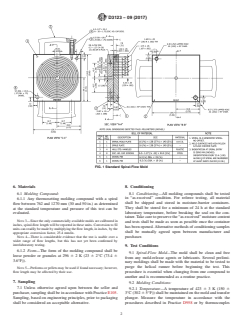
5.2 Standard Spiral-Flow Mold shown in Fig. 1 shall be
The last approved version of this historical standard is referenced on
www.astm.org. utilized.
Copyright © ASTM International, 100 Barr Harbor Drive, PO Box C700, West Conshohocken, PA 19428-2959. United States
D3123 − 09 (2017)
FIG. 1 Standard Spiral-Flow Mold
6. Materials 8. Conditioning
6.1 Molding Compound: 8.1 Conditioning—All molding compounds shall be tested
in “as-received” condition. For referee testing, all material
6.1.1 Any thermosetting molding compound with a spiral
shall be shipped and stored in moisture-barrier containers.
flow between 762 and 1270 mm (30 and 50 in.) as determined
They shall be stored for a minimum of 24 h at the standard
at the standard temperature and pressure of this test can be
laboratory temperature, before breaking the seal on the con-
evaluated.
tainer.Takecaretopreservethe“as-received”moisturecontent
NOTE 3—Since the only commercially available molds are calibrated in
and tests shall be made as soon as possible once the container
inches, spiral-flow length will be reported in these units. Conversion to SI
has been opened.Alternative methods of conditioning samples
units can readily be made by multiplying the flow length, in inches, by the
shall be mutually agreed upon between manufacturer and
appropriate conversion factor, 25.4 mm/in.
purchaser.
NOTE 4—There is considerable evidence that the test is usable over a
wider range of flow lengths, but this has not yet been confirmed by
interlaboratory testing.
9. Test Conditions
6.1.2 Form—The form of the molding compound shall be
9.1 Spiral-Flow Mold—The mold shall be clean and free
loose powder or granules at 296 6 2 K (23 6 2°C (73.4 6
from any mold-release agents or lubricants. Several prelimi-
3.6°F)).
nary moldings shall be made with the material to be tested to
purge the helical runner before beginning the test. This
NOTE 5—Preforms or pellets may be used if found necessary; however,
procedure is essential w
...