

ASTM D3193-24
(Specification)Standard Specification for Ethylbenzene
General Information
- Abstract
ABSTRACT
This specification covers ethylbenzene. Different tests shall be conducted in order to determine the following properties of ethylbenzene: purity, benzene content, toluene content, xylene content, cumene content, diethylbenzene content, chloride content, sulfur content, and color.
SCOPE
1.1 This specification covers ethylbenzene.
1.2 The following applies to all specified limits in this specification for purposes of determining conformance with this specification, an observed value or a calculated value shall be rounded off “to the nearest unit” in the last right-hand digit used in expressing the specification limit, in accordance with the rounding-off method of Practice E29.
1.3 The values stated in SI units are to be regarded as standard. No other units of measure are included in this specification.
1.4 Consult current OSHA regulations, supplier’s Safety Data Sheet for all materials, and local regulations used in this specification.
1.5 This standard does not purport to address all of the safety concerns, if any, associated with its use. It is the responsibility of the user of this standard to establish appropriate safety, health, and environmental practices and determine the applicability of regulatory limitations prior to use.
1.6 This international standard was developed in accordance with internationally recognized principles on standardization established in the Decision on Principles for the Development of International Standards, Guides and Recommendations issued by the World Trade Organization Technical Barriers to Trade (TBT) Committee.
- Status
- Published
- Publication Date
- 31-Dec-2023
- Technical Committee
- D16 - Aromatic, Industrial, Specialty and Related Chemicals
- Drafting Committee
- D16.07 - Styrene, Ethylbenzene and C9 and C10 Aromatic Hydrocarbons




Overview
ASTM D3193-24: Standard Specification for Ethylbenzene defines requirements for the quality and purity of ethylbenzene, a key aromatic hydrocarbon widely used in the chemical industry. Developed and maintained by ASTM International, this specification outlines key properties, analytical methods, safety considerations, and compliance standards for ethylbenzene. The standard ensures uniformity and quality in the global supply chain of ethylbenzene by specifying minimum purity levels and limiting the presence of impurities such as benzene, toluene, xylenes, cumene, diethylbenzene, chlorides, sulfur, and color.
Key Topics
- Purity and Impurity Limits: The specification states that ethylbenzene must have a minimum purity and sets maximum limits on common impurities, ensuring reliability in industrial processes.
- Analytical Methods: Specific ASTM methods such as gas chromatography, ion chromatography, colorimetry, and visual inspections are cited for testing and verifying the composition and appearance of ethylbenzene.
- Sampling Procedures: The standard references best practices for sampling liquid cyclic products to ensure representative and reliable testing results.
- Safety and Compliance: Users are required to adhere to Occupational Safety and Health Administration (OSHA) regulations, consult Safety Data Sheets, and establish appropriate safety, health, and environmental practices.
- International Standardization: Aligned with World Trade Organization (WTO) guidelines, ASTM D3193-24 supports global conformity and trade.
Applications
Ethylbenzene is an essential raw material, primarily used in the production of styrene, which in turn is a precursor for polymers such as polystyrene. The standard aids:
- Chemical Manufacturers: Ensures that ethylbenzene meets stringent quality and purity requirements, which is critical for downstream processes and product performance.
- Quality Assurance Labs: Provides clear criteria and verified test methods for consistent and reproducible measurements across facilities.
- Regulatory Compliance: Offers a framework for regulatory bodies and companies to assess and demonstrate conformity with safety and environmental regulations.
- Global Trade: Facilitates international commerce by standardizing requirements and test protocols, reducing barriers in importing or exporting ethylbenzene.
Related Standards
ASTM D3193-24 references a number of related standards and methods to determine specific properties of ethylbenzene:
- ASTM D3437 - Practice for Sampling and Handling Liquid Cyclic Products
- ASTM D5060, D7504 - Determining impurities and trace impurities by gas chromatography
- ASTM D5194, D5808, D7359, D7536 - Determining trace chlorides and sulfur in aromatic hydrocarbons
- ASTM D5386, D8005 - Methods for determining liquid color
- ASTM E29 - Guide for significant digits and rounding-off in test data
- ASTM E2680 - Visual inspection procedure for clear liquids
- OSHA Regulations (29 CFR 1910.1000 and 1910.1200) - Workplace exposure limits and hazard communication
Practical Value
By adopting ASTM D3193-24, organizations safeguard product quality, protect worker safety, support regulatory compliance, and streamline international commerce. The standard serves as a trusted reference that helps harmonize supply chains, minimize disputes over quality, and ensure that ethylbenzene meets the precise needs of manufacturers and downstream users globally. This comprehensive specification underpins the production, quality control, and safe handling of high-purity ethylbenzene across industries.
Relations
- Effective Date
- 01-Jan-2024
- Effective Date
- 01-Jan-2024
- Effective Date
- 01-Jan-2018
Get Certified
Connect with accredited certification bodies for this standard

ECOCERT
Organic and sustainability certification.

Eurofins Food Testing Global
Global leader in food, environment, and pharmaceutical product testing.

Intertek Bangladesh
Intertek certification and testing services in Bangladesh.
Sponsored listings
Frequently Asked Questions
ASTM D3193-24 is a technical specification published by ASTM International. Its full title is "Standard Specification for Ethylbenzene". This standard covers: ABSTRACT This specification covers ethylbenzene. Different tests shall be conducted in order to determine the following properties of ethylbenzene: purity, benzene content, toluene content, xylene content, cumene content, diethylbenzene content, chloride content, sulfur content, and color. SCOPE 1.1 This specification covers ethylbenzene. 1.2 The following applies to all specified limits in this specification for purposes of determining conformance with this specification, an observed value or a calculated value shall be rounded off “to the nearest unit” in the last right-hand digit used in expressing the specification limit, in accordance with the rounding-off method of Practice E29. 1.3 The values stated in SI units are to be regarded as standard. No other units of measure are included in this specification. 1.4 Consult current OSHA regulations, supplier’s Safety Data Sheet for all materials, and local regulations used in this specification. 1.5 This standard does not purport to address all of the safety concerns, if any, associated with its use. It is the responsibility of the user of this standard to establish appropriate safety, health, and environmental practices and determine the applicability of regulatory limitations prior to use. 1.6 This international standard was developed in accordance with internationally recognized principles on standardization established in the Decision on Principles for the Development of International Standards, Guides and Recommendations issued by the World Trade Organization Technical Barriers to Trade (TBT) Committee.
ABSTRACT This specification covers ethylbenzene. Different tests shall be conducted in order to determine the following properties of ethylbenzene: purity, benzene content, toluene content, xylene content, cumene content, diethylbenzene content, chloride content, sulfur content, and color. SCOPE 1.1 This specification covers ethylbenzene. 1.2 The following applies to all specified limits in this specification for purposes of determining conformance with this specification, an observed value or a calculated value shall be rounded off “to the nearest unit” in the last right-hand digit used in expressing the specification limit, in accordance with the rounding-off method of Practice E29. 1.3 The values stated in SI units are to be regarded as standard. No other units of measure are included in this specification. 1.4 Consult current OSHA regulations, supplier’s Safety Data Sheet for all materials, and local regulations used in this specification. 1.5 This standard does not purport to address all of the safety concerns, if any, associated with its use. It is the responsibility of the user of this standard to establish appropriate safety, health, and environmental practices and determine the applicability of regulatory limitations prior to use. 1.6 This international standard was developed in accordance with internationally recognized principles on standardization established in the Decision on Principles for the Development of International Standards, Guides and Recommendations issued by the World Trade Organization Technical Barriers to Trade (TBT) Committee.
ASTM D3193-24 is classified under the following ICS (International Classification for Standards) categories: 71.080.15 - Aromatic hydrocarbons. The ICS classification helps identify the subject area and facilitates finding related standards.
ASTM D3193-24 has the following relationships with other standards: It is inter standard links to ASTM D3193-19, ASTM D5194-24, ASTM D5194-18. Understanding these relationships helps ensure you are using the most current and applicable version of the standard.
ASTM D3193-24 is available in PDF format for immediate download after purchase. The document can be added to your cart and obtained through the secure checkout process. Digital delivery ensures instant access to the complete standard document.
Standards Content (Sample)
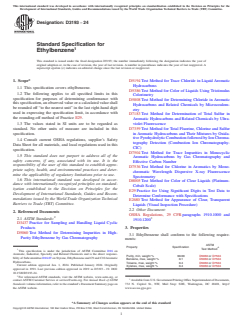
This international standard was developed in accordance with internationally recognized principles on standardization established in the Decision on Principles for the
Development of International Standards, Guides and Recommendations issued by the World Trade Organization Technical Barriers to Trade (TBT) Committee.
Designation: D3193 − 24
Standard Specification for
Ethylbenzene
This standard is issued under the fixed designation D3193; the number immediately following the designation indicates the year of
original adoption or, in the case of revision, the year of last revision. A number in parentheses indicates the year of last reapproval. A
superscript epsilon (´) indicates an editorial change since the last revision or reapproval.
1. Scope* D5194 Test Method for Trace Chloride in Liquid Aromatic
Hydrocarbons
1.1 This specification covers ethylbenzene.
D5386 Test Method for Color of Liquids Using Tristimulus
1.2 The following applies to all specified limits in this
Colorimetry
specification for purposes of determining conformance with
D5808 Test Method for Determining Chloride in Aromatic
this specification, an observed value or a calculated value shall
Hydrocarbons and Related Chemicals by Microcoulom-
be rounded off “to the nearest unit” in the last right-hand digit
etry
used in expressing the specification limit, in accordance with
D7183 Test Method for Determination of Total Sulfur in
the rounding-off method of Practice E29.
Aromatic Hydrocarbons and Related Chemicals by Ultra-
violet Fluorescence
1.3 The values stated in SI units are to be regarded as
standard. No other units of measure are included in this D7359 Test Method for Total Fluorine, Chlorine and Sulfur
in Aromatic Hydrocarbons and Their Mixtures by Oxida-
specification.
tive Pyrohydrolytic Combustion followed by Ion Chroma-
1.4 Consult current OSHA regulations, supplier’s Safety
tography Detection (Combustion Ion Chromatography-
Data Sheet for all materials, and local regulations used in this
CIC)
specification.
D7504 Test Method for Trace Impurities in Monocyclic
1.5 This standard does not purport to address all of the
Aromatic Hydrocarbons by Gas Chromatography and
safety concerns, if any, associated with its use. It is the
Effective Carbon Number
responsibility of the user of this standard to establish appro-
D7536 Test Method for Chlorine in Aromatics by Mono-
priate safety, health, and environmental practices and deter-
chromatic Wavelength Dispersive X-ray Fluorescence
mine the applicability of regulatory limitations prior to use.
Spectrometry
1.6 This international standard was developed in accor-
D8005 Test Method for Color of Clear Liquids (Platinum-
dance with internationally recognized principles on standard-
Cobalt Scale)
ization established in the Decision on Principles for the
E29 Practice for Using Significant Digits in Test Data to
Development of International Standards, Guides and Recom-
Determine Conformance with Specifications
mendations issued by the World Trade Organization Technical
E2680 Test Method for Appearance of Clear, Transparent
Barriers to Trade (TBT) Committee.
Liquids (Visual Inspection Procedure)
2.2 Other Document:
2. Referenced Documents
OSHA Regulations, 29 CFR paragraphs 1910.1000 and
2.1 ASTM Standards:
1910.1200
D3437 Practice for Sampling and Handling Liquid Cyclic
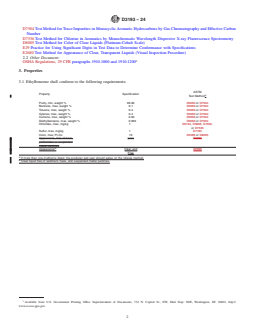
Products 3. Properties
D5060 Test Method for Determining Impurities in High-
3.1 Ethylbenzene shall conform to the following require-
Purity Ethylbenzene by Gas Chromatography
ments:
ASTM
Property Specification
A
Test Method
This specification is under the jurisdiction of ASTM Commit
...
This document is not an ASTM standard and is intended only to provide the user of an ASTM standard an indication of what changes have been made to the previous version. Because
it may not be technically possible to adequately depict all changes accurately, ASTM recommends that users consult prior editions as appropriate. In all cases only the current version
of the standard as published by ASTM is to be considered the official document.
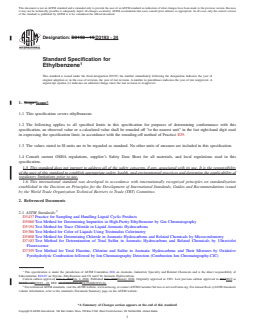
Designation: D3193 − 19 D3193 − 24
Standard Specification for
Ethylbenzene
This standard is issued under the fixed designation D3193; the number immediately following the designation indicates the year of
original adoption or, in the case of revision, the year of last revision. A number in parentheses indicates the year of last reapproval. A
superscript epsilon (´) indicates an editorial change since the last revision or reapproval.
1. Scope Scope*
1.1 This specification covers ethylbenzene.
1.2 The following applies to all specified limits in this specification for purposes of determining conformance with this
specification, an observed value or a calculated value shall be rounded off “to the nearest unit” in the last right-hand digit used
in expressing the specification limit, in accordance with the rounding-off method of Practice E29.
1.3 The values stated in SI units are to be regarded as standard. No other units of measure are included in this specification.
1.4 Consult current OSHA regulations, supplier’s Safety Data Sheet for all materials, and local regulations used in this
specification.
1.5 This standard does not purport to address all of the safety concerns, if any, associated with its use. It is the responsibility
of the user of this standard to establish appropriate safety, health, and environmental practices and determine the applicability of
regulatory limitations prior to use.
1.6 This international standard was developed in accordance with internationally recognized principles on standardization
established in the Decision on Principles for the Development of International Standards, Guides and Recommendations issued
by the World Trade Organization Technical Barriers to Trade (TBT) Committee.
2. Referenced Documents
2.1 ASTM Standards:
D3437 Practice for Sampling and Handling Liquid Cyclic Products
D5060 Test Method for Determining Impurities in High-Purity Ethylbenzene by Gas Chromatography
D5194 Test Method for Trace Chloride in Liquid Aromatic Hydrocarbons
D5386 Test Method for Color of Liquids Using Tristimulus Colorimetry
D5808 Test Method for Determining Chloride in Aromatic Hydrocarbons and Related Chemicals by Microcoulometry
D7183 Test Method for Determination of Total Sulfur in Aromatic Hydrocarbons and Related Chemicals by Ultraviolet
Fluorescence
D7359 Test Method for Total Fluorine, Chlorine and Sulfur in Aromatic Hydrocarbons and Their Mixtures by Oxidative
Pyrohydrolytic Combustion followed by Ion Chromatography Detection (Combustion Ion Chromatography-CIC)
This specification is under the jurisdiction of ASTM Committee D16 on Aromatic, Industrial, Specialty and Related Chemicals and is the direct responsibility of
Subcommittee D16.07 on Styrene, Ethylbenzene and C9 and C10 Aromatic Hydrocarbons.
Current edition approved June 1, 2019Jan. 1, 2024. Published June 2019January 2024. Originally approved in 1991. Last previous edition approved in 20172019 as
D3193 – 17.D3193 – 19. DOI: 10.1520/D3193-1910.1520/D3193-24.
For referenced ASTM standards, visit the ASTM website, www.astm.org, or contact ASTM Customer Service at service@astm.org. For Annual Book of ASTM Standards
volume information, refer to the standard’s Document Summary page on the ASTM website.
*A Summary of Changes section appears at the end of this standard
Copyright © ASTM Internat
...