


ASTM D2257-98(2012)
(Test Method)Standard Test Method for Extractable Matter in Textiles
Standard Test Method for Extractable Matter in Textiles
SIGNIFICANCE AND USE
This test method may be used for acceptance testing of commercial shipments.
In case of a dispute arising from differences in reported test results using this test method for acceptance testing of commercial shipments, the purchaser and the supplier should conduct comparative tests to determine if there is a statistical bias between the laboratories. Competent statistical assistance is recommended for the investigation of bias. As a minimum, the two parties should take a group of test specimens which are as homogeneous as possible and which are from a lot of material of the type in question. The test specimens should then be randomly assigned in equal numbers to each laboratory for testing. The average results from the two laboratories should be compared using appropriate statistical analysis and a probability level chosen by the two parties before the testing begins. If a bias is found, either its cause must be found and corrected, or the purchaser and supplier must agree to interpret future test results with consideration to the known bias.
This test method is used for the determination of the amounts of naturally present oily or waxy impurities that have not been completely removed from textiles made from animal fibers, and for the determination of the amounts of oily or waxy finishing materials applied to raw materials or textiles during manufacture. See 3.1.1, extractable matter.
The test method may be used as a step in the determination of the commercial weight of fiber, yarn, and textile shipments.
The International Wool Textile Organization specifies the use of a halogenated hydrocarbon, dichloromethane, also called methylene chloride (CH2Cl2) instead of the solvent specified in this test method (IWTO-10-62(E)).
Extractables by mass loss is frequently used for textiles which have a relatively large amount of extractable material to effect a significant mass change.
SCOPE
1.1 This test method covers a procedure for determining the extractable material on most fibers, yarns, and fabrics. Three options are included. Option 1 uses heat and Soxhlet extraction apparatus. Option 2 uses room temperature and extraction funnels. Option 3 uses either Option 1 or Option 2 extraction but provides for calculation of extractable matter from the loss in mass of the material due to the extraction rather than the extractable matter residue.
Note 1—Other standards for the determination of extractable matter in textiles made of specific fibers include: Specification , Specification , and Test Method D1574.
1.1.1 The solvents for use in this method are any solvents that the party or parties concerned agreed on; such as, Halogenated Hydrocarbon (HH) chloroform, tetrachloroethane, alcohol.
1.1.2 This test method may not extract cross-linked finishes or resins which may be on the textile.
1.2 The values stated in SI units are to be regarded as standard. No other units of measurement are included in this standard.
1.3 This standard does not purport to address all of the safety concerns, if any, associated with its use. It is the responsibility of the user of this standard to establish appropriate safety and health practices and determine the applicability of regulatory limitations prior to use. See Sections 6 and 7.
General Information
Relations
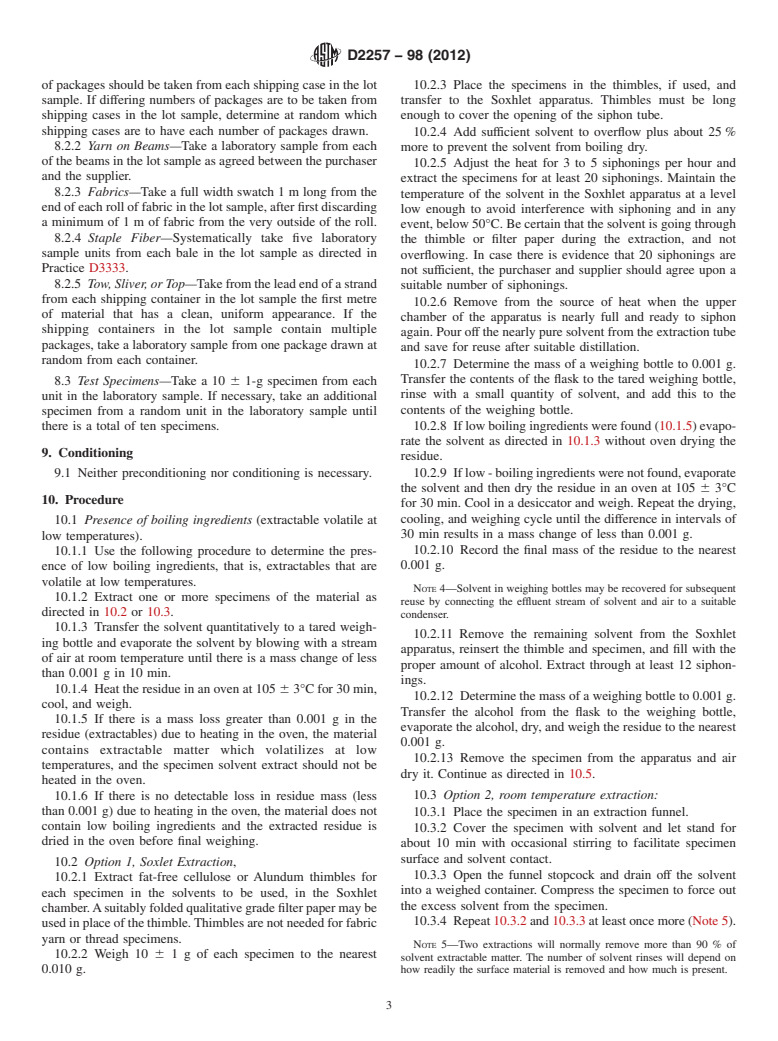
Standards Content (Sample)
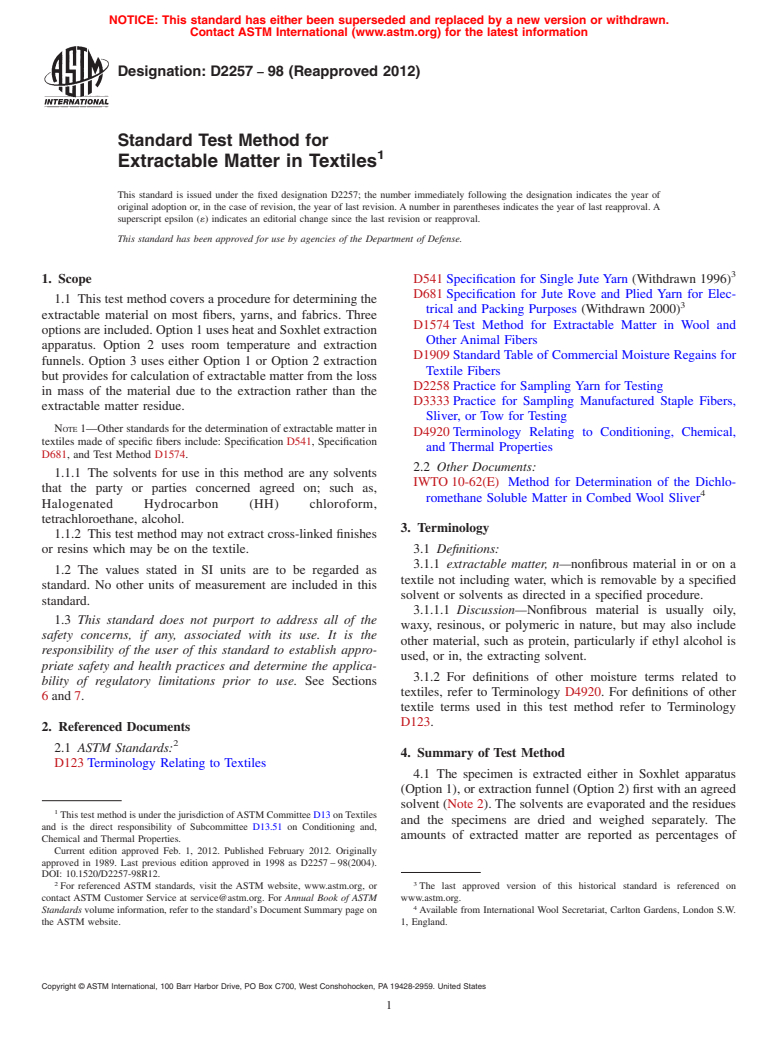
NOTICE: This standard has either been superseded and replaced by a new version or withdrawn.
Contact ASTM International (www.astm.org) for the latest information
Designation: D2257 − 98 (Reapproved 2012)
Standard Test Method for
1
Extractable Matter in Textiles
This standard is issued under the fixed designation D2257; the number immediately following the designation indicates the year of
original adoption or, in the case of revision, the year of last revision. A number in parentheses indicates the year of last reapproval. A
superscript epsilon (´) indicates an editorial change since the last revision or reapproval.
This standard has been approved for use by agencies of the Department of Defense.
3
1. Scope D541 Specification for Single Jute Yarn (Withdrawn 1996)
D681 Specification for Jute Rove and Plied Yarn for Elec-
1.1 This test method covers a procedure for determining the
3
trical and Packing Purposes (Withdrawn 2000)
extractable material on most fibers, yarns, and fabrics. Three
D1574 Test Method for Extractable Matter in Wool and
options are included. Option 1 uses heat and Soxhlet extraction
Other Animal Fibers
apparatus. Option 2 uses room temperature and extraction
D1909 Standard Table of Commercial Moisture Regains for
funnels. Option 3 uses either Option 1 or Option 2 extraction
Textile Fibers
but provides for calculation of extractable matter from the loss
D2258 Practice for Sampling Yarn for Testing
in mass of the material due to the extraction rather than the
D3333 Practice for Sampling Manufactured Staple Fibers,
extractable matter residue.
Sliver, or Tow for Testing
NOTE 1—Other standards for the determination of extractable matter in
D4920 Terminology Relating to Conditioning, Chemical,
textiles made of specific fibers include: Specification D541, Specification
and Thermal Properties
D681, and Test Method D1574.
2.2 Other Documents:
1.1.1 The solvents for use in this method are any solvents
IWTO 10-62(E) Method for Determination of the Dichlo-
that the party or parties concerned agreed on; such as,
4
romethane Soluble Matter in Combed Wool Sliver
Halogenated Hydrocarbon (HH) chloroform,
tetrachloroethane, alcohol.
3. Terminology
1.1.2 This test method may not extract cross-linked finishes
or resins which may be on the textile. 3.1 Definitions:
3.1.1 extractable matter, n—nonfibrous material in or on a
1.2 The values stated in SI units are to be regarded as
textile not including water, which is removable by a specified
standard. No other units of measurement are included in this
solvent or solvents as directed in a specified procedure.
standard.
3.1.1.1 Discussion—Nonfibrous material is usually oily,
1.3 This standard does not purport to address all of the
waxy, resinous, or polymeric in nature, but may also include
safety concerns, if any, associated with its use. It is the
other material, such as protein, particularly if ethyl alcohol is
responsibility of the user of this standard to establish appro-
used, or in, the extracting solvent.
priate safety and health practices and determine the applica-
3.1.2 For definitions of other moisture terms related to
bility of regulatory limitations prior to use. See Sections
textiles, refer to Terminology D4920. For definitions of other
6 and 7.
textile terms used in this test method refer to Terminology
D123.
2. Referenced Documents
2
2.1 ASTM Standards:
4. Summary of Test Method
D123 Terminology Relating to Textiles
4.1 The specimen is extracted either in Soxhlet apparatus
(Option 1), or extraction funnel (Option 2) first with an agreed
solvent (Note 2). The solvents are evaporated and the residues
1
This test method is under the jurisdiction ofASTM Committee D13 on Textiles
and the specimens are dried and weighed separately. The
and is the direct responsibility of Subcommittee D13.51 on Conditioning and,
amounts of extracted matter are reported as percentages of
Chemical and Thermal Properties.
Current edition approved Feb. 1, 2012. Published February 2012. Originally
approved in 1989. Last previous edition approved in 1998 as D2257 – 98(2004).
DOI: 10.1520/D2257-98R12.
2 3
For referenced ASTM standards, visit the ASTM website, www.astm.org, or The last approved version of this historical standard is referenced on
contact ASTM Customer Service at service@astm.org. For Annual Book of ASTM www.astm.org.
4
Standards volume information, refer to the standard’s Document Summary page on Available from International Wool Secretariat, Carlton Gardens, London S.W.
the ASTM website. 1, England.
Copyright © ASTM International, 100 Barr Harbor Drive, PO Box C700, West Conshohocken, PA 19428-2959. United States
1
---------------------- Page: 1 ----------------------
D2257 − 98 (2012)
either the oven-dried mass or of the oven-dried mass plus 6.4.2 To collect solvent from extractions, for Option 2.
commercial moisture regain for the textile.
NOTE 2—If metal containers are used, check to ensure that the
extracatable matter does not react with the metal if the residue is to
...
Questions, Comments and Discussion
Ask us and Technical Secretary will try to provide an answer. You can facilitate discussion about the standard in here.