

ASTM D3997/D3997M-16
(Practice)Standard Practice for Preparing Coke Samples for Microscopical Analysis by Reflected Light
General Information
- Abstract
SIGNIFICANCE AND USE
5.1 Briquettes and blocks of coke prepared in accordance with the laboratory procedures of this practice will have flat, scratch-free surfaces suitable for examination with a microscope using reflected light illumination. The polished surface of the samples prepared using this practice will contain particles representative of the original gross sample. Polished blocks of coke will preserve the porosity and undisturbed distributions of carbon forms required in the production of sequences of stitched and tiled image mosaics. Such images are required for microscopic porosity measurement.
5.2 Samples prepared by this practice are used for microscopical determination of the textural components in coke (see Test Method D5061) and the measurement of coke reflectance.
SCOPE
1.1 This practice covers laboratory procedures for the preparation of granular and lump coke into briquette and block samples for examination with a reflected light microscope. The samples prepared are used for examination and identification of the components in coke and the measurement of the reflectance of coke.
Note 1: Sieve size is identified by its standard designation in Specification E11. The alternative designation given in parentheses is for information only and does not represent a different standard sieve size
1.2 Units—The values stated in either SI units or inch-pound units are to be regarded separately as standard. The values stated in each system may not be exact equivalents; therefore, each system shall be used independently of the other. Combining values from the two systems may result in non-conformance with the standard.
1.3 This standard does not purport to address all of the safety concerns, if any, associated with its use. It is the responsibility of the user of this standard to establish appropriate safety and health practices and determine the applicability of regulatory limitations prior to use.
- Status
- Published
- Publication Date
- 30-Sep-2016
- Technical Committee
- D05 - Coal and Coke
- Drafting Committee
- D05.28 - Petrographic Analysis of Coal and Coke
Buy Documents

ASTM D3997/D3997M-16 - Standard Practice for Preparing Coke Samples for Microscopical Analysis by Reflected Light
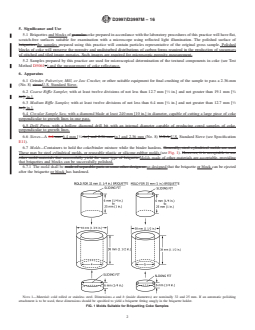
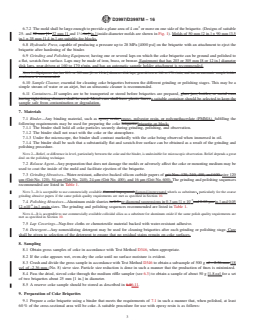
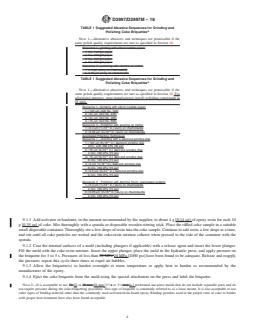
REDLINE ASTM D3997/D3997M-16 - Standard Practice for Preparing Coke Samples for Microscopical Analysis by Reflected Light
Overview
ASTM D3997/D3997M-16 is the standard practice developed by ASTM International for preparing coke samples for microscopical analysis by reflected light. This standard outlines laboratory procedures to create briquette and block samples from granular and lump coke. These prepared coke samples are essential for precise examination of coke components and the measurement of coke reflectance, both critical to the petrographic analysis of metallurgical coke.
The standard ensures that the resulting surfaces of coke specimens are flat, free of scratches, and representative of the original sample for accurate analysis. Polished coke blocks produced per ASTM D3997/D3997M-16 preserve the porosity and undisturbed distribution of carbon forms, which is fundamental for high-resolution microscopic measurement and image analysis.
Key Topics
- Coke Sample Preparation: Guidance on crushing, drying, and embedding coke samples into briquettes or blocks using appropriate binders and molds.
- Surface Grinding and Polishing: Step-by-step abrasive sequences for achieving a flat, scratch-free surface suitable for reflected light microscopy.
- Sample Representation: Requirements to ensure the polished block contains particles representative of the original coke batch.
- Apparatus & Materials: Specifications for sample preparation equipment (grinders, presses, molds), types of abrasives, binders, and cleaning agents.
- Microscopical Analysis: Ensures sample integrity so that crucial characteristics, such as textural components and coke reflectance, can be reliably measured.
- Safety & Units: Emphasizes the use of either SI or inch-pound units independently and the user’s responsibility regarding safety and regulatory compliance.
Applications
The procedures in ASTM D3997/D3997M-16 are widely applied in the coal and coke industries and research laboratories for:
- Textural Component Analysis: Preparing samples for the microscopical determination of the various textural components in coke, an important parameter for metallurgical evaluation.
- Reflectance Measurement: Enabling measurement of vitrinite reflectance, which is used as an indicator of the rank and properties of coke and coal.
- Porosity Studies: Producing polished blocks that maintain coke porosity and carbon structure, supporting high-resolution stitched and tiled image mosaics for porosity assessment.
- Quality Control: Ensuring consistent, reproducible sample preparation for quality assessment of coke in steelmaking and energy production.
- Research and Development: Providing a standardized laboratory preparation process for advanced studies and comparative analysis in petrography and materials science.
Related Standards
This standard is often used in conjunction with other key ASTM standards, including:
- ASTM D121 - Terminology of Coal and Coke
- ASTM D346 - Practice for Collection and Preparation of Coke Samples for Laboratory Analysis
- ASTM D5061 - Test Method for Microscopical Determination of the Textural Components of Metallurgical Coke
- ASTM E11 - Specification for Woven Wire Test Sieve Cloth and Test Sieves
Practical Value
Adhering to ASTM D3997/D3997M-16 ensures uniformity and reliability in coke sample preparation, which is critical for petrographic analysis, quality control, and research applications. By following this standard, laboratories can deliver consistent, accurate data used in industrial quality assurance, specification compliance, and technical investigations into coke and coal performance characteristics. This forms the foundation for advanced coke microscopy and underpins efficiency and quality in metallurgical processes.
Keywords: coke sample preparation, reflected light microscopy, metallurgical coke analysis, petrographic standards, ASTM D3997/D3997M-16, coke reflectance, sample polishing.
Relations
- Effective Date
- 01-Oct-2016
- Effective Date
- 01-Mar-2024
- Effective Date
- 01-Sep-2015
- Effective Date
- 01-Oct-2013
- Effective Date
- 01-May-2010
- Effective Date
- 01-Oct-2009
- Effective Date
- 01-May-2009
- Effective Date
- 01-Feb-2009
- Effective Date
- 15-Feb-2008
- Effective Date
- 01-Oct-2007
- Effective Date
- 01-May-2007
- Effective Date
- 01-May-2005
- Effective Date
- 01-May-2005
- Effective Date
- 01-Oct-2004
- Effective Date
- 01-Jul-2004
Buy Documents
ASTM D3997/D3997M-16 - Standard Practice for Preparing Coke Samples for Microscopical Analysis by Reflected Light
REDLINE ASTM D3997/D3997M-16 - Standard Practice for Preparing Coke Samples for Microscopical Analysis by Reflected Light
Get Certified
Connect with accredited certification bodies for this standard

Element Materials Technology
Materials testing and product certification.

ABS Group Brazil
ABS Group certification services in Brazil.

ABS Quality Evaluations Inc.
American Bureau of Shipping quality certification.
Sponsored listings
Frequently Asked Questions
ASTM D3997/D3997M-16 is a standard published by ASTM International. Its full title is "Standard Practice for Preparing Coke Samples for Microscopical Analysis by Reflected Light". This standard covers: SIGNIFICANCE AND USE 5.1 Briquettes and blocks of coke prepared in accordance with the laboratory procedures of this practice will have flat, scratch-free surfaces suitable for examination with a microscope using reflected light illumination. The polished surface of the samples prepared using this practice will contain particles representative of the original gross sample. Polished blocks of coke will preserve the porosity and undisturbed distributions of carbon forms required in the production of sequences of stitched and tiled image mosaics. Such images are required for microscopic porosity measurement. 5.2 Samples prepared by this practice are used for microscopical determination of the textural components in coke (see Test Method D5061) and the measurement of coke reflectance. SCOPE 1.1 This practice covers laboratory procedures for the preparation of granular and lump coke into briquette and block samples for examination with a reflected light microscope. The samples prepared are used for examination and identification of the components in coke and the measurement of the reflectance of coke. Note 1: Sieve size is identified by its standard designation in Specification E11. The alternative designation given in parentheses is for information only and does not represent a different standard sieve size 1.2 Units—The values stated in either SI units or inch-pound units are to be regarded separately as standard. The values stated in each system may not be exact equivalents; therefore, each system shall be used independently of the other. Combining values from the two systems may result in non-conformance with the standard. 1.3 This standard does not purport to address all of the safety concerns, if any, associated with its use. It is the responsibility of the user of this standard to establish appropriate safety and health practices and determine the applicability of regulatory limitations prior to use.
SIGNIFICANCE AND USE 5.1 Briquettes and blocks of coke prepared in accordance with the laboratory procedures of this practice will have flat, scratch-free surfaces suitable for examination with a microscope using reflected light illumination. The polished surface of the samples prepared using this practice will contain particles representative of the original gross sample. Polished blocks of coke will preserve the porosity and undisturbed distributions of carbon forms required in the production of sequences of stitched and tiled image mosaics. Such images are required for microscopic porosity measurement. 5.2 Samples prepared by this practice are used for microscopical determination of the textural components in coke (see Test Method D5061) and the measurement of coke reflectance. SCOPE 1.1 This practice covers laboratory procedures for the preparation of granular and lump coke into briquette and block samples for examination with a reflected light microscope. The samples prepared are used for examination and identification of the components in coke and the measurement of the reflectance of coke. Note 1: Sieve size is identified by its standard designation in Specification E11. The alternative designation given in parentheses is for information only and does not represent a different standard sieve size 1.2 Units—The values stated in either SI units or inch-pound units are to be regarded separately as standard. The values stated in each system may not be exact equivalents; therefore, each system shall be used independently of the other. Combining values from the two systems may result in non-conformance with the standard. 1.3 This standard does not purport to address all of the safety concerns, if any, associated with its use. It is the responsibility of the user of this standard to establish appropriate safety and health practices and determine the applicability of regulatory limitations prior to use.
ASTM D3997/D3997M-16 is classified under the following ICS (International Classification for Standards) categories: 75.160.10 - Solid fuels. The ICS classification helps identify the subject area and facilitates finding related standards.
ASTM D3997/D3997M-16 has the following relationships with other standards: It is inter standard links to ASTM D3997/D3997M-97(2009), ASTM D121-15(2024), ASTM D121-15, ASTM E11-13, ASTM D346-04(2010), ASTM D121-09a, ASTM E11-09e1, ASTM D121-09, ASTM D121-08, ASTM D5061-07, ASTM D121-07, ASTM D5061-05, ASTM D121-05, ASTM D121-04a, ASTM D121-04. Understanding these relationships helps ensure you are using the most current and applicable version of the standard.
ASTM D3997/D3997M-16 is available in PDF format for immediate download after purchase. The document can be added to your cart and obtained through the secure checkout process. Digital delivery ensures instant access to the complete standard document.
Standards Content (Sample)
This international standard was developed in accordance with internationally recognized principles on standardization established in the Decision on Principles for the
Development of International Standards, Guides and Recommendations issued by the World Trade Organization Technical Barriers to Trade (TBT) Committee.
Designation:D3997/D3997M −16
Standard Practice for
Preparing Coke Samples for Microscopical Analysis by
Reflected Light
This standard is issued under the fixed designation D3997/D3997M; the number immediately following the designation indicates the
year of original adoption or, in the case of revision, the year of last revision. A number in parentheses indicates the year of last
reapproval. A superscript epsilon (´) indicates an editorial change since the last revision or reapproval.
1. Scope 3. Terminology
3.1 Definitions:
1.1 This practice covers laboratory procedures for the
preparation of granular and lump coke into briquette and block 3.1.1 For additional definitions of terms used in this
practice, refer to Terminology D121.
samplesforexaminationwithareflectedlightmicroscope.The
samplespreparedareusedforexaminationandidentificationof 3.1.2 block, n—piece of sectioned lump coke or coke
drillcore embedded in sample binder.
thecomponentsincokeandthemeasurementofthereflectance
of coke.
3.1.3 briquette, n—cylindrical block composed of granu-
lated coal or coke particles compressed and embedded with an
NOTE 1—Sieve size is identified by its standard designation in Speci-
fication E11. The alternative designation given in parentheses is for epoxy binder.
information only and does not represent a different standard sieve size
4. Summary of Practice
1.2 Units—The values stated in either SI units or inch-
4.1 Arepresentativesampleiscrushedtoaspecifiedparticle
pound units are to be regarded separately as standard. The
size, oven-dried or after air-drying, mixed with a binder, and
values stated in each system may not be exact equivalents;
formed into a block specimen referred to as a “briquette.”
therefore,eachsystemshallbeusedindependentlyoftheother.
Combining values from the two systems may result in non-
4.2 Alternatively, a sectioned lump of coke, or coke drill
conformance with the standard.
core, oven-dried or after air-drying, is embedded in a suitable
1.3 This standard does not purport to address all of the binder and formed into a block specimen referred to as a
safety concerns, if any, associated with its use. It is the “block.”
responsibility of the user of this standard to establish appro-
4.3 The briquette or block is then polished to a flat,
priate safety and health practices and determine the applica-
scratch-free surface for microscopical examination under re-
bility of regulatory limitations prior to use.
flected light.
2. Referenced Documents
5. Significance and Use
2.1 ASTM Standards: 5.1 Briquettes and blocks of coke prepared in accordance
with the laboratory procedures of this practice will have flat,
D121Terminology of Coal and Coke
D346 Practice for Collection and Preparation of Coke scratch-free surfaces suitable for examination with a micro-
scope using reflected light illumination. The polished surface
Samples for Laboratory Analysis
D5061Test Method for Microscopical Determination of the of the samples prepared using this practice will contain
particles representative of the original gross sample. Polished
Textural Components of Metallurgical Coke
E11Specification forWovenWireTest Sieve Cloth andTest blocks of coke will preserve the porosity and undisturbed
Sieves distributions of carbon forms required in the production of
sequencesofstitchedandtiledimagemosaics.Suchimagesare
required for microscopic porosity measurement.
This practice is under the jurisdiction of ASTM Committee D05 on Coal and 5.2 Samples prepared by this practice are used for micro-
Coke and is the direct responsibility of Subcommittee D05.28 on Petrographic
scopical determination of the textural components in coke (see
Analysis of Coal and Coke.
Test Method D5061) and the measurement of coke reflectance.
Current edition approved Oct. 1, 2016. Published October 2016. Originally
approved in 1992. Last previous edition approved in 2009 as D3997–97(2009).
6. Apparatus
DOI: 10.1520/D3997_D3997M-16.
For referenced ASTM standards, visit the ASTM website, www.astm.org, or
6.1 Grinder, Pulverizer, Mill, or Jaw Crusher, or other
contact ASTM Customer Service at service@astm.org. For Annual Book of ASTM
suitable equipment for final crushing of the sample to pass a
Standards volume information, refer to the standard’s Document Summary page on
the ASTM website. 2.36-mm (No. 8) U.S. Standard Sieve.
Copyright © ASTM International, 100 Barr Harbor Drive, PO Box C700, West Conshohocken, PA 19428-2959. United States
D3997/D3997M−16
6.2 Coarse Riffle Sampler, with at least twelve divisions of 6.8 Hydraulic Press, capable of producing a pressure up to
not less than 12.7 mm [ ⁄2 in.] and not greater than 19.1 mm 28 MPa [4000 psi] on the briquette with an attachment to eject
[ ⁄4in.]. the briquette after hardening of the binder.
6.3 Medium Riffle Sampler, with at least twelve divisions of
6.9 Grinding and Polishing Equipment, having one or
not less than 6.4 mm [ ⁄4 in.] and not greater than 12.7 mm
several laps on which the coke briquette can be ground and
[ ⁄2in.].
polished to a flat, scratch-free surface. Laps may be made of
iron,brass,orbronze.Equipmentthathas203or305mm[8or
6.4 Circular Sample Saw, with a diamond blade at least
12 in.] diameter disk laps, gear-driven at 160 to 170 r/min, and
240mm[10in.]indiameter,capableofcuttingalargepieceof
has an automatic sample holder attachment is recommended.
coke perpendicular to growth lines in one pass.
6.10 Sample Cleaner, essential for cleaning coke briquettes
6.5 Drill Press, with a hollow diamond drill bit with an
betweenthedifferentgrindingorpolishingstages.Thismaybe
internal diameter capable of producing cored samples of coke,
a simple stream of water or an airjet, but an ultrasonic cleaner
perpendicular to growth lines.
is recommended.
6.6 Sieves—A 6.4 mm [ ⁄4 in.] and 2.36 mm (No. 8) U.S.
Standard Sieve (see Specification E11). 6.11 Containers—If samples are to be transported or stored
before briquettes are prepared, a suitable container should be
6.7 Molds—Containers to hold the coke/binder mixture
selected to keep the sample safe from contamination or
whilethebinderhardens.Thesemaybesteelcylindricalmolds,
degradation.
or reuseable plastic or silicone-rubber molds (see Fig. 1).
Molds made of other materials are acceptable, providing that
7. Materials
briquettes and blocks can be successfully polished.
6.7.1 The mold shall be so designed that the briquette or
7.1 Binder—Any binding material, such as epoxy, polyester
block can be ejected after the briquette or block has hardened.
resin, or polymethacrylate (PMMA), fulfilling the following
6.7.2 Themoldshallbelargeenoughtoprovideaplanearea
requirements may be used for preparing the coke briquette or
of4cm or more on one side of the briquette. (Designs of
block:
suitable 25- and 32 mm [1 and 1 ⁄4 in.] inside-diameter molds
7.1.1 The binder shall hold all coke particles securely
areshowninFig.1).Moldsof50mm[2in.]×90mm[3.5in.]
during grinding, polishing, and observation.
× 35 mm [1.4 in.] are suitable for blocks.
7.1.2 The binder shall not react with the coke or the
atmosphere.
7.1.3 Under the microscope, the binder shall contrast mark-
edly with the coke being observed when immersed in oil.
7.1.4 The binder shall be such that a substantially flat and
scratch-free surface can be obtained as a result of the grinding
and polishing procedure.
NOTE 2—Relief, or difference in level, particularly between the coke
andthebinder,isundesirableformicroscopicobservation.Reliefdepends
a great deal on the polishing technique.
7.2 Release Agent—Any preparation that does not damage
the molds or adversely affect the coke or mounting medium
may be used to coat the inside of the mold and facilitate
ejection of the briquette.
7.3 Grinding Abrasives—Water-resistant, adhesive-backed
...
This document is not an ASTM standard and is intended only to provide the user of an ASTM standard an indication of what changes have been made to the previous version. Because
it may not be technically possible to adequately depict all changes accurately, ASTM recommends that users consult prior editions as appropriate. In all cases only the current version
of the standard as published by ASTM is to be considered the official document.
Designation: D3997/D3997M − 97 (Reapproved 2009) D3997/D3997M − 16
Standard Practice for
Preparing Coke Samples for Microscopical Analysis by
Reflected Light
This standard is issued under the fixed designation D3997/D3997M; the number immediately following the designation indicates the
year of original adoption or, in the case of revision, the year of last revision. A number in parentheses indicates the year of last
reapproval. A superscript epsilon (´) indicates an editorial change since the last revision or reapproval.
1. Scope
1.1 This practice covers laboratory procedures for the preparation of granular samples of coke and lump coke into briquette and
block samples for examination with a reflected light microscope. The samples prepared are used for identifyingexamination and
quantifying identification of the textural components in coke. This practice does not apply to the preparation components in coke
and the measurement of the reflectance of coke.
NOTE 1—Sieve size is identified by its standard designation in Specification E11. The alternative designation given in parentheses is for information
only and does not represent a different standard sieve sizeof oriented lump specimens of coke for structural analysis.
1.2 Units—The values stated in either SI units or inch-pound units are to be regarded separately as standard. The values stated
in each system may not be exact equivalents; therefore, each system shall be used independently of the other. Combining values
from the two systems may result in non-conformance with the standard.
1.3 This standard does not purport to address all of the safety concerns, if any, associated with its use. It is the responsibility
of the user of this standard to establish appropriate safety and health practices and determine the applicability of regulatory
limitations prior to use.
2. Referenced Documents
2.1 ASTM Standards:
D121 Terminology of Coal and Coke
D346 Practice for Collection and Preparation of Coke Samples for Laboratory Analysis
D5061 Test Method for Microscopical Determination of the Textural Components of Metallurgical Coke
E11 Specification for Woven Wire Test Sieve Cloth and Test Sieves
3. Terminology
3.1 Definitions:
3.1.1 For additional definitions of terms used in this practice, refer to Terminology D121.
3.1.2 block, n—piece of sectioned lump coke or coke drillcore embedded in sample binder.
3.1.3 briquette, n—a cylindrical block composed of granulated coal or coke particles compressed and embedded with an epoxy
binder.
4. Summary of Practice
4.1 A representative sample is crushed to a specified particle size, oven-dried, oven-dried or after air-drying, mixed with a
binder, and formed into a block specimen referred to as a briquette. The briquette is then polished to a flat, scratch-free surface
for microscopical examination under reflected light.“briquette.”
4.2 Alternatively, a sectioned lump of coke, or coke drill core, oven-dried or after air-drying, is embedded in a suitable binder
and formed into a block specimen referred to as a “block.”
4.3 The briquette or block is then polished to a flat, scratch-free surface for microscopical examination under reflected light.
This practice is under the jurisdiction of ASTM Committee D05 on Coal and Coke and is the direct responsibility of Subcommittee D05.28 on Petrographic Analysis
of Coal and Coke.
Current edition approved Sept. 1, 2009Oct. 1, 2016. Published March 2010October 2016. Originally approved in 1992. Last previous edition approved in 20042009 as
D3997 – 97(2004).(2009). DOI: 10.1520/D3997_D3997M-97R09.10.1520/D3997_D3997M-16.
For referenced ASTM standards, visit the ASTM website, www.astm.org, or contact ASTM Customer Service at service@astm.org. For Annual Book of ASTM Standards
volume information, refer to the standard’s Document Summary page on the ASTM website.
Copyright © ASTM International, 100 Barr Harbor Drive, PO Box C700, West Conshohocken, PA 19428-2959. United States
D3997/D3997M − 16
5. Significance and Use
5.1 Briquettes and blocks of granular coke prepared in accordance with the laboratory procedures of this practice will have flat,
scratch-free surfaces suitable for examination with a microscope using reflected light illumination. The polished surface of
briquettes the samples prepared using this practice will contain particles representative of the original gross sample. Polished
blocks of coke will preserve the porosity and undisturbed distributions of carbon forms required in the production of sequences
of stitched and tiled image mosaics. Such images are required for microscopic porosity measurement.
5.2 Samples prepared by this practice are used for microscopical determination of the textural components in coke (see Test
Method D5061).) and the measurement of coke reflectance.
6. Apparatus
6.1 Grinder, Pulverizer, Mill, or Jaw Crusher, or other suitable equipment for final crushing of the sample to pass a 2.36-mm
(No. 8) sieve.U.S. Standard Sieve.
1 3
6.2 Coarse Riffle Sampler, with at least twelve divisions of not less than 12.7 mm [ ⁄2 in.] and not greater than 19.1 mm [ ⁄4
in.]. in.].
1 1
6.3 Medium Riffle Sampler, with at least twelve divisions of not less than 6.4 mm [ ⁄4 in.] and not greater than 12.7 mm [ ⁄2
in.]. in.].
6.4 Circular Sample Saw, with a diamond blade at least 240 mm [10 in.] in diameter, capable of cutting a large piece of coke
perpendicular to growth lines in one pass.
6.5 Drill Press, with a hollow diamond drill bit with an internal diameter capable of producing cored samples of coke,
perpendicular to growth lines.
6.6 Sieves—A 6.4-mm 6.4 mm [ ⁄4-in.] and 2.36-mm in.] and 2.36 mm (No. 8) U.S.A.U.S. Standard Sieve (see Specification
E11).
6.7 Molds—Containers to hold the coke/binder mixture while the binder hardens. Generally, steel cylindrical molds are used
These may be steel cylindrical molds, or reuseable plastic or silicone-rubber molds (see Fig. 1). However, it is acceptable to use
other mold materials that successfully yield the same type of briquette.Molds made of other materials are acceptable, providing
that briquettes and blocks can be successfully polished.
6.7.1 The mold shall be made of separable parts or some other design so so designed that the briquette or block can be ejected
after the briquette or block has hardened.
NOTE 1—Material: cold rolled or stainless steel. Dimensions a and b (inside diameters) are nominally 32 and 25 mm. If an automatic polishing
attachment is to be used, these dimensions should be specified to yield a briquette fitting snugly in the briquette holder.
FIG. 1 Molds Suitable for Briquetting Coke Samples
D3997/D3997M − 16
6.7.2 The mold shall be large enough to provide a plane area of 4 cm or more on one side of the briquette. (Designs of suitable
25- and 32-mm [1- 32 mm [1 and 1 ⁄4-in.] in.] inside-diameter molds are shown in Fig. 1). Molds of 50 mm [2 in.] × 90 mm [3.5
in.] × 35 mm [1.4 in.] are suitable for blocks.
6.8 Hydraulic Press, capable of producing a pressure up to 28 MPa [4000 psi] on the briquette with an attachment to eject the
briquette after hardening of the binder.
6.9 Grinding and Polishing Equipment, having one or several laps on which the coke briquette can be ground and polished to
a flat, scratch-free surface. Laps may be made of iron, brass, or bronze. Equipment that has 203 or 305 mm [8 or 12 in.] diameter
disk laps, gear-driven at 160 to 170 r/min, and has an automatic sample holder attachment is recommended.
NOTE 1—Equipment that has 203- or 305-mm [8- or 12-in.] diameter disk laps, gear-driven at 160 to 170 r/min, and has an automatic sample holder
attachment is recommended.
6.10 Sample Cleaner, essential for cleaning coke briquettes between the different grinding or polishing stages. This may be a
simple stream of water or an airjet, but an ultrasonic cleaner is recommended.
6.11 Containers—If samples are to be transported or stored before briquettes are prepared, glass jars, bottles, or metal cans
having tight-fitting closures shall be used. Metal cans shall have plastic liners.a suitable container should be selected to keep the
sample safe from contamination or degradation.
7. Materials
7.1 Binder—Any binding material, such as epoxy resin, epoxy, polyester resin, or polymethacrylate (PMMA), fulfilling the
following requirements may be used for preparing the coke briquette:briquette or block:
7.1.1 The binder shall hold all coke particles securely during grinding, polishing, and observation.
7.1.2 The binder shall not react with the coke or the atmosphere.
7.1.3 Under the microscope, the binder shall co
...