

ASTM D6874-22a
(Test Method)Standard Test Methods for Nondestructive Evaluation of the Stiffness of Wood and Wood-Based Materials Using Transverse Vibration or Stress Wave Propagation
General Information
- Abstract
SIGNIFICANCE AND USE
5.1 The dynamic modulus of elasticity provided by these test methods is a fundamental property for the configuration tested.
5.1.1 The rapidity and ease of application of these test methods facilitate their use as a substitute for static measurements.
5.1.2 Dynamic modulus of elasticity is often used for surveys, for segregation of lumber for test purposes, for quality assessment of engineered wood products, and to provide indication of environmental or processing effect.
5.2 The modulus of elasticity, whether measured statically or dynamically, is often a useful predictor variable to suggest or explain property relationships.
5.3 Results from these test methods can be related to other measurements of modulus of elasticity, such as static methods (see Annex A1 and Appendix X4).
5.4 These methods use calculations that assume specimens are prismatic in cross-section and are uniform in modulus of elasticity and density.
5.4.1 As a result of the above assumptions, the obtained values of modulus of elasticity are dependent on how the specimen is stressed (see Commentary).
5.4.2 Transverse vibration and longitudinal stress wave modulus of elasticity are correlated but not necessarily equal.
5.4.3 These methods provide a means to establish a model to predict one dynamic modulus of elasticity from another dynamic method or a static method (that is, D198, D4761, etc.).
5.4.4 The methods can also be used to estimate the Class I or Class II modulus of elasticity from the Class III method, or the Class I from the Class II method.
5.5 Testing specified to be undertaken in accordance with this Method shall include any requirements regarding the following for each Class:
5.5.1 Grades and species permitted to be combined to form the training and validation test sample.
5.5.2 Selection and positioning of manufacturing or growth characteristics to be included or permitted in the test sample.
5.5.3 Moisture content conditioning undertaken prior t...
SCOPE
1.1 These test methods cover the non-destructive determination of the following dynamic properties of wood and wood-based materials from measuring the fundamental frequency of vibration:
1.1.1 Flexural (see Refs (1-3))2 stiffness and apparent modulus of elasticity (Etv) properties using simply or freely supported beam transverse vibration in the vertical direction, and
1.1.2 Axial stiffness and apparent longitudinal modulus of elasticity (Esw) using stress wave propagation time in the longitudinal direction.
1.2 The test methods can be used for a broad range of wood-based materials and products ranging from logs, timbers, lumber, and engineered wood products.
1.2.1 The two flexural methods can be applied to flexural products such as glulam beams and I-joists.
1.2.2 The longitudinal stress wave methods are limited to solid wood and homogeneous grade glulam (for example, columns but not products with distinct subcomponents such as wood I-joists).
1.3 The standard recognizes three implementation classes for each of these test methods.
1.3.1 Class I—Defines the fundamental method to achieve the highest degree of repeatability and reproducibility that can be achieved under laboratory conditions.
Note 1: Testing should follow Class I methods to develop training and validation data sets for method conversion models (see Annex A2).
1.3.2 Class II—Method with permitted modifications to the Class I method that can be used to address practical issues found in the field, and where practical deviations from the Class I protocol are known and their effects can be accounted.
Note 2: Practical deviations include, for example, environmental and test boundary conditions. Class II methods allow for corrections to test results to account for quantifiable effect such as machine frame deflections.
1.3.3 Class III—Method permitting the broadest range of application, with permitted modifications to suit a wider ra...
- Status
- Published
- Publication Date
- 30-Sep-2022
- Technical Committee
- D07 - Wood
- Drafting Committee
- D07.01 - Fundamental Test Methods and Properties
Buy Documents
ASTM D6874-22a - Standard Test Methods for Nondestructive Evaluation of the Stiffness of Wood and Wood-Based Materials Using Transverse Vibration or Stress Wave Propagation
REDLINE ASTM D6874-22a - Standard Test Methods for Nondestructive Evaluation of the Stiffness of Wood and Wood-Based Materials Using Transverse Vibration or Stress Wave Propagation
Overview
ASTM D6874-22a outlines standard test methods for the nondestructive evaluation of the stiffness of wood and wood-based materials using transverse vibration or stress wave propagation. Developed by ASTM International, this standard helps determine the dynamic properties-specifically the modulus of elasticity and stiffness-of various wood materials without causing damage. These nondestructive methods are valuable for assessing the structural integrity and performance of products such as lumber, engineered beams, and timbers efficiently and rapidly.
By focusing on dynamic modulus of elasticity, these methods enable manufacturers, researchers, and quality control professionals to substitute traditional static testing with faster, non-invasive approaches for surveying, grading, and quality assessment purposes.
Key Topics
- Dynamic Modulus of Elasticity: The core property measured, indicative of the material stiffness under test conditions.
- Transverse Vibration Method: Determines flexural stiffness or apparent modulus of elasticity by measuring oscillations in a simply or freely supported beam.
- Stress Wave Propagation Method: Evaluates axial stiffness and apparent longitudinal modulus of elasticity by analyzing the propagation of a stress wave along the length of the specimen.
- Implementation Classes:
- Class I: Laboratory-based, fundamental method for highest accuracy and repeatability, suitable for developing reference data.
- Class II: Allows certain modifications for practical field applications, accommodating environmental or boundary condition variations.
- Class III: Maximizes applicability and flexibility, enabling broader use cases and online testing scenarios.
- Correlation with Static Methods: Results can be compared with static modulus measurements for conversion models and data standardization.
- Specimen Requirements: Assumes uniform, prismatic cross-sections for accurate calculations; specimen dimensions, moisture content, and weight are critical data points.
Applications
The ASTM D6874-22a test methods are leveraged across a range of industries for:
- Quality Control: Easily measure the stiffness of batches of lumber or engineered wood products for acceptance or grading.
- Grading and Sorting: Segregate wood products based on measured modulus of elasticity during manufacturing or before distribution.
- Research and Development: Monitor the effects of species selection, manufacturing processes, or environmental influences on wood stiffness.
- Structural Assessment: Non-destructive evaluation of existing wood components in structures, helping in maintenance or safety assessments.
- Survey and Acceptance: Rapidly survey logs, lumber, and timbers, facilitating swift decision making in procurement or production environments.
- Product Certification: Support compliance with industry standards for engineered wood products.
Related Standards
The ASTM D6874-22a standard references several key documents relevant to the mechanical testing of wood and wood-based materials:
- ASTM D198: Static tests of lumber in structural sizes.
- ASTM D4761: Mechanical properties of lumber and wood-based structural materials.
- ASTM D2395: Methods for density and specific gravity determination.
- ASTM D4442, D4444, D7438: Moisture content measurement standards.
- ASTM D9: Terminology relating to wood and wood-based products.
- ISO 7626-1/5: Experimental determination of mechanical mobility in vibration testing.
- ASTM D3043: Testing structural panels in flexure.
Practical Value
ASTM D6874-22a provides an efficient framework for nondestructive stiffness evaluation, reducing labor and time compared to conventional static test methods. The ability to assess wood and wood-based materials dynamically facilitates high-throughput quality verification, enables in-field assessments, and supports enhanced process control-all while preserving the integrity of each sample. Using this standard supports data-driven decision making in material selection, structural maintenance, and product innovation within the wood products sector.
Relations
- Effective Date
- 01-Mar-2020
- Effective Date
- 01-Jan-2020
- Effective Date
- 01-Oct-2019
- Effective Date
- 01-Apr-2019
- Effective Date
- 01-Nov-2018
- Effective Date
- 01-Jul-2018
- Effective Date
- 15-Nov-2017
- Effective Date
- 15-Nov-2016
- Effective Date
- 01-May-2016
- Effective Date
- 01-Jun-2015
- Effective Date
- 01-Jun-2014
- Effective Date
- 01-May-2014
- Effective Date
- 01-May-2014
- Effective Date
- 15-Feb-2014
- Effective Date
- 01-Feb-2014
Buy Documents
ASTM D6874-22a - Standard Test Methods for Nondestructive Evaluation of the Stiffness of Wood and Wood-Based Materials Using Transverse Vibration or Stress Wave Propagation
REDLINE ASTM D6874-22a - Standard Test Methods for Nondestructive Evaluation of the Stiffness of Wood and Wood-Based Materials Using Transverse Vibration or Stress Wave Propagation
Get Certified
Connect with accredited certification bodies for this standard

IMP NDT d.o.o.
Non-destructive testing services. Radiography, ultrasonic, magnetic particle, penetrant, visual inspection.
Inštitut za kovinske materiale in tehnologije
Institute of Metals and Technology. Materials testing, metallurgical analysis, NDT.
Q Techna d.o.o.
NDT and quality assurance specialist. 30+ years experience. NDT personnel certification per ISO 9712, nuclear and thermal power plant inspections, QA/
Sponsored listings
Frequently Asked Questions
ASTM D6874-22a is a standard published by ASTM International. Its full title is "Standard Test Methods for Nondestructive Evaluation of the Stiffness of Wood and Wood-Based Materials Using Transverse Vibration or Stress Wave Propagation". This standard covers: SIGNIFICANCE AND USE 5.1 The dynamic modulus of elasticity provided by these test methods is a fundamental property for the configuration tested. 5.1.1 The rapidity and ease of application of these test methods facilitate their use as a substitute for static measurements. 5.1.2 Dynamic modulus of elasticity is often used for surveys, for segregation of lumber for test purposes, for quality assessment of engineered wood products, and to provide indication of environmental or processing effect. 5.2 The modulus of elasticity, whether measured statically or dynamically, is often a useful predictor variable to suggest or explain property relationships. 5.3 Results from these test methods can be related to other measurements of modulus of elasticity, such as static methods (see Annex A1 and Appendix X4). 5.4 These methods use calculations that assume specimens are prismatic in cross-section and are uniform in modulus of elasticity and density. 5.4.1 As a result of the above assumptions, the obtained values of modulus of elasticity are dependent on how the specimen is stressed (see Commentary). 5.4.2 Transverse vibration and longitudinal stress wave modulus of elasticity are correlated but not necessarily equal. 5.4.3 These methods provide a means to establish a model to predict one dynamic modulus of elasticity from another dynamic method or a static method (that is, D198, D4761, etc.). 5.4.4 The methods can also be used to estimate the Class I or Class II modulus of elasticity from the Class III method, or the Class I from the Class II method. 5.5 Testing specified to be undertaken in accordance with this Method shall include any requirements regarding the following for each Class: 5.5.1 Grades and species permitted to be combined to form the training and validation test sample. 5.5.2 Selection and positioning of manufacturing or growth characteristics to be included or permitted in the test sample. 5.5.3 Moisture content conditioning undertaken prior t... SCOPE 1.1 These test methods cover the non-destructive determination of the following dynamic properties of wood and wood-based materials from measuring the fundamental frequency of vibration: 1.1.1 Flexural (see Refs (1-3))2 stiffness and apparent modulus of elasticity (Etv) properties using simply or freely supported beam transverse vibration in the vertical direction, and 1.1.2 Axial stiffness and apparent longitudinal modulus of elasticity (Esw) using stress wave propagation time in the longitudinal direction. 1.2 The test methods can be used for a broad range of wood-based materials and products ranging from logs, timbers, lumber, and engineered wood products. 1.2.1 The two flexural methods can be applied to flexural products such as glulam beams and I-joists. 1.2.2 The longitudinal stress wave methods are limited to solid wood and homogeneous grade glulam (for example, columns but not products with distinct subcomponents such as wood I-joists). 1.3 The standard recognizes three implementation classes for each of these test methods. 1.3.1 Class I—Defines the fundamental method to achieve the highest degree of repeatability and reproducibility that can be achieved under laboratory conditions. Note 1: Testing should follow Class I methods to develop training and validation data sets for method conversion models (see Annex A2). 1.3.2 Class II—Method with permitted modifications to the Class I method that can be used to address practical issues found in the field, and where practical deviations from the Class I protocol are known and their effects can be accounted. Note 2: Practical deviations include, for example, environmental and test boundary conditions. Class II methods allow for corrections to test results to account for quantifiable effect such as machine frame deflections. 1.3.3 Class III—Method permitting the broadest range of application, with permitted modifications to suit a wider ra...
SIGNIFICANCE AND USE 5.1 The dynamic modulus of elasticity provided by these test methods is a fundamental property for the configuration tested. 5.1.1 The rapidity and ease of application of these test methods facilitate their use as a substitute for static measurements. 5.1.2 Dynamic modulus of elasticity is often used for surveys, for segregation of lumber for test purposes, for quality assessment of engineered wood products, and to provide indication of environmental or processing effect. 5.2 The modulus of elasticity, whether measured statically or dynamically, is often a useful predictor variable to suggest or explain property relationships. 5.3 Results from these test methods can be related to other measurements of modulus of elasticity, such as static methods (see Annex A1 and Appendix X4). 5.4 These methods use calculations that assume specimens are prismatic in cross-section and are uniform in modulus of elasticity and density. 5.4.1 As a result of the above assumptions, the obtained values of modulus of elasticity are dependent on how the specimen is stressed (see Commentary). 5.4.2 Transverse vibration and longitudinal stress wave modulus of elasticity are correlated but not necessarily equal. 5.4.3 These methods provide a means to establish a model to predict one dynamic modulus of elasticity from another dynamic method or a static method (that is, D198, D4761, etc.). 5.4.4 The methods can also be used to estimate the Class I or Class II modulus of elasticity from the Class III method, or the Class I from the Class II method. 5.5 Testing specified to be undertaken in accordance with this Method shall include any requirements regarding the following for each Class: 5.5.1 Grades and species permitted to be combined to form the training and validation test sample. 5.5.2 Selection and positioning of manufacturing or growth characteristics to be included or permitted in the test sample. 5.5.3 Moisture content conditioning undertaken prior t... SCOPE 1.1 These test methods cover the non-destructive determination of the following dynamic properties of wood and wood-based materials from measuring the fundamental frequency of vibration: 1.1.1 Flexural (see Refs (1-3))2 stiffness and apparent modulus of elasticity (Etv) properties using simply or freely supported beam transverse vibration in the vertical direction, and 1.1.2 Axial stiffness and apparent longitudinal modulus of elasticity (Esw) using stress wave propagation time in the longitudinal direction. 1.2 The test methods can be used for a broad range of wood-based materials and products ranging from logs, timbers, lumber, and engineered wood products. 1.2.1 The two flexural methods can be applied to flexural products such as glulam beams and I-joists. 1.2.2 The longitudinal stress wave methods are limited to solid wood and homogeneous grade glulam (for example, columns but not products with distinct subcomponents such as wood I-joists). 1.3 The standard recognizes three implementation classes for each of these test methods. 1.3.1 Class I—Defines the fundamental method to achieve the highest degree of repeatability and reproducibility that can be achieved under laboratory conditions. Note 1: Testing should follow Class I methods to develop training and validation data sets for method conversion models (see Annex A2). 1.3.2 Class II—Method with permitted modifications to the Class I method that can be used to address practical issues found in the field, and where practical deviations from the Class I protocol are known and their effects can be accounted. Note 2: Practical deviations include, for example, environmental and test boundary conditions. Class II methods allow for corrections to test results to account for quantifiable effect such as machine frame deflections. 1.3.3 Class III—Method permitting the broadest range of application, with permitted modifications to suit a wider ra...
ASTM D6874-22a is classified under the following ICS (International Classification for Standards) categories: 19.100 - Non-destructive testing. The ICS classification helps identify the subject area and facilitates finding related standards.
ASTM D6874-22a has the following relationships with other standards: It is inter standard links to ASTM D4442-20, ASTM E2655-14(2020), ASTM D1990-19, ASTM D4761-19, ASTM D4761-18, ASTM D4444-13(2018), ASTM D3043-17, ASTM D4442-16, ASTM D1990-16, ASTM D4442-15, ASTM E4-14, ASTM D2395-14e1, ASTM D2395-14, ASTM D1990-14, ASTM D198-14e1. Understanding these relationships helps ensure you are using the most current and applicable version of the standard.
ASTM D6874-22a is available in PDF format for immediate download after purchase. The document can be added to your cart and obtained through the secure checkout process. Digital delivery ensures instant access to the complete standard document.
Standards Content (Sample)
This international standard was developed in accordance with internationally recognized principles on standardization established in the Decision on Principles for the
Development of International Standards, Guides and Recommendations issued by the World Trade Organization Technical Barriers to Trade (TBT) Committee.
Designation: D6874 − 22a
Standard Test Methods for
Nondestructive Evaluation of the Stiffness of Wood and
Wood-Based Materials Using Transverse Vibration or Stress
Wave Propagation
This standard is issued under the fixed designation D6874; the number immediately following the designation indicates the year of
original adoption or, in the case of revision, the year of last revision.Anumber in parentheses indicates the year of last reapproval.A
superscript epsilon (´) indicates an editorial change since the last revision or reapproval.
INTRODUCTION
Nondestructive testing methods are used to determine the physical and mechanical properties of
wood and wood-based materials. These test methods help ensure structural performance of products
manufactured from a variety of wood species and quality levels of raw materials. These test methods
also assist in evaluating the influence of environmental conditions on product performance.
Dynamic test methods based on the transverse vibration of a simply or freely supported beam, or
the propagation of a longitudinal stress wave are methods used to nondestructively evaluate
wood-based materials. These methods yield results comparable to traditional static test methods,
permitting standardization of results, interchange and correlation of data, and establishment of a
cumulative body of information on wood species and products of the world.
1. Scope 1.3 The standard recognizes three implementation classes
for each of these test methods.
1.1 These test methods cover the non-destructive determi-
1.3.1 Class I—Defines the fundamental method to achieve
nation of the following dynamic properties of wood and
the highest degree of repeatability and reproducibility that can
wood-based materials from measuring the fundamental fre-
be achieved under laboratory conditions.
quency of vibration:
1.1.1 Flexural (see Refs (1-3)) stiffness and apparent
NOTE1—TestingshouldfollowClassImethodstodeveloptrainingand
modulus of elasticity (E ) properties using simply or freely
tv
validation data sets for method conversion models (see Annex A2).
supported beam transverse vibration in the vertical direction,
1.3.2 Class II—Method with permitted modifications to the
and
Class I method that can be used to address practical issues
1.1.2 Axial stiffness and apparent longitudinal modulus of
found in the field, and where practical deviations from the
elasticity (E ) using stress wave propagation time in the
sw
Class I protocol are known and their effects can be accounted.
longitudinal direction.
1.2 The test methods can be used for a broad range of NOTE 2—Practical deviations include, for example, environmental and
test boundary conditions. Class II methods allow for corrections to test
wood-basedmaterialsandproductsrangingfromlogs,timbers,
results to account for quantifiable effect such as machine frame deflec-
lumber, and engineered wood products.
tions.
1.2.1 The two flexural methods can be applied to flexural
1.3.3 Class III—Method permitting the broadest range of
products such as glulam beams and I-joists.
1.2.2 The longitudinal stress wave methods are limited to application, with permitted modifications to suit a wider range
solid wood and homogeneous grade glulam (for example,
of practical needs with an emphasis on repeatability.
columns but not products with distinct subcomponents such as
NOTE 3—Online testing machines implemented to grade/sort lumber
wood I-joists).
may be treated as Class III.
1.4 The standard provides guidance for developing a model
These test methods are under the jurisdiction of ASTM Committee D07 on
for estimating a non-destructive test method result (for
WoodandisthedirectresponsibilityofSubcommitteeD07.01onFundamentalTest
example, static modulus of elasticity obtained in accordance
Methods and Properties.
Current edition approved Oct. 1, 2022. Published November 2022. Originally
with Test Methods D198) from another non-destructive test
approved in 2003. Last previous edition approved in 2022 as D6874–22. DOI:
method result (for example, dynamic longitudinal modulus of
10.1520/D6874-22A.
elasticityfrommeasurementoflongitudinalstresswavepropa-
Theboldfacenumbersinparenthesesrefertothelistofreferencesattheendof
this standard. gation time).
Copyright © ASTM International, 100 Barr Harbor Drive, PO Box C700, West Conshohocken, PA 19428-2959. United States
D6874 − 22a
1.4.1 The standard covers only models developed from test E4Practices for Force Calibration and Verification of Test-
data obtained directly from non-destructively testing a repre- ing Machines
sentative sample using one test method, and retesting the same E2655Guide for Reporting Uncertainty of Test Results and
sample following a second test method. Use of the Term Measurement Uncertainty inASTM Test
1.4.2 Results used for model development shall not be Methods
estimated from a model.
2.2 ISO Standards:
ISO7626⁄1Mechanical vibration and shock—Experimental
1.5 Thevaluesstatedininch-poundunitsaretoberegarded
determination of mechanical mobility—Part 1: Basic
as standard. The values given in parentheses are mathematical
terms and definitions, and transducer specifications
conversions to SI units that are provided for information only
ISO 7625/5Vibration and shock—Experimental determina-
and are not considered standard.
tion of mechanical mobility—Part 5: Measurements using
1.6 This standard does not purport to address all of the
impact excitation with an exciter which is not attached to
safety concerns, if any, associated with its use. It is the
the structure
responsibility of the user of this standard to establish appro-
priate safety, health, and environmental practices and deter-
3. Terminology
mine the applicability of regulatory limitations prior to use.
3.1 Definitions—See Terminology D9 and Test Methods
1.7 This international standard was developed in accor-
D198.
dance with internationally recognized principles on standard-
ization established in the Decision on Principles for the
3.2 Definitions of Terms Specific to This Standard:
Development of International Standards, Guides and Recom-
3.2.1 calibration, v—the determination of the relationship
mendations issued by the World Trade Organization Technical
between the response of a standardized instrumentation to
Barriers to Trade (TBT) Committee.
properties determined by a standard method of a reference
materialinordertoobtaincomparableresultsbetweendifferent
2. Referenced Documents
instruments.
2.1 ASTM Standards:
3.2.2 fundamental mode of vibration, n—the simplest mode
D9Terminology Relating to Wood and Wood-Based Prod-
of vibration for the given support condition.
ucts
3.2.2.1 Discussion—For a simply supported beam, the fun-
D198Test Methods of Static Tests of Lumber in Structural
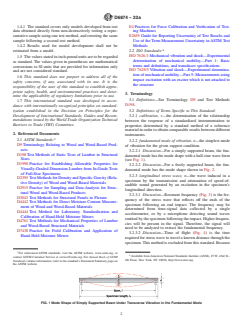
damentalmodehasthemodeshapewithahalf-sinewaveform
Sizes
(see Fig. 1).
D1990Practice for Establishing Allowable Properties for
3.2.2.2 Discussion—For a freely supported beam, the fun-
Visually-Graded Dimension Lumber from In-Grade Tests
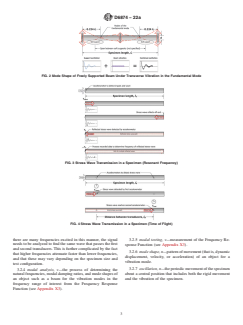
damental mode has the mode shape shown in Fig. 2.
of Full-Size Specimens
3.2.3 longitudinal stress wave, n—the wave induced in a
D2395TestMethodsforDensityandSpecificGravity(Rela-
specimen by the transmission and attenuation of speed-of-
tive Density) of Wood and Wood-Based Materials
audible sound generated by an excitation in the specimen’s
D2915Practice for Sampling and Data-Analysis for Struc-
longitudinal direction.
tural Wood and Wood-Based Products
3.2.3.1 Discussion—Resonant frequency (Fig. 3) is the fre-
D3043Test Methods for Structural Panels in Flexure
quency of the stress wave that reflects off the ends of the
D4442Test Methods for Direct Moisture Content Measure-
specimen following an end impact. The frequency may be
ment of Wood and Wood-Based Materials
determined from time-signal data collected by a single
D4444Test Method for Laboratory Standardization and
accelerometer, or by a microphone detecting sound waves
Calibration of Hand-Held Moisture Meters
emittedbythespecimenfollowingtheimpact.Higherfrequen-
D4761Test Methods for Mechanical Properties of Lumber
cies will be present in the signal. Therefore, the signal will
and Wood-Based Structural Materials
need to be analyzed to extract the fundamental frequency.
D7438Practice for Field Calibration and Application of
3.2.3.2 Discussion—Time of flight (Fig. 4) is the time
Hand-Held Moisture Meters
requiredforstresswavetotravelaknowndistancethroughthe
specimen.Thismethodisexcludedfromthisstandard.Because
For referenced ASTM standards, visit the ASTM website, www.astm.org, or
Available fromAmerican National Standards Institute (ANSI), 25 W. 43rd St.,
contact ASTM Customer Service at service@astm.org. For Annual Book of ASTM
4th Floor, New York, NY 10036, http://www.ansi.org.
Standards volume information, refer to the standard’s Document Summary page on
the ASTM website.
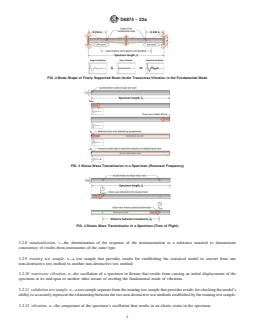
FIG. 1 Mode Shape of Simply Supported Beam Under Transverse Vibration in the Fundamental Mode
D6874 − 22a
FIG. 2 Mode Shape of Freely Supported Beam Under Transverse Vibration in the Fundamental Mode
FIG. 3 Stress Wave Transmission in a Specimen (Resonant Frequency)
FIG. 4 Stress Wave Transmission in a Specimen (Time of Flight)
there are many frequencies excited in this manner, the signal 3.2.5 modal testing, v—measurement of the Frequency Re-
needstobeanalyzedtofindthesamewavethatpassesthefirst sponse Function (see Appendix X3).
and second transducers.This is further complicated by the fact
3.2.6 mode shape, n—patternofmovement(thatis,dynamic
that higher frequencies attenuate faster than lower frequencies,
displacement, velocity, or acceleration) of an object for a
and that these may vary depending on the specimen size and
vibration mode.
test configuration.
3.2.7 oscillation, n—theperiodicmovementofthespecimen
3.2.4 modal analysis, v—the process of determining the
about a central position that includes both the rigid movement
naturalfrequencies,modaldampingratios,andmodeshapesof
and the vibration of the specimen.
an object such as a beam for the vibration modes in the
frequency range of interest from the Frequency Response
Function (see Appendix X3).
D6874 − 22a
3.2.8 standardization, v—the determination of the response 5.1.2 Dynamic modulus of elasticity is often used for
of the instrumentation to a reference material to demonstrate surveys,forsegregationoflumberfortestpurposes,forquality
consistency of results from instruments of the same type. assessment of engineered wood products, and to provide
indication of environmental or processing effect.
3.2.9 training test sample, n—a test sample that provides
resultsforestablishingthestatisticalmodeltoconvertfromone
5.2 The modulus of elasticity, whether measured statically
non-destructive test method to another non-destructive test
or dynamically, is often a useful predictor variable to suggest
method.
or explain property relationships.
3.2.10 transverse vibration, n—theoscillationofaspecimen
5.3 Results from these test methods can be related to other
in flexure that results from causing an initial displacement of
measurements of modulus of elasticity, such as static methods
thespecimenatitsmid-spanoranotherothermeansofexciting
(see Annex A1 and Appendix X4).
the fundamental mode of vibration.
5.4 These methods use calculations that assume specimens
3.2.11 validation test sample, n—a test sample separate
are prismatic in cross-section and are uniform in modulus of
from the training test sample that provides results for checking
elasticity and density.
the model’s ability to accurately represent the relationship
5.4.1 As a result of the above assumptions, the obtained
between the two non-destructive test methods established by
values of modulus of elasticity are dependent on how the
the training test sample.
specimen is stressed (see Commentary).
3.2.12 vibration, n—thecomponentofthespecimen’soscil- 5.4.2 Transverse vibration and longitudinal stress wave
lation that results in an elastic strain in the specimen. modulus of elasticity are correlated but not necessarily equal.
3.2.12.1 Discussion—The oscillation that remains after the 5.4.3 These methods provide a means to establish a model
periodic rigid body motion is removed. to predict one dynamic modulus of elasticity from another
dynamic method or a static method (that is, D198, D4761,
3.2.13 vibration mode, n—thevibrationbehaviorofaspeci-
etc.).
men that is characterized by its natural frequency, modal
5.4.4 The methods can also be used to estimate the Class I
damping, and mode shape.
or Class II modulus of elasticity from the Class III method, or
3.2.13.1 Discussion—The free vibration of a continuous
the Class I from the Class II method.
object such as a beam or a log contains a summation of an
infinite number of vibration modes. The free vibration from
5.5 Testing specified to be undertaken in accordance with
which the modulus of elasticity is computed shall not include
this Method shall include any requirements regarding the
any periodic rigid body motion, or oscillating motion that does
following for each Class:
not result in any elastic strain in the specimen.
5.5.1 Grades and species permitted to be combined to form
the training and validation test sample.
4. Summary of Test Methods
5.5.2 Selection and positioning of manufacturing or growth
4.1 Two dynamic modulus of elasticity methods are cov- characteristics to be included or permitted in the test sample.
5.5.3 Moisture content conditioning undertaken prior to
ered:
4.1.1 Transverse Vibration Methods—The specimen is de- testing.
5.5.4 Acceptable moisture content adjustment models.
flected at its mid-span and allowed to oscillate in a transverse
bendingmode.Observationsofthefrequencyofoscillationare 5.5.5 Any other sampling and data adjustment requirements
to obtain a representative sample of the population under
used to calculate a flexural stiffness or apparent modulus of
elasticity. consideration.
4.1.2 Longitudinal Stress Wave Method—A longitudinal
NOTE 5—Guidance or requirements from applicable product standards
stress wave is induced by impacting the end of a specimen.
or specifications for representative sampling should be considered. See
Indirect observation of the transmission time from measuring Annex A2.
NOTE6—SeeCommentaryAppendixX4foradditionalinformation(for
resonant frequency is used to calculate an axial stiffness or
example, blocking parameter and blocking limits) that may need to be
apparent longitudinal modulus of elasticity.
provided for generating a test sample suitable for developing the test
method conversion model.
NOTE 4—The dynamic modulus of elasticity is determined when the
specimen’s stress state is changing. The static modulus of elasticity is the
traditional method where the modulus of elasticity is determined at two
6. Precision and Bias
different stress states where the stresses are not changing or changing at a
6.1 The precision and bias of these test methods have not
slow rate as defined in the static test method. Examples of static test
methods for wood and wood-based products are standard Test Methods yet been established.
D198, D4761, and D3043.
TRANSVERSE VIBRATION METHODS
5. Significance and Use
7. Apparatus
5.1 The dynamic modulus of elasticity provided by these
test methods is a fundamental property for the configuration 7.1 The testing equipment shall consist of four essential
tested. elements:
5.1.1 The rapidity and ease of application of these test 7.1.1 Support apparatus,
methods facilitate their use as a substitute for static measure- 7.1.2 Excitation system,
ments. 7.1.3 Response and weight measurement devices, and
D6874 − 22a
with a pad can affect the fundamental frequency.
7.1.4 Time signal processing algorithm.
(1) Reactions—The specimen shall be supported in a man-
ner to prevent damage to the specimen at the point of contact
8. Test Procedure
between it and the reaction support.
8.1 Standardization and Calibration—The testing system
NOTE 9—Dimension lumber specimens are typically light enough to
shall be standardized and calibrated using standard reference
enable them to be supported on knife edges or the load button of a load
materials. The procedures of AnnexA1 shall be followed. The
cell. Where flat bearing plates are required, ensure the plate does not
results of this test method are conditional upon proper stan- impede free rotation of the specimen.
dardization and appropriate choice of calibration method. (2)The reactions shall be such that rotation of the speci-
NOTE 7—It has been a practice to use aluminum bars or lumber men about the reaction due to deflection will be unrestricted.
specimens as standardization materials and also for calibration against a
(3)Transverse vibration that results in a large mid-span
standard static test results.
deflection (for example, when the vibration amplitude exceeds
8.2 Excitation—The procedures of excitation listed under
approximately half the specimen depth, d) shall have at least
each Class shall be followed. Repetitions and inter-laboratory
one support configured to provide unrestricted longitudinal
testing are recommended to assess test procedures and to
movementofthespecimenrelativetothesupport(forexample,
reduce the chance of bias caused by improper excitation.
a roller).
(4) Reaction Alignment—Provision shall be made at the
8.3 Calculation of Dynamic Modulus of Elasticity and
reactionstoallowforinitialtwistinthelengthofthespecimen.
Stiffness:
If the bearing surfaces of the specimen at its reaction are not
8.3.1 Basic Equations—The following formulas, Eq 1 and
parallel to the bearing surface of the reactions, the specimen
Eq 2, shall be used to calculate apparent dynamic modulus of
shall be shimmed or the bearing surfaces shall be permitted to
elasticity and bending stiffness from the measured oscillation
rotate about an axis parallel to the span to provide adequate
in the fundamental mode for either the simply supported (Fig.
contact across the width of the specimen.
1) or freely supported (Fig. 2) beams:
(5) Lateral Support—No lateral support shall be applied.
2 3
f wℓ
Specimens unstable in this mode shall not be tested using this
E 5 (1)
tv
ℓ
t
method.
KIg
S D
ℓ
(6) Lengthwise Positioning and Overhang of the
2 3
f wℓ
Specimen—The specimen shall be positioned with an equal
~EI! 5 (2)
tv
ℓ
portion of the length overhanging each support. If basic
t
Kg
S D
ℓ
equation (Eq 1) is used, then the span (ℓ) to length (ℓ) ratio
t
shall equal or exceed 0.98 (for example, an overhang of 1 in.
where:
(25 mm) at each end of an 8-ft (2400-mm) long member).
E = modulus of elasticity determined using transverse
tv
NOTE 10—Excessive or unequal overhang may alter results obtained.
vibration, psi (MPa),
Overhangthatdiffersbyonespecimendepth(d,asdefinedin8.3.1)orless
(EI) = bending stiffness determined using transverse vibra-
tv may be neglected.
2 2
tion method, lb-in (N-mm ),
NOTE 11—When developing data for method conversion (see Annex
ℓ = specimen length, in. (mm), A2), it is recommended that the span not be varied to meet the maximum
t
overhang criteria. Doing so may introduce additional measurement errors
ℓ = span, in. (mm) for simply-supported beams,
associated with setting the test span. If possible, samples should be cut to
= ℓ, for freely supported beams,
t
a common length so that the test can be carried out at the same span.
w = total specimen weight, lbf (N),
-1
f = fundamental vibration mode frequency, Hz (s ), 9.1.1.2 Freely Supported Beams—The free support condi-
4 4
I = specimen moment of inertia, in (mm ); for
tion (soft supports, such as by air bags) shall provide vertical
example, bh /12, for a rectangular cross-section,
support when the specimen is at rest, and permit rotation and
b = horizontal breadth (width), in. (mm),
vertical movement when the specimen is excited and vibrating
d = vertical depth, in. (mm),
in the fundamental mode.The stiffness of the supports shall be
2 2
g = accelerationduetogravity,386in./s (9807mm/s ),
identical and sufficiently flexible at both support points to
and
permit the specimen to oscillate at a frequency that is less than
K = constant for free vibration of a beam (see Ref (4))
approximately one-tenth of the fundamental vibration fre-
= 2.47, if simply supported,
quency of the specimen.
= 12.48, if freely supported.
NOTE 12—The frequency of oscillation of the specimen contains the
movementofthespecimenrelativetothefixedgroundandwilldependon
9. Class I—Laboratory Use
the stiffness of the supports and the specimen. The fundamental vibration
9.1 Apparatus
frequency of the specimen contains only movement of the specimen
9.1.1 Support Apparatus: relative to the nodes of the fundamental mode (see Fig. 2) and is
dependent on the stiffness of the specimen.
9.1.1.1 Simply Supported Beams—Vertical support is pro-
NOTE 13—In order to accurately isolate and not affect the measured
vided at the ends of the beam while rotation is unrestrained.
vibration frequency of the specimen, the supporting material should be
NOTE 8—The supporting material should be sufficiently stiff so that the sufficiently flexible so that the vertical stiffness of the support is much
vertical stiffness of the support is much greater than the flexural stiffness smaller than the stiffness of the specimen. If the stiffness of the support is
of the specimen. If the stiffness of the support is not sufficiently high not sufficiently low compared to the stiffness of the specimen, the
compared to the stiffness of the specimen, the measured fundamental measured fundamental vibration frequency of the specimen will be
frequency will be affected. See Refs. (5) and (6). Even support on carpet affected.Thesupportmaybeaspring,elasticstring,elasticmat,orairbag
D6874 − 22a
selected or adjusted to have the desired compliance. See commentary.
fundamental frequency of the system. Test procedures shall
(1) Reactions and Lateral Support—The specimen shall be
include steps to eliminate transient force readings.
supported in a manner as specified in 9.1.1.1(1) to 9.1.1.1(5).
NOTE 21—If the stiffness of load transducers is not sufficiently high, it
(2) Lengthwise Positioning and Overhang of the
will alter the natural transverse vibration frequency of the specimen and
Specimen—The specimen shall be positioned such that the
produce erroneous results. This is issue is normally not related to the
lengthofoverhangateachsupportisapproximatelyequal.The
transducer calibration.
supports shall be positioned to minimize rigid body rotation of
9.1.3.2 Deflection, Velocity, or Acceleration Transducer—
the specimen.
Measurement of the mid-span displacement, velocity, or accel-
NOTE 14—The freely supported beam method is not as susceptible as
eration in response to the initial displacement are alternative
the simply supported beam method to measurement errors arising from
methods to obtain the vibration time signal. Displacement,
unequal overhangs. A large unequal overhang is likely to result in rigid
velocity or acceleration transducers shall meet the require-
body rotation of the specimen.
NOTE 15—Ideally, the supports should be placed at the nodes of the
ments of ISO 7626/1.
fundamental mode. Supports located far from the node, particularly when
9.1.4 Time Signal Processing Algorithm—A procedure
they are not sufficiently flexible, or at mid-length may alter the beam
implemented manually, or in hardware and software for pro-
vibration frequency. As the supports are moved closer together, the
cessing the time signals to obtain the fundamental natural
specimen becomes susceptible to rigid body rotation (that is, downward
frequency shall be established.
movement at one support and upward movement at the other support)
which should be avoided or minimized. Such rotation effects can be
9.1.4.1 Thestandardizationprocedureshallincludethetime
assessed by applying a downward impact at only one end and observing
signal processing algorithm and all calibrated transducers.
if significant oscillation due to rigid body rotation occurs.
9.1.4.2 Changes to the time signal processing algorithm or
9.1.2 Excitation System—The specimen shall be excited so
any of the transducers shall be subject to the standardization
as to produce a vertical oscillation in a repeatable and
procedures.
reproducible manner in the fundamental mode. The method of
9.1.5 Determining the Fundamental Mode—Document the
analysis is based on oscillation in this mode (Fig. 2).
procedures used to identify the frequency associated with the
fundamental vertical oscillation mode, and to ensure that the
NOTE 16—It is recommended to measure the time signals of the
data acquired is only related to the fundamental vertical mode
excitation.
(Fig. 1).
9.1.2.1 Manual Method—Amanualdeflectionandreleaseof
the specimen will provide sufficient impetus for oscillation for NOTE22—AppendixX3andRef (7)providetheproceduretodetermine
the mode shape.
many products. The initial deflection shall be vertical with an
NOTE 23—When validated for a specific flexural stiffness and span-to-
effort to exclude lateral components; neither excessive impact
depth ratio, a short delay before acquiring the data may also be used to
nor prolonged contact with the specimen are recommended.
ensure the data acquired is only related to the fundamental vertical mode.
NOTE 17—For example, a manual tap on a 16-foot 2-by-12, supported
9.2 Test Specimen
flat-wise having a modulus of elasticity of 2.0 × 10 psi will result in a
9.2.1 Specimens shall be solid and prismatic (uniform in
vertical fundamental vibration frequency of between 3 and 4 Hz in either
cross-section area along the length). Deviations in shape and
of the two transverse vibration methods.
uniformity in dimension from end-to-end and side-to-side
NOTE18—Amanualtapwithahammerinstrumentedwithanintegrated
incidental to sampling, such as wane included in a lumber
load cell is preferred.
grade description, shall be noted as part of the sample or
9.1.2.2 Mechanical Methods—Use of a mechanical exciter
specimen description.
to cause a deflection as noted in 9.1.2.1 is permitted. Caution
9.2.2 Span to Depth Ratio—Specimensshallbetestedatthe
shall be exercised to limit the excitation forces to avoid
permitted span-to-depth ratio.
exciting a non-linear response.
9.2.2.1 Except as permitted in 9.2.2.2, the span-to-depth
9.1.3 Response and Weight Measurement Devices—
ratio shall be greater than or equal to 20.
Measurement of the frequency of oscillation shall be obtained
9.2.2.2 Where the span-to-depth is less than 20, modal
byeitheraforcetransducerinstalledatoneorbothsupports;or
analysis shall be conducted on tests on a representative sample
a displacement, velocity, or acceleration transducer installed at
to show that the procedures used will determine the vibration
mid-span. The time signals from the transducers shall be
frequency corresponding to the fundamental frequency.
recorded in analog or digital form that preserves the accuracy
9.2.3 Specimen Dimensions—Specimen dimensions (for
as specified in the applicable standards in 2.2.
example, diameter, width, depth, length, etc.) shall be mea-
NOTE 19—Displacement sensors are normally not used to measure the
sured to at least three significant figures. Sufficient measure-
vibrationsignals.Inpractice,accelerometers,whicharebothcosteffective
ments of the cross-section shall be made to establish the
and rugged, are the most common.
number of measurements needed to determine the average
NOTE 20—The minimum speed and resolution of the data acquisition
dimensions along the length.
system, and the minimum sampling rates used must anticipate the
frequency to be measured.
NOTE 24—The cross-section size of Surfaced Dry (S-Dry) dimension
lumber can typically be established by measuring the cross-section at one
9.1.3.1 Force Transducer—Changesintheforceinresponse
location along the length.
to the vibration at one or both of the supports is one method
usedtoobtainthevibrationtimesignal.Forcetransducersshall 9.2.4 Moisture Content—Moisture content (MC) of speci-
be selected and calibrated to ensure accuracy in accordance mens shall be measured in accordance with Test Methods
with Practices E4 and shall be sufficiently stiff to not affect the D4442 or Practice D7438, or both. Specific reference to the
D6874 − 22a
current moisture status of the specimens shall be made; for 10.2.3.3 Where the average dimensions of the sample are
example, equilibrated, recently kiln dried containing gradients, not used, specimen dimensions shall be measured in accor-
air dried, packaged specimens of unknown drying history, and dance with 9.2.3.
so forth. Identification of MC gradients caused by drying or 10.2.4 Moisture Content—A sample representative of the
surface wetting is recommended. moisture content of the test population shall be measured for
moisture content in accordance with Test Methods D4442,
NOTE 25—MC gradients within a piece may affect the dynamic
Practice D7438, or both.
modulus of elasticity (see X1.1.23).
10.2.4.1 Where the 95% confidence interval for the average
9.2.5 Specimen Weight—The specimen weight used in Eq 1
moisturecontentis2%orgreater,themoisturecontentshallbe
or Eq 2 shall be determined to at least 3 significant figures.
determined as specified in 9.2.4.
10.2.4.2 Where the 95% confidence interval for the average
10. Class II—Field Use
moisture content is less than 2%, it is permitted to report only
the average and 95% confidence interval for the average
10.1 Apparatus
moisture content.
10.1.1 Support Apparatus:
10.2.5 Specimen Weight—The specimen weight used in Eq
10.1.1.1 Simply Supported Beams—The support apparatus
1orEq2shallbedeterminedtoatleasttwosignificantfigures.
shall meet the requirements of 9.1.1.1.
10.1.1.2 Lengthwise Positioning and Overhang of the
NOTE 28—For the simply supported method, the specimen weight may
be estimated from a force reading at one support (that is, the “half-
Specimen—The specimen shall be positioned such that an
weight”).Itisrecommendedtoverifythatthetestpopulationtestedinthis
equal portion of the length overhangs each support. If basic
mannerprovidesaweightreadingwithinthetolerancespecifiedin10.2.5.
equation (Eq 1) is used, then the span (ℓ) to length (ℓ) ratio
t
shall equal or exceed 0.85. If other ℓ/ℓ ratios are used, more
t
11. Class III—Other Applications
exacting analysis and equations shall be used; see Ref (8).
11.1 Apparatus
NOTE 26—Excessive or unequal overhang may alter results obtained.
11.1.1 Support Apparatus:
Overhangthatdiffersbyonespecimendepth(d,asdefinedin8.3.1)orless
11.1.1.1 Simply Supported Beams—The support apparatus
may be neglected.
shall meet the requirements of 9.1.1.1.
10.1.1.3 Freely Supported Beams—The support apparatus
11.1.1.2 Lengthwise Positioning and Overhang of the
shall meet the requirements of 9.1.1.2.
Specimen—The lengthwise positioning and overhang of the
10.1.2 Excitation System—The excitation system shall meet
specimen shall be meet the requirements of 10.1.1.2.
the requirements of 9.1.2.
11.1.1.3 Freely Supported Beams—The support apparatus
10.1.3 Response and Weight Measurement Devices—The shall meet the requirements of 9.1.1.2.
response and weight measurement devices shall meet the 11.1.2 Excitation System—The excitation system shall meet
requirements of 9.1.3. the requirements of 9.1.2.
10.1.4 Time Signal Processing Algorithm—The time signal 11.1.3 Response and Weight Measurement Devices—The
response and weight measurement devices shall meet the
processing algorithm shall meet the requirements of 9.1.4.
requirements of 9.1.3.
10.2 Test Specimen
11.1.4 Time Signal Processing Algorithm—The time signal
10.2.1 Specimens shall be solid and prismatic (uniform in
processing algorithm shall meet the requirements of 9.1.4.
cross-section area along the length). Deviations in shape and
11.2 Test Specimen
uniformity in dimension from end-to-end and side-to-side
11.2.1 Specimens shall meet the requirements of 10.2.1.
incidental to sampling, such as wane included in a lumber
11.2.2 Span-to-Depth Ratio—The span-to-depth ratio used
grade description, shall be noted as part of the sample or
shall meet the requirements of 10.2.2.
specimen description.
11.2.3 Specimen Dimensions—The specimen dimensions
10.2.2 Span-to-Depth Ratio—The span-to-depth ratio used
used to compute the modulus of elasticity shall be recorded.
shall meet the requirements of 9.2.2.
11.2.3.1 Where a dimension monitoring program is not in
10.2.3 Specimen Dimensions—The specimen dimensions
effectorisnotabletoprovidespecimendimensioninformation
used to compute the modulus of elasticity shall be recorded.
onthesample,asamplerepresentativeofthedimensionsofthe
10.2.3.1 Unless the effect of cross-section modification is a
test population shall be measured in accordance with 9.2.3.
testevaluationobjective,testthespecimenswithoutmodifying
the dimensions of the commercial cross-section. NOTE 29—Monitoring programs include measurements for quality
assurance.
10.2.3.2 Where the average dimensions of the sample are
used, a representative sub-sample of specimens shall be se- 11.2.4 Moisture Content—The specimen moisture content
lected and measured for specimen dimension in accordance shall be within the range of moisture content permitted for the
with 9.2.3. The sub-sample size shall be sufficient to estimate protocol established in accordance with Annex A1.
the 95% confidence limits of each average dimension. 11.2.4.1 Where a moisture monitoring program is not in
effect or is not able to provide specimen moisture content
NOTE 27—Where the sample consists of specimens produced at
information on the sample, a sample representative of the
different facilities or at different times, the average dimension of the
dimensions of the test population shall be measured in accor-
sample may not be representative of the combined population. Measuring
the dimensions of each specimen is recommended. dance with 10.2.4.
D6874 − 22a
11.2.5 Specimen Weight—The specimen weight shall be 14.1.1.1 The support apparatus shall provide vertical sup-
determinedasrequiredbytheprotocolevaluatedinaccordance port yet permit longitudinal movement.
with Annex A1.
NOTE 31—A thick elastic mat or air bag are examples of suitable
11.2.5.1 The accuracy of the method for estimating the
supports.
specimen weight used in Eq 1 or Eq 2 shall be recorded.
(1) Lateral Support—No lateral support shall be applied.
11.2.5.2 The specimen weight, when measured for each
Specimens unstable in this mode shall not be tested using this
specimen, shall be recorded to at least two significant figures.
method.
14.1.2 Excitation System—The specimen shall be excited as
STRESS WAVE METHOD
to produce a stress wave that propagates through the length of
12. Apparatus
a specimen in a repeatable and reproducible manner (Fig. 4).
The magnitude of the impact force, and the duration of contact
12.1 The testing equipment shall consist of three essential
with the specimen shall be kept to a minimum.
elements:
12.1.1 A support apparatus,
NOTE 32—A mechanical exciter, such as a hammer, is preferred.
12.1.2 An excitation system, and
14.1.3 Measurement System—A transducer shall be used to
12.1.3 Ameasurement system to determine the stress wave
obtain the time-signal data of the longitudinal stress wave
transmission time, or a time signal processing algorithm.
reflected off the ends of the specimen. Analysis of the time-
13. Test Procedure signal data shall be used to determine the resonant frequency.
The dynamic modulus of elasticity or dynamic axial stiffness
13.1 Standardization and Calibration—The testing system
shall be calculated in accordance with 13.3.1.
shall be standardized and calibrated using standard reference
14.1.4 Time Signal Processing Algorithm—A procedure
materials. The procedures of AnnexA1 shall be followed. The
implemented manually, or in hardware and software for pro-
results of this test method are conditional upon proper stan-
cessing the time signals shall be established.
dardization and appropriate choice of calibration method.
14.1.4.1 The standardization procedure shall include the
NOTE 30—It has been a practice to use aluminum bars or standardiza-
tion materials and, often, also for calibration against a standard static test timesignalprocessingalgorithmandallcalibratedtransducers.
results.
14.1.4.2 Changes to the time signal processing algorithm or
any of the transducers shall be subject to the standardization
13.2 Excitation—The procedures of excitation listed under
procedures.
each Class shall be followed. Repetitions and inter-laboratory
testing are recommended to assess test procedures and to 14.1.5 Determining the Resonant Frequency—Document
the procedures used to identify the frequency associated with
reduce the chance of bias caused by improper excitation.
thefundamentalfrequency,andtoensurethatthedataacquired
13.2.1 To quantify measurement uncertainty for precision
isonlyrelatedtothefundamentalfrequencyofthelongitudinal
and bias estimates, specific data sets shall be taken during the
stress wave.
test sequence to allow calculation of this contribution to
measurement tolerances.
14.2 Test Specimen
13.3 Calculation of Dynamic Modulus of Elasticity and 14.2.1 Specimens shall be uniform along the length. Devia-
Stiffness:
tions in shape and uniformity in dimension from end-to-end
13.3.1 The following equations, Eq 3 or Eq 4, shall be used and side-to-side incidental to sampling, such as wane included
to calculate the longitudinal modulus of elasticity and axial in a lumber grade description, shall be noted as part of the
stiffness from the measured frequency of the reflected stress sample or specimen description.
wave (Fig. 3):
14.2.2 Specimen Dimensions—Specimen dimensions (for
2 example, diameter, width, depth, length, etc.) shall be mea-
4ℓ wf
t
E 5 (3)
sw sured as specified in 9.2.3.
gA
NOTE 33—The cross-section size of Surfaced Dry (S-Dry) dimension
4ℓ wf
t
~EA! 5 (4)
lumber can typically be established by measuring the cross-section at one
sw
g
location along the length.
where:
14.2.3 Moisture Content—The MC shall be determined as
E = modulus of elasticity determined using longitudinal
sw specified in 9.2.4.
stress wave, psi (MPa),
14.2.4 Specimen Weight—The specimen weight used in Eq
EA = axial stiffness determined using longitudinal stress
sw
3 or Eq 4 shall be recorded as specified in 9.2.5.
wave, lb (N),
ℓ = specimen length, in. (mm),
t
15. Class II—Field Use
f = frequency of the first mode of the longitudinal
-1
15.1 Apparatus
vibration, s (Hz) (see Fig. 3), and
2 2
15.1.1 Support Apparatus:
A = cross-section area of the specimen, in. (mm ).
15.1.1.1 The support apparatus shall meet the requirements
14. Class I—Laboratory Use
of 14.1.1.
14.1 Apparatus 15.1.2 Excitation System—The excitation system shall meet
14.1.1 Support Apparatus: the requirements of 14.1.2.
D6874 − 22a
NOTE 35—Monitoring programs include measurements for quality
15.1.3 Measurement System—The measurement system
assurance.
shall meet the requirements of 14.1.3.
16.2.3 Moisture Content—The specimen moisture content
15.1.4 Determining the Resonant Frequency—The signal
shall be determined as required by the protocol evaluated in
processing system shall meet the requirements of 14.1.4.
accordance with Annex A1.
15.2 Test Specimen
16.2.4 Specimen Weight—The specimen weight shall be
15.2.1 Thecharacteristicspecimenshapeshallbeasdefined
determinedasrequiredbytheprotocolevaluatedinaccordance
in the model and validated in accordance with Annex A1.
with Annex A1.
15.2.2 Specimen Dimensions—The specimen dimensions
16.2.4.1 The accuracy of the method for estimating the
used to compute the modulus of elasticity shall be recorded.
specimen weight used in Eq 3 or Eq 4 shall be recorded.
15.2.2.1 Unless the effect of cross-section modification is a
16.2.4.2 The specimen weight, when measured for each
testevaluationobjective,testthespecimenswithoutmodifying
specimen, shall be recorded to at least two significant figures.
the dimensions of the commercial cross-section.
15.2.2.2 Wheredimensionsusedaretheaveragedimensions 17. Report
of the sample, a representative sub-sample of specimens shall
17.1 General:
be selected and measured for specimen dimension in accor-
17.1.1 The report shall be sufficiently complete to permit
dance with 14.2.2. The sub-sample size shall be sufficient to
reproduction of the test, including the calibration process and
estimate the 95% confidence limits of each dimension.
steps taken to reduce sources of error.
NOTE 34—Where the sample consists of specimens produced at
NOTE 36—Inadequate explanation of the basis of the modulus of
different facilities or at different times, the average dimension of the
elasticity and stiffness measurement results in data of unknown compa-
sample may not be representative and measuring the dimensions of each
rability. For example, specific steps taken to specify a load cell with
specimen is recommended.
adequate stiffness so as to not to influence the fundamental transverse
vibration frequency of the specimens tested should be noted.
15.2.2.3 Where the average dimensions of the sample are
not used, specimen dimensions shall be measured in accor-
17.1.2 The report shall document the traceability of trans-
dance with 14.2.2. ducer calibrations to nationally acceptable references.
15.2.3 Moisture Content—The specimen MC shall be deter- 17.1.3 The report shall contain at least the following ele-
mined as specified in 9.2.4. ments:
17.1.3.1 Equipment—Description of the apparatus, includ-
15.2.4 Specimen Weight—The specimen weight used in Eq
ing the manufacturer of the device, the model, and the
3orEq4shallbedeterminedtoatleasttwosignificantfigures.
calibration system if incorporated in the manufactured device.
If mechanical excitation is employed, the mechanism shall be
16. Class III—Other Applications
described along with the method of assuring adequate excita-
16.1 Apparatus
tion.
16.1.1 Support Apparatus:
17.1.3.2 Test Setup—Description of the specimen supports
16.1.1.1 The support apparatus shall meet the requirements
including how the transducer stiffness is considered in the
of 14.1.1.
supportdesignandstandardizationofthetestprocedures,ifnot
16.1.2 Excitation System—The excitation system shall meet
reported as part of 17.1.3.1; the support surfaces; and the
the requirements of 14.1.2.
provisions employed for support of twisted or irregular sur-
16.1.3 Measurement System—The measurement system and
faces.
measured parameters shall be as defined in the protocol
17.1.3.3 Environment—Describe the temperatures during
evaluated in accordance with Annex A1.
calibration and data collection and other factors in the operat-
16.1.4 Determining the Resonant Frequency—The signal
ingenvironmentthatmayaffectmeasurement.Notechangesin
processing system shall meet the requirements of 14.1.4.
these factors over the data collection period.
16.2 Test Specimen 17.2 Class I – Laboratory Use:
16.2.1 Thecharacteristicspecimenshapeshallbeasdefined 17.2.1 Calibration—A description and rationale for the use
of the materials for standardization and for calibration shall be
in the model as established in accordance with Annex A1.
provided in sufficient detail to allow for an independent
16.2.2 Specimen Dimensions—The specimen dimensions
assessment of the calibration.
used to compute the modulus of elasticity shall be recorded.
17.2.2 Test Data—Present the test data using units consis-
16.2.2.1 Specimen dimensions shall be as defined in the
tentwiththatusedfor17.2.1andfordescribingtheelementsin
model as established in accordance with Annex A1.
17.1.3. The data presentation shall include an estimate of the
16.2.2.2 Where a nominal size is used for all specimens, a
precision and bias of the data and method of estimation.
specimen dimension monitoring program shall maintain the
specimen dimensions within the ranges covered by the model
17.3 Class II – Field Use:
as established in accordance with Annex A1.
17.3.1 Calibration—Identify whether the E, EI,or EA were
16.2.2.3 Where a specimen dimension monitoring program calculated using the fundamental formula (Eq 1-4)orthe
is not able to provide specimen dimension information on the adjustedformula(seeEqA1.1).Ifthelatterwasused,describe
sample, a sample representative of the dimensions o
...
This document is not an ASTM standard and is intended only to provide the user of an ASTM standard an indication of what changes have been made to the previous version. Because
it may not be technically possible to adequately depict all changes accurately, ASTM recommends that users consult prior editions as appropriate. In all cases only the current version
of the standard as published by ASTM is to be considered the official document.
Designation: D6874 − 22 D6874 − 22a
Standard Test Methods for
Nondestructive Evaluation of the Stiffness of Wood and
Wood-Based Materials Using Transverse Vibration or Stress
Wave Propagation
This standard is issued under the fixed designation D6874; the number immediately following the designation indicates the year of
original adoption or, in the case of revision, the year of last revision. A number in parentheses indicates the year of last reapproval. A
superscript epsilon (´) indicates an editorial change since the last revision or reapproval.
INTRODUCTION
Nondestructive testing methods are used to determine the physical and mechanical properties of
wood and wood-based materials. These test methods help ensure structural performance of products
manufactured from a variety of wood species and quality levels of raw materials. These test methods
also assist in evaluating the influence of environmental conditions on product performance.
Dynamic test methods based on the transverse vibration of a simply or freely supported beam, or
the propagation of a longitudinal stress wave are methods used to nondestructively evaluate
wood-based materials. These methods yield results comparable to traditional static test methods,
permitting standardization of results, interchange and correlation of data, and establishment of a
cumulative body of information on wood species and products of the world.
1. Scope
1.1 These test methods cover the non-destructive determination of the following dynamic properties of wood and wood-based
materials from measuring the fundamental frequency of vibration:
1.1.1 Flexural (see Refs (1-3)) stiffness and apparent modulus of elasticity (E ) properties using simply or freely supported beam
tv
transverse vibration in the vertical direction, and
1.1.2 Axial stiffness and apparent longitudinal modulus of elasticity (E ) using stress wave propagation time in the longitudinal
sw
direction.
1.2 The test methods can be used for a broad range of wood-based materials and products ranging from logs, timbers, lumber, and
engineered wood products.
1.2.1 The two flexural methods can be applied to flexural products such as glulam beams and I-joists.
1.2.2 The longitudinal stress wave methods are limited to solid wood and homogeneous grade glulam (for example, columns but
not products with distinct subcomponents such as wood I-joists).
These test methods are under the jurisdiction of ASTM Committee D07 on Wood and is the direct responsibility of Subcommittee D07.01 on Fundamental Test Methods
and Properties.
Current edition approved Aug. 1, 2022Oct. 1, 2022. Published October 2022November 2022. Originally approved in 2003. Last previous edition approved in 20212022
as D6874 – 21.D6874 – 22. DOI: 10.1520/D6874-22.10.1520/D6874-22A.
The boldface numbers in parentheses refer to the list of references at the end of this standard.
Copyright © ASTM International, 100 Barr Harbor Drive, PO Box C700, West Conshohocken, PA 19428-2959. United States
D6874 − 22a
1.3 The standard recognizes three implementation classes for each of these test methods.
1.3.1 Class I—Defines the fundamental method to achieve the highest degree of repeatability and reproducibility that can be
achieved under laboratory conditions.
NOTE 1—Testing should follow Class I methods to develop training and validation data sets for method conversion models (see Annex A2).
1.3.2 Class II—Method with permitted modifications to the Class I method that can be used to address practical issues found in
the field, and where practical deviations from the Class I protocol are known and their effects can be accounted.
NOTE 2—Practical deviations include, for example, environmental and test boundary conditions. Class II methods allow for corrections to test results to
account for quantifiable effect such as machine frame deflections.
1.3.3 Class III—Method permitting the broadest range of application, with permitted modifications to suit a wider range of
practical needs with an emphasis on repeatability.
NOTE 3—Online testing machines implemented to grade/sort lumber may be treated as Class III.
1.4 The standard provides guidance for developing a model for estimating a non-destructive test method result (for example, static
modulus of elasticity obtained in accordance with Test Methods D198) from another non-destructive test method result (for
example, dynamic longitudinal modulus of elasticity from measurement of longitudinal stress wave propagation time).
1.4.1 The standard covers only models developed from test data obtained directly from non-destructively testing a representative
sample using one test method, and retesting the same sample following a second test method.
1.4.2 Results used for model development shall not be estimated from a model.
1.5 The values stated in inch-pound units are to be regarded as standard. The values given in parentheses are mathematical
conversions to SI units that are provided for information only and are not considered standard.
1.6 This standard does not purport to address all of the safety concerns, if any, associated with its use. It is the responsibility
of the user of this standard to establish appropriate safety, health, and environmental practices and determine the applicability of
regulatory limitations prior to use.
1.7 This international standard was developed in accordance with internationally recognized principles on standardization
established in the Decision on Principles for the Development of International Standards, Guides and Recommendations issued
by the World Trade Organization Technical Barriers to Trade (TBT) Committee.
2. Referenced Documents
2.1 ASTM Standards:
D9 Terminology Relating to Wood and Wood-Based Products
D198 Test Methods of Static Tests of Lumber in Structural Sizes
D1990 Practice for Establishing Allowable Properties for Visually-Graded Dimension Lumber from In-Grade Tests of Full-Size
Specimens
D2395 Test Methods for Density and Specific Gravity (Relative Density) of Wood and Wood-Based Materials
D2915 Practice for Sampling and Data-Analysis for Structural Wood and Wood-Based Products
D3043 Test Methods for Structural Panels in Flexure
D4442 Test Methods for Direct Moisture Content Measurement of Wood and Wood-Based Materials
D4444 Test Method for Laboratory Standardization and Calibration of Hand-Held Moisture Meters
D4761 Test Methods for Mechanical Properties of Lumber and Wood-Based Structural Materials
D7438 Practice for Field Calibration and Application of Hand-Held Moisture Meters
E4 Practices for Force Calibration and Verification of Testing Machines
E2655 Guide for Reporting Uncertainty of Test Results and Use of the Term Measurement Uncertainty in ASTM Test Methods
For referenced ASTM standards, visit the ASTM website, www.astm.org, or contact ASTM Customer Service at service@astm.org. For Annual Book of ASTM Standards
volume information, refer to the standard’s Document Summary page on the ASTM website.
D6874 − 22a
2.2 ISO Standards:
ISO 7626 ⁄1 Mechanical vibration and shock—Experimental determination of mechanical mobility—Part 1: Basic terms and
definitions, and transducer specifications
ISO 7625/5 Vibration and shock—Experimental determination of mechanical mobility—Part 5: Measurements using impact
excitation with an exciter which is not attached to the structure
3. Terminology
3.1 Definitions—See Terminology D9 and Test Methods D198.
3.2 Definitions of Terms Specific to This Standard:
3.2.1 calibration, v—the determination of the relationship between the response of a standardized instrumentation to properties
determined by a standard method of a reference material in order to obtain comparable results between different instruments.
3.2.2 fundamental mode of vibration, n—the simplest mode of vibration for the given support condition.
3.2.2.1 Discussion—
For a simply supported beam, the fundamental mode has the mode shape with a half-sine wave form (see Fig. 1).
3.2.2.2 Discussion—
For a freely supported beam, the fundamental mode has the mode shape shown in Fig. 2.
3.2.3 longitudinal stress wave, n—the wave induced in a specimen by the transmission and attenuation of speed-of-audible sound
generated by an excitation in the specimen’s longitudinal direction.
3.2.3.1 Discussion—
Resonant frequency (Fig. 3) is the frequency of the stress wave that reflects off the ends of the specimen following an end impact.
The frequency may be determined from time-signal data collected by a single accelerometer, or by a microphone detecting sound
waves emitted by the specimen following the impact. Higher frequencies will be present in the signal. Therefore, the signal will
need to be analyzed to extract the fundamental frequency.
3.2.3.2 Discussion—
Time of flight (Fig. 4) is the time required for stress wave to travel a known distance through the specimen. This method is
excluded from this standard. Because there are many frequencies excited in this manner, the signal needs to be analyzed to find
the same wave that passes the first and second transducers. This is further complicated by the fact that higher frequencies attenuate
faster than lower frequencies, and that these may vary depending on the specimen size and test configuration.
3.2.4 modal analysis, v—the process of determining the natural frequencies, modal damping ratios, and mode shapes of an object
such as a beam for the vibration modes in the frequency range of interest from the Frequency Response Function (see Appendix
X3).
3.2.5 modal testing, v—measurement of the Frequency Response Function (see Appendix X3).
3.2.6 mode shape, n—pattern of movement (that is, dynamic displacement, velocity, or acceleration) of an object for a vibration
mode.
3.2.7 oscillation, n—the periodic movement of the specimen about a central position that includes both the rigid movement and
the vibration of the specimen.
FIG. 1 Mode Shape of Simply Supported Beam Under Transverse Vibration in the Fundamental Mode
Available from American National Standards Institute (ANSI), 25 W. 43rd St., 4th Floor, New York, NY 10036, http://www.ansi.org.
D6874 − 22a
FIG. 2 Mode Shape of Freely Supported Beam Under Transverse Vibration in the Fundamental Mode
FIG. 3 Stress Wave Transmission in a Specimen (Resonant Frequency)
FIG. 4 Stress Wave Transmission in a Specimen (Time of Flight)
3.2.8 standardization, v—the determination of the response of the instrumentation to a reference material to demonstrate
consistency of results from instruments of the same type.
3.2.9 training test sample, n—a test sample that provides results for establishing the statistical model to convert from one
non-destructive test method to another non-destructive test method.
3.2.10 transverse vibration, n—the oscillation of a specimen in flexure that results from causing an initial displacement of the
specimen at its mid-span or another other means of exciting the fundamental mode of vibration.
3.2.11 validation test sample, n—a test sample separate from the training test sample that provides results for checking the model’s
ability to accurately represent the relationship between the two non-destructive test methods established by the training test sample.
3.2.12 vibration, n—the component of the specimen’s oscillation that results in an elastic strain in the specimen.
D6874 − 22a
3.2.12.1 Discussion—
The oscillation that remains after the periodic rigid body motion is removed.
3.2.13 vibration mode, n—the vibration behavior of a specimen that is characterized by its natural frequency, modal damping, and
mode shape.
3.2.13.1 Discussion—
The free vibration of a continuous object such as a beam or a log contains a summation of an infinite number of vibration modes.
The free vibration from which the modulus of elasticity is computed shall not include any periodic rigid body motion, or oscillating
motion that does not result in any elastic strain in the specimen.
4. Summary of Test Methods
4.1 Two dynamic modulus of elasticity methods are covered:
4.1.1 Transverse Vibration Methods—The specimen is deflected at its mid-span and allowed to oscillate in a transverse bending
mode. Observations of the frequency of oscillation are used to calculate a flexural stiffness or apparent modulus of elasticity.
4.1.2 Longitudinal Stress Wave Method—A longitudinal stress wave is induced by impacting the end of a specimen. Indirect
observation of the transmission time from measuring resonant frequency is used to calculate an axial stiffness or apparent
longitudinal modulus of elasticity.
NOTE 4—The dynamic modulus of elasticity is determined when the specimen’s stress state is changing. The static modulus of elasticity is the traditional
method where the modulus of elasticity is determined at two different stress states where the stresses are not changing or changing at a slow rate as defined
in the static test method. Examples of static test methods for wood and wood-based products are standard Test Methods D198, D4761, and D3043.
5. Significance and Use
5.1 The dynamic modulus of elasticity provided by these test methods is a fundamental property for the configuration tested.
5.1.1 The rapidity and ease of application of these test methods facilitate their use as a substitute for static measurements.
5.1.2 Dynamic modulus of elasticity is often used for surveys, for segregation of lumber for test purposes, for quality assessment
of engineered wood products, and to provide indication of environmental or processing effect.
5.2 The modulus of elasticity, whether measured statically or dynamically, is often a useful predictor variable to suggest or explain
property relationships.
5.3 Results from these test methods can be related to other measurements of modulus of elasticity, such as static methods (see
Annex A1 and Appendix X4).
5.4 These methods use calculations that assume specimens are prismatic in cross-section and are uniform in modulus of elasticity
and density.
5.4.1 As a result of the above assumptions, the obtained values of modulus of elasticity are dependent on how the specimen is
stressed (see Commentary).
5.4.2 Transverse vibration and longitudinal stress wave modulus of elasticity are correlated but not necessarily equal.
5.4.3 These methods provide a means to establish a model to predict one dynamic modulus of elasticity from another dynamic
method or a static method (that is, D198, D4761, etc.).
5.4.4 The methods can also be used to estimate the Class I or Class II modulus of elasticity from the Class III method, or the Class
I from the Class II method.
5.5 Testing specified to be undertaken in accordance with this Method shall include any requirements regarding the following for
each Class:
D6874 − 22a
5.5.1 Grades and species permitted to be combined to form the training and validation test sample.
5.5.2 Selection and positioning of manufacturing or growth characteristics to be included or permitted in the test sample.
5.5.3 Moisture content conditioning undertaken prior to testing.
5.5.4 Acceptable moisture content adjustment models.
5.5.5 Any other sampling and data adjustment requirements to obtain a representative sample of the population under
consideration.
NOTE 5—Guidance or requirements from applicable product standards or specifications for representative sampling should be considered. See Annex A2.
NOTE 6—See Commentary Appendix X4 for additional information (for example, blocking parameter and blocking limits) that may need to be provided
for generating a test sample suitable for developing the test method conversion model.
6. Precision and Bias
6.1 The precision and bias of these test methods have not yet been established.
TRANSVERSE VIBRATION METHODS
7. Apparatus
7.1 The testing equipment shall consist of four essential elements:
7.1.1 Support apparatus,
7.1.2 Excitation system,
7.1.3 Response and weight measurement devices, and
7.1.4 Time signal processing algorithm.
8. Test Procedure
8.1 Standardization and Calibration—The testing system shall be standardized and calibrated using standard reference materials.
The procedures of Annex A1 shall be followed. The results of this test method are conditional upon proper standardization and
appropriate choice of calibration method.
NOTE 7—It has been a practice to use aluminum bars or lumber specimens as standardization materials and also for calibration against a standard static
test results.
8.2 Excitation—The procedures of excitation listed under each Class shall be followed. Repetitions and inter-laboratory testing are
recommended to assess test procedures and to reduce the chance of bias caused by improper excitation.
8.3 Calculation of Dynamic Modulus of Elasticity and Stiffness:
8.3.1 Basic Equations—The following formulas, Eq 1 and Eq 2, shall be used to calculate apparent dynamic modulus of elasticity
and bending stiffness from the measured oscillation in the fundamental mode for either the simply supported (Fig. 1) or freely
supported (Fig. 2) beams:
2 3
f wℓ
E 5 (1)
tv
ℓ
t
KIg
S D
ℓ
D6874 − 22a
2 3
f wℓ
~EI! 5 (2)
tv
ℓ
t
Kg
S D
ℓ
where:
E = modulus of elasticity determined using transverse vibration, psi (MPa),
tv
2 2
(EI) = bending stiffness determined using transverse vibration method, lb-in (N-mm ),
tv
ℓ = specimen length, in. (mm),
t
ℓ = span, in. (mm) for simply-supported beams,
= ℓ , for freely supported beams,
t
w = total specimen weight, lbf (N),
-1
f = fundamental vibration mode frequency, Hz (s ),
4 4 3
I = specimen moment of inertia, in (mm ); for example, bh /12, for a rectangular cross-section,
b = horizontal breadth (width), in. (mm),
d = vertical depth, in. (mm),
2 2
g = acceleration due to gravity, 386 in./s (9807 mm/s ), and
K = constant for free vibration of a beam (see Ref (4))
= 2.47, if simply supported,
= 12.48, if freely supported.
9. Class I—Laboratory Use
9.1 Apparatus
9.1.1 Support Apparatus:
9.1.1.1 Simply Supported Beams—Vertical support is provided at the ends of the beam while rotation is unrestrained.
NOTE 8—The supporting material should be sufficiently stiff so that the vertical stiffness of the support is much greater than the flexural stiffness of the
specimen. If the stiffness of the support is not sufficiently high compared to the stiffness of the specimen, the measured fundamental frequency will be
affected. See Refs. (5) and (6). Even support on carpet with a pad can affect the fundamental frequency.
(1) Reactions—The specimen shall be supported in a manner to prevent damage to the specimen at the point of contact between
it and the reaction support.
NOTE 9—Dimension lumber specimens are typically light enough to enable them to be supported on knife edges or the load button of a load cell. Where
flat bearing plates are required, ensure the plate does not impede free rotation of the specimen.
(2) The reactions shall be such that rotation of the specimen about the reaction due to deflection will be unrestricted.
(3) Transverse vibration that results in a large mid-span deflection (for example, when the vibration amplitude exceeds
approximately half the specimen depth, d) shall have at least one support configured to provide unrestricted longitudinal movement
of the specimen relative to the support (for example, a roller).
(4) Reaction Alignment—Provision shall be made at the reactions to allow for initial twist in the length of the specimen. If the
bearing surfaces of the specimen at its reaction are not parallel to the bearing surface of the reactions, the specimen shall be
shimmed or the bearing surfaces shall be permitted to rotate about an axis parallel to the span to provide adequate contact across
the width of the specimen.
(5) Lateral Support—No lateral support shall be applied. Specimens unstable in this mode shall not be tested using this method.
(6) Lengthwise Positioning and Overhang of the Specimen—The specimen shall be positioned with an equal portion of the
length overhanging each support. If basic equation (Eq 1) is used, then the span (ℓ) to length (ℓ ) ratio shall equal or exceed 0.98
t
(for example, an overhang of 1 in. (25 mm) at each end of an 8-ft (2400-mm) long member).
NOTE 10—Excessive or unequal overhang may alter results obtained. Overhang that differs by one specimen depth (d, as defined in 8.3.1) or less may
be neglected.
NOTE 11—When developing data for method conversion (see Annex A2), it is recommended that the span not be varied to meet the maximum overhang
criteria. Doing so may introduce additional measurement errors associated with setting the test span. If possible, samples should be cut to a common length
so that the test can be carried out at the same span.
9.1.1.2 Freely Supported Beams—The free support condition (soft supports, such as by air bags) shall provide vertical support
when the specimen is at rest, and permit rotation and vertical movement when the specimen is excited and vibrating in the
D6874 − 22a
fundamental mode. The stiffness of the supports shall be identical and sufficiently flexible at both support points to permit the
specimen to oscillate at a frequency that is less than approximately one-tenth of the fundamental vibration frequency of the
specimen.
NOTE 12—The frequency of oscillation of the specimen contains the movement of the specimen relative to the fixed ground and will depend on the
stiffness of the supports and the specimen. The fundamental vibration frequency of the specimen contains only movement of the specimen relative to the
nodes of the fundamental mode (see Fig. 2) and is dependent on the stiffness of the specimen.
NOTE 13—In order to accurately isolate and not affect the measured vibration frequency of the specimen, the supporting material should be sufficiently
flexible so that the vertical stiffness of the support is much smaller than the stiffness of the specimen. If the stiffness of the support is not sufficiently low
compared to the stiffness of the specimen, the measured fundamental vibration frequency of the specimen will be affected. The support may be a spring,
elastic string, elastic mat, or air bag selected or adjusted to have the desired compliance. See commentary.
(1) Reactions and Lateral Support—The specimen shall be supported in a manner as specified in 9.1.1.1(1) to 9.1.1.1(5).
(2) Lengthwise Positioning and Overhang of the Specimen—The specimen shall be positioned such that the length of overhang
at each support is approximately equal. The supports shall be positioned to minimize rigid body rotation of the specimen.
NOTE 14—The freely supported beam method is not as susceptible as the simply supported beam method to measurement errors arising from unequal
overhangs. A large unequal overhang is likely to result in rigid body rotation of the specimen.
NOTE 15—Ideally, the supports should be placed at the nodes of the fundamental mode. Supports located far from the node, particularly when they are
not sufficiently flexible, or at mid-length may alter the beam vibration frequency. As the supports are moved closer together, the specimen becomes
susceptible to rigid body rotation (that is, downward movement at one support and upward movement at the other support) which should be avoided or
minimized. Such rotation effects can be assessed by applying a downward impact at only one end and observing if significant oscillation due to rigid body
rotation occurs.
9.1.2 Excitation System—The specimen shall be excited so as to produce a vertical oscillation in a repeatable and reproducible
manner in the fundamental mode. The method of analysis is based on oscillation in this mode (Fig. 2).
NOTE 16—It is recommended to measure the time signals of the excitation.
9.1.2.1 Manual Method—A manual deflection and release of the specimen will provide sufficient impetus for oscillation for many
products. The initial deflection shall be vertical with an effort to exclude lateral components; neither excessive impact nor
prolonged contact with the specimen are recommended.
NOTE 17—For example, a manual tap on a 16-foot 2-by-12, supported flat-wise having a modulus of elasticity of 2.0 × 10 psi will result in a vertical
fundamental vibration frequency of between 3 and 4 Hz in either of the two transverse vibration methods.
NOTE 18—A manual tap with a hammer instrumented with an integrated load cell is preferred.
9.1.2.2 Mechanical Methods—Use of a mechanical exciter to cause a deflection as noted in 9.1.2.1 is permitted. Caution shall be
exercised to limit the excitation forces to avoid exciting a non-linear response.
9.1.3 Response and Weight Measurement Devices—Measurement of the frequency of oscillation shall be obtained by either a force
transducer installed at one or both supports; or a displacement, velocity, or acceleration transducer installed at mid-span. The time
signals from the transducers shall be recorded in analog or digital form that preserves the accuracy as specified in the applicable
standards in 2.2.
NOTE 19—Displacement sensors are normally not used to measure the vibration signals. In practice, accelerometers, which are both cost effective and
rugged, are the most common.
NOTE 20—The minimum speed and resolution of the data acquisition system, and the minimum sampling rates used must anticipate the frequency to be
measured.
9.1.3.1 Force Transducer—Changes in the force in response to the vibration at one or both of the supports is one method used
to obtain the vibration time signal. Force transducers shall be selected and calibrated to ensure accuracy in accordance with
Practices E4 and shall be sufficiently stiff to not affect the fundamental frequency of the system. Test procedures shall include steps
to eliminate transient force readings.
NOTE 21—If the stiffness of load transducers is not sufficiently high, it will alter the natural transverse vibration frequency of the specimen and produce
erroneous results. This is issue is normally not related to the transducer calibration.
D6874 − 22a
9.1.3.2 Deflection, Velocity, or Acceleration Transducer—Measurement of the mid-span displacement, velocity, or acceleration in
response to the initial displacement are alternative methods to obtain the vibration time signal. Displacement, velocity or
acceleration transducers shall meet the requirements of ISO 7626/1.
9.1.4 Time Signal Processing Algorithm—A procedure implemented manually, or in hardware and software for processing the time
signals to obtain the fundamental natural frequency shall be established.
9.1.4.1 The standardization procedure shall include the time signal processing algorithm and all calibrated transducers.
9.1.4.2 Changes to the time signal processing algorithm or any of the transducers shall be subject to the standardization
procedures.
9.1.5 Determining the Fundamental Mode—Document the procedures used to identify the frequency associated with the
fundamental vertical oscillation mode, and to ensure that the data acquired is only related to the fundamental vertical mode (Fig.
1).
NOTE 22—Appendix X3 and Ref (7) provide the procedure to determine the mode shape.
NOTE 23—When validated for a specific flexural stiffness and span-to-depth ratio, a short delay before acquiring the data may also be used to ensure the
data acquired is only related to the fundamental vertical mode.
9.2 Test Specimen
9.2.1 Specimens shall be solid and prismatic (uniform in cross-section area along the length). Deviations in shape and uniformity
in dimension from end-to-end and side-to-side incidental to sampling, such as wane included in a lumber grade description, shall
be noted as part of the sample or specimen description.
9.2.2 Span to Depth Ratio—Specimens shall be tested at the permitted span-to-depth ratio.
9.2.2.1 Except as permitted in 9.2.2.2, the span-to-depth ratio shall be greater than or equal to 20.
9.2.2.2 Where the span-to-depth is less than 20, modal analysis shall be conducted on tests on a representative sample to show
that the procedures used will determine the vibration frequency corresponding to the fundamental frequency.
9.2.3 Specimen Dimensions—Specimen dimensions (for example, diameter, width, depth, length, etc.) shall be measured to at least
three significant figures. Sufficient measurements of the cross-section shall be made to establish the number of measurements
needed to determine the average dimensions along the length.
NOTE 24—The cross-section size of Surfaced Dry (S-Dry) dimension lumber can typically be established by measuring the cross-section at one location
along the length.
9.2.4 Moisture Content—Moisture content (MC) of specimens shall be measured in accordance with Test Methods D4442 or
Practice D7438, or both. Specific reference to the current moisture status of the specimens shall be made; for example, equilibrated,
recently kiln dried containing gradients, air dried, packaged specimens of unknown drying history, and so forth. Identification of
MC gradients caused by drying or surface wetting is recommended.
NOTE 25—MC gradients within a piece may affect the dynamic modulus of elasticity (see X1.1.23).
9.2.5 Specimen Weight—The specimen weight used in Eq 1 or Eq 2 shall be determined to at least 3 significant figures.
10. Class II—Field Use
10.1 Apparatus
10.1.1 Support Apparatus:
D6874 − 22a
10.1.1.1 Simply Supported Beams—The support apparatus shall meet the requirements of 9.1.1.1.
10.1.1.2 Lengthwise Positioning and Overhang of the Specimen—The specimen shall be positioned such that an equal portion of
the length overhangs each support. If basic equation (Eq 1) is used, then the span (ℓ) to length (ℓ ) ratio shall equal or exceed 0.85.
t
If other ℓ/ℓ ratios are used, more exacting analysis and equations shall be used; see Ref (8).
t
NOTE 26—Excessive or unequal overhang may alter results obtained. Overhang that differs by one specimen depth (d, as defined in 8.3.1) or less may
be neglected.
10.1.1.3 Freely Supported Beams—The support apparatus shall meet the requirements of 9.1.1.2.
10.1.2 Excitation System—The excitation system shall meet the requirements of 9.1.2.
10.1.3 Response and Weight Measurement Devices—The response and weight measurement devices shall meet the requirements
of 9.1.3.
10.1.4 Time Signal Processing Algorithm—The time signal processing algorithm shall meet the requirements of 9.1.4.
10.2 Test Specimen
10.2.1 Specimens shall be solid and prismatic (uniform in cross-section area along the length). Deviations in shape and uniformity
in dimension from end-to-end and side-to-side incidental to sampling, such as wane included in a lumber grade description, shall
be noted as part of the sample or specimen description.
10.2.2 Span-to-Depth Ratio—The span-to-depth ratio used shall meet the requirements of 9.2.2.
10.2.3 Specimen Dimensions—The specimen dimensions used to compute the modulus of elasticity shall be recorded.
10.2.3.1 Unless the effect of cross-section modification is a test evaluation objective, test the specimens without modifying the
dimensions of the commercial cross-section.
10.2.3.2 Where the average dimensions of the sample are used, a representative sub-sample of specimens shall be selected and
measured for specimen dimension in accordance with 9.2.3. The sub-sample size shall be sufficient to estimate the 95% confidence
limits of each average dimension.
NOTE 27—Where the sample consists of specimens produced at different facilities or at different times, the average dimension of the sample may not be
representative of the combined population. Measuring the dimensions of each specimen is recommended.
10.2.3.3 Where the average dimensions of the sample are not used, specimen dimensions shall be measured in accordance with
9.2.3.
10.2.4 Moisture Content—A sample representative of the moisture content of the test population shall be measured for moisture
content in accordance with Test Methods D4442, Practice D7438, or both.
10.2.4.1 Where the 95% confidence interval for the average moisture content is 2% or greater, the moisture content shall be
determined as specified in 9.2.4.
10.2.4.2 Where the 95% confidence interval for the average moisture content is less than 2%, it is permitted to report only the
average and 95% confidence interval for the average moisture content.
10.2.5 Specimen Weight—The specimen weight used in Eq 1 or Eq 2 shall be determined to at least two significant figures.
NOTE 28—For the simply supported method, the specimen weight may be estimated from a force reading at one support (that is, the “half- weight”). It
is recommended to verify that the test population tested in this manner provides a weight reading within the tolerance specified in 10.2.5.
D6874 − 22a
11. Class III—Other Applications
11.1 Apparatus
11.1.1 Support Apparatus:
11.1.1.1 Simply Supported Beams—The support apparatus shall meet the requirements of 9.1.1.1.
11.1.1.2 Lengthwise Positioning and Overhang of the Specimen—The lengthwise positioning and overhang of the specimen shall
be meet the requirements of 10.1.1.2.
11.1.1.3 Freely Supported Beams—The support apparatus shall meet the requirements of 9.1.1.2.
11.1.2 Excitation System—The excitation system shall meet the requirements of 9.1.2.
11.1.3 Response and Weight Measurement Devices—The response and weight measurement devices shall meet the requirements
of 9.1.3.
11.1.4 Time Signal Processing Algorithm—The time signal processing algorithm shall meet the requirements of 9.1.4.
11.2 Test Specimen
11.2.1 Specimens shall meet the requirements of 10.2.1.
11.2.2 Span-to-Depth Ratio—The span-to-depth ratio used shall meet the requirements of 10.2.2.
11.2.3 Specimen Dimensions—The specimen dimensions used to compute the modulus of elasticity shall be recorded.
11.2.3.1 Where a dimension monitoring program is not in effect or is not able to provide specimen dimension information on the
sample, a sample representative of the dimensions of the test population shall be measured in accordance with 9.2.3.
NOTE 29—Monitoring programs include measurements for quality assurance.
11.2.4 Moisture Content—The specimen moisture content shall be within the range of moisture content permitted for the protocol
established in accordance with Annex A1.
11.2.4.1 Where a moisture monitoring program is not in effect or is not able to provide specimen moisture content information
on the sample, a sample representative of the dimensions of the test population shall be measured in accordance with 10.2.4.
11.2.5 Specimen Weight—The specimen weight shall be determined as required by the protocol evaluated in accordance with
Annex A1.
11.2.5.1 The accuracy of the method for estimating the specimen weight used in Eq 1 or Eq 2 shall be recorded.
11.2.5.2 The specimen weight, when measured for each specimen, shall be recorded to at least two significant figures.
STRESS WAVE METHOD
12. Apparatus
12.1 The testing equipment shall consist of three essential elements:
12.1.1 A support apparatus,
12.1.2 An excitation system, and
12.1.3 A measurement system to determine the stress wave transmission time, or a time signal processing algorithm.
D6874 − 22a
13. Test Procedure
13.1 Standardization and Calibration—The testing system shall be standardized and calibrated using standard reference materials.
The procedures of Annex A1 shall be followed. The results of this test method are conditional upon proper standardization and
appropriate choice of calibration method.
NOTE 30—It has been a practice to use aluminum bars or standardization materials and, often, also for calibration against a standard static test results.
13.2 Excitation—The procedures of excitation listed under each Class shall be followed. Repetitions and inter-laboratory testing
are recommended to assess test procedures and to reduce the chance of bias caused by improper excitation.
13.2.1 To quantify measurement uncertainty for precision and bias estimates, specific data sets shall be taken during the test
sequence to allow calculation of this contribution to measurement tolerances.
13.3 Calculation of Dynamic Modulus of Elasticity and Stiffness:
13.3.1 The following equations, Eq 3 or Eq 4, shall be used to calculate the longitudinal modulus of elasticity and axial stiffness
from the measured frequency of the reflected stress wave (Fig. 3):
4ℓ wf
t
E 5 (3)
sw
gA
4ℓ wf
t
~EA! 5 (4)
sw
g
where:
E = modulus of elasticity determined using longitudinal stress wave, psi (MPa),
sw
EA = axial stiffness determined using longitudinal stress wave, lb (N),
sw
ℓ = specimen length, in. (mm),
t
-1
f = frequency of the first mode of the longitudinal vibration, s (Hz) (see Fig. 3), and
2 2
A = cross-section area of the specimen, in. (mm ).
14. Class I—Laboratory Use
14.1 Apparatus
14.1.1 Support Apparatus:
14.1.1.1 The support apparatus shall provide vertical support yet permit longitudinal movement.
NOTE 31—A thick elastic mat or air bag are examples of suitable supports.
(1) Lateral Support—No lateral support shall be applied. Specimens unstable in this mode shall not be tested using this method.
14.1.2 Excitation System—The specimen shall be excited as to produce a stress wave that propagates through the length of a
specimen in a repeatable and reproducible manner (Fig. 4). The magnitude of the impact force, and the duration of contact with
the specimen shall be kept to a minimum.
NOTE 32—A mechanical exciter, such as a hammer, is preferred.
14.1.3 Measurement System—A transducer shall be used to obtain the time-signal data of the longitudinal stress wave reflected
off the ends of the specimen. Analysis of the time-signal data shall be used to determine the resonant frequency. The dynamic
modulus of elasticity or dynamic axial stiffness shall be calculated in accordance with 13.3.1.
14.1.4 Time Signal Processing Algorithm—A procedure implemented manually, or in hardware and software for processing the
time signals shall be established.
14.1.4.1 The standardization procedure shall include the time signal processing algorithm and all calibrated transducers.
D6874 − 22a
14.1.4.2 Changes to the time signal processing algorithm or any of the transducers shall be subject to the standardization
procedures.
14.1.5 Determining the Resonant Frequency—Document the procedures used to identify the frequency associated with the
fundamental frequency, and to ensure that the data acquired is only related to the fundamental frequency of the longitudinal stress
wave.
14.2 Test Specimen
14.2.1 Specimens shall be uniform along the length. Deviations in shape and uniformity in dimension from end-to-end and
side-to-side incidental to sampling, such as wane included in a lumber grade description, shall be noted as part of the sample or
specimen description.
14.2.2 Specimen Dimensions—Specimen dimensions (for example, diameter, width, depth, length, etc.) shall be measured as
specified in 9.2.3.
NOTE 33—The cross-section size of Surfaced Dry (S-Dry) dimension lumber can typically be established by measuring the cross-section at one location
along the length.
14.2.3 Moisture Content—The MC shall be determined as specified in 9.2.4.
14.2.4 Specimen Weight—The specimen weight used in Eq 3 or Eq 4 shall be recorded as specified in 9.2.5.
15. Class II—Field Use
15.1 Apparatus
15.1.1 Support Apparatus:
15.1.1.1 The support apparatus shall meet the requirements of 14.1.1.
15.1.2 Excitation System—The excitation system shall meet the requirements of 14.1.2.
15.1.3 Measurement System—The measurement system shall meet the requirements of 14.1.3.
15.1.4 Determining the Resonant Frequency—The signal processing system shall meet the requirements of 14.1.4.
15.2 Test Specimen
15.2.1 The characteristic specimen shape shall be as defined in the model and validated in accordance with Annex A1.
15.2.2 Specimen Dimensions—The specimen dimensions used to compute the modulus of elasticity shall be recorded.
15.2.2.1 Unless the effect of cross-section modification is a test evaluation objective, test the specimens without modifying the
dimensions of the commercial cross-section.
15.2.2.2 Where dimensions used are the average dimensions of the sample, a representative sub-sample of specimens shall be
selected and measured for specimen dimension in accordance with 14.2.2. The sub-sample size shall be sufficient to estimate the
95% confidence limits of each dimension.
NOTE 34—Where the sample consists of specimens produced at different facilities or at different times, the average dimension of the sample may not be
representative and measuring the dimensions of each specimen is recommended.
15.2.2.3 Where the average dimensions of the sample are not used, specimen dimensions shall be measured in accordance with
14.2.2.
D6874 − 22a
15.2.3 Moisture Content—The specimen MC shall be determined as specified in 9.2.4.
15.2.4 Specimen Weight—The specimen weight used in Eq 3 or Eq 4 shall be determined to at least two significant figures.
16. Class III—Other Applications
16.1 Apparatus
16.1.1 Support Apparatus:
16.1.1.1 The support apparatus shall meet the requirements of 14.1.1.
16.1.2 Excitation System—The excitation system shall meet the requirements of 14.1.2.
16.1.3 Measurement System—The measurement system and measured parameters shall be as defined in the protocol evaluated in
accordance with Annex A1.
16.1.4 Determining the Resonant Frequency—The signal processing system shall meet the requirements of 14.1.4.
16.2 Test Specimen
16.2.1 The characteristic specimen shape shall be as defined in the model as established in accordance with Annex A1.
16.2.2 Specimen Dimensions—The specimen dimensions used to compute the modulus of elasticity shall be recorded.
16.2.2.1 Specimen dimensions shall be as defined in the model as established in accordance with Annex A1.
16.2.2.2 Where a nominal size is used for all specimens, a specimen dimension monitoring program shall maintain the specimen
dimensions within the ranges covered by the model as established in accordance with Annex A1.
16.2.2.3 Where a specimen dimension monitoring program is not able to provide specimen dimension information on the sample,
a sample representative of the dimensions of the test population shall be measured in accordance with 9.2.3.
NOTE 35—Monitoring programs include measurements for quality assurance.
16.2.3 Moisture Content—The specimen moisture content shall be determined as required by the protocol evaluated in accordance
with Annex A1.
16.2.4 Specimen Weight—The specimen weight shall be determined as required by the protocol evaluated in accordance with
Annex A1.
16.2.4.1 The accuracy of the method for estimating the specimen weight used in Eq 3 or Eq 4 shall be recorded.
16.2.4.2 The specimen weight, when measured for each specimen, shall be recorded to at least two significant figures.
17. Report
17.1 General:
17.1.1 The report shall be sufficiently complete to permit reproduction of the test, including the calibration process and steps taken
to reduce sources of error.
NOTE 36—Inadequate explanation of the basis of the modulus of elasticity and stiffness measurement results in data of unknown comparability. For
example, specific steps taken to specify a load cell with adequate stiffness so as to not to influence the fundamental transverse vibration frequency of the
specimens tested should be noted.
D6874 − 22a
17.1.2 The report shall document the traceability of transducer calibrations to nationally acceptable references.
17.1.3 The report shall contain at least the following elements:
17.1.3.1 Equipment—Description of the apparatus, including the manufacturer of the device, the model, and the calibration system
if incorporated in the manufactured device. If mechanical excitation is employed, the mechanism shall be described along with the
method of assuring adequate excitation.
17.1.3.2 Test Setup—Description of the specimen supports including how th
...