


ASTM E632-82(1996)
(Practice)Standard Practice for Developing Accelerated Tests to Aid Prediction of the Service Life of Building Components and Materials (Withdrawn 2005)
Standard Practice for Developing Accelerated Tests to Aid Prediction of the Service Life of Building Components and Materials (Withdrawn 2005)
SCOPE
1.1 This practice covers steps that should be followed in developing accelerated tests for predicting the service life of building components and materials. Although mathematical analyses needed for prediction of service life are not described in detail, either deterministic or probabilistic analysis may be used. Note 1-Comparative testing is an alternative to the steps identified in this practice; it involves qualitative comparison of the results of a test component or material with the results of a similar control component or material when exposed to identical conditions.
1.2 This practice outlines a systematic approach to service life prediction, including the identification of needed information, the development of accelerated tests, the interpretation of data, and the reporting of results.
WITHDRAWN RATIONALE
This practice covers steps that should be followed in developing accelerated tests for predicting the service life of building components and materials.
Formerly under the jurisdicion of Committee G3 on Durability of Nonmetallic Materials, this practice was withdrawn in January 2005.
General Information
Standards Content (Sample)
NOTICE: This standard has either been superseded and replaced by a new version or withdrawn.
Contact ASTM International (www.astm.org) for the latest information
Designation:E632–82(Reapproved1996)
Standard Practice for
Developing Accelerated Tests to Aid Prediction of the
Service Life of Building Components and Materials
This standard is issued under the fixed designation E 632; the number immediately following the designation indicates the year of
original adoption or, in the case of revision, the year of last revision. A number in parentheses indicates the year of last reapproval. A
superscript epsilon (ε) indicates an editorial change since the last revision or reapproval.
1. Scope must be maintained above a certain minimum level if the
component or material is not to lose its ability to perform its
1.1 This practice covers steps that should be followed in
intended functions.
developing accelerated tests for predicting the service life of
2.1.7 degradation mechanism—the sequence of chemical or
building components and materials. Although mathematical
physical changes, or both, that leads to detrimental changes in
analyses needed for prediction of service life are not described
one or more properties of a building component or material
in detail, either deterministic or probabilistic analysis may be
when exposed to one or more degradation factors.
used.
2.1.8 degradation factor—any of the group of external
NOTE 1—Comparative testing is an alternative to the steps identified in
factors that adversely affect the performance of building
this practice; it involves qualitative comparison of the results of a test
components and materials, including weathering, biological,
component or material with the results of a similar control component or
stress, incompatibility, and use factors.
material when exposed to identical conditions.
2.1.9 durability—the capability of maintaining the service-
1.2 This practice outlines a systematic approach to service
ability of a product, component, assembly, or construction over
life prediction, including the identification of needed informa-
a specified time.
tion, the development of accelerated tests, the interpretation of
2.1.10 incompatibility factor—any of the group of degrada-
data, and the reporting of results.
tion factors that result from detrimental chemical and physical
interactions between building components or materials.
2. Terminology
2.1.11 in-service test—a test in which building components
2.1 Definitions of Terms Specific to This Standard:
ormaterialsareexposedtodegradationfactorsunderin-service
2.1.1 aging test—a test in which building components or
conditions.
materials are subjected or exposed to factors believed to cause
2.1.12 performance criterion—a quantitative statement of a
degradation.
level of performance for a selected performance characteristic
2.1.2 accelerated aging test—an aging test in which the
of a component or material needed to ensure compliance with
degradation of building components or materials is intention-
a performance requirement.
ally accelerated over that expected in service.
2.1.13 performance requirement—a qualitative statement of
2.1.3 biological degradation factor—any of the group of
the performance required from a building component or
degradation factors that are directly associated with living
material.
organisms, including microorganisms, fungi, and bacteria.
2.1.14 predictive service life test—a test, consisting of both
2.1.4 building component—an identifiable part of a building
a property measurement test and an aging test, that is used to
that may include a combination of building materials, such as
predict the service life (or compare the relative durabilities) of
a wall or a roof.
building components or materials in a time period much less
2.1.5 building material—an identifiable material that may
than the expected service life.
be used in a building component, such as brick, concrete,
2.1.15 property measurement test—a test for measuring one
metal, or lumber.
or more properties of building components or materials.
2.1.6 critical performance characteristic(s)—a property, or
2.1.16 serviceability—the capability of a building product,
group of properties, of a building component or material that
component, assembly, or construction to perform the func-
tion(s) for which it is designed and constructed.
This practice is under the jurisdiction of ASTM Committee G-3 on Durability
2.1.17 service life (of a building component or material)—
of Nonmetallic Materials and is the direct responsibility of Subcommittee G03.03
the period of time after installation during which all properties
on Simulated and Controlled Environmental Tests.
exceed the minimum acceptable values when routinely main-
Current edition approved Feb. 26, 1982. Published May 1982. Originally
tained.
published as E 632 – 78. Last previous edition E 632– 81.
Copyright © ASTM International, 100 Barr Harbor Drive, PO Box C700, West Conshohocken, PA 19428-2959, United States.
E632
2.1.18 stress factor—any of the group of degradation fac- dation factors to which it will be exposed, and all possible
tors that result from externally applied sustained or periodic mechanisms by which the degradation factors induce changes
loads. in the properties.
2.1.19 use factor—any of the group of degradation factors
7.1.1 Identification of Critical Performance Characteristics
that result from the design of the system, installation and
and Properties:
maintenance procedures, normal wear and tear, and user abuse.
7.1.1.1 Properties to be used as indicators of degradation
2.1.20 weathering factor—any of the group of degradation
may be the same as the properties critical to performance. Fig.
factors associated with the natural environment, including
2 is an example of a matrix that may be useful in identifying
radiation, temperature, rain and other forms of water, freezing
properties that can indicate degradation. Similar matrices can
and thawing, normal air constituents, air contaminants, and
be developed for all building components and materials.
wind.
7.1.1.2 The vertical axis of the matrix includes an alpha-
betical letter for each element or material in the component.
3. Significance and Use
For example, a wall component may include an exterior
3.1 It is difficult to develop accelerated aging tests for use in
coating (A), an exterior substrate (B), a structural member (C),
predicting long-term in-service performance for the following
insulation (D), an interior substrate (E), and an interior coating
reasons:
(F). The interfaces between each pair of materials can then be
3.1.1 The degradation mechanisms of building materials
designated, for example, A-B, B-C, A-C, etc.
are complex and seldom well understood,
7.1.1.3 Consider the characteristics of each material and
3.1.2 The external factors that affect performance are nu-
interface in the evaluation. The horizontal axis of Fig. 2 is
merous and difficult to quantify, so that many existing accel-
labeled “Observable Changes.’’ It lists changes in properties
erated procedures do not include all factors of importance and
that may be useful as measures of degradation, such as
those included seldom relate quantitatively to in-service expo-
observable changes in an exterior coating (chalking, crazing,
sure, and
cracking, checking, flaking, scaling, blistering, changes in
3.1.3 The materials are often tested in configurations differ-
color [∆ color], changes in gloss [∆ gloss], etc.).
ent from those used in-service.
7.1.2 Identification of Type and Range of Degradation
3.2 Despite their shortcomings, these tests are used to
Factors:
provide needed durability or service life data. This practice
7.1.2.1 Identify the type and range of degradation factors to
should be useful to standards-setting groups and others who
which the component or material will be exposed in service.A
develop predictive service life tests that include accelerated
list of some degradation factors is presented in Table 1. This
aging tests.
list is not exhaustive and other possible important factors
should be sought in each specific case. The listed factors
4. Procedures
include weathering, biological, stress, incompatibility, and use
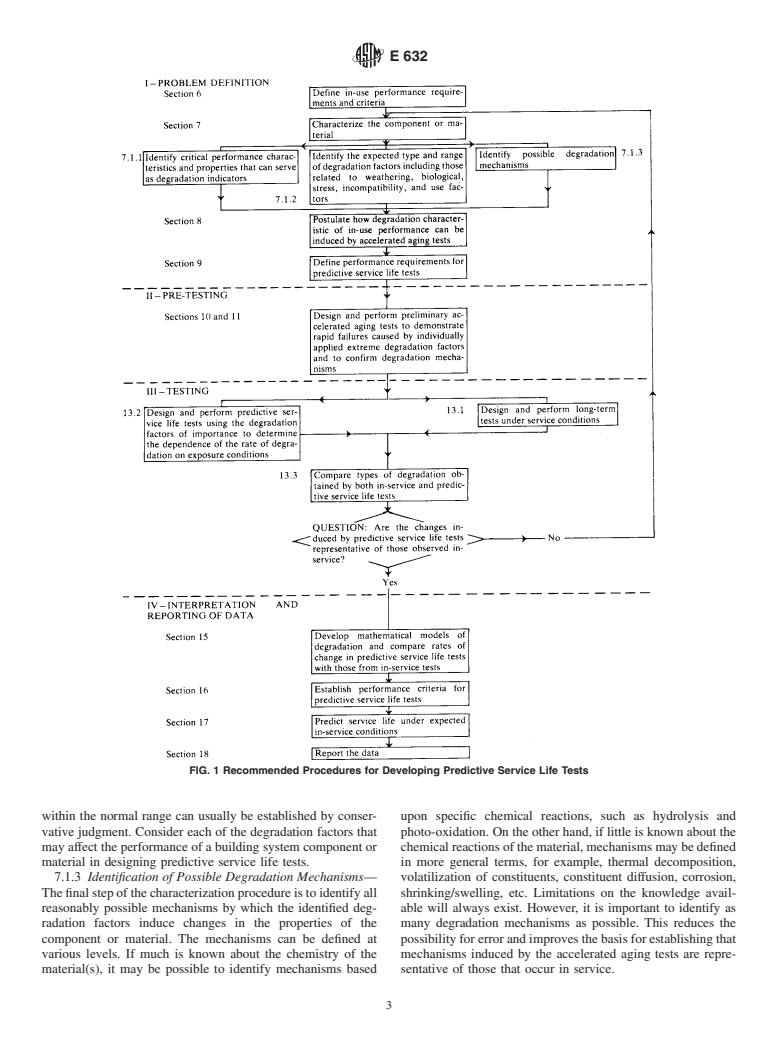
4.1 The recommended procedures for developing predictive
factors.
service life tests that utilize accelerated aging are outlined in
7.1.2.2 Weathering factors include radiation, temperature
Fig. 1.
(elevated, depressed, and cycles), water (solid, liquid, and
vapor), normal air constituents, air contaminants (gases, mists,
I—PROBLEM DEFINITION
and particulates), freeze-thaw, and wind. Some quantitative
information on weathering factors is available from published
5. Scope
weather and climatological data. These data will usually be
5.1 The problem definition step covers what the test should
sufficient to indicate the ranges of intensities to which the
do and the degradation factors that should be included in the
component or material will be exposed in service.
aging test.
7.1.2.3 Biological factors include microorganisms, fungi,
and bacteria.
6. Definition of In-Service Performance Requirements
and Criteria 7.1.2.4 Stress factors consist of sustained stress, such as
those developed by the weight of a building, and periodic
6.1 The expected in-service performance requirements and
stress, such as wind loads. The intensities of stress factors can
criteria define the minimum acceptable levels of performance,
be estimated from engineering calculations.
or the degradation from the initial performance level. The
7.1.2.5 Chemical and physical incompatibility between dis-
performance levels should be based upon the functions the
similar materials include corrosion caused by contact between
component or material shall perform under expected service
dissimilar metals or stress caused by the different thermal
conditions.
expansion coefficients of rigidly connected dissimilar materi-
als.
7. Characterization of the Component or Material and
Identification of Degradation Mechanisms
7.1.2.6 Use factors include the design of the system, instal-
lation and maintenance procedures, normal wear and tear and
7.1 Characterize the component or material to be evaluated
abuse.
as thoroughly as possible in terms of structure and composi-
tion, critical performance characteristics, properties that can 7.1.2.7 It is difficult to quantify the in-service intensity of
serve as degradation indicators, the range and type of degra- biological, incompatibility, and use factors, but upper limits
E632
FIG. 1 Recommended Procedures for Developing Predictive Service Life Tests
within the normal range can usually be established by conser- upon specific chemical reactions, such as hydrolysis and
vative judgment. Consider each of the degradation factors that photo-oxidation. On the other hand, if little is known about the
may affect the performance of a building system component or chemical reactions of the material, mechanisms may be defined
material in designing predictive service life tests. in more general terms, for example, thermal decomposition,
7.1.3 Identification of Possible Degradation Mechanisms— volatilization of constituents, constituent diffusion, corrosion,
Thefinalstepofthecharacterizationprocedureistoidentifyall shrinking/swelling, etc. Limitations on the knowledge avail-
reasonably possible mechanisms by which the identified deg- able will always exist. However, it is important to identify as
radation factors induce changes in the properties of the many degradation mechanisms as possible. This reduces the
component or material. The mechanisms can be defined at possibility for error and improves the basis for establishing that
various levels. If much is known about the chemistry of the mechanisms induced by the accelerated aging tests are repre-
material(s), it may be possible to identify mechanisms based sentative of those that occur in service.
E632
NOTE 1—Let A represent either the exterior-most or interior-most element; let A-B, B-C, etc., represent interfaces between elements.
FIG. 2 Example of a Matrix for Identifying Observable Changes of Building Components and Materials
TABLE 1 Degradation Factors Affecting the Service Life of
nism, then it may be postulated that this type of degradation
Building Components and Materials
can be accelerated by exposure to temperatures higher than
Weathering Factors
those expected in service. Take care to ensure that extreme
Radiation
levels of degradation factors do not result in degradation
Solar
Nuclear mechanisms that would not be experienced in service. The
Thermal
postulates that are made in this step lay the groundwork for
Temperature
designing preliminary accelerated aging tests.
Elevated
Depressed
9. Definition of Performance Requirements for Predictive
Cycles
Water Service Life Tests
Solid (such as, snow, ice)
9.1 Define performance requirements for the predictive
Liquid (such as, rain, condensation, standing water)
Vapor (such as, high relative humidity)
service life tests. The performance statements should be
Normal Air Constituents
qualitative summaries of the information obtained in Sections
Oxygen and ozone
7 and 8 that describe what the test shall do.
Carbon dioxide
Air Contaminants
Gases (such as, oxides of nitrogen and sulfur) II—PRE-TESTING
Mists (such as, aerosols, salt, acids, and alkalies dissolved in water)
Particulates (such as, sand, dust, dirt)
10. Scope
Freeze-thaw
10.1 The pre-testing demonstrates that rapid changes in the
Wind
Biological Factors
properties of the component or material can, in fact, be induced
Microorganisms
by exposure to extreme levels of the degradation factors.These
Fungi
changes, if observed, support (or rule out) the previously
Bacteria
Stress Factors
identified mechanisms by which property changes occur. They
Stress, sustained
may also contribute to a better understanding of the primary
Stress, periodic
degradation factors leading to property changes and indicate
Physical action of water, as rain, hail, sleet, and snow
Physical action of wind
properties that are likely to be useful as measures of the extent
Combination of physical action of water and wind
of degradation. Information obtained from pre-testing includes
Movement due to other factors, such as settlement or vehicles
indications of (1) property changes that are likely to be useful
Incompatibility Factors
Chemical
as degradation indicators, (2) the order of importance of the
Physical
degradation factors, (3) mechanisms by which properties
Use Factors
change, and (4) the intensities of degradation factors needed to
Design of system
Installation and maintenance procedures
induce rapid property changes.
Normal wear and tear
Abuse by the user
11. Design of Pre-Tests
11.1 Pre-tests should be based upon the information ob-
tained in Sections 7, 8, and 9. The tests sho
...
Questions, Comments and Discussion
Ask us and Technical Secretary will try to provide an answer. You can facilitate discussion about the standard in here.