

ASTM D6774-22
(Test Method)Standard Test Method for Crimp and Shrinkage Properties for Textured Yarns Using a Dynamic Textured Yarn Tester
General Information
- Abstract
SIGNIFICANCE AND USE
5.1 Test Method D6774, for determining maximum total contraction, crimp, and residual fiber shrinkage in textured filament yarns is suitable for acceptance testing of commercial shipments.
5.1.1 If there are differences of practical significance between reported test results for two laboratories (or more), comparative tests should be performed to determine if there is a statistical bias between them, using competent statistical assistance. As a minimum, use the samples for such a comparative tests that are as homogeneous as possible, drawn from the same lot of material as the samples that resulted in disparate results during initial testing and randomly assigned in equal numbers to each laboratory. The test results from the laboratories involved should be compared using a statistical test for unpaired data, a probability level chosen prior to the testing series. If a bias is found, either its cause must be found and corrected, or future test results for that material must be adjusted in consideration of the known bias.
5.2 The properties and their variability as measured by this method relate to bulk appearance, stretch and recovery of fabrics and dyeability of yarns.
5.3 For some yarns, elapsed time between processing and testing has a marked effect on the results, of this test, especially during the first 72 h. The effect is caused by stress decay which is known to be minimal beyond the seventh day and after which time the yarn remains relatively stable. Therefore, specimens should only be compared if tested after the same elapsed time. Samples can be tested at-line, thus having little to no elapsed time between processing and testing.
SCOPE
1.1 This test method covers the determination of crimp contraction, residual fiber shrinkage and their variability of all types of filament yarns (partially oriented yarn (POY), fully oriented yarn (FOY), flat yarns, textured and bulked continuous filament (BCF) carpet yarns) using an automated tester.
Note 1: For another method of testing crimp in textured yarns, refer to Test Method D4031.
1.1.1 This method may also be used for non-textured yarns.
1.2 This test method is limited to crimped, multi-filament yarns ranging from 22.0 dtex to 890 dtex (15 denier to 800 denier) and for BCF yarns from 890 dtex to 4200 dtex (800 denier to 3800 denier).
1.3 The values stated in SI units are to be regarded as standard. Inch-pound units in parentheses after SI units are provided for information only and are not considered standard.
1.4 This standard does not purport to address all of the safety concerns, if any, associated with its use. It is the responsibility of the user of this standard to establish appropriate safety, health, and environmental practices and determine the applicability of regulatory limitations prior to use.
1.5 This international standard was developed in accordance with internationally recognized principles on standardization established in the Decision on Principles for the Development of International Standards, Guides and Recommendations issued by the World Trade Organization Technical Barriers to Trade (TBT) Committee.
- Status
- Published
- Publication Date
- 28-Feb-2022
- Technical Committee
- D13 - Textiles
- Drafting Committee
- D13.58 - Yarns and Fibers
Overview
ASTM D6774-22 is the internationally recognized standard test method for measuring the crimp and shrinkage properties of textured and non-textured filament yarns using a dynamic automated tester. Developed by ASTM International, this standard specifies procedures for determining the maximum total contraction, crimp, and residual fiber shrinkage in a variety of filament yarns. These properties are crucial for quality assurance, acceptance testing of commercial shipments, and ensuring product consistency across batches and suppliers.
The test method is applicable to a wide range of filament yarns-including partially oriented yarns (POY), fully oriented yarns (FOY), flat yarns, textured yarns, and bulked continuous filament (BCF) carpet yarns-within specific linear density ranges. ASTM D6774-22 supports both on-site (at-line) and laboratory testing.
Key Topics
- Test Method Scope: Covers procedures for evaluating crimp contraction and shrinkage in multi-filament yarns from 22.0 dtex to 4200 dtex (15 to 3800 denier), using an automated tester.
- Acceptance Testing: The method is suitable for verifying the quality of commercial shipments, providing a consistent way to compare results across different laboratories.
- Sample Variability: Addresses the importance of using homogenous samples and random assignment for comparative testing, especially where significant differences in results occur between labs.
- Time Sensitivity: Notes the effect of elapsed time between yarn processing and testing, particularly the first 72 hours due to stress decay, which stabilizes after about a week.
- Test Parameters: Specifies that SI units are standard, with inch-pound equivalents provided for reference.
- Crimp and Shrinkage Measurement: Utilizes an automated test apparatus to determine key yarn properties affecting bulk, stretch, recovery, and dyeability.
- Data Analysis: Encourages the use of statistical analysis to detect and correct potential bias in test procedures.
- Safety and Compliance: Reminds users to establish appropriate safety, health, and environmental practices, and to consider regulatory requirements.
Applications
- Textile Industry Quality Control: Enables manufacturers, suppliers, and purchasers to assess yarn crimp and shrinkage, ensuring specification compliance and product reliability.
- Process Optimization: Provides data for optimizing yarn processing conditions, improving texture, strength, dye uptake, and overall performance in finished fabrics and carpets.
- Research and Development: Supports R&D activities focused on developing new types of filament yarns or improving existing products by allowing accurate measurement of structural properties.
- Laboratory Accreditation and Comparison: Facilitates interlaboratory studies and proficiency testing by offering a standardized, repeatable methodology for key yarn property measurements.
- Acceptance Testing for Shipments: Helps in determining whether delivered yarn shipments meet contractual or industry standards before acceptance.
Related Standards
- ASTM D2258 - Practice for Sampling Yarn for Testing: Reference for proper sampling techniques to ensure representative results.
- ASTM D4031 - Test Method for Bulk Properties of Textured Yarns: Alternative or complementary method for evaluating bulk yarn characteristics.
- ASTM D4849 - Terminology Related to Yarns and Fibers: Provides definitions for technical terms used in testing and reporting.
- ISO and International Textile Standards: Supports global harmonization in line with World Trade Organization (WTO) guidelines, promoting fair trade and barrier reduction.
Keywords: ASTM D6774, crimp contraction, residual fiber shrinkage, textured yarn, filament yarn testing, yarn quality, textile industry standards, acceptance testing, ASTM standards, yarn crimp measurement.
By adhering to ASTM D6774-22, organizations in the textile sector can improve product consistency, meet international trade requirements, and maintain high standards of quality and performance in yarns and fabrics.
Relations
- Effective Date
- 01-Jul-2018
- Effective Date
- 01-Mar-2017
- Effective Date
- 15-Sep-2015
- Effective Date
- 01-Sep-2015
- Effective Date
- 01-Apr-2015
- Effective Date
- 01-Oct-2013
- Effective Date
- 01-Oct-2013
- Effective Date
- 01-Oct-2013
- Effective Date
- 01-Oct-2013
- Effective Date
- 15-Jun-2013
- Effective Date
- 15-Jun-2013
- Effective Date
- 15-May-2013
- Effective Date
- 01-Jul-2012
- Effective Date
- 01-Mar-2012
- Effective Date
- 01-Feb-2012
Get Certified
Connect with accredited certification bodies for this standard

Control Union Certifications
Global certification for agriculture and sustainability.

Hohenstein Institut
Textile testing and certification.

Bureau Veritas Bangladesh
Bureau Veritas certification services in Bangladesh.
Sponsored listings
Frequently Asked Questions
ASTM D6774-22 is a standard published by ASTM International. Its full title is "Standard Test Method for Crimp and Shrinkage Properties for Textured Yarns Using a Dynamic Textured Yarn Tester". This standard covers: SIGNIFICANCE AND USE 5.1 Test Method D6774, for determining maximum total contraction, crimp, and residual fiber shrinkage in textured filament yarns is suitable for acceptance testing of commercial shipments. 5.1.1 If there are differences of practical significance between reported test results for two laboratories (or more), comparative tests should be performed to determine if there is a statistical bias between them, using competent statistical assistance. As a minimum, use the samples for such a comparative tests that are as homogeneous as possible, drawn from the same lot of material as the samples that resulted in disparate results during initial testing and randomly assigned in equal numbers to each laboratory. The test results from the laboratories involved should be compared using a statistical test for unpaired data, a probability level chosen prior to the testing series. If a bias is found, either its cause must be found and corrected, or future test results for that material must be adjusted in consideration of the known bias. 5.2 The properties and their variability as measured by this method relate to bulk appearance, stretch and recovery of fabrics and dyeability of yarns. 5.3 For some yarns, elapsed time between processing and testing has a marked effect on the results, of this test, especially during the first 72 h. The effect is caused by stress decay which is known to be minimal beyond the seventh day and after which time the yarn remains relatively stable. Therefore, specimens should only be compared if tested after the same elapsed time. Samples can be tested at-line, thus having little to no elapsed time between processing and testing. SCOPE 1.1 This test method covers the determination of crimp contraction, residual fiber shrinkage and their variability of all types of filament yarns (partially oriented yarn (POY), fully oriented yarn (FOY), flat yarns, textured and bulked continuous filament (BCF) carpet yarns) using an automated tester. Note 1: For another method of testing crimp in textured yarns, refer to Test Method D4031. 1.1.1 This method may also be used for non-textured yarns. 1.2 This test method is limited to crimped, multi-filament yarns ranging from 22.0 dtex to 890 dtex (15 denier to 800 denier) and for BCF yarns from 890 dtex to 4200 dtex (800 denier to 3800 denier). 1.3 The values stated in SI units are to be regarded as standard. Inch-pound units in parentheses after SI units are provided for information only and are not considered standard. 1.4 This standard does not purport to address all of the safety concerns, if any, associated with its use. It is the responsibility of the user of this standard to establish appropriate safety, health, and environmental practices and determine the applicability of regulatory limitations prior to use. 1.5 This international standard was developed in accordance with internationally recognized principles on standardization established in the Decision on Principles for the Development of International Standards, Guides and Recommendations issued by the World Trade Organization Technical Barriers to Trade (TBT) Committee.
SIGNIFICANCE AND USE 5.1 Test Method D6774, for determining maximum total contraction, crimp, and residual fiber shrinkage in textured filament yarns is suitable for acceptance testing of commercial shipments. 5.1.1 If there are differences of practical significance between reported test results for two laboratories (or more), comparative tests should be performed to determine if there is a statistical bias between them, using competent statistical assistance. As a minimum, use the samples for such a comparative tests that are as homogeneous as possible, drawn from the same lot of material as the samples that resulted in disparate results during initial testing and randomly assigned in equal numbers to each laboratory. The test results from the laboratories involved should be compared using a statistical test for unpaired data, a probability level chosen prior to the testing series. If a bias is found, either its cause must be found and corrected, or future test results for that material must be adjusted in consideration of the known bias. 5.2 The properties and their variability as measured by this method relate to bulk appearance, stretch and recovery of fabrics and dyeability of yarns. 5.3 For some yarns, elapsed time between processing and testing has a marked effect on the results, of this test, especially during the first 72 h. The effect is caused by stress decay which is known to be minimal beyond the seventh day and after which time the yarn remains relatively stable. Therefore, specimens should only be compared if tested after the same elapsed time. Samples can be tested at-line, thus having little to no elapsed time between processing and testing. SCOPE 1.1 This test method covers the determination of crimp contraction, residual fiber shrinkage and their variability of all types of filament yarns (partially oriented yarn (POY), fully oriented yarn (FOY), flat yarns, textured and bulked continuous filament (BCF) carpet yarns) using an automated tester. Note 1: For another method of testing crimp in textured yarns, refer to Test Method D4031. 1.1.1 This method may also be used for non-textured yarns. 1.2 This test method is limited to crimped, multi-filament yarns ranging from 22.0 dtex to 890 dtex (15 denier to 800 denier) and for BCF yarns from 890 dtex to 4200 dtex (800 denier to 3800 denier). 1.3 The values stated in SI units are to be regarded as standard. Inch-pound units in parentheses after SI units are provided for information only and are not considered standard. 1.4 This standard does not purport to address all of the safety concerns, if any, associated with its use. It is the responsibility of the user of this standard to establish appropriate safety, health, and environmental practices and determine the applicability of regulatory limitations prior to use. 1.5 This international standard was developed in accordance with internationally recognized principles on standardization established in the Decision on Principles for the Development of International Standards, Guides and Recommendations issued by the World Trade Organization Technical Barriers to Trade (TBT) Committee.
ASTM D6774-22 is classified under the following ICS (International Classification for Standards) categories: 59.080.20 - Yarns. The ICS classification helps identify the subject area and facilitates finding related standards.
ASTM D6774-22 has the following relationships with other standards: It is inter standard links to ASTM D4849-13(2018), ASTM D123-17, ASTM D123-15b, ASTM D123-15a, ASTM D123-15, ASTM D4849-13e2, ASTM D4849-13, ASTM D4849-13e1, ASTM D4849-13e3, ASTM D123-13ae1, ASTM D123-13a, ASTM D123-13, ASTM D4031-07(2012), ASTM D2258-99(2012), ASTM D123-12. Understanding these relationships helps ensure you are using the most current and applicable version of the standard.
ASTM D6774-22 is available in PDF format for immediate download after purchase. The document can be added to your cart and obtained through the secure checkout process. Digital delivery ensures instant access to the complete standard document.
Standards Content (Sample)
This international standard was developed in accordance with internationally recognized principles on standardization established in the Decision on Principles for the
Development of International Standards, Guides and Recommendations issued by the World Trade Organization Technical Barriers to Trade (TBT) Committee.
Designation: D6774 − 22
Standard Test Method for
Crimp and Shrinkage Properties for Textured Yarns Using a
Dynamic Textured Yarn Tester
This standard is issued under the fixed designation D6774; the number immediately following the designation indicates the year of
original adoption or, in the case of revision, the year of last revision. A number in parentheses indicates the year of last reapproval. A
superscript epsilon (´) indicates an editorial change since the last revision or reapproval.
1. Scope D2258 Practice for Sampling Yarn for Testing
D4031 Test Method for Bulk Properties of Textured Yarns
1.1 This test method covers the determination of crimp
D4849 Terminology Related to Yarns and Fibers
contraction, residual fiber shrinkage and their variability of all
types of filament yarns (partially oriented yarn (POY), fully
3. Terminology
oriented yarn (FOY), flat yarns, textured and bulked continu-
3.1 For definitions of textile terms in this test method, refer
ous filament (BCF) carpet yarns) using an automated tester.
to Terminology D4849. For other textile terms used in this test
NOTE 1—For another method of testing crimp in textured yarns, refer to
method, refer to Terminology D123.
Test Method D4031.
1.1.1 This method may also be used for non-textured yarns.
4. Summary of Test Method
1.2 This test method is limited to crimped, multi-filament
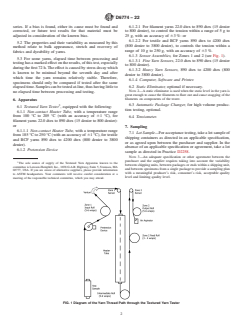
4.1 The specimen passes through a pretension device to
yarns ranging from 22.0 dtex to 890 dtex (15 denier to 800
remove crimp. The specimen then passes, at a constant speed,
denier) and for BCF yarns from 890 dtex to 4200 dtex (800
around an input roller, to a calibrated sensor which maintains a
denier to 3800 denier).
specific tension.
4.1.1 Subsequently, the specimen passes through a heating
1.3 The values stated in SI units are to be regarded as
element, at a low tension, where the specimen shrinks and
standard. Inch-pound units in parentheses after SI units are
again is crimped.
provided for information only and are not considered standard.
4.1.2 The crimped specimen then goes to an intermediate
1.4 This standard does not purport to address all of the
roll, at a low tension.
safety concerns, if any, associated with its use. It is the
4.1.3 The specimen then travels to a second sensor, which
responsibility of the user of this standard to establish appro-
maintains a tension equal to the pretension applied, to remove
priate safety, health, and environmental practices and deter-
developed crimp.
mine the applicability of regulatory limitations prior to use.
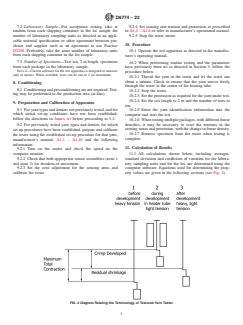
4.2 Residual fiber shrinkage, crimp developed, and maxi-
1.5 This international standard was developed in accor-
mum total contraction are calculated by the computer software
dance with internationally recognized principles on standard-
using speeds of the input, intermediate and output rolls.
ization established in the Decision on Principles for the
Development of International Standards, Guides and Recom-
5. Significance and Use
mendations issued by the World Trade Organization Technical
Barriers to Trade (TBT) Committee.
5.1 Test Method D6774, for determining maximum total
contraction, crimp, and residual fiber shrinkage in textured
2. Referenced Documents
filament yarns is suitable for acceptance testing of commercial
shipments.
2.1 ASTM Standards:
5.1.1 If there are differences of practical significance be-
D123 Terminology Relating to Textiles
tween reported test results for two laboratories (or more),
comparative tests should be performed to determine if there is
This test method is under the jurisdiction ofASTM Committee D13 on Textiles
a statistical bias between them, using competent statistical
and is the direct responsibility of Subcommittee D13.58 on Yarns and Fibers.
assistance. As a minimum, use the samples for such a com-
Current edition approved March 1, 2022. Published March 2022. Originally
parative tests that are as homogeneous as possible, drawn from
approved in 2002. Last previous edition approved in 2010 as D6774 – 02 (2010)
thesamelotofmaterialasthesamplesthatresultedindisparate
which was withdrawn January 2019 and reinstated March 2022. DOI: 10.1520/
D6774-22.
results during initial testing and randomly assigned in equal
For referenced ASTM standards, visit the ASTM website, www.astm.org, or
numbers to each laboratory. The test results from the labora-
contact ASTM Customer Service at service@astm.org. For Annual Book of ASTM
tories involved should be compared using a statistical test for
Standards volume information, refer to the standard’s Document Summary page on
the ASTM website. unpaired data, a probability level chosen prior to the testing
Copyright © ASTM International, 100 Barr Harbor Drive, PO Box C700, West Conshohocken, PA 19428-2959. United States
D6774 − 22
series. If a bias is found, either its cause must be found and 6.1.2.1 For filament yarns 22.0 dtex to 890 dtex (15 denier
corrected, or future test results for that material must be to 800 denier), to control the tension within a range of5gto
adjusted in consideration of the known bias. 25 g, with an accuracy of 63%:or
6.1.2.2 For textile and BCF yarns 890 dtex to 4200 dtex
5.2 The properties and their variability as measured by this
(800 denier to 3800 denier), to controls the tension within a
method relate to bulk appearance, stretch and recovery of
range of 10 g to 250 g, with an accuracy of 63%.
fabrics and dyeability of yarns.
6.1.3 Sensor Assemblies, for Zones 1 and 2 (see Fig. 1).
5.3 For some yarns, elapsed time between processing and
6.1.3.1 Fine Yarn Sensors, 22.0 dtex to 890 dtex (15 denier
testinghasamarkedeffectontheresults,ofthistest,especially
to 800 denier).
during the first 72 h.The effect is caused by stress decay which
6.1.3.2 Heavy Yarn Sensors, 890 dtex to 4200 dtex (800
is known to be minimal beyond the seventh day and after
denier to 3800 denier).
which time the yarn remains relatively stable. Therefore,
6.1.4 Computer, Software and Printer.
specimens should only be compared if tested after the same
6.2 Static Eliminator, optional if necessary.
elapsedtime.Samplescanbetestedat-line,thushavinglittleto
NOTE 2—Astatic eliminator is used when the static level in the yarn is
no elapsed time between processing and testing.
great enough to cause the filaments to flare out and cause snagging of the
filaments on components of the tester.
6. Apparatus
3 6.3 Automatic Package Changer, for high volume produc-
6.1 Textured Yarn Tester , equipped with the following:
tion testing, optional.
6.1.1 Non-contact Heater Tube, with a temperature range
from 100 °C to 205 °C (with an accuracy of 61 °C), for
6.4 Tensiometer.
filament yarns 22.0 dtex to 890 dtex (15 denier to 800 denier):
or
7. Sampling
6.1.1.1 Non-contact Heater Tube, with a temperature range
7.1 LotSample—Foracceptancetesting,takealotsampleof
from 185 °C to 250 °C (with an accuracy of 61 °C), for textile
shipping containers as directed in an applicable specification,
and BCF yarns 890 dtex to 4200 dtex (800 denier to 3800
or as agreed upon between the purchaser and supplier. In the
denier).
absence of an applicable specification or agreement, take a lot
6.1.2 Pretension Device
sample as directed in Practice D2258.
NOTE 3—An adequate specification or other agreement between the
purchaser and the supplier requires taking into account the variability
The sole source of supply of the Textured Yarn Apparatus known to the
between shipping units, between packages or ends within a shipping unit,
committee is Lawson-Hemphill, Inc., 1658 G.A.R. Highway, Suite 5, Swansea, MA
and between specimens from a single package to provide a sampling plan
02777, USA. If you are aware of alternative suppliers, please provide information
with a meaningful producer’s risk, consumer’s risk, acceptable quality
to ASTM headquarters. Your comments will receive careful consideration at a
level and limiting quality level.
meeting of the responsible technical committee, which you may attend.
FIG. 1 Diagram of the Yarn Thread Path through the Textured Yarn Tester
D6774 − 22
7.2 Laboratory Sample—For acceptance testing, take at 9.2.4 Set sensing arm tension and pretension as prescribed
random from each shipping container in the lot sample the in A1.4 – A1.6 or refer to manufacturer’s operational manual.
number of laboratory sampling units as directed in an appli- 9.2.5 Stop the tester motor.
cable material specification or other agreement between pur-
10. Procedure
chaser and supplier such as an agreement to use Practice
D2258. Preferably, take the same number of laboratory units
10.1 Operate the test apparatus as directed in the manufac-
from each shipping container in the lot sample.
turer’s operating manual.
7.3 Number of Specimens—Test ten, 2 m length, specimens
10.2 When performing routine testing and the parameters
from each package in the laboratory sample.
have previously been set as directed in Section 9, follow the
NOTE 4—Current software for the test apparatus is designed to measure
procedure below.
only in meters. When available, tests can be run in 2 yd increments.
10.2.1 Thread the yarn in the tester and let the tester run
about a minute. Check to ensure that the yarn moves freely
8. Conditioning
through the tester in the center of the heating tube.
8.1 Conditioningandpreconditioningarenotrequired.Test-
10.2.2 Stop the tester.
ing may be performed in the production area (at-line).
10.2.3 Set the pretension as required for the yarn under test.
10.2.4 Set the test length to 2 m and the number of tests to
9. Preparation and Calibration of Apparatus
ten.
9.1 For yarn types and deniers not previously tested, and for
10.2.5 Enter the yarn identification information into the
which initial set-up conditions have not been established,
computer and start the test.
follow the directions in Annex A1 before proceeding to 9.2.
10.2.6 When testing multiple packages, with different linear
densities, it may be necessary to reset the tensions in the
9.2 For previously tested yarn types and deniers for
...