

ASTM F2247-18
(Test Method)Standard Test Method for Metal Doors Used in Blast Resistant Applications (Equivalent Static Load Method)
General Information
- Abstract
SIGNIFICANCE AND USE
5.1 Blast resistant doors are designed to protect against the problems and dangers created by a planned or accidental explosion or pressure leak. This test method will provide reasonable assurance to the specifier of the reliability of a door's structure, the restraining hardware, the frame, and the frame anchors when used in a blast resistant application.
SCOPE
1.1 This test method covers the structural performance of metal doors and frames and their restraining hardware (such as latches and hinges) used as a blast resistant barrier. This method involves applying an equivalent static pressure based on the characteristics of the specified blast pressure and structural properties of the door panel design.
1.2 The static tests are valid for the unit size tested or for smaller units of analogous construction. Extrapolation of test results for units larger than the test specimen are not permitted.
1.3 This standard test method is not applicable to tests where the forces are created by explosive charges, forced air from a shock tube apparatus, or any other method used to generate a dynamic load.
1.4 The proper use of this method requires knowledge of the principles of pressure, deflection, and when applicable, strain gauge measurement.
1.5 Using this method, specimens may be tested to determine ultimate static capacity or tested to specific static test loads.
1.5.1 Procedure A shall be used when a load-deflection curve is not required and a single load is applied.
1.5.2 Procedure B shall be used when a load-deflection curve is required and a single or multiple loads are applied.
1.6 The values stated in SI units are to be regarded as the standard. The values provided in parentheses are for information only.
1.7 This standard does not purport to address all of the safety concerns, if any, associated with its use. It is the responsibility of the user of this standard to establish appropriate safety, health, and environmental practices and determine the applicability of regulatory limitations prior to use.
1.8 This international standard was developed in accordance with internationally recognized principles on standardization established in the Decision on Principles for the Development of International Standards, Guides and Recommendations issued by the World Trade Organization Technical Barriers to Trade (TBT) Committee.
- Status
- Published
- Publication Date
- 31-Mar-2018
- Technical Committee
- F12 - Security Systems and Equipment
- Drafting Committee
- F12.10 - Systems Products and Services
Buy Documents
ASTM F2247-18 - Standard Test Method for Metal Doors Used in Blast Resistant Applications (Equivalent Static Load Method)
REDLINE ASTM F2247-18 - Standard Test Method for Metal Doors Used in Blast Resistant Applications (Equivalent Static Load Method)
Overview
ASTM F2247-18 is a standard test method developed by ASTM International for evaluating the structural performance of metal doors and frames, including hardware such as latches and hinges, used in blast resistant applications. The method applies an equivalent static load to simulate blast pressures, offering a controlled, repeatable approach for verifying the reliability of doors that serve as barriers against explosion hazards in industrial, military, and high-security environments.
The purpose of this standard is to provide designers, manufacturers, and specifiers with a scientifically sound method to ensure that metal door assemblies can withstand blast scenarios without experiencing unacceptable deformation or catastrophic failure. This test method focuses on static loading to assess the capacity of the door system, refraining from dynamic testing such as charges or shock tubes.
Key Topics
- Blast Resistance: Ensures doors can resist pressures from explosions or accidental pressure leaks.
- Structural Performance: Assesses the door, frame, latching hardware, and anchors under equivalent static loads reflective of real blast conditions.
- Testing Procedures:
- Procedure A for a single static load (no load-deflection curve required).
- Procedure B for multiple loads with deflection curve measurements.
- Damage Categories: Classifies test results into four levels based on deformation and door operability:
- Category I: No permanent deformation, fully operable.
- Category II: Measurable permanent deformation, door openable once.
- Category III-IV: Permanent deformation, inoperable, but system remains a blast barrier.
- Measurement Requirements: Involves tracking deflections, deformations, and stresses with calibrated instruments.
- Acceptance Criteria: Focuses on post-test door integrity, operability, and absence of flying debris hazards.
Applications
ASTM F2247-18 is widely used in security-sensitive industries where protection against explosion is critical. Practical applications include:
- Industrial Facilities: Refineries, chemical plants, and high-pressure processing sites requiring blast-resistant entryways.
- Military Installations: Protecting personnel and assets in buildings vulnerable to attack or accidental detonations.
- Critical Infrastructure: Government buildings, utilities, and transportation hubs requiring robust security measures.
- Design Verification: Supports compliance with end-user specifications and regulatory safety codes for blast resistance.
- Product Certification: Used by manufacturers to certify doors for use in hazardous or high-security environments.
This standard improves confidence in blast-resistant doors by providing a repeatable, controlled method for demonstrating structural performance-crucial for risk management and safety assurance.
Related Standards
ASTM F2247-18 is used alongside or referenced by several related standards to ensure comprehensive assessment of building envelope security:
- ASTM E330/E330M: Test Method for Structural Performance of Exterior Windows, Doors, Skylights and Curtain Walls by Uniform Static Air Pressure Difference.
- UFC 3-340-02: Unified Facilities Criteria for structures resisting effects of accidental explosions.
- Additional ASTM standards on door and lock hardware performance.
Understanding the relationships among these documents helps architects, engineers, and facility managers select, specify, and install the correct blast-resistant products for their specific application.
Keywords: ASTM F2247-18, blast resistant metal doors, equivalent static load, door testing, structural performance, hardware, security, safety standard, industrial facilities, military buildings, explosion protection standards.
Relations
- Effective Date
- 01-Apr-2018
Buy Documents
ASTM F2247-18 - Standard Test Method for Metal Doors Used in Blast Resistant Applications (Equivalent Static Load Method)
REDLINE ASTM F2247-18 - Standard Test Method for Metal Doors Used in Blast Resistant Applications (Equivalent Static Load Method)
Get Certified
Connect with accredited certification bodies for this standard

DIBt (Deutsches Institut für Bautechnik)
German Institute for Building Technology.
DIN CERTCO
DIN Group product certification.

Aboma Certification B.V.
Specialized in construction, metal, and transport sectors.
Sponsored listings
Frequently Asked Questions
ASTM F2247-18 is a standard published by ASTM International. Its full title is "Standard Test Method for Metal Doors Used in Blast Resistant Applications (Equivalent Static Load Method)". This standard covers: SIGNIFICANCE AND USE 5.1 Blast resistant doors are designed to protect against the problems and dangers created by a planned or accidental explosion or pressure leak. This test method will provide reasonable assurance to the specifier of the reliability of a door's structure, the restraining hardware, the frame, and the frame anchors when used in a blast resistant application. SCOPE 1.1 This test method covers the structural performance of metal doors and frames and their restraining hardware (such as latches and hinges) used as a blast resistant barrier. This method involves applying an equivalent static pressure based on the characteristics of the specified blast pressure and structural properties of the door panel design. 1.2 The static tests are valid for the unit size tested or for smaller units of analogous construction. Extrapolation of test results for units larger than the test specimen are not permitted. 1.3 This standard test method is not applicable to tests where the forces are created by explosive charges, forced air from a shock tube apparatus, or any other method used to generate a dynamic load. 1.4 The proper use of this method requires knowledge of the principles of pressure, deflection, and when applicable, strain gauge measurement. 1.5 Using this method, specimens may be tested to determine ultimate static capacity or tested to specific static test loads. 1.5.1 Procedure A shall be used when a load-deflection curve is not required and a single load is applied. 1.5.2 Procedure B shall be used when a load-deflection curve is required and a single or multiple loads are applied. 1.6 The values stated in SI units are to be regarded as the standard. The values provided in parentheses are for information only. 1.7 This standard does not purport to address all of the safety concerns, if any, associated with its use. It is the responsibility of the user of this standard to establish appropriate safety, health, and environmental practices and determine the applicability of regulatory limitations prior to use. 1.8 This international standard was developed in accordance with internationally recognized principles on standardization established in the Decision on Principles for the Development of International Standards, Guides and Recommendations issued by the World Trade Organization Technical Barriers to Trade (TBT) Committee.
SIGNIFICANCE AND USE 5.1 Blast resistant doors are designed to protect against the problems and dangers created by a planned or accidental explosion or pressure leak. This test method will provide reasonable assurance to the specifier of the reliability of a door's structure, the restraining hardware, the frame, and the frame anchors when used in a blast resistant application. SCOPE 1.1 This test method covers the structural performance of metal doors and frames and their restraining hardware (such as latches and hinges) used as a blast resistant barrier. This method involves applying an equivalent static pressure based on the characteristics of the specified blast pressure and structural properties of the door panel design. 1.2 The static tests are valid for the unit size tested or for smaller units of analogous construction. Extrapolation of test results for units larger than the test specimen are not permitted. 1.3 This standard test method is not applicable to tests where the forces are created by explosive charges, forced air from a shock tube apparatus, or any other method used to generate a dynamic load. 1.4 The proper use of this method requires knowledge of the principles of pressure, deflection, and when applicable, strain gauge measurement. 1.5 Using this method, specimens may be tested to determine ultimate static capacity or tested to specific static test loads. 1.5.1 Procedure A shall be used when a load-deflection curve is not required and a single load is applied. 1.5.2 Procedure B shall be used when a load-deflection curve is required and a single or multiple loads are applied. 1.6 The values stated in SI units are to be regarded as the standard. The values provided in parentheses are for information only. 1.7 This standard does not purport to address all of the safety concerns, if any, associated with its use. It is the responsibility of the user of this standard to establish appropriate safety, health, and environmental practices and determine the applicability of regulatory limitations prior to use. 1.8 This international standard was developed in accordance with internationally recognized principles on standardization established in the Decision on Principles for the Development of International Standards, Guides and Recommendations issued by the World Trade Organization Technical Barriers to Trade (TBT) Committee.
ASTM F2247-18 is classified under the following ICS (International Classification for Standards) categories: 91.060.50 - Doors and windows. The ICS classification helps identify the subject area and facilitates finding related standards.
ASTM F2247-18 has the following relationships with other standards: It is inter standard links to ASTM F2247-11(2017). Understanding these relationships helps ensure you are using the most current and applicable version of the standard.
ASTM F2247-18 is available in PDF format for immediate download after purchase. The document can be added to your cart and obtained through the secure checkout process. Digital delivery ensures instant access to the complete standard document.
Standards Content (Sample)
This international standard was developed in accordance with internationally recognized principles on standardization established in the Decision on Principles for the
Development of International Standards, Guides and Recommendations issued by the World Trade Organization Technical Barriers to Trade (TBT) Committee.
Designation: F2247 − 18
Standard Test Method for
Metal Doors Used in Blast Resistant Applications
(Equivalent Static Load Method)
This standard is issued under the fixed designation F2247; the number immediately following the designation indicates the year of
original adoption or, in the case of revision, the year of last revision. A number in parentheses indicates the year of last reapproval. A
superscript epsilon (´) indicates an editorial change since the last revision or reapproval.
1. Scope ization established in the Decision on Principles for the
Development of International Standards, Guides and Recom-
1.1 This test method covers the structural performance of
mendations issued by the World Trade Organization Technical
metal doors and frames and their restraining hardware (such as
Barriers to Trade (TBT) Committee.
latches and hinges) used as a blast resistant barrier. This
method involves applying an equivalent static pressure based
2. Referenced Documents
on the characteristics of the specified blast pressure and
2.1 ASTM Standards:
structural properties of the door panel design.
E330/E330M Test Method for Structural Performance of
1.2 The static tests are valid for the unit size tested or for
Exterior Windows, Doors, Skylights and Curtain Walls by
smaller units of analogous construction. Extrapolation of test
Uniform Static Air Pressure Difference
results for units larger than the test specimen are not permitted.
2.2 Other Standard:
1.3 This standard test method is not applicable to tests
UFC 3-340-02 Unified Facilities Criteria (UFC), Structures
where the forces are created by explosive charges, forced air
to Resist the Effects of Accidental Explosions
from a shock tube apparatus, or any other method used to
generate a dynamic load.
3. Terminology
1.4 Theproperuseofthismethodrequiresknowledgeofthe
3.1 Definitions:
principles of pressure, deflection, and when applicable, strain
3.1.1 metal door—a term used in reference to doors which
gauge measurement.
are built from steel sheets, internally stiffened with cold-
formed shapes or structural steel shapes. Materials can be
1.5 Using this method, specimens may be tested to deter-
carbon or stainless steel. The materials may be joined together
mine ultimate static capacity or tested to specific static test
by any fabrication technique (that is, welding, bolting, struc-
loads.
tural adhesive, etc.). The material voids may be filled with
1.5.1 Procedure A shall be used when a load-deflection
insulation.
curve is not required and a single load is applied.
1.5.2 Procedure B shall be used when a load-deflection 3.1.2 openable—as it relates to the working condition of
curve is required and a single or multiple loads are applied. latching hardware after testing, openable latching hardware
allows the door to open one time only (allows egress but may
1.6 The values stated in SI units are to be regarded as the
not continue to function as originally intended after being
standard. The values provided in parentheses are for informa-
opened once).
tion only.
3.1.3 operable—as it relates to the working condition of
1.7 This standard does not purport to address all of the
latching hardware after testing, operable latching hardware
safety concerns, if any, associated with its use. It is the
allowsthedoortoopenandcloserepeatedly(allowsegressand
responsibility of the user of this standard to establish appro-
continues to function as originally intended).
priate safety, health, and environmental practices and deter-
3.1.4 permanent deformation—the permanent displacement
mine the applicability of regulatory limitations prior to use.
from an original position that remains after an applied load has
1.8 This international standard was developed in accor-
been removed. Measured in millimetres (mm) (inches (in.)).
dance with internationally recognized principles on standard-
1 2
This test method is under the jurisdiction ofASTM Committee F12 on Security For referenced ASTM standards, visit the ASTM website, www.astm.org, or
Systems and Equipment and is the direct responsibility of Subcommittee F12.10 on contact ASTM Customer Service at service@astm.org. For Annual Book of ASTM
Systems Products and Services. Standards volume information, refer to the standard’s Document Summary page on
Current edition approved April 1, 2018. Published May 2018. Originally the ASTM website.
approved in 2003. Last previous edition approved in 2017 as F2247 – 11 (2017). Available from National Institute of Building Sciences, 1090 VermontAvenue,
DOI: 10.1520/F2247-18. NW, Suite 700, Washington, DC 20005, http://www.wbdg.org/index.php.
Copyright © ASTM International, 100 Barr Harbor Drive, PO Box C700, West Conshohocken, PA 19428-2959. United States
F2247 − 18
3.1.5 rebound—stress reversal in the material of the door. 6.1.2 Configuration and spacing of the door panel’s internal
stiffeners will be as designed by the specifier or the door
3.1.6 seating pressure—an applied pressure that causes the
manufacturer. Space between stiffeners may be filled with
door panel to seat against the frame that is expressed in pascals
insulation.
(Pa) (pounds-force per square foot (psf) or pounds-force per
6.1.3 The typical door panel shall be considered as a three
square inch (psi)).
side supported, one edge free loading condition for a seating
3.1.7 specifier—individual or party requesting that a metal
load case. Generally, the bottom edge of the door panel is free
door assembly meet specific blast resistance criteria.
(no structural threshold). If the door assembly does have a
3.1.8 specimen—the entire assembly unit submitted for test
structuralthreshold,thedoorpanelmaybeconsideredasafour
as described in Section 6.
sidesupportedconditionforaseatingloadcase.Thedoorpanel
3.1.9 steady state pressure—a test pressure held for a is supported by the restraining hardware during the unseating
minimum of 3 min.
loadcase.Thedoorpanelwillbeattachedtotheframewiththe
same quantity and size of hinge fasteners that the specifier or
3.1.10 test director—the individual identified as being re-
the door manufacturer intends to use in the actual door
sponsible to complete the specified tests as required and to
installation. The door frame will be attached to the test fixture
document the results.
using the same quantity, size, and spacing of fasteners or
3.1.11 test load—the specified static pressure differential
anchors that the specifier or door manufacturer intends to use
(positive or negative) for which the specimen is to be tested,
in the actual door installation.
expressedinpascals(Pa)(pounds-forcepersquarefoot(psf)or
pounds-force per square inch (psi)).
7. Apparatus
3.1.12 ultimate load—the pressure (positive or negative) at
7.1 Equipment capable of performing the test procedure
which failure of the specimen occurs expressed in Pa (psf or
described in this standard within the allowable tolerances is
psi).
acceptable. Figs. 1-4 are examples of apparatus layout.
3.1.13 unseating pressure—an applied pressure that tends
the door panel to unseat from the frame so that the door
7.2 Major Components:
reactions must be resisted by the restraining hardware, that is
7.2.1 Test Chamber—A chamber or box with an opening
expressedinpascals(Pa)(pounds-forcepersquarefoot(psf)or
and a removable mounting panel, into which the specimen is
pounds-force per square inch (psi)).
installed.Atleastonepressuretapshallbeprovidedtomeasure
the chamber pressure and shall be so located that the reading is
4. Summary of Test Method
unaffected by the velocity of the fluid supply to or from the
chamber or any other fluid movement. A means of access is
4.1 This test method consists of sealing the test specimen
into or against one face of a test chamber, supplying air to the permitted to be provided to facilitate adjustments and obser-
chamber at a ratio required to maintain the test pressure
vations after the specimen is installed. The test chamber must
difference across the specimen, and observing, measuring, and
not deflect under the test load in such a manner that the
recording the deflection, deformations, stresses (if recorded),
performance of the specimen will be affected.
and nature of any failures of principal or critical members or
7.2.2 Air System—A controllable blower or a compressed
the entire specimen.
air supply, designed to provide the required air-pressure
difference across the specimen. The system shall provide a
5. Significance and Use
constant air pressure difference for the duration of the test.
5.1 Blast resistant doors are designed to protect against the
7.2.3 Combined Air/Water System—A combined air and
problems and dangers created by a planned or accidental
water (fluid) system (See Fig. 1).
explosion or pressure leak. This test method will provide
7.2.4 Pressure-Measuring Apparatus—A device to measure
reasonable assurance to the specifier of the reliability of a
the test pressure difference with accuracy of 62 % of the
door’s structure, the restraining hardware, the frame, and the
reading over the full range of test pressures.
frame anchors when used in a blast resistant application.
7.2.5 Deflection-Measuring System—Ameans of measuring
deflections with an accuracy of 60.25 mm (60.01 in.).
6. Specimen Preparation
7.2.5.1 For Procedure A (see 10.2), any locations at which
6.1 Construction—The door panel shall meet the general
deflections are to be measured shall be stated by the Specifier
definition of a metal door as outlined in 3.1.1. The test method
or the Test Director. See Figs. 2 and 3 for suggested locations.
isgeneralanddoesnotlimitthedoormanufacturertoaspecific
7.2.5.2 For Procedure B (see 10.3), any locations at which
door panel construction or fabrication process. Ultimately, the
deflections are to be measured shall be stated by the Specifier
designofthedoorpanelisbaseduponthetargetpressurerating
or the Test Director. See Figs. 2 and 3 for suggested locations.
established by the specifier or door manufacturer.
7.2.5.3 Deflection measurements shall be independent of
6.1.1 The size of the specimen (door panel and frame) shall
movements of, or movements within, the specimen or member
be representative or larger than the application under investi-
gation. supports.
F2247 − 18
FIG. 1 Schematic of Test Arrangement
7.2.6 If desired, strain gauges to measure strain shall be 9. Calibration
mounted on the side of the door panel in tension. Strain gauges
9.1 Pressure Gage, deflection-measuring devices, and strain
are attached to the tension side of the door panel. They are to
gauges shall be calibrated prior to testing to make certain the
bemountedinaccordancewiththestraingaugemanufacturer’s
devices are within specifications and requirements (see 7.2.4
instructions.
and7.2.5).Calibrationoftestequipmentshallbeinaccordance
7.2.6.1 The location of the gauges are to be determined by
with the manufacturer’s recommendations and to a national
the specifier or the door manufacturer and they shall be placed
recognized standard.
where the greatest changes in strain are anticipated, typically at
the points of greatest flexure. See Figs. 2 and 3 for suggested
10. Required Information
locations.
10.1 The following information shall be supplied by the
specifier:
8. Hazards
10.2 Procedure A—Single Loading with no Deflection
8.1 Proper care must be taken for the possibility of a failure.
Curve:
The system used in this test method contains considerable
10.2.1 Performance criteria and the number and gage loca-
stored energy and constitutes a hazard. The testing apparatus
shall be equipped with a method to restrain the specimen in the tion.
event of failure. The restraint method shall not interfere with 10.2.2 The blast duration defined as the time interval
the test nor the results of the test. between time of arrival of the blast wave at a given location
F2247 − 18
FIG. 2 Test Fixture Elevation—Unseating Load Case
and the time for the magnitude of the pressure to return to 10.3 Procedure B—Single or Multiple Loading with Deflec-
ambient pressure. See Annex A1 for example of converting a tion Curve:
dynamic pressure into an equivalent static load. 10.3.1 Same as 10.2.1 – 10.2.4, additionally:
10.2.3 The permitted damage level category in accordance 10.3.2 The number of load cycles at which deflection and
with Section 11. stress-strain measurements are required.
10.2.4 The number and location of deflection and, if 10.3.3 The number and location of required deflection and
applicable, strain gages. strain gages (if desired).
F2247 − 18
FIG. 3 Test Fixture Elevation—Seating Load Case
11. Acceptance Criteria 11.1.1 Category I—The specimen is unchanged (no perma-
nent deformation) after the loading incident and the door is
11.1 Acceptance of the door is based on the end use of the
fully operable. The specimen remains intact and responds
door. The door is classified into one of four damage level
elastically.
categories. The criterion and acceptance for each category is:
F2247 − 18
NOTE 1—A single type of frame anchor is depicted in the above illustration. There are several variations of anchor configurations that may be used
to secure the frame to the test fixture that may simulate field conditions.
FIG. 4 Horizontal Section—Unseating Load Case
11.1.1.1 Acceptance: (6) Verify that there is no permanent deformation of frame
(1) After the specimen has been unloaded, verify that the anchors.
deflection gages have returned to zero reading with a tolerance
11.1.2 Category II—The door is openable but measurable,
of +2 mm ( ⁄64 in.).
permanent deformation to the door panel exceeding the toler-
(2) Verify that the door is operable by unlatching the door
ance listed in 11.1.1.1 has been experienced. The specimen
and swinging the panel.
remains an integral system.
(3) If strain gages are used, check that the recorded stresses
11.1.2.1 Acceptance:
are within acceptable limits of door material.
(1) After the specimen has been unloaded, verify that the
(4) Verify that the door can be latched and unlatched three
measurable deformation is acceptable to the end use of the
times (thereby proving operability).
door.
(5) Verify that the external portions of the latch and hinges
(2) Verify that the specimen remains an integral system.
have not suffered any permanent set.
F2247 − 18
(3) If strain gages are used, check that the recorded stresses Tape shall not be used when it can restrict differential move-
are with
...
This document is not an ASTM standard and is intended only to provide the user of an ASTM standard an indication of what changes have been made to the previous version. Because
it may not be technically possible to adequately depict all changes accurately, ASTM recommends that users consult prior editions as appropriate. In all cases only the current version
of the standard as published by ASTM is to be considered the official document.
Designation: F2247 − 11 (Reapproved 2017) F2247 − 18
Standard Test Method for
Metal Doors Used in Blast Resistant Applications
(Equivalent Static Load Method)
This standard is issued under the fixed designation F2247; the number immediately following the designation indicates the year of
original adoption or, in the case of revision, the year of last revision. A number in parentheses indicates the year of last reapproval. A
superscript epsilon (´) indicates an editorial change since the last revision or reapproval.
1. Scope
1.1 This test method covers the structural performance of metal doors and frames and their restraining hardware (such as latches
and hinges) used as a blast resistant barrier. This method involves applying an equivalent static pressure based on the characteristics
of the specified blast pressure and structural properties of the door panel design.
1.2 The static tests are valid for the unit size tested or for smaller units of analogous construction. Extrapolation of test results
for units larger than the test specimen are not permitted.
1.3 This standard test method is not applicable to tests where the forces are created by explosive charges, forced air from a shock
tube apparatus, or any other method used to generate a dynamic load.
1.4 The proper use of this method requires knowledge of the principles of pressure, deflection, and when applicable, strain
gauge measurement.
1.5 Using this method, specimens may be tested to determine ultimate static capacity or tested to specific static test loads.
1.5.1 Procedure A shall be used when a load-deflection curve is not required and a single load is applied.
1.5.2 Procedure B shall be used when a load-deflection curve is required and a single or multiple loads are applied.
1.6 The values stated in SI units are to be regarded as the standard. The values provided in parenthesisparentheses are for
information only.
1.7 This standard does not purport to address all of the safety concerns, if any, associated with its use. It is the responsibility
of the user of this standard to establish appropriate safety safety, health, and healthenvironmental practices and determine the
applicability of regulatory limitations prior to use.
1.8 This international standard was developed in accordance with internationally recognized principles on standardization
established in the Decision on Principles for the Development of International Standards, Guides and Recommendations issued
by the World Trade Organization Technical Barriers to Trade (TBT) Committee.
2. Referenced Documents
2.1 ASTM Standards:
E330/E330M Test Method for Structural Performance of Exterior Windows, Doors, Skylights and Curtain Walls by Uniform
Static Air Pressure Difference
2.2 Other Standard:
UFC 3-340-02 Unified Facilities Criteria (UFC), Structures to Resist the Effects of Accidental Explosions
3. Terminology
3.1 Definitions:
3.1.1 metal door—a term used in reference to doors which are built from steel sheets, internally stiffened with cold-formed
shapes or structural steel shapes. Materials can be carbon or stainless steel. The materials may be joined together by any fabrication
technique (that is, welding, bolting, structural adhesive, etc.). The material voids may be filled with insulation.
This test method is under the jurisdiction of ASTM Committee F12 on Security Systems and Equipment and is the direct responsibility of Subcommittee F12.10 on
Systems Products and Services.
Current edition approved March 1, 2017April 1, 2018. Published March 2017May 2018. Originally approved in 2003. Last previous edition approved in 20112017 as
F2247 – 11.F2247 – 11 (2017). DOI: 10.1520/F2247-11R17.10.1520/F2247-18.
For referenced ASTM standards, visit the ASTM website, www.astm.org, or contact ASTM Customer Service at service@astm.org. For Annual Book of ASTM Standards
volume information, refer to the standard’s Document Summary page on the ASTM website.
Available from National Institute of Building Sciences, 1090 Vermont Avenue, NW, Suite 700, Washington, DC 20005, http://www.wbdg.org/index.php.
Copyright © ASTM International, 100 Barr Harbor Drive, PO Box C700, West Conshohocken, PA 19428-2959. United States
F2247 − 18
3.1.2 openable—as it relates to the working condition of latching hardware after testing, openable latching hardware allows the
door to open one time only (allows egress but may not continue to function as originally intended after being opened once).
3.1.3 operable—as it relates to the working condition of latching hardware after testing, operable latching hardware allows the
door to open and close repeatedly (allows egress and continues to function as originally intended).
3.1.4 permanent deformation—the permanent displacement from an original position that remains after an applied load has been
removed. Measured in millimetres (mm) (inches (in.)).
3.1.5 rebound—stress reversal in the material of the door.
3.1.6 seating pressure—an applied pressure that causes the door panel to seat against the frame that is expressed in pascals (Pa)
(pounds-force per square foot (psf) or pounds-force per square inch (psi)).
3.1.7 specifier—individual or party requesting that a metal door assembly meet specific blast resistance criteria.
3.1.8 specimen—the entire assembly unit submitted for test as described in Section 6.
3.1.9 steady state pressure—a test pressure held for a minimum of 3 min.
3.1.10 test director—the individual identified as being responsible to complete the specified tests as required and to document
the results.
3.1.11 test load—the specified static pressure differential (positive or negative) for which the specimen is to be tested, expressed
in pascals (Pa) (pounds-force per square foot (psf) or pounds-force per square inch (psi)).
3.1.12 ultimate load—the pressure (positive or negative) at which failure of the specimen occurs expressed in Pa (psf or psi).
3.1.13 unseating pressure—an applied pressure that tends the door panel to unseat from the frame so that the door reactions must
be resisted by the restraining hardware, that is expressed in pascals (Pa) (pounds-force per square foot (psf) or pounds-force per
square inch (psi)).
4. Summary of Test Method
4.1 This test method consists of sealing the test specimen into or against one face of a test chamber, supplying air to the chamber
at a ratio required to maintain the test pressure difference across the specimen, and observing, measuring, and recording the
deflection, deformations, stresses (if recorded), and nature of any failures of principal or critical members or the entire specimen.
5. Significance and Use
5.1 Blast resistant doors are designed to protect against the problems and dangers created by a planned or accidental explosion
or pressure leak. This test method will provide reasonable assurance to the specifier of the reliability of a door’s structure, the
restraining hardware, the frame, and the frame anchors when used in a blast resistant application.
6. Specimen Preparation
6.1 Construction—The door panel shall meet the general definition of a metal door as outlined in 3.1.1. The test method is
general and does not limit the door manufacturer to a specific door panel construction or fabrication process. Ultimately, the design
of the door panel is based upon the target pressure rating established by the specifier or door manufacturer.
6.1.1 The size of the specimen (door panel and frame) shall be representative or larger than the application under investigation.
6.1.2 Configuration and spacing of the door panel’s internal stiffeners will be as designed by the specifier or the door
manufacturer. Space between stiffeners may be filled with insulation.
6.1.3 The typical door panel shall be considered as a three side supported, one edge free loading condition for a seating load
case. Generally, the bottom edge of the door panel is free (no structural threshold). If the door assembly does have a structural
threshold, the door panel may be considered as a four side supported condition for a seating load case. The door panel is supported
by the restraining hardware during the unseating load case. The door panel will be attached to the frame with the same quantity
and size of hinge fasteners that the specifier or the door manufacturer intends to use in the actual door installation. The door frame
will be attached to the test fixture using the same quantity, size, and spacing of fasteners or anchors that the specifier or door
manufacturer intends to use in the actual door installation.
7. Apparatus
7.1 Equipment capable of performing the test procedure described in this standard within the allowable tolerances is acceptable.
Figs. 1-4 are examples of apparatus layout.
7.2 Major Components:
7.2.1 Test Chamber—A chamber or box with an opening and a removable mounting panel, into which the specimen is installed.
At least one pressure tap shall be provided to measure the chamber pressure and shall be so located that the reading is unaffected
by the velocity of the fluid supply to or from the chamber or any other fluid movement. A means of access is permitted to be
provided to facilitate adjustments and observations after the specimen is installed. The test chamber must not deflect under the test
load in such a manner that the performance of the specimen will be affected.
F2247 − 18
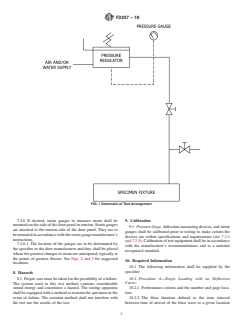
FIG. 1 Schematic of Test Arrangement
7.2.2 Air System—A controllable blower or a compressed air supply, designed to provide the required air-pressure difference
across the specimen. The system shall provide a constant air pressure difference for the duration of the test.
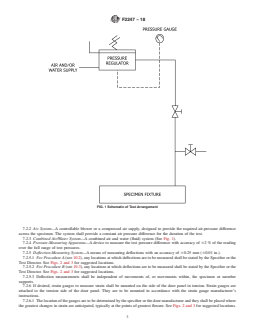
7.2.3 Combined Air/Water System—A combined air and water (fluid) system (See Fig. 1).
7.2.4 Pressure-Measuring Apparatus—A device to measure the test pressure difference with accuracy of 62 % of the reading
over the full range of test pressures.
7.2.5 Deflection-Measuring System—A means of measuring deflections with an accuracy of 60.25 mm (60.01 in.).
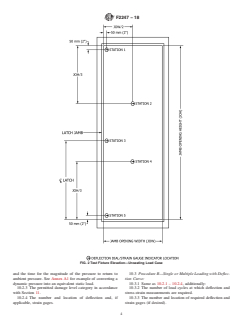
7.2.5.1 For Procedure A (see 10.2), any locations at which deflections are to be measured shall be stated by the Specifier or the
Test Director. See Figs. 2 and 3 for suggested locations.
7.2.5.2 For Procedure B (see 10.3), any locations at which deflections are to be measured shall be stated by the Specifier or the
Test Director. See Figs. 2 and 3 for suggested locations.
7.2.5.3 Deflection measurements shall be independent of movements of, or movements within, the specimen or member
supports.
7.2.6 If desired, strain gauges to measure strain shall be mounted on the side of the door panel in tension. Strain gauges are
attached to the tension side of the door panel. They are to be mounted in accordance with the strain gauge manufacturer’s
instructions.
7.2.6.1 The location of the gauges are to be determined by the specifier or the door manufacturer and they shall be placed where
the greatest changes in strain are anticipated, typically at the points of greatest flexure. See Figs. 2 and 3 for suggested locations.
F2247 − 18
FIG. 2 Test Fixture Elevation—Unseating Load Case
8. Hazards
8.1 Proper care must be taken for the possibility of a failure. The system used in this test method contains considerable stored
energy and constitutes a hazard. The testing apparatus shall be equipped with a method to restrain the specimen in the event of
failure. The restraint method shall not interfere with the test nor the results of the test.
F2247 − 18
FIG. 3 Test Fixture Elevation—Seating Load Case
9. Calibration
9.1 Pressure Gage, deflection-measuring devices, and strain gauges shall be calibrated prior to testing to make certain the
devices are within specifications and requirements (see 7.2.4 and 7.2.5). Calibration of test equipment shall be in accordance with
the manufacturer’s recommendations and to a national recognized standard.
F2247 − 18
NOTE 1—A single type of frame anchor is depicted in the above illustration. There are several variations of anchor configurations that may be used
to secure the frame to the test fixture that may simulate field conditions.
FIG. 4 Horizontal Section—Unseating Load Case
10. Required Information
10.1 The following information shall be supplied by the specifier:
10.2 Procedure A—Single Loading with no Deflection Curve:
10.2.1 Performance criteria and the number and gage location.
10.2.2 The blast duration defined as the time interval between time of arrival of the blast wave at a given location and the time
for the magnitude of the pressure to return to ambient pressure. See Annex A1 for example of converting a dynamic pressure into
an equivalent static load.
10.2.3 The permitted damage level category in accordance with Section 11.
10.2.4 The number and location of deflection and, if applicable, strain gages.
10.3 Procedure B—Single or Multiple Loading with Deflection Curve:
10.3.1 Same as 10.2.1 – 10.2.4, additionally:
10.3.2 The number of load cycles at which deflection and stress-strain measurements are required.
F2247 − 18
10.3.3 The number and location of required deflection and strain gages (if desired).
11. Acceptance Criteria
11.1 Acceptance of the door is based on the end use of the door. The door is classified into one of four damage level categories.
The criterion and acceptance for each category is:
11.1.1 Category I—The specimen is unchanged (no permanent deformation) after the loading incident and the door is fully
operable. The specimen remains intact and responds elastically.
11.1.1.1 Acceptance:
(1) After the specimen has been unloaded, verify that the deflection gages have returned to zero reading with a tolerance of
+2 mm ( ⁄64 in.).
(2) Verify that the door is operable by unlatching the door and swinging the panel.
(3) If strain gages are used, check that the recorded stresses are within acceptable limits of door material.
(4) Verify that the door can be latched.latched and unlatched three times (thereby proving operability).
(5) Verify that the external portions of the latch and hinges have not suffered any permanent set.
(6) Verify that there is no permanent deformation of frame anchors.
11.1.2 Category II—The door is operableopenable but measurable;measurable, permanent deformation to the door panel
exceeding the tolerance listed in 11.1.1.1 has been experienced. The specimen remains as an integral system.
11.1.2.1 Acceptance:
(1) After the specimen has been unloaded, verify that the measurable deformation is acceptable to the end use of the door.
(2) Verify that the specimen remains an integral system.
(3) If strain gages are used, check that the recorded stresses are within acceptable limits of door material.
(4) Verify that the door is operableopenable by unlatching the door and swinging the panel.panel one time only.
(5) Verify that there is not significant permanent deformation of the frame anchors.
11.1.3 Category III—Non-catastrophic failure. No structural failure occurs to the specimen that prevents the specimen from
providing a barrier to blast wave propagation. However, the specimen is permanently deformed and the door panel is inoperable.
11.1.3.1 Acceptance:
(1) After the specimen has been unloaded, verify that the measurable deformation is acceptable to the end use of the door.
(2) Verify that the specimen remains an integral sys
...