


ASTM D3164-03(2017)
(Test Method)Standard Test Method for Strength Properties of Adhesively Bonded Plastic Lap-Shear Sandwich Joints in Shear by Tension Loading
Standard Test Method for Strength Properties of Adhesively Bonded Plastic Lap-Shear Sandwich Joints in Shear by Tension Loading
SIGNIFICANCE AND USE
4.1 Due to the increased use of adhesively bonded plastics as a result of the inherent advantages afforded by bonded rather than mechanically fastened joints, particularly the alleviation of stress risers and stress cracking, there is a need for standard tests by which joints of various substrates and adhesives can be compared. This test method is intended to meet such a need.
4.2 This test method is limited to test temperatures below the softening point of the subject adherends, and is not intended for use on anisotropic adherends such as reinforced plastic laminates.
4.3 The misuse of strength values obtained from this test method as design stress allowable values for structural joints could lead to product failure, property damage, and human injury.
4.4 The apparent shear strength of an adhesive obtained from a given small single-lap specimen may differ from that obtained from a joint made with different adherends or by a different bonding process. The normal variation of temperature and moisture in the service environment causes the adherends and the adhesive to swell and shrink. The adherends and adhesive are likely to have different thermal and moisture coefficients of expansion.
4.5 Even in small specimens, short-term environmental changes can induce internal stresses or chemical changes in the adhesive that permanently affect the apparent strength and other mechanical properties of the adhesive. The problem of predicting joint behavior in a changing environment is even more difficult if a different type of adherend is used in a larger structural joint than was used in the small specimen.
4.6 The apparent shear strength measured with a single-lap specimen is not suitable for determining allowable design stresses for designing structural joints that differ in any manner from the joints tested without thorough analysis and understanding of the joint and adhesive behaviors.
4.7 Single-lap tests may be used for comparing and selecting adhesives ...
SCOPE
1.1 This test method is intended to complement Test Method D1002 and Test Method D3163 and extend its application to single-lap-shear adhesive joints employing plastic adherends. The test method is useful for generating comparative shear strength data for joints made from a number of plastics. It can also provide a means by which several plastics surface treatments can be compared.
1.2 The values stated in SI units are to be regarded as the standard. The values given in parentheses are for information only.
Note 1: A complete metric companion to Test Method D3164 has been developed — D3164M.
1.3 This standard does not purport to address all of the safety concerns, if any, associated with its use. It is the responsibility of the user of this standard to establish appropriate safety and health practices and determine the applicability of regulatory limitations prior to use.
1.4 This international standard was developed in accordance with internationally recognized principles on standardization established in the Decision on Principles for the Development of International Standards, Guides and Recommendations issued by the World Trade Organization Technical Barriers to Trade (TBT) Committee.
General Information
- Status
- Published
- Publication Date
- 31-Mar-2017
- Technical Committee
- D14 - Adhesives
- Drafting Committee
- D14.40 - Adhesives for Plastics
Relations
- Effective Date
- 01-Apr-2017
- Effective Date
- 01-Apr-2019
- Effective Date
- 01-Apr-2017
- Effective Date
- 01-May-2016
- Effective Date
- 01-May-2016
- Effective Date
- 01-Jun-2014
- Effective Date
- 01-Jul-2012
- Effective Date
- 01-May-2012
- Effective Date
- 06-Jan-2012
- Effective Date
- 01-Dec-2011
- Effective Date
- 01-Jan-2011
- Effective Date
- 01-Jan-2011
- Effective Date
- 01-Jun-2010
- Effective Date
- 01-Nov-2009
- Effective Date
- 01-Apr-2009
Overview
ASTM D3164-03(2017), titled Standard Test Method for Strength Properties of Adhesively Bonded Plastic Lap-Shear Sandwich Joints in Shear by Tension Loading, is an ASTM International standard that outlines the procedure to determine and compare the shear strength properties of adhesively bonded plastic lap-shear joints. As the use of adhesive bonding in plastics continues to rise due to benefits such as reducing stress risers and preventing stress cracking, the need for reliable test methods for various adhesives and substrates is more critical than ever.
This test method is especially relevant when seeking comparative shear strength data for different plastics and surface treatments. It is intended to supplement related ASTM standards, extending their applications to lap-shear joints with plastic elements under tension loading conditions.
Key Topics
- Test Applicability: ASTM D3164-03(2017) applies to single-lap-shear joints made with plastic adherends at test temperatures below their softening point. It is not suitable for anisotropic materials such as reinforced plastic laminates.
- Comparative Testing: The method allows for direct comparison of shear strength for different adhesives, plastics, and surface treatments, supporting material selection and process validation in product development.
- Specimen Preparation: Samples are prepared according to prescribed geometry, using recommended cleaning and surface preparation techniques to ensure consistency.
- Environmental Considerations: The method highlights the impacts of temperature and moisture on both plastics and adhesives, as their differing expansion coefficients can affect joint performance and reliability.
- Limitations and Cautions:
- The apparent shear strength values from this method are not to be directly used as allowable design stresses for structural joints unless thorough analysis of adhesive and joint behavior is conducted.
- Environmental effects and the specific characteristics of the joined materials can significantly influence test results.
- Only comparable joints, adhesives, and conditions should be evaluated together.
Applications
ASTM D3164 is widely used in various industries where adhesive bonding of plastics is common, including:
- Automotive and Aerospace: For selecting and comparing adhesives used in plastic component bonding, reducing weight, improving durability, and ensuring structural soundness.
- Consumer Electronics: In the assembly of plastic housings and parts, where adhesive performance is critical under operational and environmental stresses.
- Manufacturing and Product Development: For evaluating new adhesives, optimizing joint design, and assessing the suitability of surface treatments or bonding processes.
- Quality Assurance and Material Qualification: Providing a standardized means to ensure product consistency and meet regulatory requirements.
The method serves as a valuable tool for engineers, materials scientists, and quality technicians for comparative analysis and decision-making in adhesive bonding applications.
Related Standards
For broader context and complementary procedures, the following ASTM standards are often referenced alongside ASTM D3164:
- ASTM D1002: Test Method for Apparent Shear Strength of Single-Lap-Joint Adhesively Bonded Metal Specimens by Tension Loading.
- ASTM D3163: Test Method for Determining Strength of Adhesively Bonded Rigid Plastic Lap-Shear Joints in Shear by Tension Loading.
- ASTM D2093: Practice for Preparation of Surfaces of Plastics Prior to Adhesive Bonding.
- ASTM D2651: Guide for Preparation of Metal Surfaces for Adhesive Bonding.
- ASTM D4896: Guide for Use of Adhesive-Bonded Single Lap-Joint Specimen Test Results.
- ASTM E4: Practices for Force Verification of Testing Machines.
Keywords: adhesive bond, lap-shear, sandwich joint, shear strength, plastic bonding, tension loading, ASTM D3164, adhesive testing, surface preparation, comparative shear strength.

Get Certified
Connect with accredited certification bodies for this standard

DIN CERTCO
DIN Group product certification.

Smithers Quality Assessments
US management systems and product certification.
Sponsored listings
Frequently Asked Questions
ASTM D3164-03(2017) is a standard published by ASTM International. Its full title is "Standard Test Method for Strength Properties of Adhesively Bonded Plastic Lap-Shear Sandwich Joints in Shear by Tension Loading". This standard covers: SIGNIFICANCE AND USE 4.1 Due to the increased use of adhesively bonded plastics as a result of the inherent advantages afforded by bonded rather than mechanically fastened joints, particularly the alleviation of stress risers and stress cracking, there is a need for standard tests by which joints of various substrates and adhesives can be compared. This test method is intended to meet such a need. 4.2 This test method is limited to test temperatures below the softening point of the subject adherends, and is not intended for use on anisotropic adherends such as reinforced plastic laminates. 4.3 The misuse of strength values obtained from this test method as design stress allowable values for structural joints could lead to product failure, property damage, and human injury. 4.4 The apparent shear strength of an adhesive obtained from a given small single-lap specimen may differ from that obtained from a joint made with different adherends or by a different bonding process. The normal variation of temperature and moisture in the service environment causes the adherends and the adhesive to swell and shrink. The adherends and adhesive are likely to have different thermal and moisture coefficients of expansion. 4.5 Even in small specimens, short-term environmental changes can induce internal stresses or chemical changes in the adhesive that permanently affect the apparent strength and other mechanical properties of the adhesive. The problem of predicting joint behavior in a changing environment is even more difficult if a different type of adherend is used in a larger structural joint than was used in the small specimen. 4.6 The apparent shear strength measured with a single-lap specimen is not suitable for determining allowable design stresses for designing structural joints that differ in any manner from the joints tested without thorough analysis and understanding of the joint and adhesive behaviors. 4.7 Single-lap tests may be used for comparing and selecting adhesives ... SCOPE 1.1 This test method is intended to complement Test Method D1002 and Test Method D3163 and extend its application to single-lap-shear adhesive joints employing plastic adherends. The test method is useful for generating comparative shear strength data for joints made from a number of plastics. It can also provide a means by which several plastics surface treatments can be compared. 1.2 The values stated in SI units are to be regarded as the standard. The values given in parentheses are for information only. Note 1: A complete metric companion to Test Method D3164 has been developed — D3164M. 1.3 This standard does not purport to address all of the safety concerns, if any, associated with its use. It is the responsibility of the user of this standard to establish appropriate safety and health practices and determine the applicability of regulatory limitations prior to use. 1.4 This international standard was developed in accordance with internationally recognized principles on standardization established in the Decision on Principles for the Development of International Standards, Guides and Recommendations issued by the World Trade Organization Technical Barriers to Trade (TBT) Committee.
SIGNIFICANCE AND USE 4.1 Due to the increased use of adhesively bonded plastics as a result of the inherent advantages afforded by bonded rather than mechanically fastened joints, particularly the alleviation of stress risers and stress cracking, there is a need for standard tests by which joints of various substrates and adhesives can be compared. This test method is intended to meet such a need. 4.2 This test method is limited to test temperatures below the softening point of the subject adherends, and is not intended for use on anisotropic adherends such as reinforced plastic laminates. 4.3 The misuse of strength values obtained from this test method as design stress allowable values for structural joints could lead to product failure, property damage, and human injury. 4.4 The apparent shear strength of an adhesive obtained from a given small single-lap specimen may differ from that obtained from a joint made with different adherends or by a different bonding process. The normal variation of temperature and moisture in the service environment causes the adherends and the adhesive to swell and shrink. The adherends and adhesive are likely to have different thermal and moisture coefficients of expansion. 4.5 Even in small specimens, short-term environmental changes can induce internal stresses or chemical changes in the adhesive that permanently affect the apparent strength and other mechanical properties of the adhesive. The problem of predicting joint behavior in a changing environment is even more difficult if a different type of adherend is used in a larger structural joint than was used in the small specimen. 4.6 The apparent shear strength measured with a single-lap specimen is not suitable for determining allowable design stresses for designing structural joints that differ in any manner from the joints tested without thorough analysis and understanding of the joint and adhesive behaviors. 4.7 Single-lap tests may be used for comparing and selecting adhesives ... SCOPE 1.1 This test method is intended to complement Test Method D1002 and Test Method D3163 and extend its application to single-lap-shear adhesive joints employing plastic adherends. The test method is useful for generating comparative shear strength data for joints made from a number of plastics. It can also provide a means by which several plastics surface treatments can be compared. 1.2 The values stated in SI units are to be regarded as the standard. The values given in parentheses are for information only. Note 1: A complete metric companion to Test Method D3164 has been developed — D3164M. 1.3 This standard does not purport to address all of the safety concerns, if any, associated with its use. It is the responsibility of the user of this standard to establish appropriate safety and health practices and determine the applicability of regulatory limitations prior to use. 1.4 This international standard was developed in accordance with internationally recognized principles on standardization established in the Decision on Principles for the Development of International Standards, Guides and Recommendations issued by the World Trade Organization Technical Barriers to Trade (TBT) Committee.
ASTM D3164-03(2017) is classified under the following ICS (International Classification for Standards) categories: 83.180 - Adhesives. The ICS classification helps identify the subject area and facilitates finding related standards.
ASTM D3164-03(2017) has the following relationships with other standards: It is inter standard links to ASTM D3164-03(2011), ASTM D1002-10(2019), ASTM D2093-03(2017), ASTM D4896-01(2016), ASTM D2651-01(2016), ASTM E4-14, ASTM D907-12a, ASTM D907-12, ASTM D3164M-03, ASTM D907-11a, ASTM D2093-03(2011), ASTM D907-11, ASTM E4-10, ASTM E4-09a, ASTM E4-09. Understanding these relationships helps ensure you are using the most current and applicable version of the standard.
ASTM D3164-03(2017) is available in PDF format for immediate download after purchase. The document can be added to your cart and obtained through the secure checkout process. Digital delivery ensures instant access to the complete standard document.
Standards Content (Sample)
This international standard was developed in accordance with internationally recognized principles on standardization established in the Decision on Principles for the
Development of International Standards, Guides and Recommendations issued by the World Trade Organization Technical Barriers to Trade (TBT) Committee.
Designation: D3164 − 03 (Reapproved 2017)
Standard Test Method for
Strength Properties of Adhesively Bonded Plastic Lap-Shear
Sandwich Joints in Shear by Tension Loading
This standard is issued under the fixed designation D3164; the number immediately following the designation indicates the year of
original adoption or, in the case of revision, the year of last revision. A number in parentheses indicates the year of last reapproval. A
superscript epsilon (´) indicates an editorial change since the last revision or reapproval.
1. Scope D2093 Practice for Preparation of Surfaces of Plastics Prior
to Adhesive Bonding
1.1 ThistestmethodisintendedtocomplementTestMethod
D2651 GuideforPreparationofMetalSurfacesforAdhesive
D1002 and Test Method D3163 and extend its application to
Bonding
single-lap-shear adhesive joints employing plastic adherends.
D3163 Test Method for Determining Strength ofAdhesively
The test method is useful for generating comparative shear
Bonded Rigid Plastic Lap-Shear Joints in Shear by Ten-
strength data for joints made from a number of plastics. It can
sion Loading
also provide a means by which several plastics surface treat-
D3164M Test Method for Strength Properties ofAdhesively
ments can be compared.
Bonded Plastic Lap-Shear Sandwich Joints in Shear by
1.2 The values stated in SI units are to be regarded as the
Tension Loading (Withdrawn 2012)
standard. The values given in parentheses are for information
D4896 Guide for Use ofAdhesive-Bonded Single Lap-Joint
only.
Specimen Test Results
E4 Practices for Force Verification of Testing Machines
NOTE1—AcompletemetriccompaniontoTestMethodD3164hasbeen
developed — D3164M.
3. Terminology
1.3 This standard does not purport to address all of the
safety concerns, if any, associated with its use. It is the 3.1 Definitions—Many terms in this test method are defined
responsibility of the user of this standard to establish appro-
in Terminology D907.
priate safety and health practices and determine the applica-
4. Significance and Use
bility of regulatory limitations prior to use.
1.4 This international standard was developed in accor-
4.1 Due to the increased use of adhesively bonded plastics
dance with internationally recognized principles on standard-
asaresultoftheinherentadvantagesaffordedbybondedrather
ization established in the Decision on Principles for the
than mechanically fastened joints, particularly the alleviation
Development of International Standards, Guides and Recom-
of stress risers and stress cracking, there is a need for standard
mendations issued by the World Trade Organization Technical
tests by which joints of various substrates and adhesives can be
Barriers to Trade (TBT) Committee.
compared. This test method is intended to meet such a need.
4.2 This test method is limited to test temperatures below
2. Referenced Documents
the softening point of the subject adherends, and is not
2.1 ASTM Standards:
intended for use on anisotropic adherends such as reinforced
D907 Terminology of Adhesives
plastic laminates.
D1002 Test Method for Apparent Shear Strength of Single-
4.3 The misuse of strength values obtained from this test
Lap-Joint Adhesively Bonded Metal Specimens by Ten-
method as design stress allowable values for structural joints
sion Loading (Metal-to-Metal)
could lead to product failure, property damage, and human
injury.
4.4 The apparent shear strength of an adhesive obtained
This test method is under the jurisdiction of ASTM Committee D14 on
from a given small single-lap specimen may differ from that
AdhesivesandisthedirectresponsibilityofSubcommitteeD14.40onAdhesivesfor
Plastics. obtained from a joint made with different adherends or by a
Current edition approved April 1, 2017. Published May 2017. Originally
different bonding process.The normal variation of temperature
approved in 1973. Last previous edition approved in 2011 as D3164 – 03 (2011).
and moisture in the service environment causes the adherends
DOI: 10.1520/D3164-03R17.
For referenced ASTM standards, visit the ASTM website, www.astm.org, or
contact ASTM Customer Service at service@astm.org. For Annual Book of ASTM
Standards volume information, refer to the standard’s Document Summary page on The last approved version of this historical standard is referenced on
the ASTM website. www.astm.org.
Copyright © ASTM International, 100 Barr Harbor Drive, PO Box C700, West Conshohocken, PA 19428-2959. United States
D3164 − 03 (2017)
and the adhesive to swell and shrink. The adherends and 63°C (65°F) and the relative humidity to 63 %. If ambient
adhesive are likely to have different thermal and moisture laboratory conditions are employed the same degree of control
coefficients of expansion.
is required.
4.5 Even in small specimens, short-term environmental
6. Test Specimen
changes can induce internal stresses or chemical changes in the
adhesive that permanently affect the apparent strength and
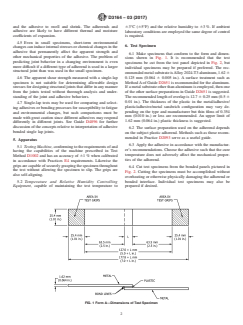
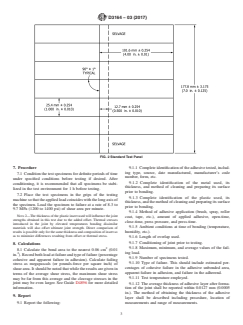
6.1 Make specimens that conform to the form and dimen-
other mechanical properties of the adhesive. The problem of
sions shown in Fig. 1. It is recommended that the test
predicting joint behavior in a changing environment is even
specimens be cut from the test panel depicted in Fig. 2, but
more difficult if a different type of adherend is used in a larger
individual specimens may be prepared if preferred. The rec-
structural joint than was used in the small specimen.
ommendedmetalsubstrateisAlloy2024-T3aluminum,1.62 6
4.6 The apparent shear strength measured with a single-lap 0.125 mm (0.064 6 0.005 in.). A surface treatment such as
specimen is not suitable for determining allowable design MethodAof Guide D2651 is recommended for the aluminum.
stresses for designing structural joints that differ in any manner If a metal substrate other than aluminum is employed, then one
from the joints tested without thorough analysis and under-
of the other surface preparations in Guide D2651 is suggested.
standing of the joint and adhesive behaviors.
The recommended length of overlap is 12.7 6 0.25 mm (0.5 6
0.01 in.). The thickness of the plastic in the metal/adhesive/
4.7 Single-lap tests ma
...
Questions, Comments and Discussion
Ask us and Technical Secretary will try to provide an answer. You can facilitate discussion about the standard in here.
Loading comments...