

ASTM D7151-15(2023)
(Test Method)Standard Test Method for Determination of Elements in Insulating Oils by Inductively Coupled Plasma Atomic Emission Spectrometry (ICP-AES)
General Information
- Abstract
SIGNIFICANCE AND USE
5.1 This test method covers the rapid determination of 12 elements in insulating oils, and it provides rapid screening of used oils for indications of wear. Test times approximate several minutes per test specimen, and detectability is in the 10 μg/kg through 100 μg/kg range.
5.2 This test method can be used to monitor equipment condition and help to define when corrective action is needed. It can also be used to detect contamination such as from silicone fluids (via Silicon) or from dirt (via Silicon and Aluminum).
5.3 This test method can be used to indicate the efficiency of reclaiming used insulating oil.
SCOPE
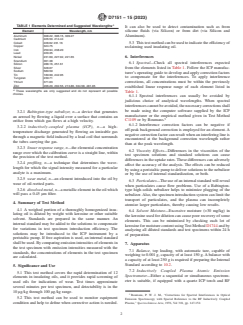
1.1 This test method describes the determination of metals and contaminants in insulating oils by inductively coupled plasma atomic emission spectrometry (ICP-AES). The specific elements are listed in Table 1. This test method is similar to Test Method D5185, but differs in methodology, which results in the greater sensitivity required for insulating oil applications.
1.2 This test method uses oil-soluble metals for calibration and does not purport to quantitatively determine insoluble particulates. Analytical results are particle size dependent, and low results are obtained for particles larger than several micrometers.2
1.3 This test method determines the dissolved metals (which can originate from overheating or arcing, or both) and a portion of the particulate metals (which generally originate from a wear mechanism). While this ICP method detects nearly all particles less than several micrometers, the response of larger particles decreases with increasing particle size because larger particles are less likely to make it through the nebulizer and into the sample excitation zone.
1.4 This test method includes an option for filtering the oil sample for those users who wish to separately determine dissolved metals and particulate metals (and hence, total metals).
1.5 Elements present at concentrations above the upper limit of the calibration curves can be determined with additional, appropriate dilutions and with no degradation of precision.
1.6 The values stated in SI units are to be regarded as standard. No other units of measurement are included in this standard.
1.7 This standard does not purport to address all of the safety concerns, if any, associated with its use. It is the responsibility of the user of this standard to establish appropriate safety, health, and environmental practices and determine the applicability of regulatory limitations prior to use.
1.8 This international standard was developed in accordance with internationally recognized principles on standardization established in the Decision on Principles for the Development of International Standards, Guides and Recommendations issued by the World Trade Organization Technical Barriers to Trade (TBT) Committee.
- Status
- Published
- Publication Date
- 30-Nov-2023
- Technical Committee
- D27 - Electrical Insulating Liquids and Gases
- Drafting Committee
- D27.03 - Analytical Tests
Overview
ASTM D7151-15(2023) is the internationally recognized Standard Test Method for Determination of Elements in Insulating Oils by Inductively Coupled Plasma Atomic Emission Spectrometry (ICP-AES), published by ASTM International. This test method provides a rapid and sensitive analytical procedure for determining the concentration of 12 specified elements in electrical insulating oils. It is essential for monitoring the condition of oils used in transformers, circuit breakers, and other electrical equipment.
This method is tailored for screening used insulating oils for wear elements, contamination, and reclamation efficiency. It offers detection capabilities in the range of 10 μg/kg to 100 μg/kg, making it valuable for trend analysis and routine monitoring in the power and electrical utilities industries.
Key Topics
- ICP-AES Technology: The method utilizes inductively coupled plasma atomic emission spectrometry, ensuring high sensitivity and multi-element detection.
- Elements Determined: Key elements include aluminum, cadmium, cobalt, copper, iron, lead, nickel, scandium, silicon, silver, sodium, tin, tungsten, yttrium, and zinc.
- Sample Preparation: Dilution of homogenized oil samples with kerosene, use of internal standards, and optional filtration for distinguishing dissolved and particulate metals.
- Calibration & Quality Control: Oil-soluble standards are used for calibration. The inclusion of check standards and blanks ensures analytical precision and traceability.
- Detection Capability: Suitable for trace metal detection, with results dependent on particle size, especially for insoluble or large particles.
- Screening & Trend Analysis: Rapid analysis enables screening for signs of equipment wear, contamination from silicone fluids or dirt, and efficiency of oil reclamation.
Applications
- Condition Monitoring:
- Track the presence of wear metals that may indicate deterioration in transformers and electrical equipment.
- Identify contamination from external sources such as silicone fluids or airborne dust via elements like silicon and aluminum.
- Routine Maintenance:
- Implement preventive maintenance programs by regularly analyzing used insulating oils to detect early signs of wear or contamination.
- Inform asset management strategies and reduce the risk of unexpected equipment failures.
- Reclaiming Oil Evaluation:
- Assess the effectiveness of oil reclamation processes by checking the removal of metallic contaminants.
- Regulatory & Compliance Testing:
- Support compliance with industry and environmental standards for electrical insulating liquids.
- Research and Development:
- Facilitate R&D in the development of more robust insulating oils and improvement of maintenance protocols.
Related Standards
- ASTM D5185 - Multielement Determination of Used and Unused Lubricating Oils and Base Oils by ICP-AES (methodology differs; D7151 offers greater sensitivity for insulating oils)
- ASTM D923 - Sampling Electrical Insulating Liquids
- ASTM D4307 - Preparation of Liquid Blends for Analytical Standards
- ASTM D2864 - Terminology Relating to Electrical Insulating Liquids and Gases
- ASTM E177, ASTM E691 - Precision and Interlaboratory Studies in ASTM Test Methods
Practical Value
Implementing ASTM D7151-15(2023) enables reliable monitoring of transformer oil quality, providing actionable data to minimize downtime and extend asset life. Its use is especially relevant for utility companies, power plants, maintenance service providers, and laboratories specializing in insulating oil analysis. With its rapid turnaround, high sensitivity, and adaptability to existing laboratory ICP-AES equipment, this standard is a cornerstone for predictive maintenance and contamination identification in the electrical power industry.
Keywords: ASTM D7151-15, ICP-AES, insulating oil analysis, wear metals, transformer oil testing, oil contamination, oil reclamation, metal determination, electrical maintenance, condition monitoring, ASTM standards.
Relations
- Effective Date
- 01-Dec-2023
- Effective Date
- 01-Dec-2023
- Effective Date
- 01-Jun-2015
- Effective Date
- 01-Dec-2023
Get Certified
Connect with accredited certification bodies for this standard

IMQ S.p.A. (Certification)
Italian electrical product certification.

SLG Prüf- und Zertifizierungs GmbH
German testing and certification body.

UL Solutions
Global safety science company with testing, inspection and certification.
Sponsored listings
Frequently Asked Questions
ASTM D7151-15(2023) is a standard published by ASTM International. Its full title is "Standard Test Method for Determination of Elements in Insulating Oils by Inductively Coupled Plasma Atomic Emission Spectrometry (ICP-AES)". This standard covers: SIGNIFICANCE AND USE 5.1 This test method covers the rapid determination of 12 elements in insulating oils, and it provides rapid screening of used oils for indications of wear. Test times approximate several minutes per test specimen, and detectability is in the 10 μg/kg through 100 μg/kg range. 5.2 This test method can be used to monitor equipment condition and help to define when corrective action is needed. It can also be used to detect contamination such as from silicone fluids (via Silicon) or from dirt (via Silicon and Aluminum). 5.3 This test method can be used to indicate the efficiency of reclaiming used insulating oil. SCOPE 1.1 This test method describes the determination of metals and contaminants in insulating oils by inductively coupled plasma atomic emission spectrometry (ICP-AES). The specific elements are listed in Table 1. This test method is similar to Test Method D5185, but differs in methodology, which results in the greater sensitivity required for insulating oil applications. 1.2 This test method uses oil-soluble metals for calibration and does not purport to quantitatively determine insoluble particulates. Analytical results are particle size dependent, and low results are obtained for particles larger than several micrometers.2 1.3 This test method determines the dissolved metals (which can originate from overheating or arcing, or both) and a portion of the particulate metals (which generally originate from a wear mechanism). While this ICP method detects nearly all particles less than several micrometers, the response of larger particles decreases with increasing particle size because larger particles are less likely to make it through the nebulizer and into the sample excitation zone. 1.4 This test method includes an option for filtering the oil sample for those users who wish to separately determine dissolved metals and particulate metals (and hence, total metals). 1.5 Elements present at concentrations above the upper limit of the calibration curves can be determined with additional, appropriate dilutions and with no degradation of precision. 1.6 The values stated in SI units are to be regarded as standard. No other units of measurement are included in this standard. 1.7 This standard does not purport to address all of the safety concerns, if any, associated with its use. It is the responsibility of the user of this standard to establish appropriate safety, health, and environmental practices and determine the applicability of regulatory limitations prior to use. 1.8 This international standard was developed in accordance with internationally recognized principles on standardization established in the Decision on Principles for the Development of International Standards, Guides and Recommendations issued by the World Trade Organization Technical Barriers to Trade (TBT) Committee.
SIGNIFICANCE AND USE 5.1 This test method covers the rapid determination of 12 elements in insulating oils, and it provides rapid screening of used oils for indications of wear. Test times approximate several minutes per test specimen, and detectability is in the 10 μg/kg through 100 μg/kg range. 5.2 This test method can be used to monitor equipment condition and help to define when corrective action is needed. It can also be used to detect contamination such as from silicone fluids (via Silicon) or from dirt (via Silicon and Aluminum). 5.3 This test method can be used to indicate the efficiency of reclaiming used insulating oil. SCOPE 1.1 This test method describes the determination of metals and contaminants in insulating oils by inductively coupled plasma atomic emission spectrometry (ICP-AES). The specific elements are listed in Table 1. This test method is similar to Test Method D5185, but differs in methodology, which results in the greater sensitivity required for insulating oil applications. 1.2 This test method uses oil-soluble metals for calibration and does not purport to quantitatively determine insoluble particulates. Analytical results are particle size dependent, and low results are obtained for particles larger than several micrometers.2 1.3 This test method determines the dissolved metals (which can originate from overheating or arcing, or both) and a portion of the particulate metals (which generally originate from a wear mechanism). While this ICP method detects nearly all particles less than several micrometers, the response of larger particles decreases with increasing particle size because larger particles are less likely to make it through the nebulizer and into the sample excitation zone. 1.4 This test method includes an option for filtering the oil sample for those users who wish to separately determine dissolved metals and particulate metals (and hence, total metals). 1.5 Elements present at concentrations above the upper limit of the calibration curves can be determined with additional, appropriate dilutions and with no degradation of precision. 1.6 The values stated in SI units are to be regarded as standard. No other units of measurement are included in this standard. 1.7 This standard does not purport to address all of the safety concerns, if any, associated with its use. It is the responsibility of the user of this standard to establish appropriate safety, health, and environmental practices and determine the applicability of regulatory limitations prior to use. 1.8 This international standard was developed in accordance with internationally recognized principles on standardization established in the Decision on Principles for the Development of International Standards, Guides and Recommendations issued by the World Trade Organization Technical Barriers to Trade (TBT) Committee.
ASTM D7151-15(2023) is classified under the following ICS (International Classification for Standards) categories: 29.040.10 - Insulating oils. The ICS classification helps identify the subject area and facilitates finding related standards.
ASTM D7151-15(2023) has the following relationships with other standards: It is inter standard links to ASTM D7151-15, ASTM C1109-23, ASTM C1109-10(2015), ASTM D117-22. Understanding these relationships helps ensure you are using the most current and applicable version of the standard.
ASTM D7151-15(2023) is available in PDF format for immediate download after purchase. The document can be added to your cart and obtained through the secure checkout process. Digital delivery ensures instant access to the complete standard document.
Standards Content (Sample)
This international standard was developed in accordance with internationally recognized principles on standardization established in the Decision on Principles for the
Development of International Standards, Guides and Recommendations issued by the World Trade Organization Technical Barriers to Trade (TBT) Committee.
Designation: D7151 − 15 (Reapproved 2023)
Standard Test Method for
Determination of Elements in Insulating Oils by Inductively
Coupled Plasma Atomic Emission Spectrometry (ICP-AES)
This standard is issued under the fixed designation D7151; the number immediately following the designation indicates the year of
original adoption or, in the case of revision, the year of last revision. A number in parentheses indicates the year of last reapproval. A
superscript epsilon (´) indicates an editorial change since the last revision or reapproval.
1. Scope responsibility of the user of this standard to establish appro-
priate safety, health, and environmental practices and deter-
1.1 This test method describes the determination of metals
mine the applicability of regulatory limitations prior to use.
and contaminants in insulating oils by inductively coupled
1.8 This international standard was developed in accor-
plasma atomic emission spectrometry (ICP-AES). The specific
dance with internationally recognized principles on standard-
elements are listed in Table 1. This test method is similar to
ization established in the Decision on Principles for the
Test Method D5185, but differs in methodology, which results
Development of International Standards, Guides and Recom-
in the greater sensitivity required for insulating oil applica-
mendations issued by the World Trade Organization Technical
tions.
Barriers to Trade (TBT) Committee.
1.2 This test method uses oil-soluble metals for calibration
and does not purport to quantitatively determine insoluble
2. Referenced Documents
particulates. Analytical results are particle size dependent, and 3
2.1 ASTM Standards:
low results are obtained for particles larger than several
C1109 Practice for Analysis of Aqueous Leachates from
micrometers.
Nuclear Waste Materials Using Inductively Coupled
1.3 This test method determines the dissolved metals (which
Plasma-Atomic Emission Spectroscopy
can originate from overheating or arcing, or both) and a portion D923 Practices for Sampling Electrical Insulating Liquids
of the particulate metals (which generally originate from a
D1744 Test Method for Determination of Water in Liquid
wear mechanism). While this ICP method detects nearly all Petroleum Products by Karl Fischer Reagent (Withdrawn
particles less than several micrometers, the response of larger
2016)
particles decreases with increasing particle size because larger D2864 Terminology Relating to Electrical Insulating Liq-
particles are less likely to make it through the nebulizer and
uids and Gases
into the sample excitation zone.
D4307 Practice for Preparation of Liquid Blends for Use as
Analytical Standards
1.4 This test method includes an option for filtering the oil
D5185 Test Method for Multielement Determination of
sample for those users who wish to separately determine
Used and Unused Lubricating Oils and Base Oils by
dissolved metals and particulate metals (and hence, total
Inductively Coupled Plasma Atomic Emission Spectrom-
metals).
etry (ICP-AES)
1.5 Elements present at concentrations above the upper limit
E177 Practice for Use of the Terms Precision and Bias in
of the calibration curves can be determined with additional,
ASTM Test Methods
appropriate dilutions and with no degradation of precision.
E691 Practice for Conducting an Interlaboratory Study to
1.6 The values stated in SI units are to be regarded as Determine the Precision of a Test Method
standard. No other units of measurement are included in this
3. Terminology
standard.
3.1 Definitions for general terms are found in Terminology
1.7 This standard does not purport to address all of the
D2864.
safety concerns, if any, associated with its use. It is the
3.2 Definitions of Terms Specific to This Standard:
This test method is under the jurisdiction of ASTM Committee D27 on
Electrical Insulating Liquids and Gases and is the direct responsibility of Subcom-
mittee D27.03 on Analytical Tests. For referenced ASTM standards, visit the ASTM website, www.astm.org, or
Current edition approved Dec. 1, 2023. Published January 2024. Originally contact ASTM Customer Service at service@astm.org. For Annual Book of ASTM
approved in 2005. Last previous edition approved in 2015 as D7151 – 15. DOI: Standards volume information, refer to the standard’s Document Summary page on
10.1520/D7151-15R23. the ASTM website.
Eisentraut, K. J., Newman, R. W., Saba, C. S., Kauffman, R. E., and Rhine, W. The last approved version of this historical standard is referenced on
E., Analytical Chemistry, Vol 56, 1984. www.astm.org.
Copyright © ASTM International, 100 Barr Harbor Drive, PO Box C700, West Conshohocken, PA 19428-2959. United States
D7151 − 15 (2023)
A
TABLE 1 Elements Determined and Suggested Wavelengths
It can also be used to detect contamination such as from
Element Wavelength, nm
silicone fluids (via Silicon) or from dirt (via Silicon and
Aluminum 308.22, 396.15, 309.27
Aluminum).
Cadmium 226.50. 214.44
Cobalt 228.62 231.16 5.3 This test method can be used to indicate the efficiency of
Copper 324.75
reclaiming used insulating oil.
Iron 259.94, 238.20
Lead 220.35
6. Interferences
Nickel 231.60, 227.02, 221.65
Scandium 361.38
6.1 Spectral—Check all spectral interferences expected
Silicon 288.16, 251.61
Silver 328.07 from the elements listed in Table 1. Follow the ICP manufac-
Sodium 589.59
turer’s operating guide to develop and apply correction factors
Tin 189.99, 242.95
to compensate for the interferences. To apply interference
Tungsten 239.71
Yttrium 371.03
corrections, all concentrations must be within the previously
Zinc 206.20, 202.55, 213.86, 334.58, 481.05
established linear response range of each element listed in
A
These wavelengths are only suggested and do not represent all possible
Table 1.
choices.
6.1.1 Spectral interferences can usually be avoided by
judicious choice of analytical wavelengths. When spectral
interferences cannot be avoided, the necessary corrections shall
be made using the computer software supplied by the ICP
3.2.1 Babington-type nebulizer, n—a device that generates
manufacturer or the empirical method given in Test Method
an aerosol by flowing a liquid over a surface that contains an
C1109 or by Boumans.
orifice from which gas flows at a high velocity.
6.1.2 Interference correction factors can be negative if
3.2.2 inductively-coupled plasma (ICP), n—a high-
off-peak background correction is employed for an element. A
temperature discharge generated by flowing an ionizable gas
negative correction factor can result when an interfering line is
through a magnetic field induced by a load coil that surrounds
encountered at the background correction wavelength rather
the tubes carrying the gas.
than at the peak wavelength.
3.2.3 linear response range, n—the elemental concentration
6.2 Viscosity Effects—Differences in the viscosities of the
range over which the calibration curve is a straight line, within
test specimen solutions and standard solutions can cause
the precision of the test method.
differences in the uptake rates. These differences can adversely
3.2.4 profiling, n—a technique that determines the wave-
affect the accuracy of the analysis. The effects can be reduced
length for which the signal intensity measured for a particular
by using a peristaltic pump to deliver solutions to the nebulizer
analyte is a maximum.
or by the use of internal standardization, or both.
3.2.5 wear metal, n—an element introduced into the oil by
6.3 Particulates—The use of an internal standard will reveal
wear of oil-wetted parts.
when particulates cause flow problems. Use of a Babington-
3.2.6 dissolved metal, n—a metallic element in the oil which
type high-solids nebulizer helps to minimize plugging of the
will pass a 0.45 μm filter.
nebulizer. Also, the specimen introduction system can limit the
transport of particulates, and the plasma can incompletely
4. Summary of Test Method
atomize larger particulates, thereby causing low results.
4.1 A weighed portion of a thoroughly homogenized insu-
6.4 Solvent Moisture—Excessive moisture (>30 mg/kg) in
lating oil is diluted by weight with kerosine or other suitable
the kerosine used for dilution can cause poor recovery of some
solvent. Standards are prepared in the same manner. An
elements. This can be minimized by checking each lot of
internal standard may be added to the solutions to compensate
kerosine for moisture content using Test Method D1744 and by
for variations in test specimen introduction efficiency. The
analyzing all diluted standards and test specimens within 24 h
solutions may be introduced to the ICP instrument by a
of preparation.
peristaltic pump. If free aspiration is used, an internal standard
shall be used. By comparing emission intensities of elements in
7. Apparatus
the test specimen with emission intensities measured with the
7.1 Balance, top loading, with automatic tare, capable of
standards, the concentrations of elements in the test specimen
weighing to 0.001 g, capacity of at least 150 g. A balance with
are calculated.
a capacity of at least 250 g is required if preparing the Internal
Standard according to 10.2.
5. Significance and Use
7.2 Inductively Coupled Plasma Atomic Emission
5.1 This test method covers the rapid determination of 12
Spectrometer—Either a sequential or simultaneous spectrom-
elements in insulating oils, and it provides rapid screening of
eter is suitable, if equipped with a quartz ICP torch and RF
used oils for indications of wear. Test times approximate
several minutes per test specimen, and detectability is in the
10 μg ⁄kg through 100 μg ⁄kg range.
Boumans, P. W .J. M., “Corrections for Spectral Interferences in Optical
5.2 This test method can be used to monitor equipment
Emission Spectroscopy with Special Reference to the RF Inductively Coupled
condition and help to define when corrective action is needed. Plasma,” Spectrochimica Acta, 1976, Vol 318, pp. 147-152.
D7151 − 15 (2023)
generator to form and maintain the plasma. Suggested wave- an ultrasonic bath is recommended to ensure that complete
lengths for the determination of the elements in insulating oil mixing is achieved. It is highly recommended to purchase the
are given in Table 1. standards because of the difficulty in preparing multi-element
standards.
7.3 Nebulizer—Use the nebulizer recommended by the ICP
manufacturer. A Babington-type high-solids nebulizer should
9. Hazards
be used if samples contain high solids. This type of nebulizer
9.1 Kerosine is classified as a combustible liquid and must
reduces the possibility of clogging and minimizes aerosol
be kept away from all ignition sources. If the ICP is allowed to
particle effects.
operate unattended, equipment malfunctions could cause leak-
7.4 Peristaltic Pump, (optional)—A peristaltic pump may be
age of kerosine.
used to provide a constant flow of solution. The pump tubing
10. Internal Standardization
shall be able to withstand at least 6 h exposure to the dilution
solvent. Viton tubing is typically used with hydrocarbon
10.1 The internal standard procedure requires that every test
solvents, and poly (vinyl chloride) tubing is typically used with
specimen solution have the same concentration of an internal
methyl isobutyl ketone.
standard element that is not present in the original specimen.
Specimen to specimen changes in the emission intensity of the
7.5 Solvent Dispenser (optional)—A solvent dispenser cali-
internal standard element can be used to correct for variations
brated to deliver the required weight of dilution solvent is very
in the test specimen introduction efficiency, which is dependent
useful. This dispenser shall have at least 1 % accuracy and
on the physical properties of the test specimen.
0.1 % precision.
10.2 Internal Standard Solution—Weigh 25.0 g 6 0.1 g of
7.6 Internal Standard Dispenser (optional)—A dispenser
2000 mg/kg scandium-in-oil (or cobalt- or yttrium-in-oil)
calibrated to deliver the required weight of internal standard
standard into a 500 mL Erlenmeyer flask. Add kerosine to
solution is very useful. This dispenser shall have at least 1 %
make a total of 250 g 6 1 g. Mix this solution thoroughly and
accuracy and 0.1 % precision.
transfer to the reservoir for the internal standard container or
7.7 Specimen Solution Containers, nominal 30 mL glass or
dispenser. The concentration of the internal standard is not
polyethylene vials, with screw caps or snap-top caps.
required to be 200 mg ⁄kg. However, the concentration of the
internal standard element should be at least 100 times its
8. Reagents and Materials
detection limit.
8.1 Purity of Reagents—Reagent grade chemicals shall be
11. Sampling and Sample Handling
used in all tests. Unless otherwise indicated, it is intended that
all reagents conform to the specifications of the Committee on
11.1 Laboratory samples must be taken in accordance with
Analytical Reagents of the American Chemical Society where
the instructions in Practices D923.
such specifications are available. Other grades may be used,
11.2 It is important to homogenize the insulating oil in the
provided it is first ascertained that the reagent is of sufficiently
sample container in order to obtain a representative test
high purity to permit its use without lessening the accuracy of
specimen. Mix the insulating oil sample vigorously by invert-
determination.
ing several times.
8.2 Base Oil—U.S.P. White oil or any mineral oil that is free
11.3 (Optional) To separately determine the dissolved met-
of analytes and having a viscosity at room temperature as close
als and particulate metals, filter the oil sample through a 0.45
as possible to that of the samples to be analyzed.
μm filter. The particles on the filter paper must then be
8.3 Dilution Solvent—Reagent grade kerosine is recom-
dissolved or digested by a technique not addressed by this test
mended as a dilution solvent. Another solvent (such as toluene
method.
or xylene) may be used if it is free of all analytes and
12. Preparation of Test Specimens and Standards
completely dissolves all standards and samples.
12.1 All test specimens and standards must be mixed
8.4 Internal Standard—Oil-soluble scandium, cobalt, or
thoroughly when diluted with kerosine and the internal stan-
yttrium is required when the internal standardization option is
dard. They must all be prepared utilizing the same batch of
selected.
internal standard. All prepared solutions must be analyzed
8.5 Organometallic Standards—Multi-element standards,
within 24 h of preparation.
containing 3.0 mg ⁄kg and 10.0 mg ⁄kg of each element, can be
12.2 Blank—Prepare a blank by adding 6.00 g 6 0.02 g
purchased or prepared from the individual concentrates. Refer
base oil, 1.00 g 6 0.01 g internal standard solution, and 8.00 g
to Practice D4307 for a procedure for preparation of multicom-
6 0.03 g kerosine to a 30 mL vial.
ponent liquid blends. When preparing multi-element standards,
12.3 Working Standard—Prepare a calibration standard by
adding 6.00 g 6 0.02 g of the 10 mg/kg multi-element
ACS Reagent Chemicals, Specifications and Procedures for Reagents and
standard, 1.00 g 6 0.01 g internal standard solution, and 8.00 g
Standard-Grade Reference Materials, American Chemical Society, Washington,
DC. For suggestions on the testing of reagents not listed by the American Chemical 6 0.03 g kerosine to a 30 mL vial.
Society, see Analar Standards for Laboratory Chemicals, BDH Ltd., Poole, Dorset,
12.4 Check Standard—Prepare a QC check standard by
U.K., and the United States Pharmacopeia and National Formulary, U.S. Pharma-
copeial Convention, Inc. (USPC), Rockville, MD. adding 6.00 g 6 0.02 g of the 3.0 mg/kg multi-element
D7151 − 15 (2023)
standard, 1.00 g 6 0.01 g internal standard solution, and 8.00 g 14.2 Working Standard—At the beginning of the analysis of
6 0.03 g kerosine to a 30 mL vial. Other concentrations may each batch of specimens, perform a two-point calibration
be used for the check standard as long as they are not prepared consisting of the blank and working standard. Use the check
from the 10 mg/kg standard
...