

ASTM E1942-98(2018)e1
(Guide)Standard Guide for Evaluating Data Acquisition Systems Used in Cyclic Fatigue and Fracture Mechanics Testing
General Information
- Abstract
ABSTRACT
This guide covers how to understand and minimize the errors associated with data acquisition in fatigue and fracture mechanics testing equipment. This guide is not intended to be used instead of certified traceable calibration or verification of data acquisition systems when such certification is required. The output of the fatigue and fracture mechanics data acquisition systems described is essentially a stream of digital data. Such digital data may be considered to be divided into two types– Basic Data, which are a sequence of digital samples of an equivalent analog waveform representing the output of transducers connected to the specimen under test, and Derived Data, which are digital values obtained from the Basic Data by application of appropriate computational algorithms. In its most basic form, a mechanical testing system consists of a test frame with grips which attach to a test specimen, a method of applying forces to the specimen, and a number of transducers which measure the forces and displacements applied to the specimen. The output from these transducers may be in digital or analog form, but if they are analog, they are first amplified and filtered and then converted to digital form using analog-to-digital converters (ADCs). The resulting stream of digital data may be digitally filtered and manipulated to result in a stream of output Basic Data which is presented to the user in the form of a displayed or printed output, or as a data file in a computer. Various algorithms may be applied to the Basic Data to derive parameters representing, for example, the peaks and valleys of the forces and displacements applied to the specimen, or the stresses and strains applied to the specimen and so forth. Such parameters are the Derived Data. The whole measurement system may be divided into three sections for the purpose of verification: the mechanical test frame and its components, the electrical measurement system, and the computer processing of data.
SCOPE
1.1 This guide covers how to understand and minimize the errors associated with data acquisition in fatigue and fracture mechanics testing equipment. This guide is not intended to be used instead of certified traceable calibration or verification of data acquisition systems when such certification is required. It does not cover static load verification, for which the user is referred to the current revision of Practices E4, or static extensometer verification, for which the user is referred to the current revision of Practice E83. The user is also referred to Practice E467.
1.2 The output of the fatigue and fracture mechanics data acquisition systems described in this guide is essentially a stream of digital data. Such digital data may be considered to be divided into two types– Basic Data, which are a sequence of digital samples of an equivalent analog waveform representing the output of transducers connected to the specimen under test, and Derived Data, which are digital values obtained from the Basic Data by application of appropriate computational algorithms. The purpose of this guide is to provide methods that give confidence that such Basic and Derived Data describe the properties of the material adequately. It does this by setting minimum or maximum targets for key system parameters, suggesting how to measure these parameters if their actual values are not known.
1.3 This international standard was developed in accordance with internationally recognized principles on standardization established in the Decision on Principles for the Development of International Standards, Guides and Recommendations issued by the World Trade Organization Technical Barriers to Trade (TBT) Committee.
- Status
- Published
- Publication Date
- 31-May-2018
- Technical Committee
- E08 - Fatigue and Fracture
- Drafting Committee
- E08.03 - Advanced Apparatus and Techniques
Overview
ASTM E1942-98(2018)e1 is a standard guide developed by ASTM International for evaluating data acquisition systems used in cyclic fatigue and fracture mechanics testing. This guide outlines methods for identifying and minimizing errors associated with the electronic data collection processes integral to accurate fatigue and fracture mechanics test results. The standard is designed to ensure reliability, precision, and confidence in both basic and derived digital data obtained during mechanical testing, while acting as a supplement to - not a substitute for - full system calibration or official verification where required.
Key Topics
- Data Acquisition Errors: Identification and minimization of errors in digital data streams, including those from bandwidth limitations, data rate insufficiency, noise, drift, and phase differences.
- Types of Data: Differentiation between Basic Data (digital samples from transducers) and Derived Data (processed results from computational algorithms).
- System Parameters: Guidance on evaluating key parameters such as bandwidth, data rate, noise level, phase difference, and data skew.
- Verification Approach: The measurement system is divided into three major components for evaluation - mechanical test frame, electrical measurement system, and data processing (with the standard focusing primarily on the electrical system post-transducer output).
- Reporting: Recommendations for documenting system performance parameters relevant to test data integrity.
Applications
ASTM E1942-98(2018)e1 is vital for:
- Testing Laboratories: Ensures that electronic data acquisition systems for cyclic fatigue and fracture mechanics comply with best practices in accuracy and reliability, reducing measurement uncertainty.
- Quality Assurance: Establishes protocols for ongoing verification of data acquisition effectiveness, supporting traceability and reproducibility of results in research and industrial applications.
- Equipment Validation: Assists manufacturers and users of fatigue and fracture testing machines in demonstrating that their electronic measurement and data processing systems meet internationally recognized accuracy thresholds.
- Data Integrity: Provides practical benchmarks and corrective guidance for issues such as signal noise, errors due to insufficient sampling or bandwidth, and impact of digital processing, ultimately ensuring that materials property measurements are trustworthy.
- Compliance with Regulations: Aligns with internationally recognized standardization principles (WTO Technical Barriers to Trade), supporting compliance in global trade and technical communication.
Related Standards
In addition to ASTM E1942, several other ASTM standards are referenced for broader calibration, verification, and terminology:
- ASTM E4: Practices for Force Verification of Testing Machines (for static load verification)
- ASTM E83: Practice for Verification and Classification of Extensometer Systems (for static extensometer verification)
- ASTM E467: Practice for Verification of Constant Amplitude Dynamic Forces in an Axial Fatigue Testing System
- ASTM E1823: Terminology Relating to Fatigue and Fracture Testing
These related standards provide complementary procedures and definitions essential for comprehensive mechanical testing and system verification.
By adhering to ASTM E1942-98(2018)e1, organizations ensure their fatigue and fracture mechanics test data acquisition systems deliver high-quality data with reduced error and increased confidence, supporting robust research, development, and quality control in materials science and engineering.
Relations
- Effective Date
- 01-Jun-2018
- Effective Date
- 15-Feb-2024
- Effective Date
- 01-Feb-2024
- Effective Date
- 01-Feb-2020
- Effective Date
- 01-Jun-2014
- Effective Date
- 15-Dec-2012
- Effective Date
- 15-Nov-2012
- Effective Date
- 01-Sep-2012
- Effective Date
- 01-Aug-2012
- Effective Date
- 15-May-2012
- Effective Date
- 15-Mar-2012
- Effective Date
- 01-Nov-2011
- Effective Date
- 01-Jun-2011
- Effective Date
- 01-Jun-2010
- Effective Date
- 01-Jun-2010
Get Certified
Connect with accredited certification bodies for this standard

IMP NDT d.o.o.
Non-destructive testing services. Radiography, ultrasonic, magnetic particle, penetrant, visual inspection.
Inštitut za kovinske materiale in tehnologije
Institute of Metals and Technology. Materials testing, metallurgical analysis, NDT.
Q Techna d.o.o.
NDT and quality assurance specialist. 30+ years experience. NDT personnel certification per ISO 9712, nuclear and thermal power plant inspections, QA/
Sponsored listings
Frequently Asked Questions
ASTM E1942-98(2018)e1 is a guide published by ASTM International. Its full title is "Standard Guide for Evaluating Data Acquisition Systems Used in Cyclic Fatigue and Fracture Mechanics Testing". This standard covers: ABSTRACT This guide covers how to understand and minimize the errors associated with data acquisition in fatigue and fracture mechanics testing equipment. This guide is not intended to be used instead of certified traceable calibration or verification of data acquisition systems when such certification is required. The output of the fatigue and fracture mechanics data acquisition systems described is essentially a stream of digital data. Such digital data may be considered to be divided into two types– Basic Data, which are a sequence of digital samples of an equivalent analog waveform representing the output of transducers connected to the specimen under test, and Derived Data, which are digital values obtained from the Basic Data by application of appropriate computational algorithms. In its most basic form, a mechanical testing system consists of a test frame with grips which attach to a test specimen, a method of applying forces to the specimen, and a number of transducers which measure the forces and displacements applied to the specimen. The output from these transducers may be in digital or analog form, but if they are analog, they are first amplified and filtered and then converted to digital form using analog-to-digital converters (ADCs). The resulting stream of digital data may be digitally filtered and manipulated to result in a stream of output Basic Data which is presented to the user in the form of a displayed or printed output, or as a data file in a computer. Various algorithms may be applied to the Basic Data to derive parameters representing, for example, the peaks and valleys of the forces and displacements applied to the specimen, or the stresses and strains applied to the specimen and so forth. Such parameters are the Derived Data. The whole measurement system may be divided into three sections for the purpose of verification: the mechanical test frame and its components, the electrical measurement system, and the computer processing of data. SCOPE 1.1 This guide covers how to understand and minimize the errors associated with data acquisition in fatigue and fracture mechanics testing equipment. This guide is not intended to be used instead of certified traceable calibration or verification of data acquisition systems when such certification is required. It does not cover static load verification, for which the user is referred to the current revision of Practices E4, or static extensometer verification, for which the user is referred to the current revision of Practice E83. The user is also referred to Practice E467. 1.2 The output of the fatigue and fracture mechanics data acquisition systems described in this guide is essentially a stream of digital data. Such digital data may be considered to be divided into two types– Basic Data, which are a sequence of digital samples of an equivalent analog waveform representing the output of transducers connected to the specimen under test, and Derived Data, which are digital values obtained from the Basic Data by application of appropriate computational algorithms. The purpose of this guide is to provide methods that give confidence that such Basic and Derived Data describe the properties of the material adequately. It does this by setting minimum or maximum targets for key system parameters, suggesting how to measure these parameters if their actual values are not known. 1.3 This international standard was developed in accordance with internationally recognized principles on standardization established in the Decision on Principles for the Development of International Standards, Guides and Recommendations issued by the World Trade Organization Technical Barriers to Trade (TBT) Committee.
ABSTRACT This guide covers how to understand and minimize the errors associated with data acquisition in fatigue and fracture mechanics testing equipment. This guide is not intended to be used instead of certified traceable calibration or verification of data acquisition systems when such certification is required. The output of the fatigue and fracture mechanics data acquisition systems described is essentially a stream of digital data. Such digital data may be considered to be divided into two types– Basic Data, which are a sequence of digital samples of an equivalent analog waveform representing the output of transducers connected to the specimen under test, and Derived Data, which are digital values obtained from the Basic Data by application of appropriate computational algorithms. In its most basic form, a mechanical testing system consists of a test frame with grips which attach to a test specimen, a method of applying forces to the specimen, and a number of transducers which measure the forces and displacements applied to the specimen. The output from these transducers may be in digital or analog form, but if they are analog, they are first amplified and filtered and then converted to digital form using analog-to-digital converters (ADCs). The resulting stream of digital data may be digitally filtered and manipulated to result in a stream of output Basic Data which is presented to the user in the form of a displayed or printed output, or as a data file in a computer. Various algorithms may be applied to the Basic Data to derive parameters representing, for example, the peaks and valleys of the forces and displacements applied to the specimen, or the stresses and strains applied to the specimen and so forth. Such parameters are the Derived Data. The whole measurement system may be divided into three sections for the purpose of verification: the mechanical test frame and its components, the electrical measurement system, and the computer processing of data. SCOPE 1.1 This guide covers how to understand and minimize the errors associated with data acquisition in fatigue and fracture mechanics testing equipment. This guide is not intended to be used instead of certified traceable calibration or verification of data acquisition systems when such certification is required. It does not cover static load verification, for which the user is referred to the current revision of Practices E4, or static extensometer verification, for which the user is referred to the current revision of Practice E83. The user is also referred to Practice E467. 1.2 The output of the fatigue and fracture mechanics data acquisition systems described in this guide is essentially a stream of digital data. Such digital data may be considered to be divided into two types– Basic Data, which are a sequence of digital samples of an equivalent analog waveform representing the output of transducers connected to the specimen under test, and Derived Data, which are digital values obtained from the Basic Data by application of appropriate computational algorithms. The purpose of this guide is to provide methods that give confidence that such Basic and Derived Data describe the properties of the material adequately. It does this by setting minimum or maximum targets for key system parameters, suggesting how to measure these parameters if their actual values are not known. 1.3 This international standard was developed in accordance with internationally recognized principles on standardization established in the Decision on Principles for the Development of International Standards, Guides and Recommendations issued by the World Trade Organization Technical Barriers to Trade (TBT) Committee.
ASTM E1942-98(2018)e1 is classified under the following ICS (International Classification for Standards) categories: 19.060 - Mechanical testing. The ICS classification helps identify the subject area and facilitates finding related standards.
ASTM E1942-98(2018)e1 has the following relationships with other standards: It is inter standard links to ASTM E1942-98(2010)e1, ASTM E1823-24a, ASTM E1823-24, ASTM E1823-20, ASTM E4-14, ASTM E1823-12e, ASTM E1823-12d, ASTM E1823-12c, ASTM E1823-12b, ASTM E1823-12a, ASTM E1823-12, ASTM E467-08e1, ASTM E1823-11, ASTM E1823-10a, ASTM E83-10a. Understanding these relationships helps ensure you are using the most current and applicable version of the standard.
ASTM E1942-98(2018)e1 is available in PDF format for immediate download after purchase. The document can be added to your cart and obtained through the secure checkout process. Digital delivery ensures instant access to the complete standard document.
Standards Content (Sample)
This international standard was developed in accordance with internationally recognized principles on standardization established in the Decision on Principles for the
Development of International Standards, Guides and Recommendations issued by the World Trade Organization Technical Barriers to Trade (TBT) Committee.
ϵ1
Designation: E1942 − 98 (Reapproved 2018)
Standard Guide for
Evaluating Data Acquisition Systems Used in Cyclic Fatigue
and Fracture Mechanics Testing
This standard is issued under the fixed designation E1942; the number immediately following the designation indicates the year of
original adoption or, in the case of revision, the year of last revision. A number in parentheses indicates the year of last reapproval. A
superscript epsilon (´) indicates an editorial change since the last revision or reapproval.
ε NOTE—Sections 3.1.3, A1.2.2.1, A1.2.3, and A1.2.4 were editorially corrected in August 2018.
1. Scope 2. Referenced Documents
2.1 ASTM Standards:
1.1 This guide covers how to understand and minimize the
E4 Practices for Force Verification of Testing Machines
errors associated with data acquisition in fatigue and fracture
E83 Practice for Verification and Classification of Exten-
mechanics testing equipment. This guide is not intended to be
someter Systems
used instead of certified traceable calibration or verification of
E467 Practice for Verification of Constant Amplitude Dy-
data acquisition systems when such certification is required. It
namic Forces in an Axial Fatigue Testing System
does not cover static load verification, for which the user is
E1823 TerminologyRelatingtoFatigueandFractureTesting
referred to the current revision of Practices E4, or static
extensometer verification, for which the user is referred to the
3. Terminology
current revision of Practice E83. The user is also referred to
3.1 Definitions:
Practice E467.
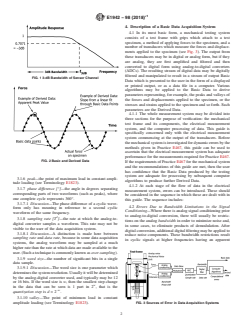
3.1.1 bandwidth[T ]—thefrequencyatwhichtheamplitude
1.2 The output of the fatigue and fracture mechanics data response of the channel has fallen to 1/=2 of its value at low
frequency.
acquisition systems described in this guide is essentially a
stream of digital data. Such digital data may be considered to
3.1.1.1 Discussion—This definition assumes the sensor
be divided into two types– Basic Data, which are a sequence of
channel response is low-pass, as in most materials testing. An
digital samples of an equivalent analog waveform representing
illustration of bandwidth is shown in Fig. 1.
the output of transducers connected to the specimen under test,
3.1.2 Basic Data sample—the sampled value of a sensor
and Derived Data, which are digital values obtained from the
waveform taken at fixed time intervals. Each sample represents
Basic Data by application of appropriate computational algo-
the actual sensor value at that instant of time.
rithms. The purpose of this guide is to provide methods that
3.1.2.1 Discussion—Fig. 2 shows examples of Basic Data
give confidence that such Basic and Derived Data describe the
samples.
properties of the material adequately. It does this by setting
3.1.3 data rate [T ]—the data rate is ⁄td Hertz where the
minimum or maximum targets for key system parameters,
time intervals between samples is ⁄td in seconds.
suggesting how to measure these parameters if their actual
3.1.3.1 Discussion—The data rate is the number of data
values are not known.
samples per second made available to the user, assuming the
rate is constant.
1.3 This international standard was developed in accor-
dance with internationally recognized principles on standard-
3.1.4 derived data—data obtained through processing of the
ization established in the Decision on Principles for the
raw data.
Development of International Standards, Guides and Recom-
3.1.4.1 Discussion—Fig. 2 illustrates examples of Derived
mendations issued by the World Trade Organization Technical
Data.
Barriers to Trade (TBT) Committee.
3.1.5 noise level—thestandarddeviationofthedatasamples
of noise in the transducer channel, expressed in the units
appropriate to that channel.
This guide is under the jurisdiction of ASTM Committee E08 on Fatigue and
Fracture and is the direct responsibility of SubcommitteeE08.03 on Advanced
Apparatus and Techniques. For referenced ASTM standards, visit the ASTM website, www.astm.org, or
Current edition approved June 1, 2018. Published August 2018. Originally contact ASTM Customer Service at service@astm.org. For Annual Book of ASTM
ɛ1
approved in 1998. Last previous edition approved in 2010 as E1942 - 98(2010) . Standards volume information, refer to the standard’s Document Summary page on
DOI: 10.1520/E1942-98R18E01 the ASTM website.
Copyright © ASTM International, 100 Barr Harbor Drive, PO Box C700, West Conshohocken, PA 19428-2959. United States
ϵ1
E1942 − 98 (2018)
4. Description of a Basic Data Acquisition System
4.1 In its most basic form, a mechanical testing system
consists of a test frame with grips which attach to a test
specimen, a method of applying forces to the specimen, and a
number of transducers which measure the forces and displace-
ments applied to the specimen (see Fig. 3). The output from
these transducers may be in digital or analog form, but if they
are analog, they are first amplified and filtered and then
converted to digital form using analog-to-digital converters
(ADCs). The resulting stream of digital data may be digitally
filtered and manipulated to result in a stream of output Basic
FIG. 1 3-dB Bandwidth of Sensor Channel
Data which is presented to the user in the form of a displayed
or printed output, or as a data file in a computer. Various
algorithms may be applied to the Basic Data to derive
parameters representing, for example, the peaks and valleys of
the forces and displacements applied to the specimen, or the
stresses and strains applied to the specimen and so forth. Such
parameters are the Derived Data.
4.1.1 The whole measurement system may be divided into
three sections for the purpose of verification: the mechanical
test frame and its components, the electrical measurement
system, and the computer processing of data. This guide is
specifically concerned only with the electrical measurement
system commencing at the output of the transducers. Before
themechanicalsystemisinvestigatedfordynamicerrorsbythe
methods given in Practice E467, this guide can be used to
ascertain that the electrical measurement system has adequate
performance for the measurements required for Practice E467.
FIG. 2 Basic and Derived Data
If the requirements of Practice E467 for the mechanical system
and the recommendations of this guide are met, then the user
has confidence that the Basic Data produced by the testing
system are adequate for processing by subsequent computer
3.1.6 peak—the point of maximum load in constant ampli-
algorithms to produce further Derived Data.
tude loading (see Terminology E1823).
4.1.2 At each stage of the flow of data in the electrical
3.1.7 phase difference [°]—the angle in degrees separating
measurement system, errors can be introduced. These should
corresponding parts of two waveforms (such as peaks), where
be considered in the sequence in which these are dealt with in
one complete cycle represents 360°.
this guide. The sequence includes:
3.1.7.1 Discussion—The phase difference of a cyclic wave-
4.2 Errors Due to Bandwidth Limitations in the Signal
form only has meaning in reference to a second cyclic
Conditioning—Where there is analog signal conditioning prior
waveform of the same frequency.
to analog-to-digital conversion, there will usually be restric-
3.1.8 sampling rate [T ]—the rate at which the analog-to-
tions on the analog bandwidth in order to minimize noise and,
digital converter samples a waveform. This rate may not be
in some cases, to eliminate products of demodulation. After
visible to the user of the data acquisition system.
digital conversion, additional digital filtering may be applied to
3.1.8.1 Discussion—A distinction is made here between
reduce noise components. These bandwidth restrictions result
sampling rate and data rate, because in some data acquisition
in cyclic signals at higher frequencies having an apparent
systems, the analog waveform may be sampled at a much
higher rate than the rate at which data are made available to the
user.(Suchatechniqueiscommonlyknownas over-sampling).
3.1.9 word size—the number of significant bits in a single
data sample.
3.1.9.1 Discussion—The word size is one parameter which
determines the system resolution. Usually it will be determined
by the analog-digital converter used, and typically may be 12
or 16 bits. If the word size is w, then the smallest step change
w
in the data that can be seen is 1 part in 2 , that is the
–w
quantization step is d=2 .
3.1.10 valley—The point of minimum load in constant
amplitude loading (see Terminology E1823). FIG. 3 Sources of Error in Data Acquisition Systems
ϵ1
E1942 − 98 (2018)
amplitude which is lower than the true value, and if the bandwidth is 100f Hz. For example, for a 10–Hz sinusoidal
waveform is not sinusoidal, also having waveform distortion. waveform,theminimumbandwidthis100Hz.Foradiscussion
The bandwidth restrictions also cause phase shifts which result of minimum bandwidth, see A1.2.1 and A1.2.2.
in phase measurement errors when comparing phase in two
5.4 Actual Bandwidth—The actual bandwidth must be equal
channels with different bandwidths.
to or greater than the minimum bandwidth. If this condition
cannot be met, then the errors will increase as shown in A1.2.1
4.3 Errors Due to Incorrect Data Rate—Errors can result
from an insufficient data rate, where the intervals between data andA1.2.2.Iftheactualbandwidthisnotknown,thenitcanbe
ascertained using one of the suggested methods in A1.2.3,or
samples are too large and intervening events are not recorded
in the Basic Data. These result also in errors in the Derived otherwise.
Data, for example, when the peak value of a waveform is
5.5 Minimum Data Rate—For measurement of the peak
missed during sampling. Data skew, where the Basic Data are
value of sinusoidal or square waveforms, the minimum data
not acquired at the same instant in time, can produce similar
rate is 50 points/cycle, or 50f points/s. For measurement of the
errors to phase shifts between channels.
peak value of triangular waveforms, the minimum data rate is
400 points/cycle, or 400f points/s. If the data acquisition
4.4 Errors Due to Noise and Drift—Noise added to the
system produces the peak value as an output, then the internal
signal being measured causes measurement uncertainty. Short–
Basic Data rate used should equal or exceed the appropriate
term noise causes variability or random error, and includes
minimumdatarate(dependingonwaveformtype).Thisshould
analog noise at the transducer output due to electrical or
be verified even if the external rate at which samples are
mechanical pick up, and analog noise added in the amplifier,
presented is less than this minimum value. For a discussion of
together with digital noise, or quantization, due to the finite
data rate, see A1.3.1.
digital word length of the ADC system.
4.4.1 Long-term effects, such as drifts in the transducer
5.6 Actual Data Rate—The actual data rate must equal or
output or its analog signal conditioning due to temperature or
exceed the minimum data rate. If the actual data rate is not
aging effects, are indistinguishable from slow changes in the
known, then it must be ascertained using a method such as that
forces and displacements seen by the specimen, and cause a
in A1.3.2.
more systematic error.
5.7 Maximum Permitted Noise Level—The noise level is the
4.4.2 Further details of these sources of error are given in
standard deviation of the noise in the transducer channel,
Annex A1.
expressed in the units appropriate to the channel. The maxi-
mum permitted noise level is 0.2 % of the expected peak value
5. System Requirements
of the waveform being measured. For example, if the expected
5.1 How This Section is Organized—This section gives the
peak value in a load channel is 100 kN, then the standard
steps that must be taken to ensure the errors are controlled.
deviation of the noise in that channel must not exceed 0.2 kN.
There are several sources of error in the electrical system, and
5.8 Actual Noise Level—The actual noise level must be
these may add both randomly and deterministically. To give
equal to or less than the maximum permitted noise level. If the
reasonable assurance that these errors have a minor effect on
actual noise level is not known, then it must be ascertained
overall accuracy of a system with 1 % accuracy, recommenda-
using a method such as that in A1.4.6. Guidance on how to
tions are given in this guide, which result in a 0.2 % error
investigate sources of noise is given in A1.4.7.
bound for each individual source of error. However, AnnexA1
5.8.1 If the actual noise level exceeds the maximum permit-
also shows how the error varies with each parameter, so that
ted noise level, it can usually be reduced by reducing
the user may choose to use larger or smaller error bounds with
bandwidth,butthiswillrequirebeginningagainat5.3toverify
appropriate adjustments to bandwidth, data rate, and so forth.
that the bandwidth reduction is permissible.
5.1.1 In this section, which is intended to be used in the
5.9 Maximum Permissible Phase Difference and Maximum
order written, a minimum value or a maximum value is
Permissible Data Skew—These terms are discussed in A1.5.1
recommended for each parameter. If the actual value of each
and A1.5.2. No value is recommended for the maximum
parameterisknown,thenthesystemrequirementisthatineach
permissible phase difference and data skew between channels,
case either:
since this is very dependent on the testing application. If
Maximum value ≥ actual value
typical phase shifts between displacement and force due to the
or
material under test are 10 to 20°, then an acceptable value for
Minimum value ≤ actual value.
themaximumphasedifferencemightbe1°.However,iftypical
However, if the actual value is not known, then help is given
phase shifts are 2 to 3°, the acceptable value for the maximum
as to how to determine it.
phase difference might be only 0.1°.
5.2 Frequency and Waveshape—The first step is to deter-
5.10 Actual Phase Shift and Data Skew—Methods for esti-
mine the highest cyclic frequency, f Hz, at which testing will
mating the combined effect of phase shift and data skew in a
occur, and the waveshape to be employed (for example,
data acquisition system are given in A1.5.3.
sinusoidal, triangular, square).
6. Report
5.3 Minimum Bandwidth—If the waveform is sinusoidal or
square, then the minimum bandwidth is 10f Hz to measure the 6.1 The purpose of the report is to record that due consid-
peak value. If the waveform is triangular, then the minimum eration was given to essential performance parameters of the
ϵ1
E1942 − 98 (2018)
dataacquisitionsystemwhenperformingaparticularfatigueor rate was ascertained, for example, from a manufacturer’s
fracture mechanics test. Since the report should ideally be an datasheet or by a measurement.
attachment to each set of such test results, it should be
6.6 Maximum Permissible Noise Level, Actual Noise Level,
sufficient but succinct. The report should contain the following
and a Note About Source—The source is a note describing how
information, preferably in a tabular format.
actual noise level was ascertained, for example, from a
6.2 Measurement Equipment Description—This should in-
manufacturer’s datasheet or by a measurement.
clude the manufacturer’s name, model number, and serial
6.7 (Where Applicable) Maximum Permissible Phase
number for the test hardware used.
Difference, Actual Phase Difference, and a Note About Source.
6.3 Waveshape and Highest Frequency Used During the
Test
6.8 (Where Applicable) Maximum Permissible Data Skew,
Actual Data Skew, and a Note About Source.
6.4 Minimum Bandwidth, Actual Bandwidth, and a Note
About its Source—The source is a note describing how actual
7. Keywords
bandwidth was ascertained, for example, from a manufactur-
er’s data sheet or by a measurement.
7.1 bandwidth; data acquisition; data rate; data skew; drift;
6.5 Minimum Data Rate, Actual Data Rate, and a Note fatigue; filter; fracture mechanics; noise; phase shift; quantiza-
About Source—The source is a note describing how actual data tion; sample rate; signal conditioning; step response
ANNEX
(Mandatory Information)
A1. SOURCES AND ESTIMATION OF ERRORS
A1.1 Method of Establishing Error Limits A1.1(a); the amplitude response rolls off above the cut-off
frequency at a rate which depends on the number of pole-pairs
A1.1.1 The approach used to develop the required perfor-
in the filter. Thus if a sinusoidal waveform were applied to this
mance levels for Section 5 has been to arrive at a value for
filter, for example for a force transducer, its amplitude would
bandwidth, data rate, and so forth, at which there is a high
be increasingly in error at frequencies approaching and above
probability the error due to each cause will not exceed 0.2 %,
the cut-off frequency. Fig.A1.1(b) shows how these computed
and in most cases will be much less than this. The following
errors will increase with frequency. Bessel filters are also
sections provide explanations of how these values were de-
common in mechanical testing instrumentation, and the com-
rived. The explanations may be used to assess how rapidly
parable curves are shown in Fig. A1.2. By considering both
errorsmightbeexpectedtoincreasewhentheconditionssetup
Fig. A1.1(b) and Fig. A1.2(b), it can be concluded that when
in Section 5 cannot be met. A heuristic approach is necessary
theactualfiltertypeemployedbythetestsystemisnotactually
because there are very many variations of data acquisition
known, then a conservative assumption would be that it is
systems, each of which would require a complex analysis to
necessary that the frequency being measured is not larger than
establish its actual errors. The approach taken here is conser-
about 0.1 of the filter bandwidth for sinusoidal waveforms.
vative but should arrive at reasonably safe system require-
A1.2.1.1 If the filter type is indeed known from vendor-
ments. Of necessity, the descriptions here are brief; more
3,4,5 supplied data, choose the characteristic in Fig. A1.1(a) or Fig.
detailed discussion can be found in references.
A1.2(a) which is closest to the known filter characteristic, then
A1.2 Bandwidth use Fig. A1.1(b) or Fig. A1.2(b) to find the highest frequency
which may be used within the permissible maximum error
A1.2.1 Amplitude Errors in Sinusoidal Waveforms Due to
limit.
Insuffıcient Bandwidth—As shown in Fig. 1, the amplitude
response of a filter with sinusoidal waveform inputs falls off at A1.2.2 Amplitude Errors in Non-Sinusoidal Waveforms Due
frequencies above the cutoff frequency and will cause increas- to Insuffıcient Bandwidth—Errors in non-sinusoidal
ing amplitude errors as frequency increases. The amplitude waveforms, such as triangular waveforms, can be more severe,
responses of typical Butterworth filters are shown in Fig. because the amplitude of the harmonics begin to be affected
when the fundamental frequency is still well below the cutoff
frequency, and they are also affected by increasing phase shift.
Stein, P. K., The Unified Approach to the Engineering of Measurement Systems
In the case of non-sinusoidal cyclic waveforms, these signals
for Test and Evaluation-I- Basic Concepts, Stein Engineering Services Inc., 6th
can be represented by a fundamental frequency and a number
ed., Phoenix, AZ, 1995.
Tovey, F. M., “Measurement UncertaintyAnalysis of aTransfer Standard Force
of multiples, or harmonics, of that frequency. These produce a
Calibration System,” Journal of Testing and Evaluation, Vol. 22 , No. 1, January
line spectrum, as illustrated in Fig. A1.3 for a triangular
1994, pp. 70–80.
waveform. The signal x(t) can be represented exactly by a sum
Wright, C. P., Applied Measurement Engineering: How to Design Effective
Mechanical Measurement Systems, Prentice Hall, Englewood Cliffs, NJ, 1995. of sinusoids at the fundamental frequency f and its multiples,
ϵ1
E1942 − 98 (2018)
FIG. A1.2 Bessel Filters
FIG. A1.1 Butterworth Filters
`
that is, x t 5 a *cos 2π·i·f1φ , where a is the amplitude of
~ ! ~ !
( i i i
i50
each harmonic and φ is the corresponding phase angle.As the
i
order of the harmonic i increases, the amplitude generally
decreases, and so only a small number of the harmonics have
significance to x(t).In Fig.A1.3, the third harmonic is 10 % of
the amplitude of the fundamental, and the ninth harmonic is
1 % of the fundamental.
A1.2.2.1 If the analog part of the signal conditioning were
perfect, then this signal would be presented to the ADC to be
sampled and digitized. In practice, however, the bandwidth of
theanalogchannelisrestricted,bothtoreducenoiseand(inthe
FIG. A1.3 Line Spectrum of a Triangular Waveform
caseofconditioningsystemswithACexcitation)toremovethe
effects of demodulation. If we consider only the frequencies i·f
of the signal, at each of these frequencies the filter will
multiply the signal amplitude by b and add additional phase significant amplitude above the filter cut-off frequency, then
i
shift θ. At frequencies below the filter cutoff frequency, also the signal will be distorted by the filter.
i
called the bandwidth, b ≈ 1 and θ ≈ 0. Above the cut-off A1.2.2.2 A computation of these errors for Butterworth
i i
frequency, b reduces towards zero and θ increases. If the filtersisshowninFig.A1.1(c),anditcanbeseenthatforerrors
i i
signal has no significant amplitude in the harmonics a above below0.5 %,thefrequencywouldhavetobelessthan0.013of
i
thecutofffrequency,thefilterwillhavenodiscernibleeffecton the filter bandwidth. A similar conclusion can be reached for
the signal. But, if indeed, there are harmonic components of Bessel filters, as shown in Fig.A1.2(c). In practice, this will be
ϵ1
E1942 − 98 (2018)
very conservative, because the mechanical system will usually
not be capable of generating a perfectly triangular waveform.
A1.2.2.3 For all other non-sinusoidal waveforms, the pre-
ceding limit for triangular waveforms will be a conservative
estimate for the bandwidth needed, since a triangular wave-
form is the worst case likely to be encountered.
A1.2.3 Procedure–How to Estimate Actual Bandwidth:
A1.2.3.1 To estimate the actual bandwidth of a signal
processing scheme, a measurement can be made of the step
response of the system. This is the response of the measure-
ment system to a step change in the input; the narrower the
bandwidth, the slower the step response. Fig. A1.4 illustrates
the response of a system to a step change in the parameter
being measured by the transducer, and how this appears when
digitized. The step responses of the different filters previously
discussed are shown in Fig. A1.5, for a nominal bandwidth of
1 Hz. When the cut-off frequencies are raised, the time axes
decrease proportionately. For example, if the bandwidth were
10 Hz, the time axis of the graph would span 0.4 s instead of
4s.
A1.2.3.2 It can be shown that the bandwidth of any of these
filters is simply related to the rise time between the 10 % and
90 % values of the step response, assuming the final amplitude
is taken as 100 %. As can be seen from the table in Fig. A1.5,
therisetimevariesfrom0.342to0.459sfora1-Hzbandwidth.
Since Butterworth filters with large numbers of poles are less
common (because of the increased ringing in the step
response), it is common to use the following expression to
estimate the bandwidth from the rise time.
0.35
Bandwidth 5 Hz (A1.1)
t
FIG. A1.5 Computed Step Responses
A1.2.3.3 Toacquirethestepresponse,itisnecessarybothto
(1) create the step change in signal, and (2) have a method to
record this.
A1.2.4 Creating a Step Change Using a Shunt Calibration
facility—The simplest measurement, which eliminates any
mechanical problems, can be made if the system is provided
with a shunt relay and resistor across the transducer to give a
change in reading for verification purposes. This sudden
change in transducer output is just as effective as breaking a
specimen in producing a step input to the transducer
conditioning, without the potential problem of mechanical
ringing mentioned in A1.2.5. Before operating such a shunt
relay,normalprecautions,suchasshuttingoffhydraulicpower,
should be taken to ensure the actuator does not move. Ex-
amples of data in this case are shown in Fig. A1.6.
A1.2.5 Creating a Step Change By Breaking a Specimen—If
there is no shunt calibration relay available, th
...