

ASTM B800-05(2021)
(Specification)Standard Specification for 8000 Series Aluminum Alloy Wire for Electrical Purposes-Annealed and Intermediate Tempers
General Information
- Abstract
ABSTRACT
This specification covers 800 series aluminum alloys fabricated into round wires in annealed or intermediate tempers suitable for stranding into conductors or for solid single conductors, usually to be insulated. The wire shall be made from drawing stock meeting the chemical composition limits for aluminum, silicon, iron, copper, magnesium, zinc, and boron. The wire shall be free of imperfections and shall conform to specified values for tensile strength, elongation, and electrical resistivity. The specified values for the density of aluminum alloys and wire diameter, shall be taken for the calculation of mass and cross sections. Joints may be made in drawing stock and in the wire prior to final drawing, or during final drawing or in the finished wire by electrical-butt welding, cold-pressure welding, or by electric-butt, cold-upset welding. Details for each kind of test and measurement method (tensile strength test, resistivity measurement, diameter measurement, surface-finish inspection) are discussed thoroughly.
SCOPE
1.1 This specification covers 8000 series aluminum alloys fabricated into round wires in annealed or intermediate tempers suitable for stranding into conductors or for solid single conductors, usually to be insulated.
1.2 The SI values for resistivity are regarded as standard. For all other properties, the inch-pound units are regarded as standard and the SI units may be approximate.
Note 1: Aluminum alloys capable of meeting the requirements of this specification are listed in Table 1.
Note 2: The alloy and temper designations conform to ANSI H35.1. Unified Numbering System alloy designations are listed in Table 1 in accordance with Practice E527.
Note 3: Certain aluminum alloys may be subject to patent rights. U.S. patents numbers are shown in Table 1.
1.3 This standard does not purport to address all of the safety concerns, if any, associated with its use. It is the responsibility of the user of this standard to establish appropriate safety, health, and environmental practices and determine the applicability of regulatory limitations prior to use.
1.4 This international standard was developed in accordance with internationally recognized principles on standardization established in the Decision on Principles for the Development of International Standards, Guides and Recommendations issued by the World Trade Organization Technical Barriers to Trade (TBT) Committee.
- Status
- Published
- Publication Date
- 31-Jan-2021
- Technical Committee
- B01 - Electrical Conductors
- Drafting Committee
- B01.07 - Conductors of Light Metals
Overview
ASTM B800-05(2021) specifies requirements for 8000 series aluminum alloy wire used for electrical purposes. This standard covers round wires produced in annealed or intermediate tempers, suitable for use as solid single conductors or for stranding into multi-wire conductors, typically to be insulated for electrical applications. Developed by ASTM International, this document ensures that such aluminum alloy wires meet stringent standards for chemical composition, mechanical properties, and electrical performance, promoting safety, reliability, and consistency in end-use applications.
Key Topics
- Scope of Application: Defines 8000 series aluminum alloy wires, including details on alloy and temper designations compliant with ANSI H35.1 and the Unified Numbering System (UNS).
- Chemical Composition: Outlines allowable ranges for elements such as aluminum, silicon, iron, copper, magnesium, zinc, and boron to ensure desired conductor properties.
- Mechanical Properties: Details required tensile strength and elongation values to guarantee durability and effective performance.
- Electrical Performance: Specifies maximum permissible electrical resistivity at 20°C to ensure efficient conductivity, referencing International Annealed Copper Standard (IACS) values.
- Dimensional Accuracy: Sets permissible wire diameter tolerances, cross-sectional area, and linear density, which are critical for installation and compatibility with insulating materials.
- Manufacturing and Jointing Methods: Permits joints in wire through electrical-butt welding, cold-pressure welding, or electric-butt, cold-upset welding under specified conditions to maintain product integrity.
- Sampling and Inspection: Establishes sampling methods and inspection terms to confirm conformance, as well as procedures for handling nonconforming lots.
- Packaging and Identification: Provides packaging guidelines to prevent damage during handling and transport, and requires clear marking of manufacturer, alloy, temper, size, and mass.
Applications
The ASTM B800-05(2021) standard is widely applied across electrical and utility sectors, where reliable, high-conductivity, lightweight aluminum wires are essential. Typical uses include:
- Power Distribution: Stranded or solid aluminum wires for overhead and underground power lines, optimizing strength-to-weight ratio and conductivity.
- Building Wiring: Utilized as single or multi-conductor wires for residential and commercial electrical systems that require insulation over aluminum conductors.
- Electrical Equipment Manufacturing: Essential for producing components where stable mechanical properties and controlled electrical resistivity are critical, such as in transformers, motor windings, and switchgear.
- Utility and Grid Infrastructure: Used in substations, transmission networks, and distribution systems, meeting industry safety and efficiency requirements.
By conforming to ASTM B800, manufacturers and utilities can ensure that their electrical aluminum wire products are safe, reliable, and meet internationally recognized standards.
Related Standards
The following standards are referenced within ASTM B800-05(2021) and relate to the production, testing, and identification of aluminum alloy conductors:
- ASTM B193 - Test Method for Resistivity of Electrical Conductor Materials
- ASTM B557 - Test Methods for Tension Testing Wrought and Cast Aluminum- and Magnesium-Alloy Products
- ASTM B830 - Specification for Uniform Test Methods and Frequency
- ASTM E29 - Practice for Using Significant Digits in Test Data to Determine Conformance with Specifications
- ASTM E527 - Practice for Numbering Metals and Alloys in the Unified Numbering System (UNS)
- ANSI H35.1 - Standard for Alloy and Temper Designation Systems for Aluminum
- NBS Handbook 100 and 109 - References for wire tables (National Bureau of Standards)
- Aluminum Association Registration Records - Guidelines for registering alloy compositions
These related standards support the complete lifecycle of 8000 series aluminum alloy wires, from production and testing to labeling and regulatory compliance.
Keywords: 8000 series aluminum alloy, ASTM B800, aluminum wire, electrical conductors, annealed temper, intermediate temper, aluminum alloy conductor, electrical wire standard, ASTM specification, conductive aluminum wire.
Relations
- Effective Date
- 15-Jun-2018
- Effective Date
- 01-Apr-2016
- Effective Date
- 15-May-2014
- Effective Date
- 01-Apr-2014
- Effective Date
- 01-Oct-2011
- Effective Date
- 01-Jul-2010
- Effective Date
- 01-Oct-2008
- Effective Date
- 01-Sep-2008
- Effective Date
- 15-Nov-2006
- Effective Date
- 15-Sep-2006
- Effective Date
- 01-May-2006
- Effective Date
- 01-May-2006
- Effective Date
- 01-Dec-2004
- Effective Date
- 01-Oct-2003
- Effective Date
- 10-Apr-2003
Get Certified
Connect with accredited certification bodies for this standard

IMQ S.p.A. (Certification)
Italian electrical product certification.

SLG Prüf- und Zertifizierungs GmbH
German testing and certification body.

UL Solutions
Global safety science company with testing, inspection and certification.
Sponsored listings
Frequently Asked Questions
ASTM B800-05(2021) is a technical specification published by ASTM International. Its full title is "Standard Specification for 8000 Series Aluminum Alloy Wire for Electrical Purposes-Annealed and Intermediate Tempers". This standard covers: ABSTRACT This specification covers 800 series aluminum alloys fabricated into round wires in annealed or intermediate tempers suitable for stranding into conductors or for solid single conductors, usually to be insulated. The wire shall be made from drawing stock meeting the chemical composition limits for aluminum, silicon, iron, copper, magnesium, zinc, and boron. The wire shall be free of imperfections and shall conform to specified values for tensile strength, elongation, and electrical resistivity. The specified values for the density of aluminum alloys and wire diameter, shall be taken for the calculation of mass and cross sections. Joints may be made in drawing stock and in the wire prior to final drawing, or during final drawing or in the finished wire by electrical-butt welding, cold-pressure welding, or by electric-butt, cold-upset welding. Details for each kind of test and measurement method (tensile strength test, resistivity measurement, diameter measurement, surface-finish inspection) are discussed thoroughly. SCOPE 1.1 This specification covers 8000 series aluminum alloys fabricated into round wires in annealed or intermediate tempers suitable for stranding into conductors or for solid single conductors, usually to be insulated. 1.2 The SI values for resistivity are regarded as standard. For all other properties, the inch-pound units are regarded as standard and the SI units may be approximate. Note 1: Aluminum alloys capable of meeting the requirements of this specification are listed in Table 1. Note 2: The alloy and temper designations conform to ANSI H35.1. Unified Numbering System alloy designations are listed in Table 1 in accordance with Practice E527. Note 3: Certain aluminum alloys may be subject to patent rights. U.S. patents numbers are shown in Table 1. 1.3 This standard does not purport to address all of the safety concerns, if any, associated with its use. It is the responsibility of the user of this standard to establish appropriate safety, health, and environmental practices and determine the applicability of regulatory limitations prior to use. 1.4 This international standard was developed in accordance with internationally recognized principles on standardization established in the Decision on Principles for the Development of International Standards, Guides and Recommendations issued by the World Trade Organization Technical Barriers to Trade (TBT) Committee.
ABSTRACT This specification covers 800 series aluminum alloys fabricated into round wires in annealed or intermediate tempers suitable for stranding into conductors or for solid single conductors, usually to be insulated. The wire shall be made from drawing stock meeting the chemical composition limits for aluminum, silicon, iron, copper, magnesium, zinc, and boron. The wire shall be free of imperfections and shall conform to specified values for tensile strength, elongation, and electrical resistivity. The specified values for the density of aluminum alloys and wire diameter, shall be taken for the calculation of mass and cross sections. Joints may be made in drawing stock and in the wire prior to final drawing, or during final drawing or in the finished wire by electrical-butt welding, cold-pressure welding, or by electric-butt, cold-upset welding. Details for each kind of test and measurement method (tensile strength test, resistivity measurement, diameter measurement, surface-finish inspection) are discussed thoroughly. SCOPE 1.1 This specification covers 8000 series aluminum alloys fabricated into round wires in annealed or intermediate tempers suitable for stranding into conductors or for solid single conductors, usually to be insulated. 1.2 The SI values for resistivity are regarded as standard. For all other properties, the inch-pound units are regarded as standard and the SI units may be approximate. Note 1: Aluminum alloys capable of meeting the requirements of this specification are listed in Table 1. Note 2: The alloy and temper designations conform to ANSI H35.1. Unified Numbering System alloy designations are listed in Table 1 in accordance with Practice E527. Note 3: Certain aluminum alloys may be subject to patent rights. U.S. patents numbers are shown in Table 1. 1.3 This standard does not purport to address all of the safety concerns, if any, associated with its use. It is the responsibility of the user of this standard to establish appropriate safety, health, and environmental practices and determine the applicability of regulatory limitations prior to use. 1.4 This international standard was developed in accordance with internationally recognized principles on standardization established in the Decision on Principles for the Development of International Standards, Guides and Recommendations issued by the World Trade Organization Technical Barriers to Trade (TBT) Committee.
ASTM B800-05(2021) is classified under the following ICS (International Classification for Standards) categories: 29.060.10 - Wires. The ICS classification helps identify the subject area and facilitates finding related standards.
ASTM B800-05(2021) has the following relationships with other standards: It is inter standard links to ASTM B830-18, ASTM B193-16, ASTM B557-14, ASTM B193-02(2014), ASTM B830-11, ASTM B557-10, ASTM E29-08, ASTM B193-02(2008), ASTM E29-06b, ASTM E29-06a, ASTM E29-06, ASTM B557-06, ASTM E29-04, ASTM B830-97(2003), ASTM E527-83(2003). Understanding these relationships helps ensure you are using the most current and applicable version of the standard.
ASTM B800-05(2021) is available in PDF format for immediate download after purchase. The document can be added to your cart and obtained through the secure checkout process. Digital delivery ensures instant access to the complete standard document.
Standards Content (Sample)
This international standard was developed in accordance with internationally recognized principles on standardization established in the Decision on Principles for the
Development of International Standards, Guides and Recommendations issued by the World Trade Organization Technical Barriers to Trade (TBT) Committee.
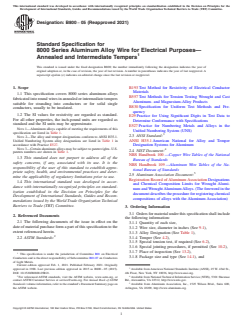
Designation:B800 −05 (Reapproved 2021)
Standard Specification for
8000 Series Aluminum Alloy Wire for Electrical Purposes—
Annealed and Intermediate Tempers
This standard is issued under the fixed designation B800; the number immediately following the designation indicates the year of
original adoption or, in the case of revision, the year of last revision. A number in parentheses indicates the year of last reapproval. A
superscript epsilon (´) indicates an editorial change since the last revision or reapproval.
1. Scope B193 Test Method for Resistivity of Electrical Conductor
Materials
1.1 This specification covers 8000 series aluminum alloys
B557 Test Methods for Tension Testing Wrought and Cast
fabricatedintoroundwiresinannealedorintermediatetempers
Aluminum- and Magnesium-Alloy Products
suitable for stranding into conductors or for solid single
B830 Specification for Uniform Test Methods and Fre-
conductors, usually to be insulated.
quency
1.2 The SI values for resistivity are regarded as standard.
E29 Practice for Using Significant Digits in Test Data to
For all other properties, the inch-pound units are regarded as
Determine Conformance with Specifications
standard and the SI units may be approximate.
E527 Practice for Numbering Metals and Alloys in the
NOTE 1—Aluminum alloys capable of meeting the requirements of this
Unified Numbering System (UNS)
specification are listed in Table 1.
2.3 ANSI Standard:
NOTE 2—The alloy and temper designations conform to ANSI H35.1.
Unified Numbering System alloy designations are listed in Table 1 in ANSI H35.1 American National for Alloy and Temper
accordance with Practice E527.
Designation Systems for Aluminum
NOTE 3—Certain aluminum alloys may be subject to patent rights. U.S.
2.4 NIST Document:
patents numbers are shown in Table 1.
NBS Handbook 100 —Copper Wire Tables of the National
1.3 This standard does not purport to address all of the
Bureau of Standards
safety concerns, if any, associated with its use. It is the
NBS Handbook 109 —Aluminum Wire Tables of the Na-
responsibility of the user of this standard to establish appro-
tional Bureau of Standards
priate safety, health, and environmental practices and deter-
2.5 Aluminum Association Document:
mine the applicability of regulatory limitations prior to use.
Registration Record of Aluminum Association Designations
1.4 This international standard was developed in accor-
and Chemical Composition Limits for Wrought Alumi-
dance with internationally recognized principles on standard-
numandWroughtAluminumAlloys.(Theforewordinthe
ization established in the Decision on Principles for the
documentdescribestheprocedureforregisteringchemical
Development of International Standards, Guides and Recom-
compositions of alloys with the Aluminum Association)
mendations issued by the World Trade Organization Technical
Barriers to Trade (TBT) Committee.
3. Ordering Information
3.1 Orders for material under this specification shall include
2. Referenced Documents
the following information:
2.1 The following documents of the issue in effect on the
3.1.1 Quantity of each size,
dateofmaterialpurchaseformapartofthisspecificationtothe
3.1.2 Wire size, diameter in inches (See 9.1),
extent referenced herein.
3.1.3 Alloy Designation (See Table 1),
3.1.4 Temper (See 4.2),
2.2 ASTM Standards:
3.1.5 Special tension test, if required (See 6.2),
3.1.6 Special jointing procedures, if permitted (See 10.2),
3.1.7 Place of inspection (See 13.2),
This specification is under the jurisdiction of Committee B01 on Electrical
3.1.8 Package size and type (See 14.1), and
Conductors and is the direct responsibility of Subcommittee B01.07 on Conductors
of Light Metals.
Current edition approved Feb. 1, 2021. Published February 2021. Originally
approved in 1988. Last previous edition approved in 2015 as B800 – 05 (2015). Available fromAmerican National Standards Institute (ANSI), 25 W. 43rd St.,
DOI: 10.1520/B0800-05R21. 4th Floor, New York, NY 10036, http://www.ansi.org.
2 4
For referenced ASTM standards, visit the ASTM website, www.astm.org, or Available from National Technical Information Service (NTIS), 5301 Shawnee
contact ASTM Customer Service at service@astm.org. For Annual Book of ASTM Rd., Alexandria, VA 22312, http://www.ntis.gov.
Standards volume information, refer to the standard’s Document Summary page on Available from Aluminum Association, Inc., 1525 Wilson Blvd., Suite 600,
the ASTM website. Arlington, VA 22209, http://www.aluminum.org.
Copyright © ASTM International, 100 Barr Harbor Drive, PO Box C700, West Conshohocken, PA 19428-2959. United States
B800−05 (2021)
TABLE 1 Aluminum Alloys
6.2 When requested by the purchaser, tension tests of joints
Alloy Designation U.S. Patent Number so permitted in 10.2 shall be made and the joints shall comply
ANSI-H35.1 UNS with the minimum tensile requirements shown in Table 3.
8017 A98017 .
Sampling shall be as agreed upon between the purchaser and
8030 A98030 3711339
the manufacturer.
8076 A98076 3697260
8130 A98130 .
8176 A98176 RE 28419
7. Resistivity
RE 30465
8177 A98177 .
7.1 The electrical resistivity shall not exceed the values
shown in Table 4. (Explanatory Note 3.)
8. Density
3.1.9 Special package marking, if required (See 14.1).
8.1 For the purpose of calculating mass, cross sections, and
so forth, the density of aluminum alloys listed in Table 1 shall
4. Materials and Manufacture 3 3
be taken as 0.098 lb/in. (2710 kg/m ) at 20°C.
4.1 The wire shall be made from drawing stock meeting the
NOTE 4—The metric density forAlloy 8177 is 2700 kg/m even though
chemical composition limits for alloys shown in Table 2 that 3
the customary value is 0.098 lb/in. .
are presently registered with registration record or for such
other alloys which may become available and will meet the
9. Diameter
requirements of this specification.
9.1 The diameter of the wire shall be specified in inches to
4.1.1 This specification applies to alloys that are recognized
the nearest 0.0001 in.; or it shall be specified in millimetres to
by Underwriters Laboratories, such as aluminum conductor
thenearest0.001mmforwireslessthan1.000mmindiameter,
material.
and to the nearest 0.01 mm for wires 1.00 mm in diameter or
4.2 Unless otherwise specified, the manufacturer shall have
larger. The actual wire diameter shall not vary from the
the option of producing the intermediate temper by either
specified diameter by more than the values shown in Table 5.
strain-hardening only (H1X) or by strain-hardening and partial
9.2 Standard nominal diameters of wire used for solid
annealing(H2X)beforeorafterstranding.(ExplanatoryNote1
conductors are shown in Table 6. Diameters of wires used for
and ANSI H35.1.)
stranded conductor shall be as agreed upon between the
purchaser and the manufacturer.
5. Workmanship, Finish, and Appearance
5.1 The wire shall be free of imperfections not consistent
10. Joints
with good commercial practice.
10.1 Joints may be made in drawing stock and in the wire
prior to final drawing in accordance with good commercial
6. Tensile Properties
practice.
6.1 Tensile Strength and Elongation—The wire shall con-
formtotensilestrengthandelongationrequirementsprescribed 10.2 If agreed upon between the manufacturer and the
in Table 3. (Explanatory Note 2.) purchaser, joints may be made during final drawing or in the
TABLE 2 Chemical Composition Requirements
NOTE 1—When single units are shown, these indicate the maximum amounts permitted.
NOTE 2—Analysis shall regularly be made only for the elements specifically mentioned in this table. If however, the presence of other elements is
suspected or indicated in the course of routine analysis, further analysis shall be made to determine that the total of these other elements is not present
in excess of the limits specified in the last column of the table.
NOTE 3—The following applies to all specified limits in this table. For purposes of acceptance and rejection, an observed value or a calculated value
obtainedfromanalysisshouldberoundedofftothenearestunitinthelastright-handplaceoffiguresusedinexpressingthespecifiedlimit(PracticeE29).
Alloys Composition,% by Mass
ANSI UNS Aluminum Silicon Iron Copper Magnesium Zinc Boron Other Other (total)
(each)
A
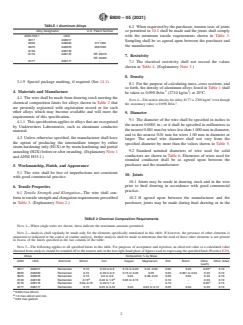
8017 A98017 Remainder 0.10 0.55 to 0.8 0.10 to 0.20 0.01–0.05 0.05 0.04 0.03 0.10
8030 A98030 Remainder 0.10 0.30 to 0.8 0.15 to 0.30 0.05 0.05 0.001 to 0.04 0.03 0.10
8076 A98076 Remainder 0.10 0.6 to 0.9 0.04 0.08–0.22 0.05 0.04 0.03 0.10
B B
8130 A98130 Remainder 0.15 0.40 to 1.0 0.05 to 0.15 . 0.10 . 0.03 0.10
C
8176 A98176 Remainder 0.03–0.15 0.40 to 1.0 . . 0.10 . 0.05 0.15
8177 A98177 Remainder 0.10 0.25 to 0.45 0.04 0.04 to 0.12 0.05 0.04 0.03 0.10
A
0.003 max lithium.
B
1.0 max silicon and iron.
C
0.03 max gallium.
B800−05 (2021)
TABLE 3 Tensile Property Limits
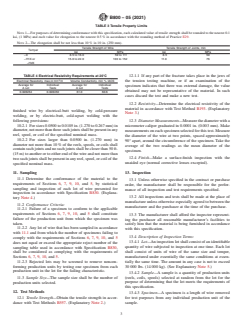
NOTE 1—For purposes of determining conformance with this specification, each calculated value of tensile strength shall be rounded to the nearest 0.1
ksi, (1 MPa) and each value for elongation to the nearest 0.5 % in accordance with the rounding method of Practice E29.
NOTE 2—The elongation shall be not less than 10 % in 10 in. (250 mm).
Tensile Strength of Wire Tensile Strength of Joints, min
Temper
ksi MPa ksi MPa
−0 8.5 to 16.0 59 to 111 8.5 59
−H1X or 15.0 to 22.0 103 to 152 11.0 76
−H2X
TABLE 4 Electrical Resistivity Requirements at 20°C
12.1.1 If any part of the fracture takes place in the jaws of
Electrical Resistivity, max,Ω mm /m Volume Conductivity, min % IACS
the tension testing machine, or if an examination of the
Average for Individual Average for Individual
specimen indicates that there was external damage, the value
A Lot Tests A Lot Tests
obtained may not be representative of the material. In such
0.028264 0.028450 61.0 60.6
cases discard the test and make a new test.
12.2 Resistivity—Determine the electrical resistivity of the
material in accordance with Test Method B193. (Explanatory
finished wire by electrical-butt welding, by cold-pr
...