

ASTM B830-18
(Specification)Standard Specification for Uniform Test Methods and Frequency
General Information
- Abstract
ABSTRACT
This specification covers a standard basis for uniform testing and frequency to determine physical and electrical compliance for aluminum and copper conductors. Diameter, tensile, resistivity and all other material properties shall be tested per specific level and acceptable quality level (AQL) and must meet the corresponding requirements. Any lot of drawing stock/wire that has been sampled and from which the number of specimens failing to comply with the requirements does not equal or exceed the appropriate reject number of the sampling used, shall be considered as complying with requirements of ASTM. Rejected lots may be screened to remove nonconforming production units by testing one specimen form each production unit in the lot for the failing characteristic. Identify and classify product, process, and service characteristics for which statistical techniques will be used as basis for the assurance and control of quality and acceptance or rejection of lots. The process performance index (CPK) shall meet the requirements of the applicable ASTM standard.
SCOPE
1.1 This specification covers a standard basis for uniform testing and frequency to determine physical and electrical compliance for aluminum and copper drawing stock, and aluminum and copper conductors.
1.2 The values stated in inch-pound units are to be regarded as standard. The values given in parentheses are mathematical conversions to SI units that are provided for information only and are not considered standard.
1.2.1 Exception—Resistivity is measured in SI units.
1.3 This international standard was developed in accordance with internationally recognized principles on standardization established in the Decision on Principles for the Development of International Standards, Guides and Recommendations issued by the World Trade Organization Technical Barriers to Trade (TBT) Committee.
- Status
- Published
- Publication Date
- 14-Jun-2018
- Technical Committee
- B01 - Electrical Conductors
- Drafting Committee
- B01.02 - Methods of Test and Sampling Procedure

Overview
ASTM B830-18: Standard Specification for Uniform Test Methods and Frequency establishes the standard basis for conducting uniform tests and defining sampling frequency to determine physical and electrical compliance of aluminum and copper conductors, as well as drawing stock. Developed by ASTM International, this specification supports consistent product quality and reliable conformity assessment in the manufacture of electrical wire and cable.
Key Topics
- Scope of Application: Applies to aluminum and copper drawing stock and electrical conductors, ensuring their compliance with physical and electrical requirements through defined methods and sampling frequencies.
- Uniform Testing Methods: Outlines standard test procedures for diameter, tensile strength, resistivity (measured in SI units), and other key material properties.
- Acceptable Quality Level (AQL): Defines AQL-based acceptance sampling plans, specifying reject and accept numbers for practical batch testing.
- Statistical Process Control (SPC): Emphasizes the use of statistical techniques, including process capability indices (e.g., CPK), for ongoing quality assurance and control.
- Inspection and Auditing: Details procedures for lot acceptance, skip-lot inspection, audit requirements, and corrective actions for nonconforming lots.
- Terminology: Clarifies specific terms such as lot, sample, specimen, process average, and AQL as they relate to conductor production.
Applications
ASTM B830-18 is essential for manufacturers, suppliers, and testing laboratories working with aluminum and copper conductors in the electrical industry. Its practical value includes:
- Assuring Product Quality: Ensures that batches of electrical conductors meet key mechanical and electrical criteria such as diameter, tensile strength, and resistivity.
- Process Control: Provides a systematic approach using statistical methods (including use of CPK value and control charts) to monitor and improve production stability.
- Conformity Assessment: Standardizes lot acceptance criteria based on statistical sampling, enabling efficient pass/fail decision-making for production lots.
- Audit and Compliance: Facilitates supplier and third-party audits through transparent record keeping and audit inspection provisions, as referenced in international quality system requirements.
- Reducing Nonconformance Risk: Allows for the detection and removal of nonconforming units within production lots via targeted specimen testing, thus helping manufacturers minimize risk of noncompliance.
- Alignment with International Standards: Supports organizations in maintaining global competitiveness with practices harmonized to international agreements, such as those recognized by the WTO TBT Committee.
Related Standards
ASTM B830-18 references or aligns with the following key standards for quality and statistical control:
- ANSI/ASQ Z1.4 - Sampling Procedures and Tables for Inspection by Attributes
- ANSI/ASQ S1 - Attribute Skip-Lot Sampling Program
- ANSI/ASQ Q9001 / ISO 9001 - Quality Management Systems – Requirements
- CSA Z299.3 - Quality Assurance Programs
- ASTM Manual 7 - Presentation of Data and Control Chart Analysis
- NBS Handbook 100 - Copper Wire Tables
These related standards work in concert to provide a comprehensive framework for test methods, frequency, statistical assessment, and continuous quality improvement in conductor manufacturing.
Keywords: ASTM B830-18, uniform test methods, aluminum conductors, copper conductors, statistical process control, CPK, AQL, electrical wire testing, process capability, quality assurance, lot acceptance, conformity assessment, skip-lot inspection, industrial standards, sampling frequency.
Relations
- Effective Date
- 15-Jun-2018
- Effective Date
- 01-Oct-2008
- Effective Date
- 15-Nov-2006
- Effective Date
- 15-Sep-2006
- Effective Date
- 01-May-2006
- Effective Date
- 01-Dec-2004
- Effective Date
- 10-May-2002
- Effective Date
- 10-May-1999
- Effective Date
- 15-Jun-2018
- Effective Date
- 15-Jun-2018
- Effective Date
- 15-Jun-2018
- Effective Date
- 15-Jun-2018
- Referred By
ASTM B230/B230M-22 - Standard Specification for Aluminum 1350–H19 Wire for Electrical Purposes - Effective Date
- 15-Jun-2018
- Effective Date
- 15-Jun-2018
- Effective Date
- 15-Jun-2018
Get Certified
Connect with accredited certification bodies for this standard

IMP NDT d.o.o.
Non-destructive testing services. Radiography, ultrasonic, magnetic particle, penetrant, visual inspection.
Inštitut za kovinske materiale in tehnologije
Institute of Metals and Technology. Materials testing, metallurgical analysis, NDT.
Q Techna d.o.o.
NDT and quality assurance specialist. 30+ years experience. NDT personnel certification per ISO 9712, nuclear and thermal power plant inspections, QA/
Sponsored listings
Frequently Asked Questions
ASTM B830-18 is a technical specification published by ASTM International. Its full title is "Standard Specification for Uniform Test Methods and Frequency". This standard covers: ABSTRACT This specification covers a standard basis for uniform testing and frequency to determine physical and electrical compliance for aluminum and copper conductors. Diameter, tensile, resistivity and all other material properties shall be tested per specific level and acceptable quality level (AQL) and must meet the corresponding requirements. Any lot of drawing stock/wire that has been sampled and from which the number of specimens failing to comply with the requirements does not equal or exceed the appropriate reject number of the sampling used, shall be considered as complying with requirements of ASTM. Rejected lots may be screened to remove nonconforming production units by testing one specimen form each production unit in the lot for the failing characteristic. Identify and classify product, process, and service characteristics for which statistical techniques will be used as basis for the assurance and control of quality and acceptance or rejection of lots. The process performance index (CPK) shall meet the requirements of the applicable ASTM standard. SCOPE 1.1 This specification covers a standard basis for uniform testing and frequency to determine physical and electrical compliance for aluminum and copper drawing stock, and aluminum and copper conductors. 1.2 The values stated in inch-pound units are to be regarded as standard. The values given in parentheses are mathematical conversions to SI units that are provided for information only and are not considered standard. 1.2.1 Exception—Resistivity is measured in SI units. 1.3 This international standard was developed in accordance with internationally recognized principles on standardization established in the Decision on Principles for the Development of International Standards, Guides and Recommendations issued by the World Trade Organization Technical Barriers to Trade (TBT) Committee.
ABSTRACT This specification covers a standard basis for uniform testing and frequency to determine physical and electrical compliance for aluminum and copper conductors. Diameter, tensile, resistivity and all other material properties shall be tested per specific level and acceptable quality level (AQL) and must meet the corresponding requirements. Any lot of drawing stock/wire that has been sampled and from which the number of specimens failing to comply with the requirements does not equal or exceed the appropriate reject number of the sampling used, shall be considered as complying with requirements of ASTM. Rejected lots may be screened to remove nonconforming production units by testing one specimen form each production unit in the lot for the failing characteristic. Identify and classify product, process, and service characteristics for which statistical techniques will be used as basis for the assurance and control of quality and acceptance or rejection of lots. The process performance index (CPK) shall meet the requirements of the applicable ASTM standard. SCOPE 1.1 This specification covers a standard basis for uniform testing and frequency to determine physical and electrical compliance for aluminum and copper drawing stock, and aluminum and copper conductors. 1.2 The values stated in inch-pound units are to be regarded as standard. The values given in parentheses are mathematical conversions to SI units that are provided for information only and are not considered standard. 1.2.1 Exception—Resistivity is measured in SI units. 1.3 This international standard was developed in accordance with internationally recognized principles on standardization established in the Decision on Principles for the Development of International Standards, Guides and Recommendations issued by the World Trade Organization Technical Barriers to Trade (TBT) Committee.
ASTM B830-18 is classified under the following ICS (International Classification for Standards) categories: 19.020 - Test conditions and procedures in general. The ICS classification helps identify the subject area and facilitates finding related standards.
ASTM B830-18 has the following relationships with other standards: It is inter standard links to ASTM B830-11, ASTM E29-08, ASTM E29-06b, ASTM E29-06a, ASTM E29-06, ASTM E29-04, ASTM E29-02e1, ASTM E29-93a(1999), ASTM B941-22, ASTM B800-05(2021), ASTM B398/B398M-22, ASTM B609/B609M-12(2021), ASTM B230/B230M-22, ASTM B324-01(2021), ASTM B976-21. Understanding these relationships helps ensure you are using the most current and applicable version of the standard.
ASTM B830-18 is available in PDF format for immediate download after purchase. The document can be added to your cart and obtained through the secure checkout process. Digital delivery ensures instant access to the complete standard document.
Standards Content (Sample)
This international standard was developed in accordance with internationally recognized principles on standardization established in the Decision on Principles for the
Development of International Standards, Guides and Recommendations issued by the World Trade Organization Technical Barriers to Trade (TBT) Committee.
Designation:B830 −18
Standard Specification for
Uniform Test Methods and Frequency
This standard is issued under the fixed designation B830; the number immediately following the designation indicates the year of
original adoption or, in the case of revision, the year of last revision. A number in parentheses indicates the year of last reapproval. A
superscript epsilon (´) indicates an editorial change since the last revision or reapproval.
1. Scope Success of an Organization—A Quality Management
Approach
1.1 This specification covers a standard basis for uniform
ANSI/ASQC S1-2012 AnAttribute Skip-Lot Sampling Pro-
testing and frequency to determine physical and electrical
gram
compliance for aluminum and copper drawing stock, and
ANSI/ASQ Z1.4-2003 (R2013) Sampling Procedures and
aluminum and copper conductors.
Tables for Inspection by Attributes
1.2 The values stated in inch-pound units are to be regarded
as standard. The values given in parentheses are mathematical
3. Terminology
conversions to SI units that are provided for information only
3.1 Definitions of Terms Specific to This Standard:
and are not considered standard.
3.1.1 acceptable quality level (AQL)—the maximum per-
1.2.1 Exception—Resistivity is measured in SI units.
cent nonconforming (or the maximum number of nonconfor-
1.3 This international standard was developed in accor-
mities per hundred units) that, for purposes of sampling
dance with internationally recognized principles on standard-
inspection, can be considered as a process average.
ization established in the Decision on Principles for the
3.1.2 average outgoing quality (AOQ)—the average quality
Development of International Standards, Guides and Recom-
ofoutgoingproduct,includingallacceptedlotsorbatches,plus
mendations issued by the World Trade Organization Technical
all lots or batches not accepted after such lots or batches have
Barriers to Trade (TBT) Committee.
been effectively 100 % inspected and all nonconforming units
replaced by conforming units.
2. Referenced Documents
3.1.3 CPK—Process Performance Index.
2.1 Thefollowingdocuments,ofthedateissued,formapart
Discussion:
of this specification to the extent referenced herein.
Capability in Relation to Spec Mean:
2.2 ASTM Standards:
USL = 5.0
E29 Practice for Using Significant Digits in Test Data to
LSL = 1.0
Determine Conformance with Specifications
MEAN = 2.0
Standard deviation (σ)=0.5
2.3 National Bureau of Standards:
CPK tells the capability of a process based upon the worst case view
NBS Handbook 100 —Copper Wire Tables
of the data.
The equation is:
2.4 ANSI Standards:
CPK = the lesser of:
ANSI/ISO/ASQ 9001-2015 Quality Management
USL 2 MEAN MEAN 2 LSL
~ ! ~ !
Systems—Requirements
or (1)
3σ 3σ
ANSI/ISO/ASQ Q9004-2009 Managing for the Sustained
For example:
~5.0 2 2.0! ~2.0 2 1.0!
CPK 5 or (2)
1.5 1.5
This specification is under the jurisdiction of ASTM Committee B01 on
Electrical Conductors and is the direct responsibility of Subcommittee B01.02 on
52.0 or 0.67
Methods of Test and Sampling Procedure.
Current edition approved June 15, 2018. Published January 2019. Originally 50.67
approved in 1993. Last previous edition approved in 2011 as B830 – 11. DOI:
A negative value for CPK indicates that the mean is out-
10.1520/B0830-18.
For referenced ASTM standards, visit the ASTM website, www.astm.org, or
side the specification limits. A CPK of zero indicates that the
contact ASTM Customer Service at service@astm.org. For Annual Book of ASTM
mean is equal to one of the specification limits. A CPK be-
Standards volume information, refer to the standard’s Document Summary page on
tween 0 and 1.0 means that part of the 6 sigma limits falls
the ASTM website.
Available from National Technical Information Service (NTIS), 5301 Shawnee
Rd., Alexandria, VA 22312, http://www.ntis.gov.
4 5
Available fromAmerican National Standards Institute (ANSI), 25 W. 43rd St., ThisANSIstandardisanidenticaladoptionofISO9001:2015andthetextdoes
4th Floor, New York, NY 10036, http://www.ansi.org. not differ in any way from ISO 9001:2015.
Copyright © ASTM International, 100 Barr Harbor Drive, PO Box C700, West Conshohocken, PA 19428-2959. United States
B830−18
outside the specification limits. A CPK of 1.0 means that one 4.1.3 Resistivity shall be tested using Special Inspection
end of the 6 sigma limits falls on a specification limit. A Level S-4 with an AQL of 4.0 %. (See Table 2.)
CPK larger than 1.0 means that the 6 sigma limits fall com-
4.1.4 All other material properties shall be tested per the
pletely within the specification limits. See Explanatory Note
specific level and AQL in ANSI/ASQ Z1.4-2003 (R2013) as
1 for an example interpretation of CPK values and actions to
required in the ASTM specification for the specific product.
follow.
4.1.5 Test records shall meet the requirements of ANSI/
Capability indices are useful tools in the analysis of capa-
ASQ 9001-2015, Section 7.5.1.
bility data. The most useful index is CPK, since it formu-
lates capability in a manner that relates to shifts in the mean 4.2 Conformance Criteria:
of the distribution away from the midpoint.
4.2.1 Failure of a specimen to conform to the applicable
requirements of ASTM shall constitute failure of the produc-
3.1.4 lot—a group of production units of one type and size
tionunitfromwhichthespecimenwastaken.Samplingofeach
of wire, which were produced during the same time period
lot shall be switched according to the rules described in
under similar production conditions, and are presented for
ANSI/ASQ Z1.4-2003 (R2013). (See Fig. 1.)
acceptance at the same time. The mass will be defined in the
ASTM document for the specific product to be tested.
4.2.2 Any lot of drawing stock/wire that has been sampled
in accordance with 4.1.2, 4.1.3,or 4.1.4, and from which the
3.1.5 process average—the average percent nonconforming
number of specimens failing to comply with the requirements
or average number of nonconformities per hundred units
does not equal or exceed the appropriate reject number of the
(whichever is applicable) of product submitted by the supplier
sampling Table 1 used, shall be considered as complying with
for original inspection. Original inspection is the first inspec-
the requirements of ASTM.
tion of a particular quantity of product as distinguished from
the inspection of product that has been resubmitted after prior
4.2.3 Rejectedlotsmaybescreenedtoremovenonconform-
rejection. When double or multiple sampling is used, only the
ing production units by testing one specimen from each
first sample results shall be included in the process average
production unit in the lot for the failing characteristic.
calculation.
4.2.4 Sample
...
This document is not an ASTM standard and is intended only to provide the user of an ASTM standard an indication of what changes have been made to the previous version. Because
it may not be technically possible to adequately depict all changes accurately, ASTM recommends that users consult prior editions as appropriate. In all cases only the current version
of the standard as published by ASTM is to be considered the official document.
Designation: B830 − 11 B830 − 18
Standard Specification for
Uniform Test Methods and Frequency
This standard is issued under the fixed designation B830; the number immediately following the designation indicates the year of
original adoption or, in the case of revision, the year of last revision. A number in parentheses indicates the year of last reapproval. A
superscript epsilon (´) indicates an editorial change since the last revision or reapproval.
1. Scope
1.1 This specification covers a standard basis for uniform testing and frequency to determine physical and electrical compliance
for aluminum and copper drawing stock, and aluminum and copper conductors.
1.2 The values stated in inch-pound units are to be regarded as standard. The values given in parentheses are mathematical
conversions to SI units that are provided for information only and are not considered standard.
1.2.1 Exception—Resistivity is measured in SI units.
1.3 This international standard was developed in accordance with internationally recognized principles on standardization
established in the Decision on Principles for the Development of International Standards, Guides and Recommendations issued
by the World Trade Organization Technical Barriers to Trade (TBT) Committee.
2. Referenced Documents
2.1 The following documents, of the issue in effect on date of material purchase date issued, form a part of this specification
to the extent referenced herein.
2.2 ASTM Standards:
E29 Practice for Using Significant Digits in Test Data to Determine Conformance with Specifications
2.3 National Bureau of Standards:
NBS Handbook 100 Handbook 100, Copper —Copper Wire Tables
2.4 Canadian Standards Association:
CAN/CSA-ISO 9001-08 Quality Management Systems – Requirements
CAN/CSA Z299.3-85 (R2006) Quality Assurance Program - Category 3
This specification is under the jurisdiction of ASTM Committee B01 on Electrical Conductors and is the direct responsibility of Subcommittee B01.02 on Methods of
Test and Sampling Procedure.
Current edition approved Oct. 1, 2011June 15, 2018. Published November 2011January 2019. Originally approved in 1993. Last previous edition approved in 20032011
as B830 – 97B830 – 11. (2003). DOI: 10.1520/B0830-11.10.1520/B0830-18.
For referenced ASTM standards, visit the ASTM website, www.astm.org, or contact ASTM Customer Service at service@astm.org. For Annual Book of ASTM Standards
volume information, refer to the standard’s Document Summary page on the ASTM website.
Available from National Technical Information Service (NTIS), 5301 Shawnee Rd., Alexandria, VA 22312, http://www.ntis.gov.
This ANSI standard is an identical adoption of ISO 9001:2015 and the text does not differ in any way from ISO 9001:2015.
Copyright © ASTM International, 100 Barr Harbor Drive, PO Box C700, West Conshohocken, PA 19428-2959. United States
B830 − 18
2.4 ANSI Standards:
ANSI/ISO/ASQ 9001-2015 3534-1-2006 Statistics-Vocabulary and Symbols Part 1-General Statistical Terms and Terms Used
In Probability Quality Management Systems—Requirements
ANSI/ISO/ASQ 3534-2-2006 Statistics-Vocabulary and Symbols Part 2-Applied Statistics
ANSI/ISO/ASQ Q9001-2008 Quality Management Systems - Requirements
ANSI/ISO/ASQ Q9004-2009 Q9004-1-2009 Managing for the Sustained Success of an Organization – A Organization—A
Quality Management Approach
ANSI/ASQC C1-1996 Specification of General Requirements for a Quality Program
ANSI/ASQC S1-1996S1-2012 An Attribute Skip-Lot Sampling Program
ANSI/ASQ Z1.4-2003 (R2013) Z1.4-2008 Sampling Procedures and Tables for Inspection by Attributes
3. Terminology
3.1 Definitions of Terms Specific to This Standard:
3.1.1 acceptable quality level (AQL)—the maximum percent nonconforming (or the maximum number of nonconformities per
hundred units) that, for purposes of sampling inspection, can be considered as a process average.
3.1.2 average outgoing quality (AOQ)—the average quality of outgoing product, including all accepted lots or batches, plus all
lots or batches not accepted after such lots or batches have been effectively 100 % inspected and all nonconforming units replaced
by conforming units.
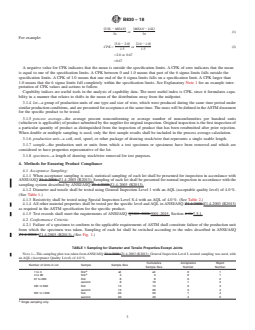
3.1.3 CPK—Process Performance Index.
Discussion:
Capability in Relation to Spec Mean:
USL = 5.0
LSL = 1.0
MEAN = 2.0
Standard deviation (σ) = 0.5
CPK tells the capability of a process based upon the worst case view of the data.
The equation is:
CPK = the lesser of:
Available from Canadian Standards Association (CSA), 5060 Spectrum Way, Mississauga, ON L4W 5N6, Canada, http://www.csa.ca.
Available from American National Standards Institute (ANSI), 25 W. 43rd St., 4th Floor, New York, NY 10036, http://www.ansi.org.
B830 − 18
USL 2 MEAN MEAN 2 LSL
~ ! ~ !
or (1)
3σ 3σ
For example:
~5.0 2 2.0! ~2.0 2 1.0!
CPK 5 or (2)
1.5 1.5
52.0 or 0.67
50.67
A negative value for CPK indicates that the mean is outside the specification limits. A CPK of zero indicates that the mean
is equal to one of the specification limits. A CPK between 0 and 1.0 means that part of the 6 sigma limits falls outside the
specification limits. A CPK of 1.0 means that one end of the 6 sigma limits falls on a specification limit. A CPK larger than
1.0 means that the 6 sigma limits fall completely within the specification limits. See Explanatory Note 1 for an example inter-
pretation of CPK values and actions to follow.
Capability indices are useful tools in the analysis of capability data. The most useful index is CPK, since it formulates capa-
bility in a manner that relates to shifts in the mean of the distribution away from the midpoint.
3.1.4 lot—a group of production units of one type and size of wire, which were produced during the same time period under
similar production conditions, and are presented for acceptance at the same time. The mass will be defined in the ASTM document
for the specific product to be tested.
3.1.5 process average—the average percent nonconforming or average number of nonconformities per hundred units
(whichever is applicable) of product submitted by the supplier for original inspection. Original inspection is the first inspection of
a particular quantity of product as distinguished from the inspection of product that has been resubmitted after prior rejection.
When double or multiple sampling is used, only the first sample results shall be included in the process average calculation.
3.1.6 production unit—a coil, reel, spool, or other package of drawing stock/wire that represents a single usable length.
3.1.7 sample—the production unit or units from which a test specimen or specimens have been removed and which are
considered to have properties representative of the lot.
3.1.8 specimen—a length of drawing stock/wire removed for test purposes.
4. Methods for Ensuring Product Compliance
4.1 Acceptance Sampling:
4.1.1 When acceptance sampling is used, statistical sampling of each lot shall be presented for inspection in accordance with
ANSI/ASQ Z1.4-2008. Z1.4-2003 (R2013). Sampling of each lot shall be presented for normal inspection in accordance with the
sampling system described by ANSI/ASQ Z1.4-2008.Z1.4-2003 (R2013).
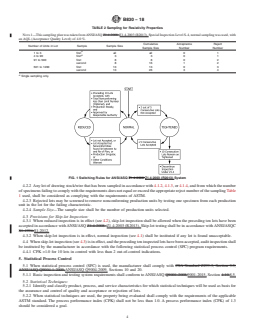
4.1.2 Diameter and tensile shall be tested using General Inspection Level 1 with an AQL (acceptable quality level) of 4.0 %.
(See Table 1.)
4.1.3 Resistivity shall be tested using Special Inspectio
...