

ASTM D4239-18e1
(Test Method)Standard Test Method for Sulfur in the Analysis Sample of Coal and Coke Using High-Temperature Tube Furnace Combustion
General Information
- Abstract
SIGNIFICANCE AND USE
4.1 Sulfur is part of the ultimate analysis of coal and coke.
4.2 Results of the sulfur analysis are used for evaluation of coal preparation and cleaning, evaluation of potential sulfur emissions from coal and coke combustion or conversion processes, and evaluation of coal and coke quality in relation to contract specifications, as well as for scientific purposes.
4.3 The competency of laboratories with respect to use of this standard can be established through reference to Practice D7448.
SCOPE
1.1 This test method covers the determination of sulfur in samples of coal or coke by high-temperature tube furnace combustion.
1.1.1 Two analysis methods are described.
1.2 When automated equipment is used, either method can be classified as an instrumental method.
1.3 The values stated in SI units are to be regarded as standard. The values given in parentheses after SI units are provided for information only and are not considered standard.
1.4 All percentages are percent mass fractions unless otherwise noted.
1.5 This standard does not purport to address all of the safety concerns, if any, associated with its use. It is the responsibility of the user of this standard to establish appropriate safety, health, and environmental practices and determine the applicability of regulatory limitations prior to use.
1.6 This international standard was developed in accordance with internationally recognized principles on standardization established in the Decision on Principles for the Development of International Standards, Guides and Recommendations issued by the World Trade Organization Technical Barriers to Trade (TBT) Committee.
- Status
- Published
- Publication Date
- 31-Aug-2018
- Technical Committee
- D05 - Coal and Coke
- Drafting Committee
- D05.21 - Methods of Analysis
Overview
ASTM D4239-18e1 is a widely recognized standard that establishes the method for determining sulfur in coal and coke samples using high-temperature tube furnace combustion. Developed and maintained by ASTM International, this standard is crucial for laboratories, power plants, and industries involved in the analysis, processing, and utilization of coal and coke. Sulfur analysis plays a vital role in quality control, contract compliance, environmental regulations, and scientific research.
This standard describes two combustion-based analytical methods for sulfur determination. Laboratory competence for applying this method can be demonstrated by reference to ASTM D7448. The results help evaluate coal preparation processes, estimate potential sulfur emissions, and assess compliance with contractual specifications.
Key Topics
- Scope of Application: Applicable to coal and coke samples, the test method provides procedures for determining total sulfur content using a high-temperature tube furnace.
- Analytical Methods: Describes two combustion methods:
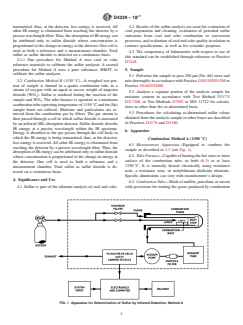
- Method A operates at a minimum of 1350°C, combusts the sample, and measures evolved sulfur dioxide by infrared detection.
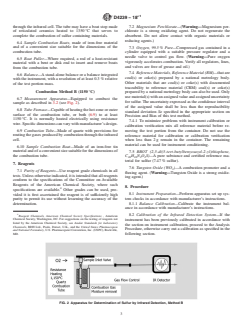
- Method B operates at a minimum of 1150°C, using tungsten trioxide as a combustion promoter and also uses infrared detection for sulfur dioxide quantification.
- Result Utilization: Sulfur results are central to:
- Evaluating the effectiveness of coal cleaning and preparation.
- Predicting sulfur oxide emissions from combustion or processing.
- Determining contract compliance and coal/coke grading.
- Quality Control: The method requires calibration with certified reference materials for accuracy, and instrument verification is mandated to ensure precision and reliability.
- Safety and Compliance: Users must establish appropriate safety, health, and environmental practices and adhere to regulatory requirements.
Applications
ASTM D4239-18e1 is essential in various sectors of the coal and coke industry, offering practical value by:
- Environmental Compliance: Assisting utilities and industrial users in monitoring and reporting sulfur content, critical to meeting air quality and emissions regulations.
- Process Optimization: Enabling facilities to optimize coal blending and preparation for reduced sulfur emissions and improved product quality.
- Quality Assurance: Providing coal mines, coke plants, and laboratories with a standard tool for meeting contract or specification requirements regarding sulfur content.
- Research and Development: Supporting scientific studies related to fuel properties, combustion efficiency, and pollution control technologies.
- Instrument Calibration: Offering a reference foundation for calibrating, maintaining, and verifying analytical devices used in sulfur determination.
Related Standards
For users needing a holistic approach to coal and coke analysis, the following ASTM and ISO standards are relevant:
- ASTM D2013/D2013M - Practice for Preparing Coal Samples for Analysis
- ASTM D3173/D3173M - Test Method for Moisture in Analysis Sample of Coal and Coke
- ASTM D3176 - Practice for Ultimate Analysis of Coal and Coke
- ASTM D3180 - Practice for Calculating Coal and Coke Analyses from As-Determined to Different Bases
- ASTM D346/D346M - Practice for Collection and Preparation of Coke Samples
- ASTM D7448 - Practice for Establishing Laboratory Competence in Coal and Coke Sampling and Analysis
- ASTM D7582 - Test Methods for Proximate Analysis of Coal and Coke by Macro Thermogravimetric Analysis
- ISO 5725-6 - Accuracy of Measurement Methods and Results
- ISO 11722 - Determination of moisture in solid mineral fuels by drying in nitrogen
These standards collectively support comprehensive coal and coke analysis programs, ensuring reliability, traceability, and international compliance in sulfur determination.
For laboratories and operators, following ASTM D4239-18e1 not only ensures analytical accuracy but also demonstrates commitment to industry best practices and regulatory standards in coal and coke quality assessment.
Relations
- Effective Date
- 01-Apr-2024
- Effective Date
- 01-Apr-2024
- Effective Date
- 01-Dec-2023
- Effective Date
- 01-Dec-2023
- Effective Date
- 01-Dec-2023
- Refers
ASTM D3173/D3173M-17 - Standard Test Method for Moisture in the Analysis Sample of Coal and Coke - Effective Date
- 01-Feb-2017
- Effective Date
- 01-Mar-2016
- Effective Date
- 01-Jan-2015
- Effective Date
- 01-Jan-2015
- Effective Date
- 01-May-2013
- Effective Date
- 01-Apr-2012
- Effective Date
- 01-Nov-2011
- Effective Date
- 01-Oct-2011
- Effective Date
- 01-Jun-2010
- Effective Date
- 01-Jun-2010
Get Certified
Connect with accredited certification bodies for this standard

Element Materials Technology
Materials testing and product certification.

ABS Group Brazil
ABS Group certification services in Brazil.

ABS Quality Evaluations Inc.
American Bureau of Shipping quality certification.
Sponsored listings
Frequently Asked Questions
ASTM D4239-18e1 is a standard published by ASTM International. Its full title is "Standard Test Method for Sulfur in the Analysis Sample of Coal and Coke Using High-Temperature Tube Furnace Combustion". This standard covers: SIGNIFICANCE AND USE 4.1 Sulfur is part of the ultimate analysis of coal and coke. 4.2 Results of the sulfur analysis are used for evaluation of coal preparation and cleaning, evaluation of potential sulfur emissions from coal and coke combustion or conversion processes, and evaluation of coal and coke quality in relation to contract specifications, as well as for scientific purposes. 4.3 The competency of laboratories with respect to use of this standard can be established through reference to Practice D7448. SCOPE 1.1 This test method covers the determination of sulfur in samples of coal or coke by high-temperature tube furnace combustion. 1.1.1 Two analysis methods are described. 1.2 When automated equipment is used, either method can be classified as an instrumental method. 1.3 The values stated in SI units are to be regarded as standard. The values given in parentheses after SI units are provided for information only and are not considered standard. 1.4 All percentages are percent mass fractions unless otherwise noted. 1.5 This standard does not purport to address all of the safety concerns, if any, associated with its use. It is the responsibility of the user of this standard to establish appropriate safety, health, and environmental practices and determine the applicability of regulatory limitations prior to use. 1.6 This international standard was developed in accordance with internationally recognized principles on standardization established in the Decision on Principles for the Development of International Standards, Guides and Recommendations issued by the World Trade Organization Technical Barriers to Trade (TBT) Committee.
SIGNIFICANCE AND USE 4.1 Sulfur is part of the ultimate analysis of coal and coke. 4.2 Results of the sulfur analysis are used for evaluation of coal preparation and cleaning, evaluation of potential sulfur emissions from coal and coke combustion or conversion processes, and evaluation of coal and coke quality in relation to contract specifications, as well as for scientific purposes. 4.3 The competency of laboratories with respect to use of this standard can be established through reference to Practice D7448. SCOPE 1.1 This test method covers the determination of sulfur in samples of coal or coke by high-temperature tube furnace combustion. 1.1.1 Two analysis methods are described. 1.2 When automated equipment is used, either method can be classified as an instrumental method. 1.3 The values stated in SI units are to be regarded as standard. The values given in parentheses after SI units are provided for information only and are not considered standard. 1.4 All percentages are percent mass fractions unless otherwise noted. 1.5 This standard does not purport to address all of the safety concerns, if any, associated with its use. It is the responsibility of the user of this standard to establish appropriate safety, health, and environmental practices and determine the applicability of regulatory limitations prior to use. 1.6 This international standard was developed in accordance with internationally recognized principles on standardization established in the Decision on Principles for the Development of International Standards, Guides and Recommendations issued by the World Trade Organization Technical Barriers to Trade (TBT) Committee.
ASTM D4239-18e1 is classified under the following ICS (International Classification for Standards) categories: 75.160.10 - Solid fuels. The ICS classification helps identify the subject area and facilitates finding related standards.
ASTM D4239-18e1 has the following relationships with other standards: It is inter standard links to ASTM D7582-24, ASTM D3176-24, ASTM D3176-15(2023), ASTM D3180-15(2023), ASTM D7582-15(2023), ASTM D3173/D3173M-17, ASTM D7448-16, ASTM D3180-15, ASTM D3176-15, ASTM E691-13, ASTM D3180-12, ASTM E691-11, ASTM D346/D346M-11, ASTM D7582-10e1, ASTM D7582-10. Understanding these relationships helps ensure you are using the most current and applicable version of the standard.
ASTM D4239-18e1 is available in PDF format for immediate download after purchase. The document can be added to your cart and obtained through the secure checkout process. Digital delivery ensures instant access to the complete standard document.
Standards Content (Sample)
This international standard was developed in accordance with internationally recognized principles on standardization established in the Decision on Principles for the
Development of International Standards, Guides and Recommendations issued by the World Trade Organization Technical Barriers to Trade (TBT) Committee.
´1
Designation: D4239 − 18
Standard Test Method for
Sulfur in the Analysis Sample of Coal and Coke Using High-
Temperature Tube Furnace Combustion
This standard is issued under the fixed designation D4239; the number immediately following the designation indicates the year of
original adoption or, in the case of revision, the year of last revision. A number in parentheses indicates the year of last reapproval. A
superscript epsilon (´) indicates an editorial change since the last revision or reapproval.
This standard has been approved for use by agencies of the U.S. Department of Defense.
ε NOTE—Table 1 was corrected editorially in October 2018.
1. Scope* D2013/D2013M Practice for Preparing Coal Samples for
Analysis
1.1 This test method covers the determination of sulfur in
D3173/D3173M Test Method for Moisture in the Analysis
samples of coal or coke by high-temperature tube furnace
Sample of Coal and Coke
combustion.
D3176 Practice for Ultimate Analysis of Coal and Coke
1.1.1 Two analysis methods are described.
D3180 Practice for Calculating Coal and Coke Analyses
1.2 When automated equipment is used, either method can
from As-Determined to Different Bases
be classified as an instrumental method.
D7448 Practice for Establishing the Competence of Labora-
1.3 The values stated in SI units are to be regarded as tories Using ASTM Procedures in the Sampling and
Analysis of Coal and Coke
standard. The values given in parentheses after SI units are
provided for information only and are not considered standard. D7582 Test Methods for Proximate Analysis of Coal and
Coke by Macro Thermogravimetric Analysis
1.4 All percentages are percent mass fractions unless other-
E691 Practice for Conducting an Interlaboratory Study to
wise noted.
Determine the Precision of a Test Method
1.5 This standard does not purport to address all of the
2.2 ISO Standard:
safety concerns, if any, associated with its use. It is the
ISO 5725-6 Accuracy (trueness and precision) of measure-
responsibility of the user of this standard to establish appro-
ment methods and results—Part 6: Use in practice of
priate safety, health, and environmental practices and deter-
accuracy values
mine the applicability of regulatory limitations prior to use.
ISO 11722 Solid mineral fuels—Hard coal—Determination
1.6 This international standard was developed in accor-
of moisture in the general analysis test sample by drying
dance with internationally recognized principles on standard-
in nitrogen
ization established in the Decision on Principles for the
Development of International Standards, Guides and Recom-
3. Summary of Test Method
mendations issued by the World Trade Organization Technical
3.1 Combustion Method A (1350 °C)—A weighed test por-
Barriers to Trade (TBT) Committee.
tion of sample is burned in a tube furnace at a minimum
combustion tube operating temperature of 1350 °C in a stream
2. Referenced Documents
of oxygen. During combustion at temperatures above 1350 °C,
2.1 ASTM Standards:
the sulfur and sulfur compounds contained in the sample are
D346/D346M Practice for Collection and Preparation of
decomposed and oxidized almost exclusively to gaseous sulfur
Coke Samples for Laboratory Analysis
dioxide, SO . Moisture and particulates are removed from the
gas by filters. The gas stream is passed through a cell in which
sulfur dioxide is measured by an infrared (IR) absorption
This test method is under the jurisdiction of ASTM Committee D05 on Coal
detector. Sulfur dioxide absorbs IR energy at a precise wave-
and Coke and is the direct responsibility of Subcommittee D05.21 on Methods of
Analysis. length within the IR spectrum. Energy is absorbed as the gas
Current edition approved Sept. 1, 2018. Published October 2018. Originally
passes through the cell body in which the IR energy is being
approved in 1983. Last previous edition approved in 2017 as D4239 – 17. DOI:
10.1520/D4239-18E01.
For referenced ASTM standards, visit the ASTM website, www.astm.org, or
contact ASTM Customer Service at service@astm.org. For Annual Book of ASTM Available from International Organization for Standardization (ISO), 1, ch. de
Standards volume information, refer to the standard’s Document Summary page on la Voie-Creuse, Case postale 56, CH-1211, Geneva 20, Switzerland, http://
the ASTM website. www.iso.ch.
*A Summary of Changes section appears at the end of this standard
Copyright © ASTM International, 100 Barr Harbor Drive, PO Box C700, West Conshohocken, PA 19428-2959. United States
´1
D4239 − 18
transmitted: thus, at the detector, less energy is received. All 4.2 Results of the sulfur analysis are used for evaluation of
other IR energy is eliminated from reaching the detector by a coal preparation and cleaning, evaluation of potential sulfur
precisewavelengthfilter.Thus,theabsorptionofIRenergycan emissions from coal and coke combustion or conversion
be attributed only to sulfur dioxide whose concentration is processes,andevaluationofcoalandcokequalityinrelationto
proportional to the change in energy at the detector. One cell is contract specifications, as well as for scientific purposes.
used as both a reference and a measurement chamber. Total
4.3 The competency of laboratories with respect to use of
sulfur as sulfur dioxide is detected on a continuous basis.
this standard can be established through reference to Practice
3.1.1 One procedure for Method A uses coal or coke
D7448.
reference materials to calibrate the sulfur analyzer. A second
procedure for Method A uses a pure substance, BBOT, to 5. Sample
calibrate the sulfur analyzer.
5.1 Pulverize the sample to pass 250 µm (No. 60) sieve and
3.2 Combustion Method B (1150 °C)—A weighed test por- mixthoroughlyinaccordancewithPracticeD2013/D2013Mor
tion of sample is burned in a quartz combustion tube in a
Practice D346/D346M.
stream of oxygen with an equal or excess weight of tungsten
5.2 Analyze a separate portion of the analysis sample for
trioxide (WO ). Sulfur is oxidized during the reaction of the
moisture content in accordance with Test Method D3173/
sample and WO . The tube furnace is operated at a minimum
D3173M, or Test Methods D7582 or ISO 11722 for calcula-
combustion tube operating temperature of 1150 °C and tin (Sn)
tions to other than the as-determined basis.
sample boats are utilized. Moisture and particulates are re-
5.3 Procedures for calculating as-determined sulfur values
moved from the combustion gas by filters. The gas stream is
obtained from the analysis sample to other bases are described
then passed through a cell in which sulfur dioxide is measured
in Practices D3176 and D3180.
by an infrared (IR) absorption detector. Sulfur dioxide absorbs
IR energy at a precise wavelength within the IR spectrum.
6. Apparatus
Energy is absorbed as the gas passes through the cell body in
which the IR energy is being transmitted: thus, at the detector,
Combustion Method A (1350 °C)
less energy is received.All other IR energy is eliminated from
6.1 Measurement Apparatus—Equipped to combust the
reaching the detector by a precise wavelength filter. Thus, the
sample as described in 3.1 (see Fig. 1).
absorptionofIRenergycanbeattributedonlytosulfurdioxide
6.2 Tube Furnace—Capable of heating the hot zone or outer
whose concentration is proportional to the change in energy at
surface of the combustion tube, or both (6.3) to at least
the detector. One cell is used as both a reference and a
1350 °C. It is normally heated electrically using resistance
measurement chamber. Total sulfur as sulfur dioxide is de-
rods, a resistance wire, or molybdenum disilicide elements.
tected on a continuous basis.
Specific dimensions can vary with manufacturer’s design.
4. Significance and Use
6.3 Combustion Tube—Madeofmullite,porcelain,orzircon
4.1 Sulfur is part of the ultimate analysis of coal and coke. with provisions for routing the gases produced by combustion
FIG. 1 Apparatus for Determination of Sulfur by Infrared Detection, Method A
´1
D4239 − 18
through the infrared cell. The tube may have a boat stop made 7.2 Magnesium Perchlorate—(Warning—Magnesium per-
of reticulated ceramics heated to 1350 °C that serves to chlorate is a strong oxidizing agent. Do not regenerate the
complete the combustion of sulfur containing materials. absorbent. Do not allow contact with organic materials or
reducing agents.)
6.4 Sample Combustion Boats, made of iron-free material
and of a convenient size suitable for the dimensions of the
7.3 Oxygen, 99.5 % Pure—Compressed gas contained in a
combustion tube. cylinder equipped with a suitable pressure regulator and a
needle valve to control gas flow. (Warning—Pure oxygen
6.5 Boat Puller—Where required, a rod of a heat-resistant
vigorously accelerates combustion. Verify all regulators, lines,
material with a bent or disk end to insert and remove boats
and valves are free of grease and oil.)
from the combustion tube.
7.4 Reference Materials, Reference Material (RM)—that are
6.6 Balance—Astand-alone balance or a balance integrated
coal(s) or coke(s) prepared by a national metrology body.
with the instrument, with a resolution of at least 0.3 % relative
Other materials that are coal(s) or coke(s) with documented
of the test portion mass.
traceability to reference material (CRM) coal(s) or coke(s)
Combustion Method B (1150 °C) prepared by a national metrology body can also be used. Only
usematerial(s)withanassignedvalueandassigneduncertainty
6.7 Measurement Apparatus—Equipped to combust the
for sulfur. The uncertainty expressed as the confidence interval
sample as described in 3.2 (see Fig. 2).
of the assigned value shall be less than the reproducibility
6.8 Tube Furnace—Capable of heating the hot zone or outer
standard deviation S specified in the appropriate section on
R
surface of the combustion tube, or both (6.9) to at least
Precision and Bias of this test method.
1150 °C. It is normally heated electrically using resistance
7.4.1 To minimize problems with instrument calibration or
wire.Specificdimensionscanvarywithmanufacturer’sdesign.
calibration verification mix all reference material before re-
6.9 Combustion Tube—Made of quartz with provisions for moving the test portion from the container. Do not use the
routing the gases produced by combustion through the infrared reference material for calibration or calibration verification
cell. when less than 2 g remain in the container. The remaining
material can be used for instrument conditioning.
6.10 Sample Combustion Boat—Made of an iron-free tin
materialandofaconvenientsizesuitableforthedimensionsof
7.5 BBOT (2,5-di(5-tert-butylbenzoxazol-2-yl)thiophene,
the combustion tube. C H N O S)—A pure substance and certified reference ma-
26 26 2 2
terial for sulfur (7.47 % sulfur).
7. Reagents
7.6 Tungsten Oxide (WO )—A combustion promoter and a
7.1 Purity of Reagents—Use reagent grade chemicals in all
fluxing agent. (Warning—Tungsten Oxide is a strong oxidiz-
tests.Unlessotherwiseindicated,itisintendedthatallreagents
ing agent.)
conform to the specifications of the Committee on Available
Reagents of the American Chemical Society, where such
8. Procedure
specifications are available. Other grades can be used, pro-
8.1 Instrument Preparation—Perform apparatus set up sys-
vided it is first ascertained the reagent is of sufficiently high
tem checks in accordance with manufacturer’s instructions.
purity to permit its use without lessening the accuracy of the
8.1.1 Balance Calibration—Calibrate the instrument bal-
determination.
ance in accordance with manufacturer’s instructions.
8.2 Calibration of the Infrared Detection System—If the
Reagent Chemicals, American Chemical Society Specifications , American
Chemical Society, Washington, DC. For suggestions on the testing of reagents not
instrument has been previously calibrated in accordance with
listed by the American Chemical Society, see Analar Standards for Laboratory
the section on instrument calibration, proceed to the Analysis
Chemicals, BDH Ltd., Poole, Dorset, U.K., and the United States Pharmacopeia
Procedure, otherwise carry out a calibration as specified in the
and National Formulary, U.S. Pharmacopeial Convention, Inc. (USPC), Rockville,
MD. following section.
FIG. 2 Apparatus for Determination of Sulfur by Infrared Detection, Method B
´1
D4239 − 18
8.2.1 Calibration with Coal and Coke Certified Reference (8.2.1). Use a mass that does not exceed the maximum mass
Materials—Select reference materials (7.4), in the range of the used for instrument calibration and with a sulfur value within
samples to be analyzed. Use at least three such reference the range of the instrument calibration.
materials, for each range of sulfur values to be tested. Select
8.2.3.1 Verify that the dry basis results for consecutive
one reference material containing at least as much sulfur as the
determinations agree within the repeatability limit of this test
highest level of sulfur expected. Select two additional refer-
method.
encematerials,oneapproximatelyatthemid-pointoftherange
8.2.3.2 Verify that each dry basis result agrees with the
and one below the lowest level of sulfur expected.
assigned value within 0.707 multiplied by the reproducibility
8.2.1.1 Use a mass of material recommended by the appa-
limit (0.707R) of this test method.
ratus manufacturer to carry out a minimum of three determi-
NOTE 2—The acceptance limit is derived from the reproducibility limit
nations to condition the equipment before calibration. Use a
in accordance with Section 4.2.3 on “Comparison with a reference value
material with a sulfur value near the mid point of the expected
for one laboratory” of ISO 5725-6.
calibration range.
8.2.3.3 If any of these acceptance criteria fails, reject all
8.2.1.2 For each reference coal or coke employed for
determinations back to the last acceptable reference material
calibration, use the as-determined sulfur value previously
determinations. Check instrument set-up (8.1) and condition
calculated from the certified dry-basis sulfur value and residual
the instrument (8.2.1.1). Calibrate the instrument according to
moisture determined using either Test Methods D3173/
8.2 before proceeding with determinations. Repeat all samples
D3173M,D7582,orISO11722.Useamassofmaterialandthe
analyzed since the last successful calibration verification.
calibrationprocedurerecommendedbytheapparatusmanufac-
8.3 Combustion Method A (1350 °C)—Set up the apparatus
turer. Weigh in accordance with section 6.6 and evenly spread
the test portion of the reference material into the sample (see 8.1) and verify the calibration (see 8.2.3).
combustion boat (6.4). Position the sample in the hot zone of
8.3.1 Raise the furnace temperature as recommended by the
the furnace until the instrument returns to baseline as indicated
manufacturer to at least 1350 °C. Weigh a mass of the sample
according to settings recommended by the manufacturer. If the
inaccordancewithsection6.6andnotexceedingthemaximum
analysis time exceeds the maximum analysis time recom-
mass of reference material(s) used for calibration.Analyze the
mended by the manufacturer take corrective action as recom-
test samples using the apparatus conditions employed for
mended by the manufacturer.
calibration (8.2.1).
8.2.2 Calibration with BBOT—To meet the precision re-
8.3.2 When the analysis is complete, the instrument indi-
quirements of this method, six calibration points are required
cates the sulfur value.
for a linear fit and eight calibration points are required for a
8.4 Combustion Method B (1150 °C)—Set up the apparatus
nonlinear fit.Acalibration point consists of a determination on
(see 8.1) and verify the calibration (see 8.2.3).
a single test portion of calibration material. Select test portions
8.4.1 Raise the furnace temperature as recommended by the
of the calibrant that have at least as much sulfur as the highest
manufacturer to at least 1150 °C.
level of sulfur expected, test portions of the calibrant that have
8.4.2 Weigh to the nearest 1 mg and evenly spread into a
as much sulfur as the lowest level of sulfur expected and test
combustion boat (6.10) a portion of tungsten oxide equal to the
portionsspreadevenlyinbetweenthehighestandlowestlevels
target weight, typically 100 mg, of the sample analysis aliquot.
of sulfur.
8.4.3 Whi
...